|
시장보고서
상품코드
2124274
수동 전자부품 시장 : 시장 점유율 분석, 업계 동향 및 통계, 성장 예측(2026-2031년)Passive Electronic Components - Market Share Analysis, Industry Trends & Statistics, Growth Forecasts (2026 - 2031) |
||||||
 Mordor Intelligence
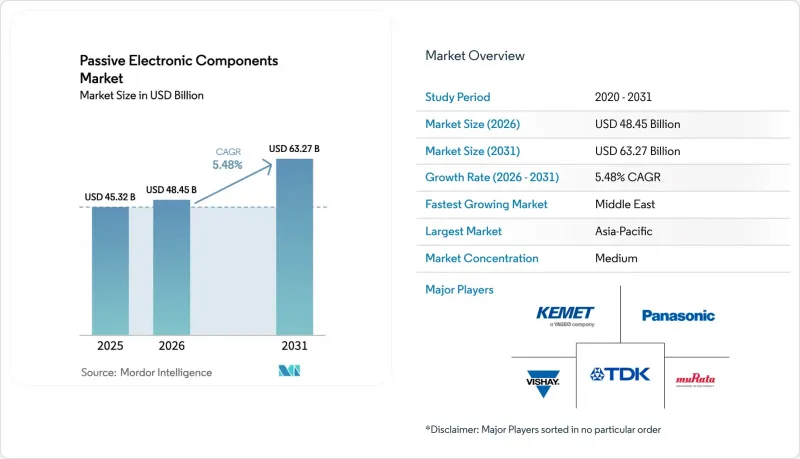
Mordor Intelligence에 의하면, 수동 전자부품 시장 규모는 2025년에 453억 2,000만 달러로 평가되었고, 2026년 484억 5,000만 달러에서 2031년까지 632억 7,000만 달러에 이를 것으로 예측되며, 예측 기간(2026-2031년) CAGR은 5.48%를 기록할 전망입니다.
본 보고서는 부품 유형별(커패시터, 인덕터, 저항기, 필터 등), 커패시터 제품 유형별(세라믹, 탄탈, 알루미늄 전해 등), 최종 사용자 산업별(자동차, 산업용, 소비자용 전자기기·컴퓨팅, 통신·서버·데이터 스토리지, 에너지, 의료 등), 지역별로 분류되어 있습니다. 시장 예측은 금액(달러) 기준으로 제시되어 있습니다.
세계의 수동 전자부품 시장 동향 및 인사이트
전기차 및 자율주행차용 자동차 전자기기의 급증
전기자동차에는 최대 3,000개의 개별 수동 부품이 탑재되어 있으며, 이는 기존 차량의 3배에 해당합니다. 이는 800V 배터리 팩에는 높은 리플을 견딜 수 있는 세라믹 커패시터, 전류 감지 저항기 및 EMI 필터가 필요하기 때문입니다. 배터리 관리 시스템만 해도 모듈당 약 200개의 MLCC가 내장되어 있으며, 리튬 이온 셀을 보호하기 위해 밸런스 전류를 평활화하고 있습니다. LiDAR 및 77GHz 레이더에는 -40°C에서 +125°C의 작동 온도 범위를 충족해야 하는 인덕터와 온도 안정성이 뛰어난 커패시터가 추가되어 있습니다. 테슬라는 2025년에 차량 1대당 수동 부품 비용이 18% 상승했다고 보고했으며, 그 주된 요인은 이러한 고전압화에 따른 업그레이드입니다. 1차 공급업체들은 유럽 및 중국의 파워트레인 공장 옆에 커패시터 생산 라인을 병설하고 있으며, 이를 통해 리드 타임을 12주에서 4주로 단축하고 운전 자금을 유휴 상태로 두고 있습니다.
5G 확산이 고주파 수동 부품 수요를 견인
5세대 매크로셀은 3.5GHz 이상의 주파수 대역을 사용하며, 이 대역에서는 기존의 수동 부품에서 발생하는 기생 성분이 삽입 손실을 유발합니다. Massive-MIMO 패널에는 64-256개의 방사 소자가 집적되어 있어, 10GHz를 초과하는 자기 공진 주파수를 가진 커패시터가 필요합니다. 2025년 말 기준으로 전 세계 5G 독립형(SA) 기지국 수는 120만 곳에 달하며, 그 중 60%가 중국과 한국에 설치되어 있습니다. 각 무선 장치에는 기가헤르츠 대역에서 작동하도록 조정된 RF 인덕터를 포함해 약 400개의 수동 부품이 사용되고 있습니다. 에릭슨은 이러한 수동 부품을 소형화함으로써 중파 대역 무선 장비의 무게를 25% 줄이고, 옥상 설치 장비의 경량화를 실현했다고 보고했습니다. 극한의 온도나 습도 조건에서도 투자율을 안정적으로 유지하는 페라이트 코어를 소결할 수 있는 공급업체는 극소수에 불과합니다.
귀금속 가격 변동이 커패시터 비용에 영향
2025년, 팔라듐 가격은 트로이 온스당 900달러에서 1,400달러 사이로 변동했으며, 헤지 조치를 취하지 않은 공급업체의 MLCC 이익률은 최대 5퍼센트 포인트 변동했습니다. 2025년 초, 러시아의 수출 규제로 인해 루테늄 공급이 부족해져 가격이 40% 급등함에 따라, 정전용량 밀도를 희생하면서 전극 페이스트의 배합을 변경할 수밖에 없었습니다. TDK에 따르면, 귀금속 가격의 급등으로 인해 2025 회계연도 커패시터의 이익률은 150 베이시스 포인트 축소되었으며, 자동차 및 산업용 구매자와의 가격 재조정이 불가피했습니다. 소규모 공급업체들은 더 큰 타격을 입었고, 업계 재편이 가속화되었습니다.
부문별 분석
2025년, 커패시터는 수동 전자부품 시장 매출의 59.89%를 차지했으며, 자동차, 산업용 및 소비자용 기기에 걸친 전력 조절 분야에서 그 범용성이 입증되었습니다. 필터는 시장 규모는 작지만, 현재 모든 5G 휴대폰에 Wi-Fi 6E, 블루투스, 초광대역 및 5G 신호를 분리하기 위한 최대 40개의 음향 필터가 내장되어 있어, 2031년까지 연평균 성장률(CAGR) 8.23%로 성장할 전망입니다. 인덕터는 전원 변환기의 기반이 되는 반면, 저항기는 모든 회로에서 전류를 제어하고 전압을 분압하는 역할을 합니다.
임베디드 기술은 카테고리의 경계를 재정의하고 있습니다. 박막 저항기와 커패시터를 탑재한 기판은 스마트폰의 두께를 얇게 만들고 있지만, 100nF를 초과하는 용량에서는 여전히 에너지 저장을 위해 개별 소자가 필수적입니다. 그 결과, 신호 체인 중심의 필터가 휴대전화 및 기지국에서 점유율을 지속적으로 확대하고 있음에도 불구하고, 자동차 및 산업 분야의 개별 커패시터 수동 전자부품 시장 규모는 계속해서 지배적인 위치를 유지할 것으로 예측됩니다.
세라믹 커패시터는 폭넓은 정전용량 범위, 낮은 ESR 및 높은 고주파 응답성을 활용하여 2025년에는 커패시터 매출의 45.78%를 차지했습니다. 슈퍼커패시터는 뛰어난 고속 충방전 사이클을 갖춘 회생 제동 및 계통 주파수 조정 분야 수요에 힘입어 연평균 성장률(CAGR) 7.31%를 기록할 전망입니다.
탄탈륨 및 알루미늄 전해 커패시터는 항공우주 분야와 산업용 구동 장치에서 계속해서 채택되고 있지만, 각 공급업체들은 800V EV 차량용 충전기에서 1,000V 정격을 달성하기 위해 필름과 세라믹 유전체를 결합한 제품을 개발하고 있습니다. 이러한 조합 덕분에 스마트폰 시장 전체가 성숙기에 접어들었음에도 불구하고, 고전압 전기차 블록과 관련된 수동 전자부품 시장 규모는 계속해서 확대되고 있습니다.
2025년, 수동 전자부품 시장 내 커패시터 수요의 26.59%를 자동차 분야가 차지했습니다. 태양광 발전용 인버터나 풍력 터빈에 킬로볼트급 서지 전압을 견딜 수 있는 필름 커패시터가 채택됨에 따라, 발전·축전 분야는 2031년까지 연평균 성장률(CAGR) 7.02%로 성장할 전망입니다.
산업용 기계, 항공우주, 의료기기 각 분야에서는 견고성과 생체 적합성을 갖춘 제품에 대한 수요가 계속해서 증가하고 있는 반면, 소비자용 전자기기 분야에서는 여전히 수백억 개 규모의 출하가 이어지고 있습니다. 따라서 부문의 초점은 단순한 수량에서 용도의 다양성으로 이동하고 있으며, 수동 전자부품 업계의 수익성이 유지되고 있습니다.
지역별 분석
아시아태평양은 2025년 커패시터 매출의 36.12%를 차지했으며, 중국, 일본, 한국, 대만의 대규모 제조 클러스터 덕분에 수동 전자부품 시장의 중심지로서의 지위를 유지하고 있습니다. 각 지역 정부는 차세대 유전체 연구에 보조금을 지급하고, 생산 능력 확대에 대해 세제상의 우대 조치를 제공하고 있으며, 이를 통해 공급업체들은 스마트폰, PC, 전기차(EV)의 최종 조립 거점 인근에 거점을 마련할 수 있게 되었습니다.
중동 수요는 시장 점유율이 한 자릿수 중반에 그치지만, 반도체 팹, 데이터센터, 태양광 발전 단지에 자금을 지원하는 정부 주도의 이니셔티브에 힘입어 2031년까지 연평균 성장률(CAGR) 6.76%로 확대되고 있습니다. 아부다비와 리야드는 수동 부품 조립을 현지화하기 위해 수십억 달러 규모의 예산을 배정하고 있으며, 중요한 통신 및 전력 인프라를 해외 공급 차질로부터 보호하고 있습니다.
북미와 유럽은 성숙해가고 있지만 회복력이 있는 시장입니다. 자동차의 전동화, 엣지 컴퓨팅, 산업용 자동화가 부품 수요를 뒷받침하는 한편, 환경 규제로 인해 무연 및 탄탈륨 프리 설계의 채택이 촉진되고 있습니다. 멕시코, 체코, 폴란드는 리쇼어링 추세를 활용하여 미국 및 독일 OEM 제조업체를 위한 물류 거리를 단축하기 위해 새로운 MLCC 및 칩 저항기 생산 라인을 유치하고 있습니다.
기타 혜택 :
- 엑셀 형식 시장 예측(ME) 시트
- 3개월간의 애널리스트 지원
자주 묻는 질문
목차
제1장 서론
제2장 조사 방법
제3장 주요 요약
제4장 시장 구도
제5장 시장 규모 및 성장 예측
제6장 경쟁 구도
제7장 시장 기회 및 향후 전망
AJY 26.09.09According to Mordor Intelligence, the passive electronic components market size was valued at USD 45.32 billion in 2025 and is estimated to grow from USD 48.45 billion in 2026 to reach USD 63.27 billion by 2031, at a CAGR of 5.48% during the forecast period (2026-2031).

This report is Segmented by Component Type (Capacitors, Inductors, Resistors, and Filters and More), Capacitor Product Type (Ceramic, Tantalum, Aluminum Electrolytic, and More), End User Industry (Automotive, Industrial, Consumer Electronics and Computing, Communication/Servers/Data Storage, Energy, and Medical, and More), and Geography. The Market Forecasts are Provided in Terms of Value (USD).
Global Passive Electronic Components Market Trends and Insights
Surge in Automotive Electronics for Electric and Autonomous Vehicles
Electric cars deploy up to 3,000 discrete passives, triple the count of legacy vehicles, because 800 V battery packs require high-ripple ceramic capacitors, current-sense resistors, and EMI filters. Battery-management systems alone integrate roughly 200 MLCCs per module, smoothing balancing currents to safeguard lithium-ion cells. Lidar and 77 GHz radar add inductors and temperature-stable capacitors that must meet minus-40 °C to plus-125 °C operating windows. Tesla reported an 18% rise in passive-component cost per vehicle in 2025, largely driven by these high-voltage upgrades. Tier 1 suppliers are co-locating capacitor lines next to European and Chinese powertrain plants, cutting lead times from 12 to four weeks and freeing working capital.
5G Rollout Driving High-Frequency Passive Component Demand
Fifth-generation macro cells use spectrum above 3.5 GHz, where parasitics in conventional passives induce insertion loss. Massive-MIMO panels pack 64-256 radiators and need capacitors with self-resonant frequencies beyond 10 GHz. Global 5G standalone sites reached 1.2 million by end-2025, with China and South Korea hosting 60% of deployments. Each radio consumes roughly 400 passives, including RF inductors tuned for gigahertz operation. Ericsson documented a 25% weight cut in its mid-band radios by miniaturizing these passives, enabling lighter rooftop installs. Only a handful of vendors can sinter ferrite cores that keep permeability stable across temperature and humidity extremes.
Volatility in Precious Metal Prices Impacting Capacitor Costs
Palladium traded between USD 900 and USD 1,400 per troy ounce during 2025, making MLCC margins swing up to 5 percentage points for suppliers without hedging. Ruthenium spiked 40% in early-2025 as Russian export curbs tightened availability, forcing reformulation of electrode pastes that sacrifice capacitance density. TDK said precious-metal inflation trimmed its capacitor margin by 150 basis points in fiscal 2025 and triggered repricing with auto and industrial buyers. Small vendors lacking scale faced steeper hits, accelerating sector consolidation.
Other drivers and restraints analyzed in the detailed report include:
- Growing Adoption of IoT Devices Requiring Ultra-Low-Power Passives
- Emergence of Embedded Passive Technology in PCB Substrates
- Miniaturization Limits for High-Capacitance Components
For complete list of drivers and restraints, kindly check the Table Of Contents.
Segment Analysis
In 2025 capacitors commanded 59.89% revenue in the passive electronic components market, validating their universality for power conditioning across automotive, industrial, and consumer gear. Filters, although smaller in base, will expand at an 8.23% CAGR to 2031 as every 5G handset now integrates up to 40 acoustic filters to isolate Wi-Fi 6E, Bluetooth, ultra-wideband, and 5G signals. Inductors underpin power converters, while resistors set currents and divide voltages in all circuits.
Embedded technology is redrawing category boundaries. Substrates hosting thin-film resistors and capacitors trim z-height for smartphones, but values above 100 nF still mandate discrete devices for energy storage. As a result the passive electronic components market size for discrete capacitors in automotive and industrial domains is expected to remain dominant, even as signal-chain-centric filters continue to seize incremental share in handsets and base stations.
Ceramic units delivered 45.78% of capacitor sales in 2025, benefiting from wide capacitance range, low ESR, and high frequency response. Super capacitors are set to post a 7.31% CAGR, supported by regenerative braking and grid-frequency regulation where their rapid charge-discharge cycles excel.
While tantalum and aluminum electrolytic devices continue in aerospace and industrial drives, suppliers are blending film and ceramic dielectrics to reach 1,000 V ratings in 800 V EV onboard chargers. This mix ensures the passive electronic components market size attached to high-voltage EV blocks keeps growing despite overall smartphone maturity.
Automotive absorbed 26.59% of capacitor demand in 2025 in the passive electronic components market. Energy generation and storage will climb at a 7.02% CAGR through 2031 as photovoltaic inverters and wind turbines adopt film capacitors capable of enduring kilovolt surges.
Industrial machinery, aerospace, and medical devices keep requiring rugged or biocompatible units, yet consumer electronics continues to ship volume in the tens of billions of pieces. Segment focus is therefore tilting from pure volume to application diversity, preserving passive electronic components industry profitability.
Complete Report Scope:
- By Component Type
- Capacitors
- Product Type
- Ceramic Capacitors
- Tantalum Capacitors
- Aluminum Electrolytic Capacitors
- Paper and Plastic Film Capacitors
- Super Capacitors
- By End User Industry
- Automotive
- Industrial
- Aerospace and Defense
- Consumer Electronics and Computing
- Communications/Servers/Data Storage
- Energy
- Medical
- By Geography
- North America
- Europe
- Asia-Pacific
- Rest of World
- Product Type
- Inductors
- By Product Type
- Power Inductors
- Frequency Inductors
- By End User Industry
- Automotive
- Aerospace and Defense
- Consumer Electronics and Computing
- Communications/Servers/Data Storage
- Other End User Industries
- By Geography
- North America
- Europe
- Asia-Pacific
- Rest of World
- By Product Type
- Resistors
- By Product Type
- Surface-mounted Chips
- Network
- Wirewound
- Film/Oxide/Foil
- Carbon
- By End User Industry
- Automotive
- Aerospace and Defense
- Consumer Electronics and Computing
- Communications/Servers/Data Storage
- Other End User Industries
- By Geography
- North America
- Europe
- Asia-Pacific
- Rest of World
- By Product Type
- Filters and Other Components
- By End User Industry
- Automotive
- Aerospace and Defense
- Consumer Electronics and Computing
- Communications/Servers/Data Storage
- Other End User Industries
- By Geography
- North America
- Europe
- Asia Pacific
- Rest of World
- By End User Industry
- Capacitors
Geography Analysis
Asia Pacific accounted for 36.12% of capacitor sales in 2025 and remains the anchor of the passive electronic components market thanks to deep manufacturing clusters in China, Japan, South Korea, and Taiwan. Regional governments subsidize next-generation dielectric research and provide tax incentives for capacity expansion, allowing suppliers to co-locate with smartphone, PC, and EV final-assembly hubs.
Middle East demand, although just mid-single-digit share, is expanding at 6.76% CAGR through 2031 under sovereign initiatives that fund semiconductor fabs, data centers, and solar farms. Abu Dhabi and Riyadh allocate multi-billion-dollar budgets to localize passive assembly, insulating critical telecom and power infrastructure from foreign supply disruptions.
North America and Europe represent mature yet resilient markets. Vehicle electrification, edge computing, and industrial automation sustain component pull, while environmental regulations push adoption of lead-free and tantalum-free designs. Mexico, the Czech Republic, and Poland capitalize on reshoring trends, attracting new MLCC and chip-resistor lines to shorten logistics for U.S. and German OEMs.
- Murata Manufacturing Co., Ltd.
- TDK Corporation
- Yageo Corporation
- Vishay Intertechnology Inc.
- Panasonic Holdings Corporation
- Kyocera Corporation (AVX)
- Samsung Electro-Mechanics Co., Ltd.
- Taiyo Yuden Co., Ltd.
- Nichicon Corporation
- KEMET LLC (Yageo Group)
- Cornell Dubilier Electronics Inc.
- Wurth Elektronik Group
- Bourns Inc.
- KOA Corporation
- TT Electronics plc
- Delta Electronics Inc.
- Eaton Corporation plc
- Coilcraft Inc.
- Susumu Co., Ltd.
- Sagami Electric Co., Ltd.
- Viking Tech Corporation
- Ohmite Manufacturing Company
- Rubycon Corporation
- WIMA GmbH and Co. KG
- United Chemi-Con Inc. (Nippon Chemi-Con Corp.)
Additional Benefits:
- The market estimate (ME) sheet in Excel format
- 3 months of analyst support
TABLE OF CONTENTS
1 INTRODUCTION
- 1.1 Study Assumptions and Market Definition
- 1.2 Scope of the Study
2 RESEARCH METHODOLOGY
3 EXECUTIVE SUMMARY
4 MARKET LANDSCAPE
- 4.1 Market Overview
- 4.2 Market Drivers
- 4.2.1 Surge in Automotive Electronics for Electric and Autonomous Vehicles
- 4.2.2 5G Rollout Driving High-Frequency Passive Component Demand
- 4.2.3 Growing Adoption of IoT Devices Requiring Ultra-Low-Power Passives
- 4.2.4 Vertical Integration of Materials Supply to Secure Palladium and Ruthenium
- 4.2.5 Emergence of Embedded Passive Technology in PCB Substrates
- 4.2.6 Regionalization of Electronics Manufacturing to Mitigate Supply Chain Risk
- 4.3 Market Restraints
- 4.3.1 Volatility in Precious Metal Prices Impacting Capacitor Costs
- 4.3.2 Miniaturization Limits for High-Capacitance Components
- 4.3.3 Environmental Regulations on Tantalum and Lead Usage
- 4.3.4 Talent Shortages in High-Frequency RF Design Expertise
- 4.4 Industry Value Chain Analysis
- 4.5 Regulatory Landscape
- 4.6 Technological Outlook
- 4.7 Porter's Five Forces Analysis
- 4.7.1 Bargaining Power of Suppliers
- 4.7.2 Bargaining Power of Buyers
- 4.7.3 Threat of New Entrants
- 4.7.4 Threat of Substitutes
- 4.7.5 Degree of Competition
- 4.8 Impact of Macroeconomic Factors on the Market
- 4.9 Demand and Supply of Palladium and Ruthenium
5 MARKET SIZE AND GROWTH FORECASTS (VALUE)
- 5.1 By Component Type
- 5.1.1 Capacitors
- 5.1.1.1 Product Type
- 5.1.1.1.1 Ceramic Capacitors
- 5.1.1.1.2 Tantalum Capacitors
- 5.1.1.1.3 Aluminum Electrolytic Capacitors
- 5.1.1.1.4 Paper and Plastic Film Capacitors
- 5.1.1.1.5 Super Capacitors
- 5.1.1.2 By End User Industry
- 5.1.1.2.1 Automotive
- 5.1.1.2.2 Industrial
- 5.1.1.2.3 Aerospace and Defense
- 5.1.1.2.4 Consumer Electronics and Computing
- 5.1.1.2.5 Communications/Servers/Data Storage
- 5.1.1.2.6 Energy
- 5.1.1.2.7 Medical
- 5.1.1.3 By Geography
- 5.1.1.3.1 North America
- 5.1.1.3.2 Europe
- 5.1.1.3.3 Asia-Pacific
- 5.1.1.3.4 Rest of World
- 5.1.1.1 Product Type
- 5.1.2 Inductors
- 5.1.2.1 By Product Type
- 5.1.2.1.1 Power Inductors
- 5.1.2.1.2 Frequency Inductors
- 5.1.2.2 By End User Industry
- 5.1.2.2.1 Automotive
- 5.1.2.2.2 Aerospace and Defense
- 5.1.2.2.3 Consumer Electronics and Computing
- 5.1.2.2.4 Communications/Servers/Data Storage
- 5.1.2.2.5 Other End User Industries
- 5.1.2.3 By Geography
- 5.1.2.3.1 North America
- 5.1.2.3.2 Europe
- 5.1.2.3.3 Asia-Pacific
- 5.1.2.3.4 Rest of World
- 5.1.2.1 By Product Type
- 5.1.3 Resistors
- 5.1.3.1 By Product Type
- 5.1.3.1.1 Surface-mounted Chips
- 5.1.3.1.2 Network
- 5.1.3.1.3 Wirewound
- 5.1.3.1.4 Film/Oxide/Foil
- 5.1.3.1.5 Carbon
- 5.1.3.2 By End User Industry
- 5.1.3.2.1 Automotive
- 5.1.3.2.2 Aerospace and Defense
- 5.1.3.2.3 Consumer Electronics and Computing
- 5.1.3.2.4 Communications/Servers/Data Storage
- 5.1.3.2.5 Other End User Industries
- 5.1.3.3 By Geography
- 5.1.3.3.1 North America
- 5.1.3.3.2 Europe
- 5.1.3.3.3 Asia-Pacific
- 5.1.3.3.4 Rest of World
- 5.1.3.1 By Product Type
- 5.1.4 Filters and Other Components
- 5.1.4.1 By End User Industry
- 5.1.4.1.1 Automotive
- 5.1.4.1.2 Aerospace and Defense
- 5.1.4.1.3 Consumer Electronics and Computing
- 5.1.4.1.4 Communications/Servers/Data Storage
- 5.1.4.1.5 Other End User Industries
- 5.1.4.2 By Geography
- 5.1.4.2.1 North America
- 5.1.4.2.2 Europe
- 5.1.4.2.3 Asia Pacific
- 5.1.4.2.4 Rest of World
- 5.1.4.1 By End User Industry
- 5.1.1 Capacitors
6 COMPETITIVE LANDSCAPE
- 6.1 Market Concentration
- 6.2 Strategic Moves
- 6.3 Market Share Analysis
- 6.4 Company Profiles (includes Global Level Overview, Market Level Overview, Core Segments, Financials as available, Strategic Information, Market Rank/Share for key companies, Products and Services, and Recent Developments)
- 6.4.1 Murata Manufacturing Co., Ltd.
- 6.4.2 TDK Corporation
- 6.4.3 Yageo Corporation
- 6.4.4 Vishay Intertechnology Inc.
- 6.4.5 Panasonic Holdings Corporation
- 6.4.6 Kyocera Corporation (AVX)
- 6.4.7 Samsung Electro-Mechanics Co., Ltd.
- 6.4.8 Taiyo Yuden Co., Ltd.
- 6.4.9 Nichicon Corporation
- 6.4.10 KEMET LLC (Yageo Group)
- 6.4.11 Cornell Dubilier Electronics Inc.
- 6.4.12 Wurth Elektronik Group
- 6.4.13 Bourns Inc.
- 6.4.14 KOA Corporation
- 6.4.15 TT Electronics plc
- 6.4.16 Delta Electronics Inc.
- 6.4.17 Eaton Corporation plc
- 6.4.18 Coilcraft Inc.
- 6.4.19 Susumu Co., Ltd.
- 6.4.20 Sagami Electric Co., Ltd.
- 6.4.21 Viking Tech Corporation
- 6.4.22 Ohmite Manufacturing Company
- 6.4.23 Rubycon Corporation
- 6.4.24 WIMA GmbH and Co. KG
- 6.4.25 United Chemi-Con Inc. (Nippon Chemi-Con Corp.)
- 6.5 List of Chinese Manufacturers
7 MARKET OPPORTUNITIES AND FUTURE OUTLOOK
- 7.1 White-Space and Unmet-Need Assessment