

|
시장보고서
상품코드
2124282
압력 용기 시장 : 시장 점유율 분석, 업계 동향 및 통계, 성장 예측(2026-2031년)Pressure Vessel - Market Share Analysis, Industry Trends & Statistics, Growth Forecasts (2026 - 2031) |
||||||
 Mordor Intelligence
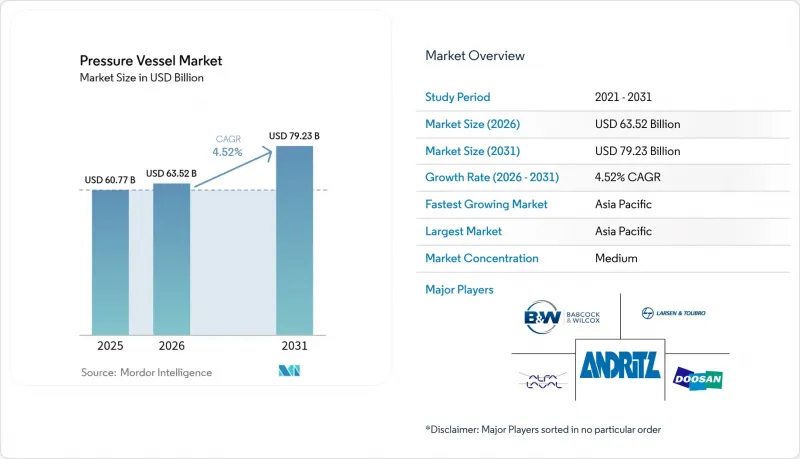
Mordor Intelligence에 의하면, 압력 용기 시장 규모는 2025년 607억 7,000만 달러로 평가되었고, 2026년에는 635억 2,000만 달러로 추정되고, 2026-2031년 CAGR 4.52%로 성장을 지속할 전망이며, 2031년에는 792억 3,000만 달러에 이를 것으로 예측됩니다.
본 보고서는 재료별(탄소강, 복합재료, 클래드강 및 합금강, 기타), 내압 등급별(0-10바, 100바 이상, 기타), 용도별(저장 용기, 공정/반응기, 열교환기, 보일러, 기타(주문 제작 용기, 특수 용기, 팽창 용기)), 최종 사용자 산업별(발전, 석유 및 가스 중류·하류, 제약·생명공학, 기타), 지역별(북미, 유럽, 아시아태평양, 기타)로 분류되어 있습니다.
세계의 압력 용기 시장 동향 및 인사이트
신흥국의 에너지 인프라 업그레이드
아시아태평양 각국 정부는 인증된 압력 용기가 대량으로 필요한 정유시설, 석유화학, 발전 프로젝트를 가속화하고 있습니다. 동방전력이 태산 2호기용으로 국산 반응기 압력 용기를 공급한 것은 수입에서 현지 생산으로의 전환을 뒷받침하는 사례입니다. 인도 및 동남아시아 각지의 산업단지에서는 복합 사이클 발전소나 LNG 터미널용으로 표준화된 압력 용기가 지정되어 있어, 기존 서유럽 공급업체들의 수주가 재분배되고 있습니다. 각국 개발은행의 자금 지원으로 프로젝트 주기가 단축되고, 지역 제조업체에 대한 생산량 보장이 강화되고 있습니다. 낮은 인건비에 더해 기술력의 급속한 향상이 맞물려, ASME 및 PED 규격을 준수하는 가격 경쟁력 있는 제품의 제조가 가능해졌습니다. 이러한 제조 능력의 지역 간 이동은 압력 용기 시장에서 제조의 회복력을 높이는 한편, 비용 측면에서의 압박도 야기하고 있습니다.
세계 LNG 무역의 확대와 이에 따른 극저온 저장 수요
캐나다에서 아시아태평양으로 태평양 연안을 통해 처음으로 선적된 LNG는 북미산 LNG 공급에 따라 변동하는 부하 조건에서 -162°C의 온도를 유지할 수 있는 이중벽 스테인리스 스틸 용기 수백 기가 필요함을 보여줍니다. 400억 달러 규모의 캐나다 LNG 플랜트는 그 규모를 여실히 보여주고 있으며, 보일오프 가스 및 주기적인 열 응력에 대응할 수 있도록 설계된 탱크가 채택되고 있습니다. LNG를 연료로 사용하는 선박이나 대형 트럭에 통합할 경우, 중량 경감 및 진공 단열이 극히 중요해지기 때문에 용기의 복잡성은 더욱 커집니다. 이러한 기술적 장벽은 검증된 극저온 기술 노하우를 보유한 기존 기업에 유리하게 작용하여, 전문 공급업체 간 시장 점유율을 공고히 하고 있습니다. 장기 오프테이크 계약은 수량 리스크를 완화하고, 극저온 용기 제조업체의 수주 잔고에 대한 가시성을 높여줍니다.
철강 가격 변동이 OEM의 이익률을 압박
2024년, 유럽의 철강 명목 소비량은 4년 연속 감소했으며, 미국의 새로운 수입 관세로 인해 비용 변동이 심화되고 있습니다. 압력 용기 제조업체는 강판 제조업체가 분기별 추가 요금을 확정하기 몇 달 전에 고정 가격 납품 계약을 체결하기 때문에 현물 가격이 급등하면 마이너스 이익률이 발생합니다. 일부 제조업체는 위험을 줄이기 위해 복합재료나 듀얼 페이즈 스테인리스로 대체하는 속도를 높이고 있지만, 규격 승인 요건으로 인해 급격한 전환은 제한되고 있습니다. 또한, 공급 사이클이 타이트한 기간에는 강판 제조업체가 더 신속한 결제를 요구하기 때문에 운전 자금 부담도 증가하고 있습니다. 따라서 가격 변동은 압력 용기 시장의 수익성을 직접적으로 압박하고 있습니다.
부문 분석
탄소강은 저비용과 폭넓은 규격 대응을 바탕으로 2025년 압력 용기 시장에서 47.35%의 점유율을 유지했습니다. 그러나 수소 모빌리티에 따른 생산량 확대에 따라 복합재료제 압력 용기 시장 규모는 2031년까지 연평균 성장률(CAGR) 7.05%로 확대될 것으로 예측됩니다. 스테인리스 스틸은 내식성을 통해 높은 가격을 정당화할 수 있는 식품, 의약품, 생명공학 서비스 부문에서 여전히 중요한 역할을 하고 있습니다. 클래드강과 합금강은 고온의 석유화학 반응기에 사용되며, 알루미늄은 무게가 중요한 틈새 시장을 차지하고 있습니다. 복합재 오버랩식 압력 용기는 700바의 사용 조건에서 60%의 경량화를 실현하여, 운송 및 고정식 저장 부문에서의 채택이 확대되고 있습니다.
압력 용기 시장은 신흥 복합재료 시장의 기회를 포착하기 위해 필라멘트 와인딩 라인의 재구축 및 탄소섬유 공급 계약 확보와 같은 조치를 추진하고 있습니다. 한편, 철강 제조업체들은 엄격한 위생 기준을 충족하기 위해 전기 연마 라인이나 이중상강을 도입함으로써 시장 점유율을 지키고 있습니다. 따라서 소재의 다양화는 경쟁을 심화시키고 있으며, 규제 당국의 승인은 장벽이 되는 동시에 촉진요인으로 작용하고 있습니다. 원자력 용도의 복합재 라이너 인증은 여전히 획득되지 않아, 이 고급 부문에서는 철강이 지배적인 지위를 유지하고 있지만, 다른 부문에서의 복합재 진출을 막지는 못하고 있습니다.
2025년 시점에서 0-10바의 저압 용기는 벌크 저장 및 수처리 부문에서 압력 용기 시장 점유율의 40.60%를 차지했습니다. 100바를 초과하는 초고압 유닛의 압력 용기 시장 규모는 수소 탱크와 초임계 반응기가 극히 높은 내압 성능을 필요로 하기 때문에 2031년까지 연평균 성장률(CAGR) 7.25%로 성장할 전망입니다. 중압(10-50바르) 및 고압(50-100바르) 부문에서는 정유시설 및 화학 플랜트에서 꾸준한 교체 수요가 예상됩니다. 수소 연료전지차는 350-700바르에서 수소를 저장하기 때문에 유형 4 탱크가 표준 설계로 채택되어 있습니다.
이 부문을 대상으로 하는 제조업체들은 ISO 19881을 준수하기 위해 오토프레팅 프레스, 정밀 권선, 사내 파열 시험 장비에 투자하고 있습니다. 저장 수소 1kg당 비용이 경쟁력의 지표가 됨에 따라, 라이너의 얇아짐과 첨단 섬유 소재 개발이 촉진되고 있습니다. 한편, 저압 탱크 제조업체들은 상품 시장에서의 이익률을 유지하기 위해 모듈식 탱크 팜과 자동 압연 라인에 주력하고 있습니다. 이러한 양극화는 신기술이 압력 용기 시장 내경쟁 구도를 어떻게 재정의하고 있는지를 여실히 보여주고 있습니다.
지역별 분석
아시아태평양은 2025년에 압력 용기 시장의 44.62%를 차지한 것으로 평가되었으며, 2031년까지 연평균 성장률(CAGR) 6.05%로 확대될 것으로 전망됩니다. 중국의 원자로 섬 부품 현지화와 인도의 정유시설 건설 확대가 대규모 수주 잔고를 뒷받침하고 있습니다. 일본제철과 미쓰비시중공업은 전 세계에 원자로용 단조품을 공급하며, 고사양 부문에서 이 지역의 우위를 공고히 하고 있습니다. 한국은 조선 분야의 전문 지식을 활용하여 LNG 탱크를 생산하고 있으며, 아세안(ASEAN)은 700바르의 COPV(압력 용기)를 사용하는 수소 충전소에 투자하고 있습니다. 이러한 프로젝트들은 지역 전체에 장기적인 제조 생태계를 정착시키고 있습니다. 북미는 성숙기에 접어들었으나 여전히 기회가 풍부한 시장 환경을 보이고 있습니다. 미국은 원자력 발전 용량을 2024년 100GW에서 2050년까지 300GW로 확대하는 것을 목표로 하고 있으며, 이는 걸프 연안 지역 및 브리티시컬럼비아주에서 원자로용 용기에 대한 상당한 수요와,수출 터미널용 극저온 저장 설비에 대한 상당한 수요를 의미하며, 특수 용기 수주를 뒷받침하고 있습니다. 정유시설의 설비 갱신 주기와 OSHA 규제의 강화로 인해 국내에서는 지속적인 수요가 발생하고 있습니다. 다만, 범용 탱크의 경우 제조업체들은 아시아산 수입품과의 경쟁에 직면해 있습니다.
유럽에서는 탈탄소화를 최우선 과제로 삼고 있어, 수소 인프라와 소형 모듈형 원자로에 자금이 투입되고 있습니다. PED(기기 지침)의 조화로 국경 간 판매는 간소화되지만, 규정 준수 장벽은 높아지고 있습니다. 철강 가격 변동과 에너지 비용이 이익률을 압박하고 있어, 중규모 제조업체들 사이에서 구조조정이 진행되고 있습니다. 스칸디나비아와 독일에서는 Power-to-X 플랜트의 시범 운영이 진행되고 있으며, 지역별 수요 목록에 초고압 용기가 추가되고 있습니다. 전반적으로 유럽의 고객들은 추적 가능한 공급망과 탄소 발자국 공개에 대해 추가 비용을 지불하고 있습니다.
남미, 중동 및 아프리카 등의 신흥 지역에서는 성장 궤적에 편차가 나타나고 있습니다. 브라질에서는 프레솔트층 개발에 따라 하류 인프라가 확대되고, 멕시코에서는 정유시설 개보수가 진행 중이며, 아르헨티나에서는 셰일 자원의 수익화가 시야에 들어오고 있습니다. 사우디아라비아와 아랍에미리트(UAE) 등 걸프 지역의 석유화학 클러스터에서는 초대형 반응기와 열교환기가 가동을 시작했습니다. 아프리카 국가들은 수입 압력 용기를 세트로 제공하는 해외 EPC 계약업체에 의존하면서도, 모듈식 비료 제조 설비 및 가스화 설비의 도입을 추진하고 있습니다. 이러한 지역들은 규모는 작지만, 전체적으로 세계 압력 용기 시장 수요 증가를 이끌고 있습니다.
기타 혜택
- 엑셀 형식 시장 예측(ME) 시트
- 3개월간의 애널리스트 지원
자주 묻는 질문
목차
제1장 서론
제2장 조사 방법
제3장 주요 요약
제4장 시장 구도
제5장 시장 규모 및 성장 예측
제6장 경쟁 구도
제7장 시장 기회 및 향후 전망
AJY 26.09.11According to Mordor Intelligence, the pressure vessel market size is expected to grow from USD 60.77 billion in 2025 to USD 63.52 billion in 2026 and is forecast to reach USD 79.23 billion by 2031 at 4.52% CAGR over 2026-2031.
This report is Segmented by Material (Carbon Steel, Composites, Clad and Alloy Steels, and More), Pressure Rating (0 To 10 Bar, Above 100 Bar, and More), Application (Storage Vessels, Process/Reactors, Heat Exchangers, Boilers, and Others), End-User Industry (Power Generation, Oil and Gas Mid/Downstream, Pharmaceuticals and Biotech, and More), and Geography (North America, Europe, Asia-Pacific, and More).
Global Pressure Vessel Market Trends and Insights
Energy Infrastructure Upgrades in Emerging Economies
Asia-Pacific governments accelerate refinery, petrochemical, and power-generation projects that require large quantities of certified vessels; Dongfang Electric's supply of domestic reactor pressure vessels for Taishan 2 underscores the shift from imports to local fabrication. Industrial parks across India and Southeast Asia specify standardised vessels for combined-cycle plants and LNG terminals, redistributing orders away from traditional Western suppliers. Funding from national development banks shortens project cycles and boosts volume guarantees for regional fabricators. Lower labour costs complement burgeoning technical skills, enabling price-competitive products that comply with ASME and PED codes. This geographic capacity migration adds manufacturing resilience and cost pressure within the pressure vessel market.
Rising Global LNG Trade and Associated Cryogenic Storage Demand
Canada's first Pacific-coast export cargo to Asia shows North American LNG flows demand hundreds of double-walled stainless-steel vessels that maintain -162 °C temperatures under variable loading. The USD 40 billion LNG Canada plant illustrates the scale, with tanks engineered to manage boil-off gas and cyclic thermal stresses. Vessel complexity grows when integrating onto LNG-fuelled ships and heavy-duty trucks, where weight reduction and vacuum insulation become mission-critical. These technical barriers favour incumbents with proven cryogenic know-how, consolidating market share among specialised suppliers. Long-term offtake contracts reduce volume risk, enabling large backlog visibility for cryogenic vessel manufacturers.
Volatile Steel Prices Squeezing OEM Margins
European apparent steel consumption shrank for the fourth year in 2024, and new US import tariffs have intensified cost swings. Pressure vessel makers negotiate fixed-price delivery contracts months before plate mills settle quarterly surcharges, creating negative margins when spot prices spike. Some producers accelerate substitution toward composites or duplex stainless grades to mitigate exposure, but code approvals limit rapid changeovers. Working-capital burdens also rise because mills demand quicker payment during tight supply cycles. Thus, price volatility directly constrains profitability in the pressure vessel market.
Other drivers and restraints analyzed in the detailed report include:
- Nuclear New-Build Resurgence in Asia
- Stricter Workplace Safety Regulations (API 510, PED, ASME)
- Lengthy Certification & Compliance Cycles
For complete list of drivers and restraints, kindly check the Table Of Contents.
Segment Analysis
Carbon steel retained 47.35% share of the pressure vessel market in 2025, thanks to low cost and broad code coverage. However, the composites' pressure vessel market size is projected to rise 7.05% CAGR to 2031 as hydrogen mobility scales production volumes. Stainless steel maintains an evergreen role in food, pharmaceutical, and biotech services, where corrosion resistance justifies its premium price. Clad and alloy steels address high-temperature petrochemical reactors, and aluminium occupies weight-sensitive niches. Composite overwrapped pressure vessels achieve 60% weight reduction at 700 bar service, expanding adoption into transport and stationary storage.
The pressure vessel market responds by retooling filament-winding lines and securing carbon-fibre supply agreements to capture the emerging composite opportunity. Steel fabricators defend their share by adding electropolishing lines and duplex alloys to meet stringent hygiene codes. Material diversification, therefore, intensifies competition, with regulatory approvals acting as both barrier and catalyst. Certifications for composite liners in nuclear service remain elusive, keeping steel dominant in that premium segment but not halting composite encroachment elsewhere.
Low-pressure vessels between 0 and 10 bar held 40.60% of the pressure vessel market share in 2025 across bulk storage and water treatment. The pressure vessel market size for ultra-high-pressure units above 100 bar will rise at a 7.25% CAGR to 2031 because hydrogen tanks and supercritical reactors require extreme ratings. Medium (10-50 bar) and high (50-100 bar) segments provide steady replacements in refining and chemical plants. Hydrogen fuel cell vehicles store at 350-700 bar, so Type 4 tanks become the design default.
Manufacturers targeting this segment invest in autofrettage presses, precision winding, and in-house burst-test rigs to comply with ISO 19881. Cost-per-kilogram of stored hydrogen becomes the competitive metric, driving thinner liners and advanced fibers. Conversely, low-pressure producers focus on modular tank farms and automated rolling lines to preserve margin in commodity markets. This bifurcation underscores how emerging technologies redefine competitive clusters within the pressure vessel market.
Complete Report Scope:
- By Material
- Carbon Steel
- Stainless Steel
- Clad and Alloy Steels
- Composites
- Aluminium and Others
- By Pressure Rating
- 0 to 10 bar (Low)
- 10 to 50 bar (Medium)
- 50 to 100 bar (High)
- Above 100 bar (Ultra-high)
- By Application
- Storage Vessels
- Process/Reactors
- Heat Exchangers
- Boilers
- Others (Custom vessels, Specialty vessels, Expansion vessels)
- By End-User Industry
- Oil and Gas Upstream
- Oil and Gas Mid/Downstream
- Chemical and Petrochemical
- Power Generation
- Food and Beverage
- Pharmaceuticals and Biotech
- Water and Wastewater
- Others
- By Geography
- North America
- United States
- Canada
- Mexico
- Europe
- Germany
- United Kingdom
- France
- Italy
- Russia
- Rest of Europe
- Asia Pacific
- China
- India
- Japan
- South Korea
- ASEAN Countries
- Rest of Asia Pacific
- South America
- Brazil
- Argentina
- Rest of South America
- Middle East and Africa
- Saudi Arabia
- United Arab Emirates
- South Africa
- Egypt
- Rest of Middle East and Africa
- North America
Geography Analysis
Asia-Pacific held 44.62% of the pressure vessel market in 2025 and is forecast to expand at a 6.05% CAGR through 2031. China's localisation of nuclear island components and India's refinery build-outs underpin large order books. Japan Steel Works and Mitsubishi Heavy Industries supply reactor forgings globally, reinforcing regional dominance in high-specification segments. South Korea leverages shipbuilding expertise to produce LNG tanks, and ASEAN economies invest in hydrogen refuelling stations that use 700 bar COPVs. These projects embed long-term manufacturing ecosystems across the region. North America represents a mature yet opportunity-rich landscape. The US aims to raise nuclear capacity from 100 GW in 2024 to 300 GW by 2050, implying that sizable reactor-grade vessel demand and export terminals along the Gulf Coast and British Columbia require cryogenic storage, sustaining specialised vessel orders. Replacement cycles in refineries and stricter OSHA rules create recurring domestic demand, although fabricators face competition from Asian imports on commodity tanks.
Europe prioritises decarbonisation, channelling funds into hydrogen infrastructure and small modular reactors. PED harmonisation simplifies cross-border sales but raises compliance thresholds. Steel price volatility and energy costs challenge margins, prompting consolidation among medium-sized fabricators. Scandinavia and Germany pilot Power-to-X plants, adding ultra-high-pressure vessels to local wish lists. Overall, European customers pay premiums for traceable supply chains and carbon-footprint disclosures.
Emerging regions such as South America, the Middle East, and Africa show divergent growth arcs. Brazil's pre-salt fields extend downstream infrastructure, Mexico retrofits refineries, and Argentina eyes shale monetisation. Gulf petrochemical clusters in Saudi Arabia and the UAE commission mega-scale reactors and heat exchangers. African nations pursue modular fertiliser and gasification units, leaning on foreign EPC contractors that bundle imported vessels. Collectively, these areas inject volume upside into the global pressure vessel market, albeit from smaller bases.
- Babcock & Wilcox Enterprises Inc
- Doosan Enerbility Co. Ltd
- Alfa Laval AB
- Andritz AG
- Larsen & Toubro Ltd
- Ergil (Aager GmbH)
- IHI Plant Services Corp.
- Frames Group BV
- GEA Group AG
- Mitsubishi Heavy Industries Ltd
- CB&I (McDermott)
- Paul Mueller Company
- Halvorsen Company
- Westinghouse Electric Co.
- Hitachi Zosen Corp.
- Keller Technology
- Samuel Pressure Vessel Group
- Toyo Kanso Co.
- Parr Instrument Company
- Pressure Vessel Engineering (PVE)
Additional Benefits:
- The market estimate (ME) sheet in Excel format
- 3 months of analyst support
TABLE OF CONTENTS
1 Introduction
- 1.1 Study Assumptions & Market Definition
- 1.2 Scope of the Study
2 Research Methodology
3 Executive Summary
4 Market Landscape
- 4.1 Market Overview
- 4.2 Market Drivers
- 4.2.1 Energy infrastructure upgrades in emerging economies
- 4.2.2 Rising global LNG trade and associated cryogenic storage demand
- 4.2.3 Nuclear new-build resurgence in Asia
- 4.2.4 Stricter workplace safety regulations (API 510, PED, ASME)
- 4.2.5 Adoption of composite overwrapped pressure vessels (COPVs) in hydrogen mobility
- 4.2.6 Modular small-scale chemical processing skids
- 4.3 Market Restraints
- 4.3.1 Volatile steel prices squeezing OEM margins
- 4.3.2 Lengthy certification & compliance cycles
- 4.3.3 Slow commercialization of Generation IV nuclear designs
- 4.3.4 Scarcity of skilled welders & inspectors
- 4.4 Supply-Chain Analysis
- 4.5 Regulatory Landscape
- 4.6 Technological Outlook
- 4.7 Porter's Five Forces
- 4.7.1 Bargaining Power of Suppliers
- 4.7.2 Bargaining Power of Buyers
- 4.7.3 Threat of New Entrants
- 4.7.4 Threat of Substitutes
- 4.7.5 Industry Rivalry
5 Market Size & Growth Forecasts
- 5.1 By Material
- 5.1.1 Carbon Steel
- 5.1.2 Stainless Steel
- 5.1.3 Clad and Alloy Steels
- 5.1.4 Composites
- 5.1.5 Aluminium and Others
- 5.2 By Pressure Rating
- 5.2.1 0 to 10 bar (Low)
- 5.2.2 10 to 50 bar (Medium)
- 5.2.3 50 to 100 bar (High)
- 5.2.4 Above 100 bar (Ultra-high)
- 5.3 By Application
- 5.3.1 Storage Vessels
- 5.3.2 Process/Reactors
- 5.3.3 Heat Exchangers
- 5.3.4 Boilers
- 5.3.5 Others (Custom vessels, Specialty vessels, Expansion vessels)
- 5.4 By End-User Industry
- 5.4.1 Oil and Gas Upstream
- 5.4.2 Oil and Gas Mid/Downstream
- 5.4.3 Chemical and Petrochemical
- 5.4.4 Power Generation
- 5.4.5 Food and Beverage
- 5.4.6 Pharmaceuticals and Biotech
- 5.4.7 Water and Wastewater
- 5.4.8 Others
- 5.5 By Geography
- 5.5.1 North America
- 5.5.1.1 United States
- 5.5.1.2 Canada
- 5.5.1.3 Mexico
- 5.5.2 Europe
- 5.5.2.1 Germany
- 5.5.2.2 United Kingdom
- 5.5.2.3 France
- 5.5.2.4 Italy
- 5.5.2.5 Russia
- 5.5.2.6 Rest of Europe
- 5.5.3 Asia Pacific
- 5.5.3.1 China
- 5.5.3.2 India
- 5.5.3.3 Japan
- 5.5.3.4 South Korea
- 5.5.3.5 ASEAN Countries
- 5.5.3.6 Rest of Asia Pacific
- 5.5.4 South America
- 5.5.4.1 Brazil
- 5.5.4.2 Argentina
- 5.5.4.3 Rest of South America
- 5.5.5 Middle East and Africa
- 5.5.5.1 Saudi Arabia
- 5.5.5.2 United Arab Emirates
- 5.5.5.3 South Africa
- 5.5.5.4 Egypt
- 5.5.5.5 Rest of Middle East and Africa
- 5.5.1 North America
6 Competitive Landscape
- 6.1 Market Concentration
- 6.2 Strategic Moves (M&A, Partnerships, PPAs)
- 6.3 Market Share Analysis (Market Rank/Share for key companies)
- 6.4 Company Profiles (includes Global level Overview, Market level overview, Core Segments, Financials as available, Strategic Information, Products & Services, and Recent Developments)
- 6.4.1 Babcock & Wilcox Enterprises Inc
- 6.4.2 Doosan Enerbility Co. Ltd
- 6.4.3 Alfa Laval AB
- 6.4.4 Andritz AG
- 6.4.5 Larsen & Toubro Ltd
- 6.4.6 Ergil (Aager GmbH)
- 6.4.7 IHI Plant Services Corp.
- 6.4.8 Frames Group BV
- 6.4.9 GEA Group AG
- 6.4.10 Mitsubishi Heavy Industries Ltd
- 6.4.11 CB&I (McDermott)
- 6.4.12 Paul Mueller Company
- 6.4.13 Halvorsen Company
- 6.4.14 Westinghouse Electric Co.
- 6.4.15 Hitachi Zosen Corp.
- 6.4.16 Keller Technology
- 6.4.17 Samuel Pressure Vessel Group
- 6.4.18 Toyo Kanso Co.
- 6.4.19 Parr Instrument Company
- 6.4.20 Pressure Vessel Engineering (PVE)
7 Market Opportunities & Future Outlook
- 7.1 White-space & Unmet-need Assessment


