

|
시장보고서
상품코드
2124317
폴리에스테르 단섬유(PSF) 시장 : 시장 점유율 분석, 업계 동향 및 통계, 성장 예측(2026-2031년)Polyester Staple Fiber (PSF) - Market Share Analysis, Industry Trends & Statistics, Growth Forecasts (2026 - 2031) |
||||||
 Mordor Intelligence
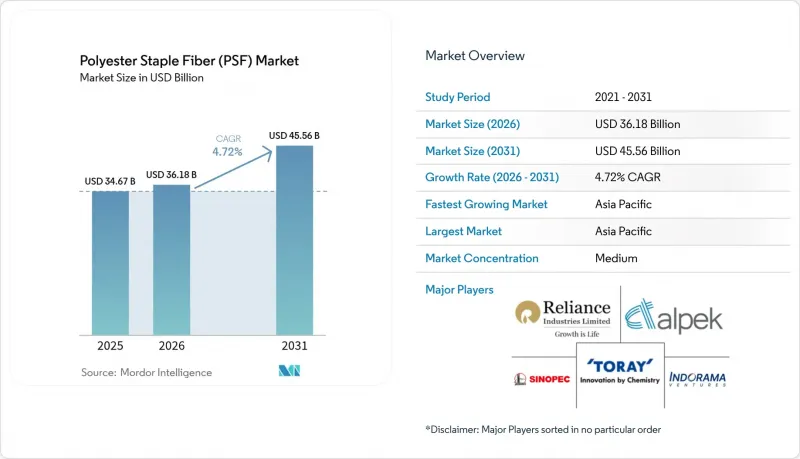
Mordor Intelligence에 의하면, 폴리에스테르 단섬유(PSF) 시장 규모는 2025년 346억 7,000만 달러로 평가되었고, 2026년에는 361억 8,000만 달러로 추정되고, 2031년까지 455억 6,000만 달러에 이를 것으로 예상되며, 2026-2031년 CAGR 4.72%로 성장할 전망입니다.
본 보고서는 제품 유형별(중실, 중공), 공급원별(버진, 혼합, 재생재), 용도별(섬유, 홈 퍼니싱, 자동차, 여과, 건설, 기타), 지역별(아시아태평양, 북미, 유럽, 남미, 중동 및 아프리카)로 분류되어 있습니다. 시장 전망은 금액(달러) 기준으로 제시되어 있습니다.
세계의 폴리에스테르 단섬유(PSF) 시장 동향 및 인사이트
패스트 패션 브랜드에 의한 재생 PSF 수요 급증
재활용 소재 사용 확대를 위한 각 브랜드의 노력은 현재 다년간의 계약 형태로 구체화되고 있으며, rPSF 가격은 버진 섬유보다 높은 수준을 유지하고 있습니다. H&M은 2024년까지 재활용 폴리에스테르 사용 목표를 달성하기 위해 화학 재활용 규모 확대를 목표로 하는 Syre에 투자했습니다. Far Eastern Group은 rPET 생산 능력을 확대했으나, 재활용 원료의 대부분을 페트병에서 조달하고 있어 원료를 둘러싼 포장 산업과의 경쟁이 격화되고 있습니다. Indorama와 Jiaren Chemical의 제휴로 인해 텍스타일 투 텍스타일(섬유에서 섬유로) 처리 능력이 더욱 확대될 전망이며, 폐쇄형 순환 시스템(클로즈드 루프 시스템) 실현에 있어 탈중합의 중요성이 높아지고 있음이 부각되고 있습니다. 한편, 2024년 ZDHC가 발표한 새로운 지침에서는 폐수 및 화학 물질에 대한 규제가 강화되었으며, 이로 인해 소규모 재활용 업체의 자금 조달 어려움이 더욱 가중되어 통합형 사업자에 의한 시장 재편이 진행될 것으로 예측됩니다.
동남아시아의 부직포 위생용품 생산 능력 확대
부직포에 대한 투자는 낮은 인건비, 우대 무역 경로, 지역 내 기저귀 보급률 상승을 배경으로 중국 연안 지역에서 베트남, 인도네시아, 태국으로 이동하고 있습니다. 태국의 합성섬유 생산량은 2024년에 증가했습니다. 한편, Sinopec 이징(Yizheng)의 벤치마크가 되는 VOC 제로 멜트 직접 라인은 아세안(ASEAN) 내 신규 공장의 기준을 확립해 가고 있습니다. EDANA와 INDA의 데이터에 따르면, 위생용 부직포는 현재 전 세계 생산량의 대부분을 차지하고 있습니다. 또한, PSF의 인장 강도와 흡수성 덕분에 코어층과 흡수층 모두에서 PSF가 선호되는 섬유로 자리 잡고 있습니다. 인도 기저귀 시장의 확대에 힘입어 현지 수요가 촉진되면서, 2027년까지 두 자릿수 생산 능력 확대의 길이 열리고 있습니다. 또한, 장거리 수출을 피함으로써 물류 비용을 절감하여 프로젝트의 경제성을 높이고, 아세안(ASEAN)이 위생용 PSF의 신흥 허브로서의 입지를 공고히 하고 있습니다.
원유 가격 변동에 따른 원료 가격 변동
2025년, 원유 가격에 연동되는 파라자일렌 비용이 섬유 가격보다 급격히 상승함에 따라 PTA와 MEG의 이익률은 큰 타격을 입었습니다. 이로 인해 중국에서는 여러 PTA 공장이 폐쇄되었습니다. 수입 의존도가 높은 유럽과 아세안은 중국의 통합형 정유시설와 비교해 원료 가격 급등으로 어려움을 겪었습니다. 이러한 격차는 양 지역의 경쟁력을 저하시켰을 뿐만 아니라, 합리화 흐름을 가속화하는 결과로 이어졌습니다. 이러한 시장 역학의 변화에 따라, Indorama는 캐나다의 PTA 공장을 폐쇄했고, Alpek은 시더크릭의 rPET 사업을 일시 중단했습니다. 이 모든 조치는 이익 마진이 마이너스로 전환된 데 따른 것입니다. 중국 공업정보화부는 생산 능력 억제를 주창하고 있지만, 세계적 상황은 다른 양상을 띠고 있습니다. PET의 설계 용량이 대폭 과잉인 탓에 구조적인 공급 과잉에 대한 우려가 짙어지고 있습니다. 게다가 원자재 비용의 변동이 심해 장기 계약에 악영향을 미치고 있으며, PSF 공급망 전체의 자본 계획 전망을 복잡하게 만들고 있습니다.
부문별 분석
2025년, 중실 폴리에스테르 단섬유(PSF)는 시장 점유율의 60.28%를 차지했습니다. 이는 주로 강인성과 색상 견뢰도가 높이 평가되는 의류, 홈 퍼니싱, 위생용 부직포로의 용도가 주도한 결과입니다. 필링(보풀) 및 장기적인 압축에 대한 내성으로 알려진 중실 섬유는 폴리에스테르·면 혼방 원단 및 가구용 덮개 원단에서 지속적인 수요가 나타나며, 천연섬유를 능가하는 성장을 이루고 있습니다. 한편, 중공 등급은 경량화와 열효율을 중시하는 자동차 제조업체,아웃도어 의류 브랜드, 단열재 제조업체에 의해 견인되어 연평균 성장률(CAGR) 5.86%로 성장하고 있습니다. 학술 연구에 따르면, 중공 폴리에스테르의 열전도율은 약 0.04W/m·K로 유리 섬유와 동등한 수준이면서도, 피부 자극이나 흡습성 같은 단점이 없습니다는 점이 강조되고 있습니다. 각 자동차 제조업체들은 현재 도어 패널용 복합재에 저융점 중공 폴리에스테르 섬유를 채택하기 시작했으며, 이를 통해 신속한 진공 성형이 가능해져 전기차 생산 목표에도 부합하고 있습니다. 건설 부문에서는 중공 배트가 주목을 받고 있으며, 기존 미네랄 울에 비해 취급이 용이하고 곰팡이에 강한 장점이 있습니다. 전기차 플랫폼의 급증과 친환경 건축 기준의 보급에 따라 2031년까지는 중실 섬유가 생산량 면에서 계속 선두를 달릴 것으로 보이지만, 중공 PSF의 매력은 더욱 높아질 것으로 전망됩니다.
지역별 분석
아시아태평양은 2025년에 73.65%의 시장 점유율을 확보했으며, 2031년까지 연평균 성장률(CAGR) 5.44%를 기록할 전망입니다. 중국의 폴리에스테르 생산 능력은 이 지역의 비용 면에서의 우위를 공고히 하고 있습니다. 그러나 2025년 PTA 이익률이 축소됨에 따라, 정부는 과잉 생산을 방지하기 위해 ‘과당 경쟁 억제’ 조치를 취하고 있습니다. 인도의 경우, 생산 연계형 인센티브와 MITRA 메가파크의 지원에 힘입어 인공 방적 라인 증설로 인해 예측 기간 동안 해당국의 폴리에스테르 단섬유 시장 규모가 확대될 것으로 전망됩니다. 한편, 태국, 베트남, 인도네시아는 고가의 중국에서 생산 기지를 전환하며 부직포 위생용품 부문에 대한 투자를 활용하고 있습니다. 이들 국가는 낮은 에너지 요금과 아세안(ASEAN)을 미국 및 EU와 연결하는 무역 회랑의 혜택을 누리고 있어 견조한 판매 실적을 확보하고 있습니다. 일본과 한국은 Toray Industries Inc.의 한국 내 설비 투자가 보여주듯이 고성능 섬유에 주력하고 있으며, 범용 PSF에서 고수익률의 탄소섬유 및 아라미드 섬유로의 전환이 진행되고 있습니다.
북미에서는 반덤핑 조치라는 보호 장치의 보호 아래 공급망 재구축이 진행되고 있습니다. 이러한 조치는 국내 생산자를 뒷받침하는 한편, 의존 관계도 야기하고 있어 수요를 충족시키기 위해 매년 PET 수입이 필요하게 되었습니다. 전략적 움직임으로, Reliance Industries와 Indorama는 관세에 따른 수입 대체를 활용하는 것을 목표로, 미국에서 생산 능력 병목 현상 해소 프로그램을 잇달아 전개하고 있습니다. 대서양을 사이에 둔 유럽에서는 환경 규제 강화에 직면해 있습니다. 미세플라스틱 관련 법규로 인해 구매자들은 저방출 등급이나 재활용 혁신 기술로 눈을 돌리고 있지만, 현지 생산자들은 에너지 비용 급등으로 인한 압박에 시달리고 있습니다. 그러나 알펙(Alpek)이 생산 능력을 확충하여 윌턴(Wilton) PET 라인을 재가동했음에도 불구하고, 파라자일렌 가격 변동으로 인해 그 전망은 여전히 불투명한 상황입니다.
남미와 중동 및 아프리카를 합친 시장은 세계 생산량에서 차지하는 비중은 작지만, 급증하는 인프라 계획과 인구 동향의 추세로 볼 때 평균을 상회하는 성장 가능성이 시사되고 있습니다. 사우디아라비아에서는 NEOM이 기반을 다지고 있으며, 두바이에서는 3D 프린팅 건축 기준이 PSF 강화 콘크리트에 대한 초기 수요를 불러일으키고 있습니다. 브라질은 전략적 전환을 도모하며, 면화 가격 변동 위험을 완화하기 위해 폴리에스테르 혼방 소재로의 전환을 추진하고 있으며, 이러한 움직임은 통화 약세에 따른 수출 경쟁력 향상으로 인해 더욱 탄력을 받고 있습니다. 1인당 섬유 소비량에서는 다른 지역에 뒤처져 있지만, 이러한 신흥 지역에서는 재정 부양책과 도시화의 뒷받침을 받아 향후 수년에 걸쳐 수요가 증가할 것으로 전망됩니다.
기타 혜택
- 엑셀 형식 시장 예측(ME) 시트
- 3개월간의 애널리스트 지원
자주 묻는 질문
목차
제1장 서론
제2장 조사 방법
제3장 주요 요약
제4장 시장 구도
제5장 시장 규모 및 성장 예측
제6장 경쟁 구도
제7장 시장 기회 및 향후 전망
AJY 26.09.11According to Mordor Intelligence, the polyester staple fiber market size is expected to increase from USD 34.67 billion in 2025 to USD 36.18 billion in 2026 and reach USD 45.56 billion by 2031, growing at a CAGR of 4.72% over 2026-2031.
This report is Segmented by Product Type (Solid and Hollow), Origin (Virgin, Blended, and Recycled), Application (Textile, Home Furnishing, Automotive, Filtration, Construction, and Other Applications), and Geography (Asia-Pacific, North America, Europe, South America, and Middle-East and Africa). The Market Forecasts are Provided in Terms of Value (USD).
Global Polyester Staple Fiber (PSF) Market Trends and Insights
Surge in Demand for Recycled PSF from Fast-Fashion Brands
Brand commitments to boost recycled content are now solidifying into multi-year contracts, with rPSF prices sitting higher than virgin fiber. H&M, hitting recycled polyester in 2024, backed Syre with an investment to scale up chemical recycling. Far Eastern Group expanded its rPET capacity, but with most of its recycled input sourced from bottles, it's facing heightened competition from the packaging sector for feedstock. Indorama's collaboration with Jiaren Chemical is set to introduce additional capacity for textile-to-textile processing, underscoring the growing importance of depolymerization in achieving a closed-loop system. Meanwhile, new guidelines from ZDHC in 2024 tighten controls on wastewater and chemicals, creating steeper capital challenges for smaller recyclers and favoring market consolidation among integrated players.
Expansion of Non-Woven Hygiene Capacity in Southeast Asia
Non-woven investments are shifting from coastal China to Vietnam, Indonesia, and Thailand, driven by lower labor costs, preferential trade corridors, and increasing regional diaper penetration. Thailand's output of man-made fibers saw growth in 2024. Meanwhile, Sinopec Yizheng's benchmark zero-VOC melt-direct line is setting the standard for new plants in ASEAN. Data from EDANA and INDA highlight that hygiene non-wovens now represent a significant portion of the global volume. Additionally, the tensile strength and absorbency of PSF make it the preferred fiber for both core and acquisition layers. With India's diaper market on the rise, local off-take is bolstered, paving the way for double-digit capacity expansions until 2027. Furthermore, logistics savings from avoiding long-haul exports enhance project economics, solidifying ASEAN's position as the emerging hub for hygiene-grade PSF.
Raw-Material Price Swings Linked to Crude-Oil Volatility
In 2025, as crude-linked paraxylene costs surged faster than fiber prices, PTA and MEG margins took a sharp hit. This led to the closure of several PTA units in China. Europe and ASEAN, both heavily reliant on imports, grappled with higher feedstock prices compared to China's integrated refineries. This disparity not only diminished their competitiveness but also hastened a wave of rationalization. In response to the shifting market dynamics, Indorama closed its Canadian PTA plant, and Alpek paused its Cedar Creek rPET operations, both actions taken as profit spreads turned negative. While China's Ministry of Industry has advocated for capacity discipline, the global landscape tells a different story: with a significant nameplate capacity for PET, a structural oversupply looms large. Furthermore, the erratic nature of feedstock costs casts a shadow over long-term contracts, complicating capital-planning visibility throughout the PSF chain.
Other drivers and restraints analyzed in the detailed report include:
- Substitution of Cotton with Polyester Amid Raw-Cotton Price Volatility
- Lightweight, Low-Noise NVH Components Boost Automotive PSF Use
- Anti-Dumping Duties on PSF in the United States and EU
For complete list of drivers and restraints, kindly check the Table Of Contents.
Segment Analysis
In 2025, solid Polyester Staple Fiber (PSF) commanded a 60.28% share of the market, primarily driven by its applications in apparel, home furnishings, and hygiene non-wovens, where its tenacity and colorfastness are highly valued. Solid fibers, known for their resistance to pilling and prolonged compression, have seen sustained demand in blended polyester-cotton fabrics and upholstery, outpacing their natural counterparts. Meanwhile, hollow grades are climbing at a 5.86% CAGR, fueled by automakers, outdoor apparel brands, and insulation providers who prioritize weight savings and thermal efficiency. Academic studies highlight hollow polyester's thermal conductivity at approximately 0.04 W/m*K, on par with fiberglass, but without the downsides of skin irritation and moisture retention. Automotive OEMs are now turning to low-melting-point hollow variants for door-panel composites, enabling rapid vacuum-forming and aligning with electric vehicle production targets. In the construction sector, hollow batts are gaining traction, offering advantages like easier handling and mold resistance over traditional mineral wool. With the surge of electric vehicle platforms and green construction standards, the appeal of hollow PSF is set to soar, even as solid fiber maintains its volume lead through 2031.
Complete Report Scope:
- By Product Type
- Solid
- Hollow
- By Origin
- Virgin
- Blended
- Recycled
- By Application
- Textile
- Home Furnishing
- Automotive
- Filtration
- Construction
- Other Applications
- By Geography
- Asia-Pacific
- China
- India
- Japan
- South Korea
- ASEAN
- Rest of Asia-Pacific
- North America
- United States
- Canada
- Mexico
- Europe
- Germany
- United Kingdom
- France
- Italy
- Spain
- Rest of Europe
- South America
- Brazil
- Argentina
- Rest of South America
- Middle East and Africa
- Saudi Arabia
- South Africa
- Rest of Middle East and Africa
- Asia-Pacific
Geography Analysis
Asia-Pacific cemented 73.65% market share in 2025 and is on track for a 5.44% CAGR through 2031. China's polyester capacity solidifies the region's cost leadership. However, with PTA margins compressing in 2025, the government has intervened with "anti-involution" measures to prevent over-building. In India, bolstered by Production-Linked Incentives and the MITRA mega-parks, the addition of man-made spinning lines is projected to elevate the country's Polyester Staple Fiber market size over the forecast period. Meanwhile, Thailand, Vietnam, and Indonesia are capitalizing on non-woven hygiene investments, shifting from pricier China. They benefit from lower energy tariffs and trade corridors with ASEAN-U.S./EU, ensuring robust offtake. Japan and South Korea are honing in on high-performance fibers, as evidenced by Toray's capex in Korea, signaling a shift towards premium-margin carbon and aramid grades over the commodity PSF.
North America, under the protective umbrella of anti-dumping measures, is reshaping its supply chain. While these shields bolster domestic producers, they also create a dependency, necessitating PET imports annually to meet demand. In a strategic move, Reliance Industries and Indorama have both rolled out debottlenecking programs in the U.S., aiming to leverage tariff-induced import substitution. Across the Atlantic, Europe grapples with tightening environmental regulations. With microplastic legislation nudging buyers towards low-shedding grades and recycling innovations, local producers face pressures from soaring energy costs. Yet, Alpek's revival of its Wilton PET line, adding capacity, remains on edge due to fluctuations in paraxylene prices.
While South America and the combined regions of the Middle-East and Africa account small portion of the global volume, burgeoning infrastructure pipelines and demographic trends hint at a potential for above-average growth. In Saudi Arabia, NEOM is setting the stage, and in Dubai, 3D-print building codes are igniting an early demand for PSF-reinforced concrete. Brazil, in a strategic shift, is turning to polyester blends to buffer against cotton's volatility, a move further supported by a depreciated currency enhancing its export competitiveness. Despite trailing in per-capita fiber consumption, these emerging regions are witnessing a multi-year uplift, fueled by fiscal stimulus and urbanization.
- Alpek
- Barnet
- Bombay Dyeing
- BoReTech Environmental Engineering Co., Ltd.
- Diyou Fibre (M) Sdn Bhd
- Far Eastern Group
- Hang Zhou Benma Chemfibre and Spinning Co.,Ltd.
- Huvis Corp
- Indorama Corporation
- Komal Fibres
- Nirmal Fibres (P) Ltd.
- Reliance Industries Limited
- Sanfame Group
- Shubhalakshmi
- SINOPEC YIZHENG CHEMICAL FIBRE LIMITED
- Thai polyester Co., Ltd.
- Tongkun Holding Group
- TORAY INDUSTRIES, INC.
- XINDA
Additional Benefits:
- The market estimate (ME) sheet in Excel format
- 3 months of analyst support
TABLE OF CONTENTS
1 Introduction
- 1.1 Study Assumptions and Market Definition
- 1.2 Scope of the Study
2 Research Methodology
3 Executive Summary
4 Market Landscape
- 4.1 Market Overview
- 4.2 Market Drivers
- 4.2.1 Surge in demand for recycled PSF from fast-fashion brands
- 4.2.2 Expansion of non-woven hygiene capacity in Southeast Asia
- 4.2.3 Substitution of cotton with polyester amid raw-cotton price volatility
- 4.2.4 Lightweight, low-noise NVH components boost automotive PSF use
- 4.2.5 Rapid growth of fibre-reinforced 3-D printed concrete panels
- 4.3 Market Restraints
- 4.3.1 Raw-material price swings linked to crude-oil volatility
- 4.3.2 Anti-dumping duties on PSF in the United States and EU
- 4.3.3 Tightened EU micro-plastic shedding legislation
- 4.4 Value Chain Analysis
- 4.5 Porter's Five Forces
- 4.5.1 Bargaining Power of Suppliers
- 4.5.2 Bargaining Power of Buyers
- 4.5.3 Threat of New Entrants
- 4.5.4 Threat of Substitutes
- 4.5.5 Competitive Rivalry
5 Market Size and Growth Forecasts (Value)
- 5.1 By Product Type
- 5.1.1 Solid
- 5.1.2 Hollow
- 5.2 By Origin
- 5.2.1 Virgin
- 5.2.2 Blended
- 5.2.3 Recycled
- 5.3 By Application
- 5.3.1 Textile
- 5.3.2 Home Furnishing
- 5.3.3 Automotive
- 5.3.4 Filtration
- 5.3.5 Construction
- 5.3.6 Other Applications
- 5.4 By Geography
- 5.4.1 Asia-Pacific
- 5.4.1.1 China
- 5.4.1.2 India
- 5.4.1.3 Japan
- 5.4.1.4 South Korea
- 5.4.1.5 ASEAN
- 5.4.1.6 Rest of Asia-Pacific
- 5.4.2 North America
- 5.4.2.1 United States
- 5.4.2.2 Canada
- 5.4.2.3 Mexico
- 5.4.3 Europe
- 5.4.3.1 Germany
- 5.4.3.2 United Kingdom
- 5.4.3.3 France
- 5.4.3.4 Italy
- 5.4.3.5 Spain
- 5.4.3.6 Rest of Europe
- 5.4.4 South America
- 5.4.4.1 Brazil
- 5.4.4.2 Argentina
- 5.4.4.3 Rest of South America
- 5.4.5 Middle East and Africa
- 5.4.5.1 Saudi Arabia
- 5.4.5.2 South Africa
- 5.4.5.3 Rest of Middle East and Africa
- 5.4.1 Asia-Pacific
6 Competitive Landscape
- 6.1 Market Concentration
- 6.2 Strategic Moves
- 6.3 Market Share(%)/Ranking Analysis
- 6.4 Company Profiles (includes Global level Overview, Market level overview, Core Segments, Financials as available, Strategic Information, Products and Services, and Recent Developments)
- 6.4.1 Alpek
- 6.4.2 Barnet
- 6.4.3 Bombay Dyeing
- 6.4.4 BoReTech Environmental Engineering Co., Ltd.
- 6.4.5 Diyou Fibre (M) Sdn Bhd
- 6.4.6 Far Eastern Group
- 6.4.7 Hang Zhou Benma Chemfibre and Spinning Co.,Ltd.
- 6.4.8 Huvis Corp
- 6.4.9 Indorama Corporation
- 6.4.10 Komal Fibres
- 6.4.11 Nirmal Fibres (P) Ltd.
- 6.4.12 Reliance Industries Limited
- 6.4.13 Sanfame Group
- 6.4.14 Shubhalakshmi
- 6.4.15 SINOPEC YIZHENG CHEMICAL FIBRE LIMITED
- 6.4.16 Thai polyester Co., Ltd.
- 6.4.17 Tongkun Holding Group
- 6.4.18 TORAY INDUSTRIES, INC.
- 6.4.19 XINDA
7 Market Opportunities and Future Outlook
- 7.1 White-space and Unmet-Need Assessment
- 7.2 Growing Awareness Regarding Recycled Polyester Staple Fiber


