

|
시장보고서
상품코드
2124353
타이어 재생 시장 : 점유율 분석, 업계 동향과 통계, 성장 예측(2026-2031년)Tire Retreading - Market Share Analysis, Industry Trends & Statistics, Growth Forecasts (2026 - 2031) |
||||||
 Mordor Intelligence
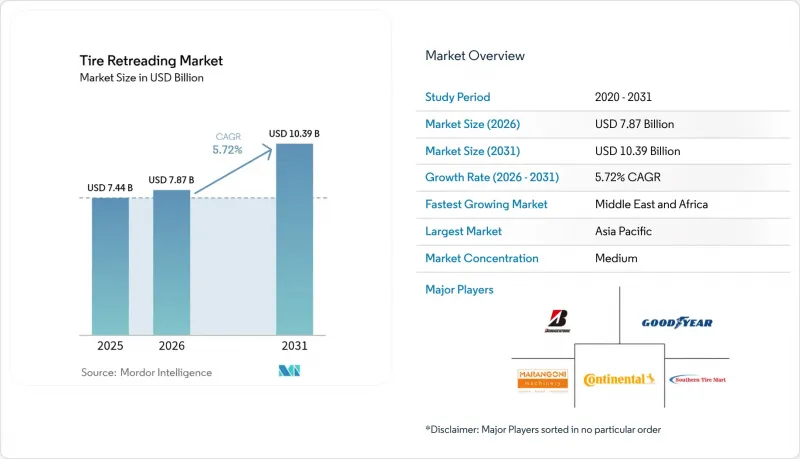
Mordor Intelligence에 의하면, 타이어 재생 시장 규모는 2025년에 74억 4,000만 달러로 평가되었고 2026년 78억 7,000만 달러에서 2031년까지 103억 9,000만 달러에 이를 것으로 예측되며, 예측 기간(2026-2031년) CAGR은 5.72%를 나타낼 전망입니다.
본 보고서는 차량 유형별(승용차, 소형 상용차, 기타), 생산 방식별(프리큐어, 몰드큐어), 타이어 유형별(레이디얼, 바이애스,솔리드 폼 충전), 유통 채널별(독립 리트레드 업체, 기타), 최종 사용자 산업별(운송 및 물류용 차량, 기타), 용도별(온로드, 오프로드), 지역별로 분류되어 있습니다. 시장 예측은 금액(달러) 기준으로 제시되어 있습니다.
세계 타이어 재생 시장 동향 및 인사이트
신품 타이어에 비해 비용 절감 가능
상업용 사업자들은 현재 리트레드를 연간 예산 계획에 포함시키고 있습니다. 이는 리트레드 타이어 1개가 동급의 신품 타이어에 비해 구매 가격의 5분의 2를 절약할 수 있기 때문입니다. 이 가격 차이는 합성고무와 석유 가격이 상승 추세를 보임에 따라 확대되고 있으며, 장거리 트럭 운송이나 택배 등 이용 빈도가 높은 차량군에서 리트레드의 비용 대비 효과가 높아지고 있음을 뒷받침하고 있습니다. 2025년 상반기에 트럭 판매 대수가 30만 대에 육박한 중국의 대형 트럭 부문은 이러한 비용 계산을 여실히 보여주고 있으며, 한편 항공사들도 미미한 영업이익률을 유지하기 위해 항공용 타이어의 수명을 여러 주기에 걸쳐 연장하고 있습니다.
더욱 엄격해진 순환형 경제와 CO₂ 규제
EU의 ‘순환 경제 행동 계획’ 규정에 따라 운송 사업자는 폐기를 우선시하기보다 재사용을 우선시해야 할 의무가 있으며, 타이어 재생은 선택적 조치가 아닌 규제 준수를 위한 수단이 되었습니다. 유로 7 배출 기준은 시기상조인 타이어 교체에 벌금을 부과함으로써 이 의무를 더욱 강화하고 있으며, 북미 및 아시아태평양의 주요 경제권에서도 유사한 움직임이 나타나고 있습니다. 환경적 측면에서의 계산은 간단명료합니다. 재포장 타이어 1개당 이산화탄소 배출량을 30%, 에너지 투입량을 70% 줄일 수 있으며, 이러한 수치는 운송 사업자가 스코프 3 보고 목표를 달성하는 데 도움이 됩니다.
불안정한 케이싱·고무 가격
천연 고무의 벤치마크 가격이나 유가에 연동되는 합성 고무 비용이 급격히 변동하면 이익률이 압박을 받아 리트레드 공장의 가격 책정이 어려워집니다. 소규모 독립 업체의 경우 선물 거래를 통한 임베디드 능력이 부족한 경우가 많아 현물 시장의 변동 영향을 받기 쉽습니다. 그 결과, 매출 총이익률이 압박받거나 가격 인상을 피할 수 없게 되어, 신품 수입 타이어에 비해 재가공 타이어가 가졌던 비용 측면의 경쟁력이 약화됩니다. 원자재 가격이 하락하면, 균형이 회복될 때까지 신품 타이어의 할인 판매로 인해 재가공 타이어 수요가 일시적으로 억제될 수 있습니다.
부문 분석
중형 및 대형 트럭은 2025년 매출의 45.02%를 차지하고 있으며, 주행 거리가 길기 때문에 간선 운송 및 지역 운송 업체에게 리트레드가 필수적이라는 사실이 입증되고 있습니다. 화물 수요가 견조한 추세를 보이는 가운데, 이 부문은 2031년까지 타이어 재생 시장의 기반을 계속 유지할 것으로 보입니다. 오프로드 및 광산용 타이어는 아프리카와 남미의 광물 채굴 활동을 배경으로 연평균 성장률(CAGR) 5.96%를 나타낼 것으로 예측됩니다. 이 지역에서는 특수 케이싱의 가격이 일반 도로용 타이어보다 몇 배나 비쌉니다. 4-10회의 리트레드 주기가 승인된 항공기 타이어의 틈새 시장은 엄격한 안전 감독과 적극적인 비용 관리가 공존할 수 있음을 보여주고 있으며, 대부분의 지상용 부문을 능가하는 견실한 연평균 성장률(CAGR)이 예측됩니다.
승용차 리트레드는 안전에 대한 우려로 인해 유럽이나 북미에서는 여전히 미미한 존재이지만, 규제 장벽이 낮은 라틴아메리카나 아시아에서는 일정한 입지를 유지하고 있습니다. 전자상거래 물류에서 중요한 역할을 하는 소형 상용 밴의 경우, 도시 지역에서의 잦은 정차에 맞추어 리트레드 주기가 단축되는 경향이 있습니다. 일본에서 부상하고 있는 더블 커플링 트럭에는 더 높은 차축 하중을 감당할 수 있는 리트레드 설계가 요구되고 있으나, 현재 이러한 기술적 역량을 갖춘 곳은 최첨단 독립 리트레드 업체로 한정되어 있습니다.
2025년, 프리큐어 공법은 전 세계 매출의 60.95%를 차지하며, 대량 생산되는 트럭용 케이싱에서는 여전히 주류 공법입니다. 이 공법의 경쟁 우위는 단위당 비용이 낮고 처리 속도가 빠르다는 점에 있습니다. 몰드 커어 공법은 가열 정밀도 향상과 사이클 타임 단축을 동시에 달성하면서 맞춤형 트레드 패턴을 구현할 수 있는 자동 프레스기의 도입으로 연평균 성장률(CAGR) 5.88%를 기록하며 시장 점유율을 확대되고 있습니다. AI를 활용한 표면 검사부터 협동 로봇을 이용한 핸들러에 이르기까지의 자동화는 품질 표준화와 인력 감축을 통해 두 공법 모두를 뒷받침하고 있습니다. 그러나 설비 투자 요건으로 인해 소규모 공장이 설비 갱신 자금 조달에 어려움을 겪는 가운데, 산업 재편이 가속화될 가능성이 있습니다.
맞춤형 패턴에 대한 수요가 확대됨에 따라, 몰드 경화 방식을 이용한 타이어 재생 시장 규모는 확대될 것으로 예측됩니다. 그렇긴 하지만, 프리큐어 방식의 간편함과 낮은 에너지 소비량 덕분에, 비용을 중시하는 차량 소유 사업자들에게는 여전히 선호되는 방식입니다. OEM과 통합된 리트레드 공장은 수주 구성이나 케이싱 확보 상황에 따라 방식을 전환할 수 있는 하이브리드 시설을 운영함으로써 리스크를 분산시키고 있습니다.
지역별 분석
2025년에는 아시아태평양이 매출의 38.51%를 차지했습니다. 이는 중국의 거대한 트럭 차량군과, 고속도로 톤킬로 수를 비약적으로 증가시키는 인도의 인프라 정비 추진에 기인한 것입니다. 중국의 ‘대형 설비 갱신 행동 계획’ 등 순환형 경제 준수를 중시하는 정부의 시책에 따라, 차량 운영 사업자들은 신에너지 차량으로의 전환을 추진하는 한편, 리트레드 이용으로 유도되고 있습니다. 일본에서는 총 소유 비용(TLC) 모델링이 중시되고 있어, 예측 유지보수 대시보드와 직접 연동되는 고도화된 리트레드 서비스에 대한 수요가 발생하고 있습니다.
연평균 성장률(CAGR) 6.06%로 가장 빠르게 성장하고 있는 중동 및 아프리카은 사막이나 노천 광산에서 오프로드용 타이어 사용이 증가하는 에너지·광물 프로젝트의 혜택을 받고 있습니다. 사우디아라비아의 재가공 타이어 수입 금지 조치와 국내 생산 장려 정책이 맞물려, 현지 공장은 해외 가격 변동의 영향으로부터 보호받고 있습니다. 남아프리카와 보츠와나의 광업 지대는 안정적인 수요를 뒷받침하고 있지만, 물류상의 제약으로 인해 설비의 가동 중단 시간을 단축하기 위해 이동식 검사 장치와 현장 버핑 장비가 필요합니다.
북미는 여전히 성숙한 시장이지만, 기술 면에서는 진전을 이어가고 있으며, RFID 프로그램과 정부의 장려책이 공장의 현대화를 촉진하고 있습니다. 캐나다에는 주로 트럭용 케이싱에 특화된 여러 재가공 전용 시설이 있으며, 미국에서 제안된 세액 공제가 법제화되면 국내 생산량을 끌어올릴 것으로 보입니다. 유럽에서는 규제 측면에서의 호재(유로 7 및 폐기물 프레임워크 지침)와 저가 수입품에 의한 경쟁상의 역풍이 혼재하고 있어, 리트레드 업체들은 비용 및 품질 면에서의 리더십을 확립하기 위해 자동 3차원 측정 및 로봇 기술에 대한 투자를 추진하고 있습니다.
기타 혜택
- 엑셀 형식 시장 예측(ME) 시트
- 3개월간의 애널리스트 지원
자주 묻는 질문
목차
제1장 서론
제2장 조사 방법
제3장 주요 요약
제4장 시장 구도
제5장 시장 규모와 성장 예측
제6장 경쟁 구도
제7장 시장 기회와 향후 전망
JHS 26.09.11According to Mordor Intelligence, the tire retreading market size was valued at USD 7.44 billion in 2025 and estimated to grow from USD 7.87 billion in 2026 to reach USD 10.39 billion by 2031, at a CAGR of 5.72% during the forecast period (2026-2031).
This report is Segmented by Vehicle Type (Passenger Car, Light Commercial Vehicle, and More), Production Method (Pre-Cure and Mold-Cure), Tire Type (Radial, Bias, and Solid/Foam-filled), Sales Channel (Independent Retreaders and More), End-User Industry (Transport & Logistics Fleets and More), Application (On-Road, Off-Road), and Geography. The Market Forecasts are Provided in Terms of Value (USD).
Global Tire Retreading Market Trends and Insights
Cost-savings Over New Tires
Commercial operators now embed retreading in annual budget planning because a single retread delivers two-fifths purchase-price relief versus a comparable new tire. That differential widens as synthetic rubber and petroleum costs trend upward, reinforcing retreading's payback in high-utilization fleets such as long-haul trucking and express-parcel delivery. China's heavy-duty sector, which logged almost 300,000 truck sales in the first half of 2025, epitomizes this cost calculus, while airlines stretch aviation-tire service life across multiple cycles to preserve thin operating margins .
Stricter Circular-Economy & CO2 Regulations
EU Circular Economy Action Plan rules oblige transport operators to prioritize reuse over disposal, turning tire retreading into a compliance tool rather than a discretionary measure. Euro 7 emission thresholds reinforce the mandate by penalizing premature tire replacement, and similar stimuli surface in North America and key Asia-Pacific economies. Environmental math is straightforward: every retread slashes carbon output by 30% and energy inputs by 70%, metrics that help carriers meet Scope 3 reporting targets .
Volatile Casing & Rubber Prices
Sudden swings in natural-rubber benchmarks and petroleum-linked synthetic rubber costs erode profit margins and complicate pricing grids for retread shops. Smaller independents often lack forward-buying capacity, exposing them to spot-market shocks that compress gross margin or force price hikes that narrow retread's cost edge against new imports. When raw material prices pull back, new-tire discounts can temporarily curb retread demand until equilibrium reasserts.
Other drivers and restraints analyzed in the detailed report include:
- Fleet-Mileage Growth From E-Commerce Logistics
- Government Tax-Credit Schemes For Domestic Retreads
- Influx Of Ultra-Low-Cost Import Tires
For complete list of drivers and restraints, kindly check the Table Of Contents.
Segment Analysis
Medium and heavy-duty trucks generated 45.02% of 2025 revenue, confirming that high-mileage cycles make retreading indispensable for line-haul and regional-haul carriers. This segment will continue anchoring the tire retreading market through 2031 as freight demand remains resilient. Off-the-road and mining tires are charted for a 5.96% CAGR, riding on mineral extraction activity in Africa and South America, where specialized casings cost multiples of on-road equivalents. With its 4-10 approved retread cycles, the aviation niche reveals how rigorous safety oversight can coexist with aggressive cost management, forecasting a robust CAGR that outpaces most ground-based segments.
Passenger car retreading remains marginal in Europe and North America amid safety perceptions but maintains footholds in Latin America and Asia, where regulatory barriers are lower. Light commercial vans, pivotal in e-commerce logistics, now adopt shorter retread cycles adjusted to urban stop frequency. Emerging double-articulated rigs in Japan require retread designs capable of handling higher axle loads, a technical capability that only the most advanced independent retreaders currently offer.
The pre-cure process held 60.95% of global revenue in 2025 and remains the go-to for high-volume truck casings. Its competitive advantage stems from lower per-unit cost and faster throughput. Mold-cure is gaining a 5.88% CAGR owing to improved precision heating and automated presses that shorten cycle times while allowing bespoke tread patterns. Automation, from AI-based surface inspection to collaborative robotic handlers, props up both methods by standardizing quality and trimming labor input. However, capitalization requirements could accelerate industry consolidation as smaller shops struggle to fund upgrades.
The tire retreading market size attributed to mold-cure lines is projected to increase as fleet demand for custom patterns grows. Yet, pre-cure's simplicity and lower energy load keep it the preferred method for cost-sensitive fleets. OEM-integrated retread plants hedge their bets by running hybrid facilities that switch methods based on order mix and casing availability.
Complete Report Scope:
- By Vehicle Type
- Passenger Car
- Light Commercial Vehicle
- Medium & Heavy-Duty Truck
- Bus & Coach
- Off-the-Road & Mining
- Agriculture & Specialty
- By Production Method
- Pre-cure
- Mold-cure
- By Tire Type
- Radial
- Bias
- Solid / Foam-filled
- By Sales Channel
- Independent Retreaders
- OEM / Captive Fleet Facilities
- By End-user Industry
- Transport & Logistics Fleets
- Construction & Mining
- Agriculture
- Aviation
- Military & Defense
- Waste Management & Others
- By Application
- On-road
- Off-road
- Geography
- North America
- United States
- Canada
- Mexico
- Rest of North America
- South America
- Brazil
- Argentina
- Rest of South America
- Europe
- Germany
- United Kingdom
- France
- Italy
- Russia
- Spain
- Rest of Europe
- Asia-Pacific
- China
- India
- Japan
- South Korea
- Rest of Asia-Pacific
- Middle East and Africa
- United Arab Emirates
- Saudi Arabia
- Turkey
- Egypt
- South Africa
- Rest of Middle East and Africa
- North America
Geography Analysis
Asia-Pacific commanded 38.51% revenue in 2025, due to China's gigantic truck fleet and India's infrastructure push that multiplies highway ton-kilometers. Government policies emphasizing circular-economy compliance, such as China's Large-scale Equipment Renewal Action Plan, channel fleets toward retreading while they phase into new-energy vehicles. Japan's emphasis on total-life cost modeling translates into sophisticated demand for retread services that plug directly into predictive maintenance dashboards.
Middle East & Africa, the fastest-advancing region at 6.06% CAGR, gains from energy and mineral projects that lift off-road tire usage in deserts and open-pit mines. Saudi Arabia's ban on retread imports, combined with incentives for domestic production, shields local plants from foreign price shocks. South Africa and Botswana mining corridors underpin steady demand, although logistical constraints require mobile inspection units and on-site buffing rigs to curtail equipment downtime.
North America remains a mature yet tech-progressive territory where RFID programs and government incentives foster plant modernization. Canada hosts multiple dedicated retread facilities focused mainly on truck casings, and proposed U.S. credits would boost domestic volumes if passed into law. Europe blends regulatory tailwinds, Euro 7 and waste-framework directives, with competitive headwinds from low-priced imports, prompting retreaters to invest in automated stereography and robotics to achieve cost and quality leadership.
- Bridgestone Corporation
- Michelin
- Goodyear
- Marangoni
- Continental AG
- Vipal Rubber
- Kal Tire
- Best-One Tire Group
- Southern Tire Mart
- Yokohama Rubber
- Hankook Tire
- Pirelli
- Sumitomo Rubber
- MRF
- Oliver Rubber
- TreadWright
- Qingdao Doublestar
- Rethread (Pty) Ltd
- Parrish Tire
- Redburn Tire
Additional Benefits:
- The market estimate (ME) sheet in Excel format
- 3 months of analyst support
TABLE OF CONTENTS
1 Introduction
- 1.1 Study Assumptions & Market Definition
- 1.2 Scope of the Study
2 Research Methodology
3 Executive Summary
4 Market Landscape
- 4.1 Market Overview
- 4.2 Market Drivers
- 4.2.1 Cost-Savings Over New Tires
- 4.2.2 Stricter Circular-Economy & Co2 Regulations
- 4.2.3 Fleet-Mileage Growth From E-Commerce Logistics
- 4.2.4 Government Tax-Credit Schemes for Domestic Retreads
- 4.2.5 RFID-Enabled Lifecycle Tracking & Warranty Analytics
- 4.2.6 Green Procurement Policies by Freight Majors
- 4.3 Market Restraints
- 4.3.1 Volatile Casing & Rubber Prices
- 4.3.2 Influx of Ultra-Low-Cost Import Tires
- 4.3.3 Passenger-Car Safety Perception Gaps
- 4.3.4 Limited EV-Ready Retread Designs
- 4.4 Value / Supply-Chain Analysis
- 4.5 Regulatory Landscape
- 4.6 Technological Outlook
- 4.7 Porter's Five Forces
- 4.7.1 Threat of New Entrants
- 4.7.2 Bargaining Power of Buyers
- 4.7.3 Bargaining Power of Suppliers
- 4.7.4 Threat of Substitutes
- 4.7.5 Competitive Rivalry
5 Market Size & Growth Forecasts (Value (USD))
- 5.1 By Vehicle Type
- 5.1.1 Passenger Car
- 5.1.2 Light Commercial Vehicle
- 5.1.3 Medium & Heavy-Duty Truck
- 5.1.4 Bus & Coach
- 5.1.5 Off-the-Road & Mining
- 5.1.6 Agriculture & Specialty
- 5.2 By Production Method
- 5.2.1 Pre-cure
- 5.2.2 Mold-cure
- 5.3 By Tire Type
- 5.3.1 Radial
- 5.3.2 Bias
- 5.3.3 Solid / Foam-filled
- 5.4 By Sales Channel
- 5.4.1 Independent Retreaders
- 5.4.2 OEM / Captive Fleet Facilities
- 5.5 By End-user Industry
- 5.5.1 Transport & Logistics Fleets
- 5.5.2 Construction & Mining
- 5.5.3 Agriculture
- 5.5.4 Aviation
- 5.5.5 Military & Defense
- 5.5.6 Waste Management & Others
- 5.6 By Application
- 5.6.1 On-road
- 5.6.2 Off-road
- 5.7 Geography
- 5.7.1 North America
- 5.7.1.1 United States
- 5.7.1.2 Canada
- 5.7.1.3 Mexico
- 5.7.1.4 Rest of North America
- 5.7.2 South America
- 5.7.2.1 Brazil
- 5.7.2.2 Argentina
- 5.7.2.3 Rest of South America
- 5.7.3 Europe
- 5.7.3.1 Germany
- 5.7.3.2 United Kingdom
- 5.7.3.3 France
- 5.7.3.4 Italy
- 5.7.3.5 Russia
- 5.7.3.6 Spain
- 5.7.3.7 Rest of Europe
- 5.7.4 Asia-Pacific
- 5.7.4.1 China
- 5.7.4.2 India
- 5.7.4.3 Japan
- 5.7.4.4 South Korea
- 5.7.4.5 Rest of Asia-Pacific
- 5.7.5 Middle East and Africa
- 5.7.5.1 United Arab Emirates
- 5.7.5.2 Saudi Arabia
- 5.7.5.3 Turkey
- 5.7.5.4 Egypt
- 5.7.5.5 South Africa
- 5.7.5.6 Rest of Middle East and Africa
- 5.7.1 North America
6 Competitive Landscape
- 6.1 Market Concentration
- 6.2 Strategic Moves
- 6.3 Market Share Analysis
- 6.4 Company Profiles (includes Global Level Overview, Market Level Overview, Core Segments, Financials as Available, Strategic Information, Market Rank/Share for Key Companies, Products and Services, SWOT Analysis, and Recent Developments)
- 6.4.1 Bridgestone Corporation
- 6.4.2 Michelin
- 6.4.3 Goodyear
- 6.4.4 Marangoni
- 6.4.5 Continental AG
- 6.4.6 Vipal Rubber
- 6.4.7 Kal Tire
- 6.4.8 Best-One Tire Group
- 6.4.9 Southern Tire Mart
- 6.4.10 Yokohama Rubber
- 6.4.11 Hankook Tire
- 6.4.12 Pirelli
- 6.4.13 Sumitomo Rubber
- 6.4.14 MRF
- 6.4.15 Oliver Rubber
- 6.4.16 TreadWright
- 6.4.17 Qingdao Doublestar
- 6.4.18 Rethread (Pty) Ltd
- 6.4.19 Parrish Tire
- 6.4.20 Redburn Tire
7 Market Opportunities & Future Outlook
- 7.1 White-space & Unmet-Need Assessment


