

|
시장보고서
상품코드
2124389
자동차용 온보드 충전기 시장 : 점유율 분석, 업계 동향과 통계, 성장 예측(2026-2031년)Automotive On-board Charger - Market Share Analysis, Industry Trends & Statistics, Growth Forecasts (2026 - 2031) |
||||||
 Mordor Intelligence
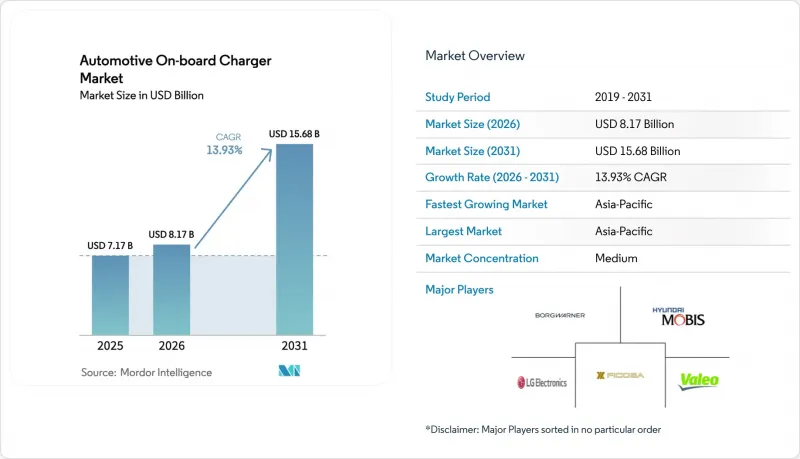
Mordor Intelligence에 의하면, 자동차 온보드 충전기 시장 규모는 2025년 71억 7,000만 달러에서 2026년에는 81억 7,000만 달러로 확대되어 2026-2031년까지 CAGR 13.93%로 성장을 지속하여, 2031년에는 156억 8,000만 달러에 이를 것으로 예측됩니다.
본 보고서는 차종별(승용차 및 상용차), 파워트레인 유형별(배터리식 전기차 및 플러그인 하이브리드 전기차), 정격 출력별(3.3kW 미만, 3.3-11kW, 11kW 초과),유통 채널별(OEM 탑재 및 애프터마켓), 지역별로 분류되어 있습니다. 시장 예측은 금액(달러)과 수량(대수)으로 제시되어 있습니다.
전 세계 자동차용 온보드 충전기 시장 동향 및 인사이트
전 세계 전기차 보급을 위한 적극적인 목표와 구매 인센티브
각국 정부는 보조금 예산을 앞당겨 투입하고 차량의 CO₂ 배출 규제를 강화하고 있으며, 자동차 제조업체들은 차량이 인센티브 제도의 대상이 될 수 있도록 11kW 이상의 충전기 표준화를 불가피하게 추진하고 있습니다. EU의 2035년 내연기관 차량 판매 금지 조치는 대중 브랜드로 하여금 양방향 충전을 지원하는 하드웨어를 탑재한 미래 지향적인 모델 개발을 촉진했습니다. 중국은 2025년까지 신에너지차(NEV) 보조금 제도를 유지하고 있으며, 3.3kW 설계는 고액 보조금 대상에서 제외되어 있습니다. 한편, 캘리포니아주의 ‘Advanced Clean Cars II’ 규제는 미국 내 다른 몇몇 주에 대해 사실상 전국적인 무공해차 판매 의무화로 이어지고 있습니다. 인도의 FAME-II 연장 조치에 따라, 국내산 양방향 충전 지원 충전기를 탑재한 차량에 막대한 투자가 이루어지고 있습니다. 이러한 정책들이 맞물리면서 제품 주기가 단축되고, 향후 그리드 서비스를 통한 수익원에 대응할 수 있는 고출력 및 다양한 프로토콜을 지원하는 충전기에 대한 수요가 높아지고 있습니다.
800V 차량 아키텍처로의 급속한 전환으로 11-22kW OBC 구현이 가능해졌습니다.
고전압 플랫폼 덕분에 AC 충전 시간은 배터리 용량과 무관해져, 90kWh 배터리 팩이라도 케이블이나 냉각 루프를 과도하게 설계하지 않고도 22kW의 가정용 충전이 가능해집니다. 포르쉐의 ‘타이칸’은 프리미엄급 AC 성능에 대한 소비자 수요를 입증했으며, 현대자동차의 2024년 E-GMP 도입으로 22kW 충전기가 중형 세단에도 보급되었습니다. GM의 ‘울티엄(Ultium)’이 2027년부터 800V로 전환됨에 따라 픽업 트럭 및 SUV 각 모델이 19.2kW의 AC 충전 성능을 공통화하게 됩니다. 한편, BYD의 ‘e-Platform 3.0’은 드라이브 인버터 내에 11kW 양방향 충전기를 통합하여 차체 하부 공간을 줄이는 동시에 부품 수를 감소시켰습니다. 유럽에서는 3상 400V 가정용 전원이 표준이므로 가장 큰 혜택을 보고 있습니다. 반면 북미에서는 단상 제한으로 인해 도입이 11kW에 그치고 있지만, 프리미엄 차종에서는 800V 실리콘 카바이드 설계를 통한 열 손실 저감이 여전히 중시되고 있습니다.
22kW 3상 OBC에서 와이드 밴드갭 기판의 비용이 여전히 높은 수준을 유지하고 있음
2026년 초, 6인치 SiC 웨이퍼는 실리콘 웨이퍼에 비해 상당히 비쌌으며, 그 결과 22kW 충전기 1대당 상당한 비용 부담이 발생하고 있었습니다. 200mm 생산 라인에 대한 예측에 따르면, 2028년까지 기판 비용이 하락할 것으로 예상되지만, 현재의 가격 차이로 인해 고출력 AC 하드웨어는 프리미엄 모델로만 제한되고 있습니다. 한편, 중국의 2차 공급업체들은 저주파 실리콘 솔루션을 검토했으나, 그 결과 집적도가 허용 기준치 미만에 그쳐 소형 플랫폼에는 적합하지 않은 것으로 판명되었습니다.
부문 분석
승용차는 판매 대수가 많기 때문에 2025년 출하 대수의 67.10%를 차지했으나, 플릿 조달 정책의 변화로 인해 그 기세가 변하고 있습니다. 전기 버스 및 라스트 마일용 밴에는 22kW 충전기가 탑재되어 있어, 이를 통해 배터리 팩 용량을 100kWh 줄임으로써 차량당 배터리 비용을 대폭 절감하고 있습니다. 상용차는 2031년까지 연평균 성장률(CAGR) 14.42%라는 가장 높은 성장률을 기록하며 확대될 전망입니다. 아마존(Amazon) 등의 물류 센터 운영 업체들은 패널 업그레이드 비용과 야간 가용성 간의 균형을 고려하여 11kW가 최적이라는 점을 검증해 왔으며, 이에 따라 밴 제조업체들은 듀얼 정격 제품을 제공하게 되었습니다. 이러한 상호작용으로 인해 자동차용 온보드 충전기 시장은 사용 주기별로 다양성을 유지하고 있습니다.
유럽의 카셰어링 사업자들은 운전자가 교대 근무 시 충전할 수 있도록 11kW를 지원하는 세단을 사양으로 지정하는 사례가 늘고 있습니다. 테슬라에 따르면, 2025년 유럽 내 ‘모델 3’ 판매 대수 중 상당 부분이 이러한 차량 대여용이었습니다고 합니다. 대형 상용차 부문에서는 프로테라(Proterra)의 19.2kW AC 솔루션을 통해 메가와트급 인프라 없이도 주간 충전이 가능해졌으며, 이러한 접근 방식은 현재 라틴아메리카의 BYD eBus 시리즈에서도 채택되고 있습니다. 이러한 사례들은 규제적 압력뿐만 아니라 운영 비용 모델링이 충전기 선택을 어떻게 변화시키고 있는지를 보여줍니다.
2025년 매출에서 배터리식 전기차가 차지하는 비중은 75.33%이며, 2031년까지 연평균 성장률(CAGR) 15.48%로 증가할 것으로 예상되어, 자동차용 온보드 충전기 시장에서 핵심적인 가치 원천으로서의 역할을 부각시키고 있습니다. 각 자동차 제조업체들은 11kW를 기준으로 수렴하고 있으며, 테슬라, 폭스바겐, GM은 향후 그리드 서비스에 대한 대가 획득을 목적으로 하는 양방향 기능을 활성화하는 소프트웨어 패키지를 탑재하고 있습니다. 플러그인 하이브리드 전기차의 경우, 20kWh 배터리를 야간에 충전하는 수요를 충족시키는 3.3-7.4kW 실리콘 설계를 중심으로 한 독자적인 공급망이 유지되고 있습니다. 또한, EU의 CO₂ 크레딧 제도 개정에 따라 플러그인 하이브리드 전기차의 배터리 용량은 30kWh로 확대되고 있으며, 이에 따라 충전기의 출력도 7.4kW로 상향 조정되고 있습니다. 그러나 많은 시장에서 11kW 하드웨어에 드는 추가 비용이 여전히 차량세 우대 조치를 상회하고 있기 때문에 자동차용 온보드 충전기 업계는 합리적인 가격과 규제 준수의 균형을 맞추기 위해 두 가지 제품 계층을 유지하고 있습니다.
이 부문을 형성하는 두 번째 요인은 잔존 가치의 유지입니다. 독일의 리스 회사에 따르면, 22kW 충전기를 탑재한 BEV는 4년 후 재판매 가격이 11kW 동급 차량보다 높기 때문에 총 소유 비용(TCO) 최적화를 목표로 하는 법인용 차량 함대의 도입이 가속화되고 있습니다. 대조적으로, 북미 교외 지역에 거주하는 구매자들은 11kW를 초과하는 사양에 대해 가격에 민감한 경향을 보입니다. 이는 단상 가정용 회로에서는 11kW를 초과하는 충전기가 거의 이점을 제공하지 않기 때문이며, 충전기 사양의 지역적 차이를 더욱 심화시키고 있습니다. 그 결과, 플러그인 하이브리드 전기차용 차량 온보드 충전기 시장 규모는 2031년까지 확대될 것으로 예측되지만, BEV 시장은 더욱 성장할 전망이며, 공급업체가 SiC 인증 비용을 두 부문에 걸쳐 상각할 수 있을 만큼 프로그램 물량은 충분히 높은 수준을 유지할 것으로 예측됩니다.
지역별 분석
아시아태평양은 2025년 매출의 39.05%를 차지하며, 2031년까지 연평균 성장률(CAGR) 15.02%로 성장할 전망입니다. 중국에서만 2025년에 1,660만 대의 신에너지차가 생산될 예정이며, 현지 SiC 공급망과 국내산 충전기의 사용률을 50% 이상으로 유지하도록 하는 ‘중국 제조 2025’ 규정이 활용되고 있습니다. 인도의 FAME-II 제도에서는 차량 1대당 보조금이 국산 OBC 조달과 연계되어 있어, Tata Motors와 Mahindra는 푸네에 위치한 Varroc 및 Sona BLW 공장에서 이중 조달을 해야 하는 상황에 놓여 있습니다. 일본과 한국은 주택 배선 업그레이드에 신중한 태도를 유지하고 있으며, 충전기 출력을 6kW로 제한하고 있어 보조금이 있음에도 불구하고 SiC의 보급은 더딘 양상을 보이고 있습니다. 한편, 동남아시아에서의 옥상 태양광 발전과의 세트 판매는 낮 동안 발전된 전력을 축전하여 저녁 시간대의 냉난방 부하에 활용하는 7.4kW 양방향 설계를 위한 길을 열어주고 있습니다.
2025년에는 독일, 프랑스, 북유럽 국가들의 3상 주택 전력망을 필두로 한 유럽이 전 세계 매출의 상당 부분을 차지했습니다. 2025년까지 ‘대체 연료 인프라 규정’에 따라 모든 공공 AC 콘센트에 ISO 15118-20 표준을 통합하는 것이 의무화됩니다. 이러한 움직임에 발맞추어 폭스바겐은 2027년형 모델부터 자사의 MEB 플랫폼을 11kW 양방향 하드웨어 규격에 부합하도록 하기로 결정했습니다. 북유럽 국가들에서는 전력 회사가 이미 수출된 kW시(kWh)에 대해 현물 가격으로 보상하고 있습니다. 그 결과, V2G(Vehicle-to-Grid) 실증 실험은 초기 시범 단계를 넘어 확대되고 있으며, 송전량을 조절할 수 있는 22kW 충전기를 갖춘 가구에 인센티브가 지급되고 있습니다. 영국도 2025년 스마트 충전 규정을 통해 이러한 움직임에 동참하고 있으며, 유사한 수요 반응(Demand Response) 접근 방식을 추진함으로써 펌웨어 기능이 풍부한 중출력 OBC(온보드 충전기)에 대한 공급업체들의 관심을 높이고 있습니다.
2025년에 큰 기여가 예상되는 북미에서는 ‘인플레이션 억제법(Inflation Reduction Act)’에 따른 세액 공제와 ‘전미 전기차 인프라(National Electric Vehicle Infrastructure)’의 투자가 자동차용 온보드 충전기 시장을 견인하고 있습니다. 연방 정부 지침에 따르면, 보조금으로 지원되는 하드웨어는 2026년 이후 양방향 충전 기능을 갖추어야 합니다. 포드(Ford)와 GM은 2027년까지 자사의 픽업트럭과 SUV에서 이 요건을 완전히 준수할 것을 이미 공약했습니다. 캘리포니아주에서는 V2G(Vehicle-to-Grid) 시범 사업을 통해 피크 시간대 전력 수요가 급증하는 상황에 대비해 소유주에게 비용을 환급해 주고 있습니다. 이로 인해 양방향 지원이 가능한 11kW 충전기가 경제적으로 매력적인 선택지가 되고 있습니다. 한편, 캐나다는 추운 기후로 인해 블록 히터 회로가 선호됩니다. 그 결과, 전력 회사는 11kW보다 7.4kW로의 업그레이드를 지원하는 방침을 취하고 있으며, 이것이 SiC의 보급률을 억제하는 요인이 되고 있습니다. 라틴아메리카와 중동은 현재 시장 점유율이 작지만, 눈에 띄는 성장을 보이고 있습니다. 이러한 급성장은 브라질의 ‘Rota 2030’에 따른 신규 공장 건설 발표와 아랍에미리트의 요금 면제 이니셔티브에 힘입고 있습니다. 두 프로그램 모두 세제 혜택을 받기 위해서는 7kW를 초과하는 충전기를 현지에서 조립해야 한다는 조건을 두고 있습니다.
기타 혜택
- 엑셀 형식 시장 예측(ME) 시트
- 3개월간의 애널리스트 지원
자주 묻는 질문
목차
제1장 서론
제2장 조사 방법
제3장 주요 요약
제4장 시장 구도
제5장 시장 규모와 성장 예측
제6장 경쟁 구도
제7장 시장 기회와 향후 전망
JHS 26.09.11According to Mordor Intelligence, the automotive on-board charger market size is expected to grow from USD 7.17 billion in 2025 to USD 8.17 billion in 2026 and is forecast to reach USD 15.68 billion by 2031 at 13.93% CAGR over 2026-2031.
This report is Segmented by Vehicle Type (Passenger Cars and Commercial Vehicles), Powertrain Type (Battery Electric Vehicles and Plug-In Hybrid Electric Vehicles), Power Rating (Less Than 3. 3 KW, 3. 3-11 KW, and More), Sales Channel (OEM-Installed and Aftermarket), and Geography. Market Forecasts are Provided in Terms of Value (USD) and Volume (Units).
Global Automotive On-board Charger Market Trends and Insights
Aggressive Global EV Adoption Targets and Purchase Incentives
Governments are front-loading subsidy budgets and tightening fleet CO2 rules, forcing automakers to standardize 11 kW or higher chargers so vehicles qualify for evolving incentive tiers. The EU's 2035 internal-combustion ban spurred volume brands to future-proof models with bidirectional-ready hardware . China kept its New Energy Vehicle rebates through 2025 and excludes 3.3 kW designs from higher rebate brackets, while California's Advanced Clean Cars II regulation is nudging several other United States states toward a de facto nationwide zero-emission sales mandate. India's FAME-II extension channels significant investment into vehicles that embed domestic, bidirectional-capable chargers. Together, these policies compress product-cycle timelines and shift demand toward power-dense, protocol-rich chargers that accommodate future grid-services revenue streams.
Rapid Switch to 800 V Vehicle Architectures Enabling 11-22 kW OBCs
High-voltage platforms decouple AC charge time from battery size, letting 90 kWh packs add 22 kW home charging without oversizing cables or cooling loops. Porsche's Taycan validated consumer appetite for premium AC performance, and Hyundai's 2024 E-GMP rollout pushed 22 kW chargers into mid-segment sedans. GM's Ultium migration to 800 V from 2027 aligns pickup and SUV families around 19.2 kW AC capability, while BYD's e-Platform 3.0 integrates an 11 kW bidirectional charger inside the drive inverter, trimming underbody space and lowering parts count. Europe reaps the most benefit because three-phase 400 V home service is standard; North America's single-phase limits keep adoption to 11 kW, yet premium fleets still value the reduced thermal losses of 800 V silicon-carbide designs.
Persistently High Wide-Band-Gap Substrate Costs in 22 kW Three-Phase OBCs
In early 2026, six-inch SiC wafers were significantly more expensive than their silicon counterparts, leading to a notable cost premium for each 22 kW charger. While projections for 200 mm lines suggest a reduction in substrate costs by 2028, the current price gap confines high-power AC hardware to premium models. Meanwhile, Chinese Tier-2 suppliers explored low-frequency silicon solutions, but these resulted in a density drop below acceptable thresholds, making them unsuitable for compact platforms.
Other drivers and restraints analyzed in the detailed report include:
- Declining SIC/GAN Device Prices Lifting OBC Power Density
- Mandatory ISO 15118 / Plug-&-Charge and V2G Readiness Clauses in EU and US Funding Schemes
- OEM Hesitancy to Up-Spec AC Chargers as DC Ultra-Fast (>=350 kW) Roll-Outs Accelerate
For complete list of drivers and restraints, kindly check the Table Of Contents.
Segment Analysis
Passenger cars held 67.10% of 2025 shipments due to higher unit volumes, yet fleet procurement policies are tilting the momentum. Electric buses and last-mile vans equip 22 kW chargers to trim pack sizes by 100 kWh, saving significantly in battery cost per vehicle. Commercial vehicles are set to expand with the fastest growth at a 14.42% CAGR through 2031. Depot operators such as Amazon have validated 11 kW as their optimum trade-off between panel upgrade expense and overnight availability, influencing van OEMs to offer dual ratings. This interplay keeps the automotive on-board charger market diversified across duty cycles.
Ride-hail operators in Europe increasingly specify 11 kW-capable sedans so drivers can top up during shift changes; Tesla reports that a notable share of its 2025 European Model 3 sales went to such fleets. In heavy commercial, Proterra's 19.2 kW AC solution allows midday top-ups without megawatt-scale infrastructure, an approach now mirrored by BYD's eBus line in Latin America. These cases show how operational cost modeling, not just regulatory pressure, is reshaping charger choices.
Battery-electric vehicles represented 75.33% of 2025 revenue and will rise at 15.48% CAGR through 2031, underscoring their role as the core value pool of the automotive on-board charger market. Carmakers are converging on 11 kW as the baseline, with Tesla, Volkswagen, and GM overlaying software packages that later activate bidirectional functions for grid-services compensation. Plug-in hybrids retain a separate supply chain around 3.3-7.4 kW silicon designs that meet overnight charging needs for 20 kWh batteries, and updated EU CO2 credits now push plug-in hybrid electric vehicle packs toward 30 kWh, nudging charger ratings up to 7.4 kW. Yet the incremental cost of 11 kW hardware still outweighs fleet-tax incentives in many markets, so the automotive on-board charger industry maintains dual product tiers to balance affordability and regulatory compliance.
A second dynamic shaping this segment is residual-value retention. Leasing companies in Germany report that BEVs equipped with 22 kW chargers command higher resale than 11 kW peers after four years, accelerating adoption among corporate fleets that optimize total cost of ownership. In contrast, North American suburban buyers show price sensitivity above 11 kW because single-phase home circuits seldom benefit, reinforcing regional divergence in charger specifications. As a result, the automotive on-board charger market size for plug-in hybrids is forecast to expand by 2031, whereas BEVs could grow further, keeping program volumes high enough for suppliers to amortize SiC qualification costs across both sectors.
Complete Report Scope:
- By Vehicle Type
- Passenger Cars
- Commercial Vehicles
- By Powertrain Type
- Battery Electric Vehicles (BEVs)
- Plug-in Hybrid Electric Vehicles (PHEVs)
- By Power Rating
- Less than 3.3 kW
- 3.3-11 kW
- More than 11 kW
- By Sales Channel
- OEM-installed
- Aftermarket
- By Geography
- North America
- United States
- Canada
- Rest of North America
- South America
- Brazil
- Argentina
- Rest of South America
- Europe
- Germany
- United Kingdom
- France
- Italy
- Russia
- Rest of Europe
- Asia-Pacific
- China
- Japan
- India
- South Korea
- Rest of Asia-Pacific
- Middle East and Africa
- Saudi Arabia
- United Arab Emirates
- Turkey
- South Africa
- Egypt
- Rest of Middle East and Africa
- North America
Geography Analysis
Asia-Pacific captured 39.05% of 2025 revenue and will expand at 15.02% CAGR through 2031. China alone produced 16.6 million New Energy Vehicles in 2025, leveraging local SiC supply chains and "Made in China 2025" rules that keep domestic charger content above 50%. India's FAME-II ties per-vehicle payouts to indigenous OBC procurement, pushing Tata Motors and Mahindra to dual-source from Varroc and Sona BLW plants in Pune. Japan and South Korea remain cautious on home-wiring upgrades, capping chargers at 6 kW, which slows SiC diffusion despite subsidies. Southeast Asian rooftop-solar bundling, however, is opening a path for 7.4 kW bidirectional designs that store daytime generation for evening air-conditioning loads.
In 2025, Europe, led by three-phase residential grids in Germany, France, and the Nordics, captured a significant portion of the global turnover. By 2025, the Alternative Fuels Infrastructure Regulation mandates the integration of ISO 15118-20 into every public AC plug. This push has prompted Volkswagen to align its MEB platform with the 11 kW bidirectional hardware standard for the 2027 model year. In the Nordics, utilities are already compensating exported kilowatt-hours at spot prices. As a result, vehicle-to-grid trials are expanding beyond initial pilots, rewarding households with 22 kW chargers that can modulate their feed-in. The United Kingdom is echoing this sentiment with its 2025 smart-charging rule, promoting a similar demand-response approach and piquing supplier interest in mid-power OBCs rich in firmware.
North America, contributing significantly in 2025, sees its automotive on-board charger market driven by the Inflation Reduction Act's credit and investments from the National Electric Vehicle Infrastructure. Federal guidelines stipulate that hardware funded by grants must have bidirectional capabilities after 2026. Ford and GM have already pledged full compliance for their pickups and SUVs by 2027. In California, vehicle-to-grid pilots are incentivizing owners with reimbursements during peak stress events. This makes the bidirectional 11 kW chargers a financially appealing choice. On the other hand, Canada's colder climate leans towards block-heater circuits. Consequently, utilities are opting to subsidize 7.4 kW upgrades over the 11 kW, which is moderating the penetration rates of SiC. Latin America and the Middle East, while currently representing a smaller share, are witnessing significant growth. This surge is fueled by announcements of new plants in Brazil's Rota 2030 and the UAE's fee-waiver initiative. Both programs stipulate that to avail fiscal benefits, chargers above 7 kW must be locally assembled.
- BorgWarner Inc.
- Hyundai Mobis Co., Ltd.
- LG Electronics
- STMicroelectronics NV
- Ficosa International S.A
- Valeo SE
- Delta Energy Systems AG
- Toyota Industries Corporation
- Brusa Elektronik AG
- VisIC Technologies Ltd.
- Infineon Technologies AG
- Eaton Corporation plc
- DENSO Corporation
- Panasonic Industry Co., Ltd.
- TDK Corporation
- ON Semiconductor Corporation
- Stercom Power Solutions GmbH
- Delta-Q Technologies
Additional Benefits:
- The market estimate (ME) sheet in Excel format
- 3 months of analyst support
TABLE OF CONTENTS
1 Introduction
- 1.1 Study Assumptions and Market Definition
- 1.2 Scope of the Study
2 Research Methodology
3 Executive Summary
4 Market Landscape
- 4.1 Market Overview
- 4.2 Market Drivers
- 4.2.1 Aggressive Global EV Adoption Targets and Purchase Incentives
- 4.2.2 Rapid Switch to 800 V Vehicle Architectures Enabling 11-22 kW OBCs
- 4.2.3 Declining SIC/GAN Device Prices Lifting OBC Power Density
- 4.2.4 Mandatory ISO 15118 / Plug-&-Charge and V2G Readiness Clauses in EU and US Funding Schemes
- 4.2.5 Tier-1/OEM Migration to Traction-Integrated and Bidirectional OBCs (3-in-1 E-Axle)
- 4.2.6 PV-Integrator Channel in Emerging Markets Bundling Rooftop Solar + OBC-Ready EV Packages
- 4.3 Market Restraints
- 4.3.1 Persistently High Wide-Band-Gap Substrate Costs in 22 kW Three-Phase OBCs
- 4.3.2 OEM Hesitancy to Up-Spec AC Chargers as DC Ultra-Fast (>=350 kW) Roll-Outs Accelerate
- 4.3.3 Grid-Connection Bottlenecks for Residential 11 kW Upgrades in Dense Cities
- 4.3.4 Impending Scrap-Recycling Regulation in China Taxing Large OBC Aluminum Housings
- 4.4 Value / Supply-Chain Analysis
- 4.5 Regulatory Landscape
- 4.6 Technological Outlook
- 4.7 Porter's Five Forces
- 4.7.1 Threat of New Entrants
- 4.7.2 Bargaining Power of Buyers/Consumers
- 4.7.3 Bargaining Power of Suppliers
- 4.7.4 Threat of Substitute Products
- 4.7.5 Intensity of Competitive Rivalry
5 Market Size and Growth Forecasts (Value (USD) and Volume (Units))
- 5.1 By Vehicle Type
- 5.1.1 Passenger Cars
- 5.1.2 Commercial Vehicles
- 5.2 By Powertrain Type
- 5.2.1 Battery Electric Vehicles (BEVs)
- 5.2.2 Plug-in Hybrid Electric Vehicles (PHEVs)
- 5.3 By Power Rating
- 5.3.1 Less than 3.3 kW
- 5.3.2 3.3-11 kW
- 5.3.3 More than 11 kW
- 5.4 By Sales Channel
- 5.4.1 OEM-installed
- 5.4.2 Aftermarket
- 5.5 By Geography
- 5.5.1 North America
- 5.5.1.1 United States
- 5.5.1.2 Canada
- 5.5.1.3 Rest of North America
- 5.5.2 South America
- 5.5.2.1 Brazil
- 5.5.2.2 Argentina
- 5.5.2.3 Rest of South America
- 5.5.3 Europe
- 5.5.3.1 Germany
- 5.5.3.2 United Kingdom
- 5.5.3.3 France
- 5.5.3.4 Italy
- 5.5.3.5 Russia
- 5.5.3.6 Rest of Europe
- 5.5.4 Asia-Pacific
- 5.5.4.1 China
- 5.5.4.2 Japan
- 5.5.4.3 India
- 5.5.4.4 South Korea
- 5.5.4.5 Rest of Asia-Pacific
- 5.5.5 Middle East and Africa
- 5.5.5.1 Saudi Arabia
- 5.5.5.2 United Arab Emirates
- 5.5.5.3 Turkey
- 5.5.5.4 South Africa
- 5.5.5.5 Egypt
- 5.5.5.6 Rest of Middle East and Africa
- 5.5.1 North America
6 Competitive Landscape
- 6.1 Market Concentration
- 6.2 Strategic Moves
- 6.3 Market Share Analysis
- 6.4 Company Profiles (Includes Global Level Overview, Market Level Overview, Core Segments, Financials as Available, Strategic Information, Market Rank/Share for Key Companies, Products and Services, SWOT Analysis, and Recent Developments)
- 6.4.1 BorgWarner Inc.
- 6.4.2 Hyundai Mobis Co., Ltd.
- 6.4.3 LG Electronics
- 6.4.4 STMicroelectronics NV
- 6.4.5 Ficosa International S.A
- 6.4.6 Valeo SE
- 6.4.7 Delta Energy Systems AG
- 6.4.8 Toyota Industries Corporation
- 6.4.9 Brusa Elektronik AG
- 6.4.10 VisIC Technologies Ltd.
- 6.4.11 Infineon Technologies AG
- 6.4.12 Eaton Corporation plc
- 6.4.13 DENSO Corporation
- 6.4.14 Panasonic Industry Co., Ltd.
- 6.4.15 TDK Corporation
- 6.4.16 ON Semiconductor Corporation
- 6.4.17 Stercom Power Solutions GmbH
- 6.4.18 Delta-Q Technologies
7 Market Opportunities and Future Outlook
- 7.1 White-space and unmet-need assessment


