|
시장보고서
상품코드
2124404
멀티 벤더 지원 서비스 시장 : 점유율 분석, 업계 동향과 통계, 성장 예측(2026-2031년)Multi Vendor Support Services - Market Share Analysis, Industry Trends & Statistics, Growth Forecasts (2026 - 2031) |
||||||
 Mordor Intelligence
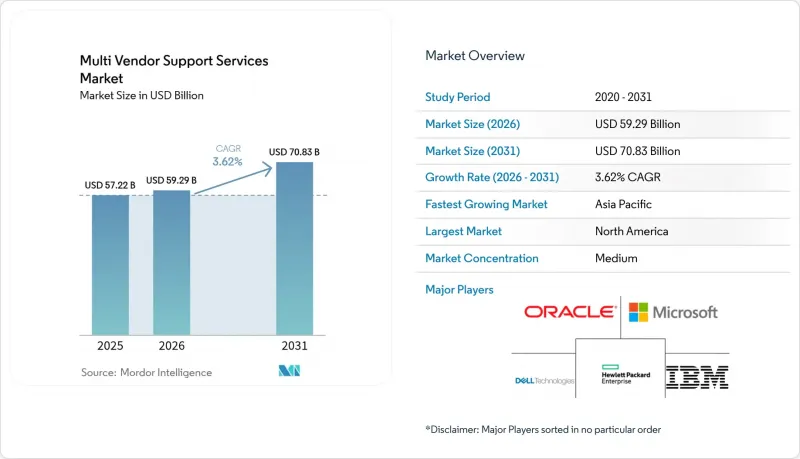
Mordor Intelligence에 의하면, 멀티 벤더 지원 서비스 시장 규모는 2025년 572억 2,000만 달러에서 2026년에는 592억 9,000만 달러로 확대되어 2026-2031년까지 CAGR 3.62%로 성장을 지속하여, 2031년에는 708억 3,000만 달러에 이를 것으로 예측됩니다.
본 보고서는 서비스 유형별(전문 서비스 및 관리형 서비스), 기업 규모별(대기업 및 중소기업(SME)), 지원 채널별(온사이트, 원격/가상, 하이브리드), 최종 사용자 산업별(IT 및 통신, 은행, 금융서비스 및 보험(BFSI), 헬스케어,에너지·발전, 제조업, 기타), 지역별로 분류되어 있습니다. 시장 예측은 금액(달러) 기준으로 제시되어 있습니다.
세계 멀티 벤더 지원 서비스 시장 동향 및 인사이트
OEM 서비스 유지보수 비용 상승
하드웨어 이익률이 하락하는 가운데, 각 OEM 업체들은 연간 유지보수 요금을 지속적으로 인상하고 있어, 동등한 SLA를 50-80% 더 낮은 비용으로 제공하는 경우가 많은 독립 지원 기업과의 비용 격차가 확대되고 있습니다. 조달 부서는 현재 표면적인 구매 가격이 아닌 총 소유 비용(TCO)을 벤치마크로 삼고 있으며, 미션 크리티컬 자산에 대해서는 OEM 지원을 유지하면서 레거시 자산을 제3자 제공업체로 이관하는 하이브리드 모델이 촉진되고 있습니다. 불확실한 경제 상황 속에서 CFO 주도의 면밀한 검토가 강화되고 있으며, 가동 시간을 보장하면서 지출을 억제하는 성과 기반 계약으로의 전환이 가속화되고 있습니다. 규제가 엄격한 조직조차도 공급업체가 산업별 규정을 준수함을 입증할 수 있다면 이러한 전환에 동참하고 있습니다. 이러한 재정적 영향으로 인해 비용 절감은 신규 입찰에서 주요 선정 기준이 되고 있습니다.
다중 벤더 IT 환경의 복잡화
현재 일반적인 기업에서는 ‘베스트 오브 브리드(Best-of-Breed)’ 전략과 클라우드의 급속한 도입의 결과로 5-7개 제조업체의 장비를 운영하고 있습니다. 이종 혼합 스택은 상호 운용성 문제를 가중시키고, 기존 OEM 중심의 지원 모델에서 발생하는 격차를 드러내고 있습니다. 따라서 기업들은 파트너에게 서버,스토리지, 네트워크, 클라우드 플랫폼에 걸쳐 있는 엔드투엔드 사고 해결을 기대하고 있습니다. 이러한 복잡성이 가져오는 부가가치로 인해, 다양한 기술에 대한 인증된 전문 지식을 보유하고, 여러 당사자 간의 에스컬레이션을 조정할 수 있는 통합된 커맨드 센터를 갖춘 서비스 통합업체가 우대받고 있습니다. 인시던트 대기열 및 SLA 준수 현황을 ‘단일 창(Single Pane of Glass)’으로 가시화하는 통합 대시보드에 대한 수요가 증가하고 있습니다.
제3자 접근에 따른 보안 및 개인정보 보호 우려
주목을 받은 공급망 침해 사건으로 인해 확대된 벤더 생태계에 대한 모니터링이 강화되고 있으며, EU의 ‘디지털 운영 복원력 법(Digital Operational Resilience Act)’과 같은 프레임워크에서는 은행에 견고한 제3자 위험 거버넌스 증명을 의무화하고 있습니다. 보안 팀은 특권적인 원격 도구가 공격의 매개체가 될 것을 우려하고 있으며, 실사 점검이 완료될 때까지 계약 주기가 지연되는 상황이 발생하고 있습니다. 주요 지원 기업들은 제로 트러스트 아키텍처, 엄격한 신원 조사, OEM이 제공하는 수준을 뛰어넘는 경우도 있는 사이버 보험을 통한 보호 조치를 취하며 대응하고 있습니다. 따라서 위험 완화 모범 사례가 성숙해짐에 따라 도입 속도는 둔화되고 있지만, 정체에 이르지는 않았습니다.
부문 분석
2025년, 멀티 벤더 지원 서비스 시장에서 매니지드 서비스의 점유율은 70.65%를 차지했으며, 기업들이 운영 리스크를 완화하고 예측 가능하며 성과 기반의 모델을 선호하는 경향이 뚜렷해졌습니다. 각 공급업체는 24시간 365일 모니터링, 부품 물류, 규정 준수 보고를 서로 다른 SLA를 통합한 다년 계약에 포함시키고 있습니다. AI를 활용한 도구를 통해 자동화가 촉진되고 단가가 하락함에 따라, 멀티 벤더 지원 서비스 시장 내 매니지드 서비스 시장 규모는 2026년부터 2031년까지 연평균 성장률(CAGR) 5.23%로 확대될 것으로 예측됩니다. 전문 서비스는 마이그레이션이나 복잡한 업그레이드 과정에서 여전히 필수적이지만, 프로젝트별 일회성 과금에 제약을 받기 때문에 성장 속도는 완만해질 것으로 전망됩니다.
선도적인 공급업체들은 장애를 예측하고 적시 부품 배송을 계획하는 머신러닝 엔진을 도입하여 차별화를 꾀하고, 자산 가동률을 높이고 있습니다. 예측 분석과 자동화된 런북을 결합하여 평균 수리 시간(MTTR)을 단축하고, 인센티브를 연계한 서비스 크레딧 모델을 실현하고 있습니다. 또한, 관리형 접근 방식은 중앙 집중화된 티켓 데이터를 통해 증거 수집이 간소화되므로 규제 감사 지원에도 도움이 됩니다. 이러한 특징들이 결합되어 고객 충성도를 강화하고 갱신율 향상을 뒷받침하며, 결과적으로 공급업체의 기업 가치를 높이고 있습니다.
2025년에는 대규모 조직이 매출 점유율의 69.10%를 차지했는데, 이는 광범위한 레거시 시스템과 복잡한 규정 준수 요건을 반영한 것입니다. 그러나 클라우드의 경제성이 경쟁 조건을 평준화함에 따라 중소기업(SME)이 가장 빠르게 성장하는 고객층이 되었으며, 2031년까지 연평균 성장률(CAGR) 4.86%로 성장을 지속하고, 있습니다. 사용량 기반 과금 방식에 더해 표준화된 지원 패키지를 통해 막대한 설비 투자가 필요 없어지며, 소규모 IT 팀도 엔터프라이즈급 서비스를 이용할 수 있게 됩니다. 제공업체는 원격 모니터링 및 템플릿화된 런북을 활용하여 고객의 직원 수에 관계없이 규모의 경제를 제공합니다.
중소기업 수요가 가장 높은 분야는 제조업, 의료, 전문 서비스와 같은 부문이며, 이러한 부문에서는 규제 및 가동 시간과 관련된 요건이 대기업과 동일합니다. 벤더는 보안, 백업, 하드웨어 유지보수를 하나의 청구서로 통합한 모듈식 서비스를 통해 이에 대응하고 있습니다. 이러한 간소화는 공급업체 통합 및 거버넌스 효율화를 원하는 중견 기업의 CFO들에게 공감을 불러일으키며, 도입 후에는 계약 기간의 장기화로 이어지고 있습니다.
지역별 분석
북미는 2025년에 전 세계 매출의 34.60%를 차지했습니다. 이는 클라우드의 조기 도입, 정교한 조달 팀, 전문 파트너를 우대하는 엄격한 데이터 보호 규정에 힘입은 결과입니다. 이 지역의 기업들은 하드웨어를 빈번하게 갱신하는 경향이 있어, 수명 주기 연장 서비스에 대한 안정적인 수요를 창출하고 있습니다. 또한 높은 인건비는 자동화 중심의 원격 지원이 주는 경제적 이점을 더욱 강화시키고 있어, 서비스 제공업체들은 미국과 캐나다에 AI 센터 오브 엑설런스를 설립하도록 장려받고 있습니다.
유럽은 수리 가능성을 촉진하는 에코디자인 규정과 감사 요건을 강화하는 GDPR(EU 개인정보보호규정) 등의 개인정보 보호 프레임워크에 힘입어 견고한 입지를 유지하고 있습니다. 다중 공급업체 계약에는 그린 IT 지표가 자주 포함되며, 자산 수명 연장을 통한 탄소 배출 감축 실적을 입증할 수 있는 공급업체에 보상을 제공하는 구조로 되어 있습니다. 독일 및 북유럽 국가들의 정부 기관은 지속가능성 KPI를 성과 대시보드에 통합한 장기적인 파트너십을 주도하고 있습니다.
아시아태평양은 성장의 원동력이며, 2031년까지 연평균 성장률(CAGR) 4.03%를 나타낼 것으로 예측됩니다. 인도, 중국, 인도네시아의 기업들은 기존 아키텍처를 뛰어넘어, 도입 초기부터 이기종 혼합 환경을 지원하는 클라우드 네이티브 워크로드를 채택하고 있습니다. 현지 서비스 통합업체들은 빠르게 규모를 확장하고 있는 반면, 세계 기업들은 증가하는 수요를 수용하기 위해 지역 서비스 허브와 이중 언어 헬프데스크를 개설하고 있습니다. 규제의 성숙도는 시장마다 다르지만, 공통점은 현지 OEM 보증 규정을 뛰어넘는 적극적인 디지털 전환 노력이며, 이로 인해 멀티 벤더 제안의 중요성이 높아지고 있습니다.
남미, 중동 및 아프리카에서는 절대적인 지출 규모는 작지만, 인력 부족과 지리적 분산을 극복하기 위한 ‘원격 우선(Remote First)’ 모델에 대한 관심이 높습니다. 환율 변동과 재정적 제약으로 인해 계약 규모는 제한되고 있지만, 데이터센터 밀도가 낮기 때문에 높은 가동 시간이 더욱 중요해지고 있어, 예측 유지보수 솔루션의 가치 제안이 강화되고 있습니다.
기타 혜택
- 엑셀 형식 시장 예측(ME) 시트
- 3개월간의 애널리스트 지원
자주 묻는 질문
목차
제1장 서론
제2장 조사 방법
제3장 주요 요약
제4장 시장 구도
제5장 시장 규모와 성장 예측
제6장 경쟁 구도
제7장 시장 기회와 향후 전망
JHSAccording to Mordor Intelligence, the multi vendor support services market size is expected to grow from USD 57.22 billion in 2025 to USD 59.29 billion in 2026 and is forecast to reach USD 70.83 billion by 2031 at 3.62% CAGR over 2026-2031.
This report is Segmented by Service Type (Professional and Managed), Enterprise Size (Large Enterprises and Small and Medium Enterprises (SMEs)), Support Channel (On-Site, Remote / Virtual, and Hybrid), End-User Vertical (IT and Telecommunication, BFSI, Healthcare, Energy and Power, Manufacturing, and More), and Geography. The Market Forecasts are Provided in Terms of Value (USD).
Global Multi Vendor Support Services Market Trends and Insights
Rising Maintenance Cost of OEM Services
OEMs continue to lift annual maintenance prices as hardware margins erode, widening the cost differential against independent support firms that frequently deliver equivalent SLAs at 50-80% lower expense. Procurement teams now benchmark total cost of ownership rather than headline purchase prices, spurring hybrid models that retain OEM cover for mission-critical assets while offloading legacy estates to third-party providers. CFO-led scrutiny has intensified under uncertain economic conditions, accelerating the switch to outcome-based contracts that guarantee uptime while capping spend. Even heavily regulated organizations are joining the shift, provided providers evidence compliance with sector-specific controls. The financial effect has made cost-savings a primary selection criterion in new tenders.
Growing Complexity of Multi-Vendor IT Estates
Typical enterprises now run equipment from five to seven manufacturers, a product of best-of-breed strategies and rapid cloud adoption. Heterogeneous stacks increase interoperability challenges and expose gaps in traditional OEM-centric support models. Companies therefore expect partners to own end-to-end incident resolution across servers, storage, networking, and cloud platforms. This complexity premium rewards service integrators with certified expertise on disparate technologies and centralized command centers capable of orchestrating multi-party escalations. Demand is rising for unified dashboards that provide single-pane-of-glass visibility into incident queues and SLA compliance.
Security and Privacy Concerns with Third-Party Access
High-profile supply-chain breaches have heightened scrutiny of extended vendor ecosystems, with frameworks such as the EU Digital Operational Resilience Act obliging banks to evidence robust third-party risk governance. Security teams fear that privileged remote tools could become attack vectors, delaying contracting cycles while due-diligence checks are completed. Leading support firms are responding with zero-trust architectures, rigorous background screening, and cyber-insurance protections that in several cases exceed OEM offerings. Adoption momentum is therefore tempered but not derailed, as risk-mitigation best practices mature.
Other drivers and restraints analyzed in the detailed report include:
- Cost-Optimization and Vendor Consolidation Push
- Shorter OEM Support-Window / Rapid Obsolescence
- OEM Resistance and Warranty-Void Threats
For complete list of drivers and restraints, kindly check the Table Of Contents.
Segment Analysis
Managed services accounted for 70.65% of the Multi Vendor Support Services market share in 2025, evidencing enterprise preference for predictable, outcome-based models that offload operational risk. Providers package 24X7 monitoring, parts logistics, and compliance reporting into multi-year contracts that harmonize disparate SLAs. The Multi Vendor Support Services market size for managed services is forecast to expand at a 5.23% CAGR from 2026 to 2031 as AI-powered tools elevate automation and lower unit costs. Professional services remain vital for migrations and complex upgrades but are expected to grow more slowly, constrained by one-time project billing.
Advanced providers differentiate by embedding machine-learning engines that anticipate failures and schedule just-in-time parts delivery, raising asset uptime. Predictive analytics combined with automated runbooks shrink mean-time-to-repair, enabling service-credit models that align incentives. The managed approach also supports regulatory audits, as centralized ticket data simplifies evidence gathering. Collectively, these attributes reinforce customer loyalty and underpin higher renewal rates that elevate provider valuations.
Large organizations retained 69.10% revenue share in 2025, reflecting extensive legacy estates and complex compliance demands. Yet SMEs are the fastest-growing constituency, logging a 4.86% CAGR through 2031 as cloud economics level the playing field. Consumption-based pricing plus standardized support bundles remove the need for hefty capital outlays, making enterprise-grade services accessible to smaller IT teams. Providers leverage remote monitoring and templated runbooks to deliver scale benefits irrespective of client headcount.
SME demand is strongest in manufacturing, healthcare, and professional-services niches where regulatory and uptime requirements mirror those of larger peers. Vendors respond with modular offerings that bundle security, backup, and hardware maintenance into a single invoice. This simplification resonates with mid-market CFOs eager to consolidate suppliers and streamline governance, translating into longer contract tenures once onboarded.
Complete Report Scope:
- By Service Type
- Professional
- Managed
- By Enterprise Size
- Large Enterprises
- Small and Medium Enterprises (SMEs)
- By Support Channel
- On-site
- Remote / Virtual
- Hybrid
- By End-user Vertical
- IT and Telecommunication
- BFSI
- Healthcare
- Energy and Power
- Manufacturing
- Retail
- Other End-user Verticals
- By Geography
- North America
- United States
- Canada
- Mexico
- Europe
- Germany
- United Kingdom
- France
- Italy
- Spain
- Rest of Europe
- Asia-Pacific
- China
- Japan
- India
- South Korea
- Australia
- Rest of Asia-Pacific
- South America
- Brazil
- Argentina
- Rest of South America
- Middle East and Africa
- Middle East
- Saudi Arabia
- United Arab Emirates
- Turkey
- Rest of Middle East
- Africa
- South Africa
- Egypt
- Nigeria
- Rest of Africa
- Middle East
- North America
Geography Analysis
North America commanded 34.60% of global revenue in 2025, underpinned by early cloud adoption, sophisticated procurement teams, and stringent data-protection rules that favor specialized partners. The region's enterprises tend to refresh hardware frequently, generating a steady pipeline for lifecycle-extension services. High labor costs also magnify the economic argument for automation-driven remote support, prompting providers to establish AI centers of excellence in the United States and Canada.
Europe maintains a solid position, buoyed by ecodesign regulations that encourage repairability and by privacy frameworks such as GDPR that elevate audit requirements. Multi-vendor contracts often incorporate green-IT metrics, rewarding providers that can document carbon savings from extended asset life. Government agencies in Germany and the Nordics are pioneering long-term partnerships that weave sustainability KPIs into performance dashboards.
Asia-Pacific is the growth engine, expected to post a 4.03% CAGR to 2031. Enterprises in India, China, and Indonesia are leapfrogging legacy architectures, adopting cloud-native workloads that require heterogeneous support from day one. Local service integrators are scaling rapidly, while global players open regional service hubs and bilingual helpdesks to tap rising demand. Regulatory maturity varies by market, but the common thread is an aggressive digital-transformation agenda that outstrips local OEM warranty provisions, reinforcing the multi-vendor proposition.
South America and the Middle East and Africa register smaller absolute spending yet demonstrate strong interest in remote-first models to overcome talent shortages and geographical dispersion. Currency volatility and fiscal constraints temper contract sizes, but low data-center density makes high uptime even more critical, enhancing the value narrative for predictive maintenance propositions.
- IBM Corporation
- Dell Technologies Inc
- Hewlett Packard Enterprise Co
- Oracle Corporation
- Cisco Systems Inc
- Microsoft Corporation
- Fujitsu Ltd
- Atos SE
- Evernex Group SAS
- Park Place Technologies
- Service Express LLC
- Hitachi Vantara LLC
- NetApp Inc
- Quantum Corporation
- Rimini Street Inc
- Clear Technologies Inc
- Technogroup IT-Service GmbH
- Blue Sky Group Ltd
- Softcat plc
Additional Benefits:
- The market estimate (ME) sheet in Excel format
- 3 months of analyst support
TABLE OF CONTENTS
1 INTRODUCTION
- 1.1 Study Assumptions and Market Definition
- 1.2 Scope of the Study
2 RESEARCH METHODOLOGY
3 EXECUTIVE SUMMARY
4 MARKET LANDSCAPE
- 4.1 Market Overview
- 4.2 Market Drivers
- 4.2.1 Rising maintenance cost of OEM services
- 4.2.2 Growing complexity of multi-vendor IT estates
- 4.2.3 Cost-optimisation and vendor consolidation push
- 4.2.4 Shorter OEM support-window / rapid obsolescence
- 4.2.5 Sustainability-linked life-extension mandates
- 4.2.6 AI-driven predictive maintenance capabilities
- 4.3 Market Restraints
- 4.3.1 Security and privacy concerns with third-party access
- 4.3.2 OEM resistance and warranty-void threats
- 4.3.3 Global shortage of legacy-hardware skill sets
- 4.3.4 Compliance / data-sovereignty complexities
- 4.4 Value Chain Analysis
- 4.5 Regulatory Landscape
- 4.6 Technological Outlook
- 4.7 Porter's Five Forces Analysis
- 4.7.1 Bargaining Power of Suppliers
- 4.7.2 Bargaining Power of Consumers
- 4.7.3 Threat of New Entrants
- 4.7.4 Threat of Substitutes
- 4.7.5 Intensity of Competitive Rivalry
- 4.8 Assessment of the Impact of Macroeconomic Trends on the Market
5 MARKET SIZE AND GROWTH FORECASTS (VALUE)
- 5.1 By Service Type
- 5.1.1 Professional
- 5.1.2 Managed
- 5.2 By Enterprise Size
- 5.2.1 Large Enterprises
- 5.2.2 Small and Medium Enterprises (SMEs)
- 5.3 By Support Channel
- 5.3.1 On-site
- 5.3.2 Remote / Virtual
- 5.3.3 Hybrid
- 5.4 By End-user Vertical
- 5.4.1 IT and Telecommunication
- 5.4.2 BFSI
- 5.4.3 Healthcare
- 5.4.4 Energy and Power
- 5.4.5 Manufacturing
- 5.4.6 Retail
- 5.4.7 Other End-user Verticals
- 5.5 By Geography
- 5.5.1 North America
- 5.5.1.1 United States
- 5.5.1.2 Canada
- 5.5.1.3 Mexico
- 5.5.2 Europe
- 5.5.2.1 Germany
- 5.5.2.2 United Kingdom
- 5.5.2.3 France
- 5.5.2.4 Italy
- 5.5.2.5 Spain
- 5.5.2.6 Rest of Europe
- 5.5.3 Asia-Pacific
- 5.5.3.1 China
- 5.5.3.2 Japan
- 5.5.3.3 India
- 5.5.3.4 South Korea
- 5.5.3.5 Australia
- 5.5.3.6 Rest of Asia-Pacific
- 5.5.4 South America
- 5.5.4.1 Brazil
- 5.5.4.2 Argentina
- 5.5.4.3 Rest of South America
- 5.5.5 Middle East and Africa
- 5.5.5.1 Middle East
- 5.5.5.1.1 Saudi Arabia
- 5.5.5.1.2 United Arab Emirates
- 5.5.5.1.3 Turkey
- 5.5.5.1.4 Rest of Middle East
- 5.5.5.2 Africa
- 5.5.5.2.1 South Africa
- 5.5.5.2.2 Egypt
- 5.5.5.2.3 Nigeria
- 5.5.5.2.4 Rest of Africa
- 5.5.5.1 Middle East
- 5.5.1 North America
6 COMPETITIVE LANDSCAPE
- 6.1 Market Concentration
- 6.2 Strategic Moves
- 6.3 Market Share Analysis
- 6.4 Company Profiles (includes Global level Overview, Market level overview, Core Segments, Financials as available, Strategic Information, Market Rank/Share for key companies, Products and Services, and Recent Developments)
- 6.4.1 IBM Corporation
- 6.4.2 Dell Technologies Inc
- 6.4.3 Hewlett Packard Enterprise Co
- 6.4.4 Oracle Corporation
- 6.4.5 Cisco Systems Inc
- 6.4.6 Microsoft Corporation
- 6.4.7 Fujitsu Ltd
- 6.4.8 Atos SE
- 6.4.9 Evernex Group SAS
- 6.4.10 Park Place Technologies
- 6.4.11 Service Express LLC
- 6.4.12 Hitachi Vantara LLC
- 6.4.13 NetApp Inc
- 6.4.14 Quantum Corporation
- 6.4.15 Rimini Street Inc
- 6.4.16 Clear Technologies Inc
- 6.4.17 Technogroup IT-Service GmbH
- 6.4.18 Blue Sky Group Ltd
- 6.4.19 Softcat plc
7 MARKET OPPORTUNITIES AND FUTURE OUTLOOK
- 7.1 White-space and Unmet-need Assessment