
|
시장보고서
상품코드
2124424
유럽의 지붕 타일 시장 : 시장 점유율 분석, 업계 동향 및 통계, 성장 예측(2026-2031년)European Roof Tiles - Market Share Analysis, Industry Trends & Statistics, Growth Forecasts (2026 - 2031) |
||||||
 Mordor Intelligence
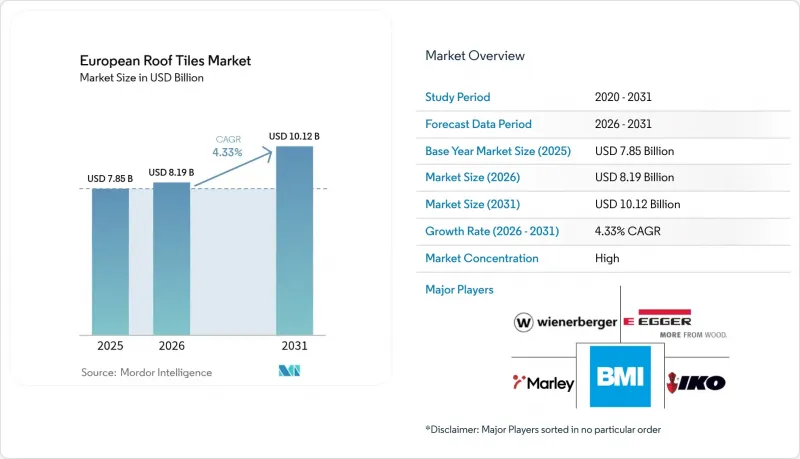
Mordor Intelligence에 의하면, 2026년 유럽 지붕 타일 시장 규모는 81억 9,000만 달러로 추정되며, 2025년 78억 5,000만 달러에서 2031년에는 101억 2,000만 달러에 달할 것으로 예측됩니다.
또한 2026-2031년 연평균 성장률(CAGR) 4.33%를 기록할 전망입니다.
본 보고서는 제품 유형별(점토 기와, 콘크리트 기와, 태양광 지붕 타일), 최종 사용자 산업별(주택, 상업 시설, 인프라, 산업·공공시설), 건설 유형별(신축, 지붕 교체·개보수), 지역별(독일, 영국, 프랑스, 이탈리아,스페인, 러시아, 북유럽 국가, 튀르키예, 기타 유럽)로 분류되어 있습니다. 시장 예측은 금액(달러) 기준으로 제시되어 있습니다.
유럽의 지붕 타일 시장 동향 및 인사이트
EU의 그린빌딩 규제가 기와 채택을 가속화
개정된 ‘건축물의 에너지 성능에 관한 지침’에 따라, 연간 290 kWh/m²를 초과하는 에너지를 소비하는 건축물에 대해서는 2030년까지 에너지 효율 개선 공사를 실시해야 할 의무가 부과되었습니다. 그 결과, 조달 사양서에서는 높은 단열 성능을 갖추고 태양광 발전 기능을 통합한 지붕 시스템이 중시되게 되었습니다. 지방 자치단체가 ‘리노베이션 웨이브’ 전략에 따라 대응을 추진하는 가운데, 새로운 U값 기준을 충족하는 콘크리트 기와와 점토 기와가 공공 입찰에서 표준적인 선택지로 자리 잡고 있습니다. 선도적인 제조업체들은 BIPV(건축 통합형 태양광 발전)와의 호환성이 사전 인증된 타일을 시장에 출시하여, 단계적으로 설정되는 준수 기한에 앞서 유리한 입지를 구축하고 있습니다. 후발 제조업체들은 해당 지침이 국내법으로 완전히 이행되면 프로젝트의 최종 후보 목록에서 제외될 위험에 직면하게 될 것입니다.
노후화된 유럽 주택 재고의 ‘리노베이션 붐’
유럽 주택의 4분의 3은 1990년 이전에 건설된 것으로, 현재의 에너지 효율 기준을 충족하지 못하고 있습니다. 브뤼셀은 2030년까지 3,500만 건의 리노베이션을 목표로 하고 있으며, 지붕은 열 손실을 즉시 줄일 수 있기 때문에 개보수 우선순위 목록의 최상위에 위치해 있습니다. 예산에 민감한 소유주들에게는 콘크리트 기와가 여전히 표준적인 선택지로 남아 있습니다. 이는 익숙한 시공 방식 덕분에 공사 시간과 공사로 인한 생활에 미치는 지장을 최소화할 수 있기 때문입니다. 각 제조업체는 예측 가능한 교체 주기를 활용하여, 생산 능력 확대를 지역별 리모델링 자금 지원 프로그램과 연계하고 있습니다. 유통업체은 적시 재고 서비스를 확충하여, 시공업체가 보조금과 연계된 엄격한 프로젝트 일정을 확실히 지킬 수 있도록 지원하고 있습니다.
아스팔트 및 금속판 지붕과의 가격 차이
점토나 콘크리트 지붕재는 아스팔트 대체품에 비해 여전히 40-60% 비싸며, 이는 가격에 민감한 동유럽 시장에서의 보급을 제한하고 있습니다. 2024-2025년 발생한 가스와 시멘트 가격의 급등으로 인해 이 가격 차이는 더욱 확대되었으며, 제조업체들은 비용을 흡수할 것인지, 아니면 판매량 감소 위험을 감수하고 가격을 인상할 것인지의 선택에 직면했습니다. 그러나 인건비가 자재비를 초과하는 지역에서는 소유주들이 기와재의 긴 수명을 점점 더 중요하게 여기게 되면서, 비용 대비 효과에 대한 논의가 초기 비용에서 수명 주기 비용으로 전환되고 있습니다.
부문 분석
태양광 발전용 기와 시장은 옥상 태양광 발전 의무화 확대에 힘입어 연평균 성장률(CAGR) 6.85%를 기록하며 모든 다른 유형을 앞질렀습니다. 콘크리트 지붕 타일(콘크리트 타일)는 2025년 유럽 시장에서 47.62%의 점유율을 유지했으며, 이는 비용 측면에서의 우위와 개보수 공사가 많은 지역에 대한 광범위한 물류망이 반영된 결과입니다. 점토 기와는 전통적인 미관과 100년의 내구성을 내세워 역사적 건축물 복원 시장을 휩쓸고 있습니다. 각 제조업체는 인접 분야에서의 매출 확대를 도모하기 위해 기존 제품 라인과 BIPV(건축일체형 태양광 발전) 제품을 융합하고 있으며, 곡면형 태양광 기와는 과거 미관에 대한 우려를 불식시키고 있습니다.
유럽의 지붕 타일 시장은 점점 더 3단계의 가치 계층을 형성하고 있습니다. 즉, 고가이지만 판매량이 제한적인 태양광 기와, 주류 주력 제품인 콘크리트 기와, 그리고 디자인을 중시하거나 보존·복원 용도로 사용되는 점토 기와입니다. 공장 현대화에서는 기업의 넷제로 달성을 위한 로드맵에 따라, 가스 사용량을 줄이기 위한 디지털 가마 제어에 중점을 두고 있습니다. 국경을 초월한 인수가 가속화되면서, 범용 콘크리트 생산 능력과 특허로 보호된 태양광 제품 포트폴리오 간의 균형을 맞추는 플랫폼이 구축됨에 따라 유럽 지붕 타일 업계의 재편이 더욱 진행되고 있습니다.
기타 혜택 :
- 엑셀 형식 시장 예측(ME) 시트
- 3개월간의 애널리스트 지원
자주 묻는 질문
목차
제1장 서론
제2장 조사 방법
제3장 주요 요약
제4장 시장 구도
제5장 시장 규모 및 성장 예측
제6장 경쟁 구도
제7장 시장 기회 및 향후 전망
AJY 26.09.09According to Mordor Intelligence, european roof tiles market size in 2026 is estimated at USD 8.19 billion, growing from 2025 value of USD 7.85 billion with 2031 projections showing USD 10.12 billion, growing at 4.33% CAGR over 2026-2031.
This report is Segmented by Product Type (Clay Tiles, Concrete Tiles, Solar Roof Tiles), End-User Industry (Residential, Commercial, Infrastructure, Industrial and Institutional), Construction Type (New Construction, Re-roofing/Renovation), and Geography (Germany, United Kingdom, France, Italy, Spain, Russia, Nordics, Turkey, Rest of Europe). The Market Forecasts are Provided in Terms of Value (USD).
European Roof Tiles Market Trends and Insights
EU Green-Building Mandates Accelerate Tile Adoption
The recast Energy Performance of Buildings Directive compels buildings consuming more than 290 kWh/m2 annually to undergo energy renovations by 2030. Consequently, procurement specifications now emphasize roof systems that offer high insulation values and integrate solar generation capacity. Concrete and clay tiles that meet emerging U-value thresholds are becoming default choices in public tenders as local governments align with the Renovation Wave strategy. Early-mover manufacturers roll out tiles pre-certified for BIPV compatibility, positioning themselves ahead of phased compliance deadlines. Late adopters risk exclusion from project shortlists once national transpositions of the directive are fully in force.
Renovation Wave Across Aging European Housing Stock
Three out of every four European dwellings were built before 1990 and fall short of present-day efficiency norms. Brussels targets 35 million renovations by 2030, and roofs top retrofit priority lists because they deliver immediate heat-loss reductions. Concrete tiles remain the default choice for budget-sensitive owners because familiar installation practices limit labor hours and project disruption. Manufacturers leverage predictable replacement cycles to synchronize capacity additions with regional renovation funding programs. Distributors expand just-in-time inventory services, ensuring installers can meet tight subsidy-linked project timelines.
Premium Pricing Versus Asphalt and Sheet-Metal Roofs
Clay and concrete solutions remain 40-60% pricier than asphalt alternatives, limiting penetration in price-sensitive Eastern European markets. Inflationary spikes in gas and cement during 2024-2025 widened this gap, forcing manufacturers to choose between absorbing costs or raising prices at the risk of volume losses. Nevertheless, where labor costs exceed material costs, owners increasingly value tiles' extended lifespans, shifting the affordability discussion from upfront expense to lifecycle economics.
Other drivers and restraints analyzed in the detailed report include:
- Durability and Life-Cycle Sustainability Advantages of Clay/Concrete Tiles
- Integrated Solar Roof Tiles Boosted by Rooftop-PV Rules
- Skilled-Labor Shortages in Specialist Tile Installation
For complete list of drivers and restraints, kindly check the Table Of Contents.
Segment Analysis
Solar tiles expanded at a 6.85% CAGR, outpacing all other formats as rooftop-PV obligations proliferated. Concrete maintained a 47.62% share of the European roof tile market in 2025, reflecting its cost advantages and logistical reach into renovation-heavy zones. Clay tiles have captured the heritage restoration market due to their authentic aesthetics and 100-year durability claims. Manufacturers merge traditional lines with BIPV variants to capture adjacency sales, while curved solar formats erase earlier aesthetic objections.
The European roof tiles market increasingly maps to a three-tier value hierarchy: solar tiles at premium price points but limited volume, concrete as a mainstream workhorse, and clay for design-driven or conservation contexts. Plant modernization focuses on digital kiln control to cut gas usage, aligning with corporate net-zero roadmaps. Cross-border acquisitions accelerate, creating platforms that balance commodity concrete capacity with patent-protected solar portfolios, further consolidating the European roof tiles industry.
Complete Report Scope:
- By Product Type
- Clay Tiles
- Concrete Tiles
- Solar Roof Tiles (BIPV)
- By End-user Industry
- Residential
- Commercial
- Infrastructure
- Industrial and Institutional
- By Construction Type
- New Construction
- Re-roofing / Renovation
- By Geography
- Germany
- United Kingdom
- France
- Italy
- Spain
- Russia
- Nordics
- Turkey
- Rest of Europe
List of Companies Covered in this Report:
- BMI Group
- Crown Roof Tiles
- Edilians
- EGGER
- Eurocell Plc
- IKO Industries Ltd
- INDUSTRIE COTTO POSSAGNO SpA
- Marley
- Sika AG
- Solarstone OU
- Tegola Canadese S.r.l.
- Vortex Hydra SRL
- Wienerberger AG
Additional Benefits:
- The market estimate (ME) sheet in Excel format
- 3 months of analyst support
TABLE OF CONTENTS
1 Introduction
- 1.1 Study Assumptions and Market Definition
- 1.2 Scope of the Study
2 Research Methodology
3 Executive Summary
4 Market Landscape
- 4.1 Market Overview
- 4.2 Market Drivers
- 4.2.1 EU green-building mandates accelerate tile adoption
- 4.2.2 Renovation wave across aging European housing stock
- 4.2.3 Durability and life-cycle sustainability advantages of clay/concrete tiles
- 4.2.4 Climate-driven re-roofing after extreme weather events
- 4.2.5 Integrated solar roof-tiles boosted by mandatory rooftop-PV rules
- 4.3 Market Restraints
- 4.3.1 Premium pricing versus asphalt and sheet-metal roofs
- 4.3.2 Skilled-labour shortages in specialist tile installation
- 4.3.3 Volatile energy and raw-material costs (clay, cement, gas)
- 4.4 Value Chain Analysis
- 4.5 Porter's Five Forces
- 4.5.1 Bargaining Power of Suppliers
- 4.5.2 Bargaining Power of Buyers
- 4.5.3 Threat of New Entrants
- 4.5.4 Threat of Substitute Products and Services
- 4.5.5 Degree of Competition
5 Market Size and Growth Forecasts (Value)
- 5.1 By Product Type
- 5.1.1 Clay Tiles
- 5.1.2 Concrete Tiles
- 5.1.3 Solar Roof Tiles (BIPV)
- 5.2 By End-user Industry
- 5.2.1 Residential
- 5.2.2 Commercial
- 5.2.3 Infrastructure
- 5.2.4 Industrial and Institutional
- 5.3 By Construction Type
- 5.3.1 New Construction
- 5.3.2 Re-roofing / Renovation
- 5.4 By Geography
- 5.4.1 Germany
- 5.4.2 United Kingdom
- 5.4.3 France
- 5.4.4 Italy
- 5.4.5 Spain
- 5.4.6 Russia
- 5.4.7 Nordics
- 5.4.8 Turkey
- 5.4.9 Rest of Europe
6 Competitive Landscape
- 6.1 Market Concentration
- 6.2 Strategic Moves
- 6.3 Market Share**/Ranking Analysis
- 6.4 Company Profiles (includes Global level Overview, Market level overview, Core Segments, Financials as available, Strategic Information, Market Rank/Share, Products and Services, Recent Developments)
- 6.4.1 BMI Group
- 6.4.2 Crown Roof Tiles
- 6.4.3 Edilians
- 6.4.4 EGGER
- 6.4.5 Eurocell Plc
- 6.4.6 IKO Industries Ltd
- 6.4.7 INDUSTRIE COTTO POSSAGNO SpA
- 6.4.8 Marley
- 6.4.9 Sika AG
- 6.4.10 Solarstone OU
- 6.4.11 Tegola Canadese S.r.l.
- 6.4.12 Vortex Hydra SRL
- 6.4.13 Wienerberger AG
7 Market Opportunities and Future Outlook
- 7.1 White-space and Unmet-need Assessment