

|
시장보고서
상품코드
2124445
휴대용 후방 산란 X선 장치 시장 : 점유율 분석, 업계 동향과 통계, 성장 예측(2026-2031년)Handheld Backscatter X-Ray Devices - Market Share Analysis, Industry Trends & Statistics, Growth Forecasts (2026 - 2031) |
||||||
 Mordor Intelligence
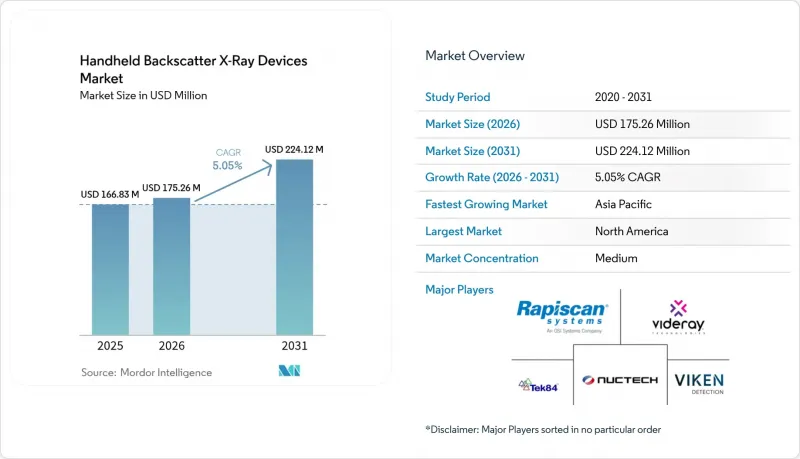
Mordor Intelligence에 의하면, 2026년 휴대용 후방 산란 X선 장치 시장 규모는 1억 7,526만 달러로 추정되고 있어 2025년 1억 6,683만 달러에서 확대해, 2031년에는 2억 2,412만 달러에 이를 것으로 예측됩니다.
2026년부터 2031년까지의 연평균 성장률(CAGR)은 5.05%를 나타낼 전망입니다.
본 보고서는 발생기의 에너지 수준(90 KeV 이하 시스템, 90-120 KeV 시스템, 120 KeV 이상 시스템), 판매 채널(정부의 직접 조달, 유통업체·시스템 통합사업자),용도(차량·화물 검사, 소포·수하물 스크리닝 등), 최종 사용자(세관·국경 경비, 법 집행 기관, 중요 인프라 등), 지역별로 분류되어 있습니다.
전 세계 휴대용 후방 산란 X선 장치 시장 동향 및 인사이트
증가하는 국경을 넘는 밀수 위협
세관 직원들은 차량의 두꺼운 패널이나 화물 컨테이너에 숨겨진 마약 밀수품을 사상 최대 규모로 적발하고 있으며, 이에 따라 휴대용 후방 산란 X선 장치 시장에서 투과 능력에 대한 관심이 높아지고 있습니다. 현장 팀은 화물을 분해하지 않고도 마약이나 무기의 작은 패키지를 감지할 수 있는 휴대용 스캐너를 필요로 하고 있습니다. 경량화된 장치를 통해 2차 검사 구역에서 신속한 검사가 가능해져, 교통 흐름을 방해하지 않으면서도 압수율을 높일 수 있습니다. 캐나다 국경 검사 연구소에서는 휴대용 스캐너가 수하물이나 소포 내의 미량의 폭발물을 어떻게 식별하는지 보여주고 있습니다. 밀수업자와 법 집행 기관 사이에서 계속되는 ‘고양이와 쥐’ 같은 줄다리기로 인해, 점점 더 소형화되는 은닉물을 감지할 수 있는 성능 향상에 대한 수요가 지속되고 있습니다.
세관에서의 비파괴 검사 기술의 급속한 도입
신흥 경제국에서는 X선 이미지를 AI 엔진 및 전자 매니페스트 데이터와 연동하는 통합 검사 레인의 도입이 가속화되고 있으며, 이를 통해 화물의 통관 시간을 단축하고 불법 거래를 억제하고 있습니다. 아시아태평양의 세관 현대화 프로그램에서는 완전한 디지털화를 통해 무역 비용을 11% 절감할 수 있을 것으로 전망되며, 스마트 휴대용 센서에 대한 예산 배정이 촉진되고 있습니다. 각국 정부는 위험 평가 소프트웨어 및 휴대용 생체 인식 도구와 원활하게 연동되는 장비를 선호하고 있어, 오픈 API를 제공하는 공급업체에게 조달상의 우위가 생기고 있습니다. 동남아시아의 시범 프로젝트에서는 드라이브스루 스캐너로 감지된 컨테이너의 이상 징후를 휴대용 후방 산란 X선 장치가 어떻게 검증하여, 부두를 증설하지 않고도 보안상의 취약점을 해소하고 있는지가 보여지고 있습니다. 상업 물류 허브에서는 유사한 워크플로를 채택하여 공급망의 신뢰성을 높이고, 해운 회사의 유치를 도모하고 있습니다.
높은 도입 비용과 수명 주기 비용
대당 4만 달러에서 10만 달러에 달하는 가격대는 저소득 지역의 지방 경찰 및 세관의 예산을 압박하고 있습니다. 연간 유지보수 계약, 소모품, 재인증 감사로 인해 총 소유 비용은 더욱 높아집니다. 리퍼브 제품은 30% 저렴할 수 있지만, 공급량이 제한적이고 보증 기간도 짧아 도입에 대한 신뢰도가 떨어지고 있습니다. 리스 모델도 등장하고 있지만, 많은 관할 구역에서는 여전히 정부 조달 규정에 따라 일괄 구매가 권장되고 있습니다. 다자간 자금 조달 메커니즘이 없기 때문에 소규모 기관들은 업그레이드를 미루고 있으며, 이로 인해 휴대용 후방 산란 X선 장치 시장 침투가 지연되고 있습니다.
부문 분석
90-120 keV 범주는 깊은 영상 촬영 능력과 관리 가능한 방사선 영향 범위의 균형이 잘 잡혀 있어, 2025년 매출의 52.62%를 차지하며 휴대용 후방 산란 X선 장치 시장에서 가장 큰 점유율을 확보하고 있습니다. 지속적인 개선을 통해 이 ‘최적 범위’는 세관 및 항공 보안 검사 레인에 있어 여전히 매력적인 선택지로 남아 있습니다. 120 keV 이상의 장치에 대한 수요는 트럭 및 운송 컨테이너의 두꺼운 강판 패널을 투과하기 위해 더 높은 투과력이 필요하기 때문에 연평균 성장률(CAGR) 7.05%로 빠르게 증가하고 있습니다. 냉각 기술의 발전으로 기존의 휴대성 제약이 해소됨에 따라, 고에너지 시스템용 휴대용 후방 산란 X선 장치 시장 규모는 확대될 것으로 예측됩니다. 각 벤더들은 운영자가 개인 소지품을 스캔할 때 에너지를 낮출 수 있도록 스마트 선량 관리 소프트웨어를 추가하고 있어, 화물 검사 이외의 용도로의 활용이 확대되고 있습니다.
각 제조업체는 무게 5kg 미만의 장치에 140 keV의 X선관을 탑재하고 있으며, 이를 통해 현장 지휘관은 로봇의 지원 없이도 즉석 폭발 장치(IED) 검사를 수행할 수 있게 되었습니다. 다중 에너지 펄스 모드를 통해 분석 담당자는 유기물과 금속 위협 요소를 구별할 수 있게 되었으며, 이 기능은 마약 단속 부대에게 매우 유용합니다. 밀리파 방식의 경쟁사들이 안전성을 강조하는 가운데, 고에너지 후방 산란 장치 제조업체들은 1회 스캔당 방사선 누출을 0.5µSv 미만으로 억제하는 ISO 인증을 받은 차폐 기능을 전면에 내세우고 있습니다. 인산철 리튬 배터리 부품 가격의 하락도 총 소유 비용(TCO)의 경제성을 향상시켜 이 부문의 중기적인 성장 전망을 뒷받침하고 있습니다.
2025년 출하 대수의 67.35%를 정부 입찰이 차지하고 있으며, 이는 휴대용 후방 산란 X선 장치 시장이 국가 안보에서 비롯되었음을 반영합니다. 각 부처는 교육, 예비 부품, 규정 준수 서비스를 패키지로 제공할 수 있는 장기적인 공급업체를 선호합니다. 다년간의 프레임워크 계약은 예산 주기를 원활하게 하고 높은 전환 비용을 초래합니다. 그럼에도 불구하고, 시스템 통합사업자 및 유통업체 채널은 연평균 성장률(CAGR) 7.6%로 빠르게 확대되고 있으며, 유연한 서비스 플랜을 선호하는 택배 수거·배송 센터, 광산, 행사장 등에 서비스를 제공합니다.
시스템 통합사업자는 휴대용 후방 산란 X선 장치를 CCTV, 주변 센서, 분석 대시보드와 결합하여 턴키 방식의 상황 인식 플랫폼을 제공합니다. 모바일 보안 기업들은 스포츠 대회에서 일시적으로 사용할 수 있도록 스캐너를 임대하고 있어, 임대 수요가 증가하고 있습니다. 전자상거래의 성장에 따라 소포 집배 센터 운영 사업자들은 표본 검사를 위한 휴대용 체크포인트 도입을 추진하고 있습니다. 이 틈새 시장에는 24시간 체제의 지원을 제공할 수 있는 현지 유통업체가 가장 적합합니다. 따라서 비정부 채널에서의 휴대용 후방 산란 X선 장치 시장 규모는 기반은 작지만 점차 확대되고 있습니다.
지역별 분석
북미는 5-7년마다 구형 장비를 교체하는 재력 있는 미국 국토안보부(DHS) 및 미국 세관·국경수비국(CBP)의 프로그램 덕분에 2025년 매출의 39.25%를 차지했습니다. 강력한 공급업체 생태계와 합리화된 조달 체계가 신속한 교체 주기를 뒷받침하고 있습니다. 북미는 휴대용 후방 산란 X선 장치 시장에서 여전히 가장 큰 점유율을 차지하고 있으며, 지속적인 연방 정부 보조금 덕분에 검문소 운영자는 성능이 검출 기준에 미치지 못하기 전에 노후된 스캐너를 교체할 수 있습니다. 주 차원의 퓨전 센터 역시 국토안보부의 예산을 활용하여, 공유 정보 포털에 데이터를 연동하는 휴대용 장비를 기동 부대에 배치하고 있습니다. 미국에서 사업을 영위하는 공급업체들은 ‘바이 아메리칸(Buy American)’ 규정의 혜택을 받고 있으며, 이로 인해 외국 기업과의 경쟁은 완화되지만 규정 준수 관련 행정 업무는 증가합니다.
한편, 아시아태평양의 휴대용 후방 산란 X선 장치 시장 규모는 각국 정부가 무역 회랑의 확대와 보다 스마트한 국경 관리를 병행하고 있기 때문에 연평균 성장률(CAGR) 7.28%라는 더 빠른 속도로 확대되고 있습니다. 아시아태평양에서는 무역의 현저한 성장과 느슨한 국경 관리가 맞물려 지속적인 장비 주문이 발생하고 있으며, 이 지역의 휴대용 후방 산란 X선 장치 시장 점유율은 매년 상승하고 있습니다. 인도, 인도네시아, 베트남의 세관 현대화 프로젝트에는 수석 분석가의 원격 심사가 가능한 클라우드 기반 이미지 저장소와 함께 휴대용 스캐너가 포함되어 있습니다. 민관 파트너십을 통해 칠레와 아르헨티나의 산악 고개에서 보안이 강화되고, 태국의 화물 철도 차량 기지에서 시범 프로그램에 자금이 지원되고 있습니다.
EU에서는 방사선 규제 및 사이버 보안 규정의 변화로 인해 도입 상황에 변동이 나타나고 있지만, Connecting Europe Facility(CEF)의 지속적인 자금 지원 덕분에 공항 개보수 작업은 순조롭게 진행되고 있습니다. 유럽에서는 엄격한 방사선 기준이 시행되고 있으며, ‘사이버 복원력 법(Cyber Resilience Act)’이 도입됨에 따라 공급업체는 장비가 가동되기 전에 수명 주기 전반에 걸친 취약점 관리 계획을 제시해야 할 의무가 있습니다. 이러한 규제는 신모델 도입을 지연시키는 한편, 견고한 펌웨어를 갖춘 고급 시스템의 구매를 유도하여 평균 판매 가격의 상승을 촉진하고 있습니다. 아프리카 및 중동의 각국 정부는 여객 검사 지출보다 인프라 보호 예산 증가 속도가 더 빠른 신축 해상 항구에 휴대용 장비를 도입하고 있습니다. 규제 차이, 기부자로부터의 자금 지원, 지역 고유의 위협이 복합적으로 작용하여 지리적으로는 분절되어 있지만 전체적으로는 계속 확대되고 있는 휴대용 후방 산란 X선 장치 시장이 형성되고 있습니다. 중동의 허브 도시에서는 고가치 에너지 자산을 보호하기 위해 다층적인 보안 솔루션에 대한 투자가 진행되고 있습니다. 라틴아메리카에서는 다자간 개발 은행의 자금 지원에 발맞추어 산발적인 도입이 이루어지고 있습니다. 모든 지역에서 고출력 휴대용 장비는 종종 최전선 기관에 가장 먼저 도입되고 있으며, 이는 위협 감지에 대한 기대치가 전 세계적으로 수렴되고 있음을 보여줍니다.
기타 혜택:
- 엑셀 형식 시장 예측(ME) 시트
- 3개월간 애널리스트 지원
자주 묻는 질문
목차
제1장 서론
제2장 조사 방법
제3장 주요 요약
제4장 시장 구도
제5장 시장 규모와 성장 예측
제6장 경쟁 구도
제7장 시장 기회와 향후 동향
JHS 26.09.11According to Mordor Intelligence, handheld backscatter x-Ray devices market size in 2026 is estimated at USD 175.26 million, growing from 2025 value of USD 166.83 million with 2031 projections showing USD 224.12 million, growing at 5.05% CAGR over 2026-2031.
This report is Segmented by Generator Energy Level (<= 90 KeV Systems, 90 - 120 KeV Systems, and >= 120 KeV Systems), Sales Channel (Direct Government Procurement and Distributors and System Integrators), Application (Vehicle and Cargo Inspection, Parcel and Baggage Screening, and More), End-User (Customs and Border Protection, Law Enforcement, Critical Infrastructure, and More), and Geography.
Global Handheld Backscatter X-Ray Devices Market Trends and Insights
Growing Cross-Border Smuggling Threats
Customs officers are intercepting record narcotics hauls that were hidden in dense vehicle panels and cargo containers, reinforcing the handheld backscatter X-ray devices market focus on penetration power. Field teams need portable scanners capable of exposing small packages of drugs or weapons without dismantling shipments. Lightweight units now allow rapid checks at secondary inspection bays, keeping traffic flowing while boosting seizure rates. Canada's border laboratory shows how mobile scanners identify trace explosives inside luggage and parcels. Continuous cat-and-mouse tactics between smugglers and enforcement agencies sustain demand for performance upgrades that can reveal ever-smaller concealments.
Rapid Customs Adoption of Non-Intrusive Inspection Tech
Emerging economies accelerate deployment of integrated inspection lanes that link X-ray imaging to AI engines and e-manifest data, shrinking cargo release times and deterring illicit trade. Asia-Pacific customs modernization programs cite potential 11% trade-cost savings from full digitalization, encouraging budget allocations for smart handheld sensors. Governments prefer devices that integrate seamlessly with risk-scoring software and handheld biometric tools, creating procurement advantages for vendors offering open APIs. Pilot projects in Southeast Asia illustrate how handheld backscatter units verify container anomalies flagged by drive-through scanners, closing security gaps without adding docks. Commercial logistics hubs adopt similar workflows to bolster supply-chain credibility and attract shipping lines.
High Acquisition and Lifecycle Costs
Price tags ranging from USD 40,000 to USD 100,000 per unit strain budgets for rural police forces and customs posts in low-income regions. Annual maintenance contracts, consumables, and recertification audits further elevate the total cost of ownership. Refurbished systems can be 30% cheaper, but limited supply and shorter warranties reduce adoption confidence. Leasing models are emerging, yet government procurement rules in many jurisdictions still favor outright purchase. Without multilateral funding mechanisms, smaller agencies postpone upgrades, slowing the handheld backscatter X-ray devices market penetration.
Other drivers and restraints analyzed in the detailed report include:
- Compact High-Energy Tube Innovations
- AI-Driven Threat-Recognition Integration
- Operator/Bystander Radiation-Exposure Concerns
For complete list of drivers and restraints, kindly check the Table Of Contents.
Segment Analysis
The 90-120 keV category accounted for 52.62% of 2025 revenue as it balances deep imaging with manageable radiation footprints, securing the largest slice of the handheld backscatter X-ray devices market. Continuous refinements keep this sweet spot attractive for customs posts and aviation security lanes. Demand for >=120 keV units rises rapidly at 7.05% CAGR because thicker steel panels in trucks and shipping containers require extra penetration. The handheld backscatter X-ray devices market size for high-energy systems is projected to widen as cooling advances offset earlier portability constraints. Vendors add smart dose-management software so operators can lower energy when scanning personal items, expanding use beyond cargo checks.
Manufacturers are packaging 140 keV tubes in devices weighing under 5 kg, enabling field commanders to inspect improvised explosive devices without robot support. Multi-energy pulse modes help analysts distinguish organics from metallic threats, a feature valuable to narcotics task forces. With millimeter-wave competitors emphasizing safety, makers of high-energy backscatter units highlight ISO-certified shielding that keeps leakage below 0.5 µSv per scan. Component price drops in lithium-iron-phosphate batteries also enhance cost-of-ownership economics, reinforcing the category's mid-term growth outlook.
Government tenders dominated 67.35% of shipments in 2025, reflecting the sovereign-security roots of the handheld backscatter X-ray devices market. Ministries favor long-term suppliers able to bundle training, spares, and compliance services. Multi-year framework contracts smooth budget cycles and create high switching costs. Even so, integrator and distributor channels are scaling faster with an 7.6% CAGR, serving courier depots, mining sites, and event venues that prefer flexible service plans.
System integrators combine handheld backscatter units with CCTV, perimeter sensors, and analytics dashboards to deliver turnkey situational awareness platforms. Mobile-security firms lease scanners for temporary use at sports tournaments, raising rental demand. E-commerce growth spurs parcel-hub operators to add handheld checkpoints for random sampling, a niche best served through local distributors who can provide 24-hour support. The handheld backscatter X-ray devices market size for non-government channels is therefore widening, albeit from a smaller base.
Complete Report Scope:
- By Generator Energy Level
- <= 90 keV Systems
- 90 - 120 keV Systems
- >= 120 keV Systems
- By Sales Channel
- Direct Government Procurement
- Distributors and System Integrators
- By Application
- Vehicle and Cargo Inspection
- Parcel and Baggage Screening
- Human Body Screening
- Counter-IED/EOD
- Forensics and Customs Labs
- Other Applications
- By End-user
- Customs and Border Protection
- Law Enforcement
- Critical Infrastructure
- Military and Defense
- Other End-users
- By Geography
- North America
- United States
- Canada
- Mexico
- South America
- Brazil
- Argentina
- Chile
- Rest of South America
- Europe
- Germany
- United Kingdom
- France
- Italy
- Spain
- Russia
- Rest of Europe
- Asia-Pacific
- China
- India
- Japan
- South Korea
- Singapore
- Malaysia
- Australia
- Rest of Asia-Pacific
- Middle East and Africa
- Middle East
- United Arab Emirates
- Saudi Arabia
- Turkey
- Rest of Middle East
- Africa
- South Africa
- Nigeria
- Rest of Africa
- Middle East
- North America
Geography Analysis
North America generated 39.25% of sales in 2025 due to well-funded DHS and CBP programs that upgrade legacy fleets every five to seven years. Strong supplier ecosystems and streamlined procurement frameworks support quick refresh cycles. North America retains the largest slice of the handheld backscatter X-ray devices market, and ongoing federal grants ensure that checkpoint operators cycle out aging scanners before performance dips below detection benchmarks. State-level fusion centers also tap Homeland Security allocations to equip mobile strike teams with portable units that plug data into shared intelligence portals. Suppliers operating in the United States benefit from Buy-American provisions that reduce foreign competition but raise compliance paperwork.
The handheld backscatter X-ray devices market size in Asia-Pacific is, however, expanding more rapidly at a 7.28% CAGR as governments pair trade-corridor expansions with smarter border controls. Asia-Pacific combines high trade growth with porous borders, triggering sustained equipment orders that elevate the region's handheld backscatter X-ray devices market share each year. Customs modernization projects in India, Indonesia, and Vietnam include handheld scanners bundled with cloud-based image repositories that permit remote adjudication by senior analysts. Public-private partnerships finance Chile-Argentina mountain-pass security upgrades and pilot programs at freight railway depots in Thailand.
EU adoption fluctuates due to evolving radiation and cybersecurity rules, yet sustained funding under the Connecting Europe Facility keeps airport upgrades on track. Europe enforces stringent radiation limits and has introduced a Cyber Resilience Act that forces vendors to show lifecycle vulnerability-management plans before devices enter service. While these rules slow the rollout of new models, they also steer purchases toward premium systems with hardened firmware, nudging average selling prices upward. African and Middle Eastern governments deploy handheld units at newly constructed maritime ports where infrastructure protection budgets are rising faster than passenger-screening outlays. The combined effect of divergent regulations, donor funding, and localized threats shapes a geographically fragmented but overall expanding handheld backscatter X-ray devices market. Middle East hubs invest in multilayered security suites to protect high-value energy assets. Latin America shows sporadic adoption tied to multilateral development-bank financing. Across all regions, high-energy portable units often reach frontline agencies first, illustrating global convergence in threat-detection expectations.
- Rapiscan Systems Inc. (OSI Systems Inc.)
- Viken Detection Corp.
- Nuctech Company Limited
- Tek84 Engineering Group LLC
- Videray Technologies Inc.
- 3DX-Ray Ltd.
- Scanna MSC Ltd.
- American Science & Engineering Inc.
- Astrophysics Inc.
- Smiths Detection Group Ltd.
- Adani Systems Inc.
- LAURUS Systems Inc.
- Greyscan Detection Pty Ltd.
- Analyticon Instruments GmbH
- Pexray Oy
- Cad-Ray Imaging Inc.
- Photodontics Ltd.
- Dexcowin Co. Ltd.
- Varex Imaging Corp.
- KA Imaging Inc.
- Logos Imaging LLC
- Vidisco Ltd.
- Shanghai Eastimage Equipment Co. Ltd.
- Zhejiang Tianjie Industrial Corp.
- Shenzhen Safeway System Tech Co. Ltd.
Additional Benefits:
- The market estimate (ME) sheet in Excel format
- 3 months of analyst support
TABLE OF CONTENTS
1 INTRODUCTION
- 1.1 Study Assumptions and Market Definition
- 1.2 Scope of the Study
2 RESEARCH METHODOLOGY
3 EXECUTIVE SUMMARY
4 MARKET LANDSCAPE
- 4.1 Market Overview
- 4.2 Market Drivers
- 4.2.1 Growing cross-border smuggling threats
- 4.2.2 Rapid customs adoption of non-intrusive inspection tech
- 4.2.3 Compact high-energy tube innovations
- 4.2.4 AI-driven threat-recognition integration
- 4.2.5 Demand for drone-compatible lightweight modules
- 4.2.6 Radiation-safe shielding for public-event use
- 4.3 Market Restraints
- 4.3.1 High acquisition and lifecycle costs
- 4.3.2 Operator/bystander radiation-exposure concerns
- 4.3.3 Millimetre-wave alternative cannibalisation
- 4.3.4 Export-control restrictions on sales
- 4.4 Industry Value Chain Analysis
- 4.5 Regulatory Landscape
- 4.6 Technological Outlook
- 4.7 Industry Attractiveness - Porter's Five Forces Analysis
- 4.7.1 Bargaining Power of Suppliers
- 4.7.2 Bargaining Power of Buyers
- 4.7.3 Threat of New Entrants
- 4.7.4 Threat of Substitutes
- 4.7.5 Intensity of Competitive Rivalry
- 4.8 Go-to-Market Strategy (Product-Market Fit, Personas, Sales)
- 4.9 Impact of Macroeconomic Factors on the Market
5 MARKET SIZE AND GROWTH FORECASTS (VALUES)
- 5.1 By Generator Energy Level
- 5.1.1 <= 90 keV Systems
- 5.1.2 90 - 120 keV Systems
- 5.1.3 >= 120 keV Systems
- 5.2 By Sales Channel
- 5.2.1 Direct Government Procurement
- 5.2.2 Distributors and System Integrators
- 5.3 By Application
- 5.3.1 Vehicle and Cargo Inspection
- 5.3.2 Parcel and Baggage Screening
- 5.3.3 Human Body Screening
- 5.3.4 Counter-IED/EOD
- 5.3.5 Forensics and Customs Labs
- 5.3.6 Other Applications
- 5.4 By End-user
- 5.4.1 Customs and Border Protection
- 5.4.2 Law Enforcement
- 5.4.3 Critical Infrastructure
- 5.4.4 Military and Defense
- 5.4.5 Other End-users
- 5.5 By Geography
- 5.5.1 North America
- 5.5.1.1 United States
- 5.5.1.2 Canada
- 5.5.1.3 Mexico
- 5.5.2 South America
- 5.5.2.1 Brazil
- 5.5.2.2 Argentina
- 5.5.2.3 Chile
- 5.5.2.4 Rest of South America
- 5.5.3 Europe
- 5.5.3.1 Germany
- 5.5.3.2 United Kingdom
- 5.5.3.3 France
- 5.5.3.4 Italy
- 5.5.3.5 Spain
- 5.5.3.6 Russia
- 5.5.3.7 Rest of Europe
- 5.5.4 Asia-Pacific
- 5.5.4.1 China
- 5.5.4.2 India
- 5.5.4.3 Japan
- 5.5.4.4 South Korea
- 5.5.4.5 Singapore
- 5.5.4.6 Malaysia
- 5.5.4.7 Australia
- 5.5.4.8 Rest of Asia-Pacific
- 5.5.5 Middle East and Africa
- 5.5.5.1 Middle East
- 5.5.5.1.1 United Arab Emirates
- 5.5.5.1.2 Saudi Arabia
- 5.5.5.1.3 Turkey
- 5.5.5.1.4 Rest of Middle East
- 5.5.5.2 Africa
- 5.5.5.2.1 South Africa
- 5.5.5.2.2 Nigeria
- 5.5.5.2.3 Rest of Africa
- 5.5.5.1 Middle East
- 5.5.1 North America
6 COMPETITIVE LANDSCAPE
- 6.1 Market Concentration
- 6.2 Strategic Moves
- 6.3 Market Share Analysis
- 6.4 Company Profiles (includes Global level Overview, Market level overview, Core Segments, Financials as available, Strategic Information, Market Rank/Share for key companies, Products and Services, and Recent Developments)
- 6.4.1 Rapiscan Systems Inc. (OSI Systems Inc.)
- 6.4.2 Viken Detection Corp.
- 6.4.3 Nuctech Company Limited
- 6.4.4 Tek84 Engineering Group LLC
- 6.4.5 Videray Technologies Inc.
- 6.4.6 3DX-Ray Ltd.
- 6.4.7 Scanna MSC Ltd.
- 6.4.8 American Science & Engineering Inc.
- 6.4.9 Astrophysics Inc.
- 6.4.10 Smiths Detection Group Ltd.
- 6.4.11 Adani Systems Inc.
- 6.4.12 LAURUS Systems Inc.
- 6.4.13 Greyscan Detection Pty Ltd.
- 6.4.14 Analyticon Instruments GmbH
- 6.4.15 Pexray Oy
- 6.4.16 Cad-Ray Imaging Inc.
- 6.4.17 Photodontics Ltd.
- 6.4.18 Dexcowin Co. Ltd.
- 6.4.19 Varex Imaging Corp.
- 6.4.20 KA Imaging Inc.
- 6.4.21 Logos Imaging LLC
- 6.4.22 Vidisco Ltd.
- 6.4.23 Shanghai Eastimage Equipment Co. Ltd.
- 6.4.24 Zhejiang Tianjie Industrial Corp.
- 6.4.25 Shenzhen Safeway System Tech Co. Ltd.
7 MARKET OPPORTUNITIES AND FUTURE TRENDS
- 7.1 White-Space and Unmet-Need Assessment


