|
시장보고서
상품코드
2124462
빅데이터 엔지니어링 서비스 : 시장 점유율 분석, 업계 동향 및 통계, 성장 예측(2026-2031년)Big Data Engineering Services - Market Share Analysis, Industry Trends & Statistics, Growth Forecasts (2026 - 2031) |
||||||
 Mordor Intelligence
Mordor Intelligence에 의하면, 빅데이터 엔지니어링 서비스 시장 규모는 2025년 915억 4,000만 달러로 평가되었습니다. 2026년에는 1,053억 8,000만 달러로 확대되어 2026년부터 2031년에 걸쳐 CAGR 15.12%로 성장하여 2031년에는 2,130억 7,000만 달러에 이를 것으로 예측됩니다.
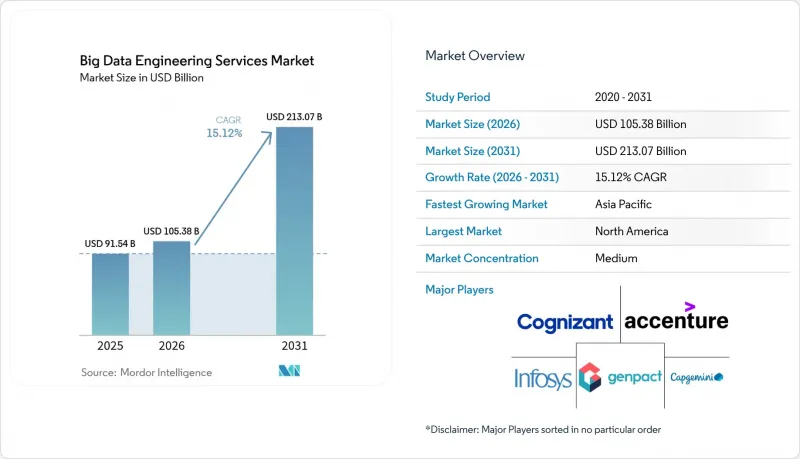
본 보고서는 서비스 유형(데이터 통합·ETL, 데이터 품질·거버넌스 등), 비즈니스 기능(마케팅 및 영업, 재무, 운영·공급망, 인사), 조직 규모(중소기업·대기업), 배포 방식(클라우드, On-Premise, 하이브리드), 지역별로 분류되어 있습니다. 시장 예측은 금액(달러)으로 표시되어 있습니다.
세계의 빅데이터 엔지니어링 서비스 시장 동향 및 인사이트
비정형 IoT 데이터 및 소셜 데이터의 급증
기업들은 현재 밀리초 단위의 센서 측정값, 감시 카메라 영상, 대화 기록 등을 수집하고 있으며, 이는 2025년에 총 181제타바이트를 넘어섰습니다. 생산 라인에서는 로봇의 각 관절에서 발생하는 진동 데이터가 원격 객체 저장소로 스트리밍되고, 소매업체에서는 천장에 설치된 카메라 영상과 POS 영수증을 융합하여 상품 진열 계획(플라노그램)을 최적화하고 있습니다. 소셜 채널에서는 감성 신호가 추가되며, 마케터는 몇 분 이내에 이를 활용하기 위해 야간 일괄 처리에서 지속적인 파이프라인으로의 전환이 시급합니다. '스키마 온 리드(Schema-on-Read)' 기법을 통해 모델링은 쿼리 실행 시점까지 미루어지며, 엄격한 관계형 제약을 피할 수 있습니다. 따라서 빅데이터 엔지니어링 서비스 시장에서는 고객 이탈을 최소화하기 위해 지연 시간을 1분 미만으로 억제하는 스트리밍 플랫폼이 우선시되고 있습니다.
비용 대비 효과가 높고 성과 기반의 서비스 계약
처리된 쿼리 수나 스캔된 레코드 수에 연동된 변동 과금 방식을 통해 재무 담당자는 지출과 수익을 대조할 수 있게 됩니다. 현재 서비스 수준 계약(SLA)에서는 파이프라인 가동률 99.9%가 보장되고 있으며, 위험이 공급업체 측으로 이전됨에 따라 노동 시간을 절감하는 자동화가 촉진되고 있습니다. 중견 기업은 설비 투자로 인한 급격한 부담 증가 없이 엔터프라이즈급 데이터 인프라를 도입할 수 있으므로 가장 큰 혜택을 받고 있습니다. 성과 목표 미달성에 대한 페널티로 인해 공급자의 책임감이 강화되고, 맞춤형 코드보다 재사용 가능한 가속기 활용이 촉진되고 있습니다. 이러한 상업적 재편으로 인해 빅데이터 엔지니어링 서비스 시장은 세계 2000 기업 이외의 구매자층으로도 확대되고 있습니다.
데이터 엔지니어링 인력의 심각한 부족
2025년에는 새로운 도구의 보급 속도가 대학 커리큘럼을 앞질렀기 때문에 수요가 공급의 3배에 달했습니다. 실리콘밸리 시니어 엔지니어의 연봉은 현재 25만 달러에 이릅니다. 인도나 동유럽의 오프쇼어 센터가 공급 부족을 메우고 있지만, 조정에 드는 간접비로 인해 비용 절감 효과는 줄어들고 있습니다. 이러한 인력 부족은 매니지드 서비스의 가격 급등을 초래하는 한편, 사내 프로젝트 진행을 지연시켜 단기적으로는 빅데이터 엔지니어링 서비스 시장의 성장을 억제하고 있습니다.
부문별 분석
2025년, 데이터 통합·ETL 서비스는 빅데이터 엔지니어링 서비스 시장 점유율의 39.22%를 차지하며, 부문 구성 중 최대의 수익원이 되었습니다. 고객들은 사일로화된 ERP, CRM, IoT 데이터를 레이크하우스 환경에 통합하고, 스키마의 일관성과 신뢰성 높은 데이터 계보를 확보하기 위해 이러한 서비스에 의존하고 있습니다. 통합 및 ETL과 관련된 빅데이터 엔지니어링 서비스 시장 규모는 스키마 드리프트와 레거시 시스템의 특수성으로 인해 파이프라인이 지속적으로 손상되고 끊임없는 리팩토링이 필요하기 때문에 견조한 성장세를 유지하고 있습니다. 한편, ‘고급 분석 및 시각화’ 분야는 기업이 기술적 인사이트에서 실시간 조치를 권장하는 예측 및 처방 모델로 전환함에 따라 2031년까지 연평균 성장률(CAGR) 15.91%를 나타낼 것으로 예측됩니다.
운영 데이터를 분석용 스토어로 직접 스트리밍하는 제로 ETL 복제 기술은 지연 시간을 단축하고 있지만, 그 대신 변환의 책임을 도메인 팀에 넘겨 거버넌스의 복잡성을 높이고 있습니다. 현재 각 벤더들은 사업 부문 전반에 걸쳐 지표의 일관성을 확보하기 위해 핵심 데이터 수집 작업에 가시성, 카탈로그화, 데이터 계보 추적 기능을 통합하고 있습니다. 자동화된 데이터 품질 검사를 통해 중복 레코드나 범위를 벗어난 센서 측정값이 경영진용 대시보드에 악영향을 미치기 전에 감지되므로, 통합 플랫폼에 대한 수요가 증가하고 있습니다. 그 결과, 구매자들은 데이터 수집부터 시각화에 이르기까지를 포괄하는 단일 벤더의 솔루션을 점점 더 선호하게 되어, 빅데이터 엔지니어링 서비스 시장에서 조달 주기가 단축되고 벤더의 난립이 억제되고 있습니다.
2025년, 기업들이 밀리초 단위의 개인화를 실현하는 고객 데이터 플랫폼 구축을 서두르는 가운데, 마케팅 및 영업 부서는 빅데이터 엔지니어링 서비스 시장의 34.86%를 차지했습니다. 이러한 프로젝트에서는 클릭 스트림, 콜센터,POS 데이터를 통합하여, 추천 엔진이 웹사이트 컨텐츠를 즉시 조정할 수 있도록 하고 있습니다. 실시간 오디언스 세분화에는 1초 미만의 쿼리 처리 성능이 요구되며, 이는 인메모리 피처 스토어 및 스트리밍 오케스트레이션에 대한 막대한 투자를 촉진하고 있습니다. 한편, 재무 부문에서는 부정 감지 및 규제 보고를 위해 스트리밍 분석을 활용하고 있으며, 인사 부문에서는 이직 예측 모델의 시범 운영이 진행되고 있으나, 유럽의 개인정보 보호에 대한 고려로 인해 후자의 진전이 지연되고 있습니다.
운영 및 공급망 워크로드는 연평균 성장률(CAGR) 15.96%로 확대될 전망이며, 2031년까지 가장 빠르게 성장하는 비즈니스 기능이 될 것입니다. 예지보전 알고리즘은 산업용 IoT의 텔레메트리 데이터를 분석하여 며칠 전에 장비 고장을 예측함으로써, 비용이 많이 드는 예기치 못한 가동 중단을 방지합니다. 소매업체와 제조업체는 출하 명세서와 GPS 데이터를 통합하여, 항만 혼잡이나 지정학적 상황의 변화가 발생할 때 재고 배송 경로를 변경하고 있습니다. 분석 결과를 업무 시스템에 피드백하는 리버스 ETL 도구를 통해 현장 팀은 작업 현장에서 경향 점수나 위험 경보를 확인할 수 있게 되어, 액션 루프가 완성됩니다. 이러한 프런트에서 백엔드에 이르는 통합을 통해 운영 부서는 단순한 비용 센터에서 전략적 성장의 원동력으로 거듭나며, 빅데이터 엔지니어링 서비스 시장에서 그 역할을 확대되고 있습니다.
지역별 분석
북미는 저비용 전력 지역에 하이퍼스케일러가 밀집해 있고, 세밀한 거버넌스가 필요한 주별 개인정보 보호법이 패치워크 형태로 존재하기 때문에 2025년 매출의 42.38%를 차지했습니다. 벤처 캐피탈은 오픈소스의 상용화에 대한 자금 지원을 계속하고 있으며, 전 세계 통합 업체들의 인수 대상 파이프라인을 풍부하게 하고 있습니다. 캐나다에서는 PIPEDA에 기반한 국경 간 데이터 전송 평가에 어려움을 겪고 있는 반면, 멕시코에서는 니어쇼어링 붐으로 인해 공급망 원격 측정 프로젝트가 확대되고 있습니다.
아시아태평양은 연평균 성장률(CAGR) 16.14%를 기록하며 가장 빠르게 성장하는 지역이 될 전망입니다. 인도의 ‘디지털 인디아(Digital India)’ 기금은 국내 데이터 인프라에 12억 달러를 투자하고 있으며, 중국에서는 각 성의 보조금을 통해 국영 제조업체의 전환 비용 절반이 보전되고 있습니다. 일본은 2026년까지 자동차 공장 전체에 디지털 트윈 도입을 의무화하고, IoT 통합 노력을 추진하고 있습니다. 한국은 알고리즘 투명성에 대해서도 데이터 주체의 권리를 확대하고 있어, 설명 가능한 AI 파이프라인에 대한 수요가 높아지고 있습니다. 호주에서는 데이터센터가 중요 인프라로 지정되어, 엔지니어링 서비스와 결합된 매니지드 보안 프로젝트가 활발해지고 있습니다.
유럽에서는 여전히 GDPR(EU 개인정보보호규정)이 적용되고 있으며, 2024년부터 2025년에 걸쳐 45억 유로(50억 달러)의 벌금이 부과됨에 따라 데이터 계보 및 동의 관리가 필수화되었습니다. 독일은 중요 인프라에 대해 On-Premise 운영을 의무화하고 있으며, 프랑스는 주권 클라우드에 자금을 지원하고 있습니다. 또한 영국의 브렉시트 이후 적정성 인정은 여전히 잠정적인 상태이므로 불확실성이 커지고 있습니다. 남미에서는 브라질의 LGPD를 시작으로 규제가 도입되기 시작했으며, 중동에서는 주권 펀드가 스마트 시티 구상의 일환으로 하이퍼스케일 데이터센터에 자금을 지원하고 있습니다. 아프리카에서는 남아프리카공화국과 나이지리아에서 시범 프로젝트가 진행되고 있으나, 전력망의 불안정성이 광범위한 도입을 방해하고 있습니다.
기타 혜택 :
- 엑셀 형식 시장 예측(ME) 시트
- 3개월간 애널리스트 지원
자주 묻는 질문
목차
제1장 서론
제2장 조사 방법
제3장 주요 요약
제4장 시장 구도
제5장 시장 규모 및 성장 예측
제6장 경쟁 구도
제7장 시장 기회 및 향후 전망
KTH 26.09.14According to Mordor Intelligence, the big data engineering services market size is expected to grow from USD 91.54 billion in 2025 to USD 105.38 billion in 2026 and is forecast to reach USD 213.07 billion by 2031 at a 15.12% CAGR over 2026-2031.
This report is Segmented by Service Type (Data Integration and ETL, Data Quality and Governance, and More), Business Function (Marketing and Sales, Finance, Operations and Supply-Chain, Human Resources), Organization Size (Small and Medium Enterprises, and Large Enterprises), Deployment Mode (Cloud, On-Premises, Hybrid), and Geography. The Market Forecasts are Provided in Terms of Value (USD).
Global Big Data Engineering Services Market Trends and Insights
Proliferation of Unstructured IoT and Social Data
Enterprises now ingest millisecond sensor readings, surveillance video, and conversational transcripts that together surpassed 181 zettabytes in 2025. Manufacturing lines stream vibration metrics from every robotic joint to remote object stores, while retailers fuse ceiling-mounted camera feeds with point-of-sale receipts to refine planograms. Social channels add sentiment signals that marketers activate within minutes, forcing a pivot from nightly batches to continuous pipelines. Schema-on-read techniques postpone modeling until query time, avoiding rigid relational constraints. The big data engineering services market, therefore, prioritizes streaming platforms that keep latency below 1 minute to minimize customer churn.
Cost-Efficient, Outcome-Based Service Contracts
Variable billing tied to queries processed or records scanned lets finance chiefs match spend with revenue. Service-level agreements now promise 99.9% pipeline uptime, shifting risk to vendors and spurring automation that curbs labor hours. Mid-market firms benefit most, gaining enterprise-grade data infrastructure without capital expenditure shocks. Penalties for missed performance targets heighten provider accountability, fostering the use of reusable accelerators over custom code. This commercial realignment expands the big data engineering services market beyond Global 2000 buyers.
Acute Shortage of Data-Engineering Talent
Demand exceeded supply three-to-one in 2025 as new tools outpaced university curricula. Senior engineers in Silicon Valley now command USD 250,000 packages. Offshore centers in India and Eastern Europe offer relief, yet coordination overhead dilutes savings. The gap fuels premium pricing for managed services, but it also slows internal projects, restraining the big data engineering services market in the near term.
Other drivers and restraints analyzed in the detailed report include:
- Cloud-Native Big-Data Stack Adoption
- Regulatory Push for Data-Driven Decision Making
- Cyber-Security and Privacy Compliance Costs
For complete list of drivers and restraints, kindly check the Table Of Contents.
Segment Analysis
Data Integration and ETL services captured 39.22% of the big data engineering services market share in 2025, making them the single largest revenue stream within the segment mix. Clients depend on these engagements to unify siloed ERP, CRM, and IoT data into lakehouse environments, ensuring schema consistency and reliable lineage. The big data engineering services market size tied to Integration and ETL remains resilient because schema drift and legacy system quirks continue to break pipelines, requiring constant refactoring. Meanwhile, Advanced Analytics and Visualization is projected to grow at a 15.91% CAGR through 2031 as enterprises move beyond descriptive insights to predictive and prescriptive models that recommend real-time actions.
Zero-ETL replication technologies that stream operational data directly into analytical stores are compressing latency, yet they shift transformation ownership to domain teams and heighten governance complexity. Vendors now bundle observability, cataloging, and lineage tracking with core ingestion work to safeguard metric consistency across business units. Automated data quality checks flag duplicate records or out-of-range sensor readings before they tarnish executive dashboards, reinforcing demand for integrated platforms. As a result, buyers increasingly favor single-vendor offerings that span ingestion to visualization, compressing procurement cycles and reducing vendor sprawl within the big data engineering services market.
Marketing and Sales accounted for 34.86% of the big data engineering services market in 2025 as firms raced to build customer data platforms that deliver millisecond-level personalization. These projects stitch together clickstream, call-center, and point-of-sale data so that recommendation engines can adapt website content on the fly. Real-time audience segmentation demands sub-second query performance, which drives heavy investment in in-memory feature stores and streaming orchestration. In parallel, Finance leverages streaming analytics for fraud detection and regulatory reporting, while Human Resources pilots attrition-prediction models, although privacy sensitivities in Europe slow the latter.
Operations and Supply-Chain workloads are set to expand at a 15.96% CAGR, positioning them as the fastest-rising business function through 2031. Predictive maintenance algorithms parse industrial IoT telemetry to forecast equipment failures days in advance, avoiding costly unplanned downtime. Retailers and manufacturers also integrate shipping manifests and GPS feeds to reroute inventory when ports clog or geopolitics shifts. Reverse ETL tools that send analytical outputs back into operational systems ensure frontline teams see propensity scores or risk alerts where they work, closing the action loop. This front-to-back integration elevates Operations from a cost center to a strategic growth lever, widening its role in the big data engineering services market.
Complete Report Scope:
- By Service Type
- Data Modelling and Architecture
- Data Integration and ETL
- Data Quality and Governance
- Advanced Analytics and Visualization
- By Business Function
- Marketing and Sales
- Finance
- Operations and Supply-Chain
- Human Resources
- By Organization Size
- Small and Medium Enterprises
- Large Enterprises
- By Deployment Mode
- Cloud
- On-Premises
- Hybrid
- By Geography
- North America
- United States
- Canada
- Mexico
- South America
- Brazil
- Argentina
- Rest of South America
- Europe
- United Kingdom
- Germany
- France
- Italy
- Rest of Europe
- Asia Pacific
- China
- Japan
- India
- South Korea
- Rest of Asia Pacific
- Middle East and Africa
- Middle East
- United Arab Emirates
- Saudi Arabia
- Rest of Middle East
- Africa
- South Africa
- Egypt
- Rest of Africa
- Middle East
- North America
Geography Analysis
North America contributed 42.38% of 2025 revenue thanks to dense hyperscaler footprints in low-cost power regions and a patchwork of state privacy statutes that necessitate fine-grained governance. Venture capital continues to finance open-source commercializations, feeding a pipeline of acquisition targets for global integrators. Canada grapples with cross-border data transfer assessments under PIPEDA, while Mexico's near-shoring boom boosts supply-chain telemetry projects.
Asia-Pacific is set to be the fastest-growing region, with a 16.14% CAGR. India's Digital India fund injects USD 1.2 billion into national data infrastructure, and China's provincial subsidies offset half of migration costs for state-owned manufacturers. Japan mandates digital twins across automotive plants by 2026, driving IoT integration work. South Korea extends subject rights to algorithmic transparency, increasing demand for explainable AI pipelines. Australia designates data centers as critical infrastructure, triggering managed security projects bundled with engineering services.
Europe remains governed by GDPR, which levied EUR 4.5 billion (USD 5.0 billion) in fines across 2024-2025, making lineage and consent management non-negotiable. Germany enforces on-premises rules for critical infrastructure, France funds a sovereign cloud, and the United Kingdom's post-Brexit adequacy is still provisional, adding uncertainty. South America starts with Brazil's LGPD, while Middle East sovereign funds finance hyperscale data centers as part of smart-city initiatives. Africa sees pilots in South Africa and Nigeria, though unreliable grids restrict broader adoption.
- Accenture plc
- International Business Machines Corporation
- Cognizant Technology Solutions Corporation
- Capgemini SE
- Infosys Limited
- Tata Consultancy Services Limited
- Wipro Limited
- Deloitte Touche Tohmatsu Limited
- Ernst and Young Global Limited
- KPMG International Limited
- Genpact Limited
- NTT Data Corporation
- L&T Technology Services Limited
- Hexaware Technologies Limited
- Mphasis Limited
- Tech Mahindra Limited
- Atos SE
- SAP SE
- Amazon Web Services, Inc.
- Microsoft Corporation
- Google LLC
- Snowflake Inc.
- Teradata Corporation
- Palantir Technologies Inc.
- Thoughtworks Holding, Inc.
- Slalom, LLC
Additional Benefits:
- The market estimate (ME) sheet in Excel format
- 3 months of analyst support
TABLE OF CONTENTS
1 INTRODUCTION
- 1.1 Study Assumptions and Market Definition
- 1.2 Scope of the Study
2 RESEARCH METHODOLOGY
3 EXECUTIVE SUMMARY
4 MARKET LANDSCAPE
- 4.1 Market Overview
- 4.2 Market Drivers
- 4.2.1 Proliferation of Unstructured IoT and Social Data
- 4.2.2 Cost-Efficient, Outcome-Based Service Contracts
- 4.2.3 Cloud-Native Big-Data Stack Adoption
- 4.2.4 Regulatory Push for Data-Driven Decision-Making
- 4.2.5 Rise of AI-Automated Data Pipelines
- 4.2.6 Industry-Specific Data Marketplaces
- 4.3 Market Restraints
- 4.3.1 Acute Shortage of Data-Engineering Talent
- 4.3.2 Cyber-Security and Privacy Compliance Costs
- 4.3.3 Legacy System Integration Complexity
- 4.3.4 Cloud-Egress and Vendor-Lock-In Economics
- 4.4 Industry Value Chain Analysis
- 4.5 Regulatory Landscape
- 4.6 Technological Outlook
- 4.7 Porter's Five Forces Analysis
- 4.7.1 Threat of New Entrants
- 4.7.2 Bargaining Power of Buyers
- 4.7.3 Bargaining Power of Suppliers
- 4.7.4 Threat of Substitutes
- 4.7.5 Competitive Rivalry
- 4.8 Impact of Macroeconomic Factors on the Market
- 4.9 Emerging Technology Trends
5 MARKET SIZE AND GROWTH FORECASTS (VALUE)
- 5.1 By Service Type
- 5.1.1 Data Modelling and Architecture
- 5.1.2 Data Integration and ETL
- 5.1.3 Data Quality and Governance
- 5.1.4 Advanced Analytics and Visualization
- 5.2 By Business Function
- 5.2.1 Marketing and Sales
- 5.2.2 Finance
- 5.2.3 Operations and Supply-Chain
- 5.2.4 Human Resources
- 5.3 By Organization Size
- 5.3.1 Small and Medium Enterprises
- 5.3.2 Large Enterprises
- 5.4 By Deployment Mode
- 5.4.1 Cloud
- 5.4.2 On-Premises
- 5.4.3 Hybrid
- 5.5 By Geography
- 5.5.1 North America
- 5.5.1.1 United States
- 5.5.1.2 Canada
- 5.5.1.3 Mexico
- 5.5.2 South America
- 5.5.2.1 Brazil
- 5.5.2.2 Argentina
- 5.5.2.3 Rest of South America
- 5.5.3 Europe
- 5.5.3.1 United Kingdom
- 5.5.3.2 Germany
- 5.5.3.3 France
- 5.5.3.4 Italy
- 5.5.3.5 Rest of Europe
- 5.5.4 Asia Pacific
- 5.5.4.1 China
- 5.5.4.2 Japan
- 5.5.4.3 India
- 5.5.4.4 South Korea
- 5.5.4.5 Rest of Asia Pacific
- 5.5.5 Middle East and Africa
- 5.5.5.1 Middle East
- 5.5.5.1.1 United Arab Emirates
- 5.5.5.1.2 Saudi Arabia
- 5.5.5.1.3 Rest of Middle East
- 5.5.5.2 Africa
- 5.5.5.2.1 South Africa
- 5.5.5.2.2 Egypt
- 5.5.5.2.3 Rest of Africa
- 5.5.5.1 Middle East
- 5.5.1 North America
6 COMPETITIVE LANDSCAPE
- 6.1 Market Concentration
- 6.2 Strategic Moves
- 6.3 Market Share Analysis
- 6.4 Company Profiles (includes Global Level Overview, Market Level Overview, Core Segments, Financials as available, Strategic Information, Market Rank/Share, Products and Services, Recent Developments)
- 6.4.1 Accenture plc
- 6.4.2 International Business Machines Corporation
- 6.4.3 Cognizant Technology Solutions Corporation
- 6.4.4 Capgemini SE
- 6.4.5 Infosys Limited
- 6.4.6 Tata Consultancy Services Limited
- 6.4.7 Wipro Limited
- 6.4.8 Deloitte Touche Tohmatsu Limited
- 6.4.9 Ernst and Young Global Limited
- 6.4.10 KPMG International Limited
- 6.4.11 Genpact Limited
- 6.4.12 NTT Data Corporation
- 6.4.13 L&T Technology Services Limited
- 6.4.14 Hexaware Technologies Limited
- 6.4.15 Mphasis Limited
- 6.4.16 Tech Mahindra Limited
- 6.4.17 Atos SE
- 6.4.18 SAP SE
- 6.4.19 Amazon Web Services, Inc.
- 6.4.20 Microsoft Corporation
- 6.4.21 Google LLC
- 6.4.22 Snowflake Inc.
- 6.4.23 Teradata Corporation
- 6.4.24 Palantir Technologies Inc.
- 6.4.25 Thoughtworks Holding, Inc.
- 6.4.26 Slalom, LLC
7 MARKET OPPORTUNITIES AND FUTURE OUTLOOK
- 7.1 White-Space and Unmet-Need Assessment