|
시장보고서
상품코드
2124487
북미의 차량 관리 솔루션 : 시장 점유율 분석, 업계 동향과 통계, 성장 예측(2026-2031년)North America Fleet Management Solutions - Market Share Analysis, Industry Trends & Statistics, Growth Forecasts (2026 - 2031) |
||||||
 Mordor Intelligence
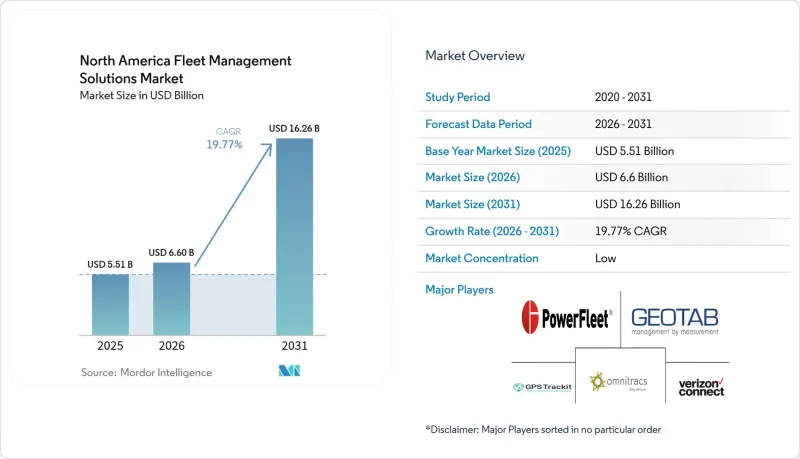
Mordor Intelligence에 의하면, 북미 차량 관리 솔루션 시장 규모는 2025년 55억 1,000만 달러에서 2026년에는 66억 달러에 이르고, 2026-2031년 CAGR 19.77%로 성장을 지속하여 2031년에는 162억 6,000만 달러에 달할 것으로 예측됩니다.
본 보고서는 도입 형태(On-Premise 등), 용도(자산 관리, 정보 관리, 운전자 관리 등), 최종 사용자 산업(운송 및 물류, 에너지·유틸리티 등), 차량 보유 규모(소규모 차량군 (1-50대), 중규모 차량군 (51-250대) 등),및 지역별로 분류되어 있습니다. 시장 예측은 금액(달러) 기준으로 제시되어 있습니다.
북미 차량 관리 솔루션 시장 동향 및 인사이트
유리한 시장 규제와 업무 효율
전자 기록 장치(ELD) 및 운전 시간 규제의 의무화로 인해 북미 대륙 전체의 트럭 운송 네트워크에서 텔레매틱스 도입이 정착되고 있습니다. 운송 사업자가 규정 준수 대응 모듈을 통합함으로써 실시간 가시성이 확보되고, 경로 최적화, 공회전 시간 단축, 연료비 절감이 실현되어, 많은 차량 관리 업체에서 총 소유 비용(TCO) 절감이 최우선 과제가 되고 있습니다. USMCA(미국·멕시코·캐나다 협정)에 기반한 통합 규정에 따라 국경을 넘는 보고 절차가 간소화되었으며, 플랫폼을 통해 3개국에 걸친 사업에서 안전 및 환경 데이터의 일관성을 확보할 수 있게 되었습니다.
친환경 차량의 부상과 탄소 중립 목표
기후 변화에 대한 대응이 차량 도입 전략을 혁신하고 있으며, 유틸리티체와 소비자 대상 브랜드들은 소형 차량 및 일부 대형 차량의 전기화 일정을 발표하고 있습니다. 연방 정부의 청정 차량 인센티브와 주 차원의 무배출 트럭 규제로 인해 사업자들은 전기차(EV)의 운행 일정,배터리 상태 진단, 재생에너지 조달을 단일 대시보드에 통합해야 하는 압박을 받고 있습니다. 내연 기관과 전기 모두의 지표를 추적해야 하는 이중적인 요구로 인해, 차량 관리 솔루션 시장 플랫폼에서 혼합 파워트레인 모듈의 도입이 가속화되고 있습니다.
根?い 데이터 개인정보 보호 및 운전자 모니터링에 대한 우려
노동조합 및 주 차원의 개인정보 보호 관련 법규에 따라, 운전자의 행동을 기록한 영상의 수집 및 저장에 제한이 설정되어 있습니다. 차량 내 카메라를 도입하는 차량 운영사는 그 목적, 보관 기간, 접근 권한을 명시한 노동조합과의 협약을 체결해야 합니다. 각 벤더사는 개인을 식별할 수 있는 정보를 분리하고 익명화된 스코어보드를 제공하는 ‘프라이버시 바이 디자인(Privacy by Design)’ 아키텍처를 통해 이러한 과제에 대응하고 있습니다.
부문 분석
클라우드 서비스는 가장 큰 점유율을 차지했으며, 사업자들이 구독 방식의 경제성과 즉각적인 기능 업데이트를 선호함에 따라 2025년에는 차량 관리 솔루션 시장 점유율의 61.58%를 차지했습니다. 하이브리드 아키텍처는 지연에 민감한 안전 경보를 위한 엣지 처리와 전략적 계획을 위한 클라우드 분석을 결합함으로써, 2031년까지 22.04%라는 높은 연평균 성장률(CAGR)을 나타낼 전망입니다. 데이터 주권이나 간헐적인 연결성으로 인해 로컬 호스팅이 필요한 상황에서는 On-Premise 환경이 계속 사용되겠지만, 클라우드의 내결함성과 암호화 기준이 성숙해짐에 따라 그 상대적 점유율은 축소될 것으로 예측됩니다.
대형 화주들은 고대역폭 센서 데이터를 처리하면서 야간에 지역 데이터 레이크와 동기화하기 위해, 창고에서 하이브리드 노드의 시범 운영을 점점 더 늘리고 있습니다. 긴급 차량을 관리하는 정부 기관은 여전히 FedRAMP 또는 이에 상응하는 프레임워크에 따라 심사를 마친 프라이빗 클라우드를 의존하고 있습니다. 또한, 위성 백홀 옵션의 확대로 인해 이전에는 ‘연결의 사막’으로 여겨졌던 장거리 운송 노선에서도 클라우드 도입이 점차 용이해지고 있습니다.
2025년 현재, 자산 관리는 차량 관리 솔루션 시장 규모의 28.44%를 계속 차지하고 있지만, 대시캠 AI 및 전자 운전자·차량 검사 보고서의 자동화가 보급됨에 따라 안전 및 규정 준수 관련 모듈이 연평균 성장률(CAGR) 23.71%로 가장 빠른 성장세를 보이고 있습니다. 운전자 교육용 대시보드와 위험 평가 매트릭스는 보험사 포털과 원활하게 연동되어 보험금 청구 처리 기간을 단축하고 있습니다.
운영 기획자는 핵심 위치 정보 데이터에 교통 체증 분석 및 기상 정보를 중첩함으로써 연료 소비량을 한 자릿수 비율로 절감하고 있습니다. 지속가능성 보고 및 배터리 잔량 관리는 프리미엄 부가 기능으로 부상하고 있으며, 공급업체는 기존 고객을 대상으로 업셀링이 가능해졌습니다. 제품군 전반에 걸친 대시보드는 데이터의 일관성을 높이고, 디스패처가 ‘의자를 돌려 화면을 전환하는’ 등의 워크플로우로 인한 피로를 최소화합니다.
기타 혜택:
- 엑셀 형식 시장 예측(ME) 시트
- 3개월간의 애널리스트 지원
자주 묻는 질문
목차
제1장 서론
제2장 조사 방법
제3장 주요 요약
제4장 시장 구도
제5장 시장 규모와 성장 예측
제6장 경쟁 구도
제7장 시장 기회와 향후 전망
LSHAccording to Mordor Intelligence, the North America fleet management solutions market size is expected to grow from USD 5.51 billion in 2025 to USD 6.6 billion in 2026 and is forecast to reach USD 16.26 billion by 2031 at 19.77% CAGR over 2026-2031.
This report is Segmented by Deployment (On-Premise, and More), Application (Asset Management, Information Management, Driver Management, and More), End-User Industry (Transportation and Logistics, Energy and Utilities, and More), Fleet Size (Small Fleet [1-50 Vehicles], Medium Fleet [51-250 Vehicles], and More), and Geography. The Market Forecasts are Provided in Terms of Value (USD).
North America Fleet Management Solutions Market Trends and Insights
Favourable Market Regulations and Operational Efficiency
Electronic-logging-device and hours-of-service mandates are anchoring telematics adoption across the continental trucking network. As carriers integrate compliance modules, they unlock real-time visibility that improves routing, idle-time reduction, and fuel spend, enabling many fleets to shift cost-of-ownership to the top of the agenda. Consolidated rules under the USMCA are simplifying cross-border reporting, allowing platforms to harmonize safety and environmental data for tri-national operations.
Advent of Green Fleets and Net-Zero Targets
Climate commitments are reshaping acquisition strategies, with utilities and consumer brands publishing timelines to electrify light-duty and portioned heavy-duty assets. Federal clean-fleet incentives and state-level zero-emission truck regulations are pushing operators to blend EV scheduling, battery-health diagnostics, and renewable-energy sourcing into a single dashboard. The dual need to track both internal-combustion and electric metrics is a catalyst for mixed-powertrain modules within fleet management solutions market platforms.
Persistent Data-Privacy and Driver Surveillance Concerns
Labor groups and provincial-level privacy statutes limit the capture and retention of driver-behaviour footage. Fleets deploying inward-facing cameras must negotiate union agreements outlining purpose, storage duration, and access rights. Vendors are countering with privacy-by-design architectures that segment personally identifiable information and provide anonymized scoreboards.
Other drivers and restraints analyzed in the detailed report include:
- Technological Advances Lowering Total Cost of Ownership
- Growing Integration of Video-Based Safety Analytics
- Rising Cybersecurity Threats to Connected Vehicles
For complete list of drivers and restraints, kindly check the Table Of Contents.
Segment Analysis
Cloud services held the largest stake, delivering 61.58% fleet management solutions market share in 2025 as operators favoured subscription economics and instant feature updates. Hybrid architectures are forecast to post a leading 22.04% CAGR to 2031, combining edge processing for latency-sensitive safety alerts with cloud analytics for strategic planning. On-premises instances persist where data-sovereignty or intermittent connectivity requires local hosting, but the relative slice is expected to erode as cloud resilience and encryption standards mature.
Large shippers increasingly pilot hybrid nodes at depots to process high-bandwidth sensor feeds while synchronizing with regional data lakes overnight. Government agencies managing emergency vehicles still lean on private clouds vetted under FedRAMP or equivalent frameworks. The expansion of satellite-backhaul options is also easing cloud adoption along long-haul corridors previously deemed connectivity deserts.
While asset management retained 28.44% of the fleet management solutions market size in 2025, safety and compliance modules are charting the fastest expansion at 23.71% CAGR as dash-cam AI and electronic driver-vehicle-inspection-report automation gain traction. Driver coaching dashboards and risk-scoring matrices integrate seamlessly with insurer portals, reducing claims cycles.
Operational planners are layering congestion analytics and weather overlays atop core location data to carve fuel consumption by single-digit percentages. Sustainability reporting and battery-state-of-charge orchestration are emerging as premium add-ons, allowing vendors to upsell existing clients. Cross-suite dashboards improve data coherence, minimizing swivel-chair workflow fatigue for dispatchers.
Complete Report Scope:
- By Deployment
- On-Premise
- Cloud
- Hybrid
- By Application
- Asset Management
- Information Management
- Driver Management
- Safety and Compliance Management
- Risk Management
- Operations Management
- Other Applications
- By End-User Industry
- Transportation and Logistics
- Energy and Utilities
- Construction
- Manufacturing
- Other End-User Industries
- By Fleet Size
- Small Fleets (1-50 vehicles)
- Medium Fleets (51-250 vehicles)
- Large Fleets (251+ vehicles)
- By Country
- United States
- Canada
- Mexico
List of Companies Covered in this Report:
- Geotab Inc.
- Verizon Communications Inc. (Verizon Connect)
- Trimble Inc.
- Samsara Inc.
- Omnitracs LLC
- PowerFleet Inc.
- MiX Telematics Ltd.
- Teletrac Navman (Vontier Corporation)
- Zonar Systems Inc.
- GPS Trackit Inc.
- Inseego Corp.
- Motive Technologies Inc.
- Fleet Complete (Constellation Software Inc.)
- Gurtam UAB
- Donlen LLC (Hertz Global Holdings Inc.)
- Enterprise Fleet Management Inc.
- ARI Fleet Management Company
- Azuga Inc. (Bridgestone Americas Inc.)
- KeepTruckin Inc.
- Michelin Connected Fleet (Sascar Tecnologia Automotiva S.A.)
Additional Benefits:
- The market estimate (ME) sheet in Excel format
- 3 months of analyst support
TABLE OF CONTENTS
1 INTRODUCTION
- 1.1 Study Assumptions and Market Definition
- 1.2 Scope of the Study
2 RESEARCH METHODOLOGY
3 EXECUTIVE SUMMARY
4 MARKET LANDSCAPE
- 4.1 Market Overview
- 4.2 Market Drivers
- 4.2.1 Favorable market regulations coupled with growing emphasis on operational efficiency
- 4.2.2 Advent of Green Fleets and corporate net-zero targets
- 4.2.3 Technological advancements lowering total cost of ownership
- 4.2.4 Growing integration of video-based safety analytics
- 4.2.5 Uptake of EV-ready telematics platforms
- 4.2.6 AI-enabled predictive maintenance for mixed-asset fleets (under-reported)
- 4.3 Market Restraints
- 4.3.1 Persistent data-privacy and driver surveillance concerns
- 4.3.2 Limited cellular coverage in rural/long-haul corridors
- 4.3.3 Rising cybersecurity threats to connected vehicles (under-reported)
- 4.3.4 Fragmented regulatory landscape for cross-border fleets (under-reported)
- 4.4 Impact of Macroeconomic Factors
- 4.5 Industry Value-Chain Analysis
- 4.6 Regulatory Landscape
- 4.7 Technological Outlook
- 4.8 Porter's Five Forces Analysis
- 4.8.1 Bargaining Power of Suppliers
- 4.8.2 Bargaining Power of Consumers
- 4.8.3 Threat of New Entrants
- 4.8.4 Threat of Substitute Products
- 4.8.5 Intensity of Competitive Rivalry
5 MARKET SIZE AND GROWTH FORECASTS (VALUE)
- 5.1 By Deployment
- 5.1.1 On-Premise
- 5.1.2 Cloud
- 5.1.3 Hybrid
- 5.2 By Application
- 5.2.1 Asset Management
- 5.2.2 Information Management
- 5.2.3 Driver Management
- 5.2.4 Safety and Compliance Management
- 5.2.5 Risk Management
- 5.2.6 Operations Management
- 5.2.7 Other Applications
- 5.3 By End-User Industry
- 5.3.1 Transportation and Logistics
- 5.3.2 Energy and Utilities
- 5.3.3 Construction
- 5.3.4 Manufacturing
- 5.3.5 Other End-User Industries
- 5.4 By Fleet Size
- 5.4.1 Small Fleets (1-50 vehicles)
- 5.4.2 Medium Fleets (51-250 vehicles)
- 5.4.3 Large Fleets (251+ vehicles)
- 5.5 By Country
- 5.5.1 United States
- 5.5.2 Canada
- 5.5.3 Mexico
6 COMPETITIVE LANDSCAPE
- 6.1 Market Concentration
- 6.2 Strategic Moves
- 6.3 Market Share Analysis
- 6.4 Company Profiles
- 6.4.1 Geotab Inc.
- 6.4.2 Verizon Communications Inc. (Verizon Connect)
- 6.4.3 Trimble Inc.
- 6.4.4 Samsara Inc.
- 6.4.5 Omnitracs LLC
- 6.4.6 PowerFleet Inc.
- 6.4.7 MiX Telematics Ltd.
- 6.4.8 Teletrac Navman (Vontier Corporation)
- 6.4.9 Zonar Systems Inc.
- 6.4.10 GPS Trackit Inc.
- 6.4.11 Inseego Corp.
- 6.4.12 Motive Technologies Inc.
- 6.4.13 Fleet Complete (Constellation Software Inc.)
- 6.4.14 Gurtam UAB
- 6.4.15 Donlen LLC (Hertz Global Holdings Inc.)
- 6.4.16 Enterprise Fleet Management Inc.
- 6.4.17 ARI Fleet Management Company
- 6.4.18 Azuga Inc. (Bridgestone Americas Inc.)
- 6.4.19 KeepTruckin Inc.
- 6.4.20 Michelin Connected Fleet (Sascar Tecnologia Automotiva S.A.)
7 MARKET OPPORTUNITIES AND FUTURE OUTLOOK
- 7.1 White-space and Unmet-Need Assessment