|
시장보고서
상품코드
2124492
유럽의 플릿 관리 : 시장 점유율 분석, 업계 동향 및 통계, 성장 예측(2026-2031년)Europe Fleet Management - Market Share Analysis, Industry Trends & Statistics, Growth Forecasts (2026 - 2031) |
||||||
 Mordor Intelligence
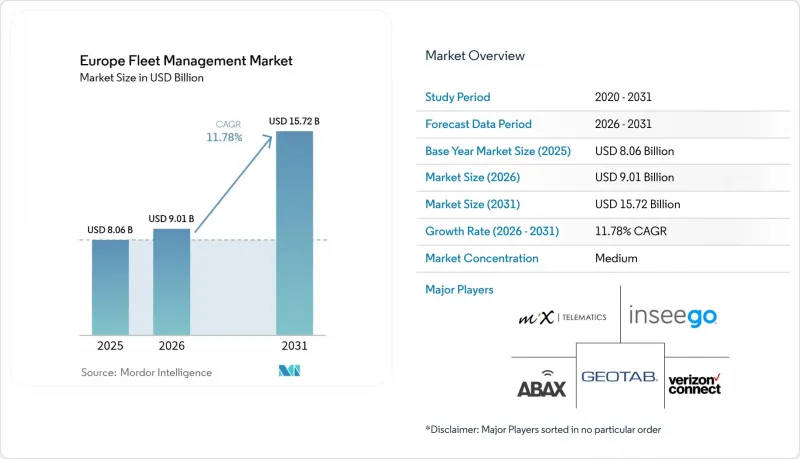
유럽의 플릿 관리 규모는 2025년에 80억 6,000만 달러로 평가되었습니다. 2026년 90억 1,000만 달러에서 2031년까지 157억 2,000만 달러에 이를 것으로 예상되며, 예측 기간(2026-2031년) CAGR은 11.78%를 나타낼 전망입니다.
본 보고서는 도입 형태(온디맨드형 클라우드, On-Premise), 용도(자산 관리, 정보 관리 등), 최종 사용자 업종(운송 및 물류, 에너지·유틸리티 등), 차량 보유 대수, 차종(소형 상용차, 대형 상용차 등) 및 지역별로 분류되어 있습니다. 시장 예측은 금액(달러) 기준으로 제시되어 있습니다.
유럽의 플릿 관리 시장 동향 및 인사이트
EU의 스마트 타코그래프 2단계 의무화로 인해 규정 준수가 필수화됨
2025년 6월부터 시행된 이 의무화에 따라, 3.5톤 이상의 모든 상용차는 위치 정보 및 운전 시간 데이터를 지속적으로 전송해야 하며, 정기적인 데이터 다운로드에서 실시간 모니터링으로 전환됩니다. 1,500유로에서 1만 5,000유로 범위로 설정된 자동 과금 제도로 인해 사업자들은 통합형 텔레매틱스 제품군을 도입할 수밖에 없는 상황에 몰리고 있습니다. 독일의 대형 물류 기업들은 서비스 중단을 피하기 위해 이미 도입을 완료했으며, 공급업체에 따르면 소규모 차량 보유 사업자들 사이에서도 단일 타코그래프가 아닌, 여러 대의 차량을 대상으로 한 구독형 요금제에 대한 수요가 증가하고 있다고 합니다. 사업자들은 모든 차량 등급에 걸쳐 일원적으로 관리할 수 있는 ‘싱글 페인 오브 글래스(Single Pane of Glass)’를 선호하기 때문에 수요는 소형 밴이나 회사용 차량 플릿으로도 확산되고 있으며, 이는 플랫폼의 총 도입 대수를 끌어올리고 있습니다.
전자상거래의 성장이 라스트 마일 배송 최적화를 가속화
2024년에는 유럽 매출에서 온라인 소매가 차지하는 비중이 13.4%로 상승했으며, 소포 배송 사업자에게 라스트 마일 비용은 물류비의 41%를 차지하고 있습니다. 소비자들이 익일 배송을 기대하게 되면서 소형 밴의 주행 거리는 2024년 대비 23% 증가했습니다. Seur와 같은 사업자들은 AI를 활용한 일정 관리를 도입한 결과, 경로 관련 비용을 15% 절감하며 텔레매틱스의 구체적인 투자 대비 효과를 입증했습니다. 바르셀로나, 마드리드, 파리의 저공해 구역에서는 배송 시간대 제한으로 인해 상황이 더욱 복잡해지고 있어, 실시간 규제 데이터가 필수적입니다. 따라서 유럽의 차량 관리 업계는 전자상거래의 확대와 환경 규제의 압박이라는 두 가지 요인이 맞물려, 위치 정보, 교통 상황, 규정 준수 관련 데이터의 지속적인 제공이 요구되는 상황에서 혜택을 보고 있습니다.
GDPR(EU 개인정보보호규정) 준수가 도입의 복잡성을 야기
GDPR(EU 개인정보보호규정)에 따르면, GPS 추적에 대한 직원의 동의는 명시적이고 철회 가능해야 합니다. 또한, 2024년 독일에서 발생한 몇 가지 재판 사례에서는 종합적인 감시가 근로자의 권리를 침해한다는 사실이 확인되었습니다. 중규모 차량 보유 기업의 경우, 법적 검토, 데이터 보호 책임자, 소프트웨어 재설계에 드는 연간 비용은 총 약 12만 5,000유로에 달할 전망입니다. 다국적 사업자는 규제가 더 엄격한 국경을 넘을 때 운전자용 카메라 스트리밍 등의 기능을 비활성화해야 할 수 있으며, 이로 인해 텔레매틱스가 약속하는 효율성이 저하되고 도입 일정이 장기화됩니다.
부문별 분석
클라우드 서비스는 2025년 유럽의 플릿 관리 시장 점유율의 63.55%를 차지했으며, 종량제 요금제 및 자동 소프트웨어 업데이트에 힘입어 2031년까지 연평균 성장률(CAGR) 14.56%로 성장을 이어갈 전망입니다. 도이치 텔레콤은 멀티테넌트 아키텍처를 통해 사업자가 서버 조달 및 유지보수 의무를 회피할 수 있으므로, On-Premise형 호스팅에 비해 총 소유 비용(TCO)을 34% 절감할 수 있다고 지적합니다. 플릿 관리자에게 있어 탄력적인 데이터 스토리지는 수동으로 확장할 필요 없이 계절적인 데이터 양의 변동에 대응할 수 있습니다. 데이터 주권에 대한 우려로 인해 일부 중요 인프라 플릿은 사설 서버로만 제한되어 있었으나, 클라우드 제공업체들은 GDPR(EU 개인정보보호규정) 인증을 획득한 EU 소재 데이터센터를 제공함으로써 이에 대응하고 규정 준수상의 격차를 해소했습니다.
엣지 컴퓨팅은 현재 클라우드 모델의 대안이 아닌, 그 연장선상에서 기능하고 있습니다. 시간적 제약이 있는 운전자 지원 시스템의 계산은 차량용 프로세서에서 실행되는 반면, 집계 분석, 보고서 작성 및 무선 업데이트는 중앙 집중식 허브를 통해 수행됩니다. 이러한 하이브리드 접근 방식은 지연 시간과 거버넌스 요건을 모두 충족시키며, 유럽의 플릿 관리 시장에서 신규 도입 시 기본 아키텍처로서 클라우드의 입지를 공고히 하고 있습니다.
2025년, 자산 관리는 유럽 플릿 관리 시장의 26.72%를 차지했습니다. 이는 모든 사업자가 위치 정보 및 이용 현황 데이터를 중요하게 여기기 때문입니다. 한편, 안전 및 규정 준수 관련 도구는 규제 당국과 보험사가 사고 예방에 금전적 인센티브를 연계하고 있기 때문에 연평균 성장률(CAGR) 14.34%로 확대되고 있습니다. 알리안츠는 차량이 능동적인 운전자 모니터링을 실시하고 있음을 입증할 경우 최대 15%의 보험료 할인을 제공하고 있으며, 이로 인해 주행 거리가 많은 택배 서비스 분야에서 도입이 가속화되고 있습니다. 2050년까지 도로 사망 사고 제로를 목표로 하는 EU의 ‘비전 제로(Vision Zero)’ 프로그램에서는 AI를 활용한 피로 감지 및 사각지대 경보가 일부 회원국에서 영업 허가의 필수 요건으로 자리 잡고 있습니다. 현재 각 벤더사는 안전 대시보드와 타코그래프 파일을 세트로 제공하여, 규정 준수 보고가 원활하고 검증 가능하도록 보장하고 있습니다.
기타 혜택 :
- 엑셀 형식 시장 예측(ME) 시트
- 3개월간의 애널리스트 지원
자주 묻는 질문
목차
제1장 서론
제2장 조사 방법
제3장 주요 요약
제4장 시장 구도
제5장 시장 규모 및 성장 예측
제6장 경쟁 구도
제7장 시장 기회 및 향후 전망
KTHAccording to Mordor Intelligence, the Europe fleet management market size was valued at USD 8.06 billion in 2025 and estimated to grow from USD 9.01 billion in 2026 to reach USD 15.72 billion by 2031, at a CAGR of 11.78% during the forecast period (2026-2031).
This report is Segmented by Deployment Type (On-Demand Cloud, On-Premises), Application (Asset Management, Information Management, and More), End-User Vertical (Transportation and Logistics, Energy and Utilities, and More), Fleet Size, Vehicle Type (Light Commercial Vehicles, Heavy Commercial Vehicles, and More), and Geography. The Market Forecasts are Provided in Terms of Value (USD).
Europe Fleet Management Market Trends and Insights
EU Smart-Tachograph Phase II Mandate Creates Compliance Imperative
The mandate enforced from June 2025 forces every commercial vehicle above 3.5 t to transmit location and driver-hours data continuously, replacing periodic data downloads with real-time oversight. Automatic fines structured between EUR 1,500 and EUR 15,000 leave operators' little choice but to install integrated telematics suites. Large German logistics firms have already completed rollouts to avoid service disruption, and suppliers report that small fleets now request multi-vehicle subscriptions rather than standalone tachographs. Because operators prefer a single pane of glass across all classes of vehicles, demand is spilling into light vans and company-car pools, lifting total platform adoption.
E-Commerce Growth Intensifies Last-Mile Delivery Optimization
Online retail penetration climbed to 13.4% of European sales in 2024, and last-mile costs swallow 41% of logistics spend for parcel operators. Light vans now cover 23% more mileage than in 2024 as consumers expect next-day delivery. Operators such as Seur cut route-related costs by 15% after introducing AI-based scheduling, demonstrating tangible return on telematics. Low-emission zones in Barcelona, Madrid, and Paris add further complexity by restricting time-window access, making real-time regulatory data essential. The Europe fleet management market, therefore benefits from converging e-commerce and environmental pressures that require constant location, traffic, and compliance feeds.
GDPR Compliance Creates Implementation Complexity
Under GDPR, employee consent for GPS tracking must be explicit and revocable, and several German court cases in 2024 confirmed that blanket monitoring infringes worker rights. For medium fleets, annual spending on legal review, data-protection officers, and software redesign totals about EUR 125,000. Multinational operators must sometimes deactivate features such as driver-cam streaming when crossing borders with stricter rules, diluting the efficiency promise of telematics and extending deployment timelines.
Other drivers and restraints analyzed in the detailed report include:
- Cellular-IoT Cost Reductions Enable Mass-Market Adoption
- OEM Telematics Platforms Monetize Connected Vehicle Data
- AI Video Telematics Capital Requirements Limit SME Adoption
For complete list of drivers and restraints, kindly check the Table Of Contents.
Segment Analysis
Cloud services captured 63.55% of Europe fleet management market share in 2025 and are climbing at a 14.56% CAGR through 2031, propelled by pay-as-you-go pricing and automatic software updates. Deutsche Telekom observes that a multi-tenant architecture trims total cost of ownership by 34% relative to on-premises hosting because operators avoid server procurement and maintenance obligations. For fleet managers, elastic data storage accommodates seasonal volume swings without manual scaling. Data-sovereignty concerns confined some critical infrastructure fleets to private servers, yet cloud providers have responded with EU-based data centers that carry GDPR certification, closing the compliance gap.
Edge computing now operates as an extension of the cloud model rather than a replacement. Time-sensitive driver-assistance calculations run on in-vehicle processors, while aggregate analysis, reporting, and over-the-air updates flow through centralized hubs. This hybrid approach satisfies both latency and governance requirements, cementing cloud as the default architecture for new deployments within the Europe fleet management market.
Asset management held 26.72% of Europe fleet management market size in 2025 because every operator values location and utilization data. Safety and compliance tools, however, are advancing at a 14.34% CAGR because regulators and insurers tie monetary incentives to incident prevention. Allianz provides up to 15% premium discounts when fleets demonstrate proactive driver monitoring, accelerating adoption among high-mileage courier services. The EU Vision Zero program, which aims for zero road fatalities by 2050, positions AI-enabled fatigue detection and blind-spot alerts as pre-requisites for operating licenses in several member states. Vendors now bundle safety dashboards with tachograph files, ensuring compliance submissions are seamless and verifiable.
Complete Report Scope:
- By Deployment Type
- On-Demand (Cloud)
- On-Premises
- By Application
- Asset Management
- Information Management
- Driver Management
- Safety and Compliance Management
- Risk Management
- Operations Management
- By End-user Vertical
- Transportation and Logistics
- Energy and Utilities
- Construction
- Manufacturing
- Other End-Users Verticals
- By Fleet Size
- Small (1-50 vehicles)
- Medium (51-250)
- Large (251 +)
- By Vehicle Type
- Light Commercial Vehicles
- Heavy Commercial Vehicles
- Bus and Coach
- By Geography (Country)
- Germany
- United Kingdom
- France
- Spain
- Italy
- Rest of Europe
List of Companies Covered in this Report:
- TomTom N.V. (WEBFLEET)
- Verizon Communications Inc. (Verizon Connect)
- Bridgestone Mobility Solutions B.V. (WEBFLEET)
- Masternaut Ltd. (MICHELIN Connected Fleet)
- Geotab Inc.
- MiX Telematics Ltd.
- Trimble Inc.
- Samsara Inc.
- Powerfleet Inc. (incl. Fleet Complete)
- ABAX Group AS
- Teletrac Navman (Vontier Corp.)
- AT&T Inc.
- Chevin Fleet Solutions Ltd.
- Gurtam ( Wialon )
- Avrios International AG
- Mapon SIA
- Fleetster GmbH
- Shiftmove GmbH
- Transpoco Telematics Ltd.
- Fleetio ( RareStep Inc. )
- Teltonika Telematics UAB
- Ruptela UAB
- Motive Technologies Inc.
Additional Benefits:
- The market estimate (ME) sheet in Excel format
- 3 months of analyst support
TABLE OF CONTENTS
1 INTRODUCTION
- 1.1 Study Assumptions and Market Definition
- 1.2 Scope of the Study
2 RESEARCH METHODOLOGY
3 EXECUTIVE SUMMARY
4 MARKET LANDSCAPE
- 4.1 Market Overview
- 4.2 Market Drivers
- 4.2.1 EU smart-tachograph Phase II mandate (2025)
- 4.2.2 E-commerce-driven LCV mileage surge
- 4.2.3 Falling cellular-IoT tariffs and eSIM adoption
- 4.2.4 OEM open-API telematics monetisation
- 4.2.5 EU ETS-2 credits for low-CO? fleets
- 4.2.6 5G C-V2X micro-platooning pilots
- 4.3 Market Restraints
- 4.3.1 GDPR and ePrivacy compliance burden
- 4.3.2 High cap-ex for AI video telematics
- 4.3.3 Patchwork low-emission city zones
- 4.3.4 Telematics-chip supply disruptions
- 4.4 Industry Value-Chain Analysis
- 4.5 Regulatory Landscape
- 4.6 Technological Outlook
- 4.7 Porter's Five Forces Analysis
- 4.7.1 Bargaining Power of Suppliers
- 4.7.2 Bargaining Power of Buyers
- 4.7.3 Threat of New Entrants
- 4.7.4 Threat of Substitutes
- 4.7.5 Intensity of Competitive Rivalry
5 MARKET SIZE AND GROWTH FORECASTS (VALUE)
- 5.1 By Deployment Type
- 5.1.1 On-Demand (Cloud)
- 5.1.2 On-Premises
- 5.2 By Application
- 5.2.1 Asset Management
- 5.2.2 Information Management
- 5.2.3 Driver Management
- 5.2.4 Safety and Compliance Management
- 5.2.5 Risk Management
- 5.2.6 Operations Management
- 5.3 By End-user Vertical
- 5.3.1 Transportation and Logistics
- 5.3.2 Energy and Utilities
- 5.3.3 Construction
- 5.3.4 Manufacturing
- 5.3.5 Other End-Users Verticals
- 5.4 By Fleet Size
- 5.4.1 Small (1-50 vehicles)
- 5.4.2 Medium (51-250)
- 5.4.3 Large (251 +)
- 5.5 By Vehicle Type
- 5.5.1 Light Commercial Vehicles
- 5.5.2 Heavy Commercial Vehicles
- 5.5.3 Bus and Coach
- 5.6 By Geography (Country)
- 5.6.1 Germany
- 5.6.2 United Kingdom
- 5.6.3 France
- 5.6.4 Spain
- 5.6.5 Italy
- 5.6.6 Rest of Europe
6 COMPETITIVE LANDSCAPE
- 6.1 Market Concentration
- 6.2 Strategic Moves
- 6.3 Market Share Analysis
- 6.4 Company Profiles (includes Global-level overview, market-level overview, core segments, financials, strategic information, market rank/share, products and services, recent developments)
- 6.4.1 TomTom N.V. (WEBFLEET)
- 6.4.2 Verizon Communications Inc. (Verizon Connect)
- 6.4.3 Bridgestone Mobility Solutions B.V. (WEBFLEET)
- 6.4.4 Masternaut Ltd. (MICHELIN Connected Fleet)
- 6.4.5 Geotab Inc.
- 6.4.6 MiX Telematics Ltd.
- 6.4.7 Trimble Inc.
- 6.4.8 Samsara Inc.
- 6.4.9 Powerfleet Inc. (incl. Fleet Complete)
- 6.4.10 ABAX Group AS
- 6.4.11 Teletrac Navman (Vontier Corp.)
- 6.4.12 AT&T Inc.
- 6.4.13 Chevin Fleet Solutions Ltd.
- 6.4.14 Gurtam ( Wialon )
- 6.4.15 Avrios International AG
- 6.4.16 Mapon SIA
- 6.4.17 Fleetster GmbH
- 6.4.18 Shiftmove GmbH
- 6.4.19 Transpoco Telematics Ltd.
- 6.4.20 Fleetio ( RareStep Inc. )
- 6.4.21 Teltonika Telematics UAB
- 6.4.22 Ruptela UAB
- 6.4.23 Motive Technologies Inc.
7 MARKET OPPORTUNITIES AND FUTURE OUTLOOK
- 7.1 White-space and Unmet-need Assessment