
|
시장보고서
상품코드
2124491
이벤트 스트림 처리 : 시장 점유율 분석, 업계 동향과 통계, 성장 예측(2026-2031년)Event Stream Processing - Market Share Analysis, Industry Trends & Statistics, Growth Forecasts (2026 - 2031) |
||||||
 Mordor Intelligence
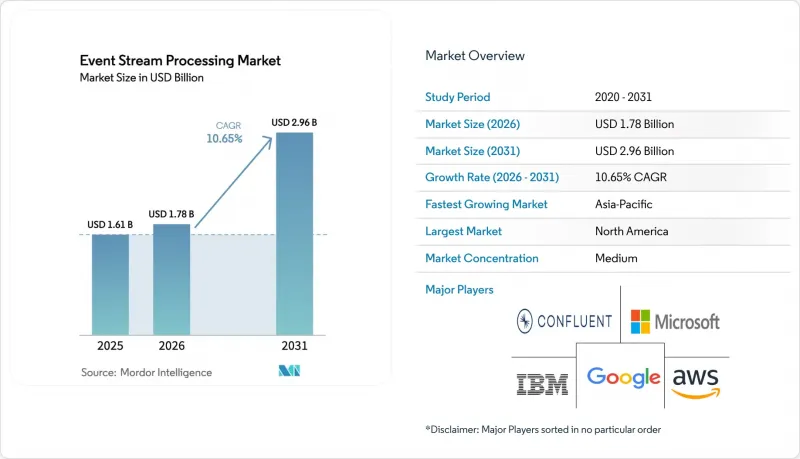
Mordor Intelligence에 의하면, 이벤트 스트림 처리 시장 규모는 2025년에 16억 1,000만 달러, 2026년에 17억 8,000만 달러, 2031년까지 29억 6,000만 달러에 이를 것으로 예측되며, 2026-2031년 CAGR 10.65%를 기록할 전망입니다.

본 보고서는 도입 형태(클라우드 및 On-Premise), 구성 요소(솔루션 및 서비스), 용도(사기 감지, 거래, 모니터링, 위치 인텔리전스, 개인화, 고객 경험 등), 최종 사용자 산업(IT 및 통신, 은행, 금융서비스 및 보험(BFSI), 제조, 소매, 에너지,헬스케어 등), 그리고 지역별로 분류되어 있습니다. 시장 예측은 금액(달러) 기준으로 제시되어 있습니다.
세계 이벤트 스트림 처리 시장 동향 및 인사이트
Kubernetes 네이티브 데이터 파이프라인이 ESP 도입을 가속화
2024년 Cloud Native Computing Foundation(CNCF)이 Kubernetes의 이벤트 주도형 자동 스케일링을 표준화함에 따라, 팀은 토픽 지연 시간을 기반으로 Apache Flink나 Pulsar의 포드를 스케일링할 수 있게 되어,정적 가상 머신에 비해 유휴 상태의 컴퓨팅 비용을 30-40% 절감할 수 있습니다. Redpanda의 C++ 아키텍처는 Java 가상 머신의 오버헤드를 제거하고 p99 지연 시간을 10밀리초 미만으로 억제합니다. 이는 금융 기관이 실시간 사기 점수 산정에 요구하는 성능 수준입니다. Airbyte는 2024년에 출시된 신규 커넥터의 62%가 Kubernetes 클러스터를 대상으로 한다고 밝혔습니다. 이는 컨테이너가 스트리밍 워크로드의 기본 인프라가 되었음을 시사합니다. Helm 차트와 오퍼레이터가 성숙해짐에 따라, 중규모 소매업체는 전담 사이트 신뢰성 팀 없이도 엔터프라이즈급 파이프라인을 배포할 수 있게 되어, 자본을 데이터 사이언스 인재 양성에 투자할 수 있게 됩니다.
MiFID III 실시간 거래 보고
금융상품시장지침 III(MiFID III)에 따라 투자 회사는 주문, 변경 및 취소를 영업일 기준 1일 이내에 1마이크로초의 타임스탬프 정확도로 보고해야 합니다. 맥킨지의 조사에 따르면, 유럽 은행의 73%가 2025년에 저지연 분석에 대한 지출을 최소 20% 증액할 예산을 편성하고 있으며, 그 대부분은 거래소 데이터센터에 코로케이션된 Apache Flink 클러스터를 위한 것입니다. 체계적 내부자(Systematic Internaizer)는 최선의 집행을 입증할 의무가 있으며, 이는 밀리초 단위의 주문장 통합에 대한 수요를 부추기고 있습니다. 도이치은행과 BNP 파리바 등의 은행은 일일 결산 전에 규정 위반을 감지하는 이벤트 스트림 처리 플랫폼으로의 전환을 발표했습니다.
다양한 오픈소스 엔진의 보급이 표준화를 복잡하게 만듦
리눅스 재단(Linux Foundation)의 조사에 따르면, 47%의 조직이 2개 이상의 스트리밍 엔진을 동시에 가동하고 있으며, 일반적으로 Kafka Streams와 Flink를 조합하여 사용하고 있습니다. 각 프레임워크마다 상태 관리의 의미론, 모니터링 스택, 직렬화 형식이 서로 달라 총 소유 비용(TCO)을 높이고 있습니다. 범용적인 스트리밍 SQL 표준이 부재함에 따라 기업들은 벤더 고유의 구문을 사용할 수밖에 없으며, 이로 인해 벤더 종속성이 발생하고 있습니다. Ververica나 StreamNative가 관리형 추상화 기능을 제공하고는 있지만, 이러한 기능의 채택은 플랫폼의 위험을 감수할 준비가 된 얼리 어답터로 제한되고 있습니다.
부문 분석
2025년 현재, 이벤트 스트림 처리 시장의 57.12%를 클라우드 도입이 차지하고 있으며, 2031년까지 연평균 성장률(CAGR) 11.32%로 확대될 것으로 예측됩니다. 이러한 급속한 성장은 Kubernetes의 자동 스케일링 성숙도와 궤를 같이 하며, 운영자는 수동 조정 없이 워크로드 변동에 따라 컴퓨팅 리소스를 조정할 수 있게 되었습니다. 한때 지연 시간이나 주권상의 우려로 인해 퍼블릭 클라우드를 기피했던 금융 기관들도 현재는 하이브리드 토폴로지를 채택하여, 주문 장부는 On-Premise에 보관하면서 시장 데이터의 정규화는 클라우드에서 수행함으로써 개발 주기를 단축하고 있습니다.
워크로드의 일일 처리량이 100TB를 초과하면 클라우드의 경제적 우위는 약화되며, 그 이후부터는 전용 하드웨어의 감가상각이 빨라집니다. 그러나 하이퍼스케일 벤더들은 머신 러닝, 데이터 레이크, BI 서비스를 번들로 제공하고 있으며, 이는 전환 비용을 발생시켜 클라우드의 성장세를 유지하고 있습니다. 중국과 독일의 데이터 거주지 규제로 인해 일부 클러스터는 On-Premise에서 운영할 수밖에 없지만, 대다수의 세계 기업은 여전히 매니지드 서비스를 기본 선택지로 간주하고 있습니다. 그 결과, 이벤트 스트림 처리 시장은 종량제 요금제로의 전환을 지속하고 있으며, 위험 완화를 위한 모범 사례로서 멀티클라우드가 부상하고 있습니다.
2025년에는 솔루션이 매출의 64.31%를 차지했으나, 기업들이 스테이트풀 스트림 처리에 정통한 엔지니어 부족에 직면함에 따라 서비스 부문은 2031년까지 연평균 성장률(CAGR) 10.78%를 나타낼 것으로 예측됩니다. 액센츄어, 캡제미니, 인포시스 등 각사의 전문 서비스 부문은 현재 이벤트 주도형 아키텍처를 전문으로 하며, 금융 서비스 및 통신 업계 고객의 역량 격차를 메우고 있습니다. Confluent는 자체 호스팅형 Kafka에서 마이그레이션이 진행됨에 따라 2024년 3분기 관리형 서비스 매출이 전년 동기 대비 35% 증가했다고 보고했습니다.
스트리밍 분석은 핵심 엔진에 부가가치를 부여하고, SQL 인터페이스 및 자동 ML 후크를 제공함으로써 비즈니스 사용자가 Java나 Scala를 사용하지 않고도 데이터를 분석할 수 있도록 합니다. Databricks의 Delta Live Tables는 스트리밍 ETL을 간소화하여, 출시 후 6개월 만에 1,000건의 프로덕션 도입을 달성했습니다. 규제 당국이 실시간 리스크 모델을 면밀히 검토함에 따라, 리니지 및 품질 점검과 같은 거버넌스 기능에 대한 수요가 증가하고 있으며, 이는 더 광범위한 이벤트 스트림 처리 업계에서 서비스 성장을 뒷받침하고 있습니다.
지역별 분석
북미는 하이퍼스케일 클라우드 벤더와 고빈도 거래 기업들의 조기 도입에 힘입어 2025년 매출 점유율 38.64%로 이벤트 스트림 처리 시장을 주도했습니다. 거래소 엔진에서 불과 몇 미터 거리에 위치한 시카고 및 뉴저지의 데이터센터 생태계는 초저지연 혁신을 촉진하는 코로케이션 투자를 지속적으로 유치하고 있습니다. 또한, 미국의 소매업체들은 셀프 체크아웃 분야의 사기 분석 선구자 역할을 하며 실시간 플랫폼에 대한 수요를 더욱 높이고 있습니다.
아시아태평양은 중국, 일본, 한국의 5G SA 텔레메트리 부하에 힘입어 세계 최고 수준인 연평균 성장률(CAGR) 13.60%를 나타낼 것으로 예측됩니다. 인도의 OTT(Over-The-Top) 동영상 서비스는 9억 명의 시청자에게 컨텐츠를 전송하고 있으며, CDN을 최적화하기 위해 초 단위의 버퍼링 및 지연 시간 텔레메트리에 의존하고 있습니다. 중국과 인도네시아의 데이터 현지화 규제로 인해 사업자들은 국내에 클러스터를 구축할 수밖에 없어 비용은 상승하지만, 안정적인 국내 지출이 보장됩니다.
유럽의 동향은 MiFID III의 시행에 달려 있습니다. 이에 따라 금융 기업은 마이크로초 단위의 정밀도를 갖춘 파이프라인으로 업그레이드하고, 주문 변경 시마다 타임스탬프를 부여해야 할 의무가 있습니다. 독일은 예측 유지보수를 위해 진동 및 음향 데이터를 스트리밍하는 ‘인더스트리 4.0’ 도입을 주도하고 있습니다. 중동에서는 ‘사우디 비전 2030’을 통해 스마트 시티 대시보드에 자금이 투입되고 있으며, 신호등, 수도 계량기, 대기질 센서가 통합되고 있습니다. 남미와 아프리카는 여전히 규모는 작지만 성장을 이어가고 있으며, 브라질의 전자상거래 기업과 남아프리카의 은행이 인재 풀이 제한적임에도 불구하고 지역 선구자로서 활약하고 있습니다.
기타 혜택:
- 엑셀 형식 시장 예측(ME) 시트
- 3개월간의 애널리스트 지원
자주 묻는 질문
목차
제1장 서론
제2장 조사 방법
제3장 주요 요약
제4장 시장 구도
제5장 시장 규모와 성장 예측
제6장 경쟁 구도
제7장 시장 기회와 향후 전망
LSH 26.09.14According to Mordor Intelligence, the event stream processing market size is projected to be USD 1.61 billion in 2025, USD 1.78 billion in 2026, and reach USD 2.96 billion by 2031, growing at a CAGR of 10.65% from 2026 to 2031.
This report is Segmented by Deployment Type (Cloud, and On-Premise), Component (Solutions, and Services), Application (Fraud Detection, Trading, Monitoring, Location Intelligence, Personalization, Customer Experience, and More), End-User Vertical (IT and Telecom, BFSI, Manufacturing, Retail, Energy, Healthcare, and More), and Geography. The Market Forecasts are Provided in Terms of Value (USD).
Global Event Stream Processing Market Trends and Insights
Kubernetes-Native Data Pipelines Accelerate ESP Adoption
Cloud Native Computing Foundation standardization of Kubernetes Event-Driven Autoscaling in 2024 lets teams scale Apache Flink or Pulsar pods based on topic lag, trimming idle compute costs by 30-40% compared with static virtual machines. Redpanda's C++ architecture removes Java Virtual Machine overhead and delivers sub-10 ms p99 latency, a performance tier that financial institutions require for real-time fraud scoring. Airbyte disclosed that 62% of new connectors launched in 2024 target Kubernetes clusters, signaling that containers have become the default substrate for streaming workloads. As Helm charts and Operators mature, mid-sized retailers can deploy enterprise-grade pipelines without a dedicated site-reliability team, reallocating capital toward data-science talent.
MiFID III Real-Time Transaction Reporting
The Markets in Financial Instruments Directive III compels investment firms to report orders, amendments, and cancellations within one business day and with 1-microsecond timestamp accuracy. McKinsey found that 73% of European banks budgeted at least 20% spending increases for low-latency analytics in 2025, predominantly for Apache Flink clusters co-located at exchange data centers. Systematic internalizers must now prove best execution, driving demand for millisecond-level order-book aggregation. Banks such as Deutsche Bank and BNP Paribas publicly confirmed moves to event stream processing platforms that flag compliance breaches before end-of-day reconciliation.
Proliferation of Divergent Open-Source Engines Complicates Standardization
Linux Foundation research shows 47% of organizations run two or more streaming engines simultaneously, usually pairing Kafka Streams with Flink. Each framework has distinct state-management semantics, monitoring stacks, and serialization formats, driving up total cost of ownership. The lack of a universal streaming SQL standard forces firms into vendor-specific dialects that create lock-in. While Ververica and StreamNative offer managed abstractions, uptake remains limited to early adopters ready to absorb platform risk.
Other drivers and restraints analyzed in the detailed report include:
- 5G Stand-Alone Telemetry Growth
- Industry 4.0 Predictive-Maintenance Sensors
- China and EU Data-Residency Mandates Elevate On-Premise CapEx
For complete list of drivers and restraints, kindly check the Table Of Contents.
Segment Analysis
Cloud installations held 57.12% of the Event stream processing market share in 2025 and are forecast to compound at an 11.32% CAGR through 2031. This surge aligns with maturing autoscaling on Kubernetes, letting operators modulate compute to workload volatility without manual tuning. Financial firms that once shunned public clouds for latency or sovereignty concerns now run hybrid topologies, keeping order books on-premise but normalizing market data in the cloud to shorten development cycles.
The economic advantage of cloud narrows once workloads exceed 100 TB of daily throughput, after which dedicated hardware amortizes quickly. However, hyperscale vendors bundle machine-learning, data-lake, and BI services, creating switching costs that preserve cloud momentum. Data-residency rules in China or Germany force some clusters on-premise, but most global firms still view managed services as the default. As a result, the Event stream processing market continues its pivot toward consumption-based pricing, and multicloud is emerging as best practice for risk mitigation.
Solutions generated 64.31% of revenue in 2025, yet services are projected to grow at a 10.78% CAGR to 2031 as enterprises confront a shortage of engineers fluent in stateful stream processing. Professional-services practices inside Accenture, Capgemini, and Infosys now specialize in event-driven architectures, filling capability gaps for financial services and telecom clients. Confluent reported 35% year-over-year managed-service revenue growth in Q3 2024 on the back of migrations from self-hosted Kafka.
Streaming analytics add value on top of core engines, offering SQL interfaces and auto-ML hooks that let business users interrogate data without Java or Scala. Databricks' Delta Live Tables simplified streaming ETL and saw 1,000 production deployments in its first six months. Demand for governance features such as lineage and quality checks is rising as regulators scrutinize real-time risk models, reinforcing services growth in the broader Event stream processing industry.
Complete Report Scope:
- By Deployment Type
- Cloud
- On-Premise
- By Component
- Solutions
- Stream Processing Engines
- Streaming Analytics Software
- Event Visualization and Dashboarding
- Services
- Professional Services
- Managed Services
- Solutions
- By Application
- Fraud Detection and Risk Analytics
- Algorithmic and High-Frequency Trading
- Process and Operations Monitoring
- Location Intelligence and Geospatial Analytics
- Sales and Marketing Personalization
- Customer Experience and Sentiment Analysis
- Other Application
- By End-User Vertical
- IT and Telecommunications
- BFSI
- Manufacturing
- Retail and eCommerce
- Energy and Utilities
- Healthcare and Life Sciences
- Transportation and Logistics
- Others
- By Geography
- North America
- United States
- Canada
- Mexico
- South America
- Brazil
- Argentina
- Rest of South America
- Europe
- Germany
- United Kingdom
- France
- Italy
- Spain
- Rest of Europe
- Asia Pacific
- China
- Japan
- South Korea
- India
- Australia
- New Zealand
- Rest of Asia-Pacific
- Middle East and Africa
- Middle East
- United Arab Emirates
- Saudi Arabia
- Turkey
- Rest of Middle East
- Africa
- South Africa
- Nigeria
- Kenya
- Rest of Africa
- Middle East
- North America
Geography Analysis
North America led the Event stream processing market with 38.64% revenue share in 2025 thanks to early adoption by hyperscale cloud vendors and high-frequency trading firms. Chicago and New Jersey data-center ecosystems, located meters from exchange engines, continue to attract co-location spend that fuels ultra-low-latency innovation. U.S. retailers also pioneer self-checkout fraud analytics, adding incremental demand for real-time platforms.
Asia-Pacific is forecast to post a 13.60% CAGR, the fastest worldwide, buoyed by 5G SA telemetry loads in China, Japan, and South Korea. India's over-the-top video services deliver content to 900 million viewers and rely on second-by-second buffering and latency telemetry to optimize CDNs. Data-localization rules in China and Indonesia force operators to deploy clusters inside national borders, raising costs yet guaranteeing steady local spend.
Europe's trajectory hinges on MiFID III enforcement, which obliges financial firms to upgrade to microsecond-accurate pipelines and timestamp every order change. Germany leads Industry 4.0 deployments that stream vibration and acoustic data for predictive maintenance. The Middle East funds smart-city dashboards through Saudi Vision 2030, integrating traffic-light, water-meter, and air-quality sensors. South America and Africa remain smaller but growing, with Brazil's e-commerce firms and South Africa's banks acting as regional pioneers despite limited talent pools.
- Confluent Inc.
- IBM Corporation
- Amazon Web Services Inc.
- Microsoft Corporation
- Google LLC
- Oracle Corporation
- SAP SE
- TIBCO Software Inc.
- Hazelcast Inc.
- Cloudera Inc.
- SAS Institute Inc.
- Hitachi Vantara LLC
- Informatica Inc.
- Redpanda Data Inc.
- Ververica GmbH
- Databricks Inc.
- Software AG
- Lightbend Inc.
- StreamNative Inc.
- Imply Data Inc.
Additional Benefits:
- The market estimate (ME) sheet in Excel format
- 3 months of analyst support
TABLE OF CONTENTS
1 INTRODUCTION
- 1.1 Study Assumptions and Market Definition
- 1.2 Scope of the Study
2 RESEARCH METHODOLOGY
3 EXECUTIVE SUMMARY
4 MARKET LANDSCAPE
- 4.1 Market Overview
- 4.2 Market Drivers
- 4.2.1 North-American Kubernetes-Native Data Pipelines Accelerate ESP Adoption
- 4.2.2 MiFID III Real-Time Reporting Drives Low-Latency Trading Analytics in Europe
- 4.2.3 5G SA Network Telemetry Surges ESP Demand Across Asia-Pacific Telcos
- 4.2.4 Industry-4.0 Predictive-Maintenance Sensors Expand ESP Use in German and Japanese Plants
- 4.2.5 US Retail Self-Checkout Fraud Analytics Adoption
- 4.2.6 OTT Video CX Monitoring Growth in India and Southeast Asia
- 4.3 Market Restraints
- 4.3.1 Proliferation of Divergent Open-Source Engines Complicates Enterprise Standardization
- 4.3.2 China and EU Data-Residency Mandates Elevate On-Prem CapEx
- 4.3.3 Scarcity of Apache Flink or Kafka-Streams Talent in Emerging Markets
- 4.3.4 High Cost of Sub-50 ms Infrastructure for Capital-Market Workloads
- 4.4 Industry Value-Chain Analysis
- 4.5 Regulatory Landscape
- 4.6 Technological Outlook
- 4.7 Porter's Five Forces Analysis
- 4.7.1 Bargaining Power of Buyers
- 4.7.2 Bargaining Power of Suppliers
- 4.7.3 Threat of New Entrants
- 4.7.4 Threat of Substitutes
- 4.7.5 Competitive Rivalry
5 MARKET SIZE AND GROWTH FORECASTS (VALUE)
- 5.1 By Deployment Type
- 5.1.1 Cloud
- 5.1.2 On-Premise
- 5.2 By Component
- 5.2.1 Solutions
- 5.2.1.1 Stream Processing Engines
- 5.2.1.2 Streaming Analytics Software
- 5.2.1.3 Event Visualization and Dashboarding
- 5.2.2 Services
- 5.2.2.1 Professional Services
- 5.2.2.2 Managed Services
- 5.2.1 Solutions
- 5.3 By Application
- 5.3.1 Fraud Detection and Risk Analytics
- 5.3.2 Algorithmic and High-Frequency Trading
- 5.3.3 Process and Operations Monitoring
- 5.3.4 Location Intelligence and Geospatial Analytics
- 5.3.5 Sales and Marketing Personalization
- 5.3.6 Customer Experience and Sentiment Analysis
- 5.3.7 Other Application
- 5.4 By End-User Vertical
- 5.4.1 IT and Telecommunications
- 5.4.2 BFSI
- 5.4.3 Manufacturing
- 5.4.4 Retail and eCommerce
- 5.4.5 Energy and Utilities
- 5.4.6 Healthcare and Life Sciences
- 5.4.7 Transportation and Logistics
- 5.4.8 Others
- 5.5 By Geography
- 5.5.1 North America
- 5.5.1.1 United States
- 5.5.1.2 Canada
- 5.5.1.3 Mexico
- 5.5.2 South America
- 5.5.2.1 Brazil
- 5.5.2.2 Argentina
- 5.5.2.3 Rest of South America
- 5.5.3 Europe
- 5.5.3.1 Germany
- 5.5.3.2 United Kingdom
- 5.5.3.3 France
- 5.5.3.4 Italy
- 5.5.3.5 Spain
- 5.5.3.6 Rest of Europe
- 5.5.4 Asia Pacific
- 5.5.4.1 China
- 5.5.4.2 Japan
- 5.5.4.3 South Korea
- 5.5.4.4 India
- 5.5.4.5 Australia
- 5.5.4.6 New Zealand
- 5.5.4.7 Rest of Asia-Pacific
- 5.5.5 Middle East and Africa
- 5.5.5.1 Middle East
- 5.5.5.1.1 United Arab Emirates
- 5.5.5.1.2 Saudi Arabia
- 5.5.5.1.3 Turkey
- 5.5.5.1.4 Rest of Middle East
- 5.5.5.2 Africa
- 5.5.5.2.1 South Africa
- 5.5.5.2.2 Nigeria
- 5.5.5.2.3 Kenya
- 5.5.5.2.4 Rest of Africa
- 5.5.5.1 Middle East
- 5.5.1 North America
6 COMPETITIVE LANDSCAPE
- 6.1 Market Concentration
- 6.2 Strategic Moves
- 6.3 Market Share Analysis
- 6.4 Company Profiles (includes Global Level Overview, Market Level Overview, Core Segments, Financials as available, Strategic Information, Market Rank/Share, Products and Services, Recent Developments)
- 6.4.1 Confluent Inc.
- 6.4.2 IBM Corporation
- 6.4.3 Amazon Web Services Inc.
- 6.4.4 Microsoft Corporation
- 6.4.5 Google LLC
- 6.4.6 Oracle Corporation
- 6.4.7 SAP SE
- 6.4.8 TIBCO Software Inc.
- 6.4.9 Hazelcast Inc.
- 6.4.10 Cloudera Inc.
- 6.4.11 SAS Institute Inc.
- 6.4.12 Hitachi Vantara LLC
- 6.4.13 Informatica Inc.
- 6.4.14 Redpanda Data Inc.
- 6.4.15 Ververica GmbH
- 6.4.16 Databricks Inc.
- 6.4.17 Software AG
- 6.4.18 Lightbend Inc.
- 6.4.19 StreamNative Inc.
- 6.4.20 Imply Data Inc.
7 MARKET OPPORTUNITIES AND FUTURE OUTLOOK
- 7.1 White-Space and Unmet-Need Assessment