|
시장보고서
상품코드
2124568
앰비언트 어시스티드 리빙(AAL) : 시장 점유율 분석, 업계 동향 및 통계, 성장 예측(2026-2031년)Ambient Assisted Living - Market Share Analysis, Industry Trends & Statistics, Growth Forecasts (2026 - 2031) |
||||||
 Mordor Intelligence
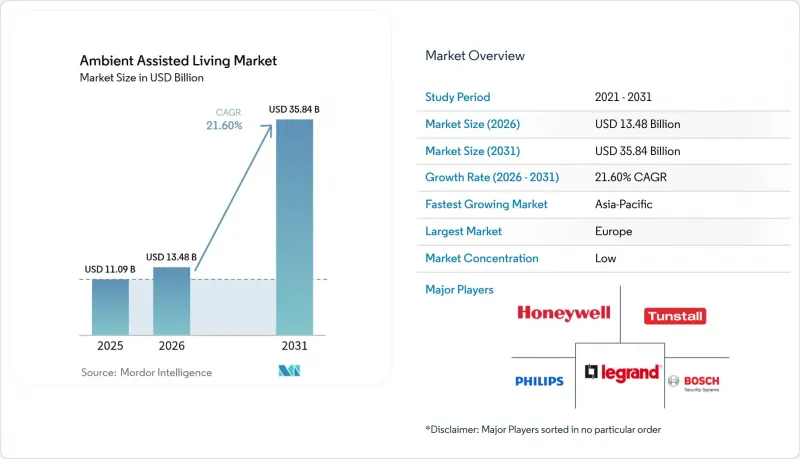
Mordor Intelligence에 의하면, 앰비언트 어시스티드 리빙(AAL) 시장 규모는 2025년에 110억 9,000만 달러로 평가되었습니다. 2026년 134억 8,000만 달러에서 2031년까지 358억 4,000만 달러에 이를 것으로 예상되며, 예측 기간(2026-2031년) CAGR은 21.6%를 나타낼 전망입니다.
본 보고서는 구성 요소(하드웨어, 소프트웨어, 서비스), 기술(스마트 홈 및 자동화 등), 시스템 기능(안전 및 보안, 통신·연결성 등), 배포 모델(독립형 주택, 요양 시설 등),연령대(60-69세, 70-79세, 80세 이상), 지역별로 분류되어 있습니다. 시장 예측은 금액(달러)으로 제시되어 있습니다.
세계의 앰비언트 어시스티드 리빙(AAL) 시장 동향 및 인사이트
‘재택 고령화’ 보상 모델을 향한 급속한 정책 전환
메디케어 어드밴티지는 2024년부터 비의료적 재택 지원 서비스에 대한 급여를 시작하여, 기존에는 본인 부담이었던 서비스를 앰비언트 어시스티드 리빙(AAL) 솔루션에 직접 자금을 지원하는 보상 대상 급여로 전환했습니다. 메디케이드의 재택·지역 밀착형 서비스에서도 유사한 제도가 도입되고 있어, 지급 기관은 고액의 시설 입소 병상을 센서를 활용한 재택 간호로 대체할 수 있게 되었습니다. OECD 회원국 전체에서 2050년까지 장기 요양 예산이 급증할 것으로 예측됨에 따라, 예방적 디지털 모니터링에 대한 지원을 위한 입법 움직임이 더욱 강화되고 있습니다. 이러한 개혁을 통해 앰비언트 어시스티드 리빙(AAL) 기술은 선택적 구매 품목에서 환급 대상 돌봄 서비스로 위상이 변화하고, 총 대상 시장(TAM)이 확대됨과 동시에 의료 시스템 구매자의 도입 장벽이 낮아집니다.
65세 이상 가구의 스마트홈 보급률 급증
팬데믹 기간 동안 고령자의 스마트 기기 도입이 가속화되어, 2024년까지 여러 고소득 국가에서 55세에서 65세 사이 고령자의 스마트폰 이용률은 80%를 넘어섰습니다. 음성 인터페이스, 환경 센서 및 커넥티드 가전제품은 현재 가정 환경에 쉽게 통합되어 있으며, 서비스 제공업체는 낙상 감지, 복약 알림, 사회적 교류 도구를 하나의 설치로 통합하여 제공할 수 있게 되었습니다. PHArA-ON과 같은 EU 이니셔티브를 통해 자금을 지원받은 시범 프로그램에서는 허약한 고령자층에서 수동형 환경 센서가 웨어러블 기기보다 더 높은 수용도를 보인다는 사실이 입증되었습니다. 이는 생활 방식의 변화를 최소화하면서 임상의에게 더 풍부한 데이터 세트를 수집할 수 있는 하드웨어 전략을 뒷받침하는 것입니다.
분산된 상호운용성 표준이 통합된 간병인용 대시보드 구축을 방해하고 있습니다.
주택 및 시설 구매 담당자들은 기기 제조업체마다 건강 데이터 템플릿을 해석하는 방식이 다르기 때문에 여전히 여러 개의 독자적인 포털을 병행하여 사용해야 하는 상황에 처해 있습니다. 미국의 ‘Core Data for Interoperability’나 유럽의 ‘EEHRxF’와 같은 이니셔티브에서는 진전이 보이지만, 그 도입 상황은 여전히 고르지 않습니다. 통합에 드는 비용이 대량 도입의 걸림돌이 되고 있으며, 특히 IT 예산이 부족한 소규모 주거형 요양 사업자에서 그 영향이 두드러집니다. 플러그 앤 플레이 방식의 시맨틱스 부재는 벤더 간 분석을 지연시키고, 예측 모델의 정확도를 제한하며, 조달 팀이 단일 브랜드 생태계에 묶이게 함으로써 결과적으로 전환에 따른 마찰을 야기하고 단기적인 시장 성장을 저해하고 있습니다.
부문별 분석
2025년에는 하드웨어가 매출 점유율의 51.35%를 차지했습니다. 이는 대부분의 설치 기반이 되는 수동형 적외선 센서, 도어 콘택트, 웨어러블 단말기의 대량 출하에 힘입은 결과입니다. 2025년에는 기본 모션 센서의 단가가 10달러 미만으로 떨어지면서 중산층 가구의 보급이 확대되었습니다. 수요는 단일 기능 장치에서 환경 데이터, 생체 인식 데이터, 위치 정보 데이터를 통합하는 멀티 센서 모듈로 이동하고 있습니다. 각 벤더는 배터리 구동 태그에 AI 추론 엔진을 탑재할 수 있게 해준 반도체 기술의 발전으로 혜택을 보고 있으며, 이를 통해 현장 가동 기간이 연장되고 유지보수 비용이 절감되고 있습니다.
서비스 분야는 더욱 빠르게 확대되고 있으며, 서비스 제공업체들이 관리형 모니터링, AI 기반 경보 분류, 연중무휴 24시간 운영되는 가상 콜센터를 통해 수익을 창출함에 따라 2031년까지 연평균 성장률(CAGR)이 23.9%를 나타낼 것으로 예측됩니다. 지불자는 하드웨어 감가상각비, 소프트웨어 라이선스, 전문 대응 팀을 단일 정액 요금으로 묶은 구독 번들을 선호합니다. AAL(Ambient Assisted Living) 시장의 서비스 제공 부문 시장 규모는 5년 이내에 3배 이상 확대될 전망이며, 지속적인 수익원 다각화를 목표로 하는 통신 사업자들에게는 인수 대상이 될 것입니다. 소프트웨어 계층이 고객 유지율을 높이고, 오픈 API 및 원격 펌웨어 관리를 제공하는 플랫폼은 현장 출장 대응을 줄여 매출 총이익률을 향상시킵니다.
스마트 홈 자동화는 Zigbee, Z-Wave, Wi-Fi와 같은 성숙한 소비자용 생태계를 활용함으로써 2025년에는 매출의 47.85%를 차지했습니다. 음성 어시스턴트는 현재 별도의 배선 공사 없이 약물 복용 알림,조명 제어, 간병인에 의한 안부 확인 기능을 통합하여 설치 시간을 30% 단축하고 있습니다. 주류 기기와의 상호 운용성을 통해 벤더는 엔터테인먼트 구독 서비스와 함께 헬스케어 서비스를 업셀링할 수 있는 입지를 확보하며, 가정 내 시장 점유율을 확대되고 있습니다.
연평균 성장률(CAGR) 22.85%가 예상되는 소셜 컴패니언 로봇 분야는 자연어 처리 및 촉각 피드백을 통해 대화가 더욱 인간미 있게 변모함에 따라, 실험적인 신기함에서 확장 가능한 제품 라인으로 전환되고 있습니다. 일본 정부는 간병 로봇 연구 개발 프로그램에 3억 달러 이상을 투자하여 턴키 방식의 로봇 보조 기기의 신속한 상용화 및 수출을 가능하게 했습니다. 모듈식 설계를 통해 문화적 배경에 맞춘 비용 효율적인 맞춤화가 가능해졌으며, 사례 연구에서는 고립된 고령자의 외로움 지수가 통계적으로 유의미한 수준으로 감소한 것으로 보고되었습니다. 로봇 공학을 원격 의료 포털과 통합하는 업체들은 원활한 돌봄의 연속성을 실현하고, 서비스 전환의 장벽을 높이는 동시에 앰비언트 어시스티드 리빙(AAL) 시장의 추가적인 확장을 뒷받침하고 있습니다.
지역별 분석
유럽은 2025년에 매출의 33.65%를 차지했으며, 시범 도입을 지원하고 조달 준비가 완료된 사례 연구 파이프라인을 구축하는 ‘호라이즌 유럽(Horizon Europe)’의 보조금에 힘입고 있습니다(ec.europa.eu). 북유럽 및 DACH 시장의 응급 대응 의무화 규제는 예측 가능한 수요 기준을 마련해 주었으며, 한편 GDPR(EU 개인정보보호규정) 준수 프레임워크는 사용자의 신뢰를 조성했습니다. 각국의 의료 제도에서는 AAL 경보를 전자 진료 기록에 통합하는 움직임이 가속화되고 있으며, 이를 통해 임상의의 업무 흐름이 원활해지고 의료기기 등급 인증 절차가 강화되고 있습니다. 재택 간호 기관과 제휴하는 공급업체는 지불을 보장하는 공공 자금에 의한 상환 제도의 혜택을 받아 지속적인 수익원을 확보하고 있습니다.
아시아태평양에서는 각국 정부가 전례 없는 고령화 곡선에 직면함에 따라 연평균 성장률(CAGR)이 23.1%로 가장 높은 성장세를 보일 것으로 예측됩니다. 일본의 로봇 기술에 대한 보조금, 중국의 ‘스마트 노인 돌봄’ 국가 계획, 그리고 한국의 5G 연계형 만성 질환 모니터링 시범 사업은 정책 주도 시장 형성의 좋은 예입니다. 도시 지역의 인구 밀도는 도입의 경제성을 높입니다. 고층 빌딩 한 동당 수백 세대의 아파트에 네트워크 서비스를 제공할 수 있게 되면 센서 배포 비용은 낮아집니다. 그러나 지방의 디지털 격차는 여전히 존재하며, 공평한 접근을 보장하기 위한 위성 통신의 시범 도입이 진행되고 있습니다. 통신 사업자와 제휴하는 지역 기업들은 소비자용 라우터에 AAL 지원 펌웨어를 탑재함으로써 확산 속도를 높이고, 시장 출시까지의 시간을 단축하며, 지역 전체의 앰비언트 어시스티드 리빙(AAL) 시장 확대를 뒷받침하고 있습니다.
북미에서는 메디케어 어드밴티지(Medicare Advantage)의 보상 제도와 민간 보험사의 인센티브에 힘입어 대규모 도입 기반이 유지되고 있습니다. 병원 시스템에서는 예측 분석을 도입하여 고비용 재입원을 줄이고, 가치 기반 의료의 목표를 달성하고 있습니다. 벤처 자금 조달은 여전히 활발하며, AI를 핵심으로 하는 스타트업 기업들은 3,000만 달러를 넘는 자금 조달 라운드를 성사시켜 제품화 및 지리적 확장에 투자하고 있습니다. 또한, 미국은 소프트웨어 미들웨어의 주요 수출국이기도 하며, 유럽 및 아시아의 디바이스 제조업체에 데이터 통합 스택 라이선스를 제공합니다. 캐나다의 단일 지불자 제도에서는 주 차원의 조달 시범 사업이 진행되고 있으며, 이를 통해 얻은 인사이트를 바탕으로 2027년까지 더 넓은 보급을 가능하게 할 전국적인 상호 운용성 청사진이 수립되고 있습니다.
기타 혜택 :
- 엑셀 형식 시장 예측(ME) 시트
- 3개월간의 애널리스트 지원
자주 묻는 질문
목차
제1장 서론
제2장 조사 방법
제3장 주요 요약
제4장 시장 구도
제5장 시장 규모 및 성장 예측
제6장 경쟁 구도
제7장 시장 기회 및 향후 전망
KTH 26.09.14According to Mordor Intelligence, the ambient assisted living market size was valued at USD 11.09 billion in 2025 and estimated to grow from USD 13.48 billion in 2026 to reach USD 35.84 billion by 2031, at a CAGR of 21.6% during the forecast period (2026-2031).
This report is Segmented by Component (Hardware, Software, Services), Technology (Smart Home and Automation, and More), System Function (Safety and Security, Communication and Connectivity, and More), Deployment Model (Stand-Alone Residential Units, Assisted Living Facilities, and More), Age Group (60-69 Years, 70-79 Years, 80+ Years), and Geography. The Market Forecasts are Provided in Terms of Value (USD).
Global Ambient Assisted Living Market Trends and Insights
Rapid Policy Shifts Toward Aging-in-Place Reimbursement Models
Medicare Advantage began covering non-medical home supports in 2024, converting formerly out-of-pocket services into reimbursable benefits that directly fund Ambient Assisted Living solutions . Similar parity is emerging in Medicaid Home and Community-Based Services, allowing payers to substitute costly institutional beds with sensor-enhanced home care. Across OECD economies, long-term care budgets are projected to rise sharply by 2050, reinforcing legislative momentum to subsidize proactive digital monitoring. These reforms reposition Ambient Assisted Living technologies from discretionary purchases to reimbursable care, enlarging the total addressable market and lowering adoption friction for health-system buyers.
Surge in Smart-Home Penetration Among 65+ Households
Older adults accelerated smart-device adoption during the pandemic, and by 2024 smartphone usage exceeded 80% among 55- to 65-year-olds in multiple high-income countries. Voice interfaces, ambient sensors, and connected appliances now integrate easily into the domestic environment, allowing providers to bundle fall detection, medication reminders, and social-engagement tools in one installation. Pilot programs funded through EU initiatives such as PHArA-ON demonstrated that passive ambient sensors achieved higher acceptance than wearables among frail seniors, supporting hardware strategies that minimize lifestyle disruption while collecting richer datasets for clinicians.
Fragmented Interoperability Standards Hindering Unified Caregiver Dashboards
Residential and institutional buyers still juggle multiple proprietary portals because device makers interpret health-data templates differently. Despite progress in initiatives such as the United States Core Data for Interoperability and Europe's EEHRxF, implementation remains uneven . Integration costs suppress volume deployments, particularly in small home-care agencies that lack IT budgets. The absence of plug-and-play semantics delays cross-vendor analytics, limits predictive-model accuracy, and forces procurement teams to lock in single-brand ecosystems, creating switching frictions that mute near-term market acceleration.
Other drivers and restraints analyzed in the detailed report include:
- AI-Driven Predictive Analytics Lowering False-Alarm Rates
- 5G / Fibre Roll-outs Enabling Low-Latency Remote Care Services Across Asia
- Privacy and Data-Sovereignty Rules Limiting Cross-Border Monitoring
For complete list of drivers and restraints, kindly check the Table Of Contents.
Segment Analysis
Hardware captured a 51.35% revenue share in 2025, underpinned by volume shipments of passive infrared sensors, door contacts, and wearables that anchor most installations. Unit prices dropped below USD 10 for basic motion sensors in 2025, widening access for mid-income households. Demand is shifting from single-function devices to multi-sensor modules that integrate environmental, biometric, and location data feeds. Vendors benefit from silicon advances that squeeze AI inference engines onto battery-powered tags, prolonging field life and trimming maintenance.
Services are scaling faster, projected at 23.9% CAGR to 2031 as providers monetize managed monitoring, AI-based alert triage, and 24/7 virtual call centers. Payers favor subscription bundles that combine hardware amortization, software licenses, and professional response teams under one capitated fee. The Ambient Assisted Living market size for service offerings is set to more than triple within five years, creating acquisition targets for telecom operators seeking recurring revenue diversification. Software layers add stickiness; platforms offering open APIs and remote firmware management reduce truck rolls and improve gross margins.
Smart-home automation retained 47.85% revenue in 2025 by piggybacking on mature consumer ecosystems such as Zigbee, Z-Wave, and Wi-Fi. Voice assistants now integrate medication reminders, lighting cues, and caregiver check-ins without custom wiring, cutting installation times by 30%. Interoperability with mainstream devices positions vendors to upsell health services alongside entertainment subscriptions, broadening household reach.
Social and companion robotics, forecast to grow 22.85% CAGR, is transitioning from pilot novelty to scalable product line as natural-language processing and haptic feedback humanize interactions. Japan's government injected more than USD 300 million into care-robot RandD programs, enabling rapid commercialization and export of turnkey robotic aides. Modular designs facilitate cost-effective customization for cultural context, and case studies report statistically significant reductions in loneliness metrics among isolated seniors. Vendors integrating robotics with telehealth portals enable seamless continuity of care, raising switching barriers and fueling the next leg of Ambient Assisted Living market expansion.
Complete Report Scope:
- By Component
- Hardware
- Sensors
- Actuators
- Wearable and Smart Devices
- Smart Appliances
- Software (AI and Analytics Platforms, Middleware and Device Management, Security and Privacy)
- Services (Installation and Integration, Managed Services, Emergency Response and Monitoring)
- Hardware
- By Technology
- Smart Home and Automation
- Telehealth and Telecare
- Wearable Devices
- Social and Companion Robotics
- By System Function
- Safety and Security
- Communication and Connectivity
- Health and Medical Assistive
- Mobility and Transport
- Vitality and Wellness
- By Deployment Model
- Stand-alone Residential Units
- Assisted Living Facilities
- Senior Care Homes
- Hospitals and Clinics
- By Age Group
- 60-69 Years
- 70-79 Years
- 80+ Years
- By Geography
- North America
- United States
- Canada
- Mexico
- South America
- Brazil
- Argentina
- Rest of South America
- Asia Pacific
- China
- Japan
- India
- South Korea
- ASEAN
- Australia
- New Zealand
- Rest of Asia Pacific
- Europe
- Germany
- United Kingdom
- France
- Italy
- Spain
- Nordics (Sweden, Denmark, Norway, Finland)
- Rest of Europe
- Middle East and Africa
- Middle East
- Saudi Arabia
- United Arab Emirates
- Qatar
- Kuwait
- Bahrain
- Rest of Middle East
- Africa
- South Africa
- Nigeria
- Kenya
- Rest of Africa
- Middle East
- North America
Geography Analysis
Europe commanded 33.65% revenue in 2025, supported by Horizon Europe grants that subsidize pilot deployments and build a pipeline of procurement-ready case studies ec.europa.eu. Mandatory emergency-response regulations in Nordic and DACH markets created predictable demand baselines, while GDPR compliance frameworks cultivated user trust. National health systems are increasingly integrating AAL alerts into electronic health records, smoothing clinician workflows and bolstering medical-device-class certification pathways. Vendors partnering with home-care agencies benefit from publicly funded reimbursement schemes that guarantee payment, anchoring recurring revenue streams.
Asia-Pacific will generate the fastest 23.1% CAGR as governments confront unprecedented aging curves. Japan's robotics subsidies, China's smart-senior-care national plan, and South Korea's 5G-linked chronic-disease monitoring pilots illustrate policy-led market making. Urban density aids installation economics; sensor distribution costs fall when networks can service hundreds of apartments per vertical tower. However, rural digital divide persists, prompting satellite connectivity trials to ensure equitable access. Regional players collaborating with telecom carriers accelerate rollout by embedding AAL-ready firmware on consumer routers, shrinking time-to-market and fueling Ambient Assisted Living market acceleration across the region.
North America maintains a large installed base, propelled by Medicare Advantage reimbursement and private insurer incentives. Hospital systems adopt predictive analytics to trim costly readmissions and meet value-based care targets. Venture funding remains vigorous, with AI-centric start-ups attracting rounds above USD 30 million that finance productization and geographic scaling. The United States is also a leading exporter of software middleware, licensing data-integration stacks to European and Asian device makers. Canada's single-payer system conducts province-level procurement pilots, and lessons learned are forming national interoperability blueprints that could unlock broader adoption by 2027.
- Koninklijke Philips N.V.
- Tunstall Healthcare Group
- Legrand SA
- Honeywell International Inc.
- Bosch Security & Safety Systems GmbH
- Johnson Controls International plc
- CareTech AB
- Doro AB
- Sensara BV
- Alcove Ltd
- 2PCS Solutions GmbH
- Cogvis Software and Consulting GmbH
- Cerner Corporation
- Televic Group NV
- Assisted Living Technologies Inc.
- GrandCare Systems
- Medical Guardian LLC
- GetSafe Home Security
- Huawei Technologies Co. Ltd.
- Panasonic Corporation
- Resideo Technologies Inc.
- LifeStation Inc.
Additional Benefits:
- The market estimate (ME) sheet in Excel format
- 3 months of analyst support
TABLE OF CONTENTS
1 INTRODUCTION
- 1.1 Study Assumptions and Market Definition
- 1.2 Scope of the Study
2 RESEARCH METHODOLOGY
3 EXECUTIVE SUMMARY
4 MARKET LANDSCAPE
- 4.1 Market Overview
- 4.2 Evolution of the Ambient Assisted Living Sector
- 4.3 Value Chain and Business Models
- 4.4 Regulatory and Technological Outlook
- 4.5 Market Drivers
- 4.5.1 Rapid policy shifts toward ageing-in-place reimbursement models in OECD economies
- 4.5.2 Surge in smart-home penetration among 65+ households in North America and Europe
- 4.5.3 AI-driven predictive analytics lowering false-alarm rates in emergency response
- 4.5.4 5G?/?fibre roll-outs enabling low-latency remote care services across Asia
- 4.5.5 EU Horizon Europe and AAL-Programme grants accelerating start-up adoption
- 4.5.6 Declining costs of edge sensors and wearables
- 4.6 Market Restraints
- 4.6.1 Fragmented interoperability standards hindering unified caregiver dashboards
- 4.6.2 Privacy and data-sovereignty rules (GDPR, HIPAA) limiting cross-border monitoring
- 4.6.3 Low digital literacy among 75+ cohort in rural regions
- 4.6.4 Reimbursement gaps for non-clinical AAL services in emerging markets
- 4.7 Porter's Five Forces
- 4.7.1 Bargaining Power of Suppliers
- 4.7.2 Bargaining Power of Buyers
- 4.7.3 Threat of New Entrants
- 4.7.4 Intensity of Competitive Rivalry
- 4.7.5 Threat of Substitutes
5 MARKET SIZE AND GROWTH FORECASTS (VALUE)
- 5.1 By Component
- 5.1.1 Hardware
- 5.1.1.1 Sensors
- 5.1.1.2 Actuators
- 5.1.1.3 Wearable and Smart Devices
- 5.1.1.4 Smart Appliances
- 5.1.2 Software (AI and Analytics Platforms, Middleware and Device Management, Security and Privacy)
- 5.1.3 Services (Installation and Integration, Managed Services, Emergency Response and Monitoring)
- 5.1.1 Hardware
- 5.2 By Technology
- 5.2.1 Smart Home and Automation
- 5.2.2 Telehealth and Telecare
- 5.2.3 Wearable Devices
- 5.2.4 Social and Companion Robotics
- 5.3 By System Function
- 5.3.1 Safety and Security
- 5.3.2 Communication and Connectivity
- 5.3.3 Health and Medical Assistive
- 5.3.4 Mobility and Transport
- 5.3.5 Vitality and Wellness
- 5.4 By Deployment Model
- 5.4.1 Stand-alone Residential Units
- 5.4.2 Assisted Living Facilities
- 5.4.3 Senior Care Homes
- 5.4.4 Hospitals and Clinics
- 5.5 By Age Group
- 5.5.1 60-69 Years
- 5.5.2 70-79 Years
- 5.5.3 80+ Years
- 5.6 By Geography
- 5.6.1 North America
- 5.6.1.1 United States
- 5.6.1.2 Canada
- 5.6.1.3 Mexico
- 5.6.2 South America
- 5.6.2.1 Brazil
- 5.6.2.2 Argentina
- 5.6.2.3 Rest of South America
- 5.6.3 Asia Pacific
- 5.6.3.1 China
- 5.6.3.2 Japan
- 5.6.3.3 India
- 5.6.3.4 South Korea
- 5.6.3.5 ASEAN
- 5.6.3.6 Australia
- 5.6.3.7 New Zealand
- 5.6.3.8 Rest of Asia Pacific
- 5.6.4 Europe
- 5.6.4.1 Germany
- 5.6.4.2 United Kingdom
- 5.6.4.3 France
- 5.6.4.4 Italy
- 5.6.4.5 Spain
- 5.6.4.6 Nordics (Sweden, Denmark, Norway, Finland)
- 5.6.4.7 Rest of Europe
- 5.6.5 Middle East and Africa
- 5.6.5.1 Middle East
- 5.6.5.1.1 Saudi Arabia
- 5.6.5.1.2 United Arab Emirates
- 5.6.5.1.3 Qatar
- 5.6.5.1.4 Kuwait
- 5.6.5.1.5 Bahrain
- 5.6.5.1.6 Rest of Middle East
- 5.6.5.2 Africa
- 5.6.5.2.1 South Africa
- 5.6.5.2.2 Nigeria
- 5.6.5.2.3 Kenya
- 5.6.5.2.4 Rest of Africa
- 5.6.5.1 Middle East
- 5.6.1 North America
6 COMPETITIVE LANDSCAPE
- 6.1 Market Concentration
- 6.2 Strategic Moves
- 6.3 Market Share Analysis
- 6.4 Company Profiles {(includes Global level Overview, Market level overview, Core Segments, Financials as available, Strategic Information, Market Rank/Share for key companies, Products and Services, and Recent Developments)}
- 6.4.1 Koninklijke Philips N.V.
- 6.4.2 Tunstall Healthcare Group
- 6.4.3 Legrand SA
- 6.4.4 Honeywell International Inc.
- 6.4.5 Bosch Security & Safety Systems GmbH
- 6.4.6 Johnson Controls International plc
- 6.4.7 CareTech AB
- 6.4.8 Doro AB
- 6.4.9 Sensara BV
- 6.4.10 Alcove Ltd
- 6.4.11 2PCS Solutions GmbH
- 6.4.12 Cogvis Software and Consulting GmbH
- 6.4.13 Cerner Corporation
- 6.4.14 Televic Group NV
- 6.4.15 Assisted Living Technologies Inc.
- 6.4.16 GrandCare Systems
- 6.4.17 Medical Guardian LLC
- 6.4.18 GetSafe Home Security
- 6.4.19 Huawei Technologies Co. Ltd.
- 6.4.20 Panasonic Corporation
- 6.4.21 Resideo Technologies Inc.
- 6.4.22 LifeStation Inc.
7 MARKET OPPORTUNITIES AND FUTURE OUTLOOK
- 7.1 White-space and Unmet-Need Assessment