|
시장보고서
상품코드
2124746
미국의 시니어 리빙 시장 : 시장 점유율 분석, 업계 동향 및 통계, 성장 예측(2026-2031년)United States Senior Living - Market Share Analysis, Industry Trends & Statistics, Growth Forecasts (2026 - 2031) |
||||||
 Mordor Intelligence
Mordor Intelligence에 의하면, 2026년 미국의 시니어 리빙 시장 규모는 763억 9,000만 달러로 추정되고, 2025년 721억 1,000만 달러에서 확대해, 2031년에는 1,018억 6,000만 달러에 이를 것으로 예측됩니다.
2026-2031년 연평균 성장률(CAGR)은 5.92%를 나타낼 전망입니다.
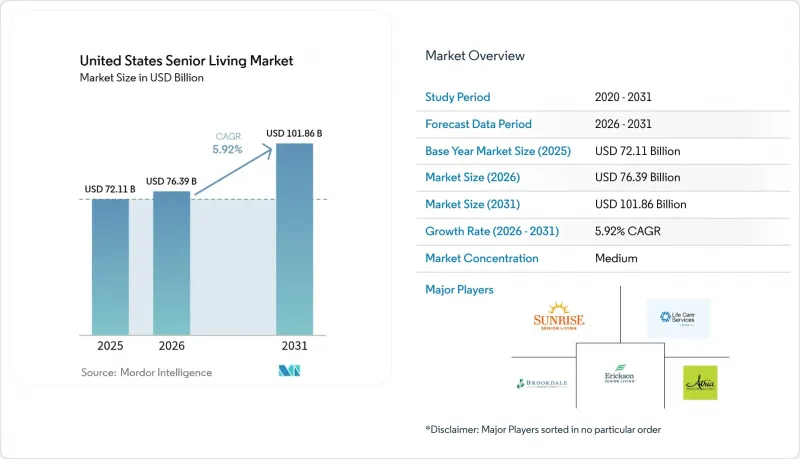
본 보고서는 주택 유형별(지원형, 자립형, 치매 케어, 요양), 비즈니스 모델별(완전 매각(프리홀드), 장기 임대, 하이브리드(매각+임대)), 연령(55-64세, 65-74세, 그 이상), 주(텍사스주, 캘리포니아주, 플로리다주, 뉴욕주, 일리노이주, 기타)별로 분류되어 있습니다. 시장 예측은 금액(달러)으로 표시되어 있습니다.
미국의 시니어 리빙 시장 동향 및 인사이트
고령화되는 베이비붐 세대가 모든 돌봄 수준에서 지속적인 수요를 견인
약 6,900만 명에 달하는 베이비붐 세대의 거의 전원이 2033년까지 70세 이상이 됨에 따라, 미국 시니어 리빙 시장의 입주자층이 극적으로 확대될 것입니다. 이 세대의 높은 주택 소유율과 순자산은 자비 부담의 경제적 부담을 완화하는 기반이 되고 있으며, 한편 기술의 보급이 진행됨에 따라 디지털을 활용한 돌봄에 대한 수용도도 높아지고 있습니다. 전문적인 간호나 치매 돌봄이 필요할 가능성이 가장 높은 85세 이상 인구는 2040년까지 2배로 늘어날 것으로 예상되며, 고도의 의료 돌봄 서비스에 대한 수요가 확실시되고 있습니다. 텍사스주나 플로리다주 등 세제 및 기후적 이점을 활용해 은퇴자들을 유치하고 있는 주에서는 특히 강력한 성장이 예상됩니다. 이 부유층이자 기술에 정통한 세대에 맞추어 편의 시설, 지불 계획, 마케팅을 최적화하는 사업자는 평생 가치를 확보할 수 있는 위치에 있습니다. 그린 스트리트의 추산에 따르면, 고령자의 40% 이상이 자산을 매각하지 않고도 노인 주택 비용을 지불할 수 있는 것으로 나타났으며, 이는 막대한 잠재 수요가 있음을 시사합니다.
개발과 통합을 뒷받침하는 활발한 자본 시장과 헬스케어 REIT
헬스케어 REIT는 미국 내 시니어 주거 시장 자산에 사상 최대 규모의 자금을 투입하고 있습니다. 벤타스(Ventas)는 2024년에 20억 달러를 투자한 데 이어, 2025년 투자 목표를 15억 달러로 상향 조정하며 이 부문의 펀더멘털에 대한 장기적인 확신을 보여주었습니다. Welltower가 Amica Senior Lifestyles를 32억 달러에 인수한 사례는 REIT가 우량 포트폴리오를 확보하기 위해 어느 정도의 규모로 거래를 진행하는지 여실히 보여줍니다. 부채 자본은 여전히 풍부하여, Walker & Dunlop은 2024년에 6억 달러 규모의 시니어 리빙용 대출을 주선했습니다. Fortress와 같은 대형 사모펀드들도 경쟁에 가세하여 평가액을 끌어올리는 동시에 운영 측면의 개선을 촉진하고 있습니다. 풍부한 유동성은 공급 부족이 있는 대도시권의 신규 건설을 뒷받침하고, 지역 소유주 및 운영자에게 엑시트 경로를 제공함으로써 생태계 전체의 통합과 전문화를 가속화하고 있습니다.
인력 부족과 임금 인플레이션이 이익률과 서비스 수준에 압박을 가하고 있습니다.
심각한 인력 부족은 사실상 모든 돌봄 수준에서 문제가 되고 있으며, 시설들은 시급 인상과 복리후생 확충을 강요받고, 파견 근로자에 대한 의존도를 높이고 있습니다. 입소자 1인당 하루 3.48시간의 간호 시간을 의무화하는 CMS(미국 의료보험·의료서비스센터)의 새로운 요양 시설 인력 배치 규정은 자격을 갖춘 간호사를 둘러싼 경쟁을 통해 요양 주택 및 자립 생활 시설로도 파급되고 있습니다. 현재 24시간 365일 간호사 배치 의무를 충족하는 요양 시설은 고작 6%에 불과하며, 이는 업계를 아우르는 입찰 경쟁을 유발하여 이익률을 압박하고 있습니다. 네바다주에서 시급을 16달러에서 20달러로 인상하라는 요구 등 요양 종사자들의 임금 인상 운동은 인플레이션 압력을 여실히 드러내고 있습니다. 연방거래위원회(FTC)가 검토 중인 경쟁 금지 조항 금지 조치는 이직률을 더욱 높이고, 돌봄의 연속성을 저해할 우려가 있습니다. 지방의 운영 사업자들은 가장 큰 장벽에 직면해 있으며, 의무화된 직원 대 입소자 비율을 유지하기 위해 입소자 수용을 제한할 수밖에 없는 경우도 있습니다.
부문 분석
2025년 기준, 요양 시설은 시장 규모의 40.62%를 차지했으며, 2031년까지 연평균 성장률(CAGR) 6.29%라는 가장 높은 성장률을 기록할 전망입니다. 이러한 수요는 여러 만성 질환을 앓고 있는 입소자들이 병원으로의 전원 대신 지속적인 돌봄이 제공되는 환경에서 재택 노년을 보내기를 원하기 때문입니다. 지원형 시설이 여전히 주류를 이루고 있지만, 운영 사업자들은 입소자를 유지하고 부가가치를 창출하기 위해 치매 돌봄 및 아급성기 돌봄을 위한 시설을 개조하고 있습니다. 자립형 커뮤니티는 라이프스타일을 고려한 편의 시설, 피트니스 센터, 셰프가監修한 식사, 문화 프로그램에 중점을 두고 있으며, 자립을 중시하는 비교적 젊은 고령자를 대상으로 하고 있습니다. 보안 대책이 마련된 구조와 치매 돌봄 훈련을 받은 직원을 갖춘 기억 돌봄 유닛의 성숙은 주거 환경의 분위기를 유지하면서도 보다 고도화된 돌봄으로의 전환이 진행되고 있음을 보여줍니다. 지속적 돌봄형 은퇴 커뮤니티는 틈새 시장이지만, 계약에 따라 여러 수준의 돌봄 서비스를 이용하고자 하는 부유층 노인들 사이에서 지지를 넓혀가고 있습니다.
요양 돌봄이 주류를 이루고 있는 만큼, 임상 직원 연수, 음압실, 시설 내 재활실 등에 대한 설비 투자가 요구되고 있습니다. 운영 사업자는 안전성과 효율성을 높이기 위해 전자 투약 관리 기록 및 스마트 리프트를 도입하고 있습니다. 돌봄 서비스의 고도화에 따라 재입원율 감소를 목표로 하는 보험사와의 제휴도 증가하고 있으며, 미국의 시니어 리빙 시장에는 보험사 주도의 수익원이 추가되고 있습니다. 그러나 인력 배치 비율, 감염 대책 및 보수의 적정성에 대한 규제 당국의 감시는 여전히 엄격하여, 높은 수준의 규정 준수 체제가 요구되고 있습니다.
기타 혜택 :
- 엑셀 형식 시장 예측(ME) 시트
- 3개월간의 애널리스트 지원
자주 묻는 질문
목차
제1장 서론
제2장 조사 방법
제3장 주요 요약
제4장 시장 동향과 분석
제5장 시장 규모 및 성장 예측
제6장 경쟁 구도
제7장 시장 기회 및 향후 전망
AJY 26.09.15According to Mordor Intelligence, United States senior living market size in 2026 is estimated at USD 76.39 billion, growing from 2025 value of USD 72.11 billion with 2031 projections showing USD 101.86 billion, growing at 5.92% CAGR over 2026-2031.
This report is Segmented by Property Type (Assisted Living, Independent Living, Memory Care, Nursing Care), by Business Model (Outright Sale (Freehold), Long-Lease / Rental, Hybrid (Sale + Lease)), by Age (55 To 64 Years, 65 To 74 Years, and More), and by States (Texas, California, Florida, New York, Illinois, Rest of US). The Market Forecasts are Provided in Terms of Value (USD).
United States Senior Living Market Trends and Insights
Aging Baby-Boomer Cohort Driving Sustained Demand Across Care Levels
Nearly all 69 million baby boomers will be 70 or older by 2033, dramatically enlarging the resident pool for the United States senior living market. Higher home ownership and net worth among this cohort underpin private-pay affordability, while broader acceptance of technology raises comfort with digitally enabled care. The 85-plus population, most likely to require skilled nursing and memory care, is set to double by 2040, guaranteeing demand for high-acuity services. States attracting retirees through favorable taxes and climate, such as Texas and Florida, will see especially strong growth. Operators that tailor amenities, payment plans, and marketing to this wealthier, tech-savvy generation are positioned to capture lifetime value. Green Street estimates show more than 40% of seniors can pay for senior housing without liquidating assets, indicating significant latent demand.
Deep Capital Markets and Active Healthcare REITs Supporting Development and Consolidation
Healthcare REITs are pouring record funds into United States senior living market assets. Ventas lifted its 2025 investment target to USD 1.5 billion after deploying USD 2 billion in 2024, signaling long-term conviction in sector fundamentals. Welltower's USD 3.2 billion acquisition of Amica Senior Lifestyles illustrates the scale REITs will transact to secure premier portfolios. Debt capital remains abundant, with Walker & Dunlop arranging USD 600 million in seniors-housing loans during 2024. Private equity heavyweights such as Fortress add further competition for assets, driving valuations and spurring operational upgrades. Strong liquidity supports new builds in undersupplied metros and offers exit paths for regional owner-operators, accelerating consolidation and professionalization across the ecosystem.
Labor Shortages and Wage Inflation Pressuring Margins and Service Levels
Severe staffing shortages plague virtually every care level, forcing communities to raise hourly wages, expand benefits, and rely heavily on agency labor. New CMS nursing-home staffing rules requiring 3.48 nursing hours per resident per day ripple into assisted and independent living through competition for licensed nurses. Only 6% of nursing homes currently meet the 24/7 RN mandate, driving cross-sector bidding wars that compress margins. Caregiver wage campaigns, such as Nevada's push from USD 16 to USD 20 per hour, spotlight inflationary pressures. The FTC's pending ban on non-compete clauses may further elevate turnover, undermining continuity of care. Operators in rural areas confront the steepest hurdles, sometimes restricting admissions to maintain mandated staff-resident ratios.
Other drivers and restraints analyzed in the detailed report include:
- Shift to Healthcare-Integrated Models Enhancing Value Proposition and Resident Outcomes
- Home-Sale Equity and Retirement Savings Enabling Private-Pay Affordability
- State-by-State Regulatory Complexity Increasing Compliance Costs and Development Timelines
For complete list of drivers and restraints, kindly check the Table Of Contents.
Segment Analysis
Nursing care facilities controlled 40.62% of the United States senior living market size in 2025 and will post the quickest 6.29% CAGR through 2031. Demand stems from residents with multiple chronic conditions who prefer aging in place within a continuum-of-care setting instead of hospital transfers. Assisted-living remains the mainstream entry point, yet operators retrofit wings for memory-care or sub-acute services to retain residents and capture value. Independent-living communities focus on lifestyle amenities, fitness centers, chef-led dining, and cultural programs, geared toward younger seniors who prize autonomy. The maturation of memory-care units, complete with secured layouts and dementia-trained staff, illustrates the sector's pivot to higher acuity while preserving residential ambience. Continuing-care retirement communities, though niche, gain traction among affluent seniors desiring contractual access to multiple care levels.
Nursing-care dominance compels capital investment in clinical staff training, negative-pressure rooms, and on-site therapy suites. Operators deploy electronic medication-administration records and smart lifts to boost safety and efficiency. Rising acuity also attracts insurer partnerships seeking reduced readmissions, adding payer-driven revenue to the United States senior living market. However, regulatory scrutiny on staffing ratios, infection control, and reimbursement adequacy remains intense, requiring sophisticated compliance infrastructures.
Complete Report Scope:
- By Property Type
- Assisted Living
- Independent Living
- Memory Care
- Nursing Care
- By Business Model
- Outright Sale (Freehold)
- Long-Lease / Rental
- Hybrid (Sale + Lease)
- By Age
- 55 to 64 years
- 65 to 74 years
- 75 to 85 years
- Above 85 years
- By States
- Texas
- California
- Florida
- New York
- Illinois
- Rest of US
List of Companies Covered in this Report:
- Brookdale Senior Living Inc.
- Atria Senior Living Inc.
- LCS (Life Care Services)
- Erickson Senior Living
- Sunrise Senior Living
- Five Star Senior Living
- Holiday by Atria
- Kisco Senior Living
- Sonida Senior Living
- Watermark Retirement Communities
- Silverado Senior Living
- Trilogy Health Services
- Benchmark Senior Living
- Ensign Group Inc.
- Ventas Inc.
- Welltower Inc.
- Capital Senior Living (Grace Management)
- Pegasus Senior Living
- Frontier Management
- Merrill Gardens
Additional Benefits:
- The market estimate (ME) sheet in Excel format
- 3 months of analyst support
TABLE OF CONTENTS
1 Introduction
- 1.1 Study Assumptions & Market Definition
- 1.2 Scope of the Study
2 Research Methodology
3 Executive Summary
4 Market Insights and dynamics
- 4.1 Market Overview
- 4.2 Market Drivers
- 4.2.1 Aging baby-boomer cohort driving sustained demand across independent, assisted, and memory care
- 4.2.2 Deep capital markets and active healthcare REITs supporting development and consolidation
- 4.2.3 Shift to healthcare-integrated models (primary care, rehab, memory care) enhancing value proposition
- 4.2.4 Home-sale equity and retirement savings enabling private-pay affordability in many metros
- 4.2.5 Technology adoption (remote monitoring, EHRs, fall detection) elevating care quality and efficiency
- 4.3 Market Restraints
- 4.3.1 Labor shortages and wage inflation pressuring margins and service levels
- 4.3.2 State-by-state regulatory complexity increasing compliance costs and timelines
- 4.3.3 Affordability gaps and uneven occupancy recovery in certain secondary markets
- 4.4 Value / Supply-Chain Analysis
- 4.5 Policy & Regulatory Framework (state guidelines, licensing, incentives)
- 4.6 Insight on Upcoming and Ongoing Projects
- 4.7 Insights on Digital & Tech Enablers (telemedicine, smart amenities)
- 4.8 Insights on Business Model & Operator Evolution
- 4.9 Insights on Investment & Financing Trends
- 4.10 Insights Sustainability & Design Innovation
- 4.11 Porter's Five Forces
- 4.11.1 Bargaining Power of Suppliers
- 4.11.2 Bargaining Power of Buyers/Consumers
- 4.11.3 Threat of New Entrants
- 4.11.4 Threat of Substitutes
- 4.11.5 Competitive Rivalry
5 Market Size & Growth Forecasts (Value)
- 5.1 By Property Type
- 5.1.1 Assisted Living
- 5.1.2 Independent Living
- 5.1.3 Memory Care
- 5.1.4 Nursing Care
- 5.2 By Business Model
- 5.2.1 Outright Sale (Freehold)
- 5.2.2 Long-Lease / Rental
- 5.2.3 Hybrid (Sale + Lease)
- 5.3 By Age
- 5.3.1 55 to 64 years
- 5.3.2 65 to 74 years
- 5.3.3 75 to 85 years
- 5.3.4 Above 85 years
- 5.4 By States
- 5.4.1 Texas
- 5.4.2 California
- 5.4.3 Florida
- 5.4.4 New York
- 5.4.5 Illinois
- 5.4.6 Rest of US
6 Competitive Landscape
- 6.1 Market Concentration
- 6.2 Strategic Moves
- 6.3 Company Profiles (includes Global level Overview, Market level overview, Core Segments, Financials as available, Strategic Information, Products & Services, and Recent Developments)
- 6.3.1 Brookdale Senior Living Inc.
- 6.3.2 Atria Senior Living Inc.
- 6.3.3 LCS (Life Care Services)
- 6.3.4 Erickson Senior Living
- 6.3.5 Sunrise Senior Living
- 6.3.6 Five Star Senior Living
- 6.3.7 Holiday by Atria
- 6.3.8 Kisco Senior Living
- 6.3.9 Sonida Senior Living
- 6.3.10 Watermark Retirement Communities
- 6.3.11 Silverado Senior Living
- 6.3.12 Trilogy Health Services
- 6.3.13 Benchmark Senior Living
- 6.3.14 Ensign Group Inc.
- 6.3.15 Ventas Inc.
- 6.3.16 Welltower Inc.
- 6.3.17 Capital Senior Living (Grace Management)
- 6.3.18 Pegasus Senior Living
- 6.3.19 Frontier Management
- 6.3.20 Merrill Gardens
7 Market Opportunities & Future Outlook
- 7.1 White-space & Unmet-Need Assessment