|
시장보고서
상품코드
2124575
첨단 배전 관리 시스템 : 시장 점유율 분석, 업계 동향과 통계, 성장 예측(2026-2031년)Advanced Distribution Management System - Market Share Analysis, Industry Trends & Statistics, Growth Forecasts (2026 - 2031) |
||||||
 Mordor Intelligence
Mordor Intelligence에 의하면, 2026년 첨단배전 관리 시스템(DMS) 시장 규모는 43억 1,000만 달러로 추정되며, 2025년 36억 달러에서 2031년에는 105억 3,000만 달러에 달할 것으로 예측됩니다.
2026-2031년 연평균 성장률(CAGR)은 19.60%를 기록할 것으로 전망됩니다.
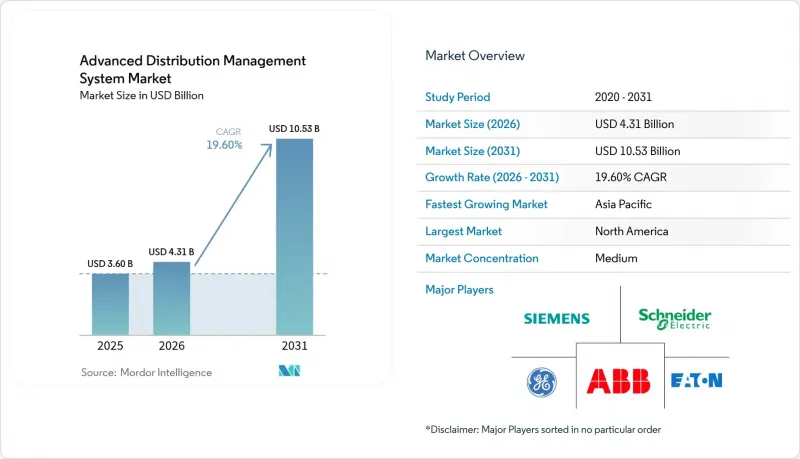
본 보고서는 제공 형태(소프트웨어 및 서비스), 도입 형태(On-Premise, 클라우드, 하이브리드), 시스템 유형(배전 관리 시스템(DMS), AMR/AMI 등), 최종 사용자 업종(에너지 및 유틸리티, IT 및 통신, 제조업 등), 그리고 지역별로 분류되어 있습니다. 시장 전망은 금액(달러) 기준으로 제시되어 있습니다.
세계 첨단 배전 관리 시스템 시장 동향 및 인사이트
스마트 그리드의 디지털화가 급속히 확산
전력 회사는 실시간 상황 파악 기능이 부족한 레거시 시스템을 대체하기 위해 디지털 제어 시스템의 업그레이드를 급속도로 추진하고 있습니다. 중국 국가전망은 2025년까지 배전 자동화 및 첨단 계량 시스템 도입에 887억 달러를 배정하여, 대규모 스마트 그리드 구축에서 이 지역의 주도적 입지를 공고히 하고 있습니다. 유럽의 송배전 사업자들은 전기화 목표를 달성하기 위해 연간 배전 투자액을 670억 유로(757억 달러)로 늘려야 하며, 이러한 의무로 인해 ADMS의 즉각적인 도입이 시급해졌습니다. 조기 도입 기업에 따르면, 완전히 통합된 ADMS가 가동된 후 정전 시간이 21% 단축되고, 복구 시간이 17% 단축되어 연간 약 1억 5,000만 달러의 비용 절감 효과를 거두고 있습니다.
분산형 에너지 자원의 통합이 진전
지붕형 태양광 발전, 고정형 배터리, V2G(Vehicle-to-Grid) 자산에서 발생하는 양방향 전력 흐름은 기존의 배전 관리 워크플로우를 압도하고 있습니다. 인도에서는 태양광 발전, 수력 발전, 축전지의 운영을 공동으로 최적화하는 첨단 ADMS 알고리즘을 활용하여 2024년에 사상 최고치인 241기가와트의 피크 부하를 부족 없이 충당했습니다. 미국에서는 FERC 지침 2222에 따라 집약된 분산형 에너지 자원(DER) 시장 참여가 의무화되어 있어, 전력 회사는 DER의 가시화와 운영을 동기화하는 ADMS 플랫폼 도입을 요구받고 있습니다.
높은 초기 설비 투자 비용과 통합의 복잡성
하드웨어를 제외한 ADMS의 본격적인 도입에는 500만-5,000만 달러의 비용이 소요될 수 있습니다. 변압기의 긴 생산 리드타임은 18-24개월에 달하여 자본 배분 위험을 가중시키고 있습니다. 기존 SCADA 및 요금 청구 플랫폼과의 인터페이스 구축으로 인해 프로젝트 기간이 2배로 늘어나는 경우가 많아, SaaS(Software-as-a-Service) 옵션을 검토 중인 중소규모 전력 회사에게는 큰 과제가 되고 있습니다.
부문 분석
2025년 첨단 배전 관리 시스템(ADMS) 시장에서 소프트웨어가 80.30%를 차지하여, 전력 회사가 통합 제어 제품군을 선호하는 경향이 입증되었습니다. 서비스 부문은 21.40%의 연평균 성장률(CAGR)을 기록하고 있는데, 이는 장기적인 통합, 보안 강화, 지속적인 최적화를 위해 전문가의 지원이 필수적이기 때문입니다. 슈나이더 일렉트릭은 2024년에 382억 유로(432억 달러)의 매출을 기록했으며, 그 상당 부분이 송전망 소프트웨어의 라이프사이클 서비스에서 비롯되었습니다. 컨설팅 계약은 일반적으로 12-18개월에 걸쳐 진행되며, 계량 시스템, GIS, 정전 관리 시스템에 걸친 상호 운용성 테스트를 포함합니다. 이러한 종합적인 프로젝트는 매출의 주기성을 완화하는 정기 서비스 계약의 기반이 되고 있습니다.
클라우드의 급속한 보급으로 인해 대규모 데이터센터 업데이트에 자금을 투입할 수 없는 중견 전력 회사라는 잠재 고객층이 확대되고 있습니다. 현재 매니지드 서비스 계약에는 호스팅, 패치 적용, 실시간 사이버 모니터링이 패키지로 포함되어 있으며, 이에 따라 2031년까지 고급 배전 관리 시스템(ADMS) 서비스 시장 규모는 22억 5,000만 달러에 달할 것으로 예측됩니다.
배전 관리 시스템은 선두 위치를 유지하며, 2025년에는 첨단 배전 관리 시스템(ADMS) 시장 점유율의 35.20%를 차지했습니다. 에너지 관리 시스템(EMS)은 21.05%의 연평균 성장률(CAGR)을 보였는데, 이는 전력 회사가 송전, 배전, 발전에 걸친 종합적인 최적화를 단일 경제 방정식으로 간주하기 때문입니다. 분산형 에너지 자원(DER) 관리 모듈은 EMS 프레임워크와 자연스럽게 통합되어 통합 제어 평면을 구축합니다. 전력 회사가 재생에너지의 확률적 예측을 도입함으로써 기존 발전 설비의 출력 조정 빈도를 12% 줄일 수 있으며, 그 결과 연료비 및 운영 비용 절감으로 이어집니다. 또한, 플랫폼이 지역별 한계 가격 예측을 정교화함으로써 프론트오피스에서 시장 입찰 정확도도 향상됩니다.
계량기 데이터 관리와 첨단 계량 인프라(AMI)를 통해 소비 현황을 세밀하게 시각화할 수 있게 되며, 해당 데이터는 EMS 알고리즘에 활용됩니다. 인도의 ‘국가 스마트 그리드 미션’은 2024년에 2,200만 대의 스마트 계량기 추가 도입을 승인하여, AI 모델이 학습할 수 있는 데이터 레이크를 확대했습니다. 계량 데이터와 EMS 의사결정 지원 간의 이러한 연계는 향후 ‘에너지-어-서비스(EaaS)’ 제안의 기반이 될 것입니다.
지역별 분석
아시아태평양은 중국 국가전망의 2025년 887억 달러 예산 배정과 스마트 계량기 및 피더 자동화에 대한 인도의 강력한 인센티브에 힘입어 2031년까지 연평균 성장률(CAGR) 21.70%를 기록할 전망입니다. 이 지역 각국 정부는 지붕형 태양광 발전 및 급증하는 전기 이륜차 도입을 통합하기 위해 배전 효율 향상을 최우선 과제로 삼고 있습니다. 유럽에서는 ‘Fit-for-55’ 탈탄소화 규정을 준수하기 위해 연간 757억 달러 규모의 배전망 현대화가 의무화되어 있습니다. 유럽의 첨단 배전 관리 시스템(ADMS) 시장 규모는 네트워크 사업자들이 굵은 도체나 변압기 교체를 앞두고 디지털 오버레이 도입을 앞당김에 따라 꾸준히 확대될 전망입니다.
2025년 전 세계 매출의 39.30%를 차지한 북미에서는 FERC 지침 2222 및 각 주의 복원력(재난 대응 능력) 기금을 바탕으로 현대화가 진행되고 있습니다. 기상 이변으로 인한 사고를 배경으로 실시간 정전 예측 분석의 필요성이 높아지고 있으며, 전력 사업자들은 산불이 발생하기 쉬운 지역의 공공 안전을 위해 정전 건수를 줄이기 위해 AI를 활용한 네트워크 재구성 시범 운영을 진행하고 있습니다. 라틴아메리카는 도입 초기 단계에 있지만, 손실 감축을 목적으로 한 다자간 자금 조달의 혜택을 받고 있습니다. 아프리카의 전력 사업자들은 완전한 ADMS 제품군 도입에 앞서 수익 보호와 피더 자동화에 중점을 두고 있으나, 모바일 네이티브 클라우드 솔루션이 도입을 가속화할 가능성이 있습니다.
공급망 차질은 전 세계적인 제약 요인으로 작용하고 있습니다. Copperweld사는 2034년까지 연간 800만 톤의 구리 부족이 발생할 것으로 예측하고 있으며, 이로 인해 개폐 장치 및 도체의 비용이 상승할 가능성이 있습니다. 반도체 부족 또한 피더 자동화 하드웨어의 납기 지연을 초래하고 있습니다. 각 공급업체들은 현재 맞춤형 ASIC의 이중 조달 및 대체 실리콘에 대응 가능한 유연한 마이크로컨트롤러 설계를 도입함으로써 리스크 헤지를 도모하고 있습니다.
기타 혜택:
- 엑셀 형식 시장 예측(ME) 시트
- 3개월간 애널리스트 지원
자주 묻는 질문
목차
제1장 서론
제2장 조사 방법
제3장 주요 요약
제4장 시장 구도
제5장 시장 규모와 성장 예측
제6장 경쟁 구도
제7장 시장 기회와 향후 전망
LSH 26.09.14According to Mordor Intelligence, the advanced distribution management system market size in 2026 is estimated at USD 4.31 billion, growing from 2025 value of USD 3.60 billion with 2031 projections showing USD 10.53 billion, growing at 19.60% CAGR over 2026-2031.
This report is Segmented by Offering (Software and Services), Deployment Mode (On-Premise, Cloud, and Hybrid), System Type (Distribution Management System (DMS), AMR / AMI, and More), End-User Vertical (Energy and Utilities, IT and Telecom, Manufacturing, and More), and Geography. The Market Forecasts are Provided in Terms of Value (USD).
Global Advanced Distribution Management System Market Trends and Insights
Rapid adoption of smart-grid digitalization
Utilities are fast-tracking digital control upgrades to replace legacy systems that lack real-time situational awareness. State Grid China earmarked USD 88.7 billion for 2025 distribution automation and advanced metering deployments, cementing the region's leadership in large-scale smart-grid roll-outs. European network operators must lift annual distribution spending to EUR 67 billion (USD 75.7 billion) to cope with electrification targets, a mandate that is forcing immediate ADMS procurement. Early adopters report a 21% fall in network outage minutes and a 17% cut in restoration time after fully integrated ADMS launches, yielding annual savings near USD 150 million.
Growing integration of distributed energy resources
Bidirectional power flows from rooftop solar, stationary batteries, and vehicle-to-grid assets overwhelm legacy distribution management workflows. India met a record 241 GW peak load in 2024 without deficit by leveraging advanced ADMS algorithms that co-optimize solar, hydro, and battery dispatch. In the United States, FERC Order 2222 forces market participation by aggregated distributed resources, compelling utilities to seek ADMS platforms that deliver synchronized DER visibility and dispatch.
High initial capex and integration complexity
Full-scale ADMS deployments can cost USD 5-50 million, excluding hardware. Long production lead times on transformers have stretched to 18-24 months, magnifying capital-allocation risk. Interfaces to legacy SCADA and billing platforms often double project timelines, challenging smaller utilities that look for Software-as-a-Service options.
Other drivers and restraints analyzed in the detailed report include:
- Rising energy demand and outage-reduction priorities
- EV-charging load balancing requirements
- Cyber-security and data-privacy concerns
For complete list of drivers and restraints, kindly check the Table Of Contents.
Segment Analysis
Software accounted for 80.30% of the Advanced Distribution Management System market in 2025, affirming utilities' preference for unified control suites. The services segment is tracking a 21.40% CAGR because long-tail integration, security hardening, and continuous optimization dictate specialist support. Schneider Electric booked EUR 38.2 billion (USD 43.2 billion) in 2024 revenue, with a sizable share tied to grid-software lifecycle services. Consulting engagements typically span 12-18 months and involve interoperability testing across metering, GIS, and outage systems. These immersive projects anchor recurring service contracts that smooth revenue cyclicality.
Rapid cloud adoption widens the addressable pool of mid-tier utilities that cannot fund large data-center refreshes. Managed service agreements now bundle hosting, patching, and real-time cyber monitoring, pushing the Advanced Distribution Management System market size for services toward USD 2.25 billion by 2031.
Distribution management systems held the top position, accounting for 35.20% of the Advanced Distribution Management System market share in 2025. Energy management systems exhibit a 21.05% CAGR because utilities view holistic optimization across transmission, distribution, and generation as a single economic equation. DER management modules naturally integrate with EMS frameworks, creating an integrated control plane. When utilities incorporate probabilistic renewables forecasting, they can reduce the frequency of ramping conventional generation units by 12%, resulting in lower fuel and operational costs. Front-office market bids also improve because the platform refines locational marginal price forecasts.
Meter data management and advanced metering infrastructure provide granular visibility into consumption, which feeds EMS algorithms. India's National Smart Grid Mission cleared 22 million additional smart meters in 2024, enlarging the data lake from which AI models learn. This linkage between meter data and EMS decision support underpins future energy-as-a-service propositions.
Complete Report Scope:
- By Offering
- Software
- Distribution Management System (core engine)
- DER Management Module
- Outage Management Module
- Services
- Consulting
- System Integration
- Support and Maintenance
- Software
- By Deployment Mode
- On-premise
- Cloud
- Hybrid
- By System Type
- Distribution Management System (DMS)
- AMR / AMI
- DER Management System (DERMS)
- Energy Management System (EMS)
- Customer Information System (CIS)
- Meter Data Management System (MDMS)
- By End-user Vertical
- Energy and Utilities
- IT and Telecom
- Manufacturing
- Defense and Government
- Infrastructure
- Transportation and Logistics
- By Geography
- North America
- United States
- Canada
- Mexico
- South America
- Brazil
- Argentina
- Rest of South America
- Europe
- Germany
- United Kingdom
- France
- Italy
- Spain
- Rest of Europe
- Asia Pacific
- China
- India
- Japan
- South Korea
- Rest of Asia Pacific
- Middle East and Africa
- Middle East
- Saudi Arabia
- United Arab Emirates
- Turkey
- Rest of Middle East
- Africa
- South Africa
- Nigeria
- Egypt
- Rest of Africa
- Middle East
- North America
Geography Analysis
Asia-Pacific is on track for a 21.70% CAGR through 2031, propelled by State Grid China's USD 88.7 billion 2025 allocation and strong Indian incentives for smart meters and feeder automation. Governments in the region prioritize distribution efficiency to integrate rooftop solar and a surging electric two-wheeler fleet. Europe faces mandatory annual distribution upgrades of USD 75.7 billion to honor fit-for-55 decarbonization rules. Advanced Distribution Management System market size in Europe will expand steadily as network operators front-load digital overlays before heavier conductor and transformer replacements.
North America, which controlled 39.30% of global revenue in 2025, continues to modernize under FERC Order 2222 and state resilience funding. Severe weather incidents justify real-time outage prediction analytics, and utilities are piloting AI-based network reconfiguration to trim public safety power shutoff events in wildfire-prone regions. Latin America is at an earlier stage, yet benefits from multilateral financing directed at loss reduction. African utilities focus first on revenue protection and feeder automation before rolling out full ADMS suites, but mobile-native cloud solutions could accelerate adoption.
Supply-chain friction is a universal constraint. Copperweld forecasts an 8 million-ton annual copper shortfall by 2034, which could inflate switchgear and conductor costs. Semiconductor shortages add delay to feeder automation hardware. Vendors now hedge by dual-sourcing custom ASICs and deploying flexible microcontroller designs that can accept alternative silicon.
- ABB Ltd.
- General Electric Co.
- Siemens AG
- Schneider Electric SE
- Eaton Corp.
- Open Systems International (Emerson)
- Survalent Technology
- ETAP / Operation Technology
- Oracle Utilities
- Capgemini
- Landis+Gyr
- ETAP/Operation Technology
- Itron
- Honeywell (Elster)
- Hexagon
- Hitachi Energy
- Survalent Technology
- SandC Electric
- Trimble
- Alstom SA
Additional Benefits:
- The market estimate (ME) sheet in Excel format
- 3 months of analyst support
TABLE OF CONTENTS
1 INTRODUCTION
- 1.1 Study Assumptions and Market Definition
- 1.2 Scope of the Study
2 RESEARCH METHODOLOGY
3 EXECUTIVE SUMMARY
4 MARKET LANDSCAPE
- 4.1 Market Overview
- 4.2 Market Drivers
- 4.2.1 Rapid adoption of smart-grid digitalisation
- 4.2.2 Growing integration of distributed energy resources (DER)
- 4.2.3 Rising energy demand and outage-reduction priorities
- 4.2.4 EV-charging load balancing requirements
- 4.2.5 Decarbonisation mandates (e.g., FERC 2222) accelerating ADMS roll-outs
- 4.2.6 Cloud-native ADMS lowering entry barriers for mid-size utilities
- 4.3 Market Restraints
- 4.3.1 High initial capex and integration complexity
- 4.3.2 Cyber-security and data-privacy concerns
- 4.3.3 Shortage of ADMS-skilled workforce
- 4.3.4 Proprietary protocols limiting interoperability
- 4.4 Industry Value Chain Analysis
- 4.5 Regulatory Landscape
- 4.6 Technological Outlook
- 4.7 Porter's Five Forces Analysis
- 4.7.1 Bargaining Power of Suppliers
- 4.7.2 Bargaining Power of Buyers
- 4.7.3 Threat of New Entrants
- 4.7.4 Threat of Substitutes
- 4.7.5 Competitive Rivalry
5 MARKET SIZE AND GROWTH FORECASTS (VALUE)
- 5.1 By Offering
- 5.1.1 Software
- 5.1.1.1 Distribution Management System (core engine)
- 5.1.1.2 DER Management Module
- 5.1.1.3 Outage Management Module
- 5.1.2 Services
- 5.1.2.1 Consulting
- 5.1.2.2 System Integration
- 5.1.2.3 Support and Maintenance
- 5.1.1 Software
- 5.2 By Deployment Mode
- 5.2.1 On-premise
- 5.2.2 Cloud
- 5.2.3 Hybrid
- 5.3 By System Type
- 5.3.1 Distribution Management System (DMS)
- 5.3.2 AMR / AMI
- 5.3.3 DER Management System (DERMS)
- 5.3.4 Energy Management System (EMS)
- 5.3.5 Customer Information System (CIS)
- 5.3.6 Meter Data Management System (MDMS)
- 5.4 By End-user Vertical
- 5.4.1 Energy and Utilities
- 5.4.2 IT and Telecom
- 5.4.3 Manufacturing
- 5.4.4 Defense and Government
- 5.4.5 Infrastructure
- 5.4.6 Transportation and Logistics
- 5.5 By Geography
- 5.5.1 North America
- 5.5.1.1 United States
- 5.5.1.2 Canada
- 5.5.1.3 Mexico
- 5.5.2 South America
- 5.5.2.1 Brazil
- 5.5.2.2 Argentina
- 5.5.2.3 Rest of South America
- 5.5.3 Europe
- 5.5.3.1 Germany
- 5.5.3.2 United Kingdom
- 5.5.3.3 France
- 5.5.3.4 Italy
- 5.5.3.5 Spain
- 5.5.3.6 Rest of Europe
- 5.5.4 Asia Pacific
- 5.5.4.1 China
- 5.5.4.2 India
- 5.5.4.3 Japan
- 5.5.4.4 South Korea
- 5.5.4.5 Rest of Asia Pacific
- 5.5.5 Middle East and Africa
- 5.5.5.1 Middle East
- 5.5.5.1.1 Saudi Arabia
- 5.5.5.1.2 United Arab Emirates
- 5.5.5.1.3 Turkey
- 5.5.5.1.4 Rest of Middle East
- 5.5.5.2 Africa
- 5.5.5.2.1 South Africa
- 5.5.5.2.2 Nigeria
- 5.5.5.2.3 Egypt
- 5.5.5.2.4 Rest of Africa
- 5.5.5.1 Middle East
- 5.5.1 North America
6 COMPETITIVE LANDSCAPE
- 6.1 Market Concentration
- 6.2 Strategic Moves
- 6.3 Market Share Analysis
- 6.4 Company Profiles {(includes Global level Overview, Market level overview, Core Segments, Financials as available, Strategic Information, Market Rank/Share for key companies, Products and Services, Recent Developments)}
- 6.4.1 ABB Ltd.
- 6.4.2 General Electric Co.
- 6.4.3 Siemens AG
- 6.4.4 Schneider Electric SE
- 6.4.5 Eaton Corp.
- 6.4.6 Open Systems International (Emerson)
- 6.4.7 Survalent Technology
- 6.4.8 ETAP / Operation Technology
- 6.4.9 Oracle Utilities
- 6.4.10 Capgemini
- 6.4.11 Landis+Gyr
- 6.4.12 ETAP/Operation Technology
- 6.4.13 Itron
- 6.4.14 Honeywell (Elster)
- 6.4.15 Hexagon
- 6.4.16 Hitachi Energy
- 6.4.17 Survalent Technology
- 6.4.18 SandC Electric
- 6.4.19 Trimble
- 6.4.20 Alstom SA
7 MARKET OPPORTUNITIES AND FUTURE OUTLOOK
- 7.1 White-space and Unmet-need Assessment