|
시장보고서
상품코드
2124587
인도네시아의 경질 플라스틱 포장 : 시장 점유율 분석, 업계 동향 및 통계, 성장 예측(2026-2031년)Indonesia Rigid Plastic Packaging - Market Share Analysis, Industry Trends & Statistics, Growth Forecasts (2026 - 2031) |
||||||
 Mordor Intelligence
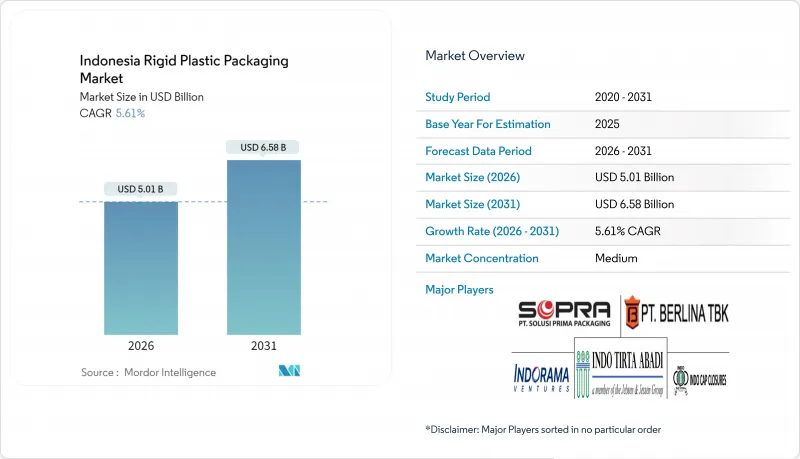
Mordor Intelligence에 의하면, 인도네시아의 경질 플라스틱 포장 시장 규모는 2026년에 50억 1,000만 달러에 달하고, 2031년까지 65억 8,000만 달러에 이를 것으로 예상되며, 예측 기간 동안 CAGR5.61%로 성장할 전망입니다.
본 보고서는 수지 유형(폴리에틸렌, PET, 폴리프로필렌, 폴리스티렌 등), 제품 유형(병·용기, 트레이, 뚜껑 및 마개, IBC, 드럼 등), 최종 사용자(식품, 음료, 헬스케어,화장품, 산업, 건설 등), 제조 공정(사출 성형, 블로우 성형 등)별로 분류되어 있습니다. 시장 전망은 금액(달러) 기준으로 제시되어 있습니다.
인도네시아의 경질 플라스틱 포장 시장 동향 및 인사이트
포장 식품 및 음료 소비 확대
인도네시아의 포장 식품 지출은 2023년 414억 달러에서 2028년에는 약 667억 달러로 확대될 것으로 예측되며, 이에 따라 HDPE 유제품용 병, 폴리프로필렌 스낵용 용기, PET 음료 용기에 대한 수요가 견인되고 있습니다. 2024년부터 2025년에 걸쳐, 맞벌이 가구가 유통 기한이 길고 편의성이 높은 제품을 선호하게 되면서 가공식품에 대한 1인당 지출은 12% 증가했습니다. 2024년에는 병에 든 식수만으로도 30만 톤의 PET가 소비되었으며, 탄산음료가 추가로 20만 톤을 차지하여, 이 두 가지를 합치면 PET 사용량의 절반을 차지했습니다. 패스트푸드점에서는 얇은 트레이와 무단 개봉 방지 뚜껑이 채택되고 있어, 이로 인해 열성형 트레이의 보급이 촉진되고 있습니다. 신선 식품 시장에서 슈퍼마켓으로의 전환은 경질 플라스틱이 식품의 안전성을 보장한다는 소비자의 인식을 강화하고 있으며, 이러한 추세는 국가의약품·식품관리국의 표시 규제에 의해서도 뒷받침되고 있습니다.
확대되는 도시 중산층의 구매력
2030년까지 연소득 5,000-1만 5,000달러인 가구 수는 1억 3,500만 가구에 달할 것이며, 이들은 저소득층에 비해 브랜드 포장 상품을 3배 더 많이 구매하고 있습니다. 2024년 1인당 GDP는 4,925달러에 달했으며, 5%의 지속적인 경제 성장이 경질 용기에 포장된 화장품, 고급 음료, 퍼스널케어 용품 등에 대한 재량 지출을 뒷받침했습니다.
원유 유래 수지 가격 변동
폴리에틸렌 및 폴리프로필렌 비용은 브렌트 원유 가격에 3개월의 시차를 두고 연동되며, 가공업체는 배럴당 15달러의 가격 변동 영향을 받아 이로 인해 이익률이 6퍼센트 포인트 축소될 가능성이 있습니다. 2024년 12월, 동남아시아의 폴리프로필렌은 CFR 가격으로 톤당 930-970달러에 거래되었습니다. 원유 가격이 10달러 상승할 때마다 나프타 비용은 톤당 7달러 상승하여, 60일 결제 조건으로 운영되는 공장의 수익성을 압박하고 있습니다. 2025년 천연가스 가격의 급등으로 인해 에틸렌 크래커는 생산량을 12% 감축할 수밖에 없게 되었고, 수지 공급이 부족해지면서 인도네시아의 경질 플라스틱 포장 시장의 고객들에게 납기에 차질이 발생했습니다.
부문별 분석
2025년, 인도네시아의 경질 플라스틱 포장 시장에서 폴리에틸렌은 세제 병 및 유제품 용기에 사용되는 고밀도 등급 덕분에 시장 점유율 29.43%를 차지했습니다. 2024년에는 고밀도 폴리에틸렌만으로도 가정용 및 산업용 화학제품에 대한 21만 톤 수요를 충족시켰습니다. 폴리에틸렌 테레프탈레이트(PET)는 이미 연간 30만 톤이 소비되고 있는 생수 수요에 힘입어 2031년까지 연평균 5.94%의 성장률을 보일 것으로 예상되며, 이는 수지 중 가장 높은 성장률입니다. Indorama Ventures사가 현재 추진 중인 생산 능력 병목 현상 해소로 인해, 2026년까지 국내 식품용 PET 생산 능력이 15만 톤 증가하여 수입 의존도가 완화될 뿐만 아니라, 병에서 병으로의 재활용이 촉진될 전망입니다.
인도네시아의 경질 플라스틱 포장 시장의 가공업체들은 폴리에틸렌 공급의 약 40%, 폴리프로필렌 공급의 32%를 찬드라 아슬리 페트로케미칼(Chandra Asli Petrochemical)에 의존하고 있어, 이로 인해 가격을 안정시키는 한편 협상력을 제한하는 준과점 상태가 형성되고 있습니다. 경량화는 여전히 중요한 경쟁 우위입니다. PT 베를리나(PT Berlina)는 2023년부터 2024년에 걸쳐 프리폼의 무게를 15% 줄여 주요 음료 제조업체 고객을 위해 4,200톤의 수지와 840만 달러를 절감했습니다. 이는 기술적 개선이 고객 유지에 직접적인 영향을 미칩니다는 것을 여실히 보여줍니다.
2025년 매출 중 병과 용기가 45.65%를 차지했으며, 그중 PET 음료병만 28%를 차지했습니다. 캡 및 마개는 가장 빠르게 성장하는 분야로, 어린이 안전 캡 및 스포츠 캡의 다양한 유형가 규제 및 마케팅 측면에서 필수 요건이 됨에 따라 2031년까지 연평균 6.32%의 성장이 예상됩니다. Indo Cap Closures가 2024년에 도입한 새로운 압축 성형 라인을 통해 캡 생산 능력은 연간 20억 개로 확대되었으며, 제약 업계 고객들이 ISO 15378 추적성 기준을 충족할 수 있게 되었습니다.
인도네시아의 경질 플라스틱 포장 시장의 각 기업들은 트레이 및 컨테이너 혁신에도 주력하고 있습니다. 열 성형 폴리프로필렌 트레이의 무게는 12g인 반면, 사출 성형품은 18g으로, 이는 개당 0.04달러의 비용 우위를 가져와 패스트푸드점이나 즉석식사 브랜드에 매력적인 요소가 되고 있습니다. 제품 매출의 9%를 차지하는 중간 대용량 컨테이너와 드럼통은 산업용 화학물질 및 윤활유용이며, 팔레트와 크레이트 등 틈새 제품이 나머지 7%를 차지하고 있습니다.
기타 혜택 :
- 엑셀 형식 시장 예측(ME) 시트
- 3개월간의 애널리스트 지원
자주 묻는 질문
목차
제1장 서론
제2장 조사 방법
제3장 주요 요약
제4장 시장 구도
제5장 시장 규모 및 성장 예측
제6장 경쟁 구도
제7장 시장 기회 및 향후 전망
KTH 26.09.14According to Mordor Intelligence, the Indonesia rigid plastic packaging market size stands at USD 5.01 billion in 2026 and is projected to reach USD 6.58 billion by 2031, expanding at a 5.61% CAGR during the forecast period.

This report is Segmented by Resin Type (Polyethylene, PET, Polypropylene, Polystyrene, and More), Product Type (Bottles and Jars, Trays, Caps and Closures, Ibcs, Drums, and More), End-User (Food, Beverage, Healthcare, Cosmetics, Industrial, Construction, and More), Manufacturing Process (Injection Moulding, Blow Moulding, and More). The Market Forecasts are Provided in Terms of Value (USD).
Indonesia Rigid Plastic Packaging Market Trends and Insights
Rising Consumption of Packaged Food and Beverages
Indonesia's packaged-food outlays are projected to grow from USD 41.4 billion in 2023 to an estimated USD 66.7 billion by 2028, driving demand for HDPE dairy bottles, polypropylene snack jars, and PET beverage containers. Per-capita spending on processed food increased by 12% from 2024 to 2025, as dual-income households sought products with longer shelf lives and greater convenience. Bottled water alone consumed 300,000 tonnes of PET in 2024, while carbonated soft drinks added 200,000 tonnes, together half of PET usage. Quick-service restaurants utilize thin-wall trays and tamper-evident lids, thereby boosting the adoption of thermoformed trays. The migration from wet markets to supermarkets reinforces consumer perceptions that rigid plastic is equivalent to food safety, a trend supported by labeling rules from the National Agency of Drug and Food Control.
Growing Urban Middle-Class Purchasing Power
Households earning USD 5,000-15,000 annually numbered 135 million by 2030 and buy three times more branded packaged goods than lower-income groups. GDP per capita reached USD 4,925 in 2024, and sustained 5% economic growth fuels discretionary purchases of cosmetics, premium beverages, and personal-care items packaged in rigid formats.
Volatility in Crude-Derived Resin Prices
Polyethylene and polypropylene costs track Brent crude with a three-month lag, exposing converters to swings of USD 15 per barrel that can compress margins by six percentage points. Southeast-Asian polypropylene traded at USD 930-970 per tonne CFR in December 2024, and every USD 10 rise in crude lifts naphtha costs by USD 7 per tonne, eroding profitability for plants running on 60-day payment terms. Natural-gas spikes in 2025 forced ethylene crackers to curtail output by 12%, tightening resin supply and disrupting delivery schedules for Indonesia rigid plastic packaging market customers.
Other drivers and restraints analyzed in the detailed report include:
- Expansion of Modern Retail and E-Commerce Channels
- Preference for Lightweight PET over Glass
- Provincial Bans on Single-Use Plastics
For complete list of drivers and restraints, kindly check the Table Of Contents.
Segment Analysis
Polyethylene accounted for 29.43% of Indonesia rigid plastic packaging market share in 2025 thanks to high-density grades used for detergent bottles and dairy containers. High-density polyethylene alone served 210,000 tonnes of household-chemical and industrial-chemical demand in 2024. Polyethylene terephthalate is projected to grow at 5.94% through 2031, the fastest among resins, buoyed by bottled-water orders that already consume 300,000 tonnes annually. Indorama Ventures' ongoing debottlenecking will lift domestic food-grade PET capacity by 150,000 tonnes by 2026, easing dependence on imports and encouraging bottle-to-bottle recycling.
Indonesia rigid plastic packaging market converters rely on Chandra Asri Petrochemical for roughly 40% of polyethylene and 32% of polypropylene supply, creating a quasi-oligopoly that stabilizes pricing yet limits bargaining leverage. Lightweighting remains a critical competitive lever; PT Berlina's 15% preform weight drop between 2023 and 2024 saved 4,200 tonnes of resin and USD 8.4 million for core beverage clients, underscoring how engineering gains directly affect customer retention.
Bottles and jars generated 45.65% of 2025 revenue, with PET beverage bottles alone representing 28%. Caps and closures are the fastest movers, set to expand 6.32% annually through 2031 as child-resistant and sports-cap variants become regulatory and marketing necessities. Indo Cap Closures' new compression-moulding lines, installed in 2024, raise closure capacity to 2 billion units per year and allow pharmaceutical customers to meet ISO 15378 traceability rules.
Indonesia rigid plastic packaging market players also emphasize tray and container innovation. Thermoformed polypropylene trays weigh 12 g versus 18 g for an injection-moulded equivalent, translating to a USD 0.04 cost advantage per unit that appeals to quick-service restaurants and ready-meal brands. Intermediate bulk containers and drums, at 9% of product revenue, address industrial chemicals and lubricants, while niche items such as pallets and crates account for the remaining 7%.
Complete Report Scope:
- By Resin Type
- Polyethylene
- High-Density Polyethylene (HDPE)
- Low-Density Polyethylene (LDPE)
- Linear Low-Density Polyethylene (LLDPE)
- Polyethylene Terephthalate
- Polypropylene
- Polystyrene and EPS
- Other Resin Types
- Polyethylene
- By Product Type
- Bottles and Jars
- Trays and Containers
- Caps and Closures
- Intermediate Bulk Containers (IBCs)
- Drums
- Other Product Types
- By End-user Industry
- Food
- Candy and Confectionery
- Dairy and Frozen
- Meat, Poultry and Seafood
- Other Food Types
- Beverage
- Healthcare and Pharmaceuticals
- Cosmetics and Personal Care
- Industrial Chemicals
- Building and Construction
- Other End-user Industries
- Food
- By Manufacturing Process
- Injection Moulding
- Blow Moulding
- Thermoforming
- Compression Moulding
- Extrusion
- Other Manufacturing Process
List of Companies Covered in this Report:
- PT. Berlina Tbk
- PT Indo Tirta Abadi
- PT Solusi Prima Packaging
- PT. Indorama Ventures Indonesia
- Indo Cap Closures
- PT. Hasil Raya Industries
- PT. Hokkan Deltapack Industri
- PT Rheem Indonesia
- PT. Neilsen
- PT. Namasindo Plus
- PT Dynapack Asia
- PT ALPLA Packaging Indonesia
- PT Plasindo Lestari
- PT Avesta Continental Pack
- PT Universal Kemas Indah
- PT Multi Kemas Plastindo
- PT Cemerlang Pola Plast
- PT Sumber Indah Plastik
- PT Cipta Kemas Abadi
Additional Benefits:
- The market estimate (ME) sheet in Excel format
- 3 months of analyst support
TABLE OF CONTENTS
1 INTRODUCTION
- 1.1 Study Assumptions and Market Definition
- 1.2 Scope of the Study
2 RESEARCH METHODOLOGY
3 EXECUTIVE SUMMARY
4 MARKET LANDSCAPE
- 4.1 Market Overview
- 4.2 Market Drivers
- 4.2.1 Rising Consumption of Packaged Food and Beverages
- 4.2.2 Growing Urban Middle-Class Purchasing Power
- 4.2.3 Expansion of Modern Retail and E-commerce Channels
- 4.2.4 Preference for Lightweight PET over Glass
- 4.2.5 Domestic Petrochemical Capacity Expansion Incentives
- 4.2.6 Brand-Led Refillable Rigid Packaging Pilots
- 4.3 Market Restraints
- 4.3.1 Competition from Flexible Packaging
- 4.3.2 Volatility in Crude-Derived Resin Prices
- 4.3.3 Provincial Bans on Single-Use Plastics
- 4.3.4 Poor Post-Consumer Recycling Infrastructure
- 4.4 Industry Value Chain Analysis
- 4.5 Impact of Macroeconomic Factors on the Market
- 4.6 Regulatory Landscape
- 4.7 Technological Outlook
- 4.8 Porter's Five Forces Analysis
- 4.8.1 Bargaining Power of Suppliers
- 4.8.2 Bargaining Power of Buyers/Consumers
- 4.8.3 Threat of New Entrants
- 4.8.4 Threat of Substitutes
- 4.8.5 Intensity of Competitive Rivalry
- 4.9 Recycling and Sustainability Landscape
5 MARKET SIZE AND GROWTH FORECASTS (VALUE)
- 5.1 By Resin Type
- 5.1.1 Polyethylene
- 5.1.1.1 High-Density Polyethylene (HDPE)
- 5.1.1.2 Low-Density Polyethylene (LDPE)
- 5.1.1.3 Linear Low-Density Polyethylene (LLDPE)
- 5.1.2 Polyethylene Terephthalate
- 5.1.3 Polypropylene
- 5.1.4 Polystyrene and EPS
- 5.1.5 Other Resin Types
- 5.1.1 Polyethylene
- 5.2 By Product Type
- 5.2.1 Bottles and Jars
- 5.2.2 Trays and Containers
- 5.2.3 Caps and Closures
- 5.2.4 Intermediate Bulk Containers (IBCs)
- 5.2.5 Drums
- 5.2.6 Other Product Types
- 5.3 By End-user Industry
- 5.3.1 Food
- 5.3.1.1 Candy and Confectionery
- 5.3.1.2 Dairy and Frozen
- 5.3.1.3 Meat, Poultry and Seafood
- 5.3.1.4 Other Food Types
- 5.3.2 Beverage
- 5.3.3 Healthcare and Pharmaceuticals
- 5.3.4 Cosmetics and Personal Care
- 5.3.5 Industrial Chemicals
- 5.3.6 Building and Construction
- 5.3.7 Other End-user Industries
- 5.3.1 Food
- 5.4 By Manufacturing Process
- 5.4.1 Injection Moulding
- 5.4.2 Blow Moulding
- 5.4.3 Thermoforming
- 5.4.4 Compression Moulding
- 5.4.5 Extrusion
- 5.4.6 Other Manufacturing Process
6 COMPETITIVE LANDSCAPE
- 6.1 Market Concentration
- 6.2 Strategic Moves
- 6.3 Market Share Analysis
- 6.4 Company Profiles (includes Global Level Overview, Market Level Overview, Core Segments, Financials as available, Strategic Information, Market Rank/Share for Key Companies, Products and Services, and Recent Developments)
- 6.4.1 PT. Berlina Tbk
- 6.4.2 PT Indo Tirta Abadi
- 6.4.3 PT Solusi Prima Packaging
- 6.4.4 PT. Indorama Ventures Indonesia
- 6.4.5 Indo Cap Closures
- 6.4.6 PT. Hasil Raya Industries
- 6.4.7 PT. Hokkan Deltapack Industri
- 6.4.8 PT Rheem Indonesia
- 6.4.9 PT. Neilsen
- 6.4.10 PT. Namasindo Plus
- 6.4.11 PT Dynapack Asia
- 6.4.12 PT ALPLA Packaging Indonesia
- 6.4.13 PT Plasindo Lestari
- 6.4.14 PT Avesta Continental Pack
- 6.4.15 PT Universal Kemas Indah
- 6.4.16 PT Multi Kemas Plastindo
- 6.4.17 PT Cemerlang Pola Plast
- 6.4.18 PT Sumber Indah Plastik
- 6.4.19 PT Cipta Kemas Abadi
7 MARKET OPPORTUNITIES AND FUTURE OUTLOOK
- 7.1 White-space and Unmet-Need Assessment