|
시장보고서
상품코드
2124610
유럽의 수축 및 스트레치 슬리브 라벨 : 시장 점유율 분석, 업계 동향 및 통계, 성장 예측(2026-2031년)Europe Shrink And Stretch Sleeve Label - Market Share Analysis, Industry Trends & Statistics, Growth Forecasts (2026 - 2031) |
||||||
 Mordor Intelligence
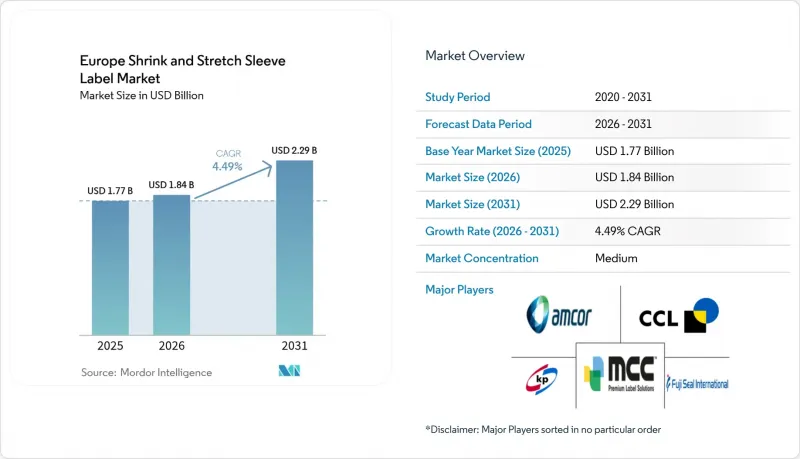
Mordor Intelligence에 의하면, 유럽의 수축 및 스트레치 슬리브 라벨 시장 규모는 2025년에 17억 7,000만 달러로 평가되었습니다. 2026년에 18억 4,000만 달러에 달하고, 2031년까지 22억 9,000만 달러에 이를 것으로 예측되며, 2026년부터 2031년에 걸쳐 CAGR 4.49%로 성장할 전망입니다.
본 보고서는 유형별(열수축 슬리브, 스트레치 슬리브, 풀바디 슬리브, 멀티팩/번들링 슬리브 등), 소재별(PVC, PET-G, OPP 및 OPS, PE, PP 등),용도(식품, 음료, 퍼스널케어 및 화장품 등), 인쇄 기술(플렉소 인쇄, 그라비아 인쇄, 디지털 인쇄 등), 국가별로 분류되어 있습니다. 시장 예측은 금액(달러) 기준으로 제시되어 있습니다.
유럽의 수축 및 스트레치 슬리브 라벨 시장 동향 및 인사이트
매장 내 어필력을 높이는 수요 증가
아이 트래킹 조사에 따르면, 유럽 쇼핑객의 64%가 3초 이내에 어떤 음료를 선택할지 결정하고 있으며, 풀바디 슬리브가 진열대에서 얼마나 큰 임팩트를 주는지가 부각되고 있습니다. 이 라벨의 360° 캔버스를 통해 브랜드는 시각적 흐름을 해치지 않으면서도 생생한 그래픽, 지속가능성 관련 메시지, QR 코드를 활용한 프로모션을 결합할 수 있습니다. 프랑스와 이탈리아의 고급 샴푸 제조업체들은 2025년에 종이 라벨에서 열수축 슬리브로 전환하여, 다국어 텍스트와 고급스러운 마감을 구현할 여지를 마련했습니다. 같은 해, 페리에(Perrier)의 홀로그램 한정판은 프랑스 대형 마트에서 충동 구매를 17% 끌어올렸습니다. 리들(Lidl)과 같은 자체 브랜드 체인들은 저비용 플렉소 인쇄 슬리브를 활용해 이러한 프리미엄 요소를 도입함으로써, 소비자의 관심을 둘러싼 경쟁을 더욱 치열하게 만들고 있습니다. 이커머스 플랫폼에서는 360° 각도에서 사진이 잘 나오는 상품이 선호되기 때문에 브랜드 소유주들은 슬리브를 단순한 비용 항목이 아닌 전환율 및 고객 충성도 향상을 위한 투자로 계속해서 인식하고 있습니다.
위조 방지 기능의 필요성
2027년까지 시행될 EU 식품 접촉 규정에 따라, 액상 유제품 및 영유아용 영양식품 포장에는 검증 가능한 무결성 씰을 표시해야 합니다. 미세 절취선이 있는 찢어내기 띠가 장착된 수축 슬리브는 2차 중첩 포장이 필요 없이 이 요건을 충족합니다. 2024년 메탄올 중독 사고를 계기로, 동유럽의 증류소들은 폴란드와 슬로바키아의 새로운 안전 법규에 따라 알코올 도수 20% 이상의 증류주에 찢어지는 스트립이 있는 풀바디 슬리브를 채택했습니다. 독일과 네덜란드의 제약 포장 제조업체들은 현재 EU의 추적 법규를 준수하는 코드가 부착된 슬리브로 임상시험용 바이알을 포장하고 있습니다. 2025년 하반기 스페인에서 출시된 후타마키의 무균 주스용 ISO-16495 인증 슬리브는 위조 방지 기능과 어린이 안전 잠금 기능이 단일 구조로 통합된 좋은 예입니다. 규제 당국이 무결성에 대한 요건을 강화함에 따라, 변조 방지 슬리브는 부가가치 요소에서 기본적인 요건으로 변화하고 있습니다.
더욱 엄격해진 EU 플라스틱 포장 폐기물 지침
독일의 VerpackG 개정법에서는 두께 40미크론 이상이거나 감지 불가능한 잉크로 인쇄된 슬리브에 대해 단계적인 EPR(생산자 책임) 요금이 도입되어, 2026년 1월부터 단가가 0.05-0.12유로 인상될 예정입니다. EU 법안 초안에서는 2028년까지 PET-G 슬리브에 30%의 재생재 함유율을 의무화할 것을 제안하고 있으나, 현재 고고유점도 rPET공급은 부족한 실정입니다. ‘실용적 재활용 가능성’이라는 지표를 둘러싼 불확실성이 가공업체들의 투자를 위축시키고 있는 반면, 남유럽의 소규모 기업들은 단일 소재 생산 라인에 대한 자금 투자가 자본 집약적이기 때문에 시장에서 철수할 위험에 직면해 있습니다.
부문별 분석
2025년, 유럽의 수축 및 스트레치 슬리브 라벨 시장에서 열수축 슬리브는 58.32%의 점유율을 차지했습니다. 이는 복잡한 병 모양 및 고속 터널과의 호환성을 반영한 결과입니다. 독일과 네덜란드에서는 병 재활용을 방해하는 라벨에 대해 벌칙이 부과되기 시작함에 따라, 2031년까지 스트레치 슬리브 시장은 연평균 5.65%의 성장률을 보일 것으로 예측됩니다. 이에 따라 떼어내기 쉽고 접착제를 사용하지 않는 슬리브에 대한 수요가 증가하고 있습니다. 2025년, Sleever International사는 시간당 3만 6,000병의 처리 능력을 갖춘 스트레치 슬리브 부착기를 도입하여 히트 터널 시스템과의 속도 차이를 줄였습니다. 풀 바디 수축 방식은 계속해서 고급 증류주나 화장품에 활용되고 있는 반면, 탄산음료에서는 멀티팩용 번들링 슬리브가 여전히 주류를 이루고 있습니다.
보증금 반환 제도의 경제적 요인이 스트레치 슬리브 수요를 뒷받침하고 있습니다. 사업자 입장에서는 세척 공정에서 불량품이 감소함과 동시에 rPET의 순도도 향상됩니다. 반면, 히트 수축 슬리브는 스트레치 슬리브가 개당 0.05-0.07유로인 데 비해 0.02-0.04유로로, 여전히 재료비 면에서 우위를 유지하고 있습니다. 그러나 보증금 반환 제도(DRS)에 따른 벌칙이 엄격해짐에 따라, 브랜드 소유주들은 스트레치 슬리브의 비용 상승을 규정 준수를 위한 안전 장치로 간주하는 경향이 강해지고 있습니다. 재활용 수수료와 라인 속도의 경제성 간의 상호 작용으로 인해 두 형식 모두 계속해서 중요하게 여겨질 것이며, 규제의 엄격성과 가격 민감도에 따라 채택 상황이 양극화될 것입니다.
PET-G는 타의 추종을 불허하는 투명도와 수축 균일성을 실현하여 2025년에는 46.23%의 점유율을 확보했습니다. 그러나 부유 및 침강을 통한 분리 용이성과 낮은 EPR 수수료 덕분에, 유럽의 폴리에틸렌 필름 수축 및 스트레치 슬리브 라벨 시장 규모는 5.83%의 속도로 확대되고 있습니다. 2025년에 출시된 크로크너 펜타플라스트(Klockner Pentaplast)사의 rPET 함유율 35% 필름은 브랜드 소유자가 재활용 소재 사용 공약을 달성하기 위해 한 걸음씩 나아갈 수 있도록 지원합니다. OPP 및 OPS는 강성이 요구되는 번들링 슬리브 분야에서 여전히 중요한 역할을 하고 있지만, 재활용성이 취약하다는 점이 대체재의 압박을 받는 요인이 되고 있습니다.
다우(Dow)사의 ‘어피니티(Affinity)’ 엘라스토머를 통해 PE 필름은 PET-G에 필적하는 광택을 유지하면서 최대 60%의 수축률을 실현할 수 있게 되었습니다. 스칸디나비아 국가들의 금지 조치로 인해 PVC 시장 퇴출이 가속화되고 있으며, 그 적용 범위는 특수 용도로 한정되고 있습니다. 폴리프로필렌은 높은 수축 온도가 허용되는 핫필 음료 분야에서 활용되고 있습니다. 2027년까지 폴리올레핀은 유제품 및 식수 분야에서 PET-G를 추월할 전망이지만, PET-G는 광택을 중시하고 그래픽을 많이 사용하는 프리미엄 SKU에서 여전히 확고한 입지를 유지할 것입니다.
기타 혜택 :
- 엑셀 형식 시장 예측(ME) 시트
- 3개월간의 애널리스트 지원
자주 묻는 질문
목차
제1장 서론
제2장 조사 방법
제3장 주요 요약
제4장 시장 구도
제5장 시장 규모 및 성장 예측
제6장 경쟁 구도
제7장 시장 기회 및 향후 전망
KTH 26.09.14According to Mordor Intelligence, the Europe shrink and stretch sleeve label market size is projected to be USD 1.77 billion in 2025, USD 1.84 billion in 2026, and reach USD 2.29 billion by 2031, growing at a CAGR of 4.49% from 2026 to 2031.
This report is Segmented by Type (Heat Shrink Sleeve, Stretch Sleeve, Full-Body Sleeve, Multi-Pack/Bundling Sleeve, and More), Material (PVC, PET-G, OPP and OPS, PE, PP, and More), Application (Food, Beverages, Personal Care and Cosmetics, and More), Printing Technology (Flexographic, Rotogravure, Digital, and More), and Country. The Market Forecasts are Provided in Terms of Value (USD).
Europe Shrink And Stretch Sleeve Label Market Trends and Insights
Demand to Increase On-Shelf Appeal
Eye-tracking research shows that 64% of European shoppers decide within three seconds which beverage to pick, underscoring how full-body sleeves elevate shelf impact. The label's 360° canvas lets brands combine vivid graphics, sustainability claims, and QR-enabled promotions without disrupting visual flow. Luxury shampoo makers in France and Italy transitioned from paper labels to heat-shrink sleeves in 2025, unlocking room for multilingual text and premium finishes. Perrier's holographic limited edition boosted impulse sales by 17% in French hypermarkets the same year. Private-label chains such as Lidl mimic these premium cues with low-cost flexo-printed sleeves, intensifying competition for consumer attention. As e-commerce platforms favor products that photograph well in 360°, brand owners continue to treat sleeves as an investment in conversion and loyalty rather than a mere cost line.
Need for Tamper-Evident Protection
EU food-contact rules coming into force by 2027 oblige liquid dairy and infant-nutrition packs to display verifiable integrity seals. Shrink sleeves with perforated tear bands meet that need without secondary over-wraps. After a 2024 methanol poisoning incident, Eastern European distilleries adopted full-body sleeves with tear strips in spirits above 20% alcohol, following new safety decrees in Poland and Slovakia. Pharmaceutical packers in Germany and the Netherlands now wrap clinical-trial vials in coded sleeves that align with EU track-and-trace law. Huhtamaki's ISO-16495-certified sleeve for aseptic juice, launched in Spain in late 2025, shows how tamper evidence and child resistance converge in a single construction. As regulators tighten integrity demands, tamper-evident sleeves shift from value-add to baseline expectation.
Stricter EU Plastics-Packaging Waste Directives
Germany's VerpackG amendment introduces a tiered EPR fee on sleeves thicker than 40 microns or printed with non-detectable inks, raising unit costs by EUR 0.05-0.12 from January 2026. A draft EU act floats a 30% recycled-content mandate for PET-G sleeves by 2028, yet the current high-intrinsic-viscosity rPET supply is insufficient. Uncertainty over "recyclable in practice" metrics stalls converter investment, while small Southern European firms risk exit because funding mono-material lines is capital-intensive.
Other drivers and restraints analyzed in the detailed report include:
- Shift Toward 360° Branding Surfaces
- Adoption of Recyclable Polyolefin Shrink Films
- Rising Prices of Virgin PET-G and PVC Resins
For complete list of drivers and restraints, kindly check the Table Of Contents.
Segment Analysis
Heat-shrink sleeves commanded 58.32% share of the Europe shrink and stretch sleeve label market in 2025, reflecting their compatibility with complex bottle shapes and high-speed tunnels. Stretch equivalents are forecast to expand at 5.65% to 2031 as Germany and the Netherlands penalize labels that hinder bottle recycling, making peelable, adhesive-free sleeves attractive. In 2025 Sleever International installed a stretch applicator rated at 36,000 bottles per hour, closing the speed gap with heat-tunnel systems. Full-body shrink formats continue to serve premium spirits and cosmetics, while multi-pack bundling sleeves remain mainstream in carbonated sodas.
Deposit-return economics amplify stretch demand; operators incur fewer wash-cycle rejects and score higher rPET purity. Conversely, heat-shrink sleeves retain a material-cost edge, at EUR 0.02-0.04 per unit against EUR 0.05-0.07 for stretch. As DRS penalties intensify, however, brand owners increasingly treat higher stretch-sleeve costs as compliance insurance. The interplay between recyclability fees and line-speed economics will keep both formats relevant, bifurcating adoption by regulatory stringency and price sensitivity.
PET-G delivered unsurpassed clarity and shrink uniformity, securing 46.23% share in 2025. Yet the Europe shrink and stretch sleeve label market size for polyethylene films is rising at 5.83% thanks to float-sink separability and lower EPR fees. Klockner Pentaplast's 35% rPET-content film, launched in 2025, helps brand owners inch toward recycled-content pledges. OPP and OPS stay relevant for bundling sleeves that need rigidity, but their recyclability weaknesses expose them to substitution pressure.
Dow's Affinity elastomers now enable PE films to achieve up to 60% shrink while maintaining gloss comparable to PET-G. PVC's exit accelerates under Scandinavian bans, shrinking its addressable pool to specialty applications. Polypropylene serves hot-fill beverages where high shrink temperature is tolerable. By 2027 polyolefins are likely to overtake PET-G in dairy and water, while PET-G remains entrenched in premium graphic-intensive SKUs that prize optical brilliance.
Complete Report Scope:
- By Type
- Heat Shrink Sleeve
- Stretch Sleeve
- Full-Body Sleeve
- Multi-Pack/Bundling Sleeve
- Other Types
- By Material
- Polyvinyl Chloride (PVC)
- Polyethylene Terephthalate Glycol-Modified (PET-G)
- OPP (Oriented Polypropylene) and OPS (Oriented Polystyrene)
- Polyethylene (PE)
- Polypropylene (PP)
- Other Materials
- By Application
- Food
- Beverages
- Personal Care and Cosmetics
- Other Applications
- By Printing Technology
- Flexographic Printing
- Rotogravure Printing
- Digital Printing
- Others Printing Technologies
- By Country
- Germany
- France
- United Kingdom
- Italy
- Poland
- Netherlands
- Spain
- Rest of Europe
List of Companies Covered in this Report:
- Amcor plc
- CCL Industries Inc.
- Klockner Pentaplast GmbH and Co. KG
- Fuji Seal International Inc.
- Huhtamaki Oyj
- Smurfit WestRock
- Mondi plc
- Multi-Color Corporation
- Sleevezone Ltd.
- Folienprint Risse Etiketten GmbH
- Oerlemans Plastics B.V.
- Decomatic S.A.
- Polifilm Extrusion GmbH
- Maca S.r.l.
- Sleever International Company
- Derprosa Films S.L.U.
- Dow Chemical Company
- UPM Raflatac Oy
- Constantia Flexibles Group GmbH
- Avery Dennison Corporation
- Coveris Holdings S.A.
Additional Benefits:
- The market estimate (ME) sheet in Excel format
- 3 months of analyst support
TABLE OF CONTENTS
1 INTRODUCTION
- 1.1 Study Assumptions and Market Definition
- 1.2 Scope of the Study
2 RESEARCH METHODOLOGY
3 EXECUTIVE SUMMARY
4 MARKET LANDSCAPE
- 4.1 Market Overview
- 4.2 Market Drivers
- 4.2.1 Demand to Increase On-Shelf Appeal
- 4.2.2 Need for Tamper-Evident Protection
- 4.2.3 Shift Toward 360° Branding Surfaces
- 4.2.4 Adoption of Recyclable Polyolefin Shrink Films
- 4.2.5 Inline Digital Printing Integration
- 4.2.6 Lithium-Metal Additive Inks Enabling Ultra-Thin Sleeves
- 4.3 Market Restraints
- 4.3.1 Stricter EU Plastics-Packaging Waste Directives
- 4.3.2 Rising Prices of Virgin PET-G and PVC Resins
- 4.3.3 Limited Recycling Streams for Multi-Layer Films
- 4.3.4 Sleeve Removal Bottlenecks in EU Deposit-Return Schemes
- 4.4 Industry Value Chain Analysis
- 4.5 Regulatory Landscape
- 4.6 Technological Outlook
- 4.7 Porter's Five Forces Analysis
- 4.7.1 Bargaining Power of Suppliers
- 4.7.2 Bargaining Power of Consumers
- 4.7.3 Threat of New Entrants
- 4.7.4 Threat of Substitutes
- 4.7.5 Intensity of Competitive Rivalry
- 4.8 Impact of Macroeconomic Factors on the Market
5 MARKET SIZE AND GROWTH FORECASTS (VALUE)
- 5.1 By Type
- 5.1.1 Heat Shrink Sleeve
- 5.1.2 Stretch Sleeve
- 5.1.3 Full-Body Sleeve
- 5.1.4 Multi-Pack/Bundling Sleeve
- 5.1.5 Other Types
- 5.2 By Material
- 5.2.1 Polyvinyl Chloride (PVC)
- 5.2.2 Polyethylene Terephthalate Glycol-Modified (PET-G)
- 5.2.3 OPP (Oriented Polypropylene) and OPS (Oriented Polystyrene)
- 5.2.4 Polyethylene (PE)
- 5.2.5 Polypropylene (PP)
- 5.2.6 Other Materials
- 5.3 By Application
- 5.3.1 Food
- 5.3.2 Beverages
- 5.3.3 Personal Care and Cosmetics
- 5.3.4 Other Applications
- 5.4 By Printing Technology
- 5.4.1 Flexographic Printing
- 5.4.2 Rotogravure Printing
- 5.4.3 Digital Printing
- 5.4.4 Others Printing Technologies
- 5.5 By Country
- 5.5.1 Germany
- 5.5.2 France
- 5.5.3 United Kingdom
- 5.5.4 Italy
- 5.5.5 Poland
- 5.5.6 Netherlands
- 5.5.7 Spain
- 5.5.8 Rest of Europe
6 COMPETITIVE LANDSCAPE
- 6.1 Market Concentration
- 6.2 Strategic Moves
- 6.3 Market Share Analysis
- 6.4 Company Profiles (Includes Global Level Overview, Market Level Overview, Core Segments, Financials as Available, Strategic Information, Market Rank/Share, Products and Services, and Recent Developments)
- 6.4.1 Amcor plc
- 6.4.2 CCL Industries Inc.
- 6.4.3 Klockner Pentaplast GmbH and Co. KG
- 6.4.4 Fuji Seal International Inc.
- 6.4.5 Huhtamaki Oyj
- 6.4.6 Smurfit WestRock
- 6.4.7 Mondi plc
- 6.4.8 Multi-Color Corporation
- 6.4.9 Sleevezone Ltd.
- 6.4.10 Folienprint Risse Etiketten GmbH
- 6.4.11 Oerlemans Plastics B.V.
- 6.4.12 Decomatic S.A.
- 6.4.13 Polifilm Extrusion GmbH
- 6.4.14 Maca S.r.l.
- 6.4.15 Sleever International Company
- 6.4.16 Derprosa Films S.L.U.
- 6.4.17 Dow Chemical Company
- 6.4.18 UPM Raflatac Oy
- 6.4.19 Constantia Flexibles Group GmbH
- 6.4.20 Avery Dennison Corporation
- 6.4.21 Coveris Holdings S.A.
7 MARKET OPPORTUNITIES AND FUTURE OUTLOOK
- 7.1 White-Space and Unmet-Need Assessment