
|
시장보고서
상품코드
2124643
전기자동차 배터리 관리 시스템 : 시장 점유율 분석, 업계 동향 및 통계, 성장 예측(2026-2031년)Electric Vehicle Battery Management System - Market Share Analysis, Industry Trends & Statistics, Growth Forecasts (2026 - 2031) |
||||||
 Mordor Intelligence
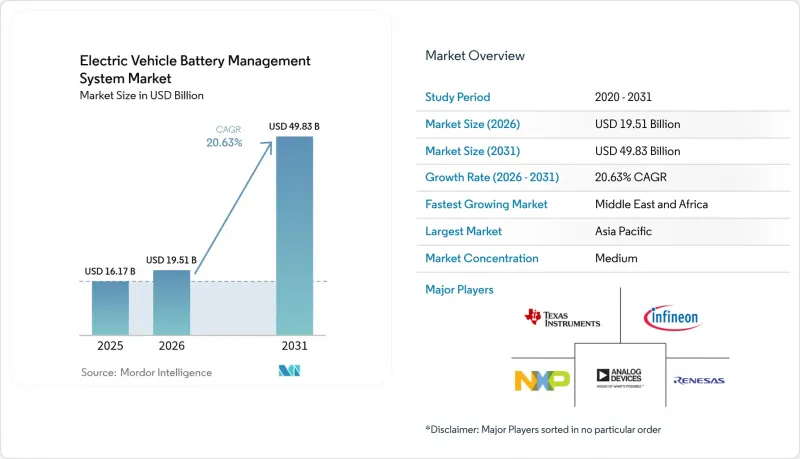
Mordor Intelligence에 의하면, 2026년 전기자동차 배터리 관리 시스템 시장 규모는 195억 1,000만 달러로 추정되고 2025년 161억 7,000만 달러에서 확대해, 2031년에는 498억 3,000만 달러에 이를 것으로 예측됩니다.
2026년부터 2031년까지의 연평균 성장률(CAGR)은 20.63%를 나타낼 전망입니다.

본 보고서는 구성 부품(집적 회로 등), 배터리 화학 조성(리튬 이온 등), 토폴로지(집중형 등), 통신 기술(유선 CAN 등),구동 방식(배터리식 전기자동차 등), 차종(승용차 등), 판매 채널 및 지역별로 세분화되어 있습니다. 시장 예측은 금액(달러) 기준으로 제시되어 있습니다.
세계의 전기자동차 배터리 관리 시스템 시장 동향 및 인사이트
전 세계 전기자동차 생산 대수의 급속한 확대
2024년 첫 5개월 동안 전 세계 전기자동차 배터리 소비량은 285.4GWh에 달하여 전년 동기 대비 23% 증가했습니다. 이러한 급증으로 인해 각 제조업체들은 단일 설계로 여러 차량 플랫폼에 대응할 수 있도록 모듈식 배터리 관리 시스템(BMS) 아키텍처를 채택할 수밖에 없게 되었습니다. 800V, 나아가 1,200V 배터리 팩으로의 전환에 따라 BMS 공급업체들은 모니터링 정확도, 열 모델,고장 격리 로직의 향상을 도모해야 할 필요가 있습니다. 제너럴 모터스(GM)는 울티엄(Ultium) 플랫폼에 무선 BMS를 채택하여 팩의 표준화를 도모하는 동시에 무거운 하네스를 제거했습니다. 생산 속도 향상에 대응하기 위해 수동 검증 대신 자동화된 BMS 시험 장비가 도입되었으며, 공급업체는 클라우드 대시보드를 통합하여 차량 운영자가 셀 수준의 데이터를 원격으로 확인할 수 있도록 하고 있습니다.
리튬 이온 배터리의 비용 절감과 에너지 밀도 향상
배터리 팩 가격이 급격히 하락함에 따라, AI 칩, 클라우드 모뎀, 고정밀 전류 센서가 현재 주류 전기자동차의 가격대에 포함될 수 있게 되었습니다. 에너지 밀도가 250-300 Wh/kg에서 400-500 Wh/kg으로 상승함에 따라 더 많은 열이 더 작은 부피에 압축되게 되었기 때문에 열 폭주를 방지하기 위해서는 BMS 펌웨어가 1밀리초 미만의 시간 내에 반응해야 합니다. CATL의 500 Wh/kg 고밀도 셀은 충전 상태(SOC) ±1%의 정확도와 실시간 상태(SOH) 예측의 필요성을 부각시키고 있습니다. 셀 비용의 하락으로 인해 첨단 마이크로컨트롤러에 대한 자본 지출(CAPEX) 여유가 생겨, 공급업체들은 실제 운영 환경에서 열화 패턴을 학습하는 온칩 신경망을 통합할 여지를 얻게 되었습니다.
반도체 부족으로 BMS용 IC 리드타임 연장
자동차용 아날로그 프론트엔드 및 SiC 게이트 드라이버의 경우, 여전히 52주를 초과하는 리드 타임을 겪고 있습니다. 공급업체들은 부족한 다이를 대형 대체품으로 교체하기 위해 기판을 재설계하고 있지만, 이러한 변경은 새로운 검증 주기를 초래하고 있습니다. 대형 Tier 1 공급업체들은 대량 발주 계약을 활용하는 반면, 중소규모 기업들은 대기할 수밖에 없는 상황이며, 이는 업계 재편을 촉진하고 있습니다. OEM이 운전 자금을 묶어두는 완충 재고를 보유하고 있기 때문에 이러한 공급 부족은 배터리 관리 시스템 시장의 가격 체계에도 파급되고 있습니다. 각 파운드리 업체의 장기적인 설비 투자 확대로 인해 2026년 하반기에는 이러한 압박이 완화될 전망이지만, 파워트레인용 전자기기의 주류를 차지하는 구형 28nm 노드에 대해서는 여전히 불확실성이 남아 있습니다.
부문별 분석
집적회로(IC)는 2025년 매출의 35.62%를 차지해 얼마나 많은 가치가 실리콘으로 이전되었는지를 보여줍니다. 고정밀 아날로그 프런트엔드, AI 가속기가 탑재된 마이크로컨트롤러, RF 트랜시버가 현재 동일한 다이 위에 집적되어 있어 기판 면적과 비용 절감으로 이어지고 있습니다. 무선 통신용 IC는 모듈식 패키지의 구현과 하네스의 경량화를 촉진하기 위해 연평균 성장률(CAGR) 21.05%로 성장을 지속하고 있으며, 모델 주기마다 여러 배터리 플랫폼을 출시하는 OEM 업체들 사이에서 채택이 확대되고 있습니다.
아날로그 신호 획득, 무선 네트워크, 암호화 블록을 융합한 시스템 온 칩(SoC) 설계를 통해 기판의 소형화와 인증 프로세스의 신속화가 가능해집니다. 집적도 향상으로 신뢰성이 높아지는 한편, 생산 라인에서의 자동 보정을 통해 최종 검사(EOL) 소요 시간이 단축됩니다. 각 벤더는 이러한 칩에 ISO 26262 준수를 위한 펌웨어 라이브러리를 결합함으로써 Tier 1 공급업체의 개발 주기를 단축하고 있습니다. 이와 동시에, 외부 연료 게이지 IC에는 24비트 ADC가 통합되어 있어 충전 상태(SOC)의 오차를 ±1%로 억제할 수 있습니다. 이는 250 Wh/kg에서 500 Wh/kg으로 전환되는 배터리 팩에 있어 필수적인 요소입니다. 그 결과, 부품 혁신은 배터리 관리 시스템 시장의 원동력으로 계속 작용하고 있습니다.
2025년에는 리튬 이온 배터리가 87.35%의 점유율을 차지하며, 거의 모든 전기자동차(EV) 프로그램을 뒷받침했습니다. 성숙한 공급 기반, 알려진 노화 특성, 그리고 비용 하락 추세로 인해 그 입지는 확고해졌습니다. 그러나 고체 배터리 기술은 더 높은 체적 에너지 밀도와 본질적인 안전성을 약속하고 있어, 2031년까지 연평균 성장률(CAGR) 21.18%를 나타낼 것으로 전망됩니다. 니켈계 배터리 팩은 저온 성능이 중요한 산업용 트랙션 분야에서 여전히 사용되고 있는 반면, 납산 배터리는 여전히 일부 플랫폼에서 12V 보조 전원을 지원하고 있습니다. 흐름형 배터리는 주로 고정형 에너지 저장 시스템에 채택되고 있지만, 셀의 모듈식 구조 덕분에 자동차용 BMS 로직을 재사용할 수 있어, 공급업체는 설계를 전용하여 배터리 관리 시스템 업계 내의 비즈니스 기회를 확대할 수 있습니다.
화학 조성의 변화에 따라 감지 요구 사항도 변화하고 있습니다. 전고체 배터리는 액체 전해질 점검이 필요 없는 반면, 스택 압력이나 계면 결함에 대한 민감도가 높아지기 때문에 차세대 BMS에는 압력 센서나 음향 센서가 내장되어 있습니다. 리튬 이온 모듈의 경우, 사이클 수명을 연장하는 머신러닝 기반의 밸런싱 알고리즘에 대한 의존도가 높아지고 있습니다. 전기화학 노하우를 보유한 공급업체는 각 양극 재료의 조성에 맞추어 펌웨어를 최적화할 수 있기 때문에 설계 채택을 확보하고 있습니다. 비용 중심의 부문에서 NMC에서 LFP로의 전환은 전압 범위의 변화도 초래하고 있으며, 해상도를 저하시키지 않으면서 더 넓은 ADC 범위를 처리할 수 있는 16비트 마이크로컨트롤러의 채택을 기판에 요구하고 있습니다. 전반적으로, 화학적 조성의 다양성은 배터리 관리 시스템 시장을 활기차게 유지하며, 틈새 전문 지식을 보유한 신규 시장 진출기업에게도 기회를 제공합니다.
모듈식 설계는 비용, 중복성, 제조 용이성 간의 균형이 잘 잡혀 있어 2025년 매출의 42.55%를 차지했습니다. 모듈별 기판 접근 방식을 통해 차종에 관계없이 팩 구성이 표준화되고 현장 유지보수도 간소화됩니다. 연평균 성장률(CAGR) 21.40%로 확대되고 있는 무선 아키텍처는 저전압 배선의 대부분을 제거하여 배터리 팩 조립 시간을 단축합니다. 이는 높은 처리량을 자랑하는 공장에 결정적인 이점이 됩니다. 반면, 마이크로모빌리티와 같은 저에너지 용도에서는 단일 기판이 가장 비용 효율적이기 때문에 집중형 레이아웃이 여전히 선호되고 있습니다. 분산형 토폴로지는 노드 장애 발생 시 단계적인 기능 저하(그레이스풀 디그레이데이션)가 요구되는 버스, 트럭 및 고정형 에너지 저장 시스템에 적합합니다.
모듈식 및 무선 방식으로의 전환은 제품의 세컨드 라이프 재사용을 촉진합니다. 각 모듈이 독자적인 컨트롤러를 탑재하고 있기 때문에 사용한 자동차용 모듈은 최소한의 개조만으로 가정용 에너지 저장 시스템에 통합할 수 있습니다. 또한, 각 OEM 업체는 세단,SUV, 밴에 걸쳐 동일한 모듈식 금형을 활용함으로써 설비 투자를 절감하고 있습니다. 이와 동시에, 각 모듈 내에 내장된 무선 피코 게이트웨이를 통해 판매 후 균형 조정의 미세 조정이나 새로운 화학 성분의 추가를 가능하게 하는 무선 업데이트(OTA)가 실현됩니다. 그 결과, 토폴로지 선택은 비용뿐만 아니라 장기적인 수익원에도 영향을 미치며, 배터리 관리 시스템 시장에서 하드웨어를 넘어서는 가치를 창출하게 됩니다.
지역별 분석
2025년, 아시아태평양은 매출의 47.10%를 차지했습니다. 중국의 주요 셀 제조업체인 CATL과 BYD는 전 세계 배터리 출하량의 절반 이상을 합쳐 차지하고 있으며, 리튬 원료 가공부터 완성된 BMS 조립에 이르는 공급망을 뒷받침하고 있습니다. 일본과 한국은 고정밀 반도체 및 소프트웨어 툴을 공급하는 한편, 인도에는 60개 이상의 현지 BMS 기업이 거점을 두고 자국의 이륜차 브랜드를 위해 기판을 맞춤 제작하고 있습니다. 생산 연계형 인센티브와 전고체 배터리 시범 생산 라인에 대한 정부 자금 투입으로 인해, 해당 지역의 전기자동차 보급이 성숙 단계에 접어들었음에도 불구하고 배터리 관리 시스템 시장은 계속해서 대규모로 확대되고 있습니다.
중동 및 아프리카는 각국이 기존의 엔진 플랫폼을 뛰어넘어 발전하고 있기 때문에 연평균 성장률(CAGR) 21.25%를 기록하며 세계에서 가장 빠른 성장률을 보이고 있습니다. 가나와 모로코에서는 태양광 발전 기반의 마이크로그리드와 연계된 이륜차 전동화를 추진하고 있어, 합리적인 가격의 BMS 싱글 보드 제품에 대한 수요를 자극하고 있습니다. 아프리카의 스타트업 기업들은 아시아의 IC 벤더와 협력하여 험한 도로와 높은 주변 온도에도 견딜 수 있는 내습성 기판 설계에 주력하고 있습니다. 정부의 지원으로 셀 수입 관세가 인하됨에 따라, 조립 제조업체는 신뢰성 차별화로 이어지는 전자 부품에 자본을 집중할 수 있게 되었습니다. 북미에서는 ‘인플레이션 억제법’의 혜택을 받고 있으며, 이 법에 따라 세액 공제가 현지 BMS 부품 사용률 및 셀 조달처와 연동됩니다. 미국 내 반도체 제조업체의 사업 확장으로 인해 고부가가치 아날로그 프런트엔드 생산이 OEM 공장에 인접하게 되어, 향후 공급 충격이 완화되고 있습니다. 캐나다의 광업 부문은 저탄소 니켈 공급자로서의 입지를 확립해 가고 있으며, 멕시코의 조립 클러스터는 내장형 무선 BMS를 갖춘 팩 라인을 구축하는 Tier 1 기업들을 유치하고 있습니다. 유럽은 2026년부터 종단 간 추적성을 의무화하는 ‘배터리 여권’에 주력하고 있으며, 수명 주기 데이터를 블록체인 원장에 스트리밍하는 클라우드 연결형 기판의 보급을 추진하고 있습니다. 두 지역 모두 꾸준한 성장을 보이고 있지만, 아시아태평양의 규모의 경제가 배터리 관리 시스템 시장에서 그 우위를 유지하고 있습니다.
기타 혜택 :
- 엑셀 형식 시장 예측(ME) 시트
- 3개월간의 애널리스트 지원
자주 묻는 질문
목차
제1장 서론
제2장 조사 방법
제3장 주요 요약
제4장 시장 구도
제5장 시장 규모 및 성장 예측
제6장 경쟁 구도
제7장 시장 기회 및 향후 전망
KTH 26.09.14According to Mordor Intelligence, electric vehicle battery management system market size in 2026 is estimated at USD 19.51 billion, growing from 2025 value of USD 16.17 billion with 2031 projections showing USD 49.83 billion, growing at 20.63% CAGR over 2026-2031.
This report is Segmented by Component (Integrated Circuits and More), Battery Chemistry (Lithium-Ion and More), Topology (Centralized and More), Communication Technology (Wired CAN and More), Propulsion Type (Battery Electric Vehicles and More), Vehicle Type (Passenger Car and More), Sales Channel, and Geography. The Market Forecasts are Provided in Terms of Value (USD).
Global Electric Vehicle Battery Management System Market Trends and Insights
Rapid Scale-up of Global EV Production Volumes
Global EV battery consumption hit 285.4 GWh in the first five months of 2024, a 23% year-on-year jump. This surge forces manufacturers to adopt modular battery management system market architectures so that a single design works across multiple vehicle platforms. Transitioning to 800 V and even 1,200 V packs obliges BMS vendors to upgrade monitoring precision, thermal models and fault isolation logic. General Motors adopted a wireless BMS on its Ultium platform to standardize packs while removing heavy harnesses. Automated BMS test rigs replace manual validation to meet higher production cadence, and suppliers bundle cloud dashboards so fleets can view cell-level data remotely.
Declining Lithium-ion Battery Costs and Energy-density Gains
Pack prices fell fast enough that AI chips, cloud modems and precision current sensors now fit inside mainstream EV price points. Rising energy density from 250-300 Wh/kg toward 400-500 Wh/kg compresses more heat into smaller volumes, so BMS firmware must react within sub-millisecond windows to avoid thermal runaway. CATL's 500 Wh/kg condensed cell highlights the need for +-1% state-of-charge accuracy and real-time state-of-health prediction. Lower cell costs free capex for advanced microcontrollers, giving suppliers room to integrate on-chip neural nets that learn degradation patterns in the field.
Semiconductor Shortages Inflating BMS IC Lead-times
Automotive-grade analog front ends and SiC gate drivers still face lead times beyond 52 weeks. Suppliers redesign boards to swap scarce dies for larger-geometry alternatives, yet those changes trigger fresh validation loops. Larger tier-ones leverage volume contracts while smaller firms queue, prompting industry consolidation. Scarcity spills into the battery management system market price stack because OEMs hold buffer stock that ties up working capital. Long-term capital expansion among foundries should ease pressure by late 2026, but uncertainty lingers around older 28 nm nodes that dominate powertrain electronics.
Other drivers and restraints analyzed in the detailed report include:
- Stringent Safety Regulations Mandating Advanced BMS
- Government Incentives and Emissions Targets Accelerating EV Uptake
- High Cost of ASIL-D Functional-safety Compliance
For complete list of drivers and restraints, kindly check the Table Of Contents.
Segment Analysis
Integrated circuits commanded 35.62% of 2025 revenue, signalling how much value has moved onto silicon. High-accuracy analog front ends, microcontrollers with AI accelerators and RF transceivers now live on the same die, trimming board area and cost. Wireless communication ICs record a 21.05% CAGR because they facilitate modular packs and slash harness weight, escalating adoption across OEMs that release multiple battery platforms per model cycle.
System-on-chip designs that fuse analog acquisition, wireless networking and cryptographic blocks enable smaller boards and faster certification. The density improvement lifts reliability, while automated calibration on the production line lowers end-of-line test time. Vendors pair these chips with firmware libraries for ISO 26262 compliance, reducing development cycles for tier-ones. In parallel, external fuel-gauge ICs integrate 24-bit ADCs that push state-of-charge error to +-1%, essential for packs moving from 250 Wh/kg toward 500 Wh/kg. As a result, component innovation remains the heartbeat of the battery management system market.
Lithium-ion held 87.35% share in 2025, underpinning almost every EV program. Its mature supply base, known ageing profile and falling cost curve keep it entrenched. Solid-state technologies, however, post a 21.18% CAGR to 2031 because they promise higher volumetric energy and intrinsic safety. Nickel-based packs survive in industrial traction where low-temperature performance matters, while lead-acid still backs 12 V auxiliaries on some platforms. Flow batteries appear mainly in stationary storage, but the modular nature of their cells invites reuse of automotive BMS logic, letting vendors repurpose designs and widen their serviceable opportunities inside the battery management system industry.
Chemistry shifts alter sensing requirements. Solid-state eliminates liquid electrolyte checks yet raises sensitivity to stack pressure and interface defects, so next-generation BMS integrates pressure and acoustic sensors. Lithium-ion modules increasingly rely on machine-learning balance algorithms that extend cycle life. Suppliers with electrochemistry know-how win design-in because they tune firmware to each cathode composition. The pivot from NMC to LFP in cost-sensitive segments also changes voltage windows, pushing boards to adopt 16-bit micro-controllers that handle wider ADC ranges without losing resolution. All told, chemistry diversity keeps the battery management system market vibrant and open to newcomers with niche expertise.
Modular designs secured 42.55% of 2025 revenue because they balance cost, redundancy and ease of manufacturing. Their board-per-module approach standardizes pack construction across vehicle classes and simplifies field service. Wireless architectures, rising at 21.40% CAGR, remove most low-voltage wiring and reduce pack build times, a decisive benefit for high-throughput plants. Centralized layouts still appeal for low-energy applications such as micro-mobility, where a single board is cheapest. Distributed topologies serve buses, trucks and stationary storage that need graceful degradation if any node fails.
The shift toward modular and wireless schemes supports second-life repurposing. Decommissioned automotive modules can slot into home storage systems with minimal rework because each module carries its own controller. OEMs also leverage the same modular tooling across sedans, SUVs and vans, cutting capital expenditure. In parallel, wireless pico-gateways inside each module enable over-the-air updates that fine-tune balancing or add new chemistries after sale. As a result, topology choice shapes not just cost but long-run revenue streams, embedding value beyond hardware in the battery management system market.
Complete Report Scope:
- By Component
- Integrated Circuits
- Cut-off FETs and Drivers
- Temperature Sensors
- Fuel-Gauge/Current-Measurement Devices
- Microcontrollers
- Communication Interface ICs
- Other Components
- By Battery Chemistry
- Lithium-ion
- Solid-state
- Nickel-based
- Lead-acid
- Flow Batteries
- By Topology
- Centralized
- Modular
- Distributed
- Wireless (Cable-less)
- By Communication Technology
- Wired CAN
- Wired Ethernet
- Wireless RF
- By Propulsion Type
- Battery Electric Vehicles (BEV)
- Hybrid Electric Vehicles (HEV)
- Plug-in Hybrid Vehicles (PHEV)
- Fuel-Cell Electric Vehicles (FCEV)
- By Vehicle Type
- Passenger Cars
- Light Commercial Vehicles
- Medium and Heavy Commercial Vehicles
- Two-Wheelers and Micro-mobility
- Off-highway and Specialty Vehicles
- By Sales Channel
- OEM-fitted
- Aftermarket/Retrofit
- By Geography
- North America
- United States
- Canada
- Rest of North America
- South America
- Brazil
- Argentina
- Rest of South America
- Europe
- Germany
- United Kingdom
- France
- Italy
- Spain
- Russia
- Rest of Europe
- Asia-Pacific
- China
- India
- Japan
- South Korea
- Australia and New Zealand
- Rest of Asia-Pacific
- Middle East and Africa
- United Arab Emirates
- Saudi Arabia
- Turkey
- South Africa
- Egypt
- Rest of Middle East and Africa
- North America
Geography Analysis
Asia-Pacific retained 47.10% revenue in 2025. China's cell giants CATL and BYD jointly shipped more than half of global batteries, anchoring a supply chain that extends from raw lithium processing to finished BMS assembly. Japan and South Korea supply precision semiconductors and software tools, while India hosts more than 60 local BMS firms that tailor boards to indigenous two-wheeler brands. Government funding through production-linked incentives and solid-state pilot lines keeps the battery management system market expanding at scale even as EV adoption in the region matures.
The Middle East and Africa post 21.25% CAGR, the fastest worldwide, because countries leapfrog traditional engine platforms. Ghana and Morocco promote two-wheeler electrification tied to solar micro-grids, spurring demand for affordable BMS single-board products. African start-ups collaborate with Asian IC vendors to design humidity-tolerant boards that handle rough roads and high ambient heat. Agency support lowers import duties on cell imports, so assemblers can focus capital on electronics that differentiate reliability. North America benefits from the Inflation Reduction Act, which links tax credits to local BMS content and cell sourcing. Chip-maker expansion in the United States pulls high-value analog front-end production closer to OEM plants, mitigating future supply shocks. Canada's mining sector positions itself as a low-carbon nickel supplier, and Mexico's assembly clusters attract tier-ones building pack lines with embedded wireless BMS. Europe concentrates on battery passports that require end-to-end traceability from 2026, pushing cloud-connected boards that stream life-cycle data into blockchain registries. Both regions grow steadily, yet Asia-Pacific scale advantages preserve its lead in the battery management system market.
- Texas Instruments
- Analog Devices
- Infineon Technologies
- NXP Semiconductors
- Renesas Electronics
- Vitesco Technologies
- Visteon Corporation
- CATL
- LG Energy Solution
- BYD Co.
- Panasonic Energy
- Denso Corporation
- TE Connectivity
- Sensata Technologies
- Hitachi Astemo
Additional Benefits:
- The market estimate (ME) sheet in Excel format
- 3 months of analyst support
TABLE OF CONTENTS
1 Introduction
- 1.1 Study Assumptions and Market Definition
- 1.2 Scope of the Study
2 Research Methodology
3 Executive Summary
4 Market Landscape
- 4.1 Market Overview
- 4.2 Market Drivers
- 4.2.1 Rapid Scale-up of Global EV Production Volumes
- 4.2.2 Declining Lithium-ion Battery Costs and Energy-density G\ains
- 4.2.3 Stringent Safety Regulations Mandating Advanced BMS
- 4.2.4 Government Incentives and Emissions Targets Accelerating EV Uptake
- 4.2.5 Shift Toward Wireless BMS Architectures to Cut Harness Weight
- 4.2.6 OEM Subscription-based Battery Analytics Services
- 4.3 Market Restraints
- 4.3.1 Semiconductor Shortages Inflating BMS IC Lead-times
- 4.3.2 High Cost of ASIL-D Functional-safety Compliance
- 4.3.3 Data-ownership Disputes Hindering Cloud-BMS Roll-outs
- 4.3.4 Stringent Cyber-security Certification Delaying Launches
- 4.4 Value/Supply-Chain Analysis
- 4.5 Technological Outlook
- 4.6 Porter's Five Forces
- 4.6.1 Bargaining Power of Suppliers
- 4.6.2 Bargaining Power of Consumers
- 4.6.3 Threat of New Entrants
- 4.6.4 Threat of Substitute Products
- 4.6.5 Intensity of Competitive Rivalry
5 Market Size and Growth Forecasts (Value (USD))
- 5.1 By Component
- 5.1.1 Integrated Circuits
- 5.1.2 Cut-off FETs and Drivers
- 5.1.3 Temperature Sensors
- 5.1.4 Fuel-Gauge/Current-Measurement Devices
- 5.1.5 Microcontrollers
- 5.1.6 Communication Interface ICs
- 5.1.7 Other Components
- 5.2 By Battery Chemistry
- 5.2.1 Lithium-ion
- 5.2.2 Solid-state
- 5.2.3 Nickel-based
- 5.2.4 Lead-acid
- 5.2.5 Flow Batteries
- 5.3 By Topology
- 5.3.1 Centralized
- 5.3.2 Modular
- 5.3.3 Distributed
- 5.3.4 Wireless (Cable-less)
- 5.4 By Communication Technology
- 5.4.1 Wired CAN
- 5.4.2 Wired Ethernet
- 5.4.3 Wireless RF
- 5.5 By Propulsion Type
- 5.5.1 Battery Electric Vehicles (BEV)
- 5.5.2 Hybrid Electric Vehicles (HEV)
- 5.5.3 Plug-in Hybrid Vehicles (PHEV)
- 5.5.4 Fuel-Cell Electric Vehicles (FCEV)
- 5.6 By Vehicle Type
- 5.6.1 Passenger Cars
- 5.6.2 Light Commercial Vehicles
- 5.6.3 Medium and Heavy Commercial Vehicles
- 5.6.4 Two-Wheelers and Micro-mobility
- 5.6.5 Off-highway and Specialty Vehicles
- 5.7 By Sales Channel
- 5.7.1 OEM-fitted
- 5.7.2 Aftermarket/Retrofit
- 5.8 By Geography
- 5.8.1 North America
- 5.8.1.1 United States
- 5.8.1.2 Canada
- 5.8.1.3 Rest of North America
- 5.8.2 South America
- 5.8.2.1 Brazil
- 5.8.2.2 Argentina
- 5.8.2.3 Rest of South America
- 5.8.3 Europe
- 5.8.3.1 Germany
- 5.8.3.2 United Kingdom
- 5.8.3.3 France
- 5.8.3.4 Italy
- 5.8.3.5 Spain
- 5.8.3.6 Russia
- 5.8.3.7 Rest of Europe
- 5.8.4 Asia-Pacific
- 5.8.4.1 China
- 5.8.4.2 India
- 5.8.4.3 Japan
- 5.8.4.4 South Korea
- 5.8.4.5 Australia and New Zealand
- 5.8.4.6 Rest of Asia-Pacific
- 5.8.5 Middle East and Africa
- 5.8.5.1 United Arab Emirates
- 5.8.5.2 Saudi Arabia
- 5.8.5.3 Turkey
- 5.8.5.4 South Africa
- 5.8.5.5 Egypt
- 5.8.5.6 Rest of Middle East and Africa
- 5.8.1 North America
6 Competitive Landscape
- 6.1 Market Concentration
- 6.2 Strategic Moves
- 6.3 Market Share Analysis
- 6.4 Company Profiles (Includes Global Level Overview, Market Level Overview, Core Segments, Financials as Available, Strategic Information, Market Rank/Share for Key Companies, Products and Services, SWOT Analysis, and Recent Developments)
- 6.4.1 Texas Instruments
- 6.4.2 Analog Devices
- 6.4.3 Infineon Technologies
- 6.4.4 NXP Semiconductors
- 6.4.5 Renesas Electronics
- 6.4.6 Vitesco Technologies
- 6.4.7 Visteon Corporation
- 6.4.8 CATL
- 6.4.9 LG Energy Solution
- 6.4.10 BYD Co.
- 6.4.11 Panasonic Energy
- 6.4.12 Denso Corporation
- 6.4.13 TE Connectivity
- 6.4.14 Sensata Technologies
- 6.4.15 Hitachi Astemo
7 Market Opportunities and Future Outlook
- 7.1 White-space and Unmet-Need Assessment