

|
시장보고서
상품코드
2124645
일회용 혈액백 : 시장 점유율 분석, 업계 동향과 통계, 성장 예측(2026-2031년)Disposable Blood Bags - Market Share Analysis, Industry Trends & Statistics, Growth Forecasts (2026 - 2031) |
||||||
 Mordor Intelligence
Mordor Intelligence에 의하면, 일회용 혈액백 시장 규모는 2025년 4억 8,061만 달러에서 2026년에는 5억 108만 달러에 이르고, 2026-2031년 CAGR 4.26%로 성장을 지속하여 2031년에는 6억 1,723만 달러에 달할 것으로 예측됩니다.
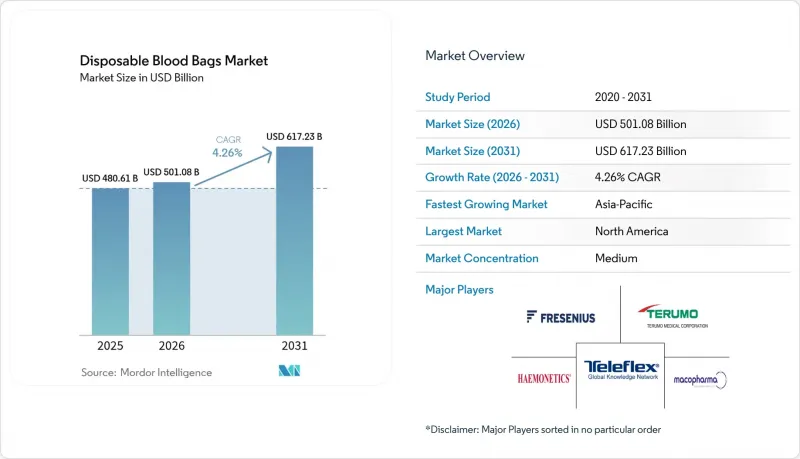
본 보고서는 제품 유형(싱글 혈액백, 더블 혈액백, 트리플 혈액백, 쿼드러플 혈액백, 펜타 혈액백), 소재(DEHP 함유 PVC, DEHP 프리 PVC, 비PVC계 EVA 및 기타), 최종 사용자(병원, 혈액은행 등),용도(채혈, 수송·보관, 처리), 지역(북미, 유럽 등)별로 분류되어 있습니다. 시장 예측은 금액(달러) 기준으로 제시되어 있습니다.
전 세계 일회용 혈액백 시장 동향 및 인사이트
고령화 사회에서의 외과 수술 건수 및 수혈률 증가
수술을 받는 환자의 연령 중앙값은 2008년부터 2020년 사이에 56세에서 59세로 상승했으며, 2030년까지 61.5세까지 더욱 상승할 것으로 예측됩니다. 고령자는 수술 전 헤마토크리트 수치가 낮은 경우가 많으며, 이는 정형외과, 순환기내과, 종양학 등 각 전문 분야에서 수혈 빈도 증가로 이어지고 있습니다. 2024년에는 심혈관 외과 분야만으로도 미국 전체 혈액 성분의 10-15%가 소비되고 있어, 지속적인 수요 기반이 뒷받침되고 있습니다. 노화에 따른 동반 질환 또한 합병증 위험을 높이고 있어, 병원에서는 병원체가 제거된 혈소판 및 백혈구가 제거된 적혈구의 재고를 더욱 늘리고 있습니다. ISO 13485 및 FDA의 품질 요건에 따라 제조업체는 이 취약한 환자 집단을 위해 제품의 유효성을 보장하는 용기를 제공해야 할 의무가 있습니다. 이러한 임상적 현실이 결합되어 일회용 혈액백 시장의 지속적인 수요를 뒷받침하고 있습니다.
혈액 제제가 필요한 외상 및 만성 질환의 유병률 증가
외상은 여전히 생산 연령층 성인의 주요 사망 원인 중 하나이며, 아시아태평양의 도시 응급실에서 혈액형별 농축 적혈구에 대한 급격한 수요를 창출하고 있습니다. 겸상 적혈구증, 지중해 빈혈, 특정 암과 같은 만성 질환의 경우 현재 빈번한 수혈이 필요하며, 전 세계 혈액 질환 부담의 절반 이상을 아시아가 차지하고 있습니다. 보험 적용 범위 확대와 경제 성장으로 치료 접근성이 개선되었고, 그 결과 중규모 병원의 수혈량이 증가하고 있습니다. 저·중소득 국가(LMICs)의 이동식 혈액 성분 요법 프로그램을 통해, 외딴 지역의 외상 센터에서는 드론을 이용한 배송을 통해 8분 이내에 혈소판을 수령할 수 있게 되어, 기존의 육로 배송에 소요되던 55분의 시간을 대폭 단축하고 있습니다. 비감염성 질환의 발생률이 높아짐에 따라, 21 CFR Part 640 기준을 충족하는 일관되고 오염되지 않은 혈액백 시스템에 대한 수요도 증가하고 있습니다. 이러한 추세가 일회용 혈액백 시장의 성장을 지속적으로 뒷받침하고 있습니다.
선진국 시장의 출산율 감소와 자가 수혈 기술
북미와 유럽의 합계 출산율은 인구 대체 수준 아래로 떨어졌으며, 기존에는 전혈에 대한 안정적인 수요를 창출하던 산과용 수혈용 혈액공급원이 축소되고 있습니다. 동시에, 세포 회수 장치를 통해 수술 중 혈액을 회수할 수 있게 되어 정형외과 및 심장외과 의사들이 환자 자신의 적혈구를 환자에게 재주입할 수 있게 됨에 따라 동종 혈액의 사용량이 감소하고 있습니다. 회수 장치를 도입한 병원에서는 대규모 관절 치환술에 필요한 헌혈 혈액 수요가 15-30% 감소하여 재고 수준에 대한 부담이 완화되고 있습니다. 회수용 백에는 여전히 멸균된 일회용 제품이 필요하지만, 그 사용량은 표준 헌혈 세트에 비해 대폭 줄어들었습니다. 장기적인 인구 감소와 수술 기술의 중복으로 인해, 특히 일회용 혈액백 업계의 성숙한 시장에서 향후 성장세는 둔화되고 있습니다.
부문 분석
2025년에도 단일 챔버 백은 응급 상황이나 지방에서의 헌혈 활동에서 비용 대비 효율이 높은 전혈 채취 도구로서 36.42%의 점유율을 유지하며, 일회용 혈액백 시장의 기본 수요를 지탱하고 있습니다. 그러나 병원이 성분 요법으로 전환함에 따라, 단일 챔버 세트 일회용 혈액백 시장 규모는 다중 챔버 구성에 비해 성장률이 둔화되고 있습니다. 연평균 성장률(CAGR) 4.34%로 확대되고 있는 4실형 백은 농축 적혈구, 혈장, 혈소판 및 크리오프레시피테이트의 동시 조제를 가능하게 하여, 1회 헌혈당 치료적 가치를 극대화합니다. 자동화된 Reveos 플랫폼은 4실형 키트와 통합되어 수율을 표준화함으로써, 1단위당 150ml의 혈장 및 3×10⁹개 이상의 혈소판을 공급하여 수동 공정에 비해 우위를 점하고 있습니다.
‘1회 치료당 비용’이라는 지표에 대한 인식이 높아짐에 따라, 보험 지급 제도를 중시하는 병원에서 멀티백의 매력이 더욱 부각되고 있습니다. 더블백 및 트리플백은 혈소판 수요가 중간 수준이면서도 예산 제약에 직면한 중규모 시설에서 여전히 중요한 역할을 수행하고 있습니다. 펜타셋은 틈새 시장 제품이지만, 고도의 병원체 불활성화 및 추가 여과를 지원하여 전문 혈액 센터로부터 주목을 받고 있습니다. 모든 제품 유형에 있어 ISO 8363의 파열 강도 기준 및 21 CFR Part 640의 무균성 요건이 설계를 규정하고 있으며, 공급업체는 가소제의 이동을 억제하면서 차단 특성을 향상시켜야 합니다. 이러한 임상적 및 규정 준수 요건의 진화로 인해 일회용 혈액백 시장의 제품 구성이 지속적으로 발전할 것으로 보장됩니다.
혈액 이송 백 부문은 나머지 시장 점유율을 차지하고 있으며, 혈액 은행 및 수혈 과정에서 매우 중요한 역할을 수행하고 있습니다. 이 백들은 채혈 장소와 의료시설 간에 혈액 성분을 수송하기 위해 특별히 설계되었으며, 혈액 제제의 안전하고 오염 없는 이송을 보장합니다. 이 부문의 성장은 혈액 성분 분리 기술의 채택 확대와 의료 현장에서 효율적인 혈액 성분 수송 시스템에 대한 수요 증가에 힘입고 있습니다. 또한, 특히 개발도상 지역에서의 혈액은행 및 수혈 센터 네트워크 확대와 혈액 제제 운송 시 적절한 콜드체인 관리의 중요성이 점점 더 커지고 있는 점도 수요를 뒷받침하고 있습니다. 이 부문은 더 광범위한 일회용 의료용 백 시장 내 혈액 이송 백 시장의 일부로서 필수적인 역할을 수행하고 있습니다.
지역별 분석
북미는 2025년에도 38.64%라는 압도적인 점유율을 유지했습니다. 이는 견실한 보험 급여, PBM(의약품 혜택 관리)의 광범위한 도입, 그리고 고품질의 혁신적인 백 시스템을 뒷받침하는 FDA의 엄격한 감독에 힘입은 것입니다. 캘리포니아주에서 시행될 예정인 DEHP 함유 의료기기 금지 조치는 이미 조달 부문에서 DINCH 및 EVA 대체재의 시범 도입을 촉진하고 있으며, 전미 병원 그룹의 소재 전환 일정을 가속화하고 있습니다. 캐나다의 국가 과학 프로그램은 소아에게 안전한 가소제에 대한 연구에 자금을 지원하여, 전국적인 구매 결정의 근거가 될 임상적 증거를 확대되고 있습니다.
아시아태평양은 도시화가 진행 중인 인구가 외과 수술 수요를 견인하고 있으며, 각국 정부가 디지털 혈액 관리 인프라에 투자하고 있어 2031년까지 연평균 성장률(CAGR)이 4.92%를 나타낼 것으로 예측되는 가장 빠르게 성장하는 지역입니다. 테르모가 항저우에서 시행하고 있는 1,500만 달러 규모의 현지화 이니셔티브는 국내 생산이 수입 관세를 절감하고 지역 공급 안정성을 강화할 수 있음을 보여줍니다. 인도에서는 이동식 헌혈 유닛이 외딴 지역에서도 서비스를 제공하게 되었으며, 지역 센터와 외상 치료 거점 간 드론 노선을 통해 배송 리드타임이 85% 단축되었습니다. 이러한 공급 능력 확대가 일회용 혈액백 시장의 지속적인 성장세를 뒷받침하고 있습니다.
유럽에서는 기존 DEHP 함유 제품의 대체 및 2027년 8월 시행될 SoHO 규정에 따른 조화로 인해 꾸준한 성장이 예상됩니다. 영국의 국내 혈장 확보 이니셔티브는 알부민 자급률 80%를 목표로 하고 있으며, 이를 통해 첨단 채혈 키트 및 콜드체인 업그레이드에 대한 투자가 촉진되고 있습니다. 남미 및 중동 및 아프리카은 미개척 기회를 내포하고 있으며, WHO 추정에 따르면 연간 1억 200만 유닛공급 부족이 예상됩니다. 국제적 협력을 통해 자원이 제한된 환경에 적합한 소형 태양광 발전식 냉장 장치와 간소화된 멀티백 플랫폼의 도입을 목표로 하고 있습니다. 규제, 인프라, 임상 실무에 있어 지역별 차이가 복합적으로 작용하여, 복잡하면서도 꾸준히 성장하고 있는 일회용 혈액백 시장을 형성하고 있습니다.
기타 혜택:
- 엑셀 형식 시장 예측(ME) 시트
- 3개월간의 애널리스트 지원
자주 묻는 질문
목차
제1장 서론
제2장 조사 방법
제3장 주요 요약
제4장 시장 구도
제5장 시장 규모와 성장 예측
제6장 경쟁 구도
제7장 시장 기회와 향후 전망
LSH 26.09.14According to Mordor Intelligence, the disposable blood bags market size is expected to grow from USD 480.61 million in 2025 to USD 501.08 million in 2026 and is forecast to reach USD 617.23 million by 2031 at 4.26% CAGR over 2026-2031.

This report is Segmented by Product Type (Single Blood Bag, Double Blood Bag, Triple Blood Bag, Quadruple Blood Bag, Penta Blood Bag), Material (PVC DEHP, PVC DEHP-Free, Non-PVC EVA & Others), End User (Hospitals, Blood Banks, and More), Application (Collection, Transportation/Storage, Processing), and Geography (North America, Europe, and More). The Market Forecasts are Provided in Terms of Value (USD).
Global Disposable Blood Bags Market Trends and Insights
Rising surgical procedures & transfusion rates in aging populations
The median age of surgical patients climbed from 56 to 59 years between 2008 and 2020, and forecasts indicate a further increase to 61.5 years by 2030. Elderly individuals often present lower preoperative hematocrit, triggering higher transfusion frequency across orthopedic, cardiovascular, and oncologic specialties. Cardiovascular surgery alone consumed 10-15% of all U.S. blood components in 2024, underscoring a durable demand base. Age-linked comorbidities also elevate complications, prompting hospitals to stock greater inventories of pathogen-reduced platelets and leukoreduced red cells. ISO 13485 and FDA quality mandates compel manufacturers to deliver containers that safeguard product potency for this vulnerable cohort. Collectively, these clinical realities reinforce sustained consumption in the disposable blood bags market.
Increasing prevalence of trauma & chronic diseases requiring blood components
Trauma remains a top cause of mortality among working-age adults, driving acute demand for type-specific packed red cells in emergency rooms across Asia-Pacific urban corridors. Chronic conditions such as sickle-cell disease, thalassemia, and certain cancers now necessitate frequent transfusions, with Asia accounting for more than half of global hematologic disease burden. Expanded insurance coverage and economic growth are improving procedure accessibility, thereby elevating transfusion volumes in mid-tier hospitals. Mobile component therapy programs in LMICs enable remote trauma centers to receive platelets within eight minutes via drone dispatch, compressing the traditional 55-minute ground delivery window. As incidence of non-communicable diseases rises, so does the requirement for consistent, contamination-free bag systems that meet 21 CFR Part 640 standards. These dynamics continually amplify growth in the disposable blood bags market.
Declining birth rates & autologous transfusion techniques in developed markets
Fertility rates in North America and Europe fell below replacement levels, narrowing the obstetric transfusion pool that historically generated stable whole-blood demand. Concurrently, cell-salvage devices reclaim intraoperative blood, allowing orthopedic and cardiac surgeons to return autologous red cells to patients, thus lowering allogeneic usage. Hospitals deploying salvage units recorded 15-30% reductions in donor blood requests during major joint replacements, easing pressure on inventory levels. Although salvage bags still require sterile disposables, volumes are significantly smaller than standard donation sets. Long-term demographic contraction and surgical technology overlap diminish future growth momentum, especially in mature markets of the disposable blood bags industry.
Other drivers and restraints analyzed in the detailed report include:
- Government initiatives to improve voluntary donation & cold-chain infrastructure
- Shift toward single-use infection-controlled products
- Patient Blood Management (PBM) programs reducing transfusion volumes
For complete list of drivers and restraints, kindly check the Table Of Contents.
Segment Analysis
Single bags retained a 36.42% lead in 2025 as cost-effective whole-blood collection tools for emergent situations and rural drives, anchoring baseline volume in the disposable blood bags market. The disposable blood bags market size for single sets, however, is growing more slowly than multi-chamber configurations as hospitals shift toward component therapy. Quadruple bags, expanding at a 4.34% CAGR, accommodate concurrent preparation of packed red cells, plasma, platelets, and cryoprecipitate, maximizing therapeutic value per donation. Automated Reveos platforms integrate with quadruple kits to standardize yields, delivering 150 plasma ml and >=3X10⁹ platelets per unit, an advantage over manual processes.
Growing recognition of cost-per-therapy metrics strengthens multi-bag appeal among reimbursement-driven hospitals. Double and triple bags maintain relevance in mid-tier facilities that perform moderate platelet demand yet face budgetary constraints. Penta sets, though niche, support advanced pathogen inactivation and add-on filtration, attracting specialized blood centers. Across all variants, ISO 8363 burst-strength criteria and 21 CFR Part 640 sterility mandates govern design, compelling suppliers to refine barrier properties while curbing plasticizer migration. These evolving clinical and compliance parameters ensure sustained product mix evolution within the disposable blood bags market.
The blood transfer bags segment holds the remaining market share and serves as a crucial component in the blood banking and transfusion process. These bags are specifically designed for transporting blood components between collection points and healthcare facilities, ensuring safe and contamination-free transfer of blood products. The segment's growth is supported by the increasing adoption of component separation techniques and the rising need for efficient blood component transportation systems in healthcare settings. The demand is further bolstered by the growing network of blood banks and transfusion centers, particularly in developing regions, along with the increasing emphasis on maintaining proper cold chain management during blood product transportation. This segment is an integral part of the blood transfer bags market within the broader disposable medical bag market.
Complete Report Scope:
- By Product Type (Value, USD million)
- Single Blood Bag
- Double Blood Bag
- Triple Blood Bag
- Quadruple Blood Bag
- Penta Blood Bag
- By Material (Value, USD million)
- PVC DEHP
- PVC DEHP-free
- Non-PVC (EVA & others)
- By End User (Value, USD million)
- Hospitals
- Blood Banks
- Diagnostic Centers
- Others
- By Application (Value)
- Collection
- Transportation / Storage
- Processing (Leukoreduction, etc.)
- By Geography (Value, USD million)
- North America
- United States
- Canada
- Mexico
- Europe
- Germany
- United Kingdom
- France
- Italy
- Spain
- Rest of Europe
- Asia-Pacific
- China
- India
- Japan
- South Korea
- Australia
- Rest of Asia-Pacific
- South America
- Brazil
- Argentina
- Rest of South America
- Middle East and Africa
- GCC
- South Africa
- Rest of Middle East and Africa
- North America
Geography Analysis
North America retained a commanding 38.64% share in 2025, underpinned by robust reimbursement, widespread PBM adoption, and stringent FDA oversight that favors premium, innovative bag systems. California's forthcoming DEHP device ban has already influenced procurement teams to pilot DINCH and EVA alternatives, accelerating material migration timelines across U.S. hospital groups. Canada's national science program funds research on pediatric-safe plasticizers, broadening clinical evidence that informs purchasing decisions nationwide.
Asia-Pacific represents the fastest-growing territory with a projected 4.92% CAGR through 2031 as urbanizing populations drive surgical demand and governments invest in digital blood-management infrastructure. Terumo's USD 15 million localization initiative in Hangzhou illustrates how domestic manufacturing can trim import tariffs and bolster regional supply security. India's mobile donation units now service remote districts, while drone corridors between regional centers and trauma hubs slash delivery lead times by 85%. These capacity expansions feed sustained momentum in the disposable blood bags market.
Europe exhibits measured growth, sustained by replacement of legacy DEHP stocks and harmonization under the SoHO regulation effective August 2027. The United Kingdom's domestic plasma initiative seeks 80% albumin self-reliance, spurring investments in advanced collection kits and cold-chain upgrades. South America and the Middle East-Africa region present untapped opportunity where WHO estimates a 102-million-unit annual shortfall. International collaborations aim to introduce compact, solar-powered refrigeration and simplified multi-bag platforms suited for resource-limited environments. Collectively, regional heterogeneity in regulation, infrastructure, and clinical practice shapes a nuanced, yet steadily expanding disposable blood bags market.
- Terumo
- Fresenius
- Haemonetics
- MacoPharma
- Grifols
- B. Braun
- JMS Co. Ltd.
- Shandong Weigao Group Medical Polymer Co. Ltd.
- Poly Medicure Ltd.
- HLL Lifecare
- Demotek Ltd.
- AdvaCare Pharma
- Mitra Industries Pvt. Ltd.
- Neomedic International
- Span Healthcare Private Ltd.
- Troge Medical
- Demophorius Healthcare
- Eightwe Digital Transformations Pvt. Ltd
- Mitra Industries Pvt Ltd.
Additional Benefits:
- The market estimate (ME) sheet in Excel format
- 3 months of analyst support
TABLE OF CONTENTS
1 Introduction
- 1.1 Study Assumptions & Market Definition
- 1.2 Scope of the Study
2 Research Methodology
3 Executive Summary
4 Market Landscape
- 4.1 Market Overview
- 4.2 Market Drivers
- 4.2.1 Rising surgical procedures & transfusion rates in aging populations
- 4.2.2 Increasing prevalence of trauma & chronic diseases requiring blood components
- 4.2.3 Government initiatives to improve voluntary donation & cold-chain infrastructure
- 4.2.4 Shift toward single-use infection-controlled products
- 4.2.5 Emerging adoption of non-PVC eco-friendly bags
- 4.2.6 Mobile donation units expanding component therapy in LMICs
- 4.3 Market Restraints
- 4.3.1 Declining birth rates & autologous transfusion techniques in developed markets
- 4.3.2 Stringent regulatory hurdles for new bag materials
- 4.3.3 Supply-chain dependence on medical-grade PVC resin price volatility
- 4.3.4 Patient Blood Management (PBM) programs reducing transfusion volumes
- 4.4 Value / Supply-Chain Analysis
- 4.5 Regulatory Landscape
- 4.6 Technological Outlook
- 4.7 Porter's Five Forces
- 4.7.1 Threat of New Entrants
- 4.7.2 Bargaining Power of Buyers
- 4.7.3 Bargaining Power of Suppliers
- 4.7.4 Threat of Substitutes
- 4.7.5 Intensity of Competitive Rivalry
5 Market Size & Growth Forecasts
- 5.1 By Product Type (Value, USD million)
- 5.1.1 Single Blood Bag
- 5.1.2 Double Blood Bag
- 5.1.3 Triple Blood Bag
- 5.1.4 Quadruple Blood Bag
- 5.1.5 Penta Blood Bag
- 5.2 By Material (Value, USD million)
- 5.2.1 PVC DEHP
- 5.2.2 PVC DEHP-free
- 5.2.3 Non-PVC (EVA & others)
- 5.3 By End User (Value, USD million)
- 5.3.1 Hospitals
- 5.3.2 Blood Banks
- 5.3.3 Diagnostic Centers
- 5.3.4 Others
- 5.4 By Application (Value)
- 5.4.1 Collection
- 5.4.2 Transportation / Storage
- 5.4.3 Processing (Leukoreduction, etc.)
- 5.5 By Geography (Value, USD million)
- 5.5.1 North America
- 5.5.1.1 United States
- 5.5.1.2 Canada
- 5.5.1.3 Mexico
- 5.5.2 Europe
- 5.5.2.1 Germany
- 5.5.2.2 United Kingdom
- 5.5.2.3 France
- 5.5.2.4 Italy
- 5.5.2.5 Spain
- 5.5.2.6 Rest of Europe
- 5.5.3 Asia-Pacific
- 5.5.3.1 China
- 5.5.3.2 India
- 5.5.3.3 Japan
- 5.5.3.4 South Korea
- 5.5.3.5 Australia
- 5.5.3.6 Rest of Asia-Pacific
- 5.5.4 South America
- 5.5.4.1 Brazil
- 5.5.4.2 Argentina
- 5.5.4.3 Rest of South America
- 5.5.5 Middle East and Africa
- 5.5.5.1 GCC
- 5.5.5.2 South Africa
- 5.5.5.3 Rest of Middle East and Africa
- 5.5.1 North America
6 Competitive Landscape
- 6.1 Market Concentration
- 6.2 Market Share Analysis
- 6.3 Company Profiles (includes Global level Overview, Market level overview, Core Segments, Financials as available, Strategic Information, Market Rank/Share for key companies, Products & Services, and Recent Developments)
- 6.3.1 Terumo Corporation
- 6.3.2 Fresenius Kabi AG
- 6.3.3 Haemonetics Corporation
- 6.3.4 Macopharma SA
- 6.3.5 Grifols S.A.
- 6.3.6 B. Braun Melsungen AG
- 6.3.7 JMS Co. Ltd.
- 6.3.8 Shandong Weigao Group Medical Polymer Co. Ltd.
- 6.3.9 Poly Medicure Ltd.
- 6.3.10 HLL Lifecare Limited
- 6.3.11 Demotek Ltd.
- 6.3.12 \AdvaCare Pharma
- 6.3.13 Mitra Industries Pvt. Ltd.
- 6.3.14 Neomedic International
- 6.3.15 Span Healthcare Private Ltd.
- 6.3.16 Troge Medical GmbH
- 6.3.17 Demophorius Healthcare
- 6.3.18 Eightwe Digital Transformations Pvt. Ltd
- 6.3.19 Mitra Industries Pvt Ltd.
7 Market Opportunities & Future Outlook
- 7.1 White-space & Unmet-Need Assessment


