
|
시장보고서
상품코드
2124660
미국의 스마트락 시장 : 시장 점유율 분석, 업계 동향 및 통계, 성장 예측(2026-2031년)United States Smart Lock - Market Share Analysis, Industry Trends & Statistics, Growth Forecasts (2026 - 2031) |
||||||
 Mordor Intelligence
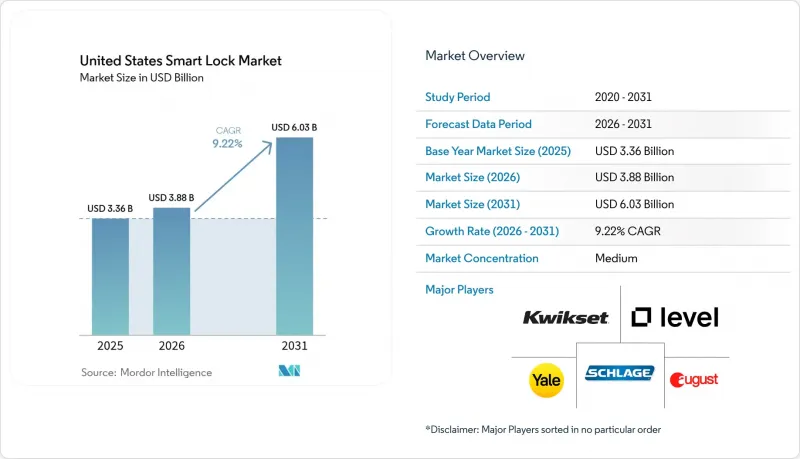
Mordor Intelligence에 의하면, 미국의 스마트락 시장 규모는 2025년에 33억 6,000만 달러로 평가되었고, 2026년 38억 8,000만 달러에서 2031년까지 60억 3,000만 달러에 이를 것으로 예측되며, 예측 기간(2026-2031년) CAGR은 9.22%를 나타낼 전망입니다.

본 보고서는 제품 유형별(데드볼트, 자물쇠 등), 최종 사용자별(주택(단독주택, 공동주택), 상업시설(호텔·리조트, 소매, 기업 사무실 등)), 설치 유형별(후설치 등), 유통 채널별(온라인(마켓플레이스 등), 오프라인(소매업체, 전문 설치 업체))로 분류되어 있습니다. 시장 예측은 금액(달러) 기준으로 제시되어 있습니다.
미국의 스마트락 시장 동향 및 인사이트
스마트 홈 허브 및 음성 어시스턴트와의 연동
2024년 하반기에 승인된 ‘Matter 1.3’ 인증을 통해, 잠금 장치는 별도의 브리지 없이 Apple Home, Google Home, Amazon Alexa, Samsung SmartThings 간에 상호 운용이 가능해졌으며, 도입에 있어 큰 장벽이 해소되었습니다. Thread 메시 네트워크가 배터리 구동형 잠금 장치의 기본 무선 통신 표준으로 Bluetooth Low Energy를 대체하여 지연을 줄이고, 다층 주택 내 통신 범위를 확대되고 있습니다. Schlage사의 ‘Encode Plus’는 2025년 초에 Apple Home Key 지원을 시작했으며, Kwikset사의 ‘Halo Select Plus’도 2025년 8월까지 동등한 기능 세트를 구현함으로써 인증 옵션 측면에서 경쟁사와의 대등성이 강화되었습니다. 음성 비서는 현재 하나의 음성 명령으로 문 잠금, 경보 시스템 작동, 온도 조절기 조정과 같은 복합적인 루틴을 실행할 수 있게 되어, 처음 구매하는 사용자에게 기술적 진입 장벽이 낮아졌습니다. 그 결과 사용 편의성이 향상되어, 미국의 스마트락 시장은 얼리 어답터층을 넘어 일반 가정으로 확대되고 있습니다. 구형 기기에 Matter 인증을 적용하는 지속적인 펌웨어 업데이트는 소비자의 투자를 더욱 보호하고, 생태계 내 정착을 촉진하고 있습니다.
증가하는 택배 도난 사건이 현관 보안 수요를 부추기고 있습니다.
운송업체의 집계 데이터와 소매업체의 조사에 따르면, 2025년에는 하루 평균 약 25만 개의 소포가 도난당해 미국 가정 전체에서 연간 150억 달러의 손실이 발생했습니다. 도어벨 카메라와 연동된 스마트 잠금장치를 사용하면, 소유자는 일회용 코드나 시간 제한이 있는 코드를 생성할 수 있어, 배송 기사가 현관 홀이나 차고 내에 소포를 두고 갈 수 있게 됩니다. 아마존의 ‘Key In-Garage Delivery’ 프로그램은 2025년에 15개 대도시권으로 추가 확대될 예정이며, 자물쇠 제조업체들은 해당 채널에 진출하기 위해 ‘Key 호환’ 인증 획득에 나서고 있습니다. 교외의 단독주택 지역에서는 소포 처리량이 증가하고 있는 반면, 도심에 비해 카메라 설치 밀도가 낮기 때문에 접근 제어가 가능한 소포 수령 거점에 대한 수요가 높아지고 있습니다. 그 결과, 영상 확인, 일시적인 인증 정보, 클라우드 로그 기록 등의 기능이 융합되면서 현관문은 라스트 마일 물류 체인에서 중요한 거점으로 재조명되었으며, 이는 미국 스마트락 시장의 판매 대수를 끌어올렸습니다.
뿌리 깊은 사이버 보안 취약성과 공개된 해킹 사례
2024년 DEF CON 32에서 진행된 시연에서는 호텔 잠금 장치용 RFID 카드가 60초 이내에 복제되는 것이 입증되었습니다. 또한, 2024-2025년 공개된 CVE를 통해 여러 소비자용 브랜드에서 하드코딩된 키 및 리플레이 공격에 대한 취약점이 드러났습니다. 유럽의 ETSI TS 103 815 표준과 달리, 미국에는 의무적인 연방 인증 제도가 없기 때문에 미국에서는 구매자가 언론 보도나 브랜드 평판을 바탕으로 기기의 보안 수준을 판단하고 있습니다. 이러한 보안 침해 사고가 발생할 때마다, 특히 문 잠금 해제가 악용될 것을 우려하는 기술에 정통한 주택 소유자들 사이에서 소매 수요가 일시적으로 위축됩니다. 각 제조업체는 보안 부트로더나 하드웨어 기반 암호화 기술로 대응하고 있지만, SoC 업데이트로 인해 제품 주기가 길어지고 부품 원가가 상승하고 있습니다. 그 결과, 기능 면에서의 혁신이 가속화되고 있음에도 불구하고 부정적인 뉴스가 잇따르면서 미국 스마트락 시장의 성장세는 둔화되고 있습니다.
부문 분석
2025년, 데드볼트는 미국 스마트락 시장 점유율의 60.73%를 차지했으며, 단독주택의 외문에 널리 보급되어 있음을 반영하고 있습니다. 한편, 호텔, 사무실, 의료시설은 1등급의 기계적 견고성과 건축 기준을 준수하는 패닉 탈출 기능을 우선시하고 있어, 몰타이즈형 및 레버형은 2031년까지 연평균 성장률(CAGR) 10.37%를 나타낼 것으로 예측됩니다. 미국 스마트락 시장에서 이식형 플랫폼이 차지하는 시장 규모는 2026년 7억 달러에서 2031년까지 11억 5,000만 달러로 확대될 것으로 예측됩니다. 이는 상업 부문 구매자들이 내구성과 보증 범위의 확충을 이유로 더 높은 평균 판매 가격을 수용함에 따라, 판매 대수 증가율을 상회하는 속도로 성장할 것으로 전망됩니다. 각 제조업체는 현재 교체 가능한 트림, 마감재, 인증 모듈, Wi-Fi, Thread 또는 Zigbee를 지원하는 모듈식 섀시를 출하하고 있으며, 이를 통해 SKU 수를 줄이고 설치 업체의 물류 업무를 원활하게 하고 있습니다.
레버 핸들식 잠금 장치는 미국 장애인법(ADA)의 여유 각도 및 한 손으로 탈출할 수 있어야 한다는 규정을 충족하고 있어, 건축 검사관이 배리어프리 하드웨어를 요구하는 노인 요양 시설이나 공립학교에서의 도입이 증가하고 있습니다. 자물쇠형 스마트락는 여전히 틈새 시장이지만 견조한 하위 부문으로, 특히 컨테이너 문에 영구적인 구멍을 뚫지 않고도 감사 로그가 필요한 물류 야드에서 수요가 있습니다. 한편, 림 잠금 장치는 문 하드웨어를 변경할 수 없는 공동 주택 거주자들에게 인기가 있지만, 표면 장착형 디자인으로 인해 고소득층의 자가 주택으로의 보급이 제한되고 있습니다. 모든 형태에서 배터리 수명 최적화 및 ‘Matter-over-Thread’로의 업그레이드를 위한 신속한 개선이 진행되고 있으며, 이로 인해 기존에 존재하던 상업용과 소비자용 기능 세트의 경계가 모호해지면서 미국 스마트락 시장의 제품 다양화 추세가 유지되고 있습니다.
2025년 매출의 88.39%는 주거용 구매자가 차지했으나, 호텔·리조트, 소매, 기업 캠퍼스, 교육, 의료 분야에서의 상업적 도입은 2031년까지 연평균 성장률(CAGR) 11.12%를 나타낼 것으로 예측되며, 이는 주거용 시장의 성장률의 2배에 해당합니다. RFID 카드에서 모바일 인증 정보로의 전환을 추진하고 있는 호텔 체인에서는 명확한 ROI가 확인되고 있습니다. 프런트 데스크에서의 절차를 생략할 수 있게 됨에 따라 투숙객 만족도 점수가 향상되는 동시에 플라스틱 카드 비용도 절감되고 있습니다. 도마카바(Dormakaba)사의 ‘Ambiance Cloud’는 2025년에 500개 이상의 호텔에 도입될 예정이며, Vingcard사의 ‘VConnect’는 기존 설비에 Apple 및 Google Wallet의 키 기능을 추가함으로써 생태계 전반에 걸친 광범위한 보급을 입증하고 있습니다.
핫데스크 제도로 전환하는 기업 사무실에서는 오피스 스위트, 전화 부스, 사물함에 인증 기능이 탑재된 자물쇠를 도입하고 있으며, 접근 로그를 점유율 분석과 연동시켜 부동산 통합에 관한 의사 결정에 활용하고 있습니다. 소매업의 대형 매장에서는 창고나 POS 현금 서랍에 스마트 자물쇠를 도입하여 수동으로 열쇠를 대여하던 방식을 대체하고 있습니다. 의료 분야에서는 스마트락가 약품 보관실의 보안을 확보하고, HIPAA에 기반한 마약 감사 정확도를 높이고 있습니다. 한편, 대학에서는 학생 ID 시스템을 기숙사 자물쇠에 통합하여, 졸업 시나 징계 처분 시 자동으로 인증 정보를 무효화하고 있습니다. 이러한 다양한 상업적 활용 사례를 통해 주거용 채널보다 문 한 개당 SaaS 지속 수익이 높아져, 전미 스마트 잠금장치 업계의 평균 판매 가격을 끌어올리고 수익 다각화를 촉진하고 있습니다.
기타 혜택 :
- 엑셀 형식 시장 예측(ME) 시트
- 3개월간의 애널리스트 지원
자주 묻는 질문
목차
제1장 서론
제2장 조사 방법
제3장 주요 요약
제4장 시장 구도
제5장 시장 규모 및 성장 예측
제6장 경쟁 구도
제7장 시장 기회 및 향후 전망
AJY 26.09.15According to Mordor Intelligence, the United States smart lock market size was valued at USD 3.36 billion in 2025 and estimated to grow from USD 3.88 billion in 2026 to reach USD 6.03 billion by 2031, at a CAGR of 9.22% during the forecast period (2026-2031).
This report is Segmented by Product Type (Deadbolt, Padlock, and More), End-User (Residential (Single-Family, and Multi-Family), Commercial (Hospitality, Retail, Corporate Offices, and More)), Installation Type (Retrofit, and More), and Distribution Channel (Online (Marketplaces, and More), Offline (Retailers, and Professional Installers)). The Market Forecasts are Provided in Terms of Value (USD).
United States Smart Lock Market Trends and Insights
Integration With Smart-Home Hubs and Voice Assistants
Matter 1.3 certification, ratified in late 2024, lets locks interoperate across Apple Home, Google Home, Amazon Alexa, and Samsung SmartThings without proprietary bridges, eliminating a major adoption barrier. Thread mesh networking replaces Bluetooth Low Energy as the default radio for battery-powered locks, cutting latency and improving range inside multistory residences. Schlage's Encode Plus debuted Apple Home Key support in early 2025, and Kwikset's Halo Select Plus matched the feature set by August 2025, reinforcing competitive parity on credential options. Voice assistants now trigger compound routines, such as locking the door, arming the alarm, and adjusting the thermostat, through a single spoken command, which lowers the technical threshold for first-time buyers. The resulting rise in ease of use is broadening the United States smart lock market beyond early adopters into mass-market households. Continued firmware updates that bring Matter certification to older devices further protect consumer investment and encourage ecosystem stickiness.
Rising Package-Theft Incidents Boosting Entryway Security Demand
An estimated 250 000 parcels were stolen every day in 2025, driving USD 15 billion in annual losses across U.S. households according to aggregated carrier claims and retailer surveys. Smart locks paired with doorbell cameras allow owners to create one-time or time-bounded codes so delivery drivers can leave packages inside vestibules or garages. Amazon's Key In-Garage Delivery program expanded to 15 additional metros in 2025, prompting lock vendors to pursue "Key-compatible" certification to tap that channel. Higher parcel volume in suburban single-family neighborhoods, combined with lower camera density than urban cores, intensifies demand for access-controlled drop-off points. The functional convergence of video verification, temporary credentials, and cloud logging has therefore repositioned entry doors as critical nodes in the last-mile logistics chain, lifting unit sales within the United States smart lock market.
Persistent Cyber-Security Vulnerabilities and Public Hacks
Demonstrations at DEF CON 32 in 2024 showed cloning of hotel-lock RFID cards in under 60 seconds, while CVE disclosures during 2024-2025 exposed hard-coded keys and replay flaws in several consumer brands. Absent a mandatory federal certification regime, unlike the European ETSI TS 103 815 baseline, U.S. buyers rely on media reports and brand reputation to gauge device security. Each breach temporarily suppresses retail demand, especially among tech-savvy homeowners who fear door-unlock exploits. Manufacturers have responded with secure boot loaders and hardware-backed encryption, but SoC updates lengthen product cycles and raise bill-of-materials costs. Continued negative headlines therefore subtract momentum from the United States smart lock market even as feature innovation accelerates.
Other drivers and restraints analyzed in the detailed report include:
- Build-to-Rent Single-Family Developments Adopting Smart Locks at Scale
- UWB Passive-Entry Capabilities Embedded in Smartphones
- Multi-Family Building Code Restrictions on Retrofit Devices
For complete list of drivers and restraints, kindly check the Table Of Contents.
Segment Analysis
Deadbolts commanded 60.73% of United States smart lock market share in 2025, reflecting their ubiquity on single-family exterior doors. Mortise and lever formats, however, are forecast to grow at a 10.37% CAGR through 2031 as hotels, offices, and healthcare facilities prioritize Grade 1 mechanical robustness and code-compliant panic egress. The United States smart lock market size attributed to mortise platforms is projected to expand from USD 0.70 billion in 2026 to USD 1.15 billion by 2031, outpacing unit growth because commercial buyers accept higher average selling prices for durability and warranty coverage. Manufacturers now ship modular chassis that accept interchangeable trims, finishes, and credential modules, Wi-Fi, Thread, or Zigbee, reducing SKU count and smoothing installer logistics.
Lever-handle locks satisfy Americans with Disabilities Act clearance angles and one-hand egress rules, increasing adoption in elder-care facilities and public schools where building inspectors demand accessible hardware. Padlock-style smart locks remain a niche but resilient sub-segment, especially among logistics yards that need audit logs without drilling permanent holes into container doors. Meanwhile, rim locks attract multifamily renters who cannot alter door hardware, yet their surface-mount profile limits penetration into higher-income owner-occupied homes. Across every format, rapid iteration on battery-life optimization and Matter-over-Thread upgrades is blurring historical boundaries between commercial and consumer feature sets, sustaining momentum for product diversification inside the United States smart lock market.
Residential buyers generated 88.39% of 2025 revenue, but commercial deployments, in hospitality, retail, corporate campuses, education, and healthcare, are projected to post an 11.12% CAGR to 2031, twice the residential rate. Hotel chains migrating from RFID cards to mobile credentials show clear ROI: front-desk bypass improves guest satisfaction scores while reducing plastic card costs. Dormakaba's Ambiance Cloud on-boarded over 500 hotels in 2025, and Vingcard's VConnect added Apple and Google Wallet keys to legacy installations, confirming broad ecosystem uptake.
Corporate offices pivoting toward hot-desking rely on credentialed locks for office suites, phone booths, and lockers, linking access logs to occupancy analytics that inform real-estate consolidation decisions. Retail big-box stores deploy smart padlocks on warehouses and point-of-sale cash drawers, replacing manual key sign-outs. In healthcare, smart locks secure medication rooms to improve narcotics auditing under HIPAA, while universities integrate student ID systems to dormitory locks, automatically revoking credentials upon graduation or disciplinary action. This mosaic of commercial use cases captures higher recurring SaaS revenue per door than residential channels, lifting the blended average selling price and reinforcing revenue diversification across the United States smart lock industry.
Complete Report Scope:
- By Product Type
- Deadbolt
- Padlock
- Other Product Types (Mortise, Lever, Rim, etc.)
- By End-User
- Residential
- Single-Family
- Multi-Family
- Commercial
- Hospitality
- Retail
- Corporate Offices
- Healthcare
- Education and More
- Residential
- By Installation Type
- Retrofit
- New-Construction Integrated
- By Distribution Channel
- Online
- Direct from Manufacturer
- Marketplaces
- Offline
- Retailers
- Professional Installers
- Online
List of Companies Covered in this Report:
- August Home Inc.
- ASSA ABLOY Residential Group, Inc. (doing business as Yale Home)
- Kwikset Corporation (an ASSA ABLOY company)
- Schlage Lock Company LLC (wholly owned by Allegion plc)
- Level Home Inc.
- U-Tec Group Inc.
- Wyze Labs, Inc.
- Pin Genie Inc. (doing business as Lockly)
- Anker Innovations Limited (Eufy Security brand)
- SimpliSafe, Inc.
- Aqara (Lumi United Technology Co., Ltd.)
- Gate Labs Inc.
- LockState, Inc. (doing business as RemoteLock)
- Shenzhen Wonder Technology Co., Ltd. (doing business as SwitchBot)
- Onity, Inc. (a Carrier Global Corporation company)
- Digilock, Inc.
- Igloohome Pte. Ltd.
- Nuki Home Solutions GmbH
- PDQ Manufacturing, Inc.
- Baldwin Hardware Corporation (an ASSA ABLOY company)
Additional Benefits:
- The market estimate (ME) sheet in Excel format
- 3 months of analyst support
TABLE OF CONTENTS
1 INTRODUCTION
- 1.1 Study Assumptions and Market Definition
- 1.2 Scope of the Study
2 RESEARCH METHODOLOGY
3 EXECUTIVE SUMMARY
4 MARKET LANDSCAPE
- 4.1 Market Overview
- 4.2 Market Drivers
- 4.2.1 Integration With Smart-Home Hubs and Voice Assistants
- 4.2.2 Rising Package-Theft Incidents Boosting Entryway Security Demand
- 4.2.3 Insurance Premium Discounts for Smart-Security Installations
- 4.2.4 Build-to-Rent Single-Family Developments Adopting Smart Locks at Scale
- 4.2.5 ESG and LEED Incentives for Connected Access Solutions
- 4.2.6 UWB Passive-Entry Capabilities Embedded in Smartphones
- 4.3 Market Restraints
- 4.3.1 Persistent Cyber-Security Vulnerabilities and Public Hacks
- 4.3.2 Multi-Family Building Code Restrictions on Retrofit Devices
- 4.3.3 Chip-Set Supply Constraints for Secure SoCs
- 4.3.4 Consumer Privacy Concerns Over Data Sharing
- 4.4 Industry Value Chain Analysis
- 4.5 Regulatory Landscape
- 4.6 Technological Outlook
- 4.7 Porter's Five Forces Analysis
- 4.7.1 Bargaining Power of Suppliers
- 4.7.2 Bargaining Power of Buyers
- 4.7.3 Threat of New Entrants
- 4.7.4 Intensity of Competitive Rivalry
- 4.7.5 Threat of Substitute Products
- 4.8 Pricing Analysis
- 4.9 Impact of Macroeconomic Factors on the Market
5 MARKET SIZE AND GROWTH FORECASTS (VALUE)
- 5.1 By Product Type
- 5.1.1 Deadbolt
- 5.1.2 Padlock
- 5.1.3 Other Product Types (Mortise, Lever, Rim, etc.)
- 5.2 By End-User
- 5.2.1 Residential
- 5.2.1.1 Single-Family
- 5.2.1.2 Multi-Family
- 5.2.2 Commercial
- 5.2.2.1 Hospitality
- 5.2.2.2 Retail
- 5.2.2.3 Corporate Offices
- 5.2.2.4 Healthcare
- 5.2.2.5 Education and More
- 5.2.1 Residential
- 5.3 By Installation Type
- 5.3.1 Retrofit
- 5.3.2 New-Construction Integrated
- 5.4 By Distribution Channel
- 5.4.1 Online
- 5.4.1.1 Direct from Manufacturer
- 5.4.1.2 Marketplaces
- 5.4.2 Offline
- 5.4.2.1 Retailers
- 5.4.2.2 Professional Installers
- 5.4.1 Online
6 COMPETITIVE LANDSCAPE
- 6.1 Market Concentration
- 6.2 Strategic Moves
- 6.3 Market Share Analysis
- 6.4 Company Profiles (includes Global Level Overview, Market Level Overview, Core Segments, Financials as available, Strategic Information, Market Rank/Share, Products and Services, Recent Developments)
- 6.4.1 August Home Inc.
- 6.4.2 ASSA ABLOY Residential Group, Inc. (doing business as Yale Home)
- 6.4.3 Kwikset Corporation (an ASSA ABLOY company)
- 6.4.4 Schlage Lock Company LLC (wholly owned by Allegion plc)
- 6.4.5 Level Home Inc.
- 6.4.6 U-Tec Group Inc.
- 6.4.7 Wyze Labs, Inc.
- 6.4.8 Pin Genie Inc. (doing business as Lockly)
- 6.4.9 Anker Innovations Limited (Eufy Security brand)
- 6.4.10 SimpliSafe, Inc.
- 6.4.11 Aqara (Lumi United Technology Co., Ltd.)
- 6.4.12 Gate Labs Inc.
- 6.4.13 LockState, Inc. (doing business as RemoteLock)
- 6.4.14 Shenzhen Wonder Technology Co., Ltd. (doing business as SwitchBot)
- 6.4.15 Onity, Inc. (a Carrier Global Corporation company)
- 6.4.16 Digilock, Inc.
- 6.4.17 Igloohome Pte. Ltd.
- 6.4.18 Nuki Home Solutions GmbH
- 6.4.19 PDQ Manufacturing, Inc.
- 6.4.20 Baldwin Hardware Corporation (an ASSA ABLOY company)
7 MARKET OPPORTUNITIES AND FUTURE OUTLOOK
- 7.1 White-Space and Unmet-Need Assessment