

|
시장보고서
상품코드
2124733
미국의 쓰레기봉지 : 시장 점유율 분석, 업계 동향과 통계, 성장 예측(2026-2031년)United States Trash Bags - Market Share Analysis, Industry Trends & Statistics, Growth Forecasts (2026 - 2031) |
||||||
 Mordor Intelligence
Mordor Intelligence에 의하면, 2026년 미국의 쓰레기봉지 시장 규모는 30억 9,000만 달러로 추정되며, 2025년 29억 8,000만 달러에서 2031년에는 36억 9,000만 달러에 달할 것으로 예측됩니다.
2026-2031년 연평균 성장률(CAGR)은 3.64%를 기록할 것으로 전망됩니다.
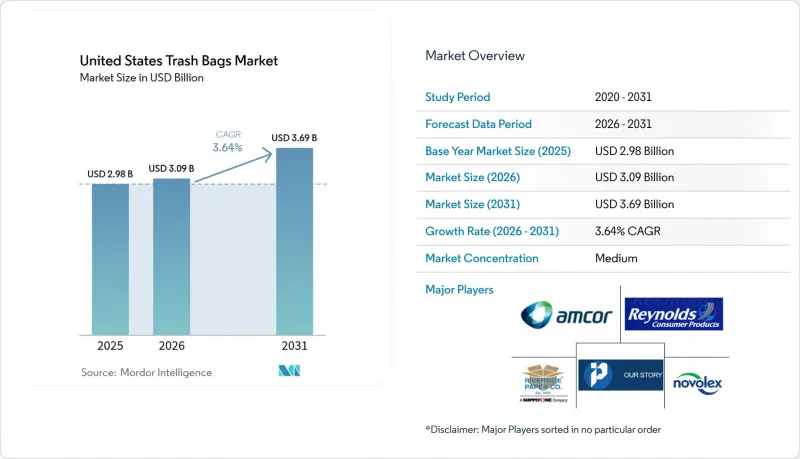
본 보고서는 소재 유형(HDPE, LDPE 등), 용량/봉투 크기(3갤런 이하, 3-13갤런, 기타), 최종 사용자(주택, 공공기관 등), 유통 채널(오프라인 매장, 온라인 소매 등)별로 분류되어 있습니다. 시장 예측은 금액(달러) 기준으로 제시되어 있습니다.
미국 쓰레기 봉투 시장 동향 및 인사이트
퇴비화 가능 및 옥소 생분해성 봉투에 대한 수요 증가
지자체에 의한 유기물 분리 수거 의무화로 인해, ASTM D6400 인증을 취득한 쓰레기 봉투에 대한 확실한 고객 기반이 형성되고 있습니다. 예를 들어, 버몬트주의 ‘범용 재활용법(Universal Recycling Act)’은 주당 26갤런 이상의 음식물 쓰레기를 배출하는 사업자에게 인증된 퇴비화 가능한 쓰레기 봉투 사용을 의무화하고 있습니다. 또한, 2024년에 지급된 3,200만 달러 규모의 연방 인프라 보조금 덕분에 2027년까지 산업용 퇴비화 시설의 수는 185곳에서 275곳으로 확대될 전망입니다. 강력한 정책적 지원이 있음에도 불구하고, 폴리젖산(PLA) 라이너는 여전히 140°F 이상의 산업용 퇴비화 온도가 필요하며, 운송 중 습기의 영향을 받기 쉬운 문제가 있습니다. 실험실 연구에 따르면, 분해에 걸리는 기간은 최적화된 시설에서는 90일, 관리가 미흡한 환경에서는 180일로 차이가 있습니다.
위생 기준 및 폐기물 분리 의무 강화
CDC의 감염 관리 지침은 의료 종사자들에게 일반 폐기물, 규제 대상 의료 폐기물 및 의약품 폐기물을 분리하도록 지시하고 있으며, 이에 따라 FDA 21 CFR 178.3297에 따라 인증된 색상 구분 봉투나 항균성 봉투의 구매가 촉진되고 있습니다. 500병상 규모의 병원에서는 하루에 가동 병상 1개당 25-30파운드의 폐기물이 발생하며, 그 중 85%는 여전히 ‘일반’ 도시 고형 폐기물(MSW)로 분류되지만, 교차 오염의 위험이 있으므로 일반 가정 쓰레기와 혼합할 수 없습니다. 조인트 커미션(Joint Commission)은 미국 내 인증을 받은 총 6,090개 병원에 대해 폐기물 처리 절차의 문서화를 의무화하고 있으며, 이로 인해 해당 의료 기관에서 발생하는 폐기물 처리량은 더욱 증가하고 있습니다.
일회용 플라스틱에 관한 규제
캘리포니아주 SB 54 법안은 단계적인 생산자 부담금과 시장 진입 제한을 부과하고 있으며, 이로 인해 제품 매출액의 8-12%에 해당하는 규정 준수 비용이 발생합니다. 또한, 2024년에 35개 주에서 제출된 127건의 플라스틱 규제 법안은 정책 리스크가 확대되고 있음을 보여줍니다. 재활용 소재 함유율이나 감축 목표를 달성하지 못하는 생산자는 매장 판매 금지 조치의 대상이 될 가능성이 있습니다.
부문 분석
저밀도 폴리에틸렌(LDPE)은 저렴한 비용과 광범위한 가공 인프라에 힘입어 2025년 미국 쓰레기봉투 시장 점유율의 39.85%를 차지했습니다. 그러나 지자체의 퇴비화 의무화에 힘입어 바이오/생분해성 플라스틱은 연평균 성장률(CAGR) 4.52%로 성장할 전망이며, 이는 모든 소재 중 가장 높은 수치입니다. 이 부문에서 ASTM D6400 규격을 준수하는 PBAT-PLA 블렌드는 90일 이내에 산업용 퇴비화가 가능하며, 기존 인플레이션 성형 라인에서 제조할 수 있어 가공업체의 설비 투자 부담을 줄여줍니다. 파생 특허인 미국 제11,456,789호에는 LDPE와 동등한 인열 강도를 실현하는 사슬 연장 첨가제에 대해 상세하게 기술되어 있습니다. 또한, EPR(확대 생산자 책임)법에 따라 가정 쓰레기 수거 프로그램에서 사용되는 봉투에 대한 PCR(사용 후 재활용) 폴리에틸렌의 최소 사용 비율이 규정되어 있기 때문에 PCR 폴리에틸렌도 빠르게 부상하고 있는 하위 부문 중 하나입니다.
규제 당국의 감독이 배합 선택을 이끌고 있습니다. FDA 21 CFR 174.5는 식품과 간접적으로 접촉하는 제품에 포함된 재생 재료를 규제하고 있는 반면, ASTM D6400 인증은 유기물 분리 수거 입찰에 참여하기 위해 필수적입니다. PCR 함량과 퇴비화 가능성 두 가지 요건을 모두 충족할 수 있는 제조업체는 특히 캘리포니아주, 오리건주, 버몬트주에서 각 속성별로 규정 준수 점수가 가산되는 조달 정책 덕분에 유리한 입지를 누리고 있습니다.
30갤런을 초과하는 카테고리는 병원, 공항, 교육 기관 캠퍼스 내 중앙 폐기물 수거소 설계를 배경으로 연평균 성장률(CAGR) 4.91%를 기록하며 가장 빠르게 성장하는 분야입니다. 대형 쓰레기 봉투는 수거 주기를 연장하고 청소 작업에 드는 노동력을 25-40% 절감합니다. 이러한 효과는 감염 위험 감소에 관한 CDC의 연구를 통해서도 입증되었습니다. 이러한 대형 포맷을 제조하기 위해서는 측벽의 강도 저하를 방지하기 위해 다층 다이헤드와 더욱 엄격한 두께 관리 시스템이 필요합니다. 현재 이러한 역량을 갖춘 곳은 최상위급 컨버터뿐이며, 이는 경쟁 장벽을 더욱 공고히 하고 있습니다.
2025년 기준으로, 13-30갤런 크기의 봉투는 미국 쓰레기 봉투 시장 규모의 38.20%를 차지하고 있으며, 가정용 주방이나 상업시설의 화장실 등에서 폭넓게 사용될 수 있어 인기를 얻고 있습니다. 3갤런 이하 및 3-13갤런 용량의 봉투는 틈새 시장이지만, 식품 조리 구역이나 생의학 시료 운송에는 필수적입니다. 반면, 2.0-3.0밀 두께 등급의 쓰레기 압축기용 라이너는 가격대가 높고 판매량이 적어, 표준 두께 제품 전체의 판매량 증가세를 소폭 끌어내리고 있습니다.
기타 혜택:
- 엑셀 형식 시장 예측(ME) 시트
- 3개월간의 애널리스트 지원
자주 묻는 질문
목차
제1장 서론
제2장 조사 방법
제3장 주요 요약
제4장 시장 구도
제5장 시장 규모와 성장 예측
제6장 경쟁 구도
제7장 시장 기회와 향후 전망
LSH 26.09.14According to Mordor Intelligence, United States trash bags market size in 2026 is estimated at USD 3.09 billion, growing from 2025 value of USD 2.98 billion with 2031 projections showing USD 3.69 billion, growing at 3.64% CAGR over 2026-2031.
This report is Segmented by Material Type (HDPE, LDPE, and More), Capacity/Bag Size (Up To 3 Gallons, 3-13 Gallons, and More), End-User (Residential, Institutional, and More), Distribution Channel (Offline Retail, Online Retail, and More). The Market Forecasts are Provided in Terms of Value (USD).
United States Trash Bags Market Trends and Insights
Growing demand for compostable and Oxo-biodegradable bags
Municipal organics diversion mandates create a verified customer base for ASTM D6400-certified liners. Vermont's Universal Recycling Law, for example, compels businesses that generate more than 26 gallons of food waste weekly to adopt certified compostable containment, while USD 32 million in federal infrastructure grants awarded in 2024 is expanding industrial composting capacity from 185 to a projected 275 facilities by 2027. Despite strong policy pull, polylactic acid (PLA) liners still require >= 140 °F industrial composting temperatures and experience moisture sensitivity during transport; laboratory studies show degradation windows ranging from 90 days in optimized facilities to 180 days in less-controlled environments.
Rising hygiene and waste-segregation mandates
CDC infection-control guidance instructs healthcare providers to differentiate general, regulated medical, and pharmaceutical waste streams, prompting purchases of color-coded or antimicrobial bags certified under FDA 21 CFR 178.3297. A 500-bed hospital generates 25-30 pounds of waste per occupied bed each day, 85% of which still falls under "general" MSW, yet cannot commingle with retail refuse due to cross-contamination risk. The Joint Commission requires all 6,090 U.S.-accredited hospitals to document waste-handling protocols, enlarging the addressable institutional volume.
Restrictions on single-use plastics
California's SB 54 imposes graduated producer fees and market-access limitations that add compliance costs equivalent to 8-12% of product revenue, while 127 plastic regulation bills introduced across 35 states in 2024 indicate broadening policy risk. Producers that fail to meet recycled-content or reduction targets may face shelf-space bans.
Other drivers and restraints analyzed in the detailed report include:
- E-grocery boom increasing household bag consumption
- Adoption of antimicrobial additive-infused bags
- Volatility in virgin resin prices
For complete list of drivers and restraints, kindly check the Table Of Contents.
Segment Analysis
Low-Density Polyethylene commanded 39.85% of the United States trash bags market share in 2025, supported by low cost and broad processing infrastructure. Yet bio-based/biodegradable plastics are on track for a 4.52% CAGR, the highest among all materials, propelled by municipal composting mandates. Within this segment, PBAT-PLA blends that meet ASTM D6400 standards can achieve industrial compostability within ninety days and run on existing blown-film lines, mitigating capital outlay for converters. A derivative patent, US 11,456,789, details chain-extending additives that enhance tear resistance to match LDPE. Post-consumer recycled (PCR) polyethylene is another fast-emerging subset because EPR statutes specify minimum PCR thresholds for bags used in curbside programs.
Regulatory oversight guides formulation choices. FDA 21 CFR 174.5 regulates recycled materials in indirect food-contact articles, while ASTM D6400 certification is vital for access to organics diversion tenders. Producers that can combine PCR inclusion and compostability credentials enjoy premium positioning, particularly in California, Oregon, and Vermont, where procurement policies award compliance points for each attribute.
The above-30-gallon category is the fastest-growing band at a 4.91% CAGR, riding on central waste-station designs in hospitals, airports, and educational campuses. Larger liners extend collection intervals and cut janitorial labor by 25-40%, outcomes backed by CDC studies on infection-risk mitigation. Manufacturing these large formats requires multi-layer die heads and tighter gauge-control systems to avoid weak sidewalls; only the top tier of converters now owns such capabilities, reinforcing competitive barriers.
The 13-30-gallon bracket held 38.20% of the United States trash bags market size in 2025, favored for versatility in residential kitchens and commercial restrooms. Up to 3-gallon and 3-13-gallon bags remain niche but indispensable for food-prep zones and biomedical sample transport. Meanwhile, trash-compactor liners in the 2.0-3.0-mil gauge class command higher price points but fewer units sold, slightly diluting overall volume growth for standard gauges.
Complete Report Scope:
- By Material Type
- High-Density Polyethylene (HDPE)
- Low-Density Polyethylene (LDPE)
- Linear Low-Density Polyethylene (LLDPE)
- Bio-based/Biodegradable Plastics (PLA, PBAT, PHA)
- Other Material Types
- By Capacity / Bag Size
- Up to 3 Gallons
- 3-13 Gallons
- 13-30 Gallons
- Above 30 Gallons
- By End-user
- Residential
- Institutional (HoReCa, Healthcare, Education)
- Commercial and Industrial
- By Distribution Channel
- Offline Retail (Supermarkets, Warehouse Clubs, Convenience Stores)
- Online Retail
- B2B / Institutional Sales
List of Companies Covered in this Report:
- Amcor plc
- Reynolds Consumer Products Inc.
- Novolex Holdings, LLC
- Inteplast Group Corporation
- Riverside Paper Co., Inc.
- Fast Bags Corp.
- International Plastics, Inc.
- Neway Packaging Corporation
- AR-BEE Transparent Products, Inc.
- Universal Plastic Bag Co.
- The Clorox Company (Glad)
- Poly-America, L.P.
- Advance Polybag, Inc.
- Crown Poly, Inc.
- Aluf Plastics, Inc.
- BioBag Americas, Inc.
- Heritage Bag Company
- Command Packaging LLC
- Green Genius LLC
- PAC Worldwide Corporation
Additional Benefits:
- The market estimate (ME) sheet in Excel format
- 3 months of analyst support
TABLE OF CONTENTS
1 INTRODUCTION
- 1.1 Study Assumptions and Market Definition
- 1.2 Scope of the Study
2 RESEARCH METHODOLOGY
3 EXECUTIVE SUMMARY
4 MARKET LANDSCAPE
- 4.1 Market Overview
- 4.2 Market Drivers
- 4.2.1 Growing demand for compostable and oxo-biodegradable bags
- 4.2.2 Rising hygiene and waste-segregation mandates
- 4.2.3 E-grocery boom increasing household bag consumption
- 4.2.4 Adoption of antimicrobial additive-infused bags
- 4.2.5 State-level EPR nudging thicker recyclable bags
- 4.2.6 Smart dispenser subscriptions for refill bags
- 4.3 Market Restraints
- 4.3.1 Restrictions on single-use plastics
- 4.3.2 Volatility in virgin resin prices
- 4.3.3 Composting infrastructure curbing conventional bags
- 4.3.4 Trash compactors reducing bag consumption
- 4.4 Industry Value Chain Analysis
- 4.5 Regulatory Landscape
- 4.6 Technological Outlook
- 4.7 Porter's Five Forces Analysis
- 4.7.1 Bargaining Power of Suppliers
- 4.7.2 Bargaining Power of Consumers
- 4.7.3 Threat of New Entrants
- 4.7.4 Threat of Substitute Products
- 4.7.5 Intensity of Competitive Rivalry
- 4.8 The Impact of Macroeconomic Factors on the Market
5 MARKET SIZE AND GROWTH FORECASTS (VALUE)
- 5.1 By Material Type
- 5.1.1 High-Density Polyethylene (HDPE)
- 5.1.2 Low-Density Polyethylene (LDPE)
- 5.1.3 Linear Low-Density Polyethylene (LLDPE)
- 5.1.4 Bio-based/Biodegradable Plastics (PLA, PBAT, PHA)
- 5.1.5 Other Material Types
- 5.2 By Capacity / Bag Size
- 5.2.1 Up to 3 Gallons
- 5.2.2 3-13 Gallons
- 5.2.3 13-30 Gallons
- 5.2.4 Above 30 Gallons
- 5.3 By End-user
- 5.3.1 Residential
- 5.3.2 Institutional (HoReCa, Healthcare, Education)
- 5.3.3 Commercial and Industrial
- 5.4 By Distribution Channel
- 5.4.1 Offline Retail (Supermarkets, Warehouse Clubs, Convenience Stores)
- 5.4.2 Online Retail
- 5.4.3 B2B / Institutional Sales
6 COMPETITIVE LANDSCAPE
- 6.1 Market Concentration
- 6.2 Strategic Moves
- 6.3 Market Share Analysis
- 6.4 Company Profiles (includes Global level Overview, Market level overview, Core Segments, Financials as available, Strategic Information, Market Rank/Share for key companies, Products and Services, and Recent Developments)
- 6.4.1 Amcor plc
- 6.4.2 Reynolds Consumer Products Inc.
- 6.4.3 Novolex Holdings, LLC
- 6.4.4 Inteplast Group Corporation
- 6.4.5 Riverside Paper Co., Inc.
- 6.4.6 Fast Bags Corp.
- 6.4.7 International Plastics, Inc.
- 6.4.8 Neway Packaging Corporation
- 6.4.9 AR-BEE Transparent Products, Inc.
- 6.4.10 Universal Plastic Bag Co.
- 6.4.11 The Clorox Company (Glad)
- 6.4.12 Poly-America, L.P.
- 6.4.13 Advance Polybag, Inc.
- 6.4.14 Crown Poly, Inc.
- 6.4.15 Aluf Plastics, Inc.
- 6.4.16 BioBag Americas, Inc.
- 6.4.17 Heritage Bag Company
- 6.4.18 Command Packaging LLC
- 6.4.19 Green Genius LLC
- 6.4.20 PAC Worldwide Corporation
7 MARKET OPPORTUNITIES AND FUTURE OUTLOOK
- 7.1 White-space and Unmet-Need Assessment


