|
시장보고서
상품코드
2124743
냉장 트레일러 : 시장 점유율 분석, 업계 동향과 통계, 성장 예측(2026-2031년)Refrigerated Trailer - Market Share Analysis, Industry Trends & Statistics, Growth Forecasts (2026 - 2031) |
||||||
 Mordor Intelligence
Mordor Intelligence에 의하면, 냉장 트레일러 시장 규모는 2025년에 74억 9,000만 달러로 평가되었고, 2026년 79억 8,000만 달러에서 2031년까지 109억 6,000만 달러에 이를 것으로 예측되며, 예측 기간(2026-2031년) CAGR은 6.55%를 기록할 전망입니다.
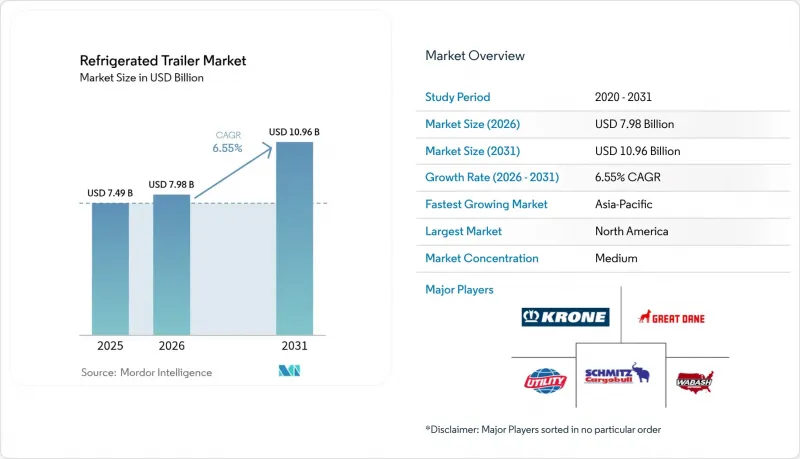
본 보고서는 제품 유형(냉동 식품용 트레일러 및 냉장 식품용 트레일러), 트레일러 길이(28피트 이하, 29-49피트, 49피트 이상),냉동 동력원(디젤 내연기관, 디젤·전기 하이브리드 등), 최종 사용자(유제품, 과일 및 채소, 육류·수산물, 의약품 등), 지역별로 분류되어 있습니다. 시장 예측은 금액(달러) 및 수량(단위)으로 제시되어 있습니다.
세계 냉장 트레일러 시장 동향 및 인사이트
전자상거래 주도형 라스트 마일 콜드체인 배송에 대한 수요 증가
온라인 식료품 배달 서비스는 배송 빈도와 트레일러 설계를 혁신하여, 다중 온도대를 지원하고 밀집된 도시 도로를 주행할 수 있는 더 짧고 기동성이 뛰어난 차량의 도입을 운송 사업자들에게 촉진하고 있습니다. 퍼포먼스 푸드 그룹은 제로 배출 풀필먼트 센터를 지원하기 위해 캘리포니아주에서 30대 이상의 배터리식 전기 냉장 트레일러를 도입하여 전기 시스템의 상업적 실현 가능성을 입증하고 있습니다. 최대 28피트 길이의 유닛이 가진 다용도성이 이러한 성장을 뒷받침하고 있으며, 서모킹(ThermoKing)사의 ‘TracKing’ 플랫폼과 같은 고정밀 텔레매틱스 기술을 통해 정지 및 재출발이 잦은 노선에서도 화물 온도를 ±0.9°F 이내로 유지하고 있습니다. 전기 트레일러에 투자하는 운송 회사는 지방자치단체의 소음 저감 규제와 디젤 차량으로는 실현 불가능한 야간 배송 시간대도 활용하고 있습니다. 도시에서 정체 요금 제도와 제로 배출 구역 도입이 진행되는 가운데, 사업자들은 전기 냉장 트레일러를 미래의 접근 제한에 대한 위험 회피 수단으로 간주하고 있습니다. 따라서 전자상거래의 성장과 지속가능성 정책의 융합으로 인해, 소형 배터리 구동 차량은 차세대 콜드체인에서 필수적인 요소로 자리 잡아가고 있습니다.
온도 기록 및 추적성을 의무화하는 더욱 엄격한 식품 안전 규제
미국에서 FSMA 204가 시행됨에 따라, 화주들은 고위험 식품에 대해 운송 전 과정에 걸친 온도 이력을 기록해야 할 의무가 있습니다. 규정 위반은 리콜이나 민사 처벌을 초래할 가능성이 있으며, 그 비용이 설비 추가 비용을 상회하기 때문에 데이터 자동 업로드가 가능한 텔레매틱스 지원 트레일러의 도입이 촉진되고 있습니다. Great Dane사는 현재 신형 냉장 모델에 FleetPulse 텔레매틱스 시스템을 기본 사양으로 장착하고 있으며, 감사 대응을 간소화하는 실시간 알림 기능을 제공합니다. EU 규정(EC) 852/2004 역시 유사한 추적성 요건을 규정하고 있으며, 운송 사업자가 기존 트레일러에 블루투스 프로브나 클라우드 대시보드를 사후 장착하도록 장려하고 있습니다. 이러한 규제 동향은 하드웨어, 소프트웨어 및 규정 준수 보고를 구독 패키지에 통합하는 공급업체에 이점을 가져다주고 있습니다. 장기적으로는 온도 기록 의무화가 전 세계적으로 통일될 가능성이 높으며, 모든 냉장 트레일러 시장 진출기업에 대해 기준 사양이 점차 높아질 것입니다.
디젤 방식에 비해 높은 전기/하이브리드식 TRU의 초기 비용
배터리식 전기 TRU는 디젤식 유닛에 비해 2-3배의 비용이 들기 때문에 보조금을 받을 수 없는 운송 사업자의 경우 투자 회수 기간이 5년을 초과하게 됩니다. 상업 대출에 의존하는 소규모 운송업체는 더 높은 금리에 직면해 있어 현금 흐름 조정이 어려워지고 있습니다. 와바시 내셔널(Wabash National)은 하드웨어, 유지보수, 텔레매틱스를 월별 지불로 통합한 ‘Trailers-as-a-Service(트레일러 애즈 어 서비스)’ 구독 서비스를 통해 이 과제를 해결하고 있으며, 자본 지출(Capex)을 운영 비용(OpEx)으로 전환하고 있습니다. 고전압 시스템을 안전하게 유지보수하기 위한 기술자 교육에는 간접 비용이 추가되는 반면, 지역의 전력 가격은 총 소유 비용(TCO)에 영향을 미칩니다. 배터리 가격이 하락하거나 인센티브가 확대되기 전까지는 연료세나 배기가스 규제에 따른 제재가 비교적 완화된 지역에서는 디젤이 계속해서 주류를 이룰 것입니다.
부문 분석
2025년, 냉동 트레일러는 영하에서 품질 유지가 요구되는 육류, 수산물, 조리 식품의 물류 덕분에 냉장 트레일러 시장 규모의 54.62%를 차지했습니다. 운송 사업자의 경우, 1회 적재당 화물 가치가 항상 10만 달러를 초과하기 때문에 높은 단열 성능과 듀얼 컴프레서 시스템의 도입은 타당합니다. 한편, 냉장 트레일러는 온라인 식료품 및 의약품·바이오 제제가 36°F에서 46°F의 온도 안정성을 필요로 하기 때문에 2031년까지 연평균 성장률(CAGR) 8.33%를 나타낼 것으로 예측되며, 이에 따라 운송 사업자들은 멀티존 라이너 및 급속 냉각 증발기에 대한 투자를 진행하고 있습니다.
기술의 융합으로 경계가 모호해지고 있습니다. 그레이트 데인(Great Dane)사의 ‘에베레스트(Everest)’ 플랫폼에서는 가변 속도 압축기와 이동식 격벽을 통해 운송 사업자가 냉동 모드와 냉장 모드를 전환할 수 있습니다. 캘리포니아 대기자원국(CARB)의 저 GWP 규제는 광범위한 온도 범위에서 효과적인 냉매를 권장하고 있으며, 각 OEM 업체들이 유연한 시스템 설계를 하도록 촉진하고 있습니다. 신선 식품의 리드타임이 단축되는 가운데, 운송업체들은 온도 누출을 일으키지 않으면서 오늘은 딸기, 내일은 아이스크림과 같이 용도를 전환할 수 있는 트레일러를 점점 더 많이 요구하고 있습니다.
49피트를 초과하는 트레일러는 2025년 매출의 52.05%를 차지하고 있으며, 이는 도크 도어와 크로스 도크가 53피트급 차량을 중심으로 표준화되어 있는 주간 노선에서의 규모의 경제를 반영합니다. 이 부문의 지속력은 예측 가능한 적재 효율과 톤마일당 운행 횟수 감소에 크게 기인합니다. 한편, 28피트 이하 트레일러는 도시 물류에서 대형 차량에 불이익을 주는 혼잡 규제가 강화되는 가운데 8.05%라는 가장 높은 연평균 성장률(CAGR)을 기록하고 있습니다.
도시 지역의 배송 시간대에는 작은 반경으로 회전하거나 갓길에 정차할 수 있는 차량이 선호됩니다. 따라서 소형 냉장 차체는 시카고, 파리, 싱가포르에서 온라인 식료품 및 밀키트 배송 수요를 확보하고 있습니다. 하이브리드형 차량 함대의 경우, 48피트 장거리 운송용 차량이 도시 지역의 집배 센터로 화물을 운반하고, 거기서부터 28피트 위성 차량이 배송을 수행하는 구조로 되어 있으며, 이는 항공 화물의 ‘허브 앤 스포크(hub-and-spoke)’ 방식을 연상시킵니다. 각 OEM 업체들은 섀시 길이에 관계없이 적용 가능한 모듈식 냉장 패키지를 제공함으로써 이에 대응하고 있으며, 이를 통해 차량 관리자는 부품 재고를 통합할 수 있게 되었습니다.
지역별 분석
북미는 2025년에 매출 점유율 39.15%를 차지하며 냉장 트레일러 시장을 주도하고 있습니다. 그 배경에는 잘 갖춰진 주간 고속도로망, 창고 자동화, 그리고 디지털 온도 기록을 의무화하는 FSMA(식품 안전 현대화법) 규제가 있습니다. 핵심 수요는 연간 평균 4만 4,000대이며, 섀시 납기 지연으로 인해 2024년에 일시적인 침체가 있었으나 2025년 수주는 회복될 전망입니다. 각 플릿 기업들은 소매업체의 ESG 스코어카드 요건을 충족하기 위해 구독 모델과 전동 TRU(트레일러용 냉동 장치)를 도입하고 있으며, 텔레매틱스 보급률은 70%를 넘어 예측 유지보수 및 경로 최적화가 가능해졌습니다.
아시아태평양은 JBS의 1억 달러 규모의 베트남 육류 허브 건설 등의 투자와 1인당 콜드체인 지출을 끌어올리는 급속한 도시화에 힘입어 8.92%의 연평균 성장률(CAGR)을 기록하며 지역별 가장 빠른 성장세를 보이고 있습니다. 현지 조립 라인을 통해 수입 관세가 절감되어, 지역 내 차량 함대에게 규정 준수 트레일러가 더 저렴한 가격으로 제공됩니다. 중국과 인도에서 농업용 냉장 창고에 대한 정부 보조금은 간접적으로 트레일러 수요를 자극하고 있으며, 라이드셰어 플랫폼에서는 적재 용량을 공유하는 냉장 밴의 시범 운영이 진행되고 있어 운송 수단 간 융합의 가능성을 시사하고 있습니다.
유럽에서는 개정된 F-가스 규제로 인해, 특히 독일, 프랑스, 북유럽 국가에서 GWP 값이 높은 R404A 시스템에서 CO2나 프로판 등의 천연 냉매로의 전환이 진행되며 꾸준한 확대가 이어지고 있습니다. 총 소유 비용(TCO) 산정 결과, 지상 전원 인프라가 충분히 갖춰진 고밀도 배송 노선에서는 완전 전기식 트레일러가 유리한 것으로 나타났습니다. 라틴아메리카와 아프리카의 신흥 시장에서는 개발은행의 자금 지원을 받은 인프라 프로젝트가 진행되고 있으나, 환율 변동으로 인해 차량 투자 속도는 둔화되고 있습니다.
기타 혜택:
- 엑셀 형식 시장 예측(ME) 시트
- 3개월간의 애널리스트 지원
자주 묻는 질문
목차
제1장 서론
제2장 조사 방법
제3장 주요 요약
제4장 시장 구도
제5장 시장 규모와 성장 예측
제6장 경쟁 구도
제7장 시장 기회와 향후 전망
LSH 26.09.14According to Mordor Intelligence, the refrigerated trailer market size was valued at USD 7.49 billion in 2025 and estimated to grow from USD 7.98 billion in 2026 to reach USD 10.96 billion by 2031, at a CAGR of 6.55% during the forecast period (2026-2031).
This report is Segmented by Product Type (Frozen Food Trailers and Chilled Food Trailers), Trailer Length (up To 28 Ft, 29-49 Ft, and Above 49 Ft), Refrigeration Power Source (Diesel ICE, Diesel-Electric Hybrids, and More), End User (Dairy, Fruits and Vegetables, Meat and Seafood, Pharmaceuticals, and More), and Geography. The Market Forecasts are Provided in Terms of Value (USD) and Volume (Units).
Global Refrigerated Trailer Market Trends and Insights
Growing Demand for E-Commerce-Driven Last-Mile Cold-Chain Deliveries
Online grocery services reshape delivery frequency and trailer design, prompting fleets to deploy shorter, agile units that navigate dense urban corridors with multi-temperature zones. Performance Food Group deployed more than 30 battery-electric refrigerated trailers in California to support zero-emission fulfillment centers, underscoring the commercial viability of electric systems . The versatility of up-to-28-foot units underpins their growth, while precise telematics such as Thermo King's TracKing platform maintain cargo integrity within +-0.9 °F during stop-and-go routes. Fleets investing in electric trailers also capitalize on municipal noise-reduction rules and overnight delivery windows unattainable for diesel units. As cities roll out congestion pricing and zero-emission zones, operators see electric refrigerated trailers as a hedge against future access restrictions. Therefore, the convergence of e-commerce growth and sustainability policies cements compact, battery-powered equipment as an essential node in next-generation cold chains.
Stricter Food-Safety Regulations Mandating Temperature Logging and Traceability
Implementing FSMA 204 in the United States forces shippers to document end-to-end temperature histories for high-risk foods. Non-compliance can trigger recalls and civil penalties that outweigh incremental equipment costs, driving adoption of telematics-enabled trailers capable of automatic data uploads. Great Dane now fits FleetPulse telematics as standard on new refrigerated models, offering real-time alerts that simplify audit readiness . Regulation (EC) 852/2004 in the EU underpins similar traceability requirements, encouraging fleets to retrofit legacy trailers with Bluetooth probes and cloud dashboards. The regulatory push benefits suppliers that bundle hardware, software, and compliance reporting into subscription packages. Over the long term, temperature-logging mandates will likely harmonize globally, creating a rising baseline specification for every refrigerated trailer market participant.
High Upfront Cost Premium of Electric / Hybrid TRUs Versus Diesel
Battery-electric TRUs can cost two to three times more than diesel units, stretching payback horizons beyond five years for fleets lacking subsidy access. Smaller carriers reliant on commercial loans face higher interest rates, making cash-flow alignment difficult. Wabash National counters the hurdle via Trailers-as-a-Service subscriptions that bundle hardware, maintenance, and telematics into monthly payments, shifting capex to opex . Training technicians to safely maintain high-voltage systems adds indirect costs, while regional electricity prices influence the total cost of ownership. Until battery prices fall or incentives broaden, diesel will persist where fuel taxation and emission penalties remain modest.
Other drivers and restraints analyzed in the detailed report include:
- Shift Toward Diesel-Free Hybrid and Fully Electric Transport Refrigeration Units
- Fleet Data Analytics Enabling Predictive Maintenance and Uptime Gains
- Limited Charging and Shore-Power Infrastructure Along Long-Haul Corridors
For complete list of drivers and restraints, kindly check the Table Of Contents.
Segment Analysis
Frozen trailers controlled 54.62% of the refrigerated trailer market size in 2025 thanks to meat, seafood, and ready-meal logistics that demand sub-zero integrity. Operators justify higher insulation and dual-compressor systems because cargo values routinely exceed USD 100,000 per load. Conversely, chilled trailers are forecast to post an 8.33% CAGR through 2031 as online grocery and pharmaceutical biologics require 36 °F to 46 °F stability, prompting fleets to invest in multi-zone liners and rapid-cool evaporators.
Technological convergence blurs boundaries: Great Dane's Everest platform allows operators to toggle between frozen and chilled modes via variable-speed compressors and movable bulkheads. CARB's low-GWP mandates favor refrigerants effective across a broad temperature envelope, nudging OEMs to design flexible systems. As fresh-produce lead times tighten, carriers increasingly seek trailers that pivot between strawberries today and ice cream tomorrow without risking thermal leakage
Trailers exceeding 49 feet held 52.05% of 2025 revenue, reflecting economies of scale on interstate lanes where dock doors and cross-docks standardize around 53-foot assets. The segment's endurance owes much to predictable cube utilization and reduced trips per ton-mile. Meanwhile, trailers up to 28 feet log the fastest 8.05% CAGR as city logistics mount congestion rules that penalize oversized rigs.
Municipal delivery windows prefer vehicles capable of tight-radius turns and curbside docking; smaller refrigerated bodies therefore capture e-grocery and meal-kit traffic in Chicago, Paris, and Singapore. Hybrid fleets mix 48-foot linehaul units feeding urban depots served by 28-foot satellites, echoing hub-and-spoke air-cargo logic. OEMs answer with modular refrigeration packages adaptable across chassis lengths, allowing fleet managers to consolidate parts inventories.
Complete Report Scope:
- By Product Type (Temperature Class)
- Frozen Food Trailers
- Chilled Food Trailers
- By Trailer Length / Capacity
- Up to 28 ft (Pup and City)
- 29 - 49 ft (Standard)
- Above 49 ft (Long-haul / 53 ft)
- By Refrigeration Power Source
- Diesel ICE Units
- Diesel-Electric Hybrids
- Full-Electric / Battery-Powered Units
- Cryogenic and Alt-Fuel Units
- By End User
- Dairy Products
- Fruits and Vegetables
- Meat and Seafood
- Pharmaceuticals and Life Sciences
- Bakery and Confectionery
- Other End Users
- By Geography
- North America
- United States
- Canada
- Rest of North America
- South America
- Brazil
- Argentina
- Rest of South America
- Europe
- Germany
- United Kingdom
- France
- Italy
- Spain
- Russia
- Rest of Europe
- Asia-Pacific
- China
- India
- Japan
- South Korea
- Australia & New Zealand
- Rest of Asia-Pacific
- Middle-East and Africa
- United Arab Emirates
- Saudi Arabia
- Turkey
- Egypt
- South Africa
- Rest of Middle-East and Africa
- North America
Geography Analysis
North America leads the refrigerated trailer market with a 39.15% revenue share in 2025, anchored by robust interstate highways, warehouse automation, and FSMA rules that obligate digital temperature logs. Core demand averages 44,000 units per year, with 2025 orders rebounding after a brief 2024 dip caused by chassis delays. Fleets adopt subscription models and electric TRUs to satisfy retailer ESG scorecards, while telematics penetration surpasses 70%, enabling predictive maintenance and route optimization.
Asia-Pacific records the fastest regional growth at a 8.92% CAGR, propelled by investments such as JBS's USD 100 million Vietnamese meat hub and rapid urbanization that elevates per-capita cold-chain spending. Local assembly lines reduce import duties, making compliant trailers more affordable for regional fleets. Government subsidies in China and India for agricultural cold storage indirectly stimulate trailer demand, and ride-hailing platforms experiment with shared-capacity cold vans, signaling potential modal convergence.
Europe maintains steady expansion as the revised F-Gas Regulation spurs replacement of high-GWP R404A systems with natural refrigerants like CO2 and propane, especially in Germany, France, and the Nordics. Total cost-of-ownership calculations favor fully electric trailers on dense distribution routes with ample shore power. Emerging markets in Latin America and Africa follow with infrastructure projects funded by development banks, though currency volatility tempers fleet investment pacing.
- Wabash National Corporation
- Great Dane LLC
- Utility Trailer Manufacturing Company
- Schmitz Cargobull AG
- Kogel Trailer GmbH
- Lamberet SAS
- Fahrzeugwerk Bernard Krone GmbH
- Montracon Ltd
- Randon Implementos
- Gray & Adams Ltd
- Hyundai Translead
- CIMC Vehicles Group
- Chereau (The Reefer Group)
- Polar King International Inc.
- Wernicke Trailer
- Stoughton Trailers LLC
- Vanguard National Trailer Corp.
- THT New Cool (Heering)
- SOR Iberica
- MHI Thermal Transport
Additional Benefits:
- The market estimate (ME) sheet in Excel format
- 3 months of analyst support
TABLE OF CONTENTS
1 Introduction
- 1.1 Study Assumptions & Market Definition
- 1.2 Scope of the Study
2 Research Methodology
3 Executive Summary
4 Market Landscape
- 4.1 Market Overview
- 4.2 Market Drivers
- 4.2.1 Growing Demand for E-Commerce-Driven Last-Mile Cold Chain Deliveries
- 4.2.2 Stricter Food-Safety Regulations Mandating Temperature Logging and Traceability
- 4.2.3 Shift Toward Diesel-Free Hybrid and Fully Electric Transport Refrigeration Units (Zetrus)
- 4.2.4 Rapid Cold-Chain Build-Out in Emerging Asia-Pacific and African Economies
- 4.2.5 Fleet Data Analytics Enabling Predictive Maintenance and Uptime Gains
- 4.2.6 ESG-Driven Investor Pressure Accelerating Fleet Modernization
- 4.3 Market Restraints
- 4.3.1 High Upfront Cost Premium of Electric / Hybrid TRUs Vs. Diesel
- 4.3.2 Limited Charging and Shore-Power Infrastructure Along Long-Haul Corridors
- 4.3.3 Chronic Driver Shortage Constraining Refrigerated Capacity
- 4.3.4 Volatile HFC Phase-Down Legislation Creating Technology Uncertainty
- 4.4 Value / Supply-Chain Analysis
- 4.5 Regulatory Landscape
- 4.6 Technological Outlook
- 4.7 Porter's Five Forces
- 4.7.1 Threat of New Entrants
- 4.7.2 Bargaining Power of Buyers
- 4.7.3 Bargaining Power of Suppliers
- 4.7.4 Threat of Substitutes
- 4.7.5 Intensity of Competitive Rivalry
5 Market Size & Growth Forecasts (Value (USD) and Volume (Units))
- 5.1 By Product Type (Temperature Class)
- 5.1.1 Frozen Food Trailers
- 5.1.2 Chilled Food Trailers
- 5.2 By Trailer Length / Capacity
- 5.2.1 Up to 28 ft (Pup and City)
- 5.2.2 29 - 49 ft (Standard)
- 5.2.3 Above 49 ft (Long-haul / 53 ft)
- 5.3 By Refrigeration Power Source
- 5.3.1 Diesel ICE Units
- 5.3.2 Diesel-Electric Hybrids
- 5.3.3 Full-Electric / Battery-Powered Units
- 5.3.4 Cryogenic and Alt-Fuel Units
- 5.4 By End User
- 5.4.1 Dairy Products
- 5.4.2 Fruits and Vegetables
- 5.4.3 Meat and Seafood
- 5.4.4 Pharmaceuticals and Life Sciences
- 5.4.5 Bakery and Confectionery
- 5.4.6 Other End Users
- 5.5 By Geography
- 5.5.1 North America
- 5.5.1.1 United States
- 5.5.1.2 Canada
- 5.5.1.3 Rest of North America
- 5.5.2 South America
- 5.5.2.1 Brazil
- 5.5.2.2 Argentina
- 5.5.2.3 Rest of South America
- 5.5.3 Europe
- 5.5.3.1 Germany
- 5.5.3.2 United Kingdom
- 5.5.3.3 France
- 5.5.3.4 Italy
- 5.5.3.5 Spain
- 5.5.3.6 Russia
- 5.5.3.7 Rest of Europe
- 5.5.4 Asia-Pacific
- 5.5.4.1 China
- 5.5.4.2 India
- 5.5.4.3 Japan
- 5.5.4.4 South Korea
- 5.5.4.5 Australia & New Zealand
- 5.5.4.6 Rest of Asia-Pacific
- 5.5.5 Middle-East and Africa
- 5.5.5.1 United Arab Emirates
- 5.5.5.2 Saudi Arabia
- 5.5.5.3 Turkey
- 5.5.5.4 Egypt
- 5.5.5.5 South Africa
- 5.5.5.6 Rest of Middle-East and Africa
- 5.5.1 North America
6 Competitive Landscape
- 6.1 Market Concentration
- 6.2 Strategic Moves
- 6.3 Market Share Analysis
- 6.4 Company Profiles (Includes Global level Overview, Market level overview, Core Segments, Financials as available, Strategic Information, Market Rank/Share for key companies, Products & Services, and Recent Developments)
- 6.4.1 Wabash National Corporation
- 6.4.2 Great Dane LLC
- 6.4.3 Utility Trailer Manufacturing Company
- 6.4.4 Schmitz Cargobull AG
- 6.4.5 Kogel Trailer GmbH
- 6.4.6 Lamberet SAS
- 6.4.7 Fahrzeugwerk Bernard Krone GmbH
- 6.4.8 Montracon Ltd
- 6.4.9 Randon Implementos
- 6.4.10 Gray & Adams Ltd
- 6.4.11 Hyundai Translead
- 6.4.12 CIMC Vehicles Group
- 6.4.13 Chereau (The Reefer Group)
- 6.4.14 Polar King International Inc.
- 6.4.15 Wernicke Trailer
- 6.4.16 Stoughton Trailers LLC
- 6.4.17 Vanguard National Trailer Corp.
- 6.4.18 THT New Cool (Heering)
- 6.4.19 SOR Iberica
- 6.4.20 MHI Thermal Transport