

|
시장보고서
상품코드
2124783
화장품용 펩티드 합성 : 시장 점유율 분석, 업계 동향 및 통계, 성장 예측(2026-2031년)Cosmetic Peptide Synthesis - Market Share Analysis, Industry Trends & Statistics, Growth Forecasts (2026 - 2031) |
||||||
 Mordor Intelligence
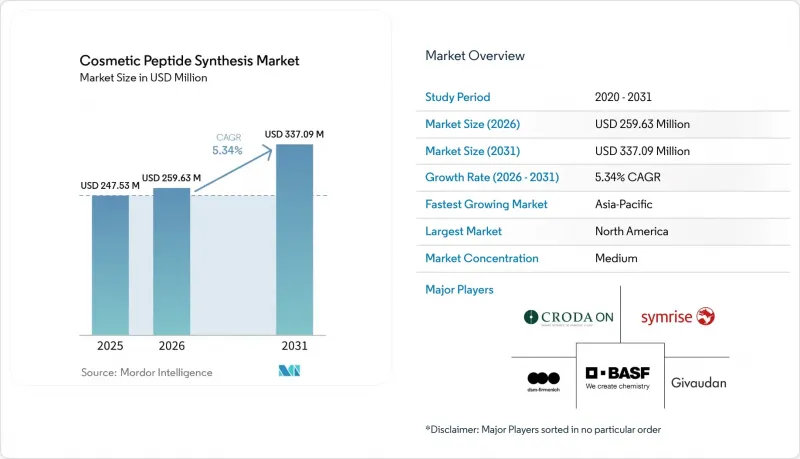
Mordor Intelligence에 의하면, 화장품용 펩티드 합성 시장 규모는 2025년에 2억 4,753만 달러로 평가되었습니다. 2026년 2억 5,963만 달러에서 2031년까지 3억 3,709만 달러에 이를 것으로 예상되며, 예측 기간(2026-2031년) CAGR은 5.34%를 나타낼 전망입니다.
본 보고서는 펩타이드 유형(신호 펩타이드, 기타), 용도(안티에이징, 기타), 합성 기술(고상 펩티드 합성, 기타), 순도 등급(98% 이상 화장품 등급, 기타), 최종 사용자(제약·바이오기술 기업, 기타), 지역(북미, 기타)별로 분류되어 있습니다. 시장 전망은 금액(달러) 기준으로 제시되어 있습니다.
세계의 화장품용 펩티드 합성 시장 동향 및 인사이트
생체 모방형 안티에이징 유효 성분에 대한 수요 증가
임상 데이터에 따르면, 팔미토일 펜타펩타이드-4는 외용 레티노이드에서 볼 수 있는 것과 같은 자극을 유발하지 않으면서 12주 이내에 주름 깊이를 최대 20%까지 줄일 수 있는 것으로 나타났습니다. 아세틸 헥사펩타이드-8은 SNARE 복합체를 억제하여 근육 수축을 억제하고, 저용량의 보툴리눔툭신(보톡스)와 맞먹는 눈에 띄는 매끄러움을 선사합니다. 또한, 구리-GHK 펩타이는 메탈로프로테이나제를 활성화하여 세포외 기질을 더욱 재구성하고, 4개월 후 진피 밀도를 18% 향상시킵니다. 각 브랜드는 신호 펩타이드, 운반 펩타이드, 효소 억제 펩타이드를 단일 제품에 통합하는 경향이 강해지고 있지만, 이러한 전략으로 인해 안정성 검사의 복잡성이 증가하고 있습니다. 규제 당국은 명시적인 구조 및 기능에 대한 주장이 의약품 기준을 초과하는 경우를 제외하고는 여전히 펩타이드를 화장품 성분으로 취급하고 있습니다.
저비용 고처리량의 SPPS 자동화
마이크로파 보조 반응 장치를 통해 커플링 시간이 몇 시간에서 몇 분으로 단축되어 인건비와 용매 사용량이 절반으로 줄었습니다. 연속 흐름 SPPS를 통해 수작업으로 수지를 옮길 필요가 없어져 용매 수요를 약 40% 절감할 수 있습니다. 이러한 플랫폼을 갖춘 수탁 제조업체는 4주 이내에 1kg 이하의 배치를 공급할 수 있어, 저분자 화합물 공급업체와 동등한 민첩성을 실현하고 있습니다. 그 결과, 맞춤형 펩타이드는 현재 50달러 이하의 중저가 제품까지 보급되어 있으며, 이는 기존에는 펩타이드 유효 성분으로는 도달할 수 없었던 가격대였습니다. ISO 22716 가이드라인에 따라, 처리량 향상으로 인해 추적성이나 오염 관리가 저해되지 않습니다.
한국산 펩타이드 세럼의 프리미엄화
한국 브랜드들은 PDRN과 다기능 펩타이드를 결합한 세럼을 보급하고 있으며, 그중 다수는 30mL당 80달러 이상에 판매되고 있습니다. 이러한 제품들은 펩타이드를 ‘피부의 모국어’로 규정하고, 클린 뷰티 이념에 부합하는 발효 유래 아미노산 서열을 중시하고 있습니다. 북미 및 유럽으로의 수출량 증가는 프리미엄 펩타이드 제품이라는 포지셔닝이 아시아 이외의 지역에서도 지지를 얻고 있음을 보여줍니다. 한국의 규제상 50개 아미노산 이하의 펩타이드가 화장품 원료로 분류되므로, 치료용 제품으로서의 심사 부담을 피하고 시장 출시까지의 기간을 단축할 수 있습니다.
부문별 분석
2025년, 시그널 펩타이는 화장품용 펩티드 합성 시장 점유율의 41.82%를 차지했습니다. 안티에이징 크림에 팔미토일 펜타펩타이드-4와 팔미토일 트리펩타이드-1이 지속적으로 사용되면서 수요가 뒷받침되고 있는 한편, 각 브랜드는 이러한 서열이 지닌 예측 가능한 안정성 프로파일을 평가하여 채택하고 있습니다. 또한, 여러 공급업체로 구성된 공급망이 가격 안정을 뒷받침하며, 품귀 현상을 억제하고 있습니다.
캐리어 펩타이드 시장은 2031년까지 연평균 성장률(CAGR) 6.43%로 가장 높은 성장률을 보일 것으로 예측됩니다. 구리-GHK 복합체는 현재 환경 심사의 대상이 되고 있는 합성 폴리머에 의존하지 않고, 세포외 기질의 재구성을 촉매하는 미량 원소를 수송하는 역할을 합니다. 제형 개발자들은 캐리어 펩타이드를 텍스처 차별화 및 전달 효율 향상을 위한 수단으로 인식하고 있습니다.
아세틸헥사펩타이드-8과 같은 신경전달물질 억제 펩타이드는 2025년에 23.1%의 점유율을 차지했으며, 표정 주름용 세럼에서 계속해서 인기를 얻고 있어 소비자에게 보툴리눔툭신(보톡스) 주사를 대체할 수 있는 외용제 선택지를 제공합니다. 엘라스타제나 콜라게나제를 억제하는 효소 억제 펩타이드도 상당한 시장 점유율을 차지하고 있으며, 미세 입자 오염이 피부 노화를 가속화하는 도시 지역에서 가장 널리 채택되고 있습니다. 항균 작용이나 색소 조절 작용을 가진 서열을 포함하는 기타 기능성 펩타이드도 여드름 및 색소 침착 개선 제품에 대한 적용 범위가 확대되고 있습니다.
2025년, 안티에이징 부문은 화장품용 펩티드 합성 시장 규모의 48.27%를 계속 차지했습니다. 성숙한 지역에서는 성장이 둔화되고 있지만, 이 부문은 시너지 효과를 통한 콜라겐 자극이 기대되는 멀티펩타이드 조합 전략의 혜택을 여전히 누리고 있습니다.
헤어케어 및 두피케어 시장은 2026년부터 2031년까지 연평균 성장률(CAGR) 8.72%를 나타낼 것으로 예측됩니다. 구리-GHK가 모낭을 성장기(아나겐기)에 최대 22% 더 오래 유지할 수 있다는 증거가, 제형 개발자들이 펩타이드의 용도를 페이셜 케어 이외의 분야로 확대하도록 부추기고 있습니다. 미백·브라이트닝 제품은 하이드로퀴논과 관련된 규제 문제를 동반하지 않으면서 티로시나제를 억제하는 올리고펩타이드-68과 노나펩타이드-1에 힘입어 16.8%의 점유율을 차지했습니다. 피부 장벽 복원 크림과 보습제는 경피 수분 증발량을 감소시키는 펩타이드의 효과 덕분에 14.3%의 시장 점유율을 차지했습니다. 아이 케어와 선 케어는 규모는 작지만 시장 점유율이 증가하고 있으며, 일광 화상 후 회복을 목적으로 한 DNA 복구 펩타이드 연구가 진행되고 있습니다.
지역별 분석
2025년, 북미는 화장품용 펩티드 합성 시장에서 42.84%의 점유율을 차지했으며, 뉴저지주, 캘리포니아주, 매사추세츠주에 위치한 cGMP 시설이 그 핵심을 이루고 있습니다. 이 지역의 연평균 성장률(CAGR) 4.8%는 미국에 집중되어 본사를 둔 AI 기반 설계 도구에 의해 뒷받침됩니다. 캐나다는 미국의 규제 체계를 따르고 있어 국경 간 공급이 원활하지만, 멕시코에서는 고순도 수입품을 선호하는 고급 백화점을 중심으로 성장이 가장 두드러집니다.
독일은 BASF와 에보닉(Evonik) 내 펩타이드 제조 부문 덕분에 소비를 주도하고 있으며, 프랑스는 럭셔리 브랜드 수요로 혜택을 보고 있습니다. 영국, 이탈리아, 스페인이 그 뒤를 잇고 있으며, 민감성 피부용 스킨케어 분야에서 펩타이드가 레티노이드를 대체함에 따라 각 시장에서 한 자릿수 중반대의 성장률을 보이고 있습니다.
아시아태평양은 가장 빠르게 성장하는 지역으로, 2031년 연평균 성장률(CAGR)은 9.36%에 달할 전망입니다. 중국에서는 선전과 상하이에서 재조합 바이오 합성 거점이 확대되고 있는 반면, 한국 브랜드들은 현지 공급업체와 제휴하여 독자적인 헥사펩타이드를 출시하고 있습니다. 일본에서는 ‘기능성 화장품’이라는 규제상 분류에 따라, 성분이 안전성 심사를 통과하면 구조 및 기능에 관한 효능 표기가 가능해졌으며, 이를 통해 국내 브랜드는 유효성 데이터를 마케팅에 활용하기 쉬워졌습니다. 인도와 동남아시아에서는 가처분 소득 증가를 배경으로 두 자릿수 성장이 나타나고 있지만, 가격에 대한 민감성으로 인해 여전히 배합률은 낮은 수준으로 유지되고 있습니다.
1인당 소비액이 높고 관광 관련 소매업이 수요를 뒷받침하고 있지만, 현지 생산 능력이 제한적이어서 펩타이드의 대부분은 완제품 형태로 수입되고 있습니다. 남아프리카는 색소 침착 및 일광 화상 피해 대책에 초점을 맞춘 이 지역의 두 번째 성장 거점이 되고 있습니다.
브라질이 시장을 독점하고 있으며, 강한 햇볕이 내리쬐는 기후에 맞추어 설계된 안티에이징 크림에 펩타이드를 배합하는 현지 브랜드들이 이를 뒷받침하고 있습니다. 아르헨티나와 칠레가 그 뒤를 잇고 있지만, 환율 변동으로 인해 수입 경로가 차질을 빚을 가능성이 있습니다. ANVISA와 같은 지역 규제 당국은 안전성 관련 자료 제출을 의무화하고 있지만, 시판 전 효능 승인은 필요하지 않기 때문에 비교적 신속하게 시장에 출시할 수 있습니다.
기타 혜택
- 엑셀 형식 시장 예측(ME) 시트
- 3개월간의 애널리스트 지원
자주 묻는 질문
목차
제1장 서론
제2장 조사 방법
제3장 주요 요약
제4장 시장 구도
제5장 시장 규모 및 성장 예측
제6장 경쟁 구도
제7장 시장 기회 및 향후 전망
KTH 26.09.14According to Mordor Intelligence, the cosmetic peptide synthesis market size was valued at USD 247.53 million in 2025 and is estimated to grow from USD 259.63 million in 2026 to reach USD 337.09 million by 2031, at a CAGR of 5.34% during the forecast period (2026-2031).
This report is Segmented by Peptide Type (Signal Peptides, and More), Application (Anti-Aging, and More), Synthesis Technique (Solid-Phase Peptide Synthesis, and More), Purity Grade (>=98% Cosmetic Grade, and More), End User (Pharmaceutical & Biotechnology Companies, and More), and Geography (North America, and More). The Market Forecasts are Provided in Terms of Value (USD).
Global Cosmetic Peptide Synthesis Market Trends and Insights
Rising Demand for Biomimetic Anti-Aging Actives
Clinical evidence shows palmitoyl pentapeptide-4 can reduce wrinkle depth by up to 20% within twelve weeks without the irritation seen with topical retinoids. Acetyl hexapeptide-8 attenuates muscle contraction by blocking the SNARE complex, delivering visible smoothing comparable to low-dose botulinum toxin. Copper-GHK peptides further remodel extracellular matrix by activating metalloproteinases, improving dermal density by 18% after four months. Brands increasingly layer signal, carrier, and enzyme-inhibitor peptides into a single product, though this strategy increases the complexity of stability testing. Regulators still treat peptides as cosmetic ingredients unless explicit structure-function claims cross the drug threshold.
Lower-Cost High-Throughput SPPS Automation
Microwave-assisted reactors have cut coupling times from hours to minutes, halving labor costs and solvent use. Continuous-flow SPPS eliminates manual resin transfers and lowers solvent demand by about 40%. Contract manufacturers equipped with these platforms can supply sub-kilogram batches inside four weeks, matching the agility of small-molecule suppliers. As a result, custom peptides now reach mid-tier products priced under USD 50, a price band historically out of reach for peptide actives. ISO 22716 guidelines ensure that higher throughput does not compromise traceability or contamination control.
Premiumization of South-Korean Peptide Serums
South-Korean labels have popularized serums that combine PDRN with multi-functional peptides, often retailing above USD 80 per 30 mL. These products pitch peptides as "skin's native language" and favor fermentation-derived sequences that align with clean-beauty narratives. Rising export volumes to North America and Europe show that premium peptide positioning is resonating outside Asia. South-Korean regulation classifies peptides under 50 amino acids as cosmetic ingredients, avoiding therapeutic review burdens and hastening launch timelines.
Other drivers and restraints analyzed in the detailed report include:
- AI-Driven Peptide Sequence Design Shortening R&D Cycles
- High Purification Costs Curb Mass-Market Pricing
For complete list of drivers and restraints, kindly check the Table Of Contents.
Segment Analysis
Signal peptides represented 41.82% of the cosmetic peptide synthesis market share in 2025. Continued use of palmitoyl pentapeptide-4 and palmitoyl tripeptide-1 in anti-aging creams sustains demand, while brands favor these sequences for their predictable stability profiles. Multi-vendor supply chains also support pricing discipline, limiting shortages.
Carrier peptides are forecast to post the fastest 6.43% CAGR through 2031. Copper-GHK complexes now shuttle trace elements that catalyze extracellular matrix remodeling without depending on synthetic polymers, which are now under environmental review. Formulators view carrier peptides as a route to differentiate textures and improve delivery efficiency.
Neurotransmitter-inhibitor peptides, such as acetyl hexapeptide-8, held a 23.1% share in 2025 and remain popular in expression-line serums, offering consumers a topical alternative to botulinum toxin injections. Enzyme-inhibitor peptides that block elastase and collagenase reached a significant share, with the highest uptake in urban regions where particulate pollution accelerates skin aging. Other functional peptides, including antimicrobial and pigment-modulating sequences and their use is widening into acne and hyperpigmentation products.
Anti-aging maintained 48.27% of the cosmetic peptide synthesis market size in 2025. Although growth moderates in mature regions, the segment still benefits from multi-peptide stacking strategies that promise synergistic collagen stimulation.
Hair-care and scalp treatments are projected to grow at an 8.72% CAGR between 2026 and 2031. Evidence that copper-GHK can keep follicles in the anagen phase up to 22% longer is encouraging formulators to extend peptides beyond facial care. Whitening and brightening products held a 16.8% share, driven by oligopeptide-68 and nonapeptide-1, which offer tyrosinase inhibition without the regulatory baggage of hydroquinone. Barrier-repair creams and moisturizers captured 14.3% share, helped by peptides that lower trans-epidermal water loss. Eye-care and sun-care collectively make up a modest but rising slice, with DNA-repair peptides under investigation for after-sun recovery.
Complete Report Scope:
- By Peptide Type
- Signal Peptides
- Neurotransmitter Inhibitor Peptides
- Carrier Peptides
- Enzyme Inhibitor Peptides
- Other Functional Peptides
- By Application
- Anti-aging
- Whitening & Brightening
- Barrier Repair & Moisturising
- Hair-care & Scalp Treatments
- Eye-care Products
- Sun-care & After-sun
- By Synthesis Technique
- Solid-Phase Peptide Synthesis (SPPS)
- Liquid-Phase Peptide Synthesis (LPPS)
- Hybrid / Fragment Condensation
- Recombinant / Cell-free Biosynthesis
- By Purity Grade
- >= 98 % Cosmetic Grade
- 95 - 98 % Cosmetic Grade
- < 95 % Industrial / R&D Grade
- By End User
- Pharmaceutical & Biotechnology Companies
- Contract Manufacturing Organisations (CMOs)
- Other End Users
- By Geography
- North America
- United States
- Canada
- Mexico
- Europe
- Germany
- United Kingdom
- France
- Italy
- Spain
- Rest of Europe
- Asia-Pacific
- China
- Japan
- India
- Australia
- South Korea
- Rest of Asia-Pacific
- Middle East & Africa
- GCC
- South Africa
- Rest of Middle East & Africa
- South America
- Brazil
- Argentina
- Rest of South America
- North America
Geography Analysis
North America held 42.84% market share of the cosmetic peptide synthesis market in 2025, anchored by cGMP facilities in New Jersey, California, and Massachusetts. Regional growth of 4.8% CAGR will be underpinned by AI-driven design tools, which are disproportionately headquartered in the United States. Canada mirrors U.S. regulatory frameworks, smoothing cross-border supply, while Mexico's growth is strongest in premium department stores that favor high-purity imports.
Germany leads consumption thanks to in-house peptide units at BASF and Evonik, while France benefits from luxury-brand demand. The United Kingdom, Italy, and Spain follow, each showing mid-single-digit growth as peptides replace retinoids in sensitive-skin regimens.
Asia-Pacific is the fastest-growing region, with a 9.36% CAGR through 2031. China hosts expanding recombinant-biosynthesis hubs in Shenzhen and Shanghai, while South Korean brands collaborate with local suppliers to launch signature hexapeptides. Japan's regulatory designation of "functional cosmetics" allows structure-function claims once ingredients pass safety review, helping local brands market efficacy data. India and Southeast Asia show double-digit growth driven by rising discretionary incomes, though price sensitivity still favors lower inclusion rates.
High per-capita spending and tourism retail bolster demand, but limited local manufacturing means most peptides enter as finished products. South Africa represents the region's secondary growth node, focused on remedies for hyperpigmentation and sun damage.
Brazil dominates, supported by local brands adding peptides to anti-aging creams designed for sun-exposed climates. Argentina and Chile follow, though currency volatility can disrupt import pipelines. Regional regulators such as ANVISA require safety dossiers but no pre-market efficacy approval, enabling relatively swift launches.
- AAPPtec
- Activotec
- AmbioPharm
- Ashland
- Bachem Holding
- BASF
- Bio Basic
- CEM
- Creative Peptides
- Croda International plc (Sederma)
- CSBio Company
- DSM-Firmenich (Pentapharm)
- Evonik Industries
- GenScript Biotech Corp.
- Givaudan SA (Active Beauty)
- Lubrizol
- PolyPeptide Group
- RS Synthesis LLC
- Symrise AG
- Shenzhen JYMed Technology
Additional Benefits:
- The market estimate (ME) sheet in Excel format
- 3 months of analyst support
TABLE OF CONTENTS
1 Introduction
- 1.1 Study Assumptions & Market Definition
- 1.2 Scope of the Study
2 Research Methodology
3 Executive Summary
4 Market Landscape
- 4.1 Market Overview
- 4.2 Market Drivers
- 4.2.1 Rising Demand for Biomimetic Anti-Aging Actives
- 4.2.2 Lower-Cost High-Throughput SPPS Automation
- 4.2.3 Premiumisation of K-Beauty Peptide Serums
- 4.2.4 Brand-Supplier Co-Development of "Signature" Peptides
- 4.2.5 AI-Driven Peptide Sequence Design Shortening R&D Cycles
- 4.2.6 Fast-Track Functional-Cosmetics Regulations
- 4.3 Market Restraints
- 4.3.1 High Purification Costs Curb Mass-Market Pricing
- 4.3.2 Batch-To-Batch Variability in Liquid-Phase Synthesis
- 4.3.3 Scrutiny of Micro-Plastic Carriers in Formulations
- 4.3.4 Consumer Sensitivity To "Synthetic-Sounding" INCI Names
- 4.4 Regulatory Landscape
- 4.5 Technological Outlook
- 4.6 Porter's Five Forces Analysis
- 4.6.1 Threat of New Entrants
- 4.6.2 Bargaining Power of Buyers
- 4.6.3 Bargaining Power of Suppliers
- 4.6.4 Threat of Substitute Products
- 4.6.5 Intensity of Competitive Rivalry
5 Market Size & Growth Forecasts
- 5.1 By Peptide Type
- 5.1.1 Signal Peptides
- 5.1.2 Neurotransmitter Inhibitor Peptides
- 5.1.3 Carrier Peptides
- 5.1.4 Enzyme Inhibitor Peptides
- 5.1.5 Other Functional Peptides
- 5.2 By Application
- 5.2.1 Anti-aging
- 5.2.2 Whitening & Brightening
- 5.2.3 Barrier Repair & Moisturising
- 5.2.4 Hair-care & Scalp Treatments
- 5.2.5 Eye-care Products
- 5.2.6 Sun-care & After-sun
- 5.3 By Synthesis Technique
- 5.3.1 Solid-Phase Peptide Synthesis (SPPS)
- 5.3.2 Liquid-Phase Peptide Synthesis (LPPS)
- 5.3.3 Hybrid / Fragment Condensation
- 5.3.4 Recombinant / Cell-free Biosynthesis
- 5.4 By Purity Grade
- 5.4.1 >= 98 % Cosmetic Grade
- 5.4.2 95 - 98 % Cosmetic Grade
- 5.4.3 < 95 % Industrial / R&D Grade
- 5.5 By End User
- 5.5.1 Pharmaceutical & Biotechnology Companies
- 5.5.2 Contract Manufacturing Organisations (CMOs)
- 5.5.3 Other End Users
- 5.6 By Geography
- 5.6.1 North America
- 5.6.1.1 United States
- 5.6.1.2 Canada
- 5.6.1.3 Mexico
- 5.6.2 Europe
- 5.6.2.1 Germany
- 5.6.2.2 United Kingdom
- 5.6.2.3 France
- 5.6.2.4 Italy
- 5.6.2.5 Spain
- 5.6.2.6 Rest of Europe
- 5.6.3 Asia-Pacific
- 5.6.3.1 China
- 5.6.3.2 Japan
- 5.6.3.3 India
- 5.6.3.4 Australia
- 5.6.3.5 South Korea
- 5.6.3.6 Rest of Asia-Pacific
- 5.6.4 Middle East & Africa
- 5.6.4.1 GCC
- 5.6.4.2 South Africa
- 5.6.4.3 Rest of Middle East & Africa
- 5.6.5 South America
- 5.6.5.1 Brazil
- 5.6.5.2 Argentina
- 5.6.5.3 Rest of South America
- 5.6.1 North America
6 Competitive Landscape
- 6.1 Market Concentration
- 6.2 Market Share Analysis
- 6.3 Company Profiles (includes Global Level Overview, Market Level Overview, Core Segments, Financials as Available, Strategic Information, Market Rank/Share for Key Companies, Products & Services, and Recent Developments)
- 6.3.1 AAPPtec
- 6.3.2 Activotec
- 6.3.3 AmbioPharm
- 6.3.4 Ashland Inc.
- 6.3.5 Bachem Holding AG
- 6.3.6 BASF SE
- 6.3.7 Bio Basic Inc.
- 6.3.8 CEM Corporation
- 6.3.9 Creative Peptides
- 6.3.10 Croda International plc (Sederma)
- 6.3.11 CSBio Company Inc.
- 6.3.12 DSM-Firmenich (Pentapharm)
- 6.3.13 Evonik Industries AG
- 6.3.14 GenScript Biotech Corp.
- 6.3.15 Givaudan SA (Active Beauty)
- 6.3.16 Lubrizol Corporation
- 6.3.17 PolyPeptide Group
- 6.3.18 RS Synthesis LLC
- 6.3.19 Symrise AG
- 6.3.20 Shenzhen JYMed Technology
7 Market Opportunities & Future Outlook
- 7.1 White-space & Unmet-Need Assessment


