|
시장보고서
상품코드
2124816
마이크로프로세서 : 시장 점유율 분석, 업계 동향과 통계, 성장 예측(2026-2031년)Microprocessor - Market Share Analysis, Industry Trends & Statistics, Growth Forecasts (2026 - 2031) |
||||||
 Mordor Intelligence
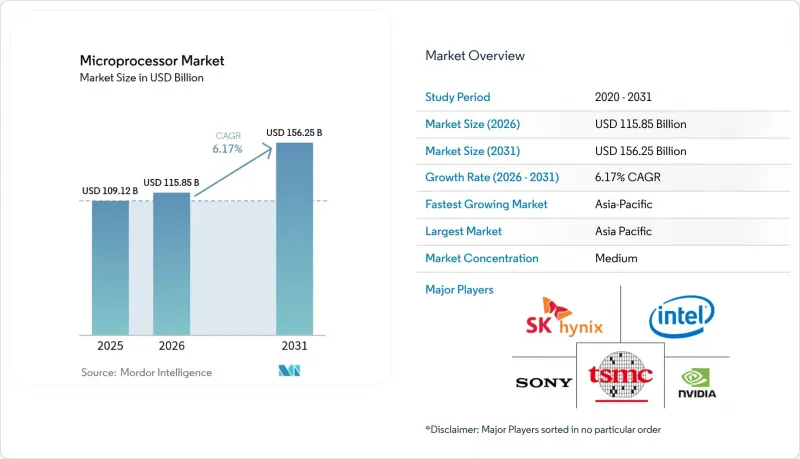
Mordor Intelligence에 의하면, 마이크로프로세서 시장 규모는 2025년에 1,091억 2,000만 달러로 평가되었고, 2026년 1,158억 5,000만 달러에서 2031년까지 1,562억 5,000만 달러에 이를 것으로 예측되며, 예측 기간(2026-2031년) CAGR은 6.17%를 기록할 전망입니다.
본 보고서는 프로세서 유형(CPU, GPU, APU, FPGA, DSP, ASIC), 명령어 세트 아키텍처(x86, Arm, RISC-V, Power, MIPS 등),제조 공정(28nm 이상, 22-16nm, 14-10nm, 7-6nm, 5-4nm 등), 용도(소비자용 전자기기, 데이터센터 및 엔터프라이즈 서버, 항공우주 및 방위, 기타), 그리고 지역(북미, 남미, 유럽,아시아태평양, 중동 및 아프리카)별로 분류되어 있습니다.
전 세계 마이크로프로세서 시장 동향 및 인사이트
고성능이자 저전력 프로세서에 대한 수요 증가
높은 처리량과 낮은 전력 소모를 동시에 실현하는 프로세서에 대한 수요가 2024년과 2025년에 걸쳐 공급업체의 로드맵을 형성했습니다. 데이터센터 운영자들이 총 소유 비용(TCO)을 우선시함에 따라, 설계자들은 와트당 성능을 최적화하고 지연 시간을 줄이기 위해 온패키지 메모리를 통합하기 시작했습니다. 소비자용 기기 제조업체들도 이에 발맞추어, 열 스로틀링 없이 기기상에서 AI 추론을 가능하게 하는 배터리 효율이 뛰어난 칩을 추구했습니다. 3nm 이하로의 미세화 추세에 따라 누설 전류 문제가 최우선 과제가 되었으며, 속도와 효율의 균형을 맞추기 위해 전자 설계 자동화(EDA) 공급업체와 파운드리 간의 협력 관계가 강화되었습니다. 에너지 절약 설계를 실현한 공급업체들은 스마트폰, 노트북, 산업용 IoT 엔드포인트에 채택되며, 마이크로프로세서 시장에서 이러한 촉진요인의 중기적 영향력을 더욱 공고히 했습니다.
AI 가속기 및 엣지 컴퓨팅 이용 사례의 확대
스마트 카메라에서 산업용 로봇에 이르기까지, 엣지 디바이스에서는 추론 처리 시 클라우드 백엔드에 대한 의존을 배제하는 임베디드형 뉴럴 엔진에 대한 수요가 점점 더 높아지고 있습니다. 2025년 후반에 널리 출시될 예정인 AMD의 Instinct MI350 가속기 제품군은 연산 밀도를 4배 향상시켜 전용 AI 실리콘으로의 전환을 상징했습니다. 각 디바이스 제조업체들은 사용자의 개인정보 보호 및 지연 시간에 대한 기대에 부응하기 위해 범용 프로세서 내에 유사한 엔진을 탑재했습니다. 그 결과, 수요는 데이터센터용 GPU에 그치지 않고 웨어러블 기기 및 자동차용 제어 장치 내의 저전력 추론 코어까지 확대되었습니다. 고객들이 AI 기능을 확보하기 위해 제품 교체 주기를 앞당기면서, 마이크로프로세서 시장에서는 단기적인 수요 증가가 나타났습니다.
기존 PC 출하 대수의 구조적 감소
기업들이 교체 주기를 연장하고 소비자들이 모바일 기기로 전환함에 따라 노트북 및 데스크톱 PC 출하량은 둔화되었습니다. 제조업체들은 유통 채널 재고 조정에 직면했고, 이는 주류 CPU에 대한 연간 수요를 억제했습니다. 각 벤더는 AI 지원 PC를 기기 교체 계기로 삼아 그 영향을 완화했으나, 2025년 한 해 동안 출하량 회복은 부분적인 수준에 그쳤습니다. 이러한 단기적인 부정적 요인으로 인해 전체 연평균 성장률(CAGR)은 0.5포인트 하락했으나, 한편으로는 기존 팹을 신흥 카테고리에 전용하는 움직임도 촉진되었습니다.
부문 분석
프로세서 유형별 마이크로프로세서 시장 규모를 살펴보면, 시리얼 워크로드에서 여전히 필수적인 역할을 하고 있기 때문에 2025년에도 CPU는 매출 점유율 51.85%를 유지했습니다. 반면, GPU는 2031년까지 연평균 성장률(CAGR)이 9.95%로 예측되어, AI, 그래픽, 과학 시뮬레이션 분야에서 대규모 병렬 워크로드로의 전환이 두드러지게 나타났습니다. 데이터센터 사업자들이 가속기 카드를 추가함에 따라 디스크리트 GPU공급 파이프라인이 확대된 반면, 소비자용 디바이스에서는 디바이스 내 추론을 위해 저전력형이 탑재되었습니다. CPU와 GPU 코어를 하나의 다이 위에 통합한 APU는 기판 공간이나 배터리 구동 시간이 중요한 틈새 시장에서 존재감을 드러냈습니다.
디스크리트 GPU는 훈련 처리량을 비약적으로 향상시킨 고대역폭 메모리의 발전으로 혜택을 받았으며, 각 하이퍼스케일러 기업들은 공급 능력을 확보하기 위해 수년에 걸친 공급 계약을 체결했습니다. FPGA는 5G 및 신흥 6G 규격에서 프로그래머블 로직이 요구되는 통신 인프라 분야에서 여전히 중요한 역할을 수행했습니다. DSP는 오디오 및 베이스밴드 처리 분야에서 계속해서 활용되었으나, 시장 점유율의 일부는 벡터 확장 기능을 탑재한 범용 코어로 이동했습니다. 특정 용도용 집적 회로(ASIC)는 대량 생산되는 AI 추론 어플라이언스에 설계로 채택되었으며, 생산량이 비반복 개발 비용(NRE)을 상쇄할 수 있다면 맞춤형 실리콘이 프로그래머블 제품을 능가하는 성능을 발휘할 수 있음을 입증했습니다.
마이크로프로세서 시장에서는 수십 년에 걸친 소프트웨어 호환성의 강점을 바탕으로, 2025년에는 x86 칩이 45.95%의 점유율을 기록했습니다. RISC-V는 연평균 성장률(CAGR) 13.20%라는 전망에 힘입어, 비용을 중시하는 임베디드 용도과 개방형 표준을 중시하는 학술 연구 프로젝트 사이에서 지지를 확대했습니다. Arm 기반 설계는 높은 전력 효율과 지속적으로 확장되는 서버급 소프트웨어 스택이라는 평판을 바탕으로 데이터센터 및 자동차 분야에서 더욱 깊이 침투했습니다.
각 벤더의 로드맵은 수렴이라기보다는 오히려 분화를 보여주었습니다. 인텔과 AMD는 싱글 스레드 성능에서의 리더십을 유지하는 것을 목표로 x86을 3nm 미만의 노드로 진화시켰습니다. RISC-V 전문가들은 IoT 및 AI 가속기 분야에서 차별화를 꾀하기 위해 벡터 명령어와 암호화 명령어 등 도메인 고유의 확장 기능을 강조했습니다. Arm 라이선스 보유사들은 칩렛 지원 멀티다이 패키지를 활용해 클라우드 워크로드를 타겟으로 맞춤형 코어 설계의 폭을 넓혔습니다. 명령어 세트의 다양화는 컴파일러 기술과 툴체인의 혁신을 촉진했으며, 결국 개발자의 선택지를 넓혀 더욱 다양한 마이크로프로세서 시장을 뒷받침하게 되었습니다.
지역별 분석
2025년, 아시아태평양은 마이크로프로세서 시장에서 41.95%의 점유율을 차지할 것으로 예상되며, 연평균 성장률(CAGR)은 8.21%로 전망됩니다. 이는 중국의 전자기기 조립 규모와 정부 주도의 파운드리 확장에 힘입은 결과입니다. 일본의 센서 및 자동차 생태계는 혼합 신호 및 안전상 중요한 프로세서에 대한 안정적인 수요를 확보했습니다. 한편, 한국의 주요 기업들은 재정적 인센티브에 힘입어 3nm 이하 노드에 대한 투자를 추진했습니다. 인도는 다국적 팹과 현지 설계 서비스 기업이 동일한 거점에 집적되도록 장려하는 반도체 제조 보조금을 도입하여, 중규모 노드에 대한 보완적인 수요를 창출했습니다.
북미는 하이퍼스케일 클라우드의 확장, 자동차의 전기화, 그리고 신규 팹에 대한 설비 투자 위험을 상쇄하는 ‘CHIPS법’의 우대 조치에 힘입어 계속해서 2위 지역으로서의 위상을 유지했습니다. TSMC가 미국 내 3개 공장에 1,650억 달러를 투자하겠다고 약속한 것은 재정 지원을 통해 생산 능력 배분을 국내로 전환할 수 있음을 여실히 보여줍니다. 캐나다와 멕시코는 자동차용 전자기기 및 국경을 초월한 물류 통합을 통해 지역의 성장 동력을 뒷받침하고, 1차 공급업체의 리드타임을 단축했습니다.
유럽에서는 엄격한 자동차 배기가스 규제와 ‘인더스트리 4.0’에 따른 현대화를 배경으로 완만한 성장이 나타났습니다. 독일 자동차 제조업체들은 ADAS(첨단 운전자 보조 시스템) 로드맵을 확실하게 추진하기 위해 반도체 전략적 공급 계약을 체결했습니다. 한편, 프랑스와 영국은 국방 및 항공우주 임무용 보안 프로세서를 공동 개발하기 위해 현지 연구 기관을 활용했습니다. 유럽의 ‘칩법’은 해외 파운드리 의존도를 낮추는 것을 목적으로 한 파일럿 라인과 첨단 패키징 클러스터에 자금을 투입했습니다. 중동 및 아프리카은 절대적인 규모 면에서는 뒤처졌지만, 걸프 국가들의 데이터센터 프로젝트와 아프리카 전역의 통신 인프라 업그레이드와 관련된 설계 채택 실적을 기록하며, 보다 광범위한 마이크로프로세서 시장으로의 장기적인 진출을 위한 기반을 다졌습니다.
기타 혜택:
- 엑셀 형식 시장 예측(ME) 시트
- 3개월간의 애널리스트 지원
자주 묻는 질문
목차
제1장 서론
제2장 조사 방법
제3장 주요 요약
제4장 시장 구도
제5장 시장 규모와 성장 예측
제6장 경쟁 구도
제7장 시장 기회와 향후 전망
LSH 26.09.14According to Mordor Intelligence, the microprocessor market size was valued at USD 109.12 billion in 2025 and estimated to grow from USD 115.85 billion in 2026 to reach USD 156.25 billion by 2031, at a CAGR of 6.17% during the forecast period (2026-2031).
This report is Segmented by Processor Type (CPU, GPU, APU, FPGA, DSP, and ASIC), Instruction-Set Architecture (x86, Arm, RISC-V, Power, MIPS, and More), Fabrication Node (>=28nm, 22-16nm, 14-10nm, 7-6nm, 5-4nm, and More), Application (Consumer Electronics, Datacentre and Enterprise Servers, Aerospace and Defence, and More), and Geography (North America, South America, Europe, Asia-Pacific, and Middle East and Africa).
Global Microprocessor Market Trends and Insights
Growing Demand for High-Performance and Energy-Efficient Processors
Demand for processors that simultaneously deliver high throughput and low power consumption shaped vendor roadmaps throughout 2024 and 2025. Data-centre operators prioritized total cost of ownership, prompting designers to optimize performance per watt and integrate on-package memory to reduce latency. Consumer device makers followed suit, seeking battery-savvy chips that enable on-device AI inference without thermal throttling. The move toward smaller geometries such as 3 nm and below pushed leakage-current challenges to the forefront, intensifying cooperation between electronic-design-automation providers and foundries to balance speed and efficiency. Suppliers that delivered energy-efficient designs captured design wins in smartphones, notebooks, and industrial IoT endpoints, reinforcing this driver's medium-term influence on the microprocessor market.
Proliferation of AI Accelerators and Edge Computing Use-Cases
Edge devices, from smart cameras to industrial robots, increasingly require embedded neural engines that eliminate dependence on cloud back-ends for inference. AMD's Instinct MI350 accelerator family, scheduled for broad availability in late 2025, illustrated the push toward specialized AI silicon with a four-fold uplift in compute density. Device makers embedded similar engines inside general-purpose processors to address user privacy and latency expectations. As a result, demand broadened beyond data-centre GPUs to encompass low-power inference cores inside wearables and automotive control units. The short-term lift to the microprocessor market emerged as customers accelerated refresh cycles to gain AI capability.
Structural Decline in Traditional PC Shipments
Notebook and desktop volumes softened as enterprises extended refresh cycles and consumers turned to mobile form factors. Manufacturers confronted channel inventory corrections that depressed run-rate demand for mainstream CPUs. Vendors mitigated the impact by positioning AI-enabled PCs as a replacement catalyst, yet volume recovery remained partial through 2025. The short-term drag shaved 0.5 percentage points from the overall CAGR, yet also prompted repurposing of existing fabs toward emerging categories.
Other drivers and restraints analyzed in the detailed report include:
- Expansion of Hyperscale Data-Centres and Cloud Workloads
- Electrification and ADAS Adoption in Automotive Electronics
- Ongoing Supply-Chain Capacity Constraints for Advanced Nodes
For complete list of drivers and restraints, kindly check the Table Of Contents.
Segment Analysis
The microprocessor market size for processor types showed CPUs retaining a 51.85% revenue share in 2025 as they remained indispensable for serial workloads. GPUs, however, posted a 9.95% CAGR outlook through 2031, underlining the shift toward massively parallel workloads in AI, graphics, and scientific simulation. The discrete-GPU pipeline expanded as data-centre operators added accelerator cards while consumer devices integrated low-power variants for on-device inference. APUs that fuse CPU and GPU cores on one die circled niche segments where board space and battery life mattered.
Discrete GPUs benefited from high-bandwidth-memory advances that multiplied training throughput, with hyperscalers locking in multiyear supply agreements to secure capacity. FPGAs preserved relevance in telecom infrastructure, where 5G and emerging 6G standards required programmable logic. DSPs continued to address audio and baseband processing, although some market share shifted toward general-purpose cores with embedded vector extensions. Application-specific integrated circuits claimed design wins in high-volume AI inference appliances, demonstrating that bespoke silicon can outpace programmable counterparts once volumes justify non-recurring engineering expense.
The microprocessor market registered x86 chips with a 45.95% share in 2025 on the strength of decades-old software compatibility. RISC-V, buoyed by its 13.20% CAGR forecast, gained traction among cost-sensitive embedded applications and academic research initiatives that valued open standards. Arm-based designs deepened penetration in data-centre and automotive sectors, leveraging a reputation for power efficiency and a growing server-class software stack.
Vendor roadmaps illustrated divergence rather than convergence. Intel and AMD advanced x86 to sub-3 nm nodes, aiming to sustain single-thread performance leadership. RISC-V specialists emphasized domain-specific extensions, such as vector and cryptography instructions, to differentiate in IoT and AI accelerators. Arm licensees broadened custom core designs, targeting cloud workloads with chiplet-enabled multi-die packages. The proliferation of instruction sets fostered innovation in compiler technologies and toolchains, ultimately expanding developer choice and supporting a more diverse microprocessor market.
Complete Report Scope:
- By Processor Type
- Central Processing Unit (CPU)
- Graphics Processing Unit (GPU)
- Accelerated Processing Unit (APU)
- Field-Programmable Gate Array (FPGA)
- Digital Signal Processor (DSP)
- Application-Specific Integrated Circuit (ASIC)
- By Instruction-Set Architecture
- x86
- Arm
- RISC-V
- Power
- MIPS
- SPARC and Others
- By Fabrication Node
- >=28 nm
- 22-16 nm
- 14-10 nm
- 7-6 nm
- 5-4 nm
- 3 nm and Below
- By Application
- Consumer Electronics
- Datacentre and Enterprise Servers
- Automotive and Transportation
- Industrial Automation and Robotics
- Aerospace and Defence
- Healthcare and Medical Devices
- By Geography
- North America
- United States
- Canada
- Mexico
- South America
- Brazil
- Rest of South America
- Europe
- Germany
- France
- United Kingdom
- Rest of Europe
- Asia-Pacific
- China
- Japan
- India
- South Korea
- Rest of Asia-Pacific
- Middle East and Africa
- Middle East
- Saudi Arabia
- United Arab Emirates
- Turkey
- Rest of Middle East
- Africa
- South Africa
- Rest of Africa
- Middle East
- North America
Geography Analysis
Asia-Pacific held a 41.95% share of the microprocessor market in 2025 and posted an 8.21% CAGR outlook, sustained by China's electronics assembly scale and government-backed foundry expansion. Japan's sensor and automotive ecosystems ensured steady demand for mixed-signal and safety-critical processors, while South Korea's champions pressed ahead with below-3 nm node investments supported by fiscal incentives. India rolled out chip-manufacturing subsidies that encouraged multinational fabs and local design-service firms to co-locate, adding complementary demand for mid-tier nodes.
North America remained the second-largest region, buoyed by hyperscale cloud build-outs, automotive electrification, and the CHIPS Act incentives that offset capital-expenditure risk for new fabs. TSMC's USD 165 billion commitment to three United States plants underlined how fiscal support can redirect capacity allocation to domestic soil. Canada and Mexico supported regional momentum through automotive electronics and cross-border logistics integration that shortened lead times for Tier-1 suppliers.
Europe delivered moderate expansion on the back of stringent vehicle-emissions rules and Industry 4.0 modernization. Germany's automakers locked in strategic silicon supply agreements to safeguard ADAS roadmaps, while France and the United Kingdom tapped local research institutes to co-develop secure processors for defense and aerospace missions. The European Chips Act channeled funds into pilot lines and advanced packaging clusters that aimed to reduce dependency on overseas foundries. The Middle East and Africa trailed in absolute volumes yet registered design-win activity tied to data center projects in the Gulf states and telecom infrastructure upgrades across Africa, setting the stage for long-term participation in the wider microprocessor market.
- Intel Corporation
- Advanced Micro Devices, Inc.
- NVIDIA Corporation
- Qualcomm Technologies, Inc.
- Taiwan Semiconductor Manufacturing Company Limited
- Samsung Electronics Co., Ltd.
- Apple Inc.
- Broadcom Inc.
- MediaTek Inc.
- HiSilicon Technologies Co., Ltd.
- NXP Semiconductors N.V.
- STMicroelectronics N.V.
- Texas Instruments Incorporated
- Marvell Technology, Inc.
- Microchip Technology Incorporated
- Analog Devices, Inc.
- Renesas Electronics Corporation
- Infineon Technologies AG
- SiFive, Inc.
- Alibaba Group Holding Ltd. (T-Head)
- Raspberry Pi Ltd.
- Rockchip Electronics Co., Ltd.
- GigaDevice Semiconductor (Beijing) Inc.
- Espressif Systems (Shanghai) Co., Ltd.
- VIA Technologies, Inc.
Additional Benefits:
- The market estimate (ME) sheet in Excel format
- 3 months of analyst support
TABLE OF CONTENTS
1 INTRODUCTION
- 1.1 Study Assumptions and Market Definition
- 1.2 Scope of the Study
2 RESEARCH METHODOLOGY
3 EXECUTIVE SUMMARY
4 MARKET LANDSCAPE
- 4.1 Market Overview
- 4.2 Market Drivers
- 4.2.1 Growing demand for high-performance and energy-efficient processors
- 4.2.2 Proliferation of AI accelerators and edge computing use-cases
- 4.2.3 Expansion of hyperscale data-centres and cloud workloads
- 4.2.4 Electrification and ADAS adoption in automotive electronics
- 4.2.5 Chiplet-based heterogeneous integration gaining traction
- 4.2.6 Government semiconductor incentive programmes (CHIPS-style)
- 4.3 Market Restraints
- 4.3.1 Structural decline in traditional PC shipments
- 4.3.2 Ongoing supply-chain capacity constraints for advanced nodes
- 4.3.3 Export-control/geopolitical limits on leading-edge equipment
- 4.3.4 Escalating R&D costs below the 3 nm technology node
- 4.4 Impact of Macroeconomic Factors
- 4.5 Value Chain Analysis
- 4.6 Regulatory Landscape
- 4.7 Technological Outlook
- 4.8 Porter's Five Forces Analysis
- 4.8.1 Threat of New Entrants
- 4.8.2 Bargaining Power of Buyers
- 4.8.3 Bargaining Power of Suppliers
- 4.8.4 Threat of Substitute Products
- 4.8.5 Intensity of Competitive Rivalry
5 MARKET SIZE AND GROWTH FORECASTS (VALUE)
- 5.1 By Processor Type
- 5.1.1 Central Processing Unit (CPU)
- 5.1.2 Graphics Processing Unit (GPU)
- 5.1.3 Accelerated Processing Unit (APU)
- 5.1.4 Field-Programmable Gate Array (FPGA)
- 5.1.5 Digital Signal Processor (DSP)
- 5.1.6 Application-Specific Integrated Circuit (ASIC)
- 5.2 By Instruction-Set Architecture
- 5.2.1 x86
- 5.2.2 Arm
- 5.2.3 RISC-V
- 5.2.4 Power
- 5.2.5 MIPS
- 5.2.6 SPARC and Others
- 5.3 By Fabrication Node
- 5.3.1 >=28 nm
- 5.3.2 22-16 nm
- 5.3.3 14-10 nm
- 5.3.4 7-6 nm
- 5.3.5 5-4 nm
- 5.3.6 3 nm and Below
- 5.4 By Application
- 5.4.1 Consumer Electronics
- 5.4.2 Datacentre and Enterprise Servers
- 5.4.3 Automotive and Transportation
- 5.4.4 Industrial Automation and Robotics
- 5.4.5 Aerospace and Defence
- 5.4.6 Healthcare and Medical Devices
- 5.5 By Geography
- 5.5.1 North America
- 5.5.1.1 United States
- 5.5.1.2 Canada
- 5.5.1.3 Mexico
- 5.5.2 South America
- 5.5.2.1 Brazil
- 5.5.2.2 Rest of South America
- 5.5.3 Europe
- 5.5.3.1 Germany
- 5.5.3.2 France
- 5.5.3.3 United Kingdom
- 5.5.3.4 Rest of Europe
- 5.5.4 Asia-Pacific
- 5.5.4.1 China
- 5.5.4.2 Japan
- 5.5.4.3 India
- 5.5.4.4 South Korea
- 5.5.4.5 Rest of Asia-Pacific
- 5.5.5 Middle East and Africa
- 5.5.5.1 Middle East
- 5.5.5.1.1 Saudi Arabia
- 5.5.5.1.2 United Arab Emirates
- 5.5.5.1.3 Turkey
- 5.5.5.1.4 Rest of Middle East
- 5.5.5.2 Africa
- 5.5.5.2.1 South Africa
- 5.5.5.2.2 Rest of Africa
- 5.5.5.1 Middle East
- 5.5.1 North America
6 COMPETITIVE LANDSCAPE
- 6.1 Market Concentration
- 6.2 Strategic Moves
- 6.3 Market Share Analysis
- 6.4 Company Profiles (includes Global level Overview, Market level overview, Core Segments, Financials as available, Strategic Information, Market Rank/Share for key companies, Products and Services, and Recent Developments)
- 6.4.1 Intel Corporation
- 6.4.2 Advanced Micro Devices, Inc.
- 6.4.3 NVIDIA Corporation
- 6.4.4 Qualcomm Technologies, Inc.
- 6.4.5 Taiwan Semiconductor Manufacturing Company Limited
- 6.4.6 Samsung Electronics Co., Ltd.
- 6.4.7 Apple Inc.
- 6.4.8 Broadcom Inc.
- 6.4.9 MediaTek Inc.
- 6.4.10 HiSilicon Technologies Co., Ltd.
- 6.4.11 NXP Semiconductors N.V.
- 6.4.12 STMicroelectronics N.V.
- 6.4.13 Texas Instruments Incorporated
- 6.4.14 Marvell Technology, Inc.
- 6.4.15 Microchip Technology Incorporated
- 6.4.16 Analog Devices, Inc.
- 6.4.17 Renesas Electronics Corporation
- 6.4.18 Infineon Technologies AG
- 6.4.19 SiFive, Inc.
- 6.4.20 Alibaba Group Holding Ltd. (T-Head)
- 6.4.21 Raspberry Pi Ltd.
- 6.4.22 Rockchip Electronics Co., Ltd.
- 6.4.23 GigaDevice Semiconductor (Beijing) Inc.
- 6.4.24 Espressif Systems (Shanghai) Co., Ltd.
- 6.4.25 VIA Technologies, Inc.
7 MARKET OPPORTUNITIES AND FUTURE OUTLOOK
- 7.1 White-space and Unmet-Need Assessment