

|
시장보고서
상품코드
2124827
파워 트랜지스터 : 시장 점유율 분석, 업계 동향과 통계, 성장 예측(2026-2031년)Power Transistor - Market Share Analysis, Industry Trends & Statistics, Growth Forecasts (2026 - 2031) |
||||||
 Mordor Intelligence
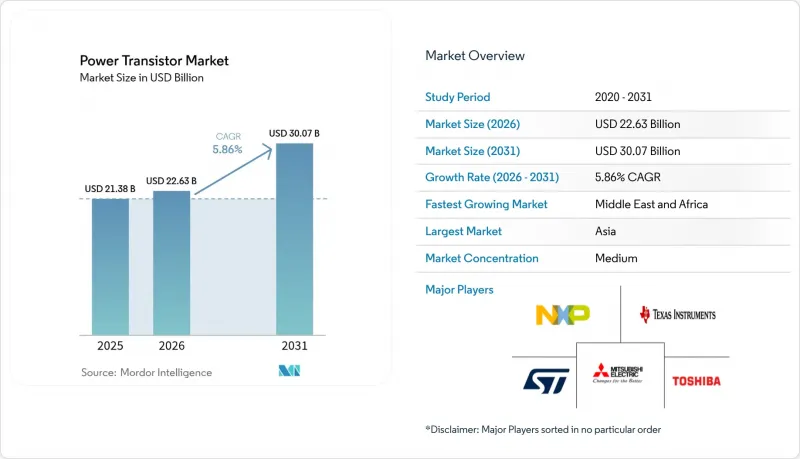
Mordor Intelligence에 의하면, 파워 트랜지스터 시장 규모는 2025년 213억 8,000만 달러에서 2026년에는 226억 3,000만 달러에 이르고, 2026-2031년 CAGR 5.86%로 성장을 지속하여 2031년에는 300억 7,000만 달러에 달할 것으로 예측됩니다.
본 보고서는 제품별(저전압 FET 등), 소재별(실리콘 등), 유형별(양극성 접합 트랜지스터 등), 패키지별(디스크리트 소자 등)로 분류되어 있습니다. 정격 전력(저전력(40V 미만) 등), 최종 사용자 산업(데이터센터 및 HPC 등), 용도(인버터 및 컨버터 등), 그리고 지역별로 분류되어 있습니다. 시장 전망은 금액(달러) 기준으로 제시되어 있습니다.
세계 파워 트랜지스터 시장 동향 및 인사이트
600V 이상의 SiC 기반 IGBT 모듈에 대한 전기차(EV) 수요 가속화
SiC MOSFET는 400V 및 800V 트랙션 인버터에서 실리콘 IGBT를 대체하고 있습니다. 이는 SiC MOSFET가 어셈블리의 무게를 40% 경량화하고 부피를 30% 소형화할 수 있을 뿐만 아니라, 스위칭 손실을 줄여 주행 거리를 연장할 수 있기 때문입니다. ST마이크로일렉트로닉스는 이 두 전압 등급 모두를 지원하는 4세대 STPOWER SiC MOSFET을 2025년에 상용화할 예정입니다. ST와 세미크론이 체결한, 2025년 이후 독일 자동차 제조업체에 SiC eMPack 모듈을 공급하는 10억 유로 규모의 계약이 장기적인 수요의 기반이 되고 있습니다. 중국, 일본, 한국의 자동차 제조업체들도 마찬가지로 자체 개발한 SiC 모듈을 탑재하고, 기판 제조업체와의 협력을 강화하고 있습니다. 조립 수량이 증가함에 따라, 학습 곡선에 따른 비용 절감이 현재 SiC 웨이퍼의 높은 가격을 부분적으로 상쇄하고 있습니다.
5G의 급속한 확산이 RF GaN 트랜지스터의 출하량을 끌어올리고 있습니다.
5G 매크로셀 및 스몰셀 무선 장비의 구축 일정에 따라 고효율 RF 프런트엔드에 대한 수요가 시급한 과제가 되고 있습니다. GaN 고전자이동도 트랜지스터(HEMT)는 선형성을 저해하지 않으면서 넓은 대역폭과 높은 드레인 전압을 지원할 수 있기 때문에 새로운 무선 아키텍처에서 LDMOS나 GaAs보다 우선적으로 채택되고 있습니다. Wolfspeed사의 28V, 30W GaN HEMT 다이는 8GHz까지 작동하며, 통신 및 위성 사양을 충족할 뿐만 아니라 NASA의 신뢰성 기준도 충족합니다. 아시아태평양의 통신 사업자, 특히 중국과 한국이 계속해서 주요 수요원으로 자리 잡고 있습니다. 이에 이어 북미에서는 사이트 수준의 전력 비용을 절감하기 위해 엄격한 효율 목표가 설정된 중대역 구축이 진행되고 있습니다. 사설 네트워크 및 위성 인터넷의 구축이 예정되어 있어 RF GaN 수요는 계속해서 상승 추세를 보이고 있습니다.
만성적인 SiC 기판 공급 부족이 BOM 비용을 상승시키고 있습니다.
2024년 이후 발표된 14개의 200mm SiC 팹조차도 지난 10년 동안 지속된 웨이퍼 부족을 해소하기에는 불충분합니다. 부르(결정)의 수율이 제한적이기 때문에 에피택셜 웨이퍼 가격이 상승하고, 파워 모듈의 부품 원가(BOM)가 부풀어 오르면서, 비용에 민감한 태양광 발전용 및 산업용 인버터에서의 채택이 주춤하고 있습니다. ST마이크로일렉트로닉스는 카타니아에 50억 유로를 투자하여 완전 통합형 SiC 복합 단지를 건설 중이며, 2033년까지 주당 1만 5,000장의 웨이퍼 생산을 목표로 하고 있습니다. 인피니온과 울프스피드 간의 계약 확대와 같은 다년간의 웨이퍼 공급 계약은 공급 상황을 일시적으로 완화하고 있지만, 200mm 결정 성장 기술이 성숙하기 전까지는 공급 부족 상태가 지속될 것으로 보입니다.
부문별 분석
2025년에는 MOSFET이 매출의 45.55%를 차지하며, 휴대전화 충전기부터 산업용 드라이브에 이르기까지 그 보급이 두드러지고 있습니다. 와이드 밴드갭 파워 트랜지스터 시장 규모는 2026년 85억 3,000만 달러에서 2031년까지 124억 9,000만 달러로 확대될 것으로 예상되며, 연평균 성장률(CAGR)은 7.95%를 나타낼 것으로 전망됩니다. GaN은 쇼트키 다이오드를 내장하여 데드 타임과 EMI를 저감하는 인피니언의 ‘CoolGaN G5’ 출시로 인해 더욱 탄력을 받고 있습니다.
트랙션 인버터 및 산업용 드라이브 분야의 IGBT 수요는 여전히 증가하고 있지만, SiC 제품의 선택지가 늘어남에 따라 그 성장률은 완만해지고 있습니다. 슈퍼 접합 MOSFET은 성숙한 공급 라인과 비용 면에서의 우위를 바탕으로 중전압 서버 시장에서 입지를 지키고 있습니다. RF 및 마이크로파 트랜지스터는 고출력 서비스 분야에서 GaN이 GaAs를 대체함에 따라 통신 및 위성 링크 분야에서 견조한 성장을 기록하고 있습니다.
2025년 출하량에서 실리콘이 차지하는 비중은 70.40%였으나, GaN의 매출액은 연평균 성장률(CAGR) 9.45%로 확대될 것으로 예상되며, 이는 각 소재 중 가장 높은 성장률입니다. GaN 파워 트랜지스터 시장 점유율은 2025년에 7.25%를 넘어설 것이며, 2031년까지 10%대 초반의 침투율을 달성할 전망입니다. 소비자용 급속 충전기, 모터 구동 장치, 그리고 48V 데이터센터용 전원 레일이 초기 주요 수요원으로 작용하고 있습니다.
SiC의 강점은 여전히 전기차, 태양광 발전, 에너지 저장 분야의 600V를 초과하는 용도에 있습니다. 시장을 선도하는 ST마이크로일렉트로닉스는 2024년 SiC 디바이스 매출의 32.6%를 차지했습니다. 갈륨 산화물(Ga₂O₃)과 같은 신흥 후보 물질들은 현재 초기 조사 단계의 제안에 그치고 있지만, 재료 과학 분야의 지속적인 혁신을 여실히 보여주고 있습니다.
전압 등급에 관계없이 효율적으로 확장할 수 있는 파워 MOSFET의 존재로 인해, 2025년 매출의 61.30%를 전계 효과형(FET) 아키텍처가 차지했습니다. 설계가 와이드 밴드갭(WBG) 플랫폼으로 전환됨에 따라, FET 파워 트랜지스터 시장 규모는 꾸준히 확대될 전망입니다. 헤테로접합 바이폴라 트랜지스터(HJT)는 점유율은 작지만, 고주파 효율이 중시되는 밀리파 5G 및 저궤도 위성의 페이로드 분야에서 그 입지를 넓혀가고 있습니다.
바이폴라 접합 소자는 스위칭 속도보다 견고성이 중시되는 기존 산업용 제어 분야에서 여전히 사용되고 있습니다. GaN 게이트 드라이버와 SiC MOSFET 출력 단을 결합한 하이브리드 토폴로지가 등장하고 있으며, 이는 시스템 중심의 최적화를 중시하는 수렴적 설계 접근 방식의 조짐을 보여주고 있습니다.
지역별 분석
2025년, 아시아태평양은 파워 트랜지스터 시장 매출의 51.40%를 차지하며, 수량 면에서 압도적인 리더십을 유지하고 있습니다. 중국의 전기차 생산 대수가 급증하고, 국내 SiC 및 GaN 팹(제조 공장)이 확대됨에 따라 공급망 전반에 걸친 수요가 확고해지고 있습니다. 일본과 한국은 고부가가치의 자동차 및民生용 디바이스 설계 채택을 확대하고 있는 반면, 인도는 ‘반도체 미션’에 따라 파운드리 투자를 가속화하고 있습니다. 200mm SiC 생산을 위한 ST마이크로일렉트로닉스와 사난의 합작 사업 등은 이 지역이 와이드 밴드갭(WBG) 기술의 현지화를 목표로 하고 있음을 보여주는 좋은 예입니다. 2024년 태국의 집적 회로 수입이 27% 증가한 것은 지역 전체의 통합이 진행되고 있음을 시사합니다.
북미와 유럽은 합쳐서 시장의 약 40%를 차지하고 있으며, 그 기반은 자동차용 파워 일렉트로닉스, 데이터센터 인프라, 산업용 자동화에 있습니다. 미국 ‘CHIPS 법’에 따른 인센티브는 자동차 및 방위 분야공급 탄력성을 우선시하는 SiC 및 GaN 팹의 새로운 물결을 뒷받침하고 있습니다. 유럽의 ‘중요 원자재법’ 및 혁신 프로그램은 DC-DC 컨버터, 솔리드 스테이트 변압기, 배터리 모듈을 대상으로 하여 전력 전자 분야의 밸류체인을 강화하고 있습니다. 두 지역 모두 200mm SiC 결정 성장 및 결함 없는 GaN 에피택시 기술의 발전을 도모하기 위해 기술 제휴를 추진하고 있습니다.
중동 및 아프리카은 규모는 작지만 가장 빠르게 성장하는 시장이며, 2031년까지 연평균 성장률(CAGR)은 8.45%로 예측됩니다. ‘사우디 비전 2030’이나 UAE의 G42 반도체 추진 계획과 같은 국가 프로그램을 통해 재생에너지용 인버터, 데이터센터 클러스터, 전기차 충전 회랑에 대한 투자가 촉진되고 있습니다. 풍부한 일사량과 유리한 전력 요금이 고전압 SiC 디바이스의 도입을 자연스럽게 뒷받침하는 한편, 현지 설계 거점이 해외 거주 엔지니어 인재를 유치하고 있습니다.
기타 혜택:
- 엑셀 형식 시장 예측(ME) 시트
- 3개월간의 애널리스트 지원
자주 묻는 질문
목차
제1장 서론
제2장 조사 방법
제3장 주요 요약
제4장 시장 구도
제5장 시장 규모와 성장 예측
제6장 경쟁 구도
제7장 시장 기회와 향후 전망
LSH 26.09.14According to Mordor Intelligence, the power transistor market size is expected to grow from USD 21.38 billion in 2025 to USD 22.63 billion in 2026 and is forecast to reach USD 30.07 billion by 2031 at 5.86% CAGR over 2026-2031.
This report is Segmented by Product (Low-Voltage FETs, and More), Material (Silicon, and More), Type (Bipolar Junction Transistor, and More), Packaging (Discrete Devices, and More). Power Rating (Low Power (Less Than 40 V), and More), End-User Industry (Data Centers and HPC, and More), Application (Inverters and Converters, and More), and Geography. The Market Forecasts are Provided in Terms of Value (USD).
Global Power Transistor Market Trends and Insights
Accelerated EV demand for >=600 V SiC-based IGBT modules
SiC MOSFETs are displacing silicon IGBTs in 400 V and 800 V traction inverters because they deliver 40% lighter, 30% smaller assemblies and cut switching losses, which extends driving range. STMicroelectronics plans to commercialize fourth-generation STPOWER SiC MOSFETs in 2025, tailored for both voltage classes. A billion-euro supply deal between ST and Semikron covering SiC eMPack modules for a German automaker from 2025 anchors long-term demand. Chinese, Japanese, and South Korean OEMs are likewise integrating captive SiC modules, tightening ties with substrate makers. As assembly volumes rise, learning-curve savings partially offset today's SiC wafer premiums.
Rapid 5G roll-outs propelling RF GaN transistor volumes
Roll-out timelines for 5G macro and small-cell radios drive urgent need for high-efficiency RF front ends. GaN high-electron-mobility transistors (HEMTs) handle wide bandwidth and high drain voltages without compromising linearity, making them preferred over LDMOS or GaAs in new radio architectures. Wolfspeed's 28 V, 30 W GaN HEMT die operates to 8 GHz, meeting telecom and satellite specifications while satisfying NASA reliability metrics. Asia-Pacific carriers, particularly in China and South Korea, remain the volume anchors; North America follows with mid-band deployments that stipulate stringent efficiency targets to curb site-level power bills. With private-network and satellite-internet roll-outs ahead, RF GaN remains on an upward curve.
Chronic SiC substrate shortages inflating BOM costs
Fourteen 200 mm SiC fabs announced since 2024 remain insufficient to eliminate the wafer deficit through the decade. Limited boule yields raise epitaxial wafer prices and inflate power-module bills of material, slowing adoption in cost-sensitive solar and industrial inverters. STMicroelectronics is investing EUR 5 billion in Catania to create a fully integrated SiC complex, aiming for 15,000 wafers/week by 2033. Multi-year wafer-supply agreements, such as Infineon-Wolfspeed's expanded pact, partially buffer availability, yet supply tightness persists until 200 mm crystal growth matures.
Other drivers and restraints analyzed in the detailed report include:
- Government PLI and CHIPS incentives boosting regional fab capacity
- Data-center race for >=98% PSU efficiency triggering super-junction MOSFET refresh
- GaN device reliability qualification lag in automotive AEC-Q101
For complete list of drivers and restraints, kindly check the Table Of Contents.
Segment Analysis
MOSFETs contributed 45.55% of revenue in 2025, underscoring their ubiquity from handset chargers to industrial drives. The power transistor market size for wide-bandgap power transistors is projected to climb from USD 8.53 billion in 2026 to USD 12.49 billion by 2031, translating to an 7.95% CAGR. GaN gets a further boost from Infineon's CoolGaN G5 launch that embeds a Schottky diode, trimming dead-time and EMI.
Demand for IGBTs in traction inverters and industrial drives still rises, yet at a tempered rate as SiC options proliferate. Super-junction MOSFETs defend medium-voltage servers thanks to mature supply lines and cost position. RF & microwave transistors record healthy gains from telecom and satellite links as GaN displaces GaAs for higher-power services.
Silicon accounted for 70.40% of 2025 shipments, but GaN revenue is forecast to expand at a 9.45% CAGR, the steepest across materials. The power transistor market share for GaN surpassed 7.25% in 2025 and is on track to achieve low-teens penetration by 2031. Consumer fast-chargers, motor drives, and 48 V data-center rails form the early-majority demand pool.
SiC's stronghold remains applications above 600 V in EVs, solar, and storage. Market leader STMicroelectronics held 32.6% of SiC device revenue in 2024. Emerging candidates such as gallium oxide remain early-research propositions, yet they highlight ongoing material-science innovation.
Field-effect architectures captured 61.30% of 2025 revenue because power MOSFETs scale efficiently across voltage grades. The power transistor market size for FETs is set to expand steadily as design-ins migrate toward WBG platforms. Heterojunction bipolar transistors, though smaller, gain momentum in millimeter-wave 5G and low-Earth-orbit satellite payloads that prize high-frequency efficiency.
Bipolar-junction devices persist in legacy industrial controls where robustness trumps switching speed. Hybrid topologies that marry GaN gate drivers with SiC MOSFET output stages are surfacing, signaling convergent design approaches that favor system-centric optimization.
Complete Report Scope:
- By Product
- Low-Voltage FETs
- High-Voltage FETs
- Discrete IGBT
- IGBT Modules
- Super-Junction MOSFETs
- RF and Microwave Transistors
- Wide-Bandgap Power Transistors (SiC, GaN)
- By Material
- Silicon
- Silicon Carbide (SiC)
- Gallium Nitride (GaN)
- Gallium Arsenide (GaAs)
- Others
- By Type
- Bipolar Junction Transistor (BJT)
- Field-Effect Transistor (MOSFET, JFET)
- Heterojunction Bipolar Transistor (HBT)
- By Packaging
- Discrete Devices
- Power Modules
- Power ICs/Integrated Power Stages
- By Power Rating
- Low Power (Less than40 V)
- Medium Power (40-600 V)
- High Power (Above 600 V)
- By End-User Industry
- Automotive and EV/HEV
- Consumer Electronics and Mobile
- Industrial Automation and Motor Drives
- Energy and Power (Renewables, Smart Grid)
- Data Centers and HPC
- Telecom and 5G Infrastructure
- Aerospace and Defense
- By Application
- Inverters and Converters
- Motor Control and Drives
- Power Supplies and Adapters
- Battery Charging and BMS
- RF Power Amplifiers
- Lighting and Display Drivers
- By Geography
- North America
- United States
- Canada
- Mexico
- Europe
- Germany
- United Kingdom
- France
- Italy
- Spain
- Nordics (Denmark, Sweden, Norway, Finland)
- Rest of Europe
- Asia-Pacific
- China
- Japan
- South Korea
- India
- Southeast Asia
- Australia
- Rest of Asia-Pacific
- South America
- Brazil
- Argentina
- Rest of South America
- Middle East
- Gulf Cooperation Council Countries
- Turkey
- Rest of Middle East
- Africa
- South Africa
- Nigeria
- Rest of Africa
- North America
Geography Analysis
Asia Pacific generated 51.40% of power transistor market revenue in 2025 and holds undisputed volume leadership. China's EV output surge, combined with expanding domestic SiC and GaN fabs, cements demand across the supply chain. Japan and South Korea add high-value automotive and consumer-device design-ins, while India accelerates foundry investments under its semiconductor mission. Joint ventures such as STMicroelectronics-Sanan for 200 mm SiC production exemplify the region's bid to localize WBG capability. Thailand's 27% rise in integrated-circuit imports during 2024 signals broader regional integration.
North America and Europe jointly account for about 40% of the market, anchored in automotive power electronics, data-center infrastructure, and industrial automation. U.S. CHIPS Act incentives underpin a new wave of SiC and GaN fabs that prioritize automotive and defense supply resilience. Europe's Critical Raw Materials Act and innovation programs target DC-DC converters, solid-state transformers, and battery modules, reinforcing its power electronics value chain. Both regions cultivate technical partnerships to advance 200 mm SiC crystal growth and zero-defect GaN epitaxy.
The Middle East & Africa represent a small but fastest-growing slice, with an 8.45% CAGR forecast to 2031. National programs such as Saudi Vision 2030 and the UAE's G42 semiconductor push channel investment into renewable energy inverters, data-center clusters, and EV charging corridors. Abundant solar irradiation and favorable power tariffs provide a natural pull for high-voltage SiC device deployment, while local design hubs attract diaspora engineering talent.
- Infineon Technologies AG
- ON Semiconductor Corp.
- STMicroelectronics N.V.
- Mitsubishi Electric Corp.
- Texas Instruments Inc.
- Fuji Electric Co. Ltd.
- Renesas Electronics Corp.
- Toshiba Electronic Devices and Storage Corp.
- Wolfspeed Inc. (Cree)
- Navitas Semiconductor
- Broadcom Inc.
- Rohm Co. Ltd.
- Vishay Intertechnology
- Alpha and Omega Semiconductor
- Littelfuse Inc.
- IXYS Integrated Circuits Division
- Power Integrations Inc.
- Nexperia B.V.
- Microchip Technology Inc.
- GeneSiC Semiconductor
- Fairchild (onsemi legacy)
- NXP Semiconductors
Additional Benefits:
- The market estimate (ME) sheet in Excel format
- 3 months of analyst support
TABLE OF CONTENTS
1 INTRODUCTION
- 1.1 Study Assumptions and Market Definition
- 1.2 Scope of the Study
2 RESEARCH METHODOLOGY
3 EXECUTIVE SUMMARY
4 MARKET LANDSCAPE
- 4.1 Market Overview
- 4.2 Market Drivers
- 4.2.1 Accelerated EV-driven demand for More than600 V SiC-based IGBT modules (Asia and Europe)
- 4.2.2 Rapid 5G radio roll-outs propelling RF GaN transistor volumes (Asia-Pacific and North America)
- 4.2.3 Government PLI and CHIPS incentives boosting regional fab capacity (U.S., India)
- 4.2.4 Data-center race for More than 98 % PSU efficiency triggering super-junction MOSFET refresh
- 4.2.5 Solar+storage inverters shifting to 1.2 kV SiC MOSFETs in EMEA utility segment
- 4.2.6 Automotive OEM vertical-integration of power modules raising captive demand (Japan, China)
- 4.3 Market Restraints
- 4.3.1 Chronic SiC substrate shortages inflating BOM costs
- 4.3.2 GaN device reliability qualification lag in automotive AEC-Q101
- 4.3.3 IGBT thermal-runaway risk above 175 degree C junction limits traction inverter design
- 4.3.4 Complex multi-source export controls on WBG devices (U.S./EU)
- 4.4 Industry Ecosystem Analysis
- 4.5 Technological Outlook
- 4.6 Porter's Five Forces Analysis
- 4.6.1 Bargaining Power of Suppliers
- 4.6.2 Bargaining Power of Buyers
- 4.6.3 Threat of New Entrants
- 4.6.4 Threat of Substitutes
- 4.6.5 Intensity of Competitive Rivalry
5 MARKET SIZE AND GROWTH FORECASTS (VALUES)
- 5.1 By Product
- 5.1.1 Low-Voltage FETs
- 5.1.2 High-Voltage FETs
- 5.1.3 Discrete IGBT
- 5.1.4 IGBT Modules
- 5.1.5 Super-Junction MOSFETs
- 5.1.6 RF and Microwave Transistors
- 5.1.7 Wide-Bandgap Power Transistors (SiC, GaN)
- 5.2 By Material
- 5.2.1 Silicon
- 5.2.2 Silicon Carbide (SiC)
- 5.2.3 Gallium Nitride (GaN)
- 5.2.4 Gallium Arsenide (GaAs)
- 5.2.5 Others
- 5.3 By Type
- 5.3.1 Bipolar Junction Transistor (BJT)
- 5.3.2 Field-Effect Transistor (MOSFET, JFET)
- 5.3.3 Heterojunction Bipolar Transistor (HBT)
- 5.4 By Packaging
- 5.4.1 Discrete Devices
- 5.4.2 Power Modules
- 5.4.3 Power ICs/Integrated Power Stages
- 5.5 By Power Rating
- 5.5.1 Low Power (Less than40 V)
- 5.5.2 Medium Power (40-600 V)
- 5.5.3 High Power (Above 600 V)
- 5.6 By End-User Industry
- 5.6.1 Automotive and EV/HEV
- 5.6.2 Consumer Electronics and Mobile
- 5.6.3 Industrial Automation and Motor Drives
- 5.6.4 Energy and Power (Renewables, Smart Grid)
- 5.6.5 Data Centers and HPC
- 5.6.6 Telecom and 5G Infrastructure
- 5.6.7 Aerospace and Defense
- 5.7 By Application
- 5.7.1 Inverters and Converters
- 5.7.2 Motor Control and Drives
- 5.7.3 Power Supplies and Adapters
- 5.7.4 Battery Charging and BMS
- 5.7.5 RF Power Amplifiers
- 5.7.6 Lighting and Display Drivers
- 5.8 By Geography
- 5.8.1 North America
- 5.8.1.1 United States
- 5.8.1.2 Canada
- 5.8.1.3 Mexico
- 5.8.2 Europe
- 5.8.2.1 Germany
- 5.8.2.2 United Kingdom
- 5.8.2.3 France
- 5.8.2.4 Italy
- 5.8.2.5 Spain
- 5.8.2.6 Nordics (Denmark, Sweden, Norway, Finland)
- 5.8.2.7 Rest of Europe
- 5.8.3 Asia-Pacific
- 5.8.3.1 China
- 5.8.3.2 Japan
- 5.8.3.3 South Korea
- 5.8.3.4 India
- 5.8.3.5 Southeast Asia
- 5.8.3.6 Australia
- 5.8.3.7 Rest of Asia-Pacific
- 5.8.4 South America
- 5.8.4.1 Brazil
- 5.8.4.2 Argentina
- 5.8.4.3 Rest of South America
- 5.8.5 Middle East
- 5.8.5.1 Gulf Cooperation Council Countries
- 5.8.5.2 Turkey
- 5.8.5.3 Rest of Middle East
- 5.8.6 Africa
- 5.8.6.1 South Africa
- 5.8.6.2 Nigeria
- 5.8.6.3 Rest of Africa
- 5.8.1 North America
6 COMPETITIVE LANDSCAPE
- 6.1 Market Concentration
- 6.2 Strategic Moves
- 6.3 Market Share Analysis
- 6.4 Company Profiles {includes Global level Overview, Market level overview, Core Segments, Financials as available, Strategic Information, Market Rank/Share, Products and Services, Recent Developments}
- 6.4.1 Infineon Technologies AG
- 6.4.2 ON Semiconductor Corp.
- 6.4.3 STMicroelectronics N.V.
- 6.4.4 Mitsubishi Electric Corp.
- 6.4.5 Texas Instruments Inc.
- 6.4.6 Fuji Electric Co. Ltd.
- 6.4.7 Renesas Electronics Corp.
- 6.4.8 Toshiba Electronic Devices and Storage Corp.
- 6.4.9 Wolfspeed Inc. (Cree)
- 6.4.10 Navitas Semiconductor
- 6.4.11 Broadcom Inc.
- 6.4.12 Rohm Co. Ltd.
- 6.4.13 Vishay Intertechnology
- 6.4.14 Alpha and Omega Semiconductor
- 6.4.15 Littelfuse Inc.
- 6.4.16 IXYS Integrated Circuits Division
- 6.4.17 Power Integrations Inc.
- 6.4.18 Nexperia B.V.
- 6.4.19 Microchip Technology Inc.
- 6.4.20 GeneSiC Semiconductor
- 6.4.21 Fairchild (onsemi legacy)
- 6.4.22 NXP Semiconductors
7 MARKET OPPORTUNITIES AND FUTURE OUTLOOK
- 7.1 White-space and Unmet-need Assessment


