
|
시장보고서
상품코드
2124837
비디오 텔레매틱스 : 시장 점유율 분석, 업계 동향 및 통계, 성장 예측(2026-2031년)Video Telematics - Market Share Analysis, Industry Trends & Statistics, Growth Forecasts (2026 - 2031) |
||||||
 Mordor Intelligence
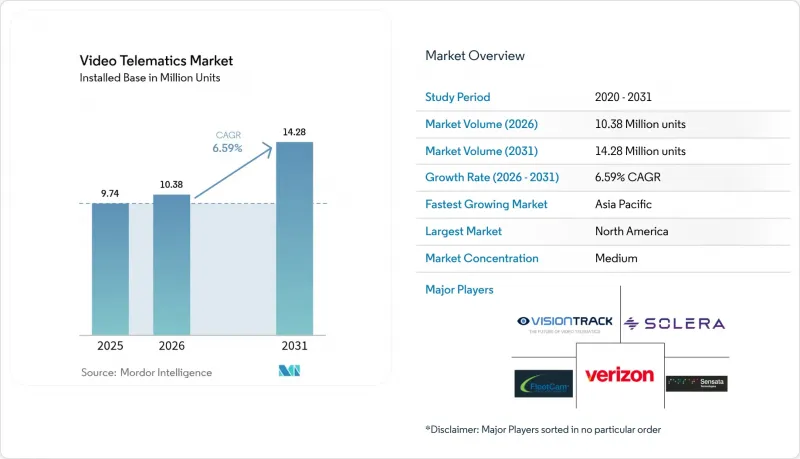
Mordor Intelligence에 의하면, 비디오 텔레매틱스 시장 규모(도입 대수 기반)는 2025년 974만 대로 평가되었습니다. 2026년 1,038만 대로부터, 2031년까지 1,428만 대로 확대되고 2026-2031년까지 연평균 복합 성장률(CAGR)은 6.59%를 나타낼 전망입니다.
본 보고서는 유형별(통합 시스템, 독립형 시스템), 차종별(대형 트럭, 버스·장거리 버스, 승용차, 기타), 배포 모델별(클라우드 기반, On-Premise·하이브리드), 구성 요소별(하드웨어, 소프트웨어·분석, 서비스), 지역별로 분류되어 있습니다. 시장 전망은 금액(달러) 기준으로 제시되어 있습니다.
세계의 비디오 텔레매틱스 시장 동향 및 인사이트
플릿 텔레매틱스와 통합된 비디오 솔루션의 채택 확대
기업 차량 플릿에서는 기존 텔레매틱스 대시보드에 카메라를 통합함으로써 벤더와의 관계를 강화하고 있습니다. Samsara가 2026년 1월에 발표한 ‘Asset Gateway’는 트레일러와 컨테이너에 대한 영상 커버리지를 확대하여 모니터링 범위를 운전석 밖으로까지 넓혔습니다. Lytx가 2025년 4월 Geotab과 제휴함에 따라, 사업자는 단일 포털 내에서 급제동 이벤트와 이에 대응하는 동기화된 영상 클립을 동시에 재생할 수 있게 되었습니다. 이러한 통합형 접근 방식은 조사 시간을 단축하고 소프트웨어 비용을 절감할 뿐만 아니라, 독립형 카메라 공급업체에 API 공개를 요구하는 압력을 강화하고 있습니다. 통합 플랫폼은 이미 2025년 매출의 62.37%를 차지했으며, 일회용 하드웨어 판매에서 다년 계약 소프트웨어 구독으로 전환됨에 따라 그 우위를 더욱 확대될 전망입니다.
운전자 모니터링 및 ADAS 데이터 로깅에 관한 규제 요건
유럽연합(EU)의 일반 안전 규정(GDPR(EU 개인정보보호규정))에 따라 2026년 7월 이후 모든 신차에 데이터 이벤트 레코더(DER) 탑재가 의무화됨에 따라, 유럽 전역에서 카메라 업그레이드가 가속화되고 있습니다. 미국 규제 당국은 현재 영상 기록을 의무화하고 있지는 않지만, FMCSA(연방 자동차 운송 안전국)에 의한 운전 시간 규제 감사가 지속되고 있어 국내 운송 사업자들은 항상 경계를 강화하고 있습니다. 2025년부터 시행되는 중국 교통운수부의 규정과 인도 도로운수부의 지침 역시 아시아 지역에서 유사한 긴박감을 야기하고 있습니다. 엄격한 기한으로 인해 각 운송 회사는 2020년 이전의 트럭을 계획보다 조기에 폐차하고, 충돌 전 5초간의 영상, 조향 조작, 속도 데이터를 기록할 수 있는 시스템을 구매할 수밖에 없는 상황입니다.
개인정보 및 데이터 보호 규정 준수 문제
GDPR(EU 개인정보보호규정) 제88조는 유럽의 고용주에게 직원 모니터링을 제한할 것을 의무화하고 있어, 일부 운송 회사는 휴식 시간 동안 운전자용 카메라의 전원을 끄도록 하고 있습니다. 캘리포니아주 의회 법안 1651호에서는 서면 동의와 24시간 이내의 영상 접근이 의무화되어 있어, 채용 절차에 추가적인 행정 업무가 발생하고 있습니다. 그 결과, 공급업체는 동의 온/오프 전환 기능, 데이터 저장 위치 지정, 영상 마스킹 기능 등을 구축해야 하며, 이 모든 것이 소프트웨어 개발 기간을 연장하고 엔지니어링 비용을 증가시키고 있습니다. 국경을 넘어 사업을 전개하는 운송 회사는 중복되는 개인정보 보호 규제에 직면해 있어, 규정 준수 예산 증가와 판매 주기 장기화를 초래하고 있습니다.
부문별 분석
통합형 플랫폼은 2025년 매출의 62.37%라는 압도적인 점유율을 차지했으며, 이는 영상과 GPS, 유지보수 알림, 운전자 스코어카드를 연동하는 단일 대시보드에 대한 차량 관리 업체의 높은 수요를 뒷받침합니다. 기업의 구매 담당자들은 하드웨어, 클라우드 스토리지, 분석 기능 업데이트를 포괄하는 단일 계약을 선호하며, 흩어져 있는 개별 솔루션을 통합된 규정 준수 엔진으로 전환하고 있습니다. 구독형 가격 책정은 카메라의 초기 구매 비용을 예측 가능한 월간 운영 비용으로 대체함으로써 이러한 추세를 더욱 부추기고 있습니다. 이는 Samsara와 같은 벤더들이 추진하는 접근 방식입니다. 동시에, 사후적인 사고 검증보다는 실시간 지침에 중점을 둠으로써, 개발 로드맵은 텔레매틱스 데이터와 몇 초 이내에 표시 가능한 동영상 클립 간의 연동을 더욱 강화하는 방향으로 나아가고 있습니다.
독립형 시스템은 2031년까지 연평균 성장률(CAGR) 6.91%로 확대되며, 전체 시장 성장률을 소폭 상회하고 있습니다. 이는 이미 타사 전자 로그 기록 장치를 도입한 혼합 차량 군에 쉽게 통합될 수 있기 때문입니다. Garmin의 LTE 지원 ‘Dash Cam Live’는 일상적인 영상을 로컬에 저장하고, 플래그가 지정된 이벤트만 업로드하는 이 볼트온형 모델의 좋은 예입니다. 이러한 설계 덕분에 휴대폰 데이터 통신 요금이 비싼 지역에서 대역폭을 절약할 수 있습니다. 소규모 운송 사업자의 경우, 현재는 전방 카메라 1대만 도입하고 나중에 측면 카메라나 운전자 카메라를 추가할 수 있는 유연성을 중요하게 여기고 있습니다. 이를 통해 기존 하드웨어를 제거할 필요가 없어집니다. 엣지 AI 프로세서를 통해 기기 내에서 분석이 가능해짐에 따라, 통합형 제품군과의 성능 격차는 줄어들고 있으며, 가격 및 기능 차별화에 새로운 압박이 가해지고 있습니다.
2025년 매출의 33.68%를 대형 트럭이 차지했습니다. 이는 장거리 운송 시 발생할 수 있는 중대 사고의 위험과 영상 기록을 의무화하는 엄격한 보험 감사가 요인으로 작용했습니다. 차선 이탈 경고, 사각지대 모니터링, 운전자 피로 감지 등의 기능은 현재 번들 옵션으로 표준 장비로 제공되고 있습니다. 이는 운송 사업자들이 차량 영상과 법정 변호 비용 사이에 명확한 상관관계를 발견했기 때문입니다. 연방자동차운송안전국(FMCSA)의 규제적 관심으로 인해, 연방 정부의 공식적인 카메라 설치 의무가 없음에도 불구하고 도입 추세는 꺾이지 않고 있습니다. 또한, 화물 소유자가 도난이나 화물 손상에 대한 클레임에 대한 증거를 강력히 요구하고 있기 때문에 트레일러 문과 화물실을 커버하는 다중 카메라 어레이도 표준 장비로 자리 잡고 있습니다.
소형 상용차는 2026년부터 2031년까지 연평균 성장률(CAGR) 7.33%를 기록할 전망이며, 이는 모든 차종 중에서 가장 높은 성장률입니다. 이는 아마존(Amazon) 등 전자상거래 사업자들이 견인, 차간 거리 미준수, 급제동을 평가하는 AI 탑재 차량 내 카메라를 배송 밴에 도입하고 있기 때문입니다. 소포 배송 경로 특유의 빈번한 출발과 정지를 반복하는 주행 패턴은 고속도로 주행보다 1마일당 이벤트 데이터가 풍부하여, 향후 충돌을 예측하는 머신러닝 모델에 활용되고 있습니다. 이에 대응해 보험사는 운전자의 행동 영상을 공유하는 배송 밴 및 차량 함대에 대해 보험료 할인을 적용하고 있으며, 이를 통해 라스트 마일 영역에서의 하드웨어 도입을 사실상 자금 면에서 지원하고 있습니다. 버스, 장거리 버스, 승용차는 현재로서는 아직 시장 점유율이 작지만, 유럽에서 도입이 예정된 안전 규제로 인해 향후 10년 후반에는 이러한 차량에서의 카메라 보급률이 상승할 전망입니다.
지역별 분석
2025년, 북미는 전 세계 비디오 텔레매틱스 시장 점유율의 38.91%를 차지했습니다. 이 지역의 성숙한 보험 생태계에서는 비디오를 통해 검증된 안전 점수에 따라 차량 군에 20-30%의 보험료 할인이 적용되고 있으며, 이로 인해 투자 회수 기간이 약 18개월로 단축되었습니다. 운전자의 피로나 근무 시간 기록에 초점을 맞춘 연방 정부의 감사로 인해, 장거리 운송 사업자들은 양방향 카메라와 실시간 알림 기능 도입을 지속적으로 추진하고 있습니다. 하드웨어, 통신, 분석 기능을 단일 월정액 요금에 묶은 구독 번들은 막대한 현금을 지출할 재정적 여력이 없는 소규모 사업자들에게 매력적입니다. 미국과 캐나다를 오가는 국경 횡단 차량들은 서로 다른 개인정보 보호 규정을 준수해야 하므로, 이에 따라 설정 가능한 동의 워크플로우와 지역에 맞춘 데이터 저장에 대한 수요가 지속적으로 유지되고 있습니다.
아시아태평양은 2031년까지 7.57%라는 가장 높은 연평균 성장률(CAGR)을 보일 것으로 예상되며, 이로 인해 해당 지역의 비디오 텔레매틱스 시장이 2025년 기준치를 크게 상회하는 수준으로 성장할 전망입니다. 중국에서는 상용차에 텔레매틱스 장비 탑재를 의무화하는 2025년 규제로 인해 이미 국내 대형 물류 기업들로부터 대량 주문이 잇따르고 있습니다. 한편, 인도의 ADAS 지침은 대형 화물 운송업체들에게 멀티 카메라 구성으로의 전환을 촉진하고 있습니다. 현지 공급업체들은 다국어 지원 대시보드와 비용에 민감한 개인 사업자 소유주를 배려한 가격 정책을 제공함으로써 경쟁 우위를 확보하고 있습니다. 일본, 한국, 호주에서는 사고 재구성 및 실시간 운전자 지도를 중시하는 자발적인 스마트 교통 프로그램이 추가적인 성장 동력을 창출하고 있습니다.
유럽은 중간적인 입장을 취하고 있으며, 2026년 7월 시행된 ‘일반 안전 규정(General Safety Regulation)’에 따라 모든 신차에 데이터 이벤트 레코더 탑재가 의무화됨에 따라 수요가 뒷받침되고 있습니다. GDPR(EU 개인정보보호규정) 제88조에 따른 엄격한 개인정보 보호 요건이 운전자용 카메라의 성장을 억제하고 있기 때문에 각 벤더사는 세심한 개인정보 보호 모드와 자동 데이터 마스킹 도구를 통해 차별화를 꾀하고 있습니다. 남미, 중동 및 아프리카는 여전히 시장 규모가 작고, 휴대전화 통신 범위가 제한적이어서 라이브 스트리밍의 보급이 더딘 편이지만, 초기 비용이 들지 않는 구독 모델이 비용에 민감한 차량 소유자층 사이에서 수요를 확대하기 시작하고 있습니다. 일상적인 영상을 로컬 기기에 저장하고, 플래그가 지정된 이벤트만 업로드하는 하이브리드 아키텍처는 대역폭 제약과 주권 관련 규제를 모두 해결하는 데 도움이 되고 있습니다.
기타 혜택
- 엑셀 형식 시장 예측(ME) 시트
- 3개월간의 애널리스트 지원
자주 묻는 질문
목차
제1장 서론
제2장 조사 방법
제3장 주요 요약
제4장 시장 구도
제5장 시장 규모 및 성장 예측
제6장 경쟁 구도
제7장 시장 기회 및 향후 전망
KTH 26.09.14According to Mordor Intelligence, the video telematics market size in terms of installed base is projected to expand from 9.74 Million units in 2025 and 10.38 Million units in 2026 to 14.28 Million units by 2031, registering a CAGR of 6.59% between 2026 to 2031.

This report is Segmented by Type (Integrated Systems, and Stand-Alone Systems), Vehicle Type (Heavy Trucks, Buses and Coaches, Passenger Cars, and More), Deployment Model (Cloud-Based, and On-Premises/Hybrid), Component (Hardware, Software and Analytics, Services), and Geography. The Market Forecasts are Provided in Terms of Value (USD).
Global Video Telematics Market Trends and Insights
Increasing Adoption of Fleet Telematics-Integrated Video Solutions
Enterprise fleets are consolidating vendor relationships by embedding cameras inside existing telematics dashboards. Samsara's January 2026 Asset Gateway added video coverage to trailers and containers, expanding surveillance beyond the cab. Lytx's April 2025 link-up with Geotab lets operators replay harsh-braking events alongside synchronized clips inside a single portal. The integrated approach reduces investigation time, cuts software costs, and pressures stand-alone camera vendors to open their APIs. Integrated platforms already captured 62.37% of 2025 revenue and will widen that lead as multiyear software subscriptions replace one-off hardware sales.
Regulatory Mandates for Driver-Monitoring and ADAS Data Logging
The European Union's General Safety Regulation requires Data Event Recorders on all new vehicles from July 2026, accelerating camera upgrades across the continent. United States regulators have not mandated video yet, but ongoing Hours-of-Service audits by FMCSA keep domestic carriers on high alert. China's Ministry of Transport rules from 2025, and India's Road Transport Ministry guidelines are generating similar urgency in Asia. Hard deadlines are compelling fleets to retire pre-2020 trucks earlier than planned and to purchase systems capable of capturing 5 seconds of pre-crash footage, steering inputs, and speed data.
Privacy and Data-Protection Compliance Hurdles
GDPR Article 88 requires European employers to limit worker monitoring, prompting some carriers to switch off driver-facing cameras during breaks. California's Assembly Bill 1651 requires written consent and access to footage within 24 hours, adding extra paperwork to onboarding. Vendors must therefore build consent toggles, data-residency paths, and footage redaction, all of which inflate software timelines and raise engineering costs. Fleets that operate across borders face overlapping privacy codes, driving up compliance budgets and extending sales cycles.
Other drivers and restraints analyzed in the detailed report include:
- Falling Camera and Edge-AI Costs
- Growing Safety-Compliance Focus among Commercial Fleets
- High Hardware and Installation Costs for SMB Fleets
For complete list of drivers and restraints, kindly check the Table Of Contents.
Segment Analysis
Integrated platforms accounted for a commanding 62.37% of 2025 revenue, underscoring fleet demand for single dashboards that align video with GPS, maintenance alerts, and driver scorecards. Enterprise buyers prefer a single contract that covers hardware, cloud storage, and analytics updates, turning a patchwork of point solutions into a unified compliance engine. Subscription pricing reinforces that pull by exchanging up-front camera purchases for predictable monthly operating costs, an approach championed by vendors such as Samsara. At the same time, the focus on real-time coaching rather than delayed incident reviews is steering development road maps toward tighter links between telematics data and video clips that can be surfaced within seconds.
Stand-alone systems are expanding at a 6.91% CAGR through 2031, slightly outpacing overall market growth, as they easily integrate into mixed fleets that already run third-party electronic logging devices. Garmin's LTE-enabled Dash Cam Live exemplifies this bolt-on model by storing routine footage locally and uploading only flagged events, a design that saves bandwidth in regions with expensive cellular data. Smaller carriers value the flexibility to deploy a single forward-facing unit today and add side or driver cameras later without ripping out legacy hardware. As edge-AI processors bring analytics to the device, performance gaps with integrated suites are narrowing, putting fresh pressure on pricing and feature differentiation.
Heavy trucks accounted for 33.68% of 2025 revenue, driven by long-haul exposure to high-severity crashes and stringent insurance audits that require video documentation. Continuous lane-departure warnings, blind-spot monitoring, and driver-fatigue detection now ship as bundled options because motor carriers see clear correlations between onboard footage and courtroom defense costs. Regulatory attention from the Federal Motor Carrier Safety Administration keeps the momentum for adoption strong, even without a formal federal camera mandate. Multiple-camera arrays covering trailer doors and cargo bays are also becoming standard as freight owners insist on proof against theft and spoilage claims.
Light commercial vehicles are on track for a 7.33% CAGR between 2026-2031, the fastest of any vehicle class, as e-commerce operators such as Amazon wire delivery vans with AI-powered cabin cameras that score distraction, tailgating, and harsh braking. The dense stop-and-go profile of parcel routes produces richer event data per mile than highway driving, feeding machine-learning models that predict future collisions. Insurers respond by tailoring premium discounts to van fleets that share driver-behavior clips, effectively financing hardware rollouts in the last-mile sector. Buses, coaches, and passenger cars remain smaller slices today, but incoming safety mandates in Europe are set to raise their camera penetration later in the decade.
Complete Report Scope:
- By Type
- Integrated Systems
- Stand-Alone Systems
- By Vehicle Type
- Heavy Trucks
- Buses and Coaches
- Light Commercial Vehicles
- Passenger Cars
- By Deployment Model
- Cloud-Based
- On-Premises / Hybrid
- By Component
- Hardware
- Software and Analytics
- Services
- By Geography
- North America
- United States
- Canada
- Mexico
- South America
- Brazil
- Argentina
- Rest of South America
- Europe
- United Kingdom
- Germany
- France
- Italy
- Rest of Europe
- Asia Pacific
- China
- Japan
- India
- South Korea
- Rest of Asia Pacific
- Middle East and Africa
- Middle East
- United Arab Emirates
- Saudi Arabia
- Rest of Middle East
- Africa
- South Africa
- Egypt
- Rest of Africa
- Middle East
- North America
Geography Analysis
North America accounted for 38.91% of the global video telematics market share in 2025. The region's mature insurance ecosystem rewards fleets with 20-30% premium discounts for video-verified safety scores, which shortens payback periods to roughly 18 months. Federal audits that spotlight driver fatigue and hours-of-service records keep long-haul carriers on a steady upgrade path for dual-facing cameras and real-time alerting. Subscription bundles that bundle hardware, connectivity, and analytics into a single monthly fee appeal to small operators who lack the capital for large cash purchases. Cross-border fleets moving between the United States and Canada juggle diverging privacy rules, which sustains demand for configurable consent workflows and localized data storage.
Asia-Pacific is projected to post the fastest CAGR of 7.57% through 2031, lifting the regional video telematics market well above its 2025 baseline. China's 2025 mandate for telematics devices in commercial vehicles has already sparked bulk orders from domestic logistics giants, while India's ADAS guidelines are nudging heavy-goods carriers toward multi-camera configurations. Local suppliers gain an edge by offering dashboards in multiple languages and pricing that aligns with cost-sensitive owner-operators. Japan, South Korea, and Australia add further momentum with voluntary smart-transportation programs that emphasize accident reconstruction and real-time driver coaching.
Europe occupies a middle ground, with demand anchored by the July 2026 General Safety Regulation, which makes Data Event Recorders compulsory on all new vehicles. Onerous privacy requirements under GDPR Article 88 temper growth for driver-facing cameras, so vendors differentiate through granular privacy modes and automated data-redaction tools. South America, the Middle East, and Africa remain smaller outlets where limited cellular coverage slows live-streaming adoption, yet zero-upfront subscription models are beginning to unlock volume among cost-conscious fleets. Hybrid architectures that store routine footage on local devices and upload only flagged events help address both bandwidth constraints and sovereignty rules.
- Sensata Technologies
- Verizon Communications Inc.
- Solera Holdings Inc.
- FleetCam Pty Ltd
- VisionTrack Ltd
- Lytx Inc.
- Nauto Inc.
- SureCam (Europe) Limited
- LightMetrics Inc.
- NetraDyne Inc.
- Geotab Inc.
- AT&T Inc.
- Fleet Complete Inc.
- Samsara Inc.
- Octo Group SpA
- Motive Technologies Inc.
- One Step GPS LLC
- MiX Telematics Ltd
- Trimble Inc.
- Streamax Technology Co. Ltd
- Howen Technologies Co. Ltd
- Micronet Ltd
- PFK Electronics Pty Ltd
- Blackvue (Pittasoft Co. Ltd)
- Garmin Ltd
- Zonar Systems Inc.
- Azuga Holdings Inc.
Additional Benefits:
- The market estimate (ME) sheet in Excel format
- 3 months of analyst support
TABLE OF CONTENTS
1 INTRODUCTION
- 1.1 Study Assumptions and Market Definition
- 1.2 Scope of the Study
2 RESEARCH METHODOLOGY
3 EXECUTIVE SUMMARY
4 MARKET LANDSCAPE
- 4.1 Market Overview
- 4.2 Market Drivers
- 4.2.1 Increasing Adoption of Fleet Telematics-Integrated Video Solutions
- 4.2.2 Regulatory Mandates for Driver-Monitoring and ADAS Data Logging
- 4.2.3 Falling Camera and Edge-AI Costs
- 4.2.4 Growing Safety-Compliance Focus among Commercial Fleets
- 4.2.5 Usage-Based-Insurance Shift to Video-Verified Claims
- 4.2.6 Road-Image Data Monetisation and Smart-City Partnerships
- 4.3 Market Restraints
- 4.3.1 Privacy and Data-Protection Compliance Hurdles
- 4.3.2 High Hardware and Installation Costs for SMB Fleets
- 4.3.3 Bandwidth or Storage Burdens for HD and 4K Streaming
- 4.3.4 Lack of Open Standards for Video-Analytics Interoperability
- 4.4 Industry Value Chain Analysis
- 4.5 Regulatory Landscape
- 4.6 Technological Outlook
- 4.7 Impact of Macroeconomic Factors on the Market
- 4.8 Porter's Five Forces Analysis
- 4.8.1 Bargaining Power of Suppliers
- 4.8.2 Bargaining Power of Buyers
- 4.8.3 Threat of New Entrants
- 4.8.4 Threat of Substitutes
- 4.8.5 Degree of Competition
- 4.9 Investment Analysis
5 MARKET SIZE AND GROWTH FORECASTS (VALUE)
- 5.1 By Type
- 5.1.1 Integrated Systems
- 5.1.2 Stand-Alone Systems
- 5.2 By Vehicle Type
- 5.2.1 Heavy Trucks
- 5.2.2 Buses and Coaches
- 5.2.3 Light Commercial Vehicles
- 5.2.4 Passenger Cars
- 5.3 By Deployment Model
- 5.3.1 Cloud-Based
- 5.3.2 On-Premises / Hybrid
- 5.4 By Component
- 5.4.1 Hardware
- 5.4.2 Software and Analytics
- 5.4.3 Services
- 5.5 By Geography
- 5.5.1 North America
- 5.5.1.1 United States
- 5.5.1.2 Canada
- 5.5.1.3 Mexico
- 5.5.2 South America
- 5.5.2.1 Brazil
- 5.5.2.2 Argentina
- 5.5.2.3 Rest of South America
- 5.5.3 Europe
- 5.5.3.1 United Kingdom
- 5.5.3.2 Germany
- 5.5.3.3 France
- 5.5.3.4 Italy
- 5.5.3.5 Rest of Europe
- 5.5.4 Asia Pacific
- 5.5.4.1 China
- 5.5.4.2 Japan
- 5.5.4.3 India
- 5.5.4.4 South Korea
- 5.5.4.5 Rest of Asia Pacific
- 5.5.5 Middle East and Africa
- 5.5.5.1 Middle East
- 5.5.5.1.1 United Arab Emirates
- 5.5.5.1.2 Saudi Arabia
- 5.5.5.1.3 Rest of Middle East
- 5.5.5.2 Africa
- 5.5.5.2.1 South Africa
- 5.5.5.2.2 Egypt
- 5.5.5.2.3 Rest of Africa
- 5.5.5.1 Middle East
- 5.5.1 North America
6 COMPETITIVE LANDSCAPE
- 6.1 Market Concentration
- 6.2 Strategic Moves
- 6.3 Market Share Analysis
- 6.4 Company Profiles (includes Global Level Overview, Market Level Overview, Core Segments, Financials as available, Strategic Information, Market Rank/Share, Products and Services, Recent Developments)
- 6.4.1 Sensata Technologies
- 6.4.2 Verizon Communications Inc.
- 6.4.3 Solera Holdings Inc.
- 6.4.4 FleetCam Pty Ltd
- 6.4.5 VisionTrack Ltd
- 6.4.6 Lytx Inc.
- 6.4.7 Nauto Inc.
- 6.4.8 SureCam (Europe) Limited
- 6.4.9 LightMetrics Inc.
- 6.4.10 NetraDyne Inc.
- 6.4.11 Geotab Inc.
- 6.4.12 AT&T Inc.
- 6.4.13 Fleet Complete Inc.
- 6.4.14 Samsara Inc.
- 6.4.15 Octo Group SpA
- 6.4.16 Motive Technologies Inc.
- 6.4.17 One Step GPS LLC
- 6.4.18 MiX Telematics Ltd
- 6.4.19 Trimble Inc.
- 6.4.20 Streamax Technology Co. Ltd
- 6.4.21 Howen Technologies Co. Ltd
- 6.4.22 Micronet Ltd
- 6.4.23 PFK Electronics Pty Ltd
- 6.4.24 Blackvue (Pittasoft Co. Ltd)
- 6.4.25 Garmin Ltd
- 6.4.26 Zonar Systems Inc.
- 6.4.27 Azuga Holdings Inc.
7 MARKET OPPORTUNITIES AND FUTURE OUTLOOK
- 7.1 White-Space and Unmet-Need Assessment