|
시장보고서
상품코드
2124873
자동차용 마이크로컨트롤러 유닛(MCU) : 시장 점유율 분석, 업계 동향 및 통계, 성장 예측(2026-2031년)Automotive MCU - Market Share Analysis, Industry Trends & Statistics, Growth Forecasts (2026 - 2031) |
||||||
 Mordor Intelligence
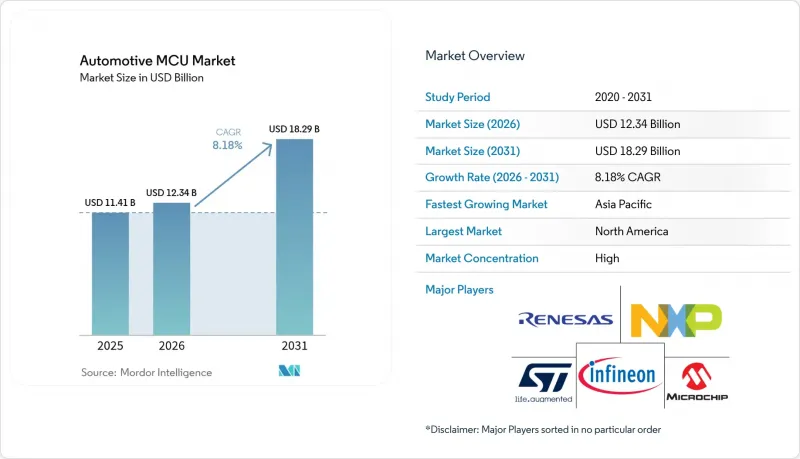
Mordor Intelligence에 의하면, 자동차용 마이크로컨트롤러 유닛(MCU) 시장 규모는 2025년에 114억 1,000만 달러로 평가되었습니다. 2026년 123억 4,000만 달러에서 2031년까지 182억 9,000만 달러에 이를 것으로 예상되며, 예측 기간(2026-2031년) CAGR은 8.18%를 나타낼 전망입니다.
본 보고서는 비트 클래스(8비트, 16비트, 32비트), 용도(파워트레인·섀시, 안전·ADAS, 기타), 차량 구동 방식(승용차(내연기관), 상용차(내연기관), 기타),프로세스 노드 기술, 코어 아키텍처(ARM Cortex-M, ARM Cortex-R/A, 기타), 지역별로 분류되어 있습니다. 시장 예측은 금액(달러) 기준으로 제시되어 있습니다.
세계의 자동차용 마이크로컨트롤러 유닛(MCU) 시장 동향 및 인사이트
전동화와 xEV의 급속한 보급
배터리식 전기차에는 내연기관 차량에 비해 300개 이상의 컨트롤러가 필요하며, MCU 수요 대수는 4배로 증가하고 있습니다. 800V 트랙션 시스템의 열 부하로 인해 접합부의 정격 온도가 150°C를 초과하는 설계가 요구되고 있습니다. NXP의 S32K39/37은 200kHz를 초과하는 주파수로 6상 모터를 제어하며, 이에 필요한 고속 루프가 제시되어 있습니다. 48V 존형 백본으로의 전환을 통해 배선 중량이 85% 감소하여, 난방, 환기, 배터리 컨디셔닝 루프에 전력 예산을 할당할 수 있게 됩니다.
확대되는 ADAS 및 자율주행 기능
레벨 2 플랫폼에는 이미 약 500달러 상당의 반도체가 탑재되어 있으며, 이는 기본 사양의 차량에 비해 한 자릿수 이상 많은 금액입니다. 레벨 4 자율 주행으로의 전환에는 센서 퓨전, 이중화, ASIL-D 준수가 필수적입니다. Texas Instruments의 AWRL6844 레이더는 MCU에 엣지 AI를 통합하여 차량 내 유아의 존재에 관한 데이터를 실시간으로 처리합니다. 지각 및 제어 코드를 단일 MCU에 통합함으로써, 분산형에서 집중형으로의 연산 처리 전환이 가속화됩니다.
장기화되는 기능 안전 인증 주기
ASIL-D 인증 획득에는 18-24개월이 소요되어 혁신이 지연되고 있습니다. 혼합 크리티컬 워크로드의 경우 하드웨어 파티셔닝과 형태 증명이 필요하여 비용 및 일정 관련 위험이 증가하고 있습니다.
부문별 분석
2025년, 16비트 부문은 주로 차체 전자기기 분야에서 매출의 35.40%를 유지했습니다. 대조적으로, 32비트 디바이스는 ADAS 수요와 소프트웨어 정의 차량의 워크로드를 배경으로 연평균 성장률(CAGR) 11.2%를 기록했습니다. ARM Cortex-R5는 안전이 중요한 역할을 주도하고 있는 반면, Infineon의 TriCore는 파워트레인 분야에서 두각을 나타내고 있습니다. 32비트 컨트롤러용 자동차용 마이크로컨트롤러 유닛(MCU) 시장 규모는 2031년까지 106억 2,000만 달러로 확대될 것으로 예측됩니다. 제어와 AI 신경망 처리를 융합한 이종 컴퓨팅으로 인해 16비트 디바이스와의 격차는 더욱 벌어지고 있습니다. 8비트 MCU는 저속 센서 인터페이스에서 여전히 사용되고 있지만, 집적화가 진행됨에 따라 시장 점유율은 하락 추세를 보이고 있습니다.
확장된 주변기기, 결정론적 지연 시간, 하드웨어 방화벽 덕분에 ASIL-D 시스템에서는 여전히 32비트 제품이 선호되고 있습니다. 인피니언(Infineon)의 최신 AURIX-3 디바이스는 트리플 코어의 락스텝 동작과 와트당 1,500DMIPS를 실현하여 효율성의 중요성을 부각시키고 있습니다. 차량용 MCU 시장에서는 16비트 제품이 비용 중심의 선택지로 여겨지는 경향이 강해지는 반면, 프리미엄 부문에서는 고도화된 암호화 및 이더넷 TSN 지원을 목적으로 32비트 제품이 채택되고 있습니다.
안전 및 ADAS 분야는 자동 제동 및 차선 유지 보조 시스템의 규제 의무화에 따라 2026년부터 2031년까지 연평균 성장률(CAGR) 13.6%를 기록할 것으로 전망됩니다. 파워트레인 및 섀시 분야는 범용적인 탑재로 인해 여전히 가장 큰 매출 비중을 차지하고 있습니다. 2025년 기준 파워트레인용 차량용 MCU 시장 점유율은 25.60%를 유지했으나, 전동화의 진전에 따라 지출이 배터리 관리 장치로 이동함에 따라 그 성장세는 완만해지고 있습니다.
소프트웨어 스택으로 인해 용도의 경계가 모호해지고 있습니다. 예측 유지보수는 파워트레인용 MCU에서 실행되는 반면, 인포테인먼트용 MCU에서는 음성 AI가 작동합니다. Texas Instruments의 AM275x-Q1은 그래픽 렌더링과 운전자 모니터링용 신경망을 통합하고 있어, 도메인 간 융합이 진행되고 있음을 보여줍니다. 엣지 학습은 클라우드 트래픽을 줄이고, 데이터 주권 관련 법규가 엄격해지고 있는 지역에서 개인정보 보호 규정 준수를 보장합니다.
지역별 분석
북미는 2025년에 매출의 18.80%를 차지했으며, 이는 자율주행차 시험 운행 구역과 국내 반도체 제조 공장을 지원하는 ‘CHIPS 법’에 힘입은 결과입니다. 마이크로칩(Microchip)이 콜로라도주에서 8억 8,000만 달러 규모의 실리콘 카바이드(SiC) 제조 거점을 확장한 것은 전기차용 트랙션 인버터의 현지 공급을 확보하기 위함입니다. 멕시코의 비용 효율을 중시하는 조립 공장은 미국의 설계 거점과 상호 보완적인 역할을 수행하고 있으며, 캐나다는 제로 배출 차량 구매 인센티브의 혜택을 받고 있습니다.
아시아태평양은 연평균 성장률(CAGR) 13.2%로 가장 빠르게 성장하고 있는 지역입니다. 중국이 2025년까지 ‘국내 칩 사용률 25%’를 의무화한 조치는 현지 MCU 스타트업과 합작 기업을 활성화시키고 있습니다. 또한, 비전파워세미컨덕터가 싱가포르에 건설한 78억 달러 규모의 300mm 팹은 자동차용 혼합 신호 제품 생산을 뒷받침하고 있습니다. 일본의 르네사스는 2024년에 자동차용 매출이 전년 대비 50% 증가를 기록한 반면, 한국은 배터리 셀에 대한 전문 지식을 활용하여 고밀도 컨트롤러를 팩 관리 시스템에 통합하고 있습니다. 인도는 생산량이 증가하고 수입 관세가 현지 조달을 촉진하고 있어, 아직 발전 단계에 있기는 하지만 전략적인 기회를 내포하고 있습니다.
2030년까지 전기차 보급률을 65%로 끌어올리겠다는 유럽의 목표를 달성하기 위해서는 차량 1대당 MCU 탑재량 증가가 필수적입니다. 2025년 3월에 발표된 ‘산업 행동 계획’에서는 디지털화와 사이버 보안에 대한 자금 배분이 지시되어 있어, 각 OEM 업체들은 ISO 21434를 준수하는 컨트롤러를 채택할 수밖에 없는 상황입니다. 독일은 중국 경쟁사들과의 비용 격차를 배경으로, 영역별 연산을 우선시하는 자동화 및 소프트웨어 중심의 설계를 추진하고 있습니다. EU의 ‘칩 법’은 2030년까지 전 세계 반도체 생산량의 20%를 차지하는 것을 목표로 하고 있지만, 국경을 초월한 협력은 여전히 과제로 남아 있습니다. 회원국 전체에서 유엔 규정 R155의 엄격한 시행에 따라 하드웨어 보안 도입이 가속화되고 있습니다.
기타 혜택
- 엑셀 형식 시장 예측(ME) 시트
- 3개월간의 애널리스트 지원
자주 묻는 질문
목차
제1장 서론
제2장 조사 방법
제3장 주요 요약
제4장 시장 구도
제5장 시장 규모 및 성장 예측
제6장 경쟁 구도
제7장 시장 기회 및 향후 전망
KTH 26.09.14According to Mordor Intelligence, the automotive MCU market size was valued at USD 11.41 billion in 2025 and estimated to grow from USD 12.34 billion in 2026 to reach USD 18.29 billion by 2031, at a CAGR of 8.18% during the forecast period (2026-2031).
This report is Segmented by Bit Class (8-Bit, 16-Bit, 32-Bit), Application (Powertrain and Chassis, Safety and ADAS, and More), Vehicle Propulsion Type (Passenger ICE, Commercial ICE, and More), Process-Node Technology, Core Architecture (ARM Cortex-M, ARM Cortex-R/A and More), and Geography. The Market Forecasts are Provided in Terms of Value (USD).
Global Automotive MCU Market Trends and Insights
Electrification and xEV Penetration Surge
Battery-electric cars need more than 300 controllers compared with 70 in ICE vehicles, quadrupling MCU unit demand. Thermal loads in 800 V traction systems drive designs rated for junctions beyond 150°C. NXP's S32K39/37 controls six-phase motors at >200 kHz, illustrating the high-speed loops required. Moving to 48 V zonal backbones trims wiring mass by 85% and frees power budget for heating, ventilation, and battery-conditioning loops.
Growing ADAS and Autonomous Feature Content
Level 2 platforms already embed about USD 500 in semiconductors, an order of magnitude above basic vehicles. Progression to Level 4 autonomy mandates sensor-fusion, redundancy, and ASIL-D conformance. Texas Instruments' AWRL6844 radar integrates edge AI in its MCU, processing in-cabin child-presence data in real time. Consolidating perception and control code on single MCUs accelerates the pivot from distributed to centralized compute.
Lengthy Functional-Safety Qualification Cycles
Achieving ASIL-D certification stretches 18-24 months, delaying innovation. Mixed-critical workloads need hardware partitioning and formal proofs, inflating cost and schedule risk.
Other drivers and restraints analyzed in the detailed report include:
- Software-Defined Vehicle and OTA Architecture
- Cyber-Security Regulation-Driven Refresh Cycles
- Persistent 150 mm Foundry Capacity Bottlenecks
For complete list of drivers and restraints, kindly check the Table Of Contents.
Segment Analysis
The 16-bit segment maintained 35.40% revenue in 2025, mainly in body electronics. In contrast, 32-bit devices recorded an 11.2% CAGR, riding ADAS demand and software-defined-vehicle workloads. ARM Cortex-R5 dominates safety-critical roles, while Infineon's TriCore excels in powertrain. The automotive MCU market size for 32-bit controllers is forecast to expand to USD 10.62 billion by 2031. Heterogeneous computing that blends control and AI neural processing widens the gap with 16-bit devices. 8-bit MCUs linger in low-speed sensor interfaces yet see declining share as integration rises.
Extended peripherals, deterministic latency, and hardware firewalls keep 32-bit parts preferable for ASIL-D systems. Infineon's latest AURIX-3 devices deliver triple-core lockstep and 1,500 DMIPS per watt, underscoring the efficiency imperative. The automotive MCU market increasingly treats 16-bit as cost bins, while premium tiers pursue 32-bit for advanced cryptography and Ethernet TSN support.
Safety and ADAS logged a 13.6% CAGR between 2026-2031, climbing on mandatory automated-brake and lane-keep assist regulations. Powertrain and chassis still hold the largest revenue due to universal fitment. The automotive MCU market share for powertrain remained 25.60% in 2025, yet its growth moderates as electrification shifts spend to battery-management units.
Software stacks now blur application lines; predictive maintenance RUNs on powertrain MCUs, while infotainment MCUs host speech AI. Texas Instruments' AM275x-Q1 merges graphics rendering and driver-monitoring neural nets, evidencing cross-domain convergence. Edge-learning reduces cloud traffic and ensures privacy compliance in regions tightening data-sovereignty laws.
Complete Report Scope:
- By Bit Class
- 8-bit
- 16-bit
- 32-bit
- By Application
- Powertrain and Chassis
- Safety and ADAS
- Body and Comfort Electronics
- Telematics and Infotainment
- By Vehicle Propulsion Type
- Passenger ICE
- Commercial ICE
- Battery Electric Vehicle (BEV)
- Hybrid Electric Vehicle (HEV)
- Plug-in Hybrid (PHEV)
- Fuel-Cell Electric Vehicle (FCEV)
- By Process-Node Technology
- >=180 nm
- 90-65 nm
- 40-22 nm
- <=16 nm (FinFET)
- By Core Architecture
- ARM Cortex-M
- ARM Cortex-R/A
- Proprietary 16/32-bit
- RISC-V
- By Geography
- North America
- United States
- Canada
- Mexico
- Europe
- United Kingdom
- Germany
- France
- Italy
- Rest of Europe
- Asia-Pacific
- China
- Japan
- India
- South Korea
- Rest of Asia-Pacific
- Middle East
- Israel
- Saudi Arabia
- United Arab Emirates
- Turkey
- Rest of Middle East
- Africa
- South Africa
- Egypt
- Rest of Africa
- South America
- Brazil
- Argentina
- Rest of South America
- North America
Geography Analysis
North America held 18.80% of revenue in 2025, propelled by autonomous-vehicle pilot zones and the CHIPS Act that subsidizes domestic fabs. Microchip's USD 880 million Colorado silicon-carbide expansion secures local supply for EV traction inverters. Mexico's cost-based assembly plants complement U.S. design hubs, while Canada benefits from zero-emission purchase incentives.
Asia-Pacific is the fastest-rising region with a 13.2% CAGR. China's 25% domestic-chip-content mandate for 2025 energizes local MCU startups and joint ventures; VisionPower Semiconductor's USD 7.8 billion 300 mm fab in Singapore underpins mixed-signal automotive output. Japan's Renesas reported 50% year-on-year automotive growth in 2024, while South Korea leverages battery-cell expertise to embed high-density controllers into pack-management systems. India represents a nascent but strategic opportunity as production volumes climb and import duties favour localized sourcing.
Europe's path to 65% EV penetration by 2030 necessitates heavier MCU content per car. The Industrial Action Plan announced March 2025 directs funds toward digitalization and cybersecurity, compelling OEMs to adopt ISO 21434-compliant controllers. Germany's cost gap versus Chinese rivals pushes automation and software-centric designs that prioritize zonal compute. The EU Chips Act aims for 20% global semiconductor output by 2030, but cross-border coordination remains a headwind. Strict UN R155 enforcement across member states accelerates hardware security adoption.
- Infineon Technologies AG
- Microchip Technology Inc.
- NXP Semiconductors N.V.
- Renesas Electronics Corporation
- STMicroelectronics N.V.
- Texas Instruments Incorporated
- Toshiba Electronic Devices and Storage Corporation
- Analog Devices, Inc.
- ROHM Semiconductor Co., Ltd.
- Broadcom Inc.
- ON Semiconductor Corp.
- Qualcomm Technologies, Inc.
Additional Benefits:
- The market estimate (ME) sheet in Excel format
- 3 months of analyst support
TABLE OF CONTENTS
1 INTRODUCTION
- 1.1 Study Assumptions and Market Definition
- 1.2 Scope of the Study
2 RESEARCH METHODOLOGY
3 EXECUTIVE SUMMARY
4 MARKET LANDSCAPE
- 4.1 Market Overview
- 4.2 Market Drivers
- 4.2.1 Electrification and xEV penetration surge
- 4.2.2 Growing ADAS and autonomous feature content
- 4.2.3 Software-defined vehicle and OTA architecture
- 4.2.4 Cyber-security regulation-driven refresh cycles
- 4.2.5 Zonal E/E architecture transition
- 4.2.6 Localization incentives (CHIPS Acts, etc.)
- 4.3 Market Restraints
- 4.3.1 Lengthy functional-safety qualification cycles
- 4.3.2 Persistent 150 mm foundry capacity bottlenecks
- 4.3.3 Junction-temperature derating issues >150 C
- 4.3.4 Rising ISO 26262/21434 compliance costs
- 4.4 Value / Supply-Chain Analysis
- 4.5 Regulatory Landscape
- 4.6 Technological Outlook
- 4.7 Porter's Five Forces Analysis
- 4.7.1 Threat of New Entrants
- 4.7.2 Bargaining Power of Suppliers
- 4.7.3 Bargaining Power of Buyers
- 4.7.4 Threat of Substitutes
- 4.7.5 Competitive Rivalry
5 MARKET SIZE AND GROWTH FORECASTS (VALUE)
- 5.1 By Bit Class
- 5.1.1 8-bit
- 5.1.2 16-bit
- 5.1.3 32-bit
- 5.2 By Application
- 5.2.1 Powertrain and Chassis
- 5.2.2 Safety and ADAS
- 5.2.3 Body and Comfort Electronics
- 5.2.4 Telematics and Infotainment
- 5.3 By Vehicle Propulsion Type
- 5.3.1 Passenger ICE
- 5.3.2 Commercial ICE
- 5.3.3 Battery Electric Vehicle (BEV)
- 5.3.4 Hybrid Electric Vehicle (HEV)
- 5.3.5 Plug-in Hybrid (PHEV)
- 5.3.6 Fuel-Cell Electric Vehicle (FCEV)
- 5.4 By Process-Node Technology
- 5.4.1 >=180 nm
- 5.4.2 90-65 nm
- 5.4.3 40-22 nm
- 5.4.4 <=16 nm (FinFET)
- 5.5 By Core Architecture
- 5.5.1 ARM Cortex-M
- 5.5.2 ARM Cortex-R/A
- 5.5.3 Proprietary 16/32-bit
- 5.5.4 RISC-V
- 5.6 By Geography
- 5.6.1 North America
- 5.6.1.1 United States
- 5.6.1.2 Canada
- 5.6.1.3 Mexico
- 5.6.2 Europe
- 5.6.2.1 United Kingdom
- 5.6.2.2 Germany
- 5.6.2.3 France
- 5.6.2.4 Italy
- 5.6.2.5 Rest of Europe
- 5.6.3 Asia-Pacific
- 5.6.3.1 China
- 5.6.3.2 Japan
- 5.6.3.3 India
- 5.6.3.4 South Korea
- 5.6.3.5 Rest of Asia-Pacific
- 5.6.4 Middle East
- 5.6.4.1 Israel
- 5.6.4.2 Saudi Arabia
- 5.6.4.3 United Arab Emirates
- 5.6.4.4 Turkey
- 5.6.4.5 Rest of Middle East
- 5.6.5 Africa
- 5.6.5.1 South Africa
- 5.6.5.2 Egypt
- 5.6.5.3 Rest of Africa
- 5.6.6 South America
- 5.6.6.1 Brazil
- 5.6.6.2 Argentina
- 5.6.6.3 Rest of South America
- 5.6.1 North America
6 COMPETITIVE LANDSCAPE
- 6.1 Market Concentration
- 6.2 Strategic Moves
- 6.3 Market Share Analysis
- 6.4 Company Profiles (includes Global level Overview, Market level overview, Core Segments, Financials as available, Strategic Information, Market Rank/Share for key companies, Products and Services, and Recent Developments)
- 6.4.1 Infineon Technologies AG
- 6.4.2 Microchip Technology Inc.
- 6.4.3 NXP Semiconductors N.V.
- 6.4.4 Renesas Electronics Corporation
- 6.4.5 STMicroelectronics N.V.
- 6.4.6 Texas Instruments Incorporated
- 6.4.7 Toshiba Electronic Devices and Storage Corporation
- 6.4.8 Analog Devices, Inc.
- 6.4.9 ROHM Semiconductor Co., Ltd.
- 6.4.10 Broadcom Inc.
- 6.4.11 ON Semiconductor Corp.
- 6.4.12 Qualcomm Technologies, Inc.
7 MARKET OPPORTUNITIES AND FUTURE OUTLOOK
- 7.1 White-space and Unmet-Need Assessment