

|
시장보고서
상품코드
2114896
중국의 자동차용 마이크로컨트롤러 시장 : 점유율 분석, 업계 동향과 통계, 성장 예측(2026-2031년)China Automotive Microcontroller - Market Share Analysis, Industry Trends & Statistics, Growth Forecasts (2026 - 2031) |
||||||
 Mordor Intelligence
Mordor Intelligence에 의하면, 중국 자동차용 마이크로컨트롤러 시장 규모는 2025년 34억 2,000만 달러에서 2026년에는 36억 6,000만 달러로 확대되어 2026년부터 2031년까지 CAGR 7.11%로 성장을 지속하여, 2031년에는 51억 7,000만 달러에 이를 것으로 예측됩니다.
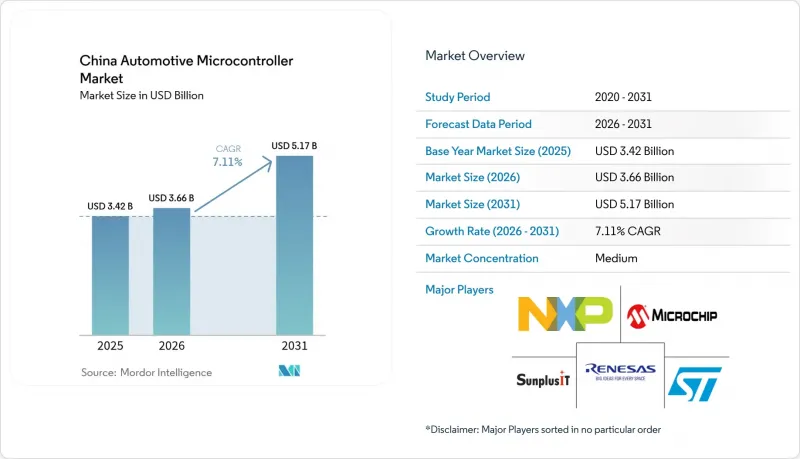
본 보고서는 비트 클래스(8비트, 16비트, 32비트, 64비트),용도(안전·ADAS, 차체 전자기기, 텔레매틱스·인포테인먼트, 파워트레인·섀시 등), 차종(승용차, 소형 상용차 등), 구동 기술(내연기관차 등)별로 분류되어 있습니다. 시장 예측은 금액(달러)으로 표시되어 있습니다.
중국 자동차용 마이크로컨트롤러 시장 동향 및 인사이트
신에너지차의 보급 확대
2024년, 중국에서는 1,040만 대의 신에너지차가 생산되었으며, 이는 중국 자동차 총 생산 대수의 35%를 차지했습니다. 각 배터리식 전기차 모델에는 50-80개의 마이크로컨트롤러가 사용되고 있는 반면, 내연기관 차량에서는 30-50개에 그칩니다. 여기에는 구동 인버터, 충전기 및 열 루프 컨트롤러도 포함됩니다. BYD의 ‘Blade’ 배터리에는 200개 이상의 셀 전체의 전압과 온도를 샘플링하여 열 폭주를 방지하는 분산형 칩이 내장되어 있습니다. 중국 공업정보화부(MIIT)는 2030년까지 신에너지 차량 보급률을 40%로 높이는 것을 목표로 하고 있으며, 이를 통해 실리콘에 대한 장기적인 수요가 확보될 것입니다. CATL의 ‘Shenxing’ 배터리 팩은 10분 만에 80%까지 충전할 수 있으며, 밀리초 단위로 전류를 균형 조정하는 32비트 컨트롤러를 채택하고 있습니다.
ADAS(첨단 운전자 보조 시스템) 통합이 진전
중국의 2024년 GB 7258 개정안에 따라 자동 긴급 제동 및 차선 유지 지원이 의무화됨에 따라, 자동차 제조업체들은 액추에이터의 이중화를 확보하기 위해 ASIL-D 규격의 마이크로컨트롤러 도입을 서두르고 있습니다. NIO의 ‘Adam’ 슈퍼컴퓨터는 페일세이프(fail-safe) 조향 및 제동을 구현하기 위해 고성능 NVIDIA Orin 프로세서와 독립적인 32비트 칩을 여전히 결합하고 있습니다. XPeng이 2024년에 발표한 ‘XNGP’는 지각 처리를 도메인 CPU에서 수행하는 한편, 저지연 제어는 실시간 마이크로컨트롤러에 맡기는 하이브리드 연산 모델을 채택하고 있음을 뒷받침합니다. 2025년 C-NCAP 규격 개정에서는 V2X 및 운전자 모니터링 요건이 도입되어, 이에 따라 안전한 무선 및 적외선 모듈용 컨트롤러 탑재량이 증가하게 될 것입니다.
반도체 공급망의 변동 지속
자동차용 웨이퍼 생산량의 65%는 여전히 대만, 일본, 한국에 의존하고 있어, 중국은 자연재해나 지정학적 충격에 취약한 상태입니다. 2024년 4월 대만 지진으로 인해 TSMC의 28nm 생산 라인이 3주간 중단되었고, 르네사스 및 NXP의 출하가 지연되었을 뿐만 아니라, GAC와 창안자동차는 생산량을 줄일 수밖에 없었습니다. SMIC 등 중국 내 파운드리 업체들은 40nm 공정의 자동차용 수율을 개선했으나, 여전히 전 세계 동종 업체들보다 15-20포인트 낮아 리드타임이 길어지는 결과를 초래하고 있습니다. 2024년 8월 페낭에서 발생한 홍수로 인해 인피니언의 백엔드 패키징이 중단되면서 그 취약성이 부각되었습니다. 안전 재고를 통한 완충 효과는 영향을 완화해 주지만, 현지 생산 능력이 확대될 때까지는 체계적 위험을 완전히 배제할 수는 없습니다.
부문별 분석
중국 자동차용 마이크로컨트롤러 시장에서 32비트 디바이스 시장 규모는 2025년에 15억 7,000만 달러에 달하여 총 가치의 45.78%를 차지했습니다. 존 및 도메인 아키텍처의 보급으로 인해 여러 개의 저사양 유닛이 소수의 고출력 칩으로 통합됨에 따라, 64비트 컨트롤러 시장은 2031년까지 연평균 성장률(CAGR) 8.78%로 성장할 전망입니다. BYD는 분산 배치되어 있던 45개의 8비트 모듈을 12개의 이더넷 기반 32비트 유닛으로 교체하여 하네스의 경량화를 도모하는 한편, 무선(OTA)을 통한 업데이트를 가능하게 했습니다. NIO의 Adam 플랫폼은 이중화 전원 공급 장치와 센서 동기화를 관리하기 위해 64비트 Cortex-A76 컨트롤러를 채택하고 있으며, 이는 가상화 및 보안 가속기에 대한 수요가 증가하고 있음을 뒷받침합니다.
기존의 8비트 부품은 윈도우 리프터 등 위험이 낮은 차체용 틈새 분야에서는 여전히 주류를 이루고 있지만, 중국 자동차용 마이크로컨트롤러 시장에서의 점유율은 축소되는 추세입니다. 16비트 부문은 툴 체인의 부족으로 인해 자동차 제조업체들이 32비트 Arm 코어로 직접 전환할 수밖에 없게 되어 구조적인 쇠퇴에 직면해 있습니다. ISO 26262 준수의 경우, 사전 인증된 라이브러리가 검증 주기를 단축시켜 칩 비용의 높음을 상쇄하는 이점이 있으므로 32비트 및 64비트 디바이스가 유리합니다. 그 결과, 비트 등급 간에 확장 가능하고 핀 호환성이 있는 제품군을 제공하는 공급업체들은 플랫폼 충성도를 유지하고 있습니다.
2025년, 안전 및 ADAS 용도는 11억 6,000만 달러 규모 시장을 창출하여 중국 자동차용 마이크로컨트롤러 시장 가치의 34.05%를 차지했습니다. 의무화된 AEB(자동 긴급 제동) 및 차선 유지 시스템으로 인해, 브레이크, 스티어링 및 이중화 전원 경로를 연동하는 ASIL-D 인증 칩에 대한 수요가 증가하고 있습니다. 한편, 배터리 관리 시스템은 밀리초 단위의 속도로 셀 수준의 감지가 필요한 고밀도 셀-투-팩(cell-to-pack) 화학 조성에 힘입어 10.26%라는 가장 높은 연평균 성장률(CAGR)을 나타낼 전망입니다. CATL의 ‘Qilin’ 배터리는 0.3 mV의 ADC 분해능을 갖춘 분산형 32비트 노드를 채택하여 255 Wh/kg을 달성했습니다.
48볼트 하이브리드 차량의 보급에 따라 파워트레인 및 섀시 분야에서는 꾸준한 수요 증가가 예상됩니다. 텔레매틱스 컨트롤러는 5G의 확산에 힘입고 있는 반면, 차체 전자 분야에서는 지역적인 상품화가 진행되면서 이익률 하락에 직면하고 있습니다. 배터리 안전에 관한 규제 프레임워크 ‘GB 38031’ 및 기능 안전에 관한 ‘GB 34660’에 따라, 용도 스택 전반에 걸친 지속적인 반도체 업그레이드가 보장되고 있습니다.
기타 혜택:
- 엑셀 형식 시장 예측(ME) 시트
- 3개월간의 애널리스트 지원
자주 묻는 질문
목차
제1장 서론
제2장 조사 방법
제3장 주요 요약
제4장 시장 구도
제5장 시장 규모와 성장 예측
제6장 경쟁 구도
제7장 시장 기회와 향후 전망
JHS 26.08.26According to Mordor Intelligence, the China automotive microcontroller market size is expected to grow from USD 3.42 billion in 2025 to USD 3.66 billion in 2026 and is forecast to reach USD 5.17 billion by 2031 at 7.11% CAGR over 2026-2031.
This report is Segmented by Bit Class (8-Bit, 16-Bit, 32-Bit, and 64-Bit), Application (Safety and ADAS, Body Electronics, Telematics and Infotainment, Powertrain and Chassis, and More), Vehicle Type (Passenger Vehicles, Light Commercial Vehicles, and More), and Propulsion Technology (Internal Combustion Engine Vehicles, and More). Market Forecasts are Provided in Terms of Value (USD).
China Automotive Microcontroller Market Trends and Insights
Growing Adoption of New Energy Vehicles
China produced 10.4 million new-energy vehicles in 2024, accounting for 35% of the country's national auto output. Each battery electric model uses 50-80 microcontrollers, compared to 30-50 in internal-combustion cars, which also include traction inverters, chargers, and thermal-loop controllers. BYD's Blade battery embeds distributed chips that sample voltage and temperature across more than 200 cells to avert thermal runaway. MIIT targets 40% new-energy penetration by 2030, securing long-term demand for silicon. CATL's Shenxing pack, capable of reaching 80% charge in 10 minutes, relies on 32-bit controllers that balance current at a millisecond cadence.
Rising Integration of Advanced Driver Assistance Systems
China's 2024 GB 7258 update made automatic emergency braking and lane-keeping assist mandatory, pushing automakers to deploy ASIL-D-rated microcontrollers for actuator redundancy. NIO's Adam supercomputer still pairs high-level NVIDIA Orin processors with discrete 32-bit chips for fail-safe steering and braking. XPeng's 2024 XNGP launch confirms a hybrid compute model where perception runs on domain CPUs but low-latency control stays with real-time microcontrollers. The 2025 C-NCAP upgrade introduces V2X and driver-monitoring requirements, thereby increasing controller content for secure wireless and infrared modules.
Persistent Semiconductor Supply Chain Volatility
Sixty-five percent of automotive-grade wafer output still originates from Taiwan, Japan, and South Korea, leaving China vulnerable to natural disasters and geopolitical shocks. The April 2024 Taiwan earthquake halted TSMC's 28-nm lines for three weeks, delaying shipments from Renesas and NXP, and forcing GAC and Changan to cut their output. Domestic foundries, such as SMIC, have raised 40-nm automotive yields yet remain 15-20 points below their global peers, inflating lead times. Penang flooding in August 2024 halted Infineon backend packaging, underscoring fragility. Safety-stock buffers mitigate the impact but cannot eliminate systemic risk until local capacity is scaled.
Other drivers and restraints analyzed in the detailed report include:
- Government Push for Semiconductor Self-Sufficiency
- Shift to Zonal Electrical Architecture in Smart Vehicles
- Intense Price Competition From Low-End Local Vendors
For complete list of drivers and restraints, kindly check the Table Of Contents.
Segment Analysis
The China automotive microcontroller market size for 32-bit devices reached USD 1.57 billion in 2025, accounting for 45.78% of the total value. Zonal and domain architectures drive consolidation of multiple low-end units into fewer, higher-power chips, propelling 64-bit controllers toward an 8.78% CAGR through 2031. BYD replaced 45 distributed 8-bit modules with 12 Ethernet-based 32-bit units, cutting harness weight while enabling over-the-air updates. NIO's Adam platform incorporates 64-bit Cortex-A76 controllers to manage redundant power and sensor synchronization, underscoring the demand for virtualization and security accelerators.
Legacy 8-bit parts remain dominant in low-risk body niches, such as window lifts, although their market share in the China automotive microcontroller market is contracting. The 16-bit category is facing a structural decline because tool-chain scarcity is pushing automakers to leapfrog directly to 32-bit Arm cores. ISO 26262 compliance favors 32-bit and 64-bit devices, as pre-certified libraries reduce validation cycles, thereby outweighing the higher die cost. As a result, suppliers that offer scalable pin-compatible families across bit classes defend platform loyalty.
Safety and ADAS applications generated USD 1.16 billion in 2025, accounting for 34.05% of China automotive microcontroller market value. Mandated AEB and lane-keeping systems elevate demand for ASIL-D-rated chips that coordinate brake, steer, and redundant power paths. Battery management systems, however, will record the fastest 10.26% CAGR, fueled by high-density cell-to-pack chemistries that require cell-level sensing at millisecond speed. CATL's Qilin battery achieves 255 Wh/kg by employing distributed 32-bit nodes with 0.3 mV ADC resolution.
The powertrain and chassis segments are adding steady volume as 48-volt hybrids proliferate. Telematics controllers ride 5G rollout, while body electronics confront margin erosion amid local commoditization. Regulatory frameworks GB 38031 for battery safety and GB 34660 for functional safety ensure persistent silicon upgrades across the application stack.
Complete Report Scope:
- By Bit Class
- 8-bit Microcontrollers
- 16-bit Microcontrollers
- 32-bit Microcontrollers
- 64-bit Microcontrollers
- By Application
- Safety and ADAS
- Body Electronics
- Telematics and Infotainment
- Powertrain and Chassis
- Battery Management System
- By Vehicle Type
- Passenger Vehicles
- Light Commercial Vehicles
- Heavy Commercial Vehicles
- Off-Highway Vehicles
- By Propulsion Technology
- Internal Combustion Engine Vehicles
- Hybrid Electric Vehicles
- Battery Electric Vehicles
- Fuel Cell Electric Vehicles
List of Companies Covered in this Report:
- NXP Semiconductors N.V.
- Microchip Technology Inc.
- Renesas Electronics Corporation
- STMicroelectronics N.V.
- Infineon Technologies AG
- Texas Instruments Incorporated
- Toshiba Electronic Devices and Storage Corporation
- Onsemi Corporation
- GigaDevice Semiconductor Inc.
- Shanghai NPCore Electronics Co., Ltd.
- CEC Huada Technology Co., Ltd.
- SinoChip Semiconductor Co., Ltd.
- BYD Semiconductor Co., Ltd.
- Autoware Microelectronics Co., Ltd.
- Hangzhou Silan Microelectronics Co., Ltd.
- Nationz Technologies Inc.
- Guangdong Fudan Microelectronics Group Co., Ltd.
- ChipON Micro-Electronics (Shenzhen) Co., Ltd.
- Wuhan Yutong Microelectronics Co., Ltd.
- Shanghai Neusoft Carrier Microelectronics Co., Ltd.
- Holtek Semiconductor Inc.
- Sunplus Technology Co., Ltd.
- AutoCore Technology Co., Ltd.
- Puolop Microelectronics Co., Ltd.
- Hangzhou Hollysys Automation Technologies Co., Ltd.
Additional Benefits:
- The market estimate (ME) sheet in Excel format
- 3 months of analyst support
TABLE OF CONTENTS
1 INTRODUCTION
- 1.1 Study Assumptions and Market Definition
- 1.2 Scope of the Study
2 RESEARCH METHODOLOGY
3 EXECUTIVE SUMMARY
4 MARKET LANDSCAPE
- 4.1 Market Overview
- 4.2 Market Drivers
- 4.2.1 Growing Adoption of New Energy Vehicles
- 4.2.2 Rising Integration of Advanced Driver Assistance Systems
- 4.2.3 Enforcement of Stricter Automotive Safety Regulations
- 4.2.4 Government Push for Semiconductor Self-Sufficiency
- 4.2.5 Shift to Zonal Electrical Architecture in Smart Vehicles
- 4.2.6 Emergence of Domain Controller-Based Vehicle Platforms
- 4.3 Market Restraints
- 4.3.1 Persistent Semiconductor Supply Chain Volatility
- 4.3.2 Intense Price Competition From Low-End Local Vendors
- 4.3.3 Complexity of Achieving ASIL-D Functional Safety Compliance
- 4.3.4 Export Controls on Advanced Design and Verification Tools
- 4.4 Industry Value Chain Analysis
- 4.5 Impact of Macroeconomic Factors on the Market
- 4.6 Regulatory Landscape
- 4.7 Technological Outlook
- 4.8 Porter's Five Forces Analysis
- 4.8.1 Threat of New Entrants
- 4.8.2 Bargaining Power of Buyers
- 4.8.3 Bargaining Power of Suppliers
- 4.8.4 Threat of Substitute Products
- 4.8.5 Intensity of Competitive Rivalry
5 MARKET SIZE AND GROWTH FORECASTS (VALUE)
- 5.1 By Bit Class
- 5.1.1 8-bit Microcontrollers
- 5.1.2 16-bit Microcontrollers
- 5.1.3 32-bit Microcontrollers
- 5.1.4 64-bit Microcontrollers
- 5.2 By Application
- 5.2.1 Safety and ADAS
- 5.2.2 Body Electronics
- 5.2.3 Telematics and Infotainment
- 5.2.4 Powertrain and Chassis
- 5.2.5 Battery Management System
- 5.3 By Vehicle Type
- 5.3.1 Passenger Vehicles
- 5.3.2 Light Commercial Vehicles
- 5.3.3 Heavy Commercial Vehicles
- 5.3.4 Off-Highway Vehicles
- 5.4 By Propulsion Technology
- 5.4.1 Internal Combustion Engine Vehicles
- 5.4.2 Hybrid Electric Vehicles
- 5.4.3 Battery Electric Vehicles
- 5.4.4 Fuel Cell Electric Vehicles
6 COMPETITIVE LANDSCAPE
- 6.1 Market Concentration
- 6.2 Strategic Moves
- 6.3 Market Share Analysis
- 6.4 Company Profiles (includes Global Level Overview, Market Level Overview, Core Segments, Financials as Available, Strategic Information, Market Rank/Share for Key Companies, Products and Services, and Recent Developments)
- 6.4.1 NXP Semiconductors N.V.
- 6.4.2 Microchip Technology Inc.
- 6.4.3 Renesas Electronics Corporation
- 6.4.4 STMicroelectronics N.V.
- 6.4.5 Infineon Technologies AG
- 6.4.6 Texas Instruments Incorporated
- 6.4.7 Toshiba Electronic Devices and Storage Corporation
- 6.4.8 Onsemi Corporation
- 6.4.9 GigaDevice Semiconductor Inc.
- 6.4.10 Shanghai NPCore Electronics Co., Ltd.
- 6.4.11 CEC Huada Technology Co., Ltd.
- 6.4.12 SinoChip Semiconductor Co., Ltd.
- 6.4.13 BYD Semiconductor Co., Ltd.
- 6.4.14 Autoware Microelectronics Co., Ltd.
- 6.4.15 Hangzhou Silan Microelectronics Co., Ltd.
- 6.4.16 Nationz Technologies Inc.
- 6.4.17 Guangdong Fudan Microelectronics Group Co., Ltd.
- 6.4.18 ChipON Micro-Electronics (Shenzhen) Co., Ltd.
- 6.4.19 Wuhan Yutong Microelectronics Co., Ltd.
- 6.4.20 Shanghai Neusoft Carrier Microelectronics Co., Ltd.
- 6.4.21 Holtek Semiconductor Inc.
- 6.4.22 Sunplus Technology Co., Ltd.
- 6.4.23 AutoCore Technology Co., Ltd.
- 6.4.24 Puolop Microelectronics Co., Ltd.
- 6.4.25 Hangzhou Hollysys Automation Technologies Co., Ltd.
7 MARKET OPPORTUNITIES AND FUTURE OUTLOOK
- 7.1 White-Space and Unmet-Need Assessment


