|
시장보고서
상품코드
2124924
VR 컨텐츠 제작 서비스 : 시장 점유율 분석, 업계 동향과 통계, 성장 예측(2026-2031년)VR Content Creation Services - Market Share Analysis, Industry Trends & Statistics, Growth Forecasts (2026 - 2031) |
||||||
 Mordor Intelligence
Mordor Intelligence에 의하면, VR 컨텐츠 제작 서비스 시장 규모는 2025년 45억 3,000만 달러에서 2026년에는 65억 5,000만 달러에 이르고, 2026-2031년 CAGR 44.62%로 성장을 지속하여 2031년에는 414억 7,000만 달러에 달할 것으로 예측됩니다.
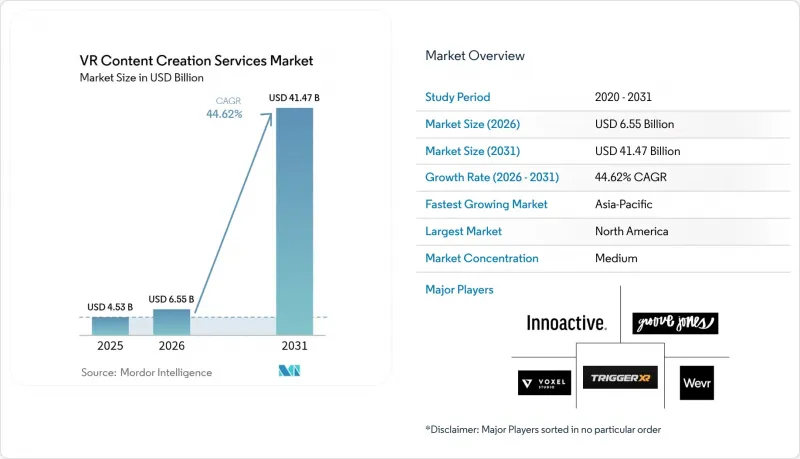
본 보고서는 서비스 유형(360도 촬영, 포스트 프로덕션 서비스 등), 컨텐츠 유형(엔터테인먼트, 교육 및 시뮬레이션 등), 최종 이용 산업(미디어 및 엔터테인먼트, 헬스케어,교육, 소매 및 전자상거래 등), 플랫폼(PC 기반 VR, 모바일 VR, 콘솔 VR, WebXR), 지역별로 분류되어 있습니다. 시장 예측은 금액(달러) 기준으로 제시되어 있습니다.
세계 VR 컨텐츠 제작 서비스 시장 동향 및 인사이트
저가형 6DoF VR 헤드셋의 보급
한때 1,000달러를 넘던 헤드셋도 현재는 500달러 미만으로 판매되고 있으며, 2024년에 240만 대를 출하한 ‘Meta Quest 3’가 그 선두주자로 자리 잡고 있습니다. ‘Apple Vision Pro’는 3,499달러라는 가격대로 프리미엄 엔터프라이즈 시장을 개척하며, 스튜디오가 수익성이 높은 포토리얼리스틱 프로젝트에 진출하는 데 힘을 실어주고 있습니다. 설치 기반이 확대됨에 따라 플랫폼 사업자는 좌석 단위 라이선싱이 가능해졌으며, 기업용 교육 프로그램 도입 장벽이 낮아지고 있습니다.
몰입형 교육 모듈에 대한 기업의 역량 강화 수요
VR 학습자는 교실 수강생보다 더 빠르게 소프트 스킬 과정을 수료했으며, 자신감이 275% 향상된 것으로 보고되었습니다. 월마트는 4,700개 매장에 ‘VR 아카데미’를 도입했고, 보잉은 737 MAX의 와이어 하네스 교육 시간을 75% 단축했습니다. 이러한 정량화된 시간 단축 효과 덕분에 VR 컨텐츠 제작 서비스 시장을 뒷받침하는 다년간의 컨텐츠 계약이 정당화되고 있습니다.
포토리얼리스틱 컨텐츠 제작 파이프라인의 높은 비용
볼륨 캡처 단계에서의 설비 투자는 100만 달러를 초과하며, 프레임스토어(FrameStore)와 같은 기업의 시네마틱 프로젝트에서는 결과물 1건당 50만 달러에서 200만 달러의 비용이 드는 경우가 많습니다. 실시간 레이 트레이싱 렌더링은 일반 동영상에 비해 클라우드 비용을 2배로 끌어올리기 때문에 중소기업의 경우 맞춤형 경험을 도입할 여력이 없어집니다.
부문 분석
인터랙티브 애플리케이션 개발은 연평균 성장률(CAGR) 46.38%를 나타낼 것으로 예측되며, 2025년 정적 3D 모델링 시장 점유율인 34.28%를 넘어설 것으로 보입니다. 기업들은 분기 로직, 물리 기반 시뮬레이션, 다중 사용자 협업에 대한 요구가 높아지고 있으며, 이로 인해 소프트웨어 엔지니어링의 복잡성이 증가하고 있습니다. Unity의 보고서에 따르면, 엔터프라이즈 프로젝트의 68%가 현재 인터랙티브 기능을 통합하고 있으며, 이는 2022년의 42%에서 증가한 수치입니다. AI를 활용한 에셋 생성기를 통해 아티스트는 게임플레이 로직에 집중할 수 있게 되어 이러한 추세를 뒷받침하고 있습니다.
3D 모델링은 여전히 핵심 기술이지만, Infinigen과 같은 도구가 배경 소품 제작을 자동화함에 따라 이익률에 대한 압박은 커지고 있습니다. 360도 영상 제작은 틈새 시장인 라이브 이벤트 스트리밍으로 진화하고 있는 반면, Adobe Premiere VR 툴셋이 확충됨에 따라 포스트 프로덕션 서비스는 상품화가 진행되고 있습니다. 언리얼 엔진(Unreal Engine) 전문 지식을 갖춘 스튜디오는 높은 요금을 청구할 수 있지만, 애니메이션 베테랑들이 게임 엔진 워크플로우에 대한 재교육을 받고 있어 인력 부족은 여전히 지속되고 있습니다.
엔터테인먼트 분야는 대히트 IP의 전개에 힘입어 2025년에도 41.05%의 점유율을 유지했습니다. 의료 분야의 시각화용 VR 컨텐츠 제작 서비스 시장 규모는 수술 계획에 VR 활용을 권장하는 FDA의 디지털 헬스 이니셔티브에 힘입어 연평균 성장률(CAGR) 46.41%로 확대될 것으로 예측됩니다. 존스 홉킨스 대학교는 복잡한 정형외과 수술에서 VR을 활용한 리허설을 실시한 결과, 수술 시간이 38% 단축되었다고 보고했습니다.
훈련 및 시뮬레이션 분야에서는 국방 관련 계약이 견조한 추세를 보이는 반면, 마케팅 분야에서는 아우디나 BMW와 같은 자동차 제조업체들이 몰입형 쇼룸을 활용하고 있습니다. 건축 투어는 Matterport사의 공간 데이터 플랫폼 덕분에 팬데믹 이후에도 계속해서 성장세를 보이고 있습니다. 교육 분야에서의 도입은 예산 제약으로 인해 뒤처지고 있지만, STEM 관련 보조금 덕분에 서서히 탄력을 받고 있습니다.
지역별 분석
북미는 2025년, 포춘 500대 기업의 교육 예산, 할리우드의 볼륨 캡처, 그리고 몰입형 스타트업에 대한 12억 달러의 벤처 자금에 힘입어 전 세계 매출의 43.05%를 차지했습니다. 미국 국방부는 2024 회계연도에 VR 교육을 위해 1억 5,000만 달러를 편성하여 시뮬레이션 제공업체에 안정적인 수주 파이프라인을 보장하고 있습니다. 캐나다의 2,500만 캐나다 달러(1,850만 달러) 규모의 몰입형 미디어 기금은 수출 가능한 제작물을 육성하고 있는 반면, 멕시코의 자동차 부품 공급업체는 조립 훈련에 VR을 도입하고 있습니다.
아시아태평양은 2031년까지 연평균 성장률(CAGR) 46.33%를 기록하며 가장 높은 성장률을 보일 것으로 예측됩니다. 중국은 2026년까지 메타버스 관련 생산액을 2,500억 위안(350억 달러)으로 늘리는 것을 목표로 하고 있으며, 컨텐츠 제작 스튜디오에 대해 세금 환급 조치를 취하고 있습니다. 한국의 ‘디지털 뉴딜’에서는 몰입형 컨텐츠에 2,200억 원(1억 6,500만 달러)을 배정했으며, 싱가포르는 3,000만 싱가포르 달러(2,200만 달러) 규모의 지원 프로그램을 시작했습니다. 일본은 ‘사회 5.0’ 구상 하에 VR을 활용한 고령자 돌봄 연수에 자금을 지원하고 있으며, 인도는 기술 허브에서 기업을 대상으로 한 역량 강화 프로그램을 시범적으로 실시했습니다.
유럽에서는 자동차 및 항공우주 분야에서 디지털 트윈 도입이 진행되고 있습니다. 독일의 프라운호퍼 연구소는 지멘스 및 BMW와 협력하여 VR 프로토타입 검증을 진행하고 있습니다. 영국에서는 현재 VR 제작에 대해 창조 산업 대상 25%의 세액 환급 제도를 도입하고 있으며, 프랑스는 몰입형 컨텐츠 공동 제작에 1,200만 유로(1,300만 달러)를 투자하고 있습니다. 중동의 성장은 사우디아라비아와 아랍에미리트에 집중되어 있으며, 양국의 정부계 펀드가 혼합현실(MR)을 활용한 관광 사업에 자금을 지원하고 있습니다. 남미는 여전히 초기 단계에 있지만, 브라질에서는 대역폭 제약이 있음에도 불구하고 VR 쇼룸 도입이 진행되고 있습니다.
기타 혜택:
- 엑셀 형식 시장 예측(ME) 시트
- 3개월간의 애널리스트 지원
자주 묻는 질문
목차
제1장 서론
제2장 조사 방법
제3장 주요 요약
제4장 시장 구도
제5장 시장 규모와 성장 예측
제6장 경쟁 구도
제7장 시장 기회와 향후 전망
LSH 26.09.14According to Mordor Intelligence, the VR content creation services market size is expected to grow from USD 4.53 billion in 2025 to USD 6.55 billion in 2026 and is forecast to reach USD 41.47 billion by 2031 at 44.62% CAGR over 2026-2031.
This report is Segmented by Service Type (360-Degree Photography, Post-Production Services, and More), Content Type (Entertainment, Training and Simulation, and More), End-Use Industry (Media and Entertainment, Healthcare, Education, Retail and Ecommerce, and More), Platform (PC-Based VR, Mobile VR, Console VR, Webxr), and Geography. The Market Forecasts are Provided in Terms of Value (USD).
Global VR Content Creation Services Market Trends and Insights
Proliferation of Affordable 6DoF VR Headsets
Headsets, once priced above USD 1,000, now retail for below USD 500, led by the Meta Quest 3, which shipped 2.4 million units in 2024. Apple Vision Pro carved out a premium enterprise tier at USD 3,499, encouraging studios to bid on higher-margin photorealistic projects. A larger installed base lets platform holders offer seat-based licensing, lowering the threshold for corporate training programs.
Corporate Upskilling Demand for Immersive Training Modules
It is expectecd that VR learners completed soft-skills courses more faster than classroom cohorts and reported 275% greater confidence. Walmart rolled out VR Academies to 4,700 stores, while Boeing cut 737 MAX wiring-harness training time by 75%. Quantified time savings justify multi-year content contracts that underpin the VR Content Creation Services market.
High Cost of Photorealistic Content Production Pipelines
Volumetric capture stages exceed USD 1 million in capital expenditure, and cinematic projects at firms such as Framestore often require USD 500,000 to USD 2 million per deliverable. Real-time ray-traced rendering doubles cloud costs compared with flat video, pricing small enterprises out of bespoke experiences.
Other drivers and restraints analyzed in the detailed report include:
- Integration of AI-Driven Procedural Content Generation
- Expansion of 5G Standalone Networks Enabling Mobile VR Streaming
- Fragmented Platform Standards Hindering Asset Reusability
For complete list of drivers and restraints, kindly check the Table Of Contents.
Segment Analysis
Interactive application development is projected to grow at a 46.38% CAGR, eclipsing static 3D modeling's 34.28% 2025 share. Corporations are increasingly requesting branching logic, physics-based simulations, and multi-user collaboration, thereby elevating the complexity of software engineering. Unity reported that 68% of enterprise projects now incorporate interactivity, up from 42% in 2022. AI-powered asset generators enable artists to focus on gameplay logic, reinforcing this trend.
3D modeling remains foundational, yet margin pressure rises as tools like Infinigen automate the creation of background props. 360-degree video production has evolved into a niche live-event broadcasting, while post-production services are being commoditized amid the expansion of Adobe Premiere VR toolsets. Studios with Unreal Engine expertise command premium rates, but talent shortages persist as animation veterans retrain on game-engine workflows.
Entertainment retained a 41.05% share in 2025, benefiting from the extension of blockbuster intellectual property. The VR Content Creation Services market size for healthcare visualization is forecast to expand at a 46.41% CAGR, driven by FDA Digital Health initiatives that endorse the use of VR for surgical planning. Johns Hopkins reported a 38% cut in operating-room time after VR rehearsal for complex orthopedic surgeries.
Training and simulation secure steady defense contracts, while marketing applications leverage immersive showrooms from automakers such as Audi and BMW. Architecture tours are continuing to build momentum post-pandemic, thanks to Matterport's spatial data platform. Education adoption lags due to budget constraints, but receives incremental boosts from STEM grants.
Complete Report Scope:
- By Service Type
- 3D Modeling and Animation
- Interactive Application Development
- 360-Degree Video Production
- 360-Degree Photography
- Post-Production Services
- By Content Type
- Entertainment
- Training and Simulation
- Marketing and Advertising
- Education
- Healthcare Visualization
- Architecture and Real Estate Virtual Tours
- By End-Use Industry
- Media and Entertainment
- Healthcare
- Education
- Retail and Ecommerce
- Manufacturing
- Real Estate and Construction
- Tourism and Hospitality
- By Platform
- PC-Based VR
- Mobile VR
- Console VR
- WebXR
- By Geography
- North America
- United States
- Canada
- Mexico
- Europe
- Germany
- United Kingdom
- France
- Italy
- Rest of Europe
- Asia-Pacific
- China
- Japan
- India
- South Korea
- Australia
- Rest of Asia-Pacific
- Middle East and Africa
- Middle East
- Saudi Arabia
- United Arab Emirates
- Rest of Middle East
- Africa
- South Africa
- Egypt
- Rest of Africa
- Middle East
- South America
- Brazil
- Argentina
- Rest of South America
- North America
Geography Analysis
North America generated 43.05% of global revenue in 2025, supported by Fortune 500 training budgets, Hollywood volumetric capture, and USD 1.2 billion in venture funding for immersive startups. The United States Department of Defense earmarked USD 150 million for VR training in fiscal 2024, underwriting a stable pipeline for simulation providers. Canada's CAD 25 million (USD 18.5 million) immersive-media fund fosters export-ready productions, while Mexico's automotive suppliers adopt VR for assembly training.
Asia-Pacific is forecast to post the fastest 46.33% CAGR through 2031. China aims to target CNY 250 billion (USD 35 billion) in metaverse output by 2026, offering tax rebates to content studios. South Korea's Digital New Deal set aside KRW 220 billion (USD 165 million) for immersive content, and Singapore launched a SGD 30 million (USD 22 million) grant program. Japan funds VR eldercare training under its Society 5.0 vision, while India pilots corporate upskilling programs in tech hubs.
Europe benefits from automotive and aerospace digital-twin adoption. Germany's Fraunhofer Institute collaborates with Siemens and BMW on reviewing VR prototypes. The United Kingdom now offers a 25% creative-industries tax rebate for VR production, and France invests EUR 12 million (USD 13 million) in immersive co-productions. Middle East growth is concentrated in Saudi Arabia and the United Arab Emirates, where sovereign funds are bankrolling mixed-reality tourism. South America remains in its early stages, with Brazil deploying VR showrooms despite bandwidth constraints.
- Voxel Digital Studios Inc.
- Groove Jones LLC
- Innoactive GmbH
- Wevr Inc.
- Trigger XR Inc.
- Future Visual Ltd.
- Zengalt LLC
- Subvrsive Inc.
- REWIND FX Ltd.
- Visualise Creative Ltd.
- PixelWhip Studios Pty Ltd.
- CreamVR Inc.
- B2Studio Sp. z o.o.
- VR Vision Group LLC
- Lucid Reality Labs LLC
- Metastage Inc.
- The Virtual Reality Company Inc.
- Framestore Ltd.
- Felix and Paul Studios Inc.
- Magnopus LLC
Additional Benefits:
- The market estimate (ME) sheet in Excel format
- 3 months of analyst support
TABLE OF CONTENTS
1 INTRODUCTION
- 1.1 Study Assumptions and Market Definition
- 1.2 Scope of the Study
2 RESEARCH METHODOLOGY
3 EXECUTIVE SUMMARY
4 MARKET LANDSCAPE
- 4.1 Market Overview
- 4.2 Market Drivers
- 4.2.1 Proliferation of Affordable 6DoF VR Headsets
- 4.2.2 Corporate Upskilling Demand for Immersive Training Modules
- 4.2.3 Integration of AI-Driven Procedural Content Generation
- 4.2.4 Edge-Cloud Rendering Networks Reducing Latency
- 4.2.5 Expansion of 5G Standalone Networks Enabling Mobile VR Streaming
- 4.2.6 Government Subsidies for Metaverse Ecosystems in Emerging Asian Markets
- 4.3 Market Restraints
- 4.3.1 High Cost of Photorealistic Content Production Pipelines
- 4.3.2 Fragmented Platform Standards Hindering Asset Reusability
- 4.3.3 Limited Bandwidth in Rural Regions
- 4.3.4 Intensifying Concerns over Motion Sickness and User Safety
- 4.4 Industry Value Chain Analysis
- 4.5 Regulatory Landscape
- 4.6 Technological Outlook
- 4.7 Impact of Macroeconomic Factors
- 4.8 Porter's Five Forces Analysis
- 4.8.1 Threat of New Entrants
- 4.8.2 Bargaining Power of Suppliers
- 4.8.3 Bargaining Power of Buyers
- 4.8.4 Threat of Substitutes
- 4.8.5 Competitive Rivalry
5 MARKET SIZE AND GROWTH FORECASTS (VALUE)
- 5.1 By Service Type
- 5.1.1 3D Modeling and Animation
- 5.1.2 Interactive Application Development
- 5.1.3 360-Degree Video Production
- 5.1.4 360-Degree Photography
- 5.1.5 Post-Production Services
- 5.2 By Content Type
- 5.2.1 Entertainment
- 5.2.2 Training and Simulation
- 5.2.3 Marketing and Advertising
- 5.2.4 Education
- 5.2.5 Healthcare Visualization
- 5.2.6 Architecture and Real Estate Virtual Tours
- 5.3 By End-Use Industry
- 5.3.1 Media and Entertainment
- 5.3.2 Healthcare
- 5.3.3 Education
- 5.3.4 Retail and Ecommerce
- 5.3.5 Manufacturing
- 5.3.6 Real Estate and Construction
- 5.3.7 Tourism and Hospitality
- 5.4 By Platform
- 5.4.1 PC-Based VR
- 5.4.2 Mobile VR
- 5.4.3 Console VR
- 5.4.4 WebXR
- 5.5 By Geography
- 5.5.1 North America
- 5.5.1.1 United States
- 5.5.1.2 Canada
- 5.5.1.3 Mexico
- 5.5.2 Europe
- 5.5.2.1 Germany
- 5.5.2.2 United Kingdom
- 5.5.2.3 France
- 5.5.2.4 Italy
- 5.5.2.5 Rest of Europe
- 5.5.3 Asia-Pacific
- 5.5.3.1 China
- 5.5.3.2 Japan
- 5.5.3.3 India
- 5.5.3.4 South Korea
- 5.5.3.5 Australia
- 5.5.3.6 Rest of Asia-Pacific
- 5.5.4 Middle East and Africa
- 5.5.4.1 Middle East
- 5.5.4.1.1 Saudi Arabia
- 5.5.4.1.2 United Arab Emirates
- 5.5.4.1.3 Rest of Middle East
- 5.5.4.2 Africa
- 5.5.4.2.1 South Africa
- 5.5.4.2.2 Egypt
- 5.5.4.2.3 Rest of Africa
- 5.5.4.1 Middle East
- 5.5.5 South America
- 5.5.5.1 Brazil
- 5.5.5.2 Argentina
- 5.5.5.3 Rest of South America
- 5.5.1 North America
6 COMPETITIVE LANDSCAPE
- 6.1 Market Concentration
- 6.2 Strategic Moves
- 6.3 Market Share Analysis
- 6.4 Company Profiles (includes Global Level Overview, Market Level Overview, Core Segments, Financials as available, Strategic Information, Market Rank/Share for Key Companies, Products and Services, and Recent Developments)
- 6.4.1 Voxel Digital Studios Inc.
- 6.4.2 Groove Jones LLC
- 6.4.3 Innoactive GmbH
- 6.4.4 Wevr Inc.
- 6.4.5 Trigger XR Inc.
- 6.4.6 Future Visual Ltd.
- 6.4.7 Zengalt LLC
- 6.4.8 Subvrsive Inc.
- 6.4.9 REWIND FX Ltd.
- 6.4.10 Visualise Creative Ltd.
- 6.4.11 PixelWhip Studios Pty Ltd.
- 6.4.12 CreamVR Inc.
- 6.4.13 B2Studio Sp. z o.o.
- 6.4.14 VR Vision Group LLC
- 6.4.15 Lucid Reality Labs LLC
- 6.4.16 Metastage Inc.
- 6.4.17 The Virtual Reality Company Inc.
- 6.4.18 Framestore Ltd.
- 6.4.19 Felix and Paul Studios Inc.
- 6.4.20 Magnopus LLC
7 MARKET OPPORTUNITIES AND FUTURE OUTLOOK
- 7.1 White-Space and Unmet-Need Assessment