|
시장보고서
상품코드
2124945
바이러스 검사 : 시장 점유율 분석, 업계 동향과 통계, 성장 예측(2026-2031년)Virology Testing - Market Share Analysis, Industry Trends & Statistics, Growth Forecasts (2026 - 2031) |
||||||
 Mordor Intelligence
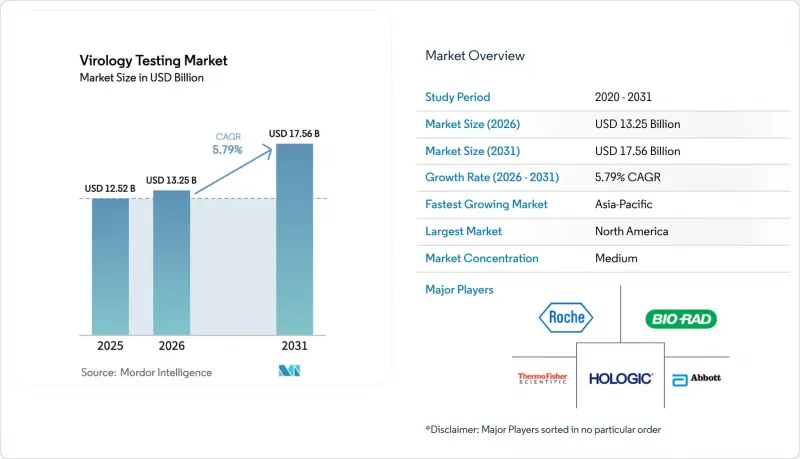
Mordor Intelligence에 의하면, 바이러스 검사 시장 규모는 2025년 125억 2,000만 달러에서 2026년에는 132억 5,000만 달러, 2031년까지 175억 6,000만 달러에 이를 전망이며, 2026-2031년 CAGR 5.79%를 나타낼 것으로 예측됩니다.
본 보고서는 유형(장비, 분석 키트 및 소모품), 진단 기술(분자진단법 등), 검사 환경(중앙 검사실 등), 최종 사용자(병원 및 진료소, 진단실험실 등), 지역(북미, 유럽, 아시아태평양, 중동 및 아프리카, 남미)별로 분류되어 있습니다. 시장 전망은 금액(달러) 기준으로 제시되어 있습니다.
세계 바이러스 검사 시장 동향 및 인사이트
바이러스성 질환 유병률 증가
2024년부터 2025년에 걸쳐 미국에서 61건의 인간 H5N1 감염 사례가 발생한 것과 같은 집단 발병으로 인해, 각 주의 검사 기관은 PCR 검사 역량 확충을 서둘러야 했습니다. 중앙아프리카에서 Mpox 클라드 Ib가 검출되면서 WHO는 긴급사태를 선포했고, 이로 인해 실시간 PCR 도입이 가속화되었습니다. 이집트의 C형 간염 근절 노력 등 장기적인 프로그램에서는 바이러스 부하 검사가 정기적으로 실시되고 있습니다. 이러한 임상 및 공중보건상의 요구가 병행되고 있기 때문에 하드웨어 교체 없이 새로운 표적에 대응할 수 있는 유연성이 높은 멀티플렉스 시스템에 대한 수요가 유지되고 있습니다. 아시아태평양 및 사하라 이남 아프리카의 높은 인구 밀도와 접근성 확대가 검사 건수 증가를 뒷받침하고 있으며, 이는 전 세계 연평균 성장률(CAGR)을 1.2포인트 끌어올리는 요인이 되고 있습니다.
신규 분석법에 대한 규제 당국의 승인 증가
FDA의 ‘브레이크스루 디바이스(Breakthrough Device)’ 제도에 따라 심사 주기가 단축되었으며, 그 대표적인 사례로 QIAGEN사의 ‘QIAstat-Dx Rise’가 신속 심사를 거쳐 2025년 9월에 승인되었습니다. 유럽의 IVDR(체외진단 의료기기 규정)의 경우, 기한이 연장되었음에도 불구하고 높은 적합성 비용을 부담하기보다는 시장에서 철수하는 중소기업이 늘어나고 있어 공급업체의 통합이 진행되고 있습니다. 국제 의료기기 규제 당국 포럼(IMDRF)의 조화된 지침은 동시 신청을 장려하고 있으며, 이를 통해 전 세계 시장 출시가 가속화되어 선진국 시장의 연평균 성장률(CAGR)에 0.9%를 더하고 있습니다.
엄격한 제품 승인 규제
IVDR 준수 비용은 기기군당 50만 유로를 초과할 수 있으며, 인증 기관의 수용 능력이 30개 기관으로 제한되어 있어 승인을 기다리는 대기 기간이 1년에 달하고 있습니다. 인도는 2024년에 현지 검증 규정을 채택함에 따라 상황이 더욱 복잡해지고 있습니다. 중소규모의 검사 키트 제조업체들이 EU 시장에서 철수함에 따라 검사 항목의 다양성이 줄어들었고, 이행 기간 동안 연평균 성장률(CAGR)은 0.5포인트 하락했습니다.
부문 분석
기기 시장은 2031년까지 연평균 6.76%의 속도로 성장하여, 전체 바이러스 검사 시장의 성장률을 상회할 전망입니다. 병원에서는 인력 부족을 해소하고 검사 결과 회신 시간을 단축하기 위해 로슈(Roche)사의 ‘cobas 5800’과 같은 통합형 PCR 워크셀을 도입하고 있습니다. 소모품은 2025년에도 매출의 62.46%를 차지하며, 지속적인 매출을 통해 바이러스 검사 시장 규모를 지탱하고 있습니다. 한편, 장비는 50%-60%의 매출 총이익률을 자랑하며, 서비스 계약을 통한 정기적인 수익을 창출함으로써 벤더 락인을 촉진하고 있습니다. 유럽 공공 부문의 예산 상한선이 도입을 억제하고 있지만, 자동화의 필요성으로 인해 이 하위 부문은 더 빠른 성장 궤도를 유지하고 있습니다.
폐수 검사 프로그램 및 만성 질환 모니터링으로 인해 검사량이 확대됨에 따라, 2031년까지 소모품이 매출의 대부분을 차지할 것으로 전망됩니다. 그럼에도 불구하고, 자본 예산 측면에서는 단일 섀시로 호흡기 질환, 성매개감염(STI), 혈액 매개 질환 검사 대상을 처리할 수 있는 멀티패널 PCR 시스템이 우선시되고 있어, 장비 시장의 성장은 여전히 활발합니다. 검증 비용과 직원 교육의 어려움이 전환의 장벽이 되어 기존 벤더에게 유리하게 작용하고 있습니다.
분자진단법은 2025년 매출의 49.26%를 차지하며 연평균 6.67%의 속도로 성장하여, 바이러스 검사 시장 점유율을 더 높은 복잡도의 검사로 이끌어 갈 전망입니다. PCR은 여전히 핵심을 이루고 있으며, Xpert Bordetella pertussis와 같은 CLIA 면제 카트리지를 통해 그 입지가 강화되고 있습니다.
시퀀싱 비용의 하락(일루미나사의 NextSeq 1000/2000 기준 검체당 200-300달러)으로 인해, 일상적인 집단 발병 대응에 있어 NGS를 활용한 감시 체계가 현실적인 선택지로 떠오르고 있습니다. 분자진단 플랫폼의 가격 하락에 따라 검사 소요 시간이 단축됨에 따라, 면역 분석법 시장 점유율은 축소되고 있습니다. 바이러스 검사에서 질량 분석법은 틈새 분야에 머무르고 있으며, 배양 기술은 여전히 참조 실험실로 한정되어 있습니다.
지역별 분석
아시아태평양은 인프라에 대한 급속한 투자와 감염병 부담이 크다는 점 때문에 2025년 매출의 40.23%를 북미가 계속 차지할 것으로 예상되지만, 이 지역이 가장 빠른 성장을 이룰 것으로 전망됩니다. 중국의 국내 기업들은 저렴한 가격을 무기로 입찰에서 승리하고 있는 반면, 인도에서는 2027년까지 1,000곳의 지역 단위 PCR 검사 시설이 구축될 예정입니다. 호주의 전국적인 폐수 네트워크는 임상 사이클 외의 정책 주도형 수요를 보여주는 좋은 예입니다.
2025년 매출의 약 4분의 1을 차지하는 유럽에서는 IVDR(체외진단용 의료기기 규정) 준수 비용이 장벽으로 작용하여, 이로 인해 중소 공급업체가 시장에서 배제되고 장비 라인업은 축소되는 반면, 대형 플랫폼으로의 교체 수요는 견조한 추세를 보이고 있습니다. 독일과 프랑스에서 일괄 구매를 통한 가격 협상이 평균 판매 가격(ASP)을 억제하는 요인으로 작용하고 있습니다.
중동 및 아프리카에서는 신속한 대응을 요구하는 규제에 부응하기 위해 지역 허브를 확대하고 있지만, 기부자의 자금 삭감으로 인해 사하라 이남 아프리카의 HIV 검사 지속성이 위협받고 있습니다. 남미에서는 민관 협력을 통해 검사 역량을 확충하고 있지만, 환율 변동이 시약 수입을 방해하여 성장을 둔화시키고 있습니다.
기타 혜택:
- 엑셀 형식 시장 예측(ME) 시트
- 3개월간 애널리스트 지원
자주 묻는 질문
목차
제1장 서론
제2장 조사 방법
제3장 주요 요약
제4장 시장 구도
제5장 시장 규모와 성장 예측
제6장 경쟁 구도
제7장 시장 기회와 향후 전망
LSH 26.09.14According to Mordor Intelligence, the virology testing market size is expected to increase from USD 12.52 billion in 2025 to USD 13.25 billion in 2026 and reach USD 17.56 billion by 2031, growing at a CAGR of 5.79% over 2026-2031.
This report is Segmented by Type (Instruments, Assay Kits & Consumables), Diagnostic Technique (Molecular Diagnostics Method, and More), Testing Setting (Centralized Laboratories, and More), End User (Hospitals and Clinics, Diagnostic Laboratories, and More), and Geography (North America, Europe, Asia-Pacific, Middle East and Africa, South America). The Market Forecasts are Provided in Terms of Value (USD).
Global Virology Testing Market Trends and Insights
Rising Prevalence of Viral Diseases
Outbreaks such as 61 U.S. human H5N1 cases in 2024-2025 pressed state labs to expand PCR capacity. Mpox clade Ib detections in Central Africa triggered WHO emergency declarations that accelerated real-time PCR rollouts. Chronic programs, for example Egypt's hepatitis C elimination effort, maintain repeat viral-load testing. These parallel clinical and public-health needs sustain demand for flexible multiplex systems that accept new targets without hardware replacement. Dense populations and expanding access in Asia-Pacific and sub-Saharan Africa amplify volume growth, underpinning the 1.2 percentage-point lift in the global CAGR.
Growing Regulatory Clearances for Novel Assays
The FDA's breakthrough-device pathway shortened review cycles, exemplified by QIAGEN's QIAstat-Dx Rise, cleared in September 2025 after an expedited process. Europe's IVDR, despite deadline extensions, is consolidating suppliers as smaller firms exit rather than absorb high conformity costs. Harmonized guidelines from the International Medical Device Regulators Forum encourage simultaneous submissions, accelerating global launches and adding 0.9 percentage points to the CAGR in developed markets.
Stringent Product-Approval Regulations
IVDR compliance costs can top EUR 500,000 per device family, and notified-body capacity is limited to 30 organizations, creating year-long approval queues. India adopted local-validation rules in 2024, adding further complexity. Smaller assay makers are leaving the EU, narrowing menu variety and shaving 0.5 percentage points off CAGR during the transition.
Other drivers and restraints analyzed in the detailed report include:
- Rapid Adoption of Molecular POC PCR Platforms
- Expansion of Wastewater-Based Viral Surveillance
- Reimbursement & Pricing Reforms in Key Markets
For complete list of drivers and restraints, kindly check the Table Of Contents.
Segment Analysis
Instruments will climb at a 6.76% pace to 2031, outstripping the overall virology testing market. Hospitals are buying integrated PCR workcells such as Roche's cobas 5800 to overcome staffing gaps and compress turnaround. Consumables still generated 62.46% of 2025 revenue, anchoring the virology testing market size with recurring sales. Instruments, however, carry 50%-60% gross margins and deliver service-contract annuities, fostering vendor lock-in. Public-sector budget caps in Europe temper adoption, but automation imperatives keep the sub-segment on a faster trajectory.
Consumables will continue to dominate revenue through 2031 as wastewater programs and chronic-disease monitoring lift test volumes. Even so, capital budgets are prioritizing multi-panel PCR systems that accept respiratory, STI and bloodborne targets on a single chassis, keeping instrument growth lively. Validation costs and staff-training hurdles create switching friction that benefits established vendors.
Molecular methods captured 49.26% of 2025 dollars and will advance at a 6.67% clip, steering the virology testing market share toward higher-complexity assays. PCR remains the backbone, bolstered by CLIA-waived cartridges like Xpert Bordetella pertussis.
Falling sequencing costs-USD 200-300 per sample on Illumina's NextSeq 1000/2000-are making NGS surveillance feasible for routine outbreak response. Immunoassays lose ground as molecular platforms match turnaround speed at declining prices. Mass-spectrometry stays niche for viral work, and culture techniques remain isolated to reference labs.
Complete Report Scope:
- By Type
- Instruments
- Assay Kits & Consumables
- By Diagnostic Technique
- Molecular Diagnostics Method
- PCR-based Methods
- NGS-based Methods
- Immunoassay-based Method
- Mass-Spectrometry-based Method
- Others
- Molecular Diagnostics Method
- By Testing Setting
- Centralized Laboratories
- Point-of-Care Testing
- At-Home and Self-Testing
- By End User
- Hospitals and Clinics
- Diagnostic Laboratories
- Public Health and Surveillance Agencies
- Others
- By Geography
- North America
- United States
- Canada
- Mexico
- Europe
- Germany
- United Kingdom
- France
- Italy
- Spain
- Rest of Europe
- Asia-Pacific
- China
- Japan
- India
- Australia
- South Korea
- Rest of Asia-Pacific
- Middle East and Africa
- GCC
- South Africa
- Rest of Middle East and Africa
- South America
- Brazil
- Argentina
- Rest of South America
- North America
Geography Analysis
Asia-Pacific's rapid infrastructure spend and infectious-disease burden position the region for the fastest ascent, even as North America continues to supply 40.23% of 2025 sales. China's domestic firms leverage lower pricing to win tenders, while India deploys 1,000 district-level PCR labs by 2027. Australia's nationwide wastewater network exemplifies policy-driven demand outside clinical cycles.
Europe, holding roughly one-quarter of 2025 revenue, is constrained by IVDR compliance costs that push smaller vendors out, narrowing instrument menus but solidifying demand for big-platform replacements. Bulk-purchase price deals in Germany and France hold down ASPs.
Middle East and Africa expand regional hubs to meet fast-response regulations, yet donor-funding cuts threaten sub-Saharan HIV testing continuity. South America adds capacity via public-private deals, but foreign-exchange swings hamper reagent imports, moderating growth.
- Abbott Laboratories
- Becton Dickinson & Co.
- bioMerieux
- Bio-Rad Laboratories
- Cepheid
- Danaher (Cepheid)
- Diasorin SpA
- Roche
- Fujirebio Diagnostics
- GenMark Diagnostics
- Hologic
- Illumina
- QIAGEN
- QuidelOrtho Corp.
- Revvity (PerkinElmer)
- Seegene
- Siemens Healthineers
- Thermo Fisher Scientific
- Trinity Biotech
Additional Benefits:
- The market estimate (ME) sheet in Excel format
- 3 months of analyst support
TABLE OF CONTENTS
1 Introduction
- 1.1 Study Assumptions & Market Definition
- 1.2 Scope of the Study
2 Research Methodology
3 Executive Summary
4 Market Landscape
- 4.1 Market Overview
- 4.2 Market Drivers
- 4.2.1 Rising prevalence of viral diseases
- 4.2.2 Growing regulatory clearances for novel assays
- 4.2.3 Rapid adoption of molecular POC PCR platforms
- 4.2.4 Expansion of wastewater-based viral surveillance
- 4.2.5 AI-driven automated laboratory workflows
- 4.2.6 Government stockpiling of multi-pathogen panels
- 4.3 Market Restraints
- 4.3.1 Stringent product-approval regulations
- 4.3.2 Reimbursement & pricing reforms in key markets
- 4.3.3 Donor-funding cuts disrupting LMIC HIV testing
- 4.3.4 Global shortage of skilled molecular technologists
- 4.4 Value / Supply-Chain Analysis
- 4.5 Regulatory Landscape
- 4.6 Technological Outlook
- 4.7 Porter's Five Forces Analysis
- 4.7.1 Threat of New Entrants
- 4.7.2 Bargaining Power of Buyers / Consumers
- 4.7.3 Bargaining Power of Suppliers
- 4.7.4 Threat of Substitute Products
- 4.7.5 Intensity of Competitive Rivalry
5 Market Size & Growth Forecasts (Value, USD)
- 5.1 By Type
- 5.1.1 Instruments
- 5.1.2 Assay Kits & Consumables
- 5.2 By Diagnostic Technique
- 5.2.1 Molecular Diagnostics Method
- 5.2.1.1 PCR-based Methods
- 5.2.1.2 NGS-based Methods
- 5.2.2 Immunoassay-based Method
- 5.2.3 Mass-Spectrometry-based Method
- 5.2.4 Others
- 5.2.1 Molecular Diagnostics Method
- 5.3 By Testing Setting
- 5.3.1 Centralized Laboratories
- 5.3.2 Point-of-Care Testing
- 5.3.3 At-Home and Self-Testing
- 5.4 By End User
- 5.4.1 Hospitals and Clinics
- 5.4.2 Diagnostic Laboratories
- 5.4.3 Public Health and Surveillance Agencies
- 5.4.4 Others
- 5.5 By Geography
- 5.5.1 North America
- 5.5.1.1 United States
- 5.5.1.2 Canada
- 5.5.1.3 Mexico
- 5.5.2 Europe
- 5.5.2.1 Germany
- 5.5.2.2 United Kingdom
- 5.5.2.3 France
- 5.5.2.4 Italy
- 5.5.2.5 Spain
- 5.5.2.6 Rest of Europe
- 5.5.3 Asia-Pacific
- 5.5.3.1 China
- 5.5.3.2 Japan
- 5.5.3.3 India
- 5.5.3.4 Australia
- 5.5.3.5 South Korea
- 5.5.3.6 Rest of Asia-Pacific
- 5.5.4 Middle East and Africa
- 5.5.4.1 GCC
- 5.5.4.2 South Africa
- 5.5.4.3 Rest of Middle East and Africa
- 5.5.5 South America
- 5.5.5.1 Brazil
- 5.5.5.2 Argentina
- 5.5.5.3 Rest of South America
- 5.5.1 North America
6 Competitive Landscape
- 6.1 Market Concentration
- 6.2 Market Share Analysis
- 6.3 Company Profiles (includes Global-level Overview, Market-level Overview, Core Segments, Financials, Strategic Info, Market Rank/Share, Products & Services, Recent Developments)
- 6.3.1 Abbott Laboratories
- 6.3.2 Becton Dickinson & Co.
- 6.3.3 bioMerieux SA
- 6.3.4 Bio-Rad Laboratories Inc.
- 6.3.5 Cepheid
- 6.3.6 Danaher (Cepheid)
- 6.3.7 Diasorin SpA
- 6.3.8 F. Hoffmann-La Roche AG
- 6.3.9 Fujirebio Diagnostics Inc.
- 6.3.10 GenMark Diagnostics
- 6.3.11 Hologic Inc.
- 6.3.12 Illumina Inc.
- 6.3.13 Qiagen
- 6.3.14 QuidelOrtho Corp.
- 6.3.15 Revvity (PerkinElmer)
- 6.3.16 Seegene Inc.
- 6.3.17 Siemens Healthineers
- 6.3.18 Thermo Fisher Scientific Inc.
- 6.3.19 Trinity Biotech
7 Market Opportunities & Future Outlook
- 7.1 White-space & Unmet-Need Assessment