|
시장보고서
상품코드
2125300
동기 모터 : 시장 점유율 분석, 업계 동향 및 통계, 성장 예측(2026-2031년)Synchronous Motor - Market Share Analysis, Industry Trends & Statistics, Growth Forecasts (2026 - 2031) |
||||||
 Mordor Intelligence
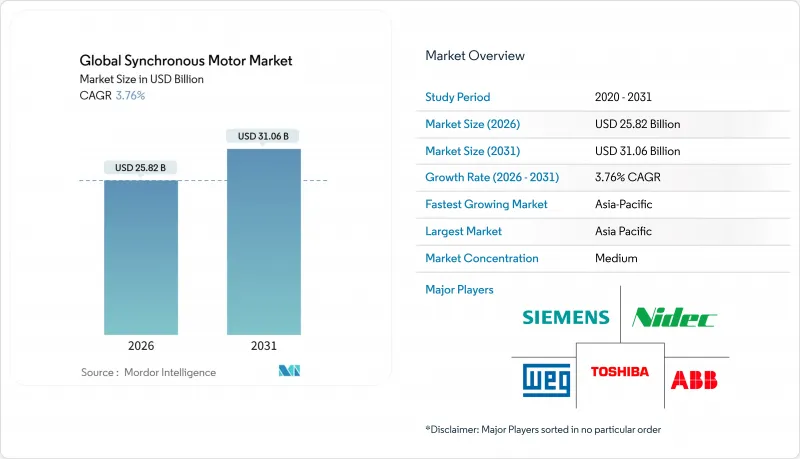
Mordor Intelligence에 의하면, 동기 모터 시장 규모는 2026년에 258억 2,000만 달러에 달하고, 2031년까지 310억 6,000만 달러에 이를 것으로 예상되며, 예측 기간 CAGR 3.76%를 나타낼 것으로 전망됩니다.
본 보고서는 로터 구조(직류 자석식, 영구 자석식 등), 정격 출력(1MW 이하, 1-10MW, 10MW 초과), 최종 사용자 산업(석유 및 가스,화학제품 및 석유화학제품, 발전 등), 용도(펌프, 압축기, 팬·블로어, 컨베이어·호이스트 등), 지역별로 분류되어 있습니다. 시장 예측은 금액(달러) 기준으로 제시되어 있습니다.
세계의 동기 모터 시장 동향 및 인사이트
엄격한 IE3/IE4 에너지 효율 기준
IEC 60034-30-1에 규정되어 있으며, 유럽연합(EU)의 에코디자인 규정 2019/1781에 포함된 효율 규제로 인해 조달 사양이 엄격해짐에 따라,구매자들은 구리 로터의 복잡성 없이도 IE4·IE5 등급을 쉽게 달성할 수 있는 동기식 기술로 전환하고 있습니다. 중국도 2025년에 GB 18613-2020에 따라 유사한 획기적인 조치를 시행하여, 현지 OEM의 생산 능력 확대를 촉진하는 동시에 구형 유도 전동기의 교체를 가속화하고 있습니다. 에너지 지출이 총 운영 비용의 40%를 초과하는 유틸리티 및 산업 사업자들은 현재, 규제 준수를 목적으로 한 개조를 통해 3년 이내에 투자 회수가 가능하다는 점을 인식하고 있으며, 이는 상수도 유틸리티 및 석유화학 플랜트 전반에 걸쳐 지속적인 업그레이드 주기를 촉진하고 있습니다. 시장 전체적으로 볼 때, 이러한 규제로 인해 기준 판매량과 고효율 제품의 가격대가 모두 확대되면서 동기 모터 시장이 활성화되고 있습니다.
HVAC 및 산업용 자동화의 확대
ASHRAE 표준 90.1-2022 등의 건축 기준 개정에 따라 10마력을 초과하는 모터에는 가변 속도 제어가 의무화되었으며, 연중 대부분의 기간 동안 부분 부하로 가동되는 옥상형 공조기나 칠러에서 동기 모터가 최적의 선택지로 자리 잡고 있습니다. 2025년에 댄포스(Danfoss)와 트레인(Train)이 출시한 장비는 동기 릴랙턴스 로터와 지능형 드라이브를 통합하고 있으며, 현장 시험을 통해 15%-25%의 전력 절감 효과가 입증되었습니다. 또한, 공장 자동화 분야에서도 Siemens Sinamics S210과 같은 엣지 연결형 드라이브를 통해 급속 가속, 회생 제동, 예측 유지보수 분석을 가능하게 하는 서보 등급의 동기 모터에 의해 병행하여 이점이 제공되고 있습니다. 이러한 HVAC와 자동화의 시너지 효과로 인해 상업용 빌딩 및 이산 제조 분야 모두에서 동기 모터 시장 점유율이 확대되고 있습니다.
영구자석 로터의 높은 초기 비용
영구 자석 동기 모터는 유도 모터에 비해 20%-40%의 가격 프리미엄이 붙습니다. 이는 자본 예산이 빠듯하고 투자 회수 기간이 3년 미만으로 예상되는 신흥 시장에서 더욱 두드러집니다. 네오디뮴·프라세오디뮴 산화물의 현물 가격은 변동이 심하며, 2025년에는 1미터톤당 4만 8,000-6만 8,000달러에 달했는데, 이는 소결 자석 1Kg당 8-12달러에 해당하며, 모든 고성능 모터의 부품 원가를 상승시키고 있습니다. 그 결과, 지방자치단체의 유틸리티체나 중소 제조업체들은 장기적인 에너지 절감 효과를 기대할 수 있음에도 불구하고 교체를 미루고 있어, 동기 모터 시장의 단기적인 판매량 확대를 둔화시키고 있습니다.
부문별 분석
2025년 매출액에서 영구자석 로터는 47.80%의 점유율을 유지했으며, 그 밀도가 비용 대비 높은 토크 용도 및 트랙션 용도의 기반이 되고 있습니다. 그러나 ABB사의 IE5 및 향후 출시 예정인 IE6 제품 라인, 그리고 Regal Rexnord사의 지적 재산을 통합한 WEG사의 2025년 출시된 W50 플랫폼에 힘입어, 유도형 모터의 설계는 연평균 성장률(CAGR) 11.80%를 나타낼 것으로 예측됩니다. 유럽의 IE5 규제 추진과 희토류 공급 부족이 맞물리면서, 펌프, 팬, 압축기에서 자석을 사용하지 않거나 페라이트를 보조적으로 사용하는 옵션에 대한 수요가 증가하고 있습니다. 직류 자석기는 계자 권선의 유연성으로 인해 무효 전력 및 전압의 안정화가 가능하기 때문에 수력 양수 발전 및 선박 추진 분야에서 여전히 중요한 역할을 하고 있습니다. 히스테리시스식 로터는 매우 부드러운 토크가 중시되는 정밀 실험 기기 및 계측 장치용으로 제공되고 있으며, 틈새 시장에 머물러 있습니다.
릴랙턴스 모터의 채택 추세는 특히 아시아태평양과 유럽에서 두드러지며, 이 지역의 OEM 기업들은 영구자석식과 동등한 제품에 비해 리드 타임 단축과 20% 이상의 단가 절감을 실현하고 있다고 보고하고 있습니다. 2024년에 실시된 IEEE 조사에 따르면, 페라이트 보조형 동기 릴랙턴스 모터의 효율이 94%를 초과하여 네오디뮴 설계와의 실용적 차이가 좁혀지고, 재료비가 약 3분의 1로 절감되는 것이 확인되었습니다. 트랙션 차량, HVAC(냉난방·환기·공조) OEM, 식품 가공업체들이 이러한 시스템을 검증함에 따라, 2031년까지 각 로터 유형 시장 점유율 균형이 재편되고, 동기 모터 시장 내에서 새로운 경쟁과 기술 로드맵이 촉진될 것입니다.
2025년 도입 대수의 38.50%를 차지하며, 1-10메가와트 대역이 주류를 이루었습니다. 이는 원심식 압축기, 칠러 구동 장치, 중규모 산업용 자동화 프로젝트와 일치합니다. 한편, 1메가와트 미만 등급의 경우 분산형 제조, 모듈식 수처리, 식품 가공 설비 업그레이드를 원동력으로 연평균 성장률(CAGR) 10.40%를 나타낼 것으로 예측됩니다. 이러한 분야에서는 모터를 최적화하여 에너지 낭비를 줄일 수 있습니다. 슈나이더 일렉트릭이 2024년에 출시한 ‘Altivar Process’ 드라이브는 0.75-500kW 동기 모터와 결합하여 클라우드 기반의 예측 분석 기능을 제공함으로써, 플랜트 관리자가 가동 중지 시간을 대폭 줄일 수 있도록 지원합니다.
미국의 ‘베터 빌딩 이니셔티브(Better Building Initiative)’에 참여하고 있는 산업용 사용자들은 지나치게 큰 유도 전동기를 최적화된 동기 전동기로 교체함으로써 15%-30%의 전력 절감 효과를 달성했으며, 리베이트 프로그램을 통해 투자 회수 기간은 2년 미만으로 단축되었습니다. 10메가와트를 초과하는 모터는 풍력 터빈이나 대형 수력 발전 설비에서 여전히 널리 사용되고 있지만, 메가와트 미만 시장이 확대되고 있다는 점은 저출력 분야의 혁신이 향후 동기 모터 시장의 성장을 뒷받침할 것임을 시사합니다.
지역별 분석
아시아태평양은 2025년 매출의 34.80%를 차지했으며, 중국, 인도, 동남아시아 국가들이 최저 효율 기준을 상향 조정하고 공장 자동화를 확대함에 따라 2031년까지 연평균 성장률(CAGR) 12.10%로 성장할 전망입니다. Wolong Electric 등 중국 제조업체들은 IE3 이상 등급의 제품 생산 확대를 위해 2025년에 저장성 시설에 5억 위안(7,000만 달러)을 투자했습니다. 한편, 인도의 ‘생산 연계 인센티브(PLI)’ 제도에 따라 Kirloskar Electric은 마하라슈트라주에 연간 5만 대의 고효율 모터를 생산할 수 있는 신규 공장을 건설했습니다. 일본의 니덱(Nidec)은 중국과 유럽에서의 트랙션 모터 설계 수주 호조에 힘입어, 2024 회계연도에 동종 모터의 매출이 18% 증가했습니다.
북미와 유럽을 합치면 2025년 시장 가치의 약 45%를 차지했습니다. 미국에서는 산업 평가 센터(IAC)의 조사에 따르면, 권장되는 에너지 절약 프로젝트의 22%를 모터 시스템의 교체가 차지하고 있으며, 교체 프로젝트의 3분의 1 이상에서 동기식 기기가 지정되고 있습니다. 유럽의 ‘그린 딜 산업 계획’에서는 국내 청정 기술 제조를 지원하기 위해 30억 유로(33억 달러)가 배정되어, 폴란드와 스페인의 새로운 모터 생산 라인에 자금이 지원되었습니다. 중동에서는 해수 담수화용 대형 동기식 펌프 모터에 대한 수요가 증가하고 있지만, 이 지역 시장 점유율은 여전히 5% 미만에 그치고 있습니다.
남미는 브라질이 중심이며, WEG사의 자라과 두 술 복합 공장에서는 2024년에 200만 대 이상을 생산했고, 에너지 비용의 급등에 따라 동기식 모터의 비중이 증가했습니다. 아프리카 수요는 남아프리카와 카퍼벨트의 광업 클러스터에 집중되어 있으며, 분쇄기 및 환기 설비를 위해 ABB와 지멘스의 고출력 솔루션이 활용되고 있습니다. 각 지역을 종합적으로 살펴보면, 동기 모터 시장은 양극화된 경향을 보이고 있습니다. 성숙한 경제권에서는 고효율화를 위한 개조가 진행되는 반면, 개발도상국 시장에서는 새로운 산업화에 따라 프리미엄 등급의 동기 모터로 비약적으로 전환되고 있습니다.
기타 혜택 :
- 엑셀 형식 시장 예측(ME) 시트
- 3개월간의 애널리스트 지원
자주 묻는 질문
목차
제1장 서론
제2장 조사 방법
제3장 주요 요약
제4장 시장 구도
제5장 시장 규모 및 성장 예측
제6장 경쟁 구도
제7장 시장 기회 및 향후 전망
KTH 26.09.14According to Mordor Intelligence, the synchronous motor market size stood at USD 25.82 billion in 2026 and is projected to reach USD 31.06 billion by 2031, reflecting a 3.76% CAGR across the forecast horizon.
This report is Segmented by Rotor Construction (DC-Excited, Permanent Magnet, and More), Power Rating (<=1 MW, 1-10 MW, and >10 MW), End-User Industry (Oil and Gas, Chemicals and Petrochemicals, Power Generation, and More), Application (Pumps, Compressors, Fans and Blowers, Conveyors and Hoists, and More), and Geography. The Market Forecasts are Provided in Terms of Value (USD).
Global Synchronous Motor Market Trends and Insights
Stringent IE3/IE4 Energy-Efficiency Mandates
Efficiency regulations anchored in IEC 60034-30-1 and codified into European Union Ecodesign Regulation 2019/1781 have tightened procurement specifications, pushing buyers toward synchronous technologies that readily achieve IE4 and IE5 grades without copper-rotor complexity. China enacted a parallel leap under GB 18613-2020 during 2025, spurring local OEM capacity expansions and accelerating the replacement of legacy induction stock. Utility and industrial operators with energy expenditures above 40% of total operating cost now see compliance-driven retrofits delivering sub-three-year paybacks, fueling recurrent upgrade cycles across water utilities and petrochemical plants. Market-wide, these mandates lift the synchronous motor market by expanding both baseline volumes and premium-efficiency price points.
Expansion of HVAC and Industrial Automation
Building-code revisions such as ASHRAE Standard 90.1-2022 compel variable-speed control on motors above 10 horsepower, positioning synchronous motors as the preferred choice for rooftop units and chillers that run at part-load most of the year. Equipment launched by Danfoss and Trane in 2025 integrates synchronous reluctance rotors with intelligent drives, documenting 15%-25% electricity savings in field pilots. Parallel gains in factory automation emerge through servo-grade synchronous motors that enable rapid acceleration, regenerative braking, and predictive health analytics via edge-connected drives like Siemens Sinamics S210. These combined HVAC and automation pull-through effects widen the synchronous motor market footprint in both commercial buildings and discrete manufacturing.
High Up-Front Cost of Permanent-Magnet Rotors
Permanent-magnet synchronous units carry a 20%-40% price premium over induction counterparts, magnified in emerging markets where capital budgets are tight, and payback expectations hover under three years. Volatile spot prices for neodymium-praseodymium oxide, ranging from USD 48,000-68,000 per metric ton in 2025, translate into USD 8-12 per kilogram of sintered magnet and elevate bill-of-materials costs for every high-end motor. Municipal utilities and small manufacturers therefore defer replacements despite long-run energy savings, slowing near-term volume expansion in the synchronous motor market.
Other drivers and restraints analyzed in the detailed report include:
- Surge in Electric Vehicle and Traction Motor Demand
- Rare-Earth-Free Synchronous Reluctance Motor Momentum
- Rare-Earth Supply Volatility
For complete list of drivers and restraints, kindly check the Table Of Contents.
Segment Analysis
Permanent-magnet rotors retained 47.80% share of 2025 revenue, anchoring high-torque and traction roles where their density justifies cost. However, reluctance designs are forecast to grow at an 11.80% CAGR, driven by ABB's IE5 and forthcoming IE6 lines and WEG's 2025-launched W50 platform, which incorporates Regal Rexnord intellectual property. Europe's regulatory push toward IE5, combined with the scarcity of rare earths, is driving demand for magnet-free or ferrite-assisted options in pumps, fans, and compressors. DC-excited machines remain relevant in hydro-pumped storage and marine propulsion because their field-winding flexibility provides reactive power and voltage support. Hysteresis rotors remain niche, serving precision lab equipment and timing devices where ultra-smooth torque is prized.
Reluctance adoption momentum is especially sharp in Asia-Pacific and Europe, where OEMs report reduced lead times and 20%-plus unit-cost savings versus permanent-magnet equivalents. IEEE research during 2024 confirmed ferrite-assisted synchronous reluctance efficiencies topping 94%, narrowing any practical gulf with neodymium designs and slicing material costs by about one-third. As traction vehicles, HVAC OEMs, and food processors validate these systems, rotor-type balances will realign by 2031, driving fresh competition and technical road-maps inside the synchronous motor market.
The 1-10 megawatt band dominated with 38.50% of 2025 installations, aligning with centrifugal compressors, chiller drives, and mid-scale industrial automation projects. Yet the sub-1 megawatt class is projected to post a 10.40% CAGR, fueled by distributed manufacturing, modular water treatment, and food processing upgrades, where right-sizing motors trims energy waste. Schneider Electric's 2024 Altivar Process drive, coupled with 0.75-500 kilowatt synchronous motors, brings cloud-based predictive analytics that help plant managers slash downtime.
Industrial users participating in the United States Better Buildings Initiative logged 15%-30% power savings when oversized induction units were swapped for optimized synchronous machines, with rebate programs pulling payback under two years. While motors exceeding 10 megawatts stay entrenched in wind turbines and large hydro units, the swelling sub-megawatt base indicates that small-horsepower innovation will underpin the next leg of expansion for the synchronous motor market size.
Complete Report Scope:
- By Rotor Construction
- DC-Excited
- Permanent Magnet
- Reluctance
- Hysteresis
- By Power Rating
- <=1 MW
- 1-10 MW
- >10 MW
- By End-User Industry
- Oil and Gas
- Chemicals and Petrochemicals
- Power Generation
- Water and Wastewater
- Metals and Mining
- Food and Beverage
- Discrete Manufacturing
- HVAC and Refrigeration
- By Application
- Pumps
- Compressors
- Fans and Blowers
- Conveyors and Hoists
- Traction/Propulsion
- Other Applications
- By Geography
- North America
- United States
- Canada
- Mexico
- Europe
- Germany
- United Kingdom
- France
- Italy
- Spain
- Russia
- Rest of Europe
- Asia-Pacific
- China
- Japan
- India
- South Korea
- Australia
- Rest of Asia-Pacific
- Middle East
- Saudi Arabia
- United Arab Emirates
- Turkey
- Rest of Middle East
- Africa
- South Africa
- Nigeria
- Rest of Africa
- South America
- Brazil
- Argentina
- Rest of South America
- North America
Geography Analysis
Asia-Pacific, holding 34.80% of 2025 revenue, is on track for a 12.10% CAGR through 2031 as China, India, and Southeast Asian nations raise minimum efficiency thresholds and expand factory automation. Chinese producers such as Wolong Electric funneled CNY 500 million (USD 70 million) into Zhejiang facilities in 2025 to scale IE3 and above units, while India's Production-Linked Incentive scheme spurred Kirloskar Electric's new Maharashtra plant capable of 50,000 high-efficiency motors annually. Japan's Nidec posted 18% synchronous revenue growth in fiscal 2024, benefitting from traction-motor design wins in China and Europe.
North America and Europe combined to capture about 45% of 2025 value. In the United States, Industrial Assessment Centers documented that motor-system upgrades accounted for 22% of recommended efficiency projects, with synchronous equipment specified in more than one-third of replacements. Europe's Green Deal Industrial Plan earmarked EUR 3 billion (USD 3.3 billion) to back domestic clean-tech manufacturing, financing new motor lines in Poland and Spain. The Middle East pursues large synchronous pump motors for desalination, yet regional share stays below 5%.
South America centers on Brazil, where WEG's Jaragua do Sul complex produced more than two million units in 2024, increasingly synchronous as energy costs bite. African demand skews toward mining clusters in South Africa and the Copperbelt, leveraging ABB and Siemens high-horsepower solutions for grinding mills and ventilation. Across regions, the synchronous motor market tracks a two-tier pattern: mature economies retrofit for higher efficiency, while developing markets leapfrog directly to premium-grade synchronous options amid new industrialization.
- ABB Ltd.
- Siemens AG
- WEG S.A.
- Nidec Corporation
- Toshiba Corporation
- Mitsubishi Electric Corporation
- Regal Rexnord Corporation
- Schneider Electric SE
- General Electric Company
- TECO-Westinghouse Motor Company
- Johnson Electric Holdings Limited
- Franklin Electric Co., Inc.
- Kirloskar Electric Company Ltd.
- SEVA-tec GmbH
- Dunkermotoren GmbH
- BEN Buchele Elektromotorenwerke GmbH
- Hyosung Heavy Industries Corporation
- CG Power and Industrial Solutions Ltd.
- Hitachi Ltd.
- Motion Drivetronics Pvt. Ltd.
Additional Benefits:
- The market estimate (ME) sheet in Excel format
- 3 months of analyst support
TABLE OF CONTENTS
1 INTRODUCTION
- 1.1 Study Assumptions and Market Definition
- 1.2 Scope of the Study
2 RESEARCH METHODOLOGY
3 EXECUTIVE SUMMARY
4 MARKET LANDSCAPE
- 4.1 Market Overview
- 4.2 Market Drivers
- 4.2.1 Stringent IE3/IE4 Energy-Efficiency Mandates
- 4.2.2 Expansion of HVAC and Industrial Automation
- 4.2.3 Surge in Electric Vehicle and Traction Motor Demand
- 4.2.4 Grid-Scale Renewable Projects, Hydro-Pumped Storage
- 4.2.5 Rare-Earth-Free Synchronous Reluctance Motor Adoption Momentum
- 4.2.6 High-Speed Magnetic Bearing Micro-Turbines
- 4.3 Market Restraints
- 4.3.1 High Up-Front Cost of Permanent-Magnet Rotors
- 4.3.2 Rare-Earth Supply Volatility
- 4.3.3 Thermal-Management Limits at High Power Density
- 4.3.4 Induction-VFD Efficiency Parity Pressure
- 4.4 Industry Value Chain Analysis
- 4.5 Regulatory Landscape
- 4.6 Technological Outlook
- 4.7 Impact of Macroeconomic Factors
- 4.8 Porter's Five Forces Analysis
- 4.8.1 Threat of New Entrants
- 4.8.2 Bargaining Power of Suppliers
- 4.8.3 Bargaining Power of Buyers
- 4.8.4 Threat of Substitutes
- 4.8.5 Competitive Rivalry
5 MARKET SIZE AND GROWTH FORECASTS (VALUE)
- 5.1 By Rotor Construction
- 5.1.1 DC-Excited
- 5.1.2 Permanent Magnet
- 5.1.3 Reluctance
- 5.1.4 Hysteresis
- 5.2 By Power Rating
- 5.2.1 <=1 MW
- 5.2.2 1-10 MW
- 5.2.3 >10 MW
- 5.3 By End-User Industry
- 5.3.1 Oil and Gas
- 5.3.2 Chemicals and Petrochemicals
- 5.3.3 Power Generation
- 5.3.4 Water and Wastewater
- 5.3.5 Metals and Mining
- 5.3.6 Food and Beverage
- 5.3.7 Discrete Manufacturing
- 5.3.8 HVAC and Refrigeration
- 5.4 By Application
- 5.4.1 Pumps
- 5.4.2 Compressors
- 5.4.3 Fans and Blowers
- 5.4.4 Conveyors and Hoists
- 5.4.5 Traction/Propulsion
- 5.4.6 Other Applications
- 5.5 By Geography
- 5.5.1 North America
- 5.5.1.1 United States
- 5.5.1.2 Canada
- 5.5.1.3 Mexico
- 5.5.2 Europe
- 5.5.2.1 Germany
- 5.5.2.2 United Kingdom
- 5.5.2.3 France
- 5.5.2.4 Italy
- 5.5.2.5 Spain
- 5.5.2.6 Russia
- 5.5.2.7 Rest of Europe
- 5.5.3 Asia-Pacific
- 5.5.3.1 China
- 5.5.3.2 Japan
- 5.5.3.3 India
- 5.5.3.4 South Korea
- 5.5.3.5 Australia
- 5.5.3.6 Rest of Asia-Pacific
- 5.5.4 Middle East
- 5.5.4.1 Saudi Arabia
- 5.5.4.2 United Arab Emirates
- 5.5.4.3 Turkey
- 5.5.4.4 Rest of Middle East
- 5.5.5 Africa
- 5.5.5.1 South Africa
- 5.5.5.2 Nigeria
- 5.5.5.3 Rest of Africa
- 5.5.6 South America
- 5.5.6.1 Brazil
- 5.5.6.2 Argentina
- 5.5.6.3 Rest of South America
- 5.5.1 North America
6 COMPETITIVE LANDSCAPE
- 6.1 Market Concentration
- 6.2 Strategic Moves
- 6.3 Market Share Analysis
- 6.4 Company Profiles (includes Global level Overview, Market level overview, Core Segments, Financials as available, Strategic Information, Market Rank/Share for key companies, Products and Services, and Recent Developments)
- 6.4.1 ABB Ltd.
- 6.4.2 Siemens AG
- 6.4.3 WEG S.A.
- 6.4.4 Nidec Corporation
- 6.4.5 Toshiba Corporation
- 6.4.6 Mitsubishi Electric Corporation
- 6.4.7 Regal Rexnord Corporation
- 6.4.8 Schneider Electric SE
- 6.4.9 General Electric Company
- 6.4.10 TECO-Westinghouse Motor Company
- 6.4.11 Johnson Electric Holdings Limited
- 6.4.12 Franklin Electric Co., Inc.
- 6.4.13 Kirloskar Electric Company Ltd.
- 6.4.14 SEVA-tec GmbH
- 6.4.15 Dunkermotoren GmbH
- 6.4.16 BEN Buchele Elektromotorenwerke GmbH
- 6.4.17 Hyosung Heavy Industries Corporation
- 6.4.18 CG Power and Industrial Solutions Ltd.
- 6.4.19 Hitachi Ltd.
- 6.4.20 Motion Drivetronics Pvt. Ltd.
7 MARKET OPPORTUNITIES AND FUTURE OUTLOOK
- 7.1 White-Space and Unmet-Need Assessment