

|
시장보고서
상품코드
2125328
인실리코 임상시험 시장 : 시장 점유율 분석, 업계 동향 및 통계, 성장 예측(2026-2031년)In Silico Clinical Trials - Market Share Analysis, Industry Trends & Statistics, Growth Forecasts (2026 - 2031) |
||||||
 Mordor Intelligence
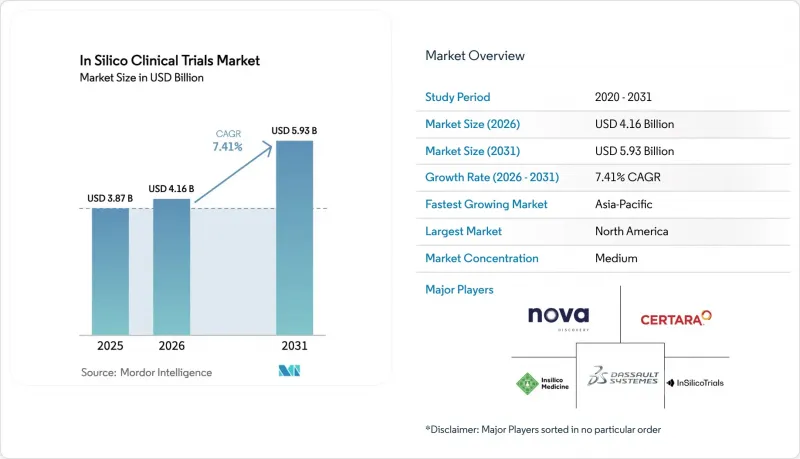
Mordor Intelligence에 의하면, 2026년 인실리코 임상시험 시장 규모는 41억 6,000만 달러로 추정되고, 2025년 38억 7,000만 달러에서 확대해, 2031년에는 59억 3,000만 달러에 이를 것으로 예측됩니다.
2026-2031년 연평균 성장률(CAGR) 7.41%로 성장할 것으로 전망됩니다.
본 보고서는 치료 분야별(종양, 감염증, 순환기, 신경 등), 산업별(제약, 의료기기, CRO), 단계별(1상, 2상, 3상, 4상·시판 후), 지역별(북미, 유럽, 아시아태평양, 중동 및 아프리카, 남미)로 분류되어 있습니다. 시장 전망은 금액(달러) 기준으로 제시되어 있습니다.
세계의 인실리코 임상시험 시장 동향 및 인사이트
In Silico 증거에 대한 규제 당국의 승인
미국 식품의약국(FDA)은 최근 계산 모델에 관한 지침을 확충하여, 검증된 가상 증거가 의료기기의 510(k) 신청 및 생물학적 제제의 IND 신청을 뒷받침할 수 있음을 확인했습니다. 유럽의 입법자들도 ‘유럽 건강 데이터 공간 규정(European Health Data Space Regulation)’을 통해 이 접근 방식을 지지하고 있으며, 이를 통해 대규모 가상 코호트에 필수적인 국경을 초월한 데이터 유통이 가능해집니다. AI로 생성된 신청 서류를 조기에 제출한 신청자들로부터 심사 기간이 단축되었습니다는 보고가 있었으며, 이는 규제 당국이 모델 기반 신청을 자원 효율적인 것으로 간주하고 있음을 시사합니다. 업계는 현재 ASME V&V의 40가지 원칙에 기반한 종단간 검증 워크플로에 투자하고 있으며, 신뢰성을 확보하기 위한 재현 가능한 프로세스를 제공합니다. 여러 관할 구역에서 규정 조화가 진행됨에 따라, 후원사들은 인실리코 임상시험 설계에 더 많은 예산을 할당할 수 있다는 자신감을 갖게 되었습니다.
제약 및 의료 기술 산업 전반에 걸친 연구개발비용 부담 증가
단일 신약을 시장에 출시하는 데 필요한 총 연구 개발 비용은 10억 달러를 초과하며, 1960년대에 비해 14배 증가했습니다. 이에 대응하여 각 기업은 수천 명의 가상 환자를 대상으로 용량-반응 곡선을 시뮬레이션할 수 있는 디지털 트윈 플랫폼에 자금을 투입하고 있으며, 이를 통해 실제 실험에 의한 스크리닝 주기를 최대 70% 단축하고 있습니다. 찰스 리버 래버러토리즈(Charles River Laboratories)나 사노피(Sanofi)와 같은 대형 제약 및 의료기기 기업의 제휴 사례에서는 가상 대조군의 도입을 통해 비용 절감을 실현하고, 통계적 검출력을 유지하면서 동물 실험을 줄이고 있습니다. 의료기기 제조업체들도 이에 동참하고 있는데, 이는 컴퓨터를 활용한 스트레스 테스트를 통해 프로토타입의 반복 시제품 제작 횟수를 줄일 수 있기 때문입니다. 이러한 경제적 효과를 합치면, 조기 도입 기업의 영업이익률을 1퍼센트 포인트 이상 끌어올리고 있습니다.
모델링 조사 기법의 표준화 지연
규제 당국은 검증을 권장하고 있지만, 단일한 세계 프레임워크에 대해서는 아직 합의에 이르지 못했습니다. 그로 인해 후원 기업은 FDA, EMA, 일본의 PMDA를 위해 병행하여 검증 패키지를 작성해야 하므로 일정이 장기화되고 있습니다. ASME V&V 40이나 TRIPOD+AI 가이드라인이 프레임워크를 제공하고는 있지만, 그 실행 방법은 치료 분야에 따라 달라져 신청 건마다 개별적인 매개변수 검증을 수행할 수밖에 없습니다. 중소 바이오테크 기업에게는 자원 측면에서 큰 부담이 되며, 평가 도구의 조화가 성숙되기 전까지는 시장으로의 광범위한 확산이 지연될 것입니다.
부문 분석
2025년, 종양 분야는 인실리코 임상시험 시장의 25.12%를 차지했으며, 이는 In Silico를 통한 용량 최적화의 혜택을 받는 다제 병용 요법에 대한 의존도를 반영합니다. 이 부문은 통계적 검출력을 확보하기 위해 대규모 합성 코호트가 필요한 종양의 유전적 이질성으로 인해 더욱 탄력을 받고 있습니다. 종양 분야의 인실리코 임상시험 시장 규모는 디지털 트윈이 적응형 설계를 주도함에 따라 2031년까지 17억 1,000만 달러에 달할 전망이며, 연평균 성장률(CAGR)은 6.78%에 이를 것으로 예측됩니다. 신경학 분야는 무제한의 가상 실험을 가능하게 하는 스탠퍼드 대학의 시각 피질 디지털 트윈에 힘입어 연평균 성장률(CAGR) 15.11%로 가장 빠르게 성장하고 있는 분야입니다. 이 두 분야 외에도, 감염증 모델에서는 AI를 활용하여 항바이러스제의 용도 변경을 신속하게 수행하고, 순환기학 디지털 트윈에서는 의료기기 이식 전략을 최적화하며, 대사성 질환 아바타에서는 인슐린 및 GLP-1의 투여량을 환자별로 최적화하고 있습니다.
가상 종양 스택에 대한 수요가 증가함에 따라, 각 CRO 기업들은 종양학에 특화된 면역 유전체 프로파일 라이브러리를 개발하여 모델 보정 소요 시간을 단축하고 있습니다. 신경학 분야의 의료 서비스 제공업체들은 뇌 오가노이드 실험에서 얻은 데이터를 활용하여 생물학적 충실도를 높이고, 가상 신경약리학의 예측 정확도를 향상시키고 있습니다. 이 두 치료 영역이 결합되어 미래의 규제 템플릿과 상업적 상환 체계의 속도를 결정하고 있습니다.
지역별 분석
북미는 명확한 FDA 지침, 풍부한 벤처 캐피탈, 그리고 강력한 슈퍼컴퓨팅 인프라 덕분에 2025년에도 46.21%의 점유율을 유지했습니다. Recursion, Tempus, Insilico Medicine 각사는 신약 개발을 위한 디지털 트윈 확장을 위해 각각 9자리 수의 자금 조달 라운드를 성공적으로 마무리하며 투자자들의 신뢰를 반영하고 있습니다. 특정 생물학적 제제에 대한 동물 실험을 폐지하겠다는 FDA의 계획이 지역 내 수요를 가속화하고 있으며, 보스턴에서 베이 에어리어에 이르는 학술 거점들이 기술의 인큐베이터 역할을 수행하고 있습니다. 캐나다는 헬스테크 스타트업 기업에 연산 크레딧을 지원하는 국가 차원의 AI 슈퍼클러스터를 통해 이 생태계를 지원하고 있습니다.
아시아태평양은 가장 빠르게 성장하는 지역으로, 2031년까지 연평균 성장률(CAGR) 12.45%를 나타낼 것으로 예측됩니다. 중국 중앙 정부는 최신 5개년 계획에서 AI를 활용한 신약 개발을 우선 과제로 삼고 있으며, 인실리코 메디신(In Silico Medicine)은 상하이를 거점으로 한 사업을 확대하기 위해 1억 1,000만 달러 규모의 시리즈 E 자금 조달을 확보했습니다. 일본 PMDA는 FDA의 모델 검증 원칙에 부합하는 지침을 발표하여 전 세계 임상시험 의뢰인의 이중 신청 절차를 간소화했습니다. 한국과 대만은 전자건강기록(EHR)의 높은 보급률을 활용하여, 실세계 데이터를 이용한 모델 조정을 위한 익명화 데이터를 제공합니다. 전반적으로 유리한 보험 급여 제도 개혁과 치료 경험이 없는 환자층이 풍부하다는 점 덕분에, 이 지역은 디지털 트윈과 간소화된 현장 시험군을 융합한 하이브리드 임상시험의 실시지로 매력적입니다.
유럽에서는 European Health Data Space 이니셔티브에 힘입어 꾸준한 진전이 나타나고 있습니다. 이 이니셔티브를 통해 회원국 전체에 걸쳐 익명화된 등록 데이터베이스가 개방될 예정입니다. 독일의 의료 데이터 통합 센터(Medical Data Integration Center)는 현재 34개 대학 병원을 연결하고 있으며, 연구자들은 심장병, 종양학, 희귀질환 데이터 세트를 담은 연합형 저장소에 접근할 수 있게 되었습니다. 지속가능성과 3R(대체·감축·개선)에 대한 노력이 비경제적인 촉진요인으로 작용하고 있습니다. 네덜란드에서는 검증된 모델이 존재하는 경우, 고위험 의료기기의 개정에 있어 이미 가상 증거(virtual evidence) 제출이 의무화되어 있습니다. 영국 규제 당국은 브렉시트 이후 AI를 활용한 신청 서류에 대한 민첩한 심사 서비스를 시범적으로 도입하여 임상 연구 분야의 주도권을 되찾고자 하고 있습니다. 이러한 움직임들이 맞물려, 유럽은 인 실리코(In Silico) 임상시험 도입 분야에서 세계 2위의 지역 클러스터로서의 입지를 공고히 하고 있습니다.
기타 혜택 :
- 엑셀 형식 시장 예측(ME) 시트
- 3개월간의 애널리스트 지원
자주 묻는 질문
목차
제1장 서론
제2장 조사 방법
제3장 주요 요약
제4장 시장 구도
제5장 시장 규모 및 성장 예측
제6장 경쟁 구도
제7장 시장 기회 및 향후 전망
AJY 26.09.15According to Mordor Intelligence, in-silico clinical trial market size in 2026 is estimated at USD 4.16 billion, growing from 2025 value of USD 3.87 billion with 2031 projections showing USD 5.93 billion, growing at 7.41% CAGR over 2026-2031.
This report is Segmented by Therapeutic Area (Oncology, Infectious Disease, Cardiology, Neurology, and More), Industry (Pharmaceutical, Medical Devices, and CROs), Phase (Phase I, Phase II, Phase III, and Phase IV & Post-Market), and Geography (North America, Europe, Asia-Pacific, The Middle East and Africa, and South America). The Market Forecasts are Provided in Terms of Value (USD).
Global In Silico Clinical Trials Market Trends and Insights
Regulatory Endorsement of In-Silico Evidence
The United States Food and Drug Administration recently broadened its computational modeling guidance, confirming that verified virtual evidence can support device 510(k) and biologic IND filings. European lawmakers echo the approach through the European Health Data Space Regulation, which enables cross-border data flows essential for large-scale virtual cohorts. Early applicants that submitted AI-generated dossiers reported shorter review cycles, signalling that regulators view model-based submissions as resource-efficient. Industry now invests in end-to-end validation workflows anchored in ASME V&V 40 principles, providing a repeatable route to credibility. As multiple jurisdictions converge on harmonised rules, sponsors gain confidence to allocate larger budgets to in-silico trial design.
Rising R&D Cost Pressure Across Pharma and Med-Tech
Total R&D expense required to bring a single novel drug to market has climbed above USD 1 billion, a 14-fold increase versus the 1960s. Companies respond by redirecting funds toward digital twin platforms that can simulate dose-response curves across thousands of virtual patients, cutting wet-lab screening cycles by up to 70%. Large pharma-device partnerships such as Charles River Laboratories and Sanofi demonstrate cost avoidance through virtual control groups, reducing animal use while maintaining statistical power. Medical-device manufacturers follow suit because computational stress testing eliminates multiple prototype iterations. Combined, these economics add more than a full percentage point to operating margins for early adopters.
Limited Standardisation of Modelling Methodologies
Regulatory agencies encourage verification but have yet to agree on a single global framework. Sponsors therefore build parallel validation packages for the FDA, EMA and Japan's PMDA, inflating timelines. While ASME V&V 40 and the TRIPOD+AI guideline provide structure, implementation varies by therapeutic area, forcing bespoke parameter checks for each filing. Smaller biotechnology firms find the resource burden heavy, which slows broader market penetration until harmonised assessment tools mature.
Other drivers and restraints analyzed in the detailed report include:
- Pandemic-Induced Digital Transformation in Clinical Development
- Accelerating Adoption of Precision Medicine and Digital Twins
- Growing HPC and Cloud Computing Accessibility
- Sustainability Mandates and 3R Animal-Reduction Policies
- Data Privacy and Interoperability Challenges
For complete list of drivers and restraints, kindly check the Table Of Contents.
Segment Analysis
Oncology held 25.12% of the in-silico clinical trial market in 2025, reflecting its dependence on multi-drug regimens that benefit from dose-optimisation in silico. The segment gains additional momentum from tumour genetic heterogeneity, which requires large synthetic cohorts to achieve statistical power. The in-silico clinical trial market size for oncology is projected to reach USD 1.71 billion by 2031, tracking a 6.78% CAGR as digital twins guide adaptive designs. Neurology is the fastest-growing discipline at a 15.11% CAGR, driven by Stanford's visual-cortex digital twin that enables unlimited virtual experimentation. Beyond these two areas, infectious-disease models use AI to repurpose antivirals quickly, cardiology twins refine device implantation strategies, and metabolic-disease avatars personalise insulin and GLP-1 dosing.
Demand for virtual oncology stacks encourages CROs to develop oncology-specific libraries of immuno-genomic profiles, reducing time to model calibration. Neurology providers leverage data from brain-organoid experiments to increase biological fidelity, making virtual neuro-pharmacology more predictive. Together, these two therapeutic areas set the pace for future regulatory templates and commercial reimbursement frameworks.
Complete Report Scope:
- By Therapeutic Area
- Oncology
- Infectious Disease
- Cardiology
- Neurology
- Diabetes
- Other Therapeutic Areas
- By Industry
- Pharmaceutical
- Medical Devices
- Contract Research Organisations (CROs)
- By Phase
- Phase I
- Phase II
- Phase III
- Phase IV & Post-Market
- Geography
- North America
- United States
- Canada
- Mexico
- Europe
- Germany
- United Kingdom
- France
- Italy
- Spain
- Rest of Europe
- Asia-Pacific
- China
- Japan
- India
- Australia
- South Korea
- Rest of Asia-Pacific
- Middle East & Africa
- GCC
- South Africa
- Rest of Middle East & Africa
- South America
- Brazil
- Argentina
- Rest of South America
- North America
Geography Analysis
North America retained 46.21% share in 2025 thanks to clear FDA guidance, extensive venture capital and strong supercomputing infrastructure. Recursion, Tempus and Insilico Medicine each raised nine-figure rounds to scale drug-discovery digital twins, reflecting investor confidence. The agency's plan to discontinue animal tests for certain biologics accelerates local demand, and academic hubs from Boston to the Bay Area serve as technology incubators. Canada supports the ecosystem with national AI superclusters that subsidise compute credits for health-tech startups.
Asia-Pacific is the fastest-growing region, expected to log a 12.45% CAGR through 2031. China's central government prioritises AI drug discovery under its latest Five-Year Plan, and Insilico Medicine secured USD 110 million Series E funding to expand Shanghai-based operations. Japan's PMDA issued guidance that aligns with FDA model-validation tenets, streamlining dual submissions for global sponsors. Korea and Taiwan leverage robust electronic health-record penetration to furnish de-identified data for real-world model tuning. Overall, favourable reimbursement reforms and large treatment-naive patient pools make the region an attractive site for hybrid trials that merge digital twins with streamlined physical arms.
Europe advances steadily, supported by the European Health Data Space initiative that will open anonymised registries across member states. Germany's Medical Data Integration Center now connects 34 university hospitals, giving researchers access to a federated repository for cardiac, oncology and rare disease datasets. Sustainability and 3R ambitions add non-economic drivers; the Netherlands already mandates virtual evidence for high-risk device revisions when validated models exist. UK regulators, post-Brexit, pilot an agile review service for AI-augmented dossiers, aiming to recapture clinical-research leadership. Together these moves solidify Europe as the second-largest regional cluster for in-silico clinical trial adoption.
- Dassault Systemes
- Certara
- InSilicoTrials Technologies
- Novadiscovery
- Insilico Medicine
- Clarivate
- GNS Healthcare
- Immunetrics
- Evotec
- Abzena
- Simulation Plus
- Ansys
- Virtonomy
- Schrdinger
- Altair Engineering
- Physiomics Plc
- Voxel Pharma
- Concentra Analytics
- IBM Research (DeepQ)
- QSP Insights
Additional Benefits:
- The market estimate (ME) sheet in Excel format
- 3 months of analyst support
TABLE OF CONTENTS
1 Introduction
- 1.1 Study Assumptions & Market Definition
- 1.2 Scope of the Study
2 Research Methodology
3 Executive Summary
4 Market Landscape
- 4.1 Market Overview
- 4.2 Market Drivers
- 4.2.1 Regulatory Endorsement of In Silico Evidence
- 4.2.2 Rising R&D Cost Pressure Across Pharma and Medtech
- 4.2.3 Pandemic-Induced Digital Transformation in Clinical Development
- 4.2.4 Accelerating Adoption Of Precision Medicine and Digital Twins
- 4.2.5 Growing HPC and Cloud Computing Accessibility
- 4.2.6 Sustainability Mandates and 3R Animal Reduction Policies
- 4.3 Market Restraints
- 4.3.1 Limited Standardization of Modeling Methodologies
- 4.3.2 Data Privacy and Interoperability Challenges
- 4.3.3 Insufficient Validation Frameworks Across Regions
- 4.3.4 Talent Shortage In Quantitative Systems Pharmacology
- 4.4 Regulatory Landscape
- 4.5 Porter's Five Forces Analysis
- 4.5.1 Threat Of New Entrants
- 4.5.2 Bargaining Power Of Buyers
- 4.5.3 Bargaining Power Of Suppliers
- 4.5.4 Threat Of Substitutes
- 4.5.5 Competitive Rivalry
5 Market Size & Growth Forecasts (Value, USD)
- 5.1 By Therapeutic Area
- 5.1.1 Oncology
- 5.1.2 Infectious Disease
- 5.1.3 Cardiology
- 5.1.4 Neurology
- 5.1.5 Diabetes
- 5.1.6 Other Therapeutic Areas
- 5.2 By Industry
- 5.2.1 Pharmaceutical
- 5.2.2 Medical Devices
- 5.2.3 Contract Research Organisations (CROs)
- 5.3 By Phase
- 5.3.1 Phase I
- 5.3.2 Phase II
- 5.3.3 Phase III
- 5.3.4 Phase IV & Post-Market
- 5.4 Geography
- 5.4.1 North America
- 5.4.1.1 United States
- 5.4.1.2 Canada
- 5.4.1.3 Mexico
- 5.4.2 Europe
- 5.4.2.1 Germany
- 5.4.2.2 United Kingdom
- 5.4.2.3 France
- 5.4.2.4 Italy
- 5.4.2.5 Spain
- 5.4.2.6 Rest of Europe
- 5.4.3 Asia-Pacific
- 5.4.3.1 China
- 5.4.3.2 Japan
- 5.4.3.3 India
- 5.4.3.4 Australia
- 5.4.3.5 South Korea
- 5.4.3.6 Rest of Asia-Pacific
- 5.4.4 Middle East & Africa
- 5.4.4.1 GCC
- 5.4.4.2 South Africa
- 5.4.4.3 Rest of Middle East & Africa
- 5.4.5 South America
- 5.4.5.1 Brazil
- 5.4.5.2 Argentina
- 5.4.5.3 Rest of South America
- 5.4.1 North America
6 Competitive Landscape
- 6.1 Market Concentration
- 6.2 Market Share Analysis
- 6.3 Company Profiles (includes Global level Overview, Market level overview, Core Business Segments, Financials, Headcount, Key Information, Market Rank, Market Share, Products and Services, and analysis of Recent Developments)
- 6.3.1 Dassault Systmes
- 6.3.2 Certara
- 6.3.3 InSilicoTrials Technologies
- 6.3.4 Novadiscovery
- 6.3.5 Insilico Medicine
- 6.3.6 Clarivate
- 6.3.7 GNS Healthcare
- 6.3.8 Immunetrics
- 6.3.9 Evotec
- 6.3.10 Abzena
- 6.3.11 Simulation Plus
- 6.3.12 Ansys
- 6.3.13 Virtonomy
- 6.3.14 Schrdinger
- 6.3.15 Altair Engineering
- 6.3.16 Physiomics Plc
- 6.3.17 Voxel Pharma
- 6.3.18 Concentra Analytics
- 6.3.19 IBM Research (DeepQ)
- 6.3.20 QSP Insights
7 Market Opportunities & Future Outlook
- 7.1 White-space & Unmet-Need Assessment


