

|
시장보고서
상품코드
2125340
유럽의 액세스 제어 하드웨어 시장 : 시장 점유율 분석, 업계 동향 및 통계, 성장 예측(2026-2031년)Europe Access Control Hardware - Market Share Analysis, Industry Trends & Statistics, Growth Forecasts (2026 - 2031) |
||||||
 Mordor Intelligence
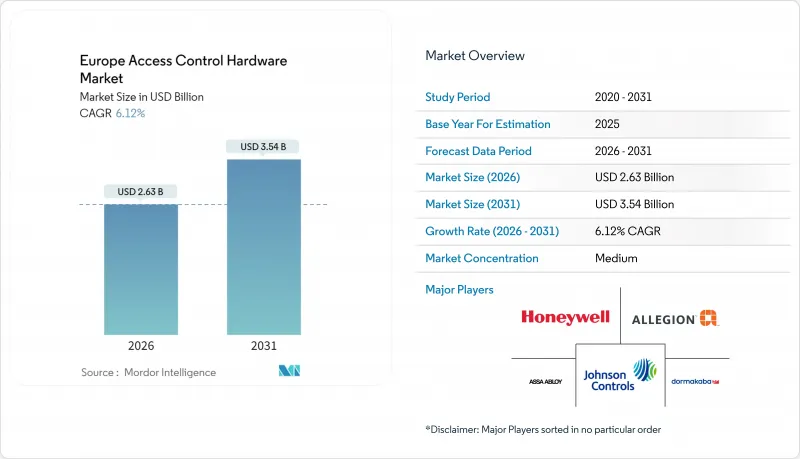
Mordor Intelligence에 의하면, 유럽의 액세스 제어 하드웨어 시장 규모는 2026년에 26억 3,000만 달러로 추정되고, 예측 기간(2026-2031년) CAGR 6.12%로 성장을 지속할 전망이며, 2031년까지 35억 4,000만 달러에 이를 전망입니다.
본 보고서는 하드웨어 유형별(리더, 잠금 장치, 컨트롤러), 인증 기술별(RFID/NFC, BLE, Wi-Fi/IP, 생체 인증), 설치 방식별(온프레미스, 스탠드얼론, 클라우드/ACaaS, 개조 키트), 최종 사용자 산업 분야별(상업, 주거, 정부 기관, 의료, 운송), 지역별로 분류되어 있습니다. 시장 예측은 금액(달러)으로 표시되어 있습니다.
유럽의 출입 통제 하드웨어 시장 동향 및 인사이트
모바일 인증 및 클라우드 네이티브 시스템으로의 급속한 전환
2025년에는 무선 도입이 유선 도입을 처음으로 추월하였고, 모바일 인증 비율은 17%에 달하여 2023년 수준의 3배가 되었습니다. 2027년까지 기업 10곳 중 9곳이 총 소유 비용(TCO)을 40% 절감하는 네이티브 클라우드 플랫폼을 통해 다중 요소 인증 요건을 충족할 것으로 예측됩니다. 유럽의 5G 보급률 30%와 RedCap 연결을 결합함으로써, 배터리 구동식 잠금 장치는 1와트 미만의 전력 소비로 실시간 로그를 전송할 수 있게 됩니다. 자본 지출을 운영 예산으로 전환하는 구독 모델이 중소기업의 도입을 촉진하는 한편, 지속가능성 목표에 따라 인증 정보 1,000건당 2.5kg의 폐기물을 발생시키는 PVC 카드의 폐지가 가속화되고 있습니다.
EU의 친환경 건물 개보수가 스마트 잠금장치 수요를 견인
지침 2024/1275에 따르면, 2029년까지 HVAC 용량이 290kW를 초과하는 비주거 시설에 자동화 및 제어 시스템 도입이 의무화되어 있으며, 상호 운용 가능한 잠금 장치가 규정 준수의 핵심 요소로 대두되고 있습니다. 스페인은 2030년까지 120만 채의 건물을 개조할 계획이며, 네트워크화된 출입 통제를 디지털 준비도 지수에 포함시키고 있습니다. 독일은 전자 잠금 장치와 재실 여부에 따른 공조 스케줄링을 결합한 공공 부문 현대화에 25억 유로(27억 5,000만 달러)를 배정했습니다. 이탈리아의 65% “슈퍼 보너스” 세액 공제나 영국의 “공공 부문 탈탄소화 계획”(18억 파운드, 22억 7,000만 달러)과 같은 보완적인 인센티브 덕분에 에너지 대시보드에 데이터를 공급하는 IP 지원 하드웨어에 대한 수요가 뒷받침되고 있습니다.
다중 요소 인증 및 사이버 보안 지원 시스템의 고액 초기 설비 투자
보안 요소와 암호화 모듈을 통합한 다중 요소 인증 패널은 단일 요소 리더기보다 60-80% 더 비싸, 중소기업의 예산을 압박하고 있습니다. 클라우드 기반 ACaaS 플랫폼은 5년간의 비용을 40% 절감할 수 있지만, 문 1개당 150-250달러의 도입 비용은 여전히 여러 거점으로의 확장에 걸림돌이 되고 있습니다. EAL6+ 인증을 획득한 생체 인증 리더기는 1대당 800달러 이상이지만, 기본적인 RFID 대체품은 120달러이므로 투자 회수 기간은 3년을 초과하게 됩니다. 1kWh당 0.15-0.20유로(0.16-0.22달러)에 달하는 급등한 전기 요금은 시스템 수명 주기 비용의 최대 70%를 에너지가 차지하기 때문에 향후 10년 동안 운영 비용을 상승시킬 것입니다.
부문 분석
2025년, 유럽의 출입 통제 하드웨어 시장에서 전자 잠금 장치 및 스마트 잠금 장치는 42.73%의 점유율을 차지했습니다. 이는 리모델링이 완료된 아파트나 상업시설에 설치하기 쉽다는 점이 뒷받침하고 있습니다. 생체 인식 리더기는 시장 규모는 작지만, GDPR(EU 개인정보보호규정)을 준수하는 의료시설 및 공공시설이 템플릿을 기기 내에 저장하는 홍채 인식 및 지문 인식 시스템을 도입함에 따라 2031년까지 연평균 성장률(CAGR) 8.03%를 나타낼 것으로 예측됩니다. 카드 리더기는 기존 시설에서 여전히 사용되고 있지만, 지속가능성에 대한 요구와 디지털 지갑의 보급으로 인해 그 중요성은 점차 낮아지고 있습니다. 현재 컨트롤러에는 엣지 프로세서가 내장되어 있어 200밀리초 이내에 대조를 완료함으로써 대역폭 사용량과 데이터 개인정보 보호 위험을 줄이고 있습니다. 2029년까지 eIDAS 인증 정보를 통합할 수 있는 NFC 지원 패널이 현장에서 계속 가동 중인 비준수 장치의 60%를 대체할 것으로 예측됩니다.
2세대 스마트 잠금 장치에는 공조 시스템을 최적화하기 위한 재실 센서도 통합되어 있습니다. 보안과 에너지 절약의 이러한 연계로 인해, 독일 연방 건축 현대화 프로그램이 자금을 지원하는 공공시설 개보수 프로젝트의 비즈니스 타당성이 강화되고 있습니다. 마찬가지로, 플러그인 방식의 BLE 및 Wi-Fi 무선 모듈을 지원하는 모듈식 설계 덕분에 시설 관리자는 전체 장치를 교체하지 않고도 새로운 인증 정보를 도입할 수 있어 자산의 노후화 주기를 연장할 수 있습니다. EAL6+ 인증을 획득한 멀티모달 생체 인식 스테이션의 가격이 800달러 이상인 반면, 신생 기업이 120달러 미만의 독립형 스마트 실린더를 출시하면서 경쟁이 치열해지고 있습니다. 하지만 NATO의 SDIP-27 암호화 요건을 준수하는 엣지 컴퓨팅 기능 업그레이드는 국방 분야 사용자들 사이에서 여전히 고가대를 유지하고 있습니다.
RFID·NFC는 정착된 카드 생태계와 물류 야드에서 선호되는 10미터의 안정적인 판독 범위를 활용하여, 2025년에도 매출의 37.53%를 계속 차지했습니다. 한편, Bluetooth Low Energy(BLE)는 스마트폰 기반 인증 방식이 프로비저닝 비용을 절감하고 관리자가 몇 초 이내에 접근 권한을 무효화할 수 있다는 점 덕분에 연평균 성장률(CAGR) 7.67%를 나타낼 것으로 예측됩니다. Wi-Fi·IP 리더기는 통합된 네트워크 관리를 필요로 하는 조직에서 사용되고 있지만, 3-5와트의 전력 소비량은 지침 2024/1275의 에너지 기준과 상충됩니다. 다중 모드 생체 인증은 높은 보안이 요구되는 용도를 위해 홍채 스캔과 정맥 스캔을 융합한 것으로, 중앙 집중식 생체 인증 데이터 저장과 관련된 GDPR(EU 개인정보보호규정)(일반 데이터 보호 규정) 집행 건수가 22% 증가함에 따라 그 보급이 가속화되고 있습니다.
최근 펌웨어 덕분에 BLE 잠금 기능은 전력 소비를 1와트 미만으로 억제할 수 있게 되었습니다. 이는 저전력 RedCap 업링크를 지원하는 유럽의 5G 보급률 30%도 한 요인으로 작용하고 있습니다. 교통 허브에서는 RFID가 주류를 이루고 있지만, 상업용 사무실과 아파트에서 BLE의 점유율이 확대되고 있는 것은 플라스틱을 사용하지 않는 인증 수단으로의 결정적인 전환을 나타냅니다. RFID의 판독 범위가 불충분한 경우, 특히 실시간 자산 추적이 필요한 창고에서 서브미터급 정밀도를 실현하는 하이브리드 솔루션으로서 초광대역(UWB) 위치 측정 기술이 부상하고 있습니다.
기타 혜택 :
- 엑셀 형식 시장 예측(ME) 시트
- 3개월간의 애널리스트 지원
자주 묻는 질문
목차
제1장 서론
제2장 조사 방법
제3장 주요 요약
제4장 시장 구도
제5장 시장 규모 및 성장 예측
제6장 경쟁 구도
제7장 시장 기회 및 향후 전망
AJY 26.09.15According to Mordor Intelligence, the Europe access control hardware market size is estimated at USD 2.63 billion in 2026, and is expected to reach USD 3.54 billion by 2031, at a CAGR of 6.12% during the forecast period (2026-2031).
This report is Segmented by Hardware Type (Readers, Locks, and Controllers), Authentication Technology (RFID/NFC, BLE, Wi-Fi/IP, and Biometrics), Installation Mode (On-Premise, Stand-Alone, Cloud/ACaaS, and Retrofit Kits), End-User Vertical (Commercial, Residential, Government, Healthcare, and Transportation), and Geography. The Market Forecasts are in Value (USD).
Europe Access Control Hardware Market Trends and Insights
Rapid Shift to Mobile-Credential and Cloud-Native Systems
Wireless deployments overtook wired installations for the first time in 2025, with mobile credentials hitting 17%, triple their 2023 level. By 2027, nine in ten enterprises are expected to satisfy multi-factor authentication requirements through native cloud platforms that trim total cost of ownership by 40%. Europe's 30% 5G penetration, coupled with RedCap connectivity, lets battery-powered locks export real-time logs while consuming under 1 watt. Subscription models that convert capital expenses into operating budgets are boosting adoption across small and medium-sized enterprises, while sustainability goals are accelerating the retirement of PVC cards that generate 2.5 kilograms of waste per 1,000 credentials.
EU Green-Building Retrofits Driving Smart-Lock Demand
Directive 2024/1275 obligates automation and control systems in non-residential facilities with HVAC capacity above 290 kilowatts by 2029, positioning interoperable locks as compliance enablers. Spain intends to refurbish 1.2 million structures by 2030, embedding networked access control within its digital readiness index. Germany earmarked EUR 2.5 billion (USD 2.75 billion) for public-sector modernizations that pair electronic locks with occupancy-driven HVAC scheduling. Complementary incentives such as Italy's 65% Superbonus credit and the United Kingdom's Public Sector Decarbonisation Scheme (GBP 1.8 billion, USD 2.27 billion) sustain demand for IP-enabled hardware that feeds energy dashboards.
High Upfront Capex for Multi-Factor, Cyber-Secure Systems
Multi-factor panels that bundle secure elements and encrypted modules cost 60-80% more than single-factor readers, straining small business budgets. Cloud ACaaS platforms can lower five-year costs by 40%, yet entrance fees of USD 150-250 per door still deter multisite roll-outs. Biometric readers certified to EAL6+ cost more than USD 800 per unit, compared with USD 120 for basic RFID alternatives, extending payback periods beyond three years. Elevated power tariffs of EUR 0.15-0.20 per kWh (USD 0.16-0.22) inflate operating costs over the decade, as energy accounts for up to 70% of system life-cycle expenses.
Other drivers and restraints analyzed in the detailed report include:
- GDPR-Driven Need for Privacy-Preserving Hardware
- Growing Adoption Amid Rising Crime and Terrorism Threats
- Legacy-System Integration Complexity Across EU Property Stock
For complete list of drivers and restraints, kindly check the Table Of Contents.
Segment Analysis
Electronic and smart locks held 42.73% of the Europe access control hardware market share in 2025, supported by ease of installation in retrofit apartments and commercial suites. Biometric readers, although smaller in base, are projected to register an 8.03% CAGR through 2031 as GDPR-compliant healthcare and public facilities adopt iris and fingerprint systems that keep templates on-device. Card readers persist in legacy estates, yet sustainability requirements and digital wallet roll-outs are eroding their relevance. Controllers now embed edge processors that complete matching in under 200 milliseconds, mitigating bandwidth use and data privacy risks. By 2029, NFC-enabled panels capable of ingesting eIDAS credentials are expected to displace 60% of non-compliant units still operating in the field.
Second-generation smart locks also integrate occupancy sensors to optimize HVAC systems. This cross-link between security and energy savings bolsters business cases in public retrofits funded by Germany's Federal Building Modernization Program. Equally, modular designs that accept plug-in BLE or Wi-Fi radios let facility managers adopt new credentials without swapping entire units, lengthening asset obsolescence cycles. Price competition heats as challengers introduce stand-alone smart cylinders for under USD 120, contrasted with USD 800 plus for multimodal biometric stations certified to EAL6+. Edge-computing upgrades nevertheless command premiums among defense users following NATO SDIP-27 encryption mandates.
RFID and NFC maintained a 37.53% revenue stake in 2025, leveraging entrenched card ecosystems and solid 10-meter read ranges favored in logistics yards. Bluetooth Low Energy, however, is projected to log a 7.67% CAGR as smartphone-based credentials shrink provisioning costs and let administrators revoke access within seconds. Wi-Fi and IP readers serve organizations seeking unified network management, but their 3-5 watt draw clashes with Directive 2024/1275 energy benchmarks. Multimodal biometrics merge iris and vein scans for high-security applications, and uptake is bolstered by the 22% rise in GDPR enforcement cases involving centralized biometric storage.
Recent firmware enables BLE locks to drop consumption below 1 watt, aided by Europe's 30% 5G penetration, which supports low-power RedCap uplinks. Although RFID dominates at transportation nodes, BLE's rising share in commercial offices and apartments signals a decisive shift toward plastic-free credentials. Ultra-wideband positioning emerges as a hybrid solution for sub-meter precision when RFID read ranges fall short, especially in warehouses that need real-time asset tracing.
Complete Report Scope:
- By Hardware Type
- Card/Proximity Readers
- Biometric Readers
- Electronic and Smart Locks
- Controllers and Panels
- By Authentication Technology
- RFID/NFC
- Bluetooth Low Energy (BLE)
- Wi-Fi/IP
- Multimodal Biometrics
- By Installation Mode
- On-premise Networked
- Stand-alone
- Cloud/ACaaS
- Retrofit Kids
- By End-User Vertical
- Commercial Offices
- Residential and Multi-Dwelling
- Government and Defense
- Healthcare
- Transportation and Logistics
- By Country
- United Kingdom
- Germany
- France
- Italy
- Spain
List of Companies Covered in this Report:
- ASSA ABLOY AB
- Dormakaba Holding AG
- Allegion plc
- Honeywell International Inc.
- Johnson Controls International plc
- Robert Bosch GmbH (Bosch Security Systems)
- Schneider Electric SE
- Axis Communications AB
- Nedap N.V.
- Identiv Inc.
- IDEMIA Group SAS
- NEC Corporation
- Suprema Inc.
- SALTO Systems S.L.
- Paxton Access Ltd.
- Genetec Inc.
- Gallagher Group Ltd.
- Brivo Inc.
- HID Global Corporation
- Axis Communications AB
Additional Benefits:
- The market estimate (ME) sheet in Excel format
- 3 months of analyst support
TABLE OF CONTENTS
1 INTRODUCTION
- 1.1 Study Assumptions and Market Definition
- 1.2 Scope of the Study
2 RESEARCH METHODOLOGY
3 EXECUTIVE SUMMARY
4 MARKET LANDSCAPE
- 4.1 Market Overview
- 4.2 Market Drivers
- 4.2.1 Growing Adoption Amid Rising Crime and Terrorism Threats
- 4.2.2 Rapid Shift To Mobile-Credential and Cloud-Native Systems
- 4.2.3 EU Green-Building Retrofits Driving Smart-Lock Demand
- 4.2.4 GDPR-Driven Need For Privacy-Preserving Hardware
- 4.2.5 Digital Id/eIDAS 2.0 Enabling Biometric Access Use-Cases
- 4.2.6 Edge-AI Readers Lowering TCO and Latency
- 4.3 Market Restraints
- 4.3.1 High Upfront Capex For Multi-Factor, Cyber-Secure Systems
- 4.3.2 Legacy-System Integration Complexity Across EU Property Stock
- 4.3.3 Supply-Chain Chip Shortages Causing Hardware Lead-Times
- 4.3.4 Energy-Price Spikes Raising Total Cost Of Ownership
- 4.4 Industry Value Chain Analysis
- 4.5 Regulatory Landscape
- 4.6 Technological Outlook
- 4.7 Porter's Five Forces Analysis
- 4.7.1 Bargaining Power of Suppliers
- 4.7.2 Bargaining Power of Buyers
- 4.7.3 Threat of New Entrants
- 4.7.4 Threat of Substitutes
- 4.7.5 Intensity of Competitive Rivalry
5 MARKET SIZE AND GROWTH FORECASTS (VALUE)
- 5.1 By Hardware Type
- 5.1.1 Card/Proximity Readers
- 5.1.2 Biometric Readers
- 5.1.3 Electronic and Smart Locks
- 5.1.4 Controllers and Panels
- 5.2 By Authentication Technology
- 5.2.1 RFID/NFC
- 5.2.2 Bluetooth Low Energy (BLE)
- 5.2.3 Wi-Fi/IP
- 5.2.4 Multimodal Biometrics
- 5.3 By Installation Mode
- 5.3.1 On-premise Networked
- 5.3.2 Stand-alone
- 5.3.3 Cloud/ACaaS
- 5.3.4 Retrofit Kids
- 5.4 By End-User Vertical
- 5.4.1 Commercial Offices
- 5.4.2 Residential and Multi-Dwelling
- 5.4.3 Government and Defense
- 5.4.4 Healthcare
- 5.4.5 Transportation and Logistics
- 5.5 By Country
- 5.5.1 United Kingdom
- 5.5.2 Germany
- 5.5.3 France
- 5.5.4 Italy
- 5.5.5 Spain
6 COMPETITIVE LANDSCAPE
- 6.1 Market Concentration
- 6.2 Strategic Moves
- 6.3 Market Share Analysis
- 6.4 Company Profiles (includes Global level Overview, Market Level Overview, Core Segments, Financials as Available, Strategic Information, Market Rank/Share for Key Companies, Products and Services, and Recent Developments)
- 6.4.1 ASSA ABLOY AB
- 6.4.2 Dormakaba Holding AG
- 6.4.3 Allegion plc
- 6.4.4 Honeywell International Inc.
- 6.4.5 Johnson Controls International plc
- 6.4.6 Robert Bosch GmbH (Bosch Security Systems)
- 6.4.7 Schneider Electric SE
- 6.4.8 Axis Communications AB
- 6.4.9 Nedap N.V.
- 6.4.10 Identiv Inc.
- 6.4.11 IDEMIA Group SAS
- 6.4.12 NEC Corporation
- 6.4.13 Suprema Inc.
- 6.4.14 SALTO Systems S.L.
- 6.4.15 Paxton Access Ltd.
- 6.4.16 Genetec Inc.
- 6.4.17 Gallagher Group Ltd.
- 6.4.18 Brivo Inc.
- 6.4.19 HID Global Corporation
- 6.4.20 Axis Communications AB
7 MARKET OPPORTUNITIES AND FUTURE OUTLOOK
- 7.1 White-space and Unmet-Need Assessment


