

|
시장보고서
상품코드
2125355
금속 분말 시장 : 시장 점유율 분석, 업계 동향 및 통계, 성장 예측(2026-2031년)Metal Powder - Market Share Analysis, Industry Trends & Statistics, Growth Forecasts (2026 - 2031) |
||||||
 Mordor Intelligence
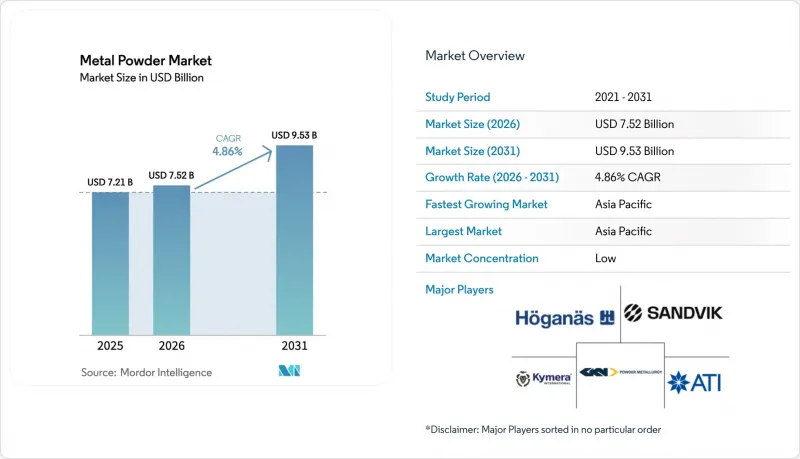
Mordor Intelligence에 의하면, 금속 분말 시장 규모는 2025년 72억 1,000만 달러로 평가되었고, 2026년 75억 2,000만 달러에서 2031년까지 95억 3,000만 달러로 확대될 것으로 예측되며, 2026-2031년 연평균 복합 성장률(CAGR)은 4.86%를 나타낼 전망입니다.
본 보고서는 유형별(철, 청동, 기타), 공정별(분무화, 화합물 환원, 전해, 기타), 제조 방법별(프레스·소결, 금속 사출 성형, 기타), 최종 사용자 산업별(운송, 전기 및 전자, 의료, 기타), 지역별(아시아태평양, 북미, 기타)로 분류되어 있습니다. 시장 전망은 금액(달러) 기준으로 제시되어 있습니다.
세계의 금속 분말 시장 동향 및 인사이트
자동차 및 항공우주 분야의 경량화 프로그램 급증
자동차 및 항공우주 제조업체들은 기어, 커넥팅로드, 브래킷, 유압 매니폴드 등의 부품에 분말 야금 기술을 채택하는 경향이 강해지고 있습니다. 이러한 변화는 차량 및 항공기의 무게를 줄일 뿐만 아니라, 수명 주기 전반에 걸친 배출량과 연료 소비량을 대폭 절감하는 결과로 이어집니다. 예를 들어, 제너럴 모터스(GM)는 전기차 플랫폼 ‘Ultium’에 프레스·소결 기어를 채택하여 20만 사이클을 넘는 피로 수명을 유지하면서 부품 경량화를 실현했습니다. 마찬가지로 에어버스는 A320neo에 알루미늄-실리콘 분말 제작 브래킷을 채택하여 경량화와 리드 타임의 대폭적인 단축을 실현했습니다. 이러한 성과로 인해 수년에 걸친 분말 공급 계약이 체결되면서, 미세 분말 생산 능력이 한계에 다다르고 있습니다. 그 결과, 2025년에는 항공우주용 알루미늄 분말 가격이 상승할 것으로 예측됩니다. CAFE 및 유로 7에 따른 규제 압력으로 경량화가 추진되는 가운데, 항공우주 인증을 취득한 분말 공급업체는 범용 철 분말 공급업체에게는 허용되지 않는 높은 이익률을 얻을 수 있을 전망입니다.
바인더 제트 방식 적층 가공의 급속한 산업화
데스크톱 메탈(Desktop Metal)사의 P-50 시스템은 바인더 제트 기술을 단순한 프로토타이핑 단계에서 본격적인 양산 단계로 끌어올렸습니다. 이러한 진보로 인해 자동차 부품 공급업체는 단품 로트에서 금속 사출 성형과 동등한 비용 효율성을 실현하여 경쟁력 있는 가격 책정이 가능해졌습니다. 중요한 지지 사례로, GE 에어로스페이스(GE Aerospace)는 RISE 엔진 프로그램에서 바인더 제트 방식으로 제조된 티타늄을 승인하며, 그 소결 밀도가 단조재를 능가한다고 지적했습니다. 분말에 대한 수요는 구형도가 높은 티타늄 원료로 점점 더 쏠리고 있지만, 이로 인해 병목 현상이 발생하고 있습니다. 고온 진공로 부족으로 인해 리드 타임이 1년까지 늘어나고 있는 것입니다. 이러한 상황은 분말 제조와 소결 능력을 모두 갖춘 수직 통합형 기업에 유리하게 작용합니다.
나노 스케일 생산 시 호흡기 및 폭발 위험성
2025년 1월, OSHA는 10µm 미만의 분말에 대해 밀폐된 환경에서의 취급과 실시간 입자 모니터링을 의무화했습니다. 이 요건으로 인해 각 생산 라인의 규정 준수 비용이 대폭 증가하고 있습니다. 한편, 유럽의 ATEX 규제로 인해 방폭용 전기 설비 및 불활성 가스 주입을 위한 개조 비용이 고액으로 책정됨에 따라, 소규모 생산 업체들은 나노 분말 생산 라인에서 철수할 수밖에 없는 상황에 처해 있습니다. 2024년에 발생한 일련의 분진 폭발 사고로 인해 보험료가 상승했습니다. 이러한 급등으로 인해 안전 투자 부담을 보다 광범위한 사업 포트폴리오 전반에 분산할 수 있는 통합형 기업으로공급 집중이 진행되고 있습니다.
부문별 분석
2025년에는 철이 44.08%의 점유율을 차지했습니다. 이는 대량 생산되는 기어, 베어링, 구조 부품에서 철이 차지하는 역할을 반영한 것이지만, 상품화(commoditization)로 인해 이익률은 계속해서 압박을 받고 있습니다. ‘기타 유형’의 경우, 정형외과용·치과용 임플란트, 초음속 시스템, 반도체의 열 관리 부품 분야에서 초고순도 분말에 대한 수요가 증가하고 있어 연평균 5.85%의 성장이 예상됩니다. 철계 분말 공급업체들은 전기차용 배터리 트레이 분야의 전동화 수요를 흡수함으로써 이익률 리스크를 헤지하고 있는 반면, 고부가가치 합금 생산업체들은 의료·방위 분야 고객과 장기 테이크-오어-페이(take-or-pay) 계약을 체결하여 가격 변동 리스크를 회피하고 있습니다.
2025년에는 아토마이징 공법이 금속 분말 시장 점유율의 69.79%를 차지했습니다. 이는 수십 년에 걸친 투자를 통해 프레스 및 소결용 철·알루미늄 분말의 저비용 생산 체제가 확립되었기 때문입니다. ‘기타 공정’은 2031년까지 연평균 성장률(CAGR) 5.38%로 확대될 것으로 전망됩니다. 이는 유동층 전해법이나 수소 환원법이 에너지 사용량을 대폭 절감하고 저품위 광석도 처리할 수 있어, 기존 아토마이징법과의 비용 격차가 줄어들고 있기 때문입니다. 아토마이징 공법을 사용하는 기존 기업들은 규모의 경제, 자사 보유 스크랩, 자동차 1차 공급업체와의 위탁 가공 계약을 활용하고 있지만, 시장 점유율을 지키기 위해 플라즈마 공법이나 수소 플라즈마 공법으로 설비를 업그레이드하는 데에도 투자하고 있습니다. 전기화학 분야의 신생 기업들은 순도나 결정 형태에 따라 프리미엄 가격이 책정되는 전자·항공우주용 티타늄, 구리, 니켈 분말에 주력하고 있으며, 소량 생산에서 비용 경쟁력이 비슷해질 때까지는 양을 앞세운 정면 대결을 피하고 있습니다. 따라서 경쟁의 치열함은 단순한 처리 능력뿐만 아니라 에너지 경제성과 원료의 유연성에 좌우될 것입니다.
지역별 분석
아시아태평양은 2025년에 금속 분말 시장 점유율의 44.26%를 차지한 것으로 평가되었으며, 2031년까지 5.48%라는 가장 높은 연평균 성장률(CAGR)을 보일 것으로 전망됩니다. 이러한 성장은 주로 중국과 인도의 노력, 특히 수소 DRI 생산 및 전기차 플랫폼 확장에 의해 주도되고 있습니다. 중국의 업계 선두주자인 바오우(Baowu)는 업스트림 공정의 스폰지 철과 물 분무법을 원활하게 통합함으로써 유럽 및 미국의 경쟁사들에 비해 상당한 비용 우위를 누리고 있습니다. 한편, 인도의 생산 연계 인센티브(PLI) 제도 덕분에 2025년에는 프레스 및 소결 생산 능력이 대폭 확대되었습니다. 일본과 한국은 다층 세라믹 커패시터용 초미세 구리·은 분말을 전문으로 하는 틈새 시장을 개척하여, 북미·남미 및 유럽에서의 수출 우위를 공고히 하고 있습니다.
북미는 항공우주, 방위, 전기차(EV) 분야의 견조한 수요에 힘입어 2025년 시장 규모의 상당 부분을 차지했습니다. 국내 티타늄 분말 생산 라인은 타이틀 III 보조금의 지원을 받았습니다. 한편, ‘인플레이션 억제법’의 첨단 제조 세액 공제는 전기차(EV)용 모터와 풍력 터빈 기어박스에 필수적인 친환경 분말의 생산을 촉진하고 있습니다. 수력 발전의 우위를 활용하여 퀘벡주의 산업 클러스터는 리오 틴토 메탈 파우더스(Rio Tinto Metal Powders)와 테크나(Tekna)와 같은 대기업을 미국 및 유럽 양측에 대한 주요 저탄소 공급업체로 자리매김하고 있습니다.
2025년에 시장 점유율이 높을 것으로 예상되는 유럽은 경차 생산이 부진해 성장에 제약을 받았습니다. 그러나 이 지역은 저탄소 분말을 우대하는 스코프 3 탈탄소화 인센티브를 통해 다시 탄력을 받고 있습니다. 호가나스(Hoganas)나 메탈리스(Metallis)와 같은 기업들은 CBAM(탄소 국경 조정 메커니즘)에 따른 관세로 수입 가격이 상승하는 가운데, 시장 주도권 확보를 목표로 수소 플라즈마 및 전해 기술 개발을 가속화하고 있습니다. 한편, 독일과 이탈리아의 중소 아토마이저 기업들은 항공우주 분야 및 고급 공구용 분말에 주력하며 전략적으로 이익률을 확보하고 있습니다. 남미, 중동 및 아프리카의 합산 시장 점유율은 작지만, 특히 브라질의 자동차 산업에 대한 의지와 사우디아라비아의 재생에너지·수소 DRI 전략 추진에 힘입어 성장 가능성이 있습니다.
기타 혜택 :
- 엑셀 형식 시장 예측(ME) 시트
- 3개월간 애널리스트 지원
자주 묻는 질문
목차
제1장 서론
제2장 조사 방법
제3장 주요 요약
제4장 시장 구도
제5장 시장 규모 및 성장 예측
제6장 경쟁 구도
제7장 시장 기회 및 향후 전망
AJY 26.09.15According to Mordor Intelligence, the metal powder market size is projected to expand from USD 7.21 billion in 2025 and USD 7.52 billion in 2026 to USD 9.53 billion by 2031, registering a CAGR of 4.86% between 2026 to 2031.
This report is Segmented by Type (Iron, Bronze, and More), Process (Atomization, Reduction of Compounds, Electrolysis, and Other Processes), Manufacturing Method (Press and Sinter, Metal Injection Molding, and More), End-User Industry (Transportation, Electrical and Electronics, Medical, and More), and Geography (Asia-Pacific, North America, and More). The Market Forecasts are Provided in Terms of Value (USD).
Global Metal Powder Market Trends and Insights
Surge in Automotive and Aerospace Lightweighting Programs
Automotive and aerospace manufacturers are increasingly turning to powder metallurgy for components like gears, connecting rods, brackets, and hydraulic manifolds. This shift not only reduces the mass of vehicles and aircraft but also leads to significant cuts in lifecycle emissions and fuel consumption. For instance, General Motors has integrated press-and-sinter gears into its Ultium electric-vehicle platform, achieving a reduction in component mass while retaining fatigue life over 200,000 cycles. Similarly, Airbus has adopted aluminum-silicon powder brackets for its A320neo, resulting in a weight reduction and a significant reduction in lead times. These achievements have paved the way for multi-year powder supply contracts, tightening atomization capacity. Consequently, prices for aerospace-grade aluminum powder are projected to rise in 2025. With regulatory pressures from CAFE and Euro 7 pushing for lightweighting, powder suppliers holding aerospace certifications stand to gain margin premiums, a privilege not extended to commodity iron-powder vendors.
Rapid Industrialization of Binder-Jet Additive Manufacturing
Desktop Metal's P-50 system has propelled binder-jet technology from mere prototyping to full-scale serial production. This advancement allows automotive suppliers to competitively price their offerings, matching the cost-efficiency of metal-injection molding for unit batches. In a significant endorsement, GE Aerospace has approved binder-jet titanium for its RISE engine program, noting a sintered density surpassing wrought materials. While the demand for powder is increasingly leaning towards a highly spherical titanium feedstock, a bottleneck emerges: a scarcity of high-temperature vacuum furnaces is extending lead times to a year. This situation is advantageous for vertically integrated firms that possess both powder and sintering capabilities.
Respiratory and Explosion Hazards in Nano-Scale Production
In January 2025, OSHA mandated enclosed handling and live particulate monitoring for powders smaller than 10 µm. This requirement has raised compliance costs significantly for each production line. Meanwhile, European ATEX regulations are pushing smaller producers away from nano-powder lines due to the high costs of retrofitting for explosion-proof electrics and inert-gas blanketing. Following a series of dust explosions in 2024, insurance premiums have increased. This spike has led to a concentration of supply among integrated players, who can spread the burden of safety investments across their broader portfolios.
Other drivers and restraints analyzed in the detailed report include:
- Electronics Densification Driving Ultra-Fine Powder Demand
- Rise of Hydrogen-Based DRI Routes Creating High-Purity Fe Powders
- Energy-Intensive Atomization Undermining Sustainability Metrics
For complete list of drivers and restraints, kindly check the Table Of Contents.
Segment Analysis
Iron accounted for a 44.08% share in 2025, reflecting its role in high-volume gears, bearings, and structural components, but commoditization continues to suppress margins. "Other Types" are forecast to grow 5.85% annually as orthopedic and dental implants, hypersonic systems, and semiconductor thermal-management parts demand ultra-clean powders. Iron suppliers hedge margin risk by capturing vehicular electrification volumes in EV battery trays, while premium-alloy producers secure long-term take-or-pay contracts with medical and defense customers that insulate pricing.
Atomization delivered 69.79% of the metal powder market share in 2025 because decades of investment locked in low-cost production for press-and-sinter iron and aluminum powders. "Other Processes" will expand at a 5.38% CAGR through 2031 as fluidized-bed electrolysis and hydrogen reduction slash energy use and accept lower-grade ores, tightening the metal powder market size cost gap versus traditional atomization. Atomization incumbents leverage scale, captive scrap, and tolling deals with automotive tier-ones, yet they invest in plasma and hydrogen-plasma upgrades to defend share. Electrochemical challengers focus on titanium, copper, and nickel powders for electronics and aerospace, where purity and morphology command premiums, avoiding head-on volume battles until cost parity approaches at smaller batch sizes. Competitive intensity, therefore, pivots on energy economics and feedstock flexibility rather than throughput alone.
Complete Report Scope:
- Type
- Iron
- Bronze
- Aluminum
- Silicon
- Nickel
- Other Types (Titanium, etc.)
- Process
- Atomization
- Reduction of Compounds
- Electrolysis
- Other Processes (Hydrometallurgical Routes, etc.)
- Manufacturing Method
- Press and Sinter (Conventional PM)
- Metal Injection Molding
- Additive Manufacturing/3D Printing
- Other Methods (Hot Isostatic Pressing, etc.)
- End-User Industry
- Transportation
- Electrical and Electronics
- Medical
- Chemical and Metallurgical
- Defense
- Construction
- Other End-User Industries (Additive Manufacturing Service Bureaus, etc.)
- Geography
- Asia-Pacific
- China
- India
- Japan
- South Korea
- Thailand
- Indonesia
- Vietnam
- Malaysia
- Philippines
- Rest of Asia-Pacific
- North America
- United States
- Canada
- Mexico
- Europe
- Germany
- United Kingdom
- France
- Italy
- Spain
- Russia
- NORDIC Countries
- Turkey
- Rest of Europe
- South America
- Brazil
- Argentina
- Colombia
- Rest of South America
- Middle-East and Africa
- Saudi Arabia
- United Arab Emirates
- Qatar
- South Africa
- Nigeria
- Egypt
- Rest of Middle-East and Africa
- Asia-Pacific
Geography Analysis
Asia-Pacific held 44.26% of the metal powder market share in 2025 and is projected to post the fastest 5.48% CAGR to 2031. This growth is largely fueled by initiatives in China and India, notably in hydrogen-DRI production and the expansion of electric vehicle platforms. Chinese industry leader Baowu is reaping significant cost advantages over Western counterparts by seamlessly integrating upstream sponge iron with water-atomization. Meanwhile, India's Production-Linked Incentive (PLI) scheme unveiled a significant boost in press-and-sinter capacity in 2025. Both Japan and South Korea have carved a niche, specializing in ultra-fine copper and silver powders tailored for multilayer ceramic capacitors, solidifying their export dominance in the Americas and Europe.
North America accounted for a substantial portion of the 2025 market volume, propelled by robust demand from the aerospace, defense, and electric vehicle sectors. Domestic titanium-powder production lines received a boost from Title III grants, while the Inflation Reduction Act's advanced-manufacturing credit is driving green-powder production, essential for EV motors and wind turbine gearboxes. Leveraging its hydropower advantage, Quebec's cluster is positioning giants like Rio Tinto Metal Powders and Tekna as prime low-carbon suppliers to both the U.S. and Europe.
Europe, holding a significant share of the market in 2025, faced growth constraints due to stagnant light-vehicle output. However, the region found momentum in scope-3 decarbonization incentives, which favor low-CO2 powders. Companies like Hoganas and Metalysis are racing ahead, fast-tracking hydrogen-plasma and electrolysis technologies, eyeing market leadership as CBAM tariffs push import prices higher. Meanwhile, smaller atomizers in Germany and Italy are honing in on aerospace and luxury tooling powders, strategically safeguarding their profit margins. Though South America and the Middle-East and Africa collectively account for a smaller portion of the market, there's potential for growth, especially with Brazil's automotive ambitions and Saudi Arabia's push towards renewables and hydrogen-DRI strategies.
- Advanced Technology & Materials Co., Ltd.
- Alcoa Corporation
- ATI
- Aubert & Duval
- BASF
- CNPC Powder
- CRS Holdings, LLC.
- Erasteel
- GKN Powder Metallurgy
- H.C. Starck Tungsten GmbH
- Hitachi High-Tech India Private Limited
- Hoganas AB
- JFE Steel Corporation
- Kymera International
- Linde Plc
- Metalysis Ltd.
- Outokumpu
- Polema
- Rio Tinto Metal Powders
- Sandvik AB
- Seiko Epson Corporation
- Tekna
- Valimet
Additional Benefits:
- The market estimate (ME) sheet in Excel format
- 3 months of analyst support
TABLE OF CONTENTS
1 Introduction
- 1.1 Study Assumptions and Market Definition
- 1.2 Scope of the Study
2 Research Methodology
3 Executive Summary
4 Market Landscape
- 4.1 Market Overview
- 4.2 Market Drivers
- 4.2.1 Surge in automotive and aerospace light-weighting programs
- 4.2.2 Rapid industrialisation of binder-jet additive manufacturing
- 4.2.3 Electronics densification driving ultra-fine powder demand
- 4.2.4 Rise of hydrogen-based DRI routes creating high-purity Fe powders
- 4.2.5 Defense-grade refractory alloys for hypersonic systems
- 4.3 Market Restraints
- 4.3.1 Respiratory and explosion hazards in nano-scale production
- 4.3.2 Quality drift in recycled feedstock streams
- 4.3.3 Energy-intensive atomisation impacting sustainability metrics
- 4.4 Value Chain Analysis
- 4.5 Porter's Five Forces
- 4.5.1 Bargaining Power of Suppliers
- 4.5.2 Bargaining Power of Buyers
- 4.5.3 Threat of New Entrants
- 4.5.4 Threat of Substitutes
- 4.5.5 Degree of Competition
5 Market Size and Growth Forecasts (Value)
- 5.1 Type
- 5.1.1 Iron
- 5.1.2 Bronze
- 5.1.3 Aluminum
- 5.1.4 Silicon
- 5.1.5 Nickel
- 5.1.6 Other Types (Titanium, etc.)
- 5.2 Process
- 5.2.1 Atomization
- 5.2.2 Reduction of Compounds
- 5.2.3 Electrolysis
- 5.2.4 Other Processes (Hydrometallurgical Routes, etc.)
- 5.3 Manufacturing Method
- 5.3.1 Press and Sinter (Conventional PM)
- 5.3.2 Metal Injection Molding
- 5.3.3 Additive Manufacturing/3D Printing
- 5.3.4 Other Methods (Hot Isostatic Pressing, etc.)
- 5.4 End-User Industry
- 5.4.1 Transportation
- 5.4.2 Electrical and Electronics
- 5.4.3 Medical
- 5.4.4 Chemical and Metallurgical
- 5.4.5 Defense
- 5.4.6 Construction
- 5.4.7 Other End-User Industries (Additive Manufacturing Service Bureaus, etc.)
- 5.5 Geography
- 5.5.1 Asia-Pacific
- 5.5.1.1 China
- 5.5.1.2 India
- 5.5.1.3 Japan
- 5.5.1.4 South Korea
- 5.5.1.5 Thailand
- 5.5.1.6 Indonesia
- 5.5.1.7 Vietnam
- 5.5.1.8 Malaysia
- 5.5.1.9 Philippines
- 5.5.1.10 Rest of Asia-Pacific
- 5.5.2 North America
- 5.5.2.1 United States
- 5.5.2.2 Canada
- 5.5.2.3 Mexico
- 5.5.3 Europe
- 5.5.3.1 Germany
- 5.5.3.2 United Kingdom
- 5.5.3.3 France
- 5.5.3.4 Italy
- 5.5.3.5 Spain
- 5.5.3.6 Russia
- 5.5.3.7 NORDIC Countries
- 5.5.3.8 Turkey
- 5.5.3.9 Rest of Europe
- 5.5.4 South America
- 5.5.4.1 Brazil
- 5.5.4.2 Argentina
- 5.5.4.3 Colombia
- 5.5.4.4 Rest of South America
- 5.5.5 Middle-East and Africa
- 5.5.5.1 Saudi Arabia
- 5.5.5.2 United Arab Emirates
- 5.5.5.3 Qatar
- 5.5.5.4 South Africa
- 5.5.5.5 Nigeria
- 5.5.5.6 Egypt
- 5.5.5.7 Rest of Middle-East and Africa
- 5.5.1 Asia-Pacific
6 Competitive Landscape
- 6.1 Market Concentration
- 6.2 Strategic Moves
- 6.3 Market Share(%)/Ranking Analysis
- 6.4 Company Profiles (includes Global level Overview, Market level overview, Core Segments, Financials as available, Strategic Information, Products and Services, Recent Developments)
- 6.4.1 Advanced Technology & Materials Co., Ltd.
- 6.4.2 Alcoa Corporation
- 6.4.3 ATI
- 6.4.4 Aubert & Duval
- 6.4.5 BASF
- 6.4.6 CNPC Powder
- 6.4.7 CRS Holdings, LLC.
- 6.4.8 Erasteel
- 6.4.9 GKN Powder Metallurgy
- 6.4.10 H.C. Starck Tungsten GmbH
- 6.4.11 Hitachi High-Tech India Private Limited
- 6.4.12 Hoganas AB
- 6.4.13 JFE Steel Corporation
- 6.4.14 Kymera International
- 6.4.15 Linde Plc
- 6.4.16 Metalysis Ltd.
- 6.4.17 Outokumpu
- 6.4.18 Polema
- 6.4.19 Rio Tinto Metal Powders
- 6.4.20 Sandvik AB
- 6.4.21 Seiko Epson Corporation
- 6.4.22 Tekna
- 6.4.23 Valimet
7 Market Opportunities and Future Outlook
- 7.1 White-space and Unmet-Need Assessment
- 7.2 Increasing Developments in Healthcare Industries


