|
시장보고서
상품코드
2125356
암호화 소프트웨어 : 시장 점유율 분석, 업계 동향과 통계, 성장 예측(2026-2031년)Encryption Software - Market Share Analysis, Industry Trends & Statistics, Growth Forecasts (2026 - 2031) |
||||||
 Mordor Intelligence
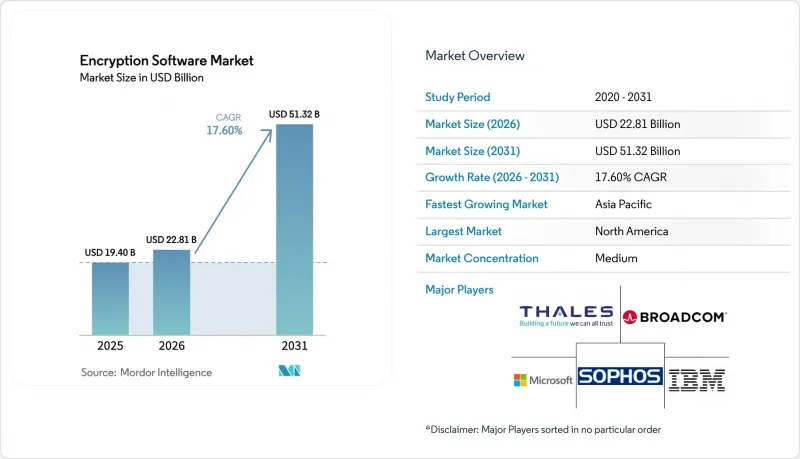
Mordor Intelligence에 따르면 암호화 소프트웨어 시장 규모는 2025년에 194억 달러로 평가되며, 2026년 228억 1,000만 달러에서 2031년까지 513억 2,000만 달러에 달할 것으로 예측되고 있으며, 예측 기간(2026-2031년)에 CAGR은 17.6%에 달할 전망입니다.
이 보고서에서는 업계를 구성 요소별(소프트웨어, 서비스), 도입 모델별(온프레미스, 클라우드),기업 규모별(대기업, 중소기업), 기능별(디스크 암호화, 통신 암호화, 파일/폴더 암호화 등), 업종별(IT·통신, BFSI 등) 및 지역별로 분류하고 있습니다. 시장 예측은 금액(달러) 기준으로 제시되어 있습니다.
전 세계 암호화 소프트웨어 시장의 동향 및 인사이트
엄격한 데이터 보호 규제
현재 전 세계 각국의 규제 당국은 보안을 단순한 형식적인 대응으로 취급하지 않고, 디지털 인프라에 통합할 것을 요구하는 적극적인 암호화 의무를 부과하고 있습니다. 영국 정보위원회(ICO)는 2025년 5월 지침을 업데이트하여, 조달 결정에 직접적인 영향을 미치는 알고리즘의 강도에 기반한 감독을 의무화했습니다. 미국에서는 ‘사이버 보안 성숙도 모델 인증(CMMC) 2.0’에 따라 계약업체가 전송 중 및 저장 중인 ‘관리 대상 비기밀 정보(CUI)’를 암호화해야 할 의무가 부과됨에 따라 연방 정부 공급업체 간의 암호화 소프트웨어 잠재 시장이 확대되고 있습니다. 또한 법무부의 ‘민사 사이버 사기 대책 구상’에서는 규정 준수 위반에 대한 벌금이 인상되어, 암호화가 중요한 위험 관리상의 필수 요건이 되었습니다. 23조 달러 규모의 자산을 관리하는 금융 기관은 GLBA, SOX, PCI-DSS와 같은 중복된 규제 요건에 직면해 있으며, 각 규제가 암호화 요건을 규정하고 있으므로 프론트 오피스, 미들 오피스, 백 오피스 각 시스템에 걸친 다층적인 도입이 강화되고 있습니다. 이러한 법규들이 복합적으로 작용하여 예측 연평균 성장률(CAGR)을 4.2% 끌어올리고 있습니다.
클라우드 워크로드에 대한 사이버 공격의 증가 및 고도화
공격은 기회를 노린 데이터 탈취에서 미래의 양자 복호화에 대비해 암호화된 데이터세트를 축적하는 체계적인 ‘지금 수집, 나중에 복호’형 캠페인으로 전환되고 있습니다. 캐나다의 ‘2025-2026년 국가 사이버 위협 평가’에서는 국가가 지원하는 행위자들이 중요 인프라를 표적으로 한 AI를 활용한 공격을 확대하고 있다고 지적하고 있습니다. 이에 대응해 기업은 여러 암호화 프로토콜과 통합된 키 계층을 다층적으로 조합한 ‘다층 방어’ 전략으로 대처하고 있습니다. 랜섬웨어가 이중, 삼중 협박 공격으로 진화하는 가운데, 멀티테넌트 워크로드를 보호해야 할 시급성이 높아지고 있는 점이 클라우드 암호화의 연평균 성장률(CAGR) 27.6%에 반영되어 있습니다. 그 결과, 경계 방어가 뚫렸을 때의 마지막 방패로서 암호화가 중요시되면서, 하이브리드 환경 전반에 걸친 통합 솔루션에 대한 수요가 증가하고 있습니다.
기업 규모의 전체 디스크 암호화에 따른 높은 TCO
총 소유 비용(TCO)에는 라이선스 비용뿐만 아니라 하드웨어 업그레이드, 성능 오버헤드, 전문 인력 배치 비용도 포함됩니다. 포스트 양자 알고리즘은 10-30%의 처리 오버헤드를 발생시켜 인프라 업데이트 주기를 앞당기는 요인이 됩니다. 키 관리에는 하드웨어 보안 모듈이나 분리된 네트워크에 대한 추가적인 설비 투자가 필요합니다. 기업의 연간 키 관리 예산은 50만 달러에서 200만 달러에 달할 수 있으며, 이는 소프트웨어 비용을 상회합니다. 고빈도 거래와 같이 지연 시간에 민감한 환경에서는 마이크로초 단위의 지연조차도 수익 손실로 이어지므로, 고가의 하드웨어 가속화 도입이 필수적입니다. 따라서 예산이 제한된 중소기업은 광범위한 암호화 도입을 연기하거나 규모를 축소하고 있으며, 이로 인해 연평균 성장률(CAGR)이 2.8% 하락하고 있습니다.
부문 분석
서비스 부문은 현재 소프트웨어 부문에 뒤처져 있지만, 기업이 2035년 PQC 규정 준수 기한을 맞이함에 따라 가장 급격한 성장세를 보이고 있습니다. 서비스에 기인한 암호화 소프트웨어 시장 규모는 암호 자산 인벤토리, 알고리즘 전환 로드맵 및 관리된 키 수명주기 모니터링에 대한 수요에 힘입어 연평균 성장률(CAGR) 20.6%로 확대될 전망입니다. 연방 정부 기관은 PQC 전환 서비스에 약 70억 달러를 할당하고 있으며, 이는 컨설팅 분야에서 큰 수익 기회가 창출되고 있음을 나타냅니다. 소프트웨어 분야는 여전히 구독을 통해 지속적인 수익을 확보하고 있지만, 복잡성이 증가함에 따라 특히 인증된 전문 지식과 지속적인 규정 준수가 필수적인 의료 및 금융 분야에서 턴키식의 관리형 서비스가 선호되고 있습니다.
동시에 소프트웨어 벤더들은 자동화된 마이그레이션 툴을 통합하고 있으며, 이를 통해 벤더들은 차별화된 가치를 제공하기 위해 자문 서비스를 번들로 제공하고 있습니다. 이러한 ‘라이선스+서비스’라는 이중 수익 모델은 특히 플랫폼 통합을 통해 운영상의 마찰이 최소화될 경우 벤더 종속성을 강화합니다. 2025년에 계약 범위가 설정된 신규 프로젝트의 60% 이상은 소프트웨어 라이선스와 현황 파악, 시정 조치, PQC 대응 아키텍처 검증을 포괄하는 전문 서비스 패키지를 결합하고 있습니다. 그 결과, 소프트웨어 벤더와 글로벌 시스템 통합사업자 간의 제휴가 급증하고 있으며, 이는 양측이 암호화 소프트웨어 시장의 양자 전환을 통해 수익을 창출하는 데 기여하고 있습니다.
2025년에는 온프레미스 배포가 암호화 소프트웨어 시장 규모의 61.28%를 차지하며, 하이브리드 아키텍처와 연방 정부의 ‘클라우드 우선’ 방침을 배경으로 클라우드 암호화가 연평균 성장률(CAGR) 24.07%로 가장 빠르게 성장하고 있습니다. 제로 트러스트 프레임워크를 도입하는 정부 기관은 퍼블릭 클라우드, 프라이빗 클라우드, 멀티클라우드 환경에 걸쳐 확장 가능한 키 관리가 필요합니다. 중소기업은 설비 투자를 피하고 온디맨드로 기업급 보안을 이용할 수 있는 클라우드 구독을 선호하고 있으며, 이는 중소기업을 대상으로 한 설문조사 응답자의 82%가 지적한 업무 효율성 향상과 일치합니다.
규제 대상인 은행 업무나 고빈도 거래 플랫폼 등 데이터 주권이나 초저지연이 요구되는 분야에서는 온프레미스형 솔루션에 대한 수요가 여전히 매력적입니다. 그러나 클라우드 제공업체들은 현재 하드웨어 보안 모듈 서비스(HSM-as-a-Service) 및 기밀 컴퓨팅 엔클레이브를 제공하고 있으며, 오프프레미스 키 관리에 대한 기존의 우려는 점차 사라지고 있습니다. 클라우드 네이티브 암호화를 통해 기존의 디스크 암호화로는 대응하기 어려웠던 컨테이너 및 서버리스 함수 전체에 정책을 신속하게 적용할 수 있게 됩니다. 그 결과, 암호화 소프트웨어 시장에서는 유연한 SaaS 모델로의 장기적인 전환이 관찰되는 반면, 하이브리드 도입으로 인해 온프레미스형 툴의 중요성은 유지되고 있지만 성장 속도는 완만해지고 있습니다.
지역별 분석
북미는 제로 트러스트의 조기 도입과 견고한 벤더 생태계에 힘입어 42.60%의 시장 점유율로 1위를 차지하고 있습니다. 이 지역은 ‘국가 양자 전략’의 혜택을 받고 있으며, 이 전략에서는 포스트 양자 암호 연구개발에 3억 6,000만 캐나다 달러(2억 6,700만 달러)가 배정되어 안전한 양자 통신 네트워크 구축을 목표로 하고 있습니다. 주 의회도 마찬가지로 활발한 활동을 보이고 있으며, 2024년 한 해에만 75건의 사이버 보안 관련 법안이 통과되어 공공 부문의 암호화 솔루션 조달을 지원하고 있습니다.
APAC 지역은 연평균 성장률(CAGR) 19.78%로 성장하고 있으며, 이는 제조업, 금융, 의료 분야의 급속한 디지털화뿐만 아니라 일본, 한국, 싱가포르에서 규제 체계 구축이 가속화되고 있음을 반영합니다. 이 지역의 반도체 분야 우위는 하드웨어 기반 신뢰 경로(RoT) 출하를 촉진하는 한편, 공급망의 취약성도 드러내고 있으며, 부품 부족을 완화하기 위한 소프트웨어 기반 암호화에만 대한 관심을 높이고 있습니다. 유럽에서는 GDPR 준수와 알고리즘의 강도에 중점을 둔 거버넌스를 강조하는 영국의 새로운 지침에 따라 꾸준한 성장을 달성하고 있으며, 디지털 주권에서 암호화의 역할이 강화되고 있습니다. 이러한 동향을 종합해 보면, 정책, 공급망, 클라우드 배포에 대한 리더십이 암호화 소프트웨어 시장에서 각 지역의 성장세를 좌우하는 지역별 상황이 드러납니다.
유럽의 동향은 데이터 현지화와 개인정보 보호라는 우선순위에 부합하는 것입니다. 동형 암호화에 대한 관심이 다시 고조되고 있으며, GDPR을 위반하지 않으면서도 국경을 초월한 분석이 가능해졌습니다. 회원국들은 중요 인프라를 보호하기 위해 양자 내성 기술(PQC)을 활용한 시범 프로젝트를 조정하고 있으며, PQC를 지원하는 이메일 게이트웨이 및 VPN 조달을 촉진하고 있습니다. 브렉시트로 인해 데이터 전송이 복잡해짐에 따라 영국과 EU 간의 상거래에서 암호화는 필수적입니다. 국가별로 규제가 분산된 상황은 서로 다른 보관 기간 및 공개 규정에 적응할 수 있는 정책 기반 키 관리를 제공하는 벤더에게 기회로 작용하고 있습니다.
기타 혜택:
- 엑셀 형식의 시장 예측(ME) 시트
- 3개월간의 애널리스트 지원
자주 묻는 질문
목차
제1장 서론
제2장 조사 방법
제3장 개요
제4장 시장 구도
제5장 시장 규모와 성장 예측
제6장 경쟁 구도
제7장 시장 기회와 향후 전망
KSA 26.09.08According to Mordor Intelligence, the encryption software market size was valued at USD 19.4 billion in 2025 and estimated to grow from USD 22.81 billion in 2026 to reach USD 51.32 billion by 2031, at a CAGR of 17.6% during the forecast period (2026-2031).
This report Segments the Industry Into by Component (Software, Service), Deployment Model (On-Premise, Cloud), by Enterprise Size (Large Enterprises, Small and Medium Enterprises), Function (Disk Encryption, Communication Encryption, File/Folder Encryption, and More), Industry Vertical (IT & Telecommunication, BFSI, and More), and Geography. The Market Forecasts are Provided in Terms of Value (USD).
Global Encryption Software Market Trends and Insights
Stringent Data-Protection Regulations
Global watchdogs now require proactive encryption mandates that embed security into digital infrastructure rather than treat it as a check-box exercise. The U.K. Information Commissioner's Office updated guidance in May 2025, mandating algorithm-strength oversight that directly steers procurement choices. In the United States, Cybersecurity Maturity Model Certification 2.0 compels contractors to encrypt Controlled Unclassified Information in transit and at rest, widening the addressable encryption software market among federal suppliers. The Department of Justice's Civil Cyber-Fraud Initiative raises financial penalties for non-compliance, turning encryption into a material risk-management imperative. Financial institutions supervising USD 23 trillion in assets face overlapping GLBA, SOX, and PCI-DSS mandates, each specifying encryption requirements, reinforcing multi-layered adoption across front-, middle-, and back-office systems. Together, these statutes contribute a 4.2% uplift to the forecast CAGR.
Rising Volume & Sophistication of Cyber-Attacks on Cloud Workloads
Attacks have shifted from opportunistic data theft to systematic "harvest-now-decrypt-later" campaigns that bank encrypted datasets for future quantum decryption. Canada's National Cyber Threat Assessment 2025-2026 flags state-sponsored actors escalating AI-assisted campaigns targeting critical infrastructure. Enterprises answer with defense-in-depth strategies layering multiple encryption protocols and unified key hierarchies. Cloud encryption's 27.6% CAGR reflects the urgency to protect multi-tenant workloads as ransomware evolves into double and triple-extortion assaults. Consequently, encryption becomes the final shield once perimeter defenses fall, fuelling integrated solution demand across hybrid environments.
High TCO of Full-Disk Encryption at Enterprise Scale
Total cost of ownership encompasses not just licensing but hardware upgrades, performance overhead, and specialist staffing. Post-quantum algorithms can impose 10-30% processing overhead, forcing infrastructure refresh cycles. Key management introduces further capital outlays for hardware security modules and segregated networks. Annual enterprise key-management budgets can range from USD 500,000 to USD 2 million, outstripping software fees. In latency-sensitive environments such as high-frequency trading, even microsecond delays translate into lost revenue, compelling expensive hardware acceleration. SMEs with limited budgets therefore delay or scale down broad encryption roll-outs, shaving 2.8% from the CAGR.
Other drivers and restraints analyzed in the detailed report include:
- Remote & Hybrid Workforce Fueling Endpoint-Level Encryption Demand
- Homomorphic Encryption Adoption in Privacy-Preserving Analytics
For complete list of drivers and restraints, kindly check the Table Of Contents.
Segment Analysis
Services currently trail software yet register the steepest ascent as enterprises confront the 2035 PQC compliance horizon. The encryption software market size attributed to services will climb on a 20.6% CAGR, driven by demand for cryptographic asset inventories, algorithm migration roadmaps, and managed key-lifecycle oversight. Federal agencies earmark an estimated USD 7 billion for PQC transition services-an indicator of the consulting windfall in play. Software still secures recurrent revenue through subscriptions, but rising complexity favors turnkey managed offerings, especially within healthcare and finance where certified expertise and continuous compliance are mandatory.
At the same time, software vendors embed automated migration tooling, prompting vendors to bundle advisory services for differentiated value. This dual revenue track-license plus services-strengthens vendor lock-in, particularly where platform integration minimises operational friction. Over 60% of new deals scoped in 2025 combine software licenses with professional-service packages that cover discovery, remediation, and PQC-ready architecture validation. Consequently, partnerships between software publishers and global systems integrators are proliferating, helping both sides monetise the quantum shift inside the encryption software market.
Despite on-premise deployments commanding 61.28% of encryption software market size in 2025, cloud encryption climbs fastest at a 24.07% CAGR on the back of hybrid architectures and federal cloud-first mandates. Government agencies implementing zero-trust frameworks require scalable key management that spans public-, private-, and multi-cloud estates gsa. Small and mid-sized enterprises favour cloud subscriptions to sidestep capital outlays and access enterprise-grade security on demand, aligning with operational efficiency gains noted in 82% of SME studies businesses.
On-premise solutions retain appeal where data sovereignty or ultra-low latency demands prevail, such as regulated banking workloads and high-frequency trading platforms. Yet cloud providers now offer Hardware Security Module-as-a-Service and confidential-computing enclaves, eroding legacy objections to off-premise key custody. Cloud-native encryption enables rapid policy propagation across containers and serverless functions otherwise hard to cover with traditional disk encryption. As a result, the encryption software market witnesses a secular tilt towards flexible SaaS models while hybrid adoption ensures on-premise tools remain relevant, albeit at a slower growth pace.
Complete Report Scope:
- By Component
- Software
- Service
- By Deployment Model
- On-premise
- Cloud
- By Enterprise Size
- Large Enterprises
- Small and Medium Enterprises
- By Function
- Disk Encryption
- Communication Encryption
- File/Folder Encryption
- Cloud Encryption
- Database Encryption
- By Industry Vertical
- IT and Telecommunication
- BFSI
- Healthcare
- Government
- Retail
- Education
- Others
- By Geography
- North America
- United States
- Canada
- Mexico
- South America
- Brazil
- Argentina
- Rest of South America
- Europe
- United Kingdom
- Germany
- France
- Italy
- Spain
- Rest of Europe
- Asia-Pacific
- China
- Japan
- India
- South Korea
- Australia
- Rest of Asia-Pacific
- Middle East
- Saudi Arabia
- United Arab Emirates
- Turkey
- Rest of Middle East
- Africa
- South Africa
- Nigeria
- Egypt
- Rest of Africa
- North America
Geography Analysis
North America leads at 42.60% market share, fortified by early zero-trust adoption and a robust vendor ecosystem. The region benefits from the National Quantum Strategy, which allocates CAD 360 million (USD 267 million) to post-quantum cryptography R&D and aims to deliver a secure quantum communication network. State legislatures are equally active, with 75 cybersecurity bills enacted in 2024 alone, driving encryption procurement within the public sector.
APAC, climbing at 19.78% CAGR, reflects rapid digitisation in manufacturing, finance, and healthcare plus accelerating regulatory frameworks in Japan, South Korea, and Singapore. The region's semiconductor dominance advances hardware-root-of-trust shipments yet also reveals supply-chain fragility, spurring interest in software-only encryption that mitigates component shortages. Europe grows at a steady clip under GDPR compliance and new U.K. guidance that stresses algorithm-strength governance, reinforcing encryption's role in digital sovereignty. Collectively, these trends map a geographic landscape where leadership in policy, supply chains, and cloud adoption determines regional momentum within the encryption software market.
Europe's trajectory aligns to data localization and privacy priorities. Renewed focus on homomorphic encryption facilitates cross-border analytics without breaching GDPR. Member states coordinate quantum-safe pilot projects to protect critical infrastructure, driving procurement of PQC-enabled email gateways and VPNs. Brexit imposes data-transfer complexity, making encryption essential for U.K.-EU commerce. Fragmented national regulations create opportunity for vendors offering policy-aware key management capable of adapting to differing retention and disclosure rules.
- IBM
- Microsoft
- Broadcom Inc. (Symantec)
- Sophos Ltd.
- Thales
- McAfee LLC
- Trend Micro Incorporated
- Dell Inc.
- Check Point Software Technologies Ltd.
- Micro Focus International plc
- Cisco Systems, Inc.
- Proofpoint Inc.
- WinMagic Inc.
- ESET spol. s r.o.
- F-Secure Corporation
- Amazon Web Services Inc.
- VMware Inc.
- Fortinet Inc.
- Oracle Corporation
- Google LLC
Additional Benefits:
- The market estimate (ME) sheet in Excel format
- 3 months of analyst support
TABLE OF CONTENTS
1 INTRODUCTION
- 1.1 Study Assumptions and Market Definition
- 1.2 Scope of the Study
2 RESEARCH METHODOLOGY
3 EXECUTIVE SUMMARY
4 MARKET LANDSCAPE
- 4.1 Market Overview
- 4.2 Market Drivers
- 4.2.1 Stringent data-protection regulations
- 4.2.2 Rising volume and sophistication of cyber-attacks on cloud workloads
- 4.2.3 Remote and hybrid workforce fuelling endpoint?level encryption demand
- 4.2.4 Homomorphic encryption adoption in privacy-preserving analytics
- 4.2.5 Quantum-resistant cryptography pilots in critical infrastructure
- 4.2.6 Embedded hardware root-of-trust chips boosting IoT encryption sales
- 4.3 Market Restraints
- 4.3.1 High TCO of full-disk encryption at enterprise scale
- 4.3.2 Proliferation of open-source and pirated encryption tools
- 4.3.3 Lawful-access regulations restricting strong encryption in select nations
- 4.3.4 Latency overhead in 5G/edge applications
- 4.4 Regulatory Landscape
- 4.5 Technological Outlook
- 4.6 Porter's Five Forces Analysis
- 4.6.1 Bargaining Power of Suppliers
- 4.6.2 Bargaining Power of Buyers/Consumers
- 4.6.3 Threat of New Entrants
- 4.6.4 Threat of Substitute Products
- 4.6.5 Intensity of Competitive Rivalry
- 4.7 Investment Analysis
5 MARKET SIZE AND GROWTH FORECASTS (VALUE)
- 5.1 By Component
- 5.1.1 Software
- 5.1.2 Service
- 5.2 By Deployment Model
- 5.2.1 On-premise
- 5.2.2 Cloud
- 5.3 By Enterprise Size
- 5.3.1 Large Enterprises
- 5.3.2 Small and Medium Enterprises
- 5.4 By Function
- 5.4.1 Disk Encryption
- 5.4.2 Communication Encryption
- 5.4.3 File/Folder Encryption
- 5.4.4 Cloud Encryption
- 5.4.5 Database Encryption
- 5.5 By Industry Vertical
- 5.5.1 IT and Telecommunication
- 5.5.2 BFSI
- 5.5.3 Healthcare
- 5.5.4 Government
- 5.5.5 Retail
- 5.5.6 Education
- 5.5.7 Others
- 5.6 By Geography
- 5.6.1 North America
- 5.6.1.1 United States
- 5.6.1.2 Canada
- 5.6.1.3 Mexico
- 5.6.2 South America
- 5.6.2.1 Brazil
- 5.6.2.2 Argentina
- 5.6.2.3 Rest of South America
- 5.6.3 Europe
- 5.6.3.1 United Kingdom
- 5.6.3.2 Germany
- 5.6.3.3 France
- 5.6.3.4 Italy
- 5.6.3.5 Spain
- 5.6.3.6 Rest of Europe
- 5.6.4 Asia-Pacific
- 5.6.4.1 China
- 5.6.4.2 Japan
- 5.6.4.3 India
- 5.6.4.4 South Korea
- 5.6.4.5 Australia
- 5.6.4.6 Rest of Asia-Pacific
- 5.6.5 Middle East
- 5.6.5.1 Saudi Arabia
- 5.6.5.2 United Arab Emirates
- 5.6.5.3 Turkey
- 5.6.5.4 Rest of Middle East
- 5.6.6 Africa
- 5.6.6.1 South Africa
- 5.6.6.2 Nigeria
- 5.6.6.3 Egypt
- 5.6.6.4 Rest of Africa
- 5.6.1 North America
6 COMPETITIVE LANDSCAPE
- 6.1 Market Concentration
- 6.2 Strategic Moves
- 6.3 Market Share Analysis
- 6.4 Company Profiles (includes Global level Overview, Market level overview, Core Segments, Financials as available, Strategic Information, Market Rank/Share for key companies, Products and Services, and Recent Developments)
- 6.4.1 IBM
- 6.4.2 Microsoft
- 6.4.3 Broadcom Inc. (Symantec)
- 6.4.4 Sophos Ltd.
- 6.4.5 Thales
- 6.4.6 McAfee LLC
- 6.4.7 Trend Micro Incorporated
- 6.4.8 Dell Inc.
- 6.4.9 Check Point Software Technologies Ltd.
- 6.4.10 Micro Focus International plc
- 6.4.11 Cisco Systems, Inc.
- 6.4.12 Proofpoint Inc.
- 6.4.13 WinMagic Inc.
- 6.4.14 ESET spol. s r.o.
- 6.4.15 F-Secure Corporation
- 6.4.16 Amazon Web Services Inc.
- 6.4.17 VMware Inc.
- 6.4.18 Fortinet Inc.
- 6.4.19 Oracle Corporation
- 6.4.20 Google LLC
7 MARKET OPPORTUNITIES AND FUTURE OUTLOOK
- 7.1 White-space and Unmet-Need Assessment