|
시장보고서
상품코드
2125363
온라인 시뮬레이션 게임 : 시장 점유율 분석, 업계 동향과 통계, 성장 예측(2026-2031년)Online Simulation Games - Market Share Analysis, Industry Trends & Statistics, Growth Forecasts (2026 - 2031) |
||||||
 Mordor Intelligence
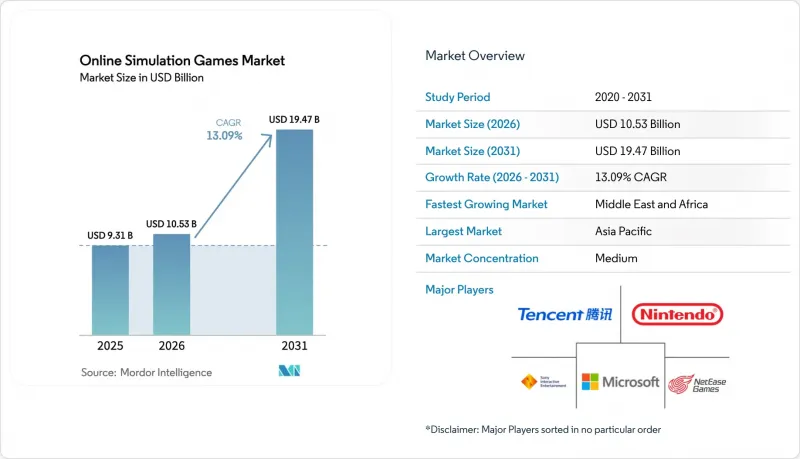
Mordor Intelligence에 따르면 2026년 온라인 시뮬레이션 게임 시장의 규모는 105억 3,000만 달러로 추정되고 있으며, 2025년 93억 1,000만 달러에서 확대하며, 2031년에는 194억 7,000만 달러에 달할 것으로 예측됩니다.2026-2031년에는 CAGR 13.09%로 성장할 것으로 전망되고 있습니다.
이 보고서는 수익 모델(광고, 인앱 결제, 구독, 유료 앱), 플랫폼(모바일, PC, 게임기, VR/AR 기기), 게임 유형(생활 시뮬레이션, 차량 시뮬레이션, 건설·경영 시뮬레이션, 스포츠 시뮬레이션, 훈련·교육 시뮬레이션) 및 지역(북미 등)별로 분류되어 있습니다. 시장 전망은 금액(달러) 기준으로 제시되어 있습니다.
전 세계 온라인 시뮬레이션 게임 시장의 동향 및 인사이트
아시아 신흥 시장에서 ‘모바일 퍼스트’형 게임의 보급 확대
2024년 상반기, 동남아시아의 모바일 앱 다운로드 수는 42억 건에 달했으며, 그중 인도네시아만으로도 41%를 차지했습니다. 현재 인도네시아, 말레이시아, 태국 3개국에서 과금 의향은 60%를 초과하고 있으며, 이에 따라 각 퍼블리셔는 컨텐츠 현지화를 추진하며 문화적으로 공감을 불러일으키는 음식이나 스포츠를 주제로 한 시뮬레이션 게임에 주력하고 있습니다. 5G 통신 영역의 확장으로 인해 기존에는 PC로만 가능했던 복잡한 물리 연산이 가능해졌으며, 이로 인해 이 지역의 온라인 시뮬레이션 게임 시장에서 모바일의 우위가 더욱 공고해지고 있습니다. 이러한 상황을 활용하는 스튜디오들은 콘솔이나 PC용 게임에 막대한 초기 마케팅 비용을 투자하지 않고도 빠르게 규모를 확장하고 있습니다.
북미에서 저지연 시뮬레이션을 가능하게 하는 클라우드 게이밍 인프라의 성장
Microsoft Azure와 통합된 AccelByte의 멀티플레이어 서버와 같은 엣지 기반 아키텍처를 통해 시뮬레이션 워크로드에 맞춰 최적화된 다양한 가상 머신 제품군이 제공되게 되었습니다. CableLabs의 ‘Low Latency DOCSIS’는 지연을 더욱 줄여, 대역폭을 대량으로 소비하는 비행 시뮬레이션이나 도시 건설 시뮬레이션을 일반적인 연결 환경에서도 문제없이 실행할 수 있게 해줍니다. 최종사용자의 하드웨어에 의존하지 않고 성능을 보장함으로써, 개발자는 여전히 고성능 GPU가 부족한 새로운 지역으로 진출할 수 있게 되어 온라인 시뮬레이션 게임 시장의 잠재 고객 기반을 확대하고 있습니다.
GPU 수요가 공급을 초과하여 PC 시뮬레이션용 하드웨어 비용을 상승시키고 있다
Nvidia가 게이밍용 디스크리트 GPU 시장에서 86%의 점유율을 차지하고 있으며, 공급 부족이 소매 가격에 직접적인 영향을 미치고 있습니다. 소비자들은 업그레이드를 미루고 있으며, 그 결과 온라인 시뮬레이션 게임 시장에서 하이엔드 PC의 점유율이 축소되고 있습니다. 개발자들은 텍스처 팩의 해상도를 낮추거나 클라우드 렌더링 모드를 추가하여 연산 처리를 데이터센터로 이전하고 있습니다. 스트리밍이 이러한 격차를 메우는 한편, 지출이 플랫폼 이용료로 전환되면서 고정형 하드웨어 판매에 의존하는 타이틀의 이익률은 극히 낮아지고 있습니다.
부문 분석
인앱 결제는 2025년 매출의 54.35%를 차지하며, 이는 진입 장벽이 낮고 충동적인 구매 심리에 힘입은 결과임을 반영합니다. 스튜디오들이 예측 가능한 현금 흐름을 중시하는 가운데, 온라인 시뮬레이션 게임 시장의 구독 규모는 2026-2031년에 연평균 성장률(CAGR) 15.55%로 확대될 것으로 예측됩니다. 로트박스 규제가 이러한 전환을 가속화하면서, 선택적 소액 결제가 월간 패스에 추가되는 하이브리드 구조가 등장하고 있습니다. 시뮬레이션 타이틀의 광고비는 전년 대비 26.7% 증가했습니다. 이는 유료 장벽 없이 참여도를 유지하는 보상형 동영상 형식이 주도한 결과입니다. 유료 다운로드 모델은 초기 투자를 마다하지 않는 전문가 커뮤니티를 대상으로 하는 틈새 시장인 항공기 및 산업용 시뮬레이터 분야에서 여전히 자리 잡고 있습니다.
높은 연간 유지율은 한정 확장팩이나 크로스 플랫폼 클라우드 저장을 포함한 구독 번들과 상관관계가 있습니다. 로열티 지표에 따르면 12개월 이상 이용 중인 사용자의 플레이 시간은 평균 42% 더 길며, 예측 가능한 업데이트가 사용자의 지지를 확보하고 있음을 보여줍니다. 통신 사업자들이 게임 구독 서비스를 데이터 요금제에 묶어 제공함에 따라 온라인 시뮬레이션 게임 시장은 그동안 가격에 민감했던 층으로까지 확대되고 있습니다.
지역별 분석
아시아태평양은 온라인 시뮬레이션 게임 시장에서 가장 큰 점유율을 차지하고 있으며, 2025년 매출의 44.70%를 차지합니다. 중국, 일본, 한국은 ARPU(사용자 1인당 평균 수익)가 높은 사용자를 공급하는 반면, 인도네시아, 태국, 말레이시아는 2024년 초 모바일 다운로드 수가 42억 건에 달함에 따라 설치 수를 견인하고 있습니다. 현지 퍼블리셔들은 언어 팩과 문화를 테마로 한 자산을 도입함으로써 평균 세션 시간과 인앱 구매 깊이를 확대하고 있습니다.
중동 및 아프리카는 게임 액셀러레이터 및 e-sports 아레나에 자본을 배분하는 정부계 투자 펀드의 지원을 받아 2031년까지 연평균 성장률(CAGR) 17.62%를 기록하며 가장 빠른 성장 궤도를 그리고 있습니다. 사우디아라비아의 ‘국가 게임·e-sports 전략’에서는 시뮬레이션 IP를 관광 및 교육 사업에 통합하고, 일자리 창출 및 스튜디오 육성을 목표로 하고 있습니다. 광섬유 및 5G 네트워크 인프라 구축으로 지연 시간이 단축되어, 온라인 게임 분야에서 이 지역 전체가 세계 경쟁 기준에 부합하게 되었습니다.
북미는 클라우드 스트리밍 및 AI 툴 분야에서 기술적 리더십을 유지하고 있으며, 2025년 4월에는 모바일 시뮬레이션 매출이 20억 달러를 기록했습니다. 유럽은 수익화 기준을 확립하고 있으며, 소비자 보호 지침이 전 세계의 설계 선택에 영향을 미치고 있습니다. 남미에서는 브라질 법률 제14.852호를 활용하여 게임에 문화적 지위를 부여하고, 개발자에 대한 공공 보조금 및 세제 혜택을 추진하고 있습니다. 지방의 대역폭 격차는 여전히 존재하므로 스튜디오는 접근성을 확보하기 위해 오프라인 진행 기능을 탑재하고 있으며, 온라인 시뮬레이션 게임 시장에서 다양한 경제 계층에 걸쳐 안정적인 성장을 유지하고 있습니다.
기타 혜택:
- 엑셀 형식의 시장 예측(ME) 시트
- 3개월간의 애널리스트 지원
자주 묻는 질문
목차
제1장 서론
제2장 조사 방법
제3장 개요
제4장 시장 구도
제5장 시장 규모와 성장 예측
제6장 경쟁 구도
제7장 시장 기회와 향후 전망
KSA 26.09.08According to Mordor Intelligence, the online simulation games market size in 2026 is estimated at USD 10.53 billion, growing from 2025 value of USD 9.31 billion with 2031 projections showing USD 19.47 billion, growing at 13.09% CAGR over 2026-2031.
This report is Segmented by Revenue Model (Advertising, In-App Purchase, Subscription, and Paid App), Platform (Mobile, PC, Console, and VR/AR Device), Game Type (Life Simulation, Vehicle Simulation, Construction and Management Simulation, Sports Simulation, and Training and Education Simulation), and Geography (North America, and More). The Market Forecasts are Provided in Terms of Value (USD).
Global Online Simulation Games Market Trends and Insights
Rise in Mobile-First Gaming Uptake across Emerging Asian Markets
Mobile downloads touched 4.2 billion in Southeast Asia during H1 2024, with Indonesia alone contributing 41%. Spending willingness now exceeds 60% across Indonesia, Malaysia, and Thailand, motivating publishers to localize content and lean on culturally resonant food- and sports-themed simulations. Expanding 5G coverage is unlocking complex physics previously limited to PCs, reinforcing the online simulation games market's mobile dominance in the region. Studios exploiting these conditions gain rapid scale without high upfront console or PC marketing costs.
Growth of Cloud Gaming Infrastructure Enabling Low-Latency Simulations in North America
Edge-based architectures such as AccelByte's Multiplayer Servers integrated with Microsoft Azure now offer diverse virtual-machine families tuned for simulation workloads. CableLabs' Low Latency DOCSIS further trims lag, letting bandwidth-heavy flight or city-building simulations run flawlessly over ordinary connections. By abstracting performance away from end-user hardware, developers unlock new regions where high-spec GPUs remain scarce, broadening the online simulation games market addressable base.
High GPU demand outpacing supply, inflating hardware costs for PC simulations
Nvidia's 86% share in discrete gaming GPUs gives shortages direct influence on retail prices. Consumers postpone upgrades, shrinking the premium PC slice of the online simulation games market size. Developers downscale texture packs or add cloud-rendered modes that shift compute to data centers. While streaming bridges the gap, it diverts spending toward platform fees and leaves razor-thin margins for titles reliant on fixed hardware sales.
Other drivers and restraints analyzed in the detailed report include:
- Integration of Generative AI for Real-Time World-Building Boosting Player Engagement
- Expansion of esports broadcasting rights for simulation titles in Europe
- Stringent loot-box regulations in Europe curtailing monetization options
For complete list of drivers and restraints, kindly check the Table Of Contents.
Segment Analysis
In-app purchases delivered 54.35% of 2025 revenue, reflecting their low entry barrier and impulse-driven psychology. The online simulation games market size for subscriptions is forecast to expand at a 15.55% CAGR from 2026-2031 as studios value predictable cash flow. Loot-box regulation accelerates that migration, and hybrid structures emerge where optional microtransactions supplement monthly passes. Advertising spend in simulation titles increased 26.7% year over year, fueled by rewarded-video formats that maintain engagement without paywalls. Paid download models persist among niche aircraft or industrial simulators that serve professional communities willing to invest upfront.
Higher annual retention correlates with subscription bundles that include exclusive expansion packs and cross-platform cloud saves. Loyalty metrics demonstrate that users enrolled longer than twelve months average 42% more playtime, evidence that predictable updates secure mindshare. As telecom operators bundle game subscriptions into data plans, the online simulation games market broadens into demographics previously price sensitive.
Complete Report Scope:
- By Revenue Model
- Advertising
- In-App Purchase
- Subscription
- Paid App
- By Platform
- Mobile
- PC
- Console
- VR/AR Devices
- By Game Type
- Life Simulation
- Vehicle Simulation
- Construction and Management Simulation
- Sports Simulation
- Training and Education Simulation
- By Geography
- North America
- United States
- Canada
- Mexico
- South America
- Brazil
- Argentina
- Chile
- Peru
- Rest of South America
- Europe
- Germany
- United Kingdom
- France
- Italy
- Spain
- Rest of Europe
- Asia-Pacific
- China
- Japan
- South Korea
- India
- Australia
- New Zealand
- Rest of Asia-Pacific
- Middle East
- United Arab Emirates
- Saudi Arabia
- Turkey
- Rest of Middle East
- Africa
- South Africa
- Rest of Africa
- North America
Geography Analysis
Asia-Pacific contributes the largest slice of the online simulation games market, holding 44.70% of 2025 revenue. China, Japan, and South Korea supply high-ARPU users, while Indonesia, Thailand, and Malaysia drive install volumes after mobile downloads reached 4.2 billion in early 2024. Local publishers adopt language packs and culturally themed assets to extend average session length and in-app purchase depth.
The Middle East & Africa region charts the fastest trajectory with an expected 17.62% CAGR to 2031, propelled by sovereign investment funds allocating capital to gaming accelerators and esports arenas. The National Gaming & Esports Strategy in Saudi Arabia outlines job-creation and studio-incubation targets that integrate simulation IP into tourism and education initiatives. Infrastructure rollouts of fiber and 5G networks shrink latency, aligning region-wide with global competitive standards for online titles.
North America maintains technical leadership in cloud delivery and AI tooling, recording USD 2 billion in mobile simulation revenue in April 2025. Europe sets monetization norms, with consumer-protection directives influencing global design choices. South America leverages Brazil's Law 14.852 to grant gaming cultural status, fostering public grants and tax incentives for developers. Rural bandwidth gaps persist, so studios embed offline progression to ensure accessibility, keeping growth steady across diverse economic tiers in the online simulation games market.
- Sony Interactive Entertainment Inc.
- Tencent Holdings Ltd.
- Nintendo Co., Ltd.
- Microsoft Corporation (Xbox Game Studios)
- NetEase, Inc.
- Activision Blizzard, Inc.
- Electronic Arts Inc.
- Take-Two Interactive Software, Inc.
- Bandai Namco Entertainment Inc.
- Square Enix Holdings Co., Ltd.
- Ubisoft Entertainment SA
- Sega Sammy Holdings Inc.
- Paradox Interactive AB
- Frontier Developments plc
- KRAFTON, Inc.
- Roblox Corporation
- Paradox Interactive AB
- Frontier Developments plc
- Wargaming Group Limited
- Colossal Order
Additional Benefits:
- The market estimate (ME) sheet in Excel format
- 3 months of analyst support
TABLE OF CONTENTS
1 Introduction
- 1.1 Study Assumptions and Market Definition
- 1.2 Scope of the Study
2 Research Methodology
3 Executive Summary
4 Market Landscape
- 4.1 Market Overview
- 4.2 Market Drivers
- 4.2.1 Rise in Mobile-First Gaming Uptake across Emerging Asian Markets
- 4.2.2 Growth of Cloud Gaming Infrastructure Enabling Low-Latency Simulations in North America
- 4.2.3 Integration of Generative AI for Real-Time World-Building Boosting Player Engagement
- 4.2.4 Expansion of Esports Broadcasting Rights for Simulation Titles in Europe
- 4.2.5 Government-Backed Digital Economy Initiatives Fueling Indie Simulation Studios in South America
- 4.2.6 Increasing Adoption of VR Flight and Driving Simulators for Training in the Middle East
- 4.3 Market Restraints
- 4.3.1 High GPU Demand Outpacing Supply, Inflating Hardware Costs for PC Simulations
- 4.3.2 Stringent Loot-Box Regulations in Europe Curtailing Monetization Options
- 4.3.3 Bandwidth Limitations in Rural Africa Hindering Real-Time Multiplayer Experiences
- 4.3.4 Rising Development Costs for Photorealistic Physics Engines
- 4.4 Technological Outlook
- 4.5 Macroeconomic Impact Assessment
- 4.6 Investment Analysis
- 4.7 Porter's Five Forces Analysis
- 4.7.1 Bargaining Power of Suppliers
- 4.7.2 Bargaining Power of Buyers/Consumers
- 4.7.3 Threat of New Entrants
- 4.7.4 Threat of Substitute Products
- 4.7.5 Intensity of Competitive Rivalry
5 Market Size and Growth Forecasts (Value)
- 5.1 By Revenue Model
- 5.1.1 Advertising
- 5.1.2 In-App Purchase
- 5.1.3 Subscription
- 5.1.4 Paid App
- 5.2 By Platform
- 5.2.1 Mobile
- 5.2.2 PC
- 5.2.3 Console
- 5.2.4 VR/AR Devices
- 5.3 By Game Type
- 5.3.1 Life Simulation
- 5.3.2 Vehicle Simulation
- 5.3.3 Construction and Management Simulation
- 5.3.4 Sports Simulation
- 5.3.5 Training and Education Simulation
- 5.4 By Geography
- 5.4.1 North America
- 5.4.1.1 United States
- 5.4.1.2 Canada
- 5.4.1.3 Mexico
- 5.4.2 South America
- 5.4.2.1 Brazil
- 5.4.2.2 Argentina
- 5.4.2.3 Chile
- 5.4.2.4 Peru
- 5.4.2.5 Rest of South America
- 5.4.3 Europe
- 5.4.3.1 Germany
- 5.4.3.2 United Kingdom
- 5.4.3.3 France
- 5.4.3.4 Italy
- 5.4.3.5 Spain
- 5.4.3.6 Rest of Europe
- 5.4.4 Asia-Pacific
- 5.4.4.1 China
- 5.4.4.2 Japan
- 5.4.4.3 South Korea
- 5.4.4.4 India
- 5.4.4.5 Australia
- 5.4.4.6 New Zealand
- 5.4.4.7 Rest of Asia-Pacific
- 5.4.5 Middle East
- 5.4.5.1 United Arab Emirates
- 5.4.5.2 Saudi Arabia
- 5.4.5.3 Turkey
- 5.4.5.4 Rest of Middle East
- 5.4.6 Africa
- 5.4.6.1 South Africa
- 5.4.6.2 Rest of Africa
- 5.4.1 North America
6 Competitive Landscape
- 6.1 Strategic Developments
- 6.2 Vendor Positioning Analysis
- 6.3 Company Profiles (includes Global level Overview, Market level overview, Core Segments, Financials as available, Strategic Information, Products and Services, and Recent Developments)
- 6.3.1 Sony Interactive Entertainment Inc.
- 6.3.2 Tencent Holdings Ltd.
- 6.3.3 Nintendo Co., Ltd.
- 6.3.4 Microsoft Corporation (Xbox Game Studios)
- 6.3.5 NetEase, Inc.
- 6.3.6 Activision Blizzard, Inc.
- 6.3.7 Electronic Arts Inc.
- 6.3.8 Take-Two Interactive Software, Inc.
- 6.3.9 Bandai Namco Entertainment Inc.
- 6.3.10 Square Enix Holdings Co., Ltd.
- 6.3.11 Ubisoft Entertainment SA
- 6.3.12 Sega Sammy Holdings Inc.
- 6.3.13 Paradox Interactive AB
- 6.3.14 Frontier Developments plc
- 6.3.15 KRAFTON, Inc.
- 6.3.16 Roblox Corporation
- 6.3.17 Paradox Interactive AB
- 6.3.18 Frontier Developments plc
- 6.3.19 Wargaming Group Limited
- 6.3.20 Colossal Order
7 Market Opportunities and Future Outlook
- 7.1 White-Space and Unmet-Need Assessment