
|
시장보고서
상품코드
2125421
북미의 시큐어 액세스 서비스 엣지(SASE) 시장 : 시장 점유율 분석, 업계 동향 및 통계, 성장 예측(2026-2031년)North America Secure Access Service Edge - Market Share Analysis, Industry Trends & Statistics, Growth Forecasts (2026 - 2031) |
||||||
 Mordor Intelligence
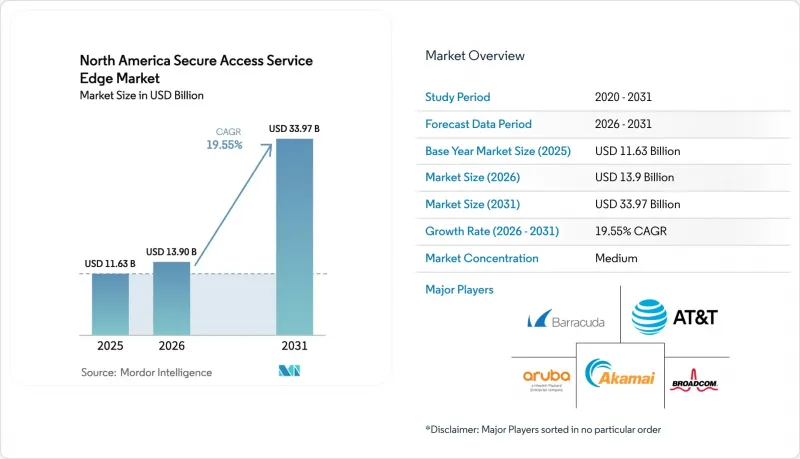
Mordor Intelligence에 의하면, 2026년 시큐어 액세스 서비스 엣지(SASE) 시장 규모는 139억 달러로 추정되고, 2025년 116억 3,000만 달러에서 확대해, 2031년에는 339억 7,000만 달러에 이를 것으로 예측됩니다.
2026-2031년 연평균 성장률(CAGR)은 19.55%가 될 것으로 전망됩니다.
본 보고서는 제공 유형별(Network-As-A-Service, Security-As-A-Service, 매니지드 SASE 서비스, 프로페셔널 서비스), 구성 요소별(SD-WAN, SWG 등), 배포 모드별(클라우드, 온프레미스), 조직 규모별(대기업, 중소기업), 최종 사용자 산업별(은행, 금융서비스 및 보험(BFSI), IT 및 통신 등) 및 지역별로 분류되어 있습니다. 시장 전망은 금액(달러) 기준으로 제시되어 있습니다.
북미의 시큐어 액세스 서비스 엣지(SASE) 시장 동향 및 인사이트
하이브리드 근무 환경에서의 연결 수요 급증
북미 조직의 80% 이상이 2026년까지 제로 트러스트 도입을 계획하고 있으며, 이는 2020-2025년 중대한 취약점이 82.5% 증가했다고 보고된 기존 VPN으로부터의 결정적인 전환을 반영합니다. SASE 플랫폼은 신원 중심의 액세스 제어, 마이크로 세분화 및 지속적인 검증을 수행함으로써 원격 근무의 생산성을 안정화합니다. Salesforce의 사례에서는 MPLS 링크를 SD-WAN을 활용한 SASE 백본으로 전환한 결과, 연결 비용을 증가시키지 않으면서 대역폭이 5배 향상된 것으로 확인되었습니다.
급증하는 멀티 클라우드 및 SaaS 트래픽 양
SD-WAN을 통한 클라우드로의 직접 브레이크아웃을 통해 데이터센터 백홀에 비해 왕복 지연 시간이 최대 5분의 1로 단축되어, 신뢰할 수 있는 SaaS 성능이 보장됩니다. SASE는 Amazon Web Services, Microsoft Azure, Google Cloud의 각 워크로드에 통일된 정책을 적용합니다. 시스코의 ‘Cloud OnRamp’는 퍼블릭 클라우드로의 온보딩 시간을 며칠에서 몇 시간으로 단축하고, 유전체 데이터 세트를 다루는 바이오의약품 연구개발 플랫폼의 라우팅을 최적화합니다.
레거시 MPLS 전환의 복잡성
MPLS의 대역폭은 2028년까지 연평균 6.7%에 그치는 반면, 클라우드 트래픽은 연평균 29%로 증가할 전망이며, 성능 격차는 계속 확대되고 있습니다. 'Rip-and-Replace' 전략은 다운타임이나 액세스 제어 설정 오류가 발생할 위험이 있으므로, 많은 기업에서는 기존 회선 위에 SD-WAN 터널을 오버레이하여 단계적인 마이그레이션을 진행하고 있습니다. 사용되지 않는 방화벽 규칙이 일시적으로 노출되면, 전환 기간 동안 공격자가 이를 악용하여 횡방향 이동(lateral movement)을 시도할 기회가 생길 수 있습니다.
부문 분석
SASE(Secure Access Service Edge) 시장에서는 자본 지출(Capex)을 배제하는 구독 모델이 선호됨에 따라, 2025년에는 ‘Security-as-a-Service’ 시장 점유율이 52.85%를 차지한 것으로 평가되었습니다. 매니지드 SASE 서비스는 현재 규모는 작지만 연평균 성장률(CAGR) 20.1%로 성장을 지속하고, 있으며, 방화벽, VPN, SD-WAN을 사이트별 요금에 통합한 번들형 연결의 혜택을 받고 있습니다. 통신 사업자는 SIM 카드에 클라이언트리스 인증을 통합함으로써 대상 범위를 확대하고, 현장 작업자의 프로비저닝에 드는 수고를 줄이고 있습니다. 프로페셔널 서비스는 은행업 등 규제가 엄격한 업계에서 평가, 설계 검증, 전환 후 최적화를 지도하는 역할을 맡아, 전환 기간 중에도 여전히 필수적인 존재입니다. Network-as-a-Service는 계절적 트래픽 피크 시에 확장되는 온디맨드 대역폭을 통해 구독의 성장세를 뒷받침하고 있습니다. 통합업체와 하이퍼스케일러 간의 전략적 제휴를 통해 사전에 테스트를 거친 레퍼런스 아키텍처가 개념 증명(PoC) 단계를 단축하고, 도입 주기를 더욱 효율화합니다.
서비스의 진화는 벤더들이 지속적인 수익을 강화하려는 의지도 반영하고 있습니다. 버라이즌의 ‘Advanced SASE’, AT&T의 엣지 컴퓨팅 제휴, T-Mobile의 5G 슬라이스는 대상 수직 시장을 확대하는 다양한 로드맵을 보여주는 좋은 예입니다. 예전에는 5년마다 보안 어플라이언스를 구매하던 기업들도 현재는 클라우드 라이선스를 매년 갱신하게 되면서, 공급자의 예측 정확도가 향상되고 있습니다. 경쟁이 치열해지는 가운데, AI를 활용한 셀프 서비스형 대시보드가 차별화 수단으로 부상하고 있으며, 고객은 전문 서비스를 이용하지 않고도 정책을 조정할 수 있게 되었습니다.
SD-WAN은 2025년에 매출의 41.25%를 차지하며, 트래픽 유도 및 동적 경로 선택의 기반 역할을 계속하고 있습니다. 그러나 이 기술이 필수 요건이 됨에 따라 성장세는 둔화되고 있습니다. VPN을 넘어선 원격 액세스의 현대화에 따라 제로 트러스트 네트워크 액세스는 연평균 성장률(CAGR) 20.9%의 궤도로 확대되고 있습니다. 디바이스 상태 점검 및 사용자 행동 분석을 통합함으로써, 고가치 워크로드 내부의 공격 표면이 축소됩니다. 보안 웹 게이트웨이 및 클라우드 액세스 보안 브로커는 모든 SaaS 트랜잭션을 로그에 기록해야 하는 금융 및 의료 기관에서 규정 준수를 위한 지출을 지속적으로 유도하고 있습니다. FaaS(Firewall-as-a-Service)는 분산형 정책 엔진을 클라우드 PoP(Point of Presence)로 이전하여 업데이트 지연을 줄입니다. 데이터 유출 방지(DLP)는 개인정보 보호 규제의 강화로 수요가 증가하고 있는 반면, 디지털 경험 모니터링은 실시간 홉별 가시성을 통해 운영 팀이 지연 급증을 진단하는 데 도움을 줍니다.
구성 요소의 통합을 통해 단일 벤더의 제품 라인업이 유리해집니다. 가트너는 통합 플랫폼이 SD-WAN 조달 점유율의 65%를 차지하게 될 것으로 예측하고 있으며, 이는 2024년의 20%에서 증가한 수치입니다. Netskope의 Infiot 인수로, 단일 포털 내에서 제로 트러스트, 경험 품질(QoE) 분석, 용도 가속화를 실현하는 ‘보더리스 WAN’이 탄생했습니다. Fortinet은 차세대 방화벽, SD-WAN, 보안 엣지 전반에 걸쳐 위협 인텔리전스를 통합하여 정책 불일치를 최소화하고, 사고 대응을 가속화하고 있습니다.
기타 혜택 :
- 엑셀 형식 시장 예측(ME) 시트
- 3개월간의 애널리스트 지원
자주 묻는 질문
목차
제1장 서론
제2장 조사 방법
제3장 주요 요약
제4장 시장 구도
제5장 시장 규모 및 성장 예측
제6장 경쟁 구도
제7장 시장 기회 및 향후 전망
AJY 26.09.15According to Mordor Intelligence, the secure access service edge market size in 2026 is estimated at USD 13.9 billion, growing from 2025 value of USD 11.63 billion with 2031 projections showing USD 33.97 billion, growing at 19.55% CAGR over 2026-2031.
This report is Segmented by Offering Type (Network-As-A-Service, Security-As-A-Service, Managed SASE Services, Professional Services), Component (SD-WAN, SWG, and More), Deployment Mode (Cloud, On-Premise), Organization Size (Large Enterprises, Smes), End-User Vertical (BFSI, IT and Telecommunications and More), and Geography. The Market Forecasts are Provided in Terms of Value (USD).
North America Secure Access Service Edge Market Trends and Insights
Surge in Hybrid-Work Connectivity Demands
More than 80% of North American organizations plan Zero Trust adoption by 2026, reflecting a decisive shift away from legacy VPNs that reported an 82.5% increase in critical vulnerabilities between 2020 and 2025. SASE platforms enforce identity-centric access, micro-segmentation, and continuous verification, thereby stabilizing remote productivity. A case study from Salesforce recorded a fivefold bandwidth gain after swapping MPLS links for an SD-WAN-powered SASE backbone without inflating connectivity cost.
Exploding Multi-Cloud and SaaS Traffic Volumes
Direct cloud break-out via SD-WAN reduces round-trip latency up to five times compared with data-center backhaul, ensuring reliable SaaS performance. SASE delivers uniform policy across Amazon Web Services, Microsoft Azure, and Google Cloud workloads. Cisco's Cloud OnRamp cuts public-cloud onboarding from days to hours and optimizes routing for biopharma R&D platforms handling genome datasets.
Legacy MPLS Migration Complexity
MPLS bandwidth now grows only 6.7% through 2028, contrasted with cloud traffic that climbs 29% annually, leaving a widening performance gap. Rip-and-replace strategies risk downtime and mis-configured access controls, so many enterprises stage migration by overlaying SD-WAN tunnels on existing circuits. Temporary exposure of unused firewall rules can create lateral-movement opportunities that adversaries exploit during cut-over windows.
Other drivers and restraints analyzed in the detailed report include:
- Tightening Data-Privacy Mandates (CCPA, Quebec Bill-64)
- AI-Driven Policy Automation Lowering OPEX
- Cyber-Security Talent Scarcity
For complete list of drivers and restraints, kindly check the Table Of Contents.
Segment Analysis
The secure access service edge market records Security-as-a-Service at 52.85% contribution in 2025 owing to preference for subscription models that eliminate capex. Managed SASE Services, though smaller today, shows a 20.1% CAGR and benefits from bundled connectivity that collapses firewall, VPN, and SD-WAN into a per-site fee. Telecom carriers deepen addressable reach by embedding clientless authentication in SIM cards, reducing provisioning friction for field workers. Professional Services remain critical during transition, guiding assessments, design validation, and post-migration optimization for highly regulated sectors such as banking. Network-as-a-Service reinforces subscription momentum through bandwidth-on-demand that scales during seasonal traffic peaks. Strategic alliances between integrators and hyperscalers further streamline adoption cycles as pre-tested reference architectures shorten proof-of-concept phases.
Service evolution also reflects vendor appetite to bolster recurring revenue. Verizon's Advanced SASE, ATandT's edge computing partnership, and T-Mobile's 5G slices illustrate diversified roadmaps that broaden addressable verticals. Enterprises that once purchased security appliances every five years now renew cloud licenses annually, improving forecast accuracy for providers. As price competition intensifies, AI-enhanced self-service dashboards emerge as differentiation levers, empowering customers to tweak policies without professional-service engagements.
SD-WAN furnished 41.25% revenue in 2025 and remains the baseline for traffic steering and dynamic path selection. Yet growth moderates as the technology becomes table-stakes. Zero-Trust Network Access rises on a 20.9% CAGR trajectory as remote access modernizes beyond VPN. Incorporation of device posture checks and user behavioral analytics reduces attack surface inside high-value workloads. Secure Web Gateway and Cloud Access Security Broker still attract compliance-driven spending among financial and healthcare entities that must log every SaaS transaction. Firewall-as-a-Service migrates distributed policy engines to cloud points of presence, cutting update latency. Data Loss Prevention gains from privacy mandates, while Digital Experience Monitoring helps operations teams diagnose latency spikes with real-time hop-by-hop visibility.
Component convergence favors single-vendor catalogs: Gartner forecasts that unified platforms will control 65% of SD-WAN procurement by 2027, up from 20% in 2024. Netskope's purchase of Infiot produced a Borderless WAN delivering Zero Trust, quality-of-experience analytics, and application acceleration inside one portal. Fortinet integrates threat intelligence across next-generation firewall, SD-WAN, and secure edge, minimizing policy drift and expediting incident response.
Complete Report Scope:
- By Offering Type
- Network-as-a-Service
- Security-as-a-Service
- Managed SASE Services
- Professional Services (Assessment, Integration)
- By Component
- Software-defined WAN (SD-WAN)
- Secure Web Gateway (SWG)
- Cloud Access Security Broker (CASB)
- Zero-Trust Network Access (ZTNA)
- Firewall-as-a-Service (FWaaS)
- Data-Loss Prevention (DLP)
- Digital Experience Monitoring
- By Deployment Mode
- Cloud
- On-premise
- By Organization Size
- Large Enterprises
- SMEs
- By End-user Vertical
- Banking, Financial Services and Insurance (BFSI)
- IT and Telecommunications
- Retail and eCommerce
- Healthcare and Life Sciences
- Government and Public Sector
- Manufacturing and Industrial
- Education
- Other Industries
- By Country
- United States
- Canada
- Mexico
List of Companies Covered in this Report:
- Akamai Technologies Inc.
- Aruba Networks (an HPE Company)
- ATandT Inc.
- Barracuda Networks Inc.
- Broadcom Inc.
- Cato Networks Ltd.
- Check Point Software Technologies Ltd.
- Cisco Systems Inc.
- Citrix Systems Inc.
- Cloudflare Inc.
- Fortinet Inc.
- Forcepoint LLC
- Hewlett Packard Enterprise Co.
- Juniper Networks Inc.
- McAfee LLC
- Netskope Inc.
- Palo Alto Networks Inc.
- Verizon Communications Inc.
- Versa Networks Inc.
- VMware Inc.
Additional Benefits:
- The market estimate (ME) sheet in Excel format
- 3 months of analyst support
TABLE OF CONTENTS
1 INTRODUCTION
- 1.1 Study Assumptions and Market Definition
- 1.2 Scope of the Study
2 RESEARCH METHODOLOGY
3 EXECUTIVE SUMMARY
4 MARKET LANDSCAPE
- 4.1 Market Overview
- 4.2 Market Drivers
- 4.2.1 Surge in hybrid-work connectivity demands
- 4.2.2 Exploding multi-cloud and SaaS traffic volumes
- 4.2.3 Tightening data-privacy mandates (CCPA, Quebec Bill-64)
- 4.2.4 AI-driven policy automation lowering OPEX
- 4.2.5 5G carriers bundling managed SASE at the edge
- 4.2.6 Sustainability push to consolidate branch hardware
- 4.3 Market Restraints
- 4.3.1 Legacy MPLS migration complexity
- 4.3.2 Cyber-security talent scarcity
- 4.3.3 Single-vendor lock-in concerns
- 4.3.4 Rural-broadband latency constraints
- 4.4 Value / Supply-Chain Analysis
- 4.5 Technological Outlook
- 4.6 Regulatory Landscape
- 4.7 Porter's Five Forces
- 4.7.1 Threat of New Entrants
- 4.7.2 Bargaining Power of Suppliers
- 4.7.3 Bargaining Power of Buyers
- 4.7.4 Threat of Substitutes
- 4.7.5 Intensity of Competitive Rivalry
5 MARKET SIZE AND GROWTH FORECASTS (VALUE)
- 5.1 By Offering Type
- 5.1.1 Network-as-a-Service
- 5.1.2 Security-as-a-Service
- 5.1.3 Managed SASE Services
- 5.1.4 Professional Services (Assessment, Integration)
- 5.2 By Component
- 5.2.1 Software-defined WAN (SD-WAN)
- 5.2.2 Secure Web Gateway (SWG)
- 5.2.3 Cloud Access Security Broker (CASB)
- 5.2.4 Zero-Trust Network Access (ZTNA)
- 5.2.5 Firewall-as-a-Service (FWaaS)
- 5.2.6 Data-Loss Prevention (DLP)
- 5.2.7 Digital Experience Monitoring
- 5.3 By Deployment Mode
- 5.3.1 Cloud
- 5.3.2 On-premise
- 5.4 By Organization Size
- 5.4.1 Large Enterprises
- 5.4.2 SMEs
- 5.5 By End-user Vertical
- 5.5.1 Banking, Financial Services and Insurance (BFSI)
- 5.5.2 IT and Telecommunications
- 5.5.3 Retail and eCommerce
- 5.5.4 Healthcare and Life Sciences
- 5.5.5 Government and Public Sector
- 5.5.6 Manufacturing and Industrial
- 5.5.7 Education
- 5.5.8 Other Industries
- 5.6 By Country
- 5.6.1 United States
- 5.6.2 Canada
- 5.6.3 Mexico
6 COMPETITIVE LANDSCAPE
- 6.1 Market Concentration
- 6.2 Strategic Moves
- 6.3 Market Share Analysis
- 6.4 Company Profiles (includes Global level Overview, Market level overview, Core Segments, Financials as available, Strategic Information, Market Rank/Share for key companies, Products and Services, and Recent Developments)
- 6.4.1 Akamai Technologies Inc.
- 6.4.2 Aruba Networks (an HPE Company)
- 6.4.3 ATandT Inc.
- 6.4.4 Barracuda Networks Inc.
- 6.4.5 Broadcom Inc.
- 6.4.6 Cato Networks Ltd.
- 6.4.7 Check Point Software Technologies Ltd.
- 6.4.8 Cisco Systems Inc.
- 6.4.9 Citrix Systems Inc.
- 6.4.10 Cloudflare Inc.
- 6.4.11 Fortinet Inc.
- 6.4.12 Forcepoint LLC
- 6.4.13 Hewlett Packard Enterprise Co.
- 6.4.14 Juniper Networks Inc.
- 6.4.15 McAfee LLC
- 6.4.16 Netskope Inc.
- 6.4.17 Palo Alto Networks Inc.
- 6.4.18 Verizon Communications Inc.
- 6.4.19 Versa Networks Inc.
- 6.4.20 VMware Inc.
7 MARKET OPPORTUNITIES AND FUTURE OUTLOOK
- 7.1 White-space and Unmet-need Assessment