|
시장보고서
상품코드
2125461
미국의 히트펌프 시장 : 점유율 분석, 업계 동향과 통계, 성장 예측(2026-2031년)United States Heat Pump - Market Share Analysis, Industry Trends & Statistics, Growth Forecasts (2026 - 2031) |
||||||
 Mordor Intelligence
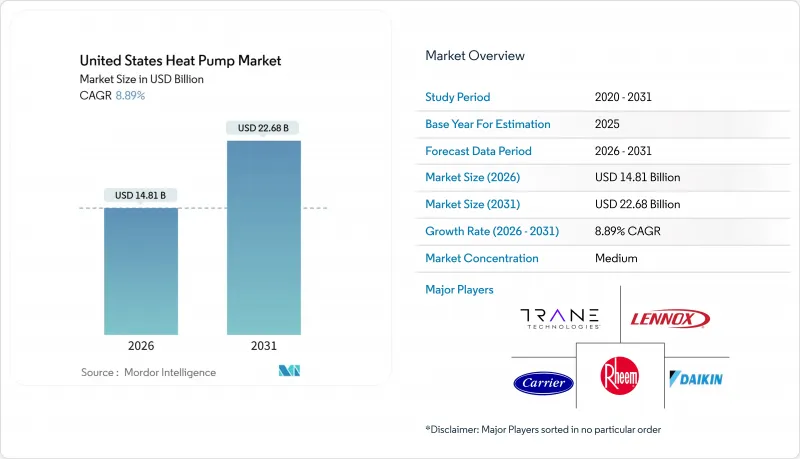
Mordor Intelligence에 의하면, 미국 히트펌프 시장 규모는 2026년에 148억 1,000만 달러가 되어, 2031년까지 226억 8,000만 달러에 이를 것으로 예측되며, 예측 기간 전체를 통해서 CAGR은 8.89%를 나타낼 전망입니다.
본 보고서는 유형별(공기원, 수원 등), 정격 출력별(10kW 이하, 10-20kW, 기타), 시스템 설계별(스플릿 시스템, 모노블록, 하이브리드 히트펌프), 최종 사용자(주거, 상업, 산업, 공공시설),및 용도(공간 냉난방, 온수 공급 등)별로 분류되어 있습니다. 시장 전망은 금액(달러) 기준으로 제시되어 있습니다.
미국 히트펌프 시장 동향 및 인사이트
‘인플레이션 억제법’에 따른 연방 세제 혜택이 보급을 촉진
공기원 열펌프에는 최대 2,000달러, 지열 열펌프 설치 비용의 30%를 지원하는 제25C조 및 제25D조의 세액 공제를 통해, 그동안 보급을 제한해 왔던 초기 비용 부담이 해소되고 있습니다. 각 OEM 기업의 실적 설명회에서는 2025년 출하 대수가 두 자릿수 성장을 보인 요인으로, 중산층 가구의 현금 흐름 부담을 경감시켜 주는 판매 시점의 세액 공제가 일관되게 거론되고 있습니다. 난방비가 공과금의 대부분을 차지하는 한랭지에서는 이 우대 조치로 인해 투자 회수 기간이 7년 미만으로 단축되어, 기존의 난방 설비가 아직 가동 중일 경우에도 개보수 공사가 촉진되고 있습니다. 시공업체 측에서는 리베이트가 세무 신고 시기까지 미뤄지지 않고 견적서에 명시되게 되면서 계약 성사율이 향상되고 있다는 보고가 접수되고 있습니다. 또한, 전력 회사는 성능 기반의 리베이트를 중첩 적용함으로써 수요를 더욱 확대하고 있으며, 매사추세츠주와 오리건주에서는 설치 비용의 40%에서 50%에 달하는 복합적인 우대 조치가 마련되어 있습니다.
GWP가 높은 냉매의 신속한 단계적 감축이 장비 교체 주기를 가속화하고 있습니다.
EPA의 AIM법에 따른 생산 상한선으로 인해 R-410A의 생산량이 감소하고, 현물 가격이 상승하고 있습니다. 이로 인해 서비스용 냉매 부족이 심각해지기 전에 판매업자들은 조기 교체를 촉진해야 하는 압박을 받고 있습니다. R-32 또는 R-454B 인증 제품 라인을 보유한 제조업체들은 미래를 내다본 규정 준수를 강조하고 있으며, 이를 통해 계약업체 채널에서 재판매 가격 프리미엄을 얻고 있습니다. 저밀도 냉매는 가변속 압축기와 결합함으로써 부분 부하 시 손실을 줄여주므로, 조기 도입 업체들은 계절 효율 향상이라는 혜택을 누리고 있습니다. 또한, 단계적 감축 일정은 ASHRAE의 안전 등급 분류를 가속화하여, 미가연성 냉매와 관련된 규제상의 병목 현상을 해소했습니다. 단기적인 공급 부족으로 인해 재생 R-410A에 의존하는 서비스 계약업체의 이익률은 압박받고 있지만, 여러 가지 냉매를 라인업에 갖춘 OEM 각사는 시장 점유율을 확대하며 더 높은 평균 판매 가격(ASP)을 실현하고 있습니다.
숙련된 설치 기술자 인력 부족이 설치 비용을 끌어올리고 있습니다.
HVAC 분야의 고용은 향후 10년간 8% 증가할 것으로 예상되지만, 히트펌프 전문 기술에 대한 수요 급증에는 여전히 미치지 못하고 있습니다. 2024년 설치 업체의 임금 중앙값은 5만 9,810달러에 달하며, 이로 인해 주거용 설치 비용 중 인건비가 45%를 초과하고 있습니다. 지방 지역에서는 계약업체가 장거리를 이동해야 하기 때문에 리드타임이 길어지고, 간접비가 증가하고 있습니다. 각 OEM 기업들은 인재 양성에 주력하고 있으며, 캐리어(Carrier)사의 ‘TechVantage’는 2028년까지 10만 명의 설치 기술자를 양성하는 것을 목표로 하고 있습니다. 한편, 유통업체은 현장 작업 시간을 단축하는 조립식 배관 키트의 도입을 시도하고 있습니다. 이러한 노력에도 불구하고 임금 상승 압력은 여전히 뿌리 깊어, 단기적인 판매량 증가를 억제하고 있습니다.
부문별 분석
2025년 매출의 74.83%를 차지한 것은 공기원 열펌프로, 이는 미국 열펌프 시장에 진입하는 가장 저렴한 수단이 되고 있습니다. 많은 주택 소유주는 2주 이내에 납품되는 가변 속도 스플릿 시스템으로 기존 덕트를 개조하고 있지만, 덕트리스 미니 스플릿 시스템은 다세대 주택 소유주에게 구조 공사를 하지 않고도 구역 제어가 가능하게 해줍니다. 영하의 환경에서는 운전 효율이 떨어지지만, 인버터 구동 압축기와 첨단 제상 사이클 덕분에 현재는 0°F에서도 COP를 1.8 이상으로 유지할 수 있게 되었습니다. 한편, 30%의 연방 세액 공제가 적용되는 지열 활용 솔루션은 9.31%의 연평균 성장률(CAGR)이 예상되며, 시공 비용은 비싸지만 수명 주기 비용의 차이는 점차 줄어들고 있습니다. WaterFurnace사의 폐쇄형 수직 시스템은 COP 5.2를 기록하고 있으며, 부하가 높은 지역에서는 7년 이내에 투자 회수가 가능합니다. 학군 및 기업 캠퍼스에서는 LEED 인증 획득과 긴 수명을 이유로 이 기술이 채택되고 있으며, 미국 히트펌프 시장에서 지열로의 점유율 전환이 더욱 진행될 조짐이 보입니다.
수명 주기 경제성에 더해, 지열의 안정적인 성능은 전력 수요가 피크에 달할 때 발생하는 가격 변동으로부터 사용자를 보호합니다. 이는 재생에너지가 주간 요금 변동을 초래하는 상황에서 매력적인 헤지 수단이 됩니다. 장비 공급업체들은 시공업체의 학습 곡선을 상쇄하기 위해 루프 필드의 설계, 시추, 시운전을 단일 계약으로 통합하고 있습니다. 이러한 턴키 모델은 도입 기간을 단축하고 설치 업체 부족이라는 과제를 해결함으로써, 지열을 미국 히트펌프 업계에서 가장 효율적인 선택지로 자리매김하고 있습니다.
2025년, 10kW 미만 시스템은 미국 히트펌프 시장 규모의 45.26%를 차지하며, 단독주택의 2-5톤 수요를 반영합니다. 판매업체들은 재고 회전율이 높고 표준화된 설치가 가능하기 때문에 이러한 SKU를 선호합니다. 30kW를 초과하는 용량 대역은 현재 규모는 작지만, 슈퍼마켓, 경공업 플랜트, 물류 센터가 Scope 1 배출량 감축을 위해 HVAC 부하의 전기화를 추진함에 따라 연평균 성장률(CAGR) 9.78%로 확대되고 있습니다. 모듈식 옥상 플랫폼은 여러 인버터 압축기를 통합하여 창고 내의 변동하는 내부 열 발생을 포착함으로써, 부분 부하 시의 비효율성을 대폭 줄여줍니다. 전력 회사는 이러한 시설에 수요 반응 인센티브를 제공하고 있으며, 가스 보일러에서 개조하는 것에 비해 순경제성이 향상되고 있습니다.
160°F를 초과하는 공정 열을 추구하는 산업 분야의 도입 기업들은 이코노마이저가 장착된 증기 주입 기능을 갖춘 2단 압축 시스템의 시범 운영을 진행하고 있습니다. 유제품 살균 및 섬유 제품 건조 분야의 초기 프로젝트에서는 천연 가스 보일러에 비해 연료비를 60% 절감할 수 있음이 입증되었으며, 이는 대용량 부문이 금세기 말까지 미국 히트펌프 시장 점유율에서 더 큰 비중을 차지할 가능성이 있음을 시사합니다.
기타 혜택:
- 엑셀 형식 시장 예측(ME) 시트
- 3개월간 애널리스트 지원
자주 묻는 질문
목차
제1장 서론
제2장 조사 방법
제3장 주요 요약
제4장 시장 구도
제5장 시장 규모와 성장 예측
제6장 경쟁 구도
제7장 시장 기회와 향후 전망
JHS 26.09.11According to Mordor Intelligence, the United States heat pump market size stood at USD 14.81 billion in 2026 and is projected to reach USD 22.68 billion by 2031, translating into an 8.89% CAGR across the forecast period.
This report is Segmented by Type (Air-Source, Water-Source, and More), Rated Capacity (Up To 10 Kilowatts, 10 To 20 Kilowatts, and More), System Design (Split System, Monobloc, and Hybrid Heat Pump), End-User (Residential, Commercial, Industrial and Institutional), and Application (Space Heating and Cooling, Water Heating and More). The Market Forecasts are Provided in Terms of Value (USD).
United States Heat Pump Market Trends and Insights
Federal Tax Incentives Under Inflation Reduction Act Boost Adoption
Section 25C and 25D credits covering up to USD 2,000 for air-source units and 30% of ground-source installed cost are eliminating the historical first-cost penalty that limited mainstream adoption. OEM earnings calls consistently attribute double-digit shipment growth in 2025 to point-of-sale credits that remove cash-flow friction for middle-income households. In cold-weather states where heat loads dominate utility bills, the incentive shortens payback to under seven years, stimulating retrofits even when legacy furnaces remain operational. Contractors report higher close rates because rebates are visible on proposals rather than deferred to tax season. Utilities further amplify demand by layering performance-based rebates, creating stacked incentives that reach 40% to 50% of installed cost in Massachusetts and Oregon.
Rapid Phasedown of High-GWP Refrigerants Accelerates Equipment Refresh Cycles
EPA's AIM Act caps are cutting R-410A production, raising spot prices and driving distributors to encourage accelerated replacement before service refrigerant scarcity becomes acute. Manufacturers with certified R-32 or R-454B product lines advertise future-proof compliance, giving them a resale premium in contractor channels. Early adopters benefit from improved seasonal efficiency because lower-density refrigerants pair with variable-speed compressors that reduce part-load losses. The phasedown timeline has also catalyzed ASHRAE to fast-track safety classifications, removing a regulatory bottleneck for mildly flammable refrigerants. While near-term supply tightness curbs margins for service contractors reliant on reclaimed R-410A, OEMs positioned with multi-refrigerant portfolios capture share and command higher ASPs.
Skilled-Installer Labor Shortage Inflates Installation Costs
HVAC employment is projected to grow 8% this decade but still lags accelerated demand for heat-pump-specific competencies. Median installer wages touched USD 59,810 in 2024, causing labor to exceed 45% of residential installed cost. Rural territories face extended lead times as contractors travel long distances, inflating soft costs. OEMs have pivoted into workforce development, Carrier's TechVantage aims to train 100,000 installers by 2028 while distributors experiment with prefabricated line-set kits that cut job-site hours. Despite these moves, wage inflation remains embedded, constraining near-term volume growth.
Other drivers and restraints analyzed in the detailed report include:
- State-Level Electrification Mandates Expand Beyond Coastal States
- Cold-Climate Heat Pump Performance Breakthroughs Unlock Northern Demand
- Legacy-Home Electrical-Panel Limits Curb Addressable Market
For complete list of drivers and restraints, kindly check the Table Of Contents.
Segment Analysis
Air-source units accounted for 74.83% of 2025 revenue as the lowest-cost entry point into the United States heat pump market. Most homeowners retrofit existing ducts with variable-speed split systems that ship in under two weeks, while ductless mini-splits give multifamily owners zone control without structural work. Operating efficiency dips in sub-freezing conditions, yet inverter-driven compressors and advanced defrost cycles now keep COP above 1.8 at 0 °F. On the other hand, ground-source solutions, supported by 30% federal credits, achieved a 9.31% CAGR outlook, eroding the lifecycle cost gap despite higher drilling expense. WaterFurnace's closed-loop vertical systems post COP 5.2, yielding sub-seven-year paybacks in high-load zones. School districts and corporate campuses embrace the technology for LEED certification and long service life, signaling further share migration toward geothermal in the United States heat pump market.
Beyond lifecycle economics, geothermal performance stability shields users from grid-peak price volatility, an attractive hedge as renewables drive intraday rate swings. Equipment suppliers are bundling loop-field design, drilling, and commissioning under single contracts to offset contractor learning curves. This turnkey model accelerates timelines and addresses installer scarcity, positioning geothermal as the premium efficiency choice within the United States heat pump industry.
Sub-10 kW systems furnished 45.26% of the United States heat pump market size in 2025, reflecting 2- to 5-ton demand in detached housing. Dealers favor these SKUs for inventory turns and standardized installation. Capacity bands above 30 kW, though smaller today, are scaling at 9.78% CAGR as supermarkets, light-manufacturing plants, and distribution centers electrify HVAC loads for Scope 1 reductions. Modular rooftop platforms integrate multiple inverter compressors to track variable internal gains in warehouses, slashing part-load inefficiency. Utilities reward these sites with demand-response incentives, improving net economics relative to gas boiler retrofits.
Industrial adopters pursuing process heat above 160 °F are piloting two-stage compression systems with economized vapor injection. Early projects in dairy pasteurization and textile drying demonstrate 60% fuel-cost cuts versus natural-gas boilers, hinting that high-capacity segments could command a larger slice of the United States heat pump market share by decade-end.
Complete Report Scope:
- By Source Type
- Air-Source
- Air-to-Air
- Air-to-Water
- Water-Source
- Surface Water
- Open Loop
- Ground / Geothermal Source
- Closed Loop Vertical
- Closed Loop Horizontal
- Direct Expansion
- Air-Source
- By Rated Capacity
- Up to 10 kW
- 10-20 kW
- 20-30 kW
- Above 30 kW
- By System Design
- Split System
- Monobloc
- Hybrid Heat Pump
- By End-User
- Residential
- Commercial
- Industrial
- Institutional
- By Application
- Space Heating and Cooling
- Water Heating
- District Heating
- Process and Industrial Heating
List of Companies Covered in this Report:
- Carrier Global Corporation
- DAIKIN INDUSTRIES, Ltd.,
- Trane Technologies plc
- Johnson Controls International plc
- Rheem Manufacturing Company
- Lennox International Inc.
- Mitsubishi Electric US, Inc.
- Bosch Thermotechnology Corp.
- Emerson Electric Co.
- GE Appliances, Inc. (a Haier company)
- Nortek Air Management
- Fujitsu General America, Inc.
- LG Electronics USA, Inc.
- WaterFurnace International, Inc.
- ClimateMaster, Inc.
- Goodman Manufacturing Co., L.P.
- Stiebel Eltron GmbH and Co. KG
- Samsung HVAC America, LLC
Additional Benefits:
- The market estimate (ME) sheet in Excel format
- 3 months of analyst support
TABLE OF CONTENTS
1 INTRODUCTION
- 1.1 Study Assumptions and Market Definition
- 1.2 Scope of the Study
2 RESEARCH METHODOLOGY
3 EXECUTIVE SUMMARY
4 MARKET LANDSCAPE
- 4.1 Market Overview
- 4.2 Market Drivers
- 4.2.1 Federal Tax Incentives Under Inflation Reduction Act Boost Adoption
- 4.2.2 Rapid Phasedown of High-GWP Refrigerants Accelerates Equipment Refresh Cycles
- 4.2.3 State-Level Electrification Mandates Expand Beyond Coastal States
- 4.2.4 Cold-Climate Heat Pump Performance Breakthroughs Unlock Northern Demand
- 4.2.5 Heat-Pump Water-Heater Rebates Open Parallel Sales Channel
- 4.2.6 OEM On-Shoring of Compressor Production Lowers Cost and Lead-Times
- 4.3 Market Restraints
- 4.3.1 Short-Term Refrigerant-Transition Supply Bottlenecks
- 4.3.2 Skilled-Installer Labor Shortage Inflates Installation Costs
- 4.3.3 Legacy-Home Electrical-Panel Limits Curb Addressable Market
- 4.3.4 Rising Interest Rates Dampen HVAC Replacement Decisions
- 4.4 Industry Supply- Chain Analysis
- 4.5 Regulatory Landscape
- 4.6 Technological Outlook
- 4.7 Impact of Macroeconomic Factors on the Market
- 4.8 Porter's Five Forces Analysis
- 4.8.1 Bargaining Power of Suppliers
- 4.8.2 Bargaining Power of Consumers
- 4.8.3 Threat of New Entrants
- 4.8.4 Intensity of Competitive Rivalry
- 4.8.5 Threat of Substitutes
5 MARKET SIZE AND GROWTH FORECASTS (VALUE)
- 5.1 By Source Type
- 5.1.1 Air-Source
- 5.1.1.1 Air-to-Air
- 5.1.1.2 Air-to-Water
- 5.1.2 Water-Source
- 5.1.2.1 Surface Water
- 5.1.2.2 Open Loop
- 5.1.3 Ground / Geothermal Source
- 5.1.3.1 Closed Loop Vertical
- 5.1.3.2 Closed Loop Horizontal
- 5.1.3.3 Direct Expansion
- 5.1.1 Air-Source
- 5.2 By Rated Capacity
- 5.2.1 Up to 10 kW
- 5.2.2 10-20 kW
- 5.2.3 20-30 kW
- 5.2.4 Above 30 kW
- 5.3 By System Design
- 5.3.1 Split System
- 5.3.2 Monobloc
- 5.3.3 Hybrid Heat Pump
- 5.4 By End-User
- 5.4.1 Residential
- 5.4.2 Commercial
- 5.4.3 Industrial
- 5.4.4 Institutional
- 5.5 By Application
- 5.5.1 Space Heating and Cooling
- 5.5.2 Water Heating
- 5.5.3 District Heating
- 5.5.4 Process and Industrial Heating
6 COMPETITIVE LANDSCAPE
- 6.1 Market Concentration
- 6.2 Strategic Moves
- 6.3 Market Share Analysis
- 6.4 Company Profiles (includes Global level Overview, Market level overview, Core Segments, Financials as available, Strategic Information, Market Rank/Share, Products and Services, Recent Developments)
- 6.4.1 Carrier Global Corporation
- 6.4.2 DAIKIN INDUSTRIES, Ltd.,
- 6.4.3 Trane Technologies plc
- 6.4.4 Johnson Controls International plc
- 6.4.5 Rheem Manufacturing Company
- 6.4.6 Lennox International Inc.
- 6.4.7 Mitsubishi Electric US, Inc.
- 6.4.8 Bosch Thermotechnology Corp.
- 6.4.9 Emerson Electric Co.
- 6.4.10 GE Appliances, Inc. (a Haier company)
- 6.4.11 Nortek Air Management
- 6.4.12 Fujitsu General America, Inc.
- 6.4.13 LG Electronics USA, Inc.
- 6.4.14 WaterFurnace International, Inc.
- 6.4.15 ClimateMaster, Inc.
- 6.4.16 Goodman Manufacturing Co., L.P.
- 6.4.17 Stiebel Eltron GmbH and Co. KG
- 6.4.18 Samsung HVAC America, LLC
7 MARKET OPPORTUNITIES AND FUTURE OUTLOOK
- 7.1 White-Space and Unmet-Need Assessment