

|
시장보고서
상품코드
2125485
급성 호흡곤란 증후군(ARDS) 치료 시장 : 시장 점유율 분석, 업계 동향 및 통계, 성장 예측(2026-2031년)Acute Respiratory Distress Syndrome Treatment - Market Share Analysis, Industry Trends & Statistics, Growth Forecasts (2026 - 2031) |
||||||
 Mordor Intelligence
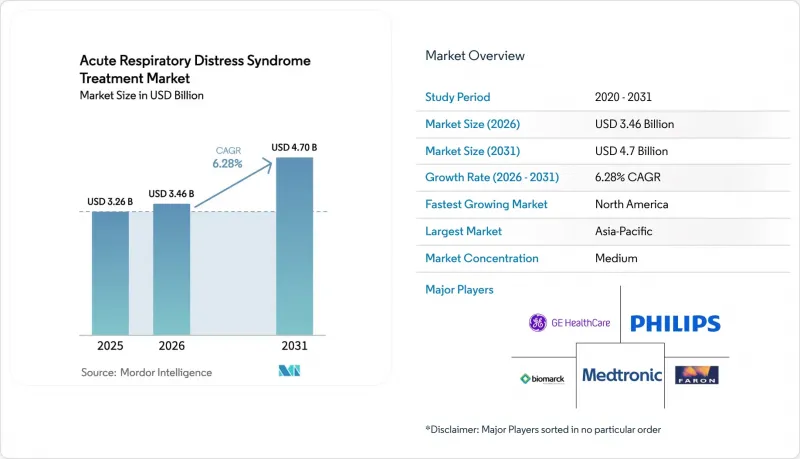
Mordor Intelligence에 의하면, 급성 호흡곤란 증후군(ARDS) 치료 시장 규모는 2025년 32억 6,000만 달러로 평가되었고, 2026년에는 34억 6,000만 달러로 추정되고, 2026-2031년 CAGR 6.28%로 성장을 지속할 전망이며, 2031년까지 47억 달러에 이를 것으로 예측됩니다.
본 보고서는 치료 방식별(의약품·약제 분류, 의료기기), 폐 손상 원인별(직접적 손상, 간접적 손상), 중증도별(경증, 중등도, 중증), 최종 사용자별(병원·중환자실, 전문 클리닉, 기타), 지역별(북미, 유럽, 아시아태평양, 기타)로 분류되어 있습니다. 시장 예측은 금액(달러) 기준으로 제시되어 있습니다.
세계의 급성 호흡곤란 증후군(ARDS) 치료 시장 동향 및 인사이트
ARDS의 주요 원인인 패혈증과 폐렴의 전 세계 발생률 증가
패혈증은 미국에서 매년 170만 명의 성인에게 영향을 미치며, 급성 호흡곤란 증후군(ARDS) 사례의 약 40%를 차지합니다. 인공호흡기 관련 폐렴은 인공호흡기를 착용하고 있는 환자의 최대 30%에서 발병하며, 중환자실(ICU) 입원 기간을 최대 9일 연장시키고 1인당 2만 4,410달러의 추가 비용을 발생시킵니다. AI를 활용한 조기 경보 모델을 통해 임상 증상이 나타나기 6시간 전에 패혈증 발병을 예측할 수 있게 되면서, 의료는 사후 대응형에서 예방형으로 전환되고 있습니다. 이러한 요인들이 복합적으로 작용하여 병원이 신속 진단 및 첨단 인공호흡 시스템에 투자함에 따라 급성 호흡곤란 증후군(ARDS) 치료 시장은 확대되고 있습니다.
높은 흡연율, 도시화, 심화되는 오염
2024년에는 미세 입자상 물질에 대한 노출이 전 세계적으로 879만 명의 조기 사망의 원인이 되었으며, 그 중 상당수가 ARDS로 진행되었습니다. 중국의 산업 집적지에서는 도시 지역의 대기 오염과 높은 흡연율이라는 위험 요인이 중첩되어 있으며, 이에 따라 정부는 2급 및 3급 도시에서 호흡기 질환 전문 중환자실(ICU) 병상을 증설하고 있습니다. 이러한 환경적 요인은 인구의 노출로 인한 영향이 수십 년에 걸쳐 누적되기 때문에 장기적인 시간 축에서 작용하지만, 영향을 받는 지역 전체에서 호흡기 질환의 기저 유병률 상승에 의료 시스템이 적응함에 따라 치료 시장은 즉각적으로 반응합니다.
중환자실(ICU)에서의 장기 입원 및 첨단 호흡 보조 장치로 인한 고액의 비용 부담
ARDS 치료에 따른 경제적 부담은 시장 진입에 있어 큰 장벽이 되고 있습니다. 중환자실(ICU)의 평균 비용은 병상당 하루 2만 5,927달러에 달하며, VAP 환자의 총 치료 비용은 평균 54만 4,467달러인 반면, 비-VAP 환자의 경우 20만 7,416달러에 그칩니다. 체외순환 시스템 및 전문 인력에 대한 설비 투자는 개발도상 지역에서의 진입 장벽을 높이고 있습니다. 유럽에서는 치료 결과에 따른 보상 제도의 대상이 되는 첨단 치료 제품이 5분의 1에 불과하여, 이로 인해 도입이 지연되고 급성 호흡곤란 증후군(ARDS) 치료 시장의 성장이 억제되고 있습니다.
부문 분석
의약품이 급성 호흡곤란 증후군(ARDS) 치료 시장의 56.62% 점유율을 차지하고 있음에도 불구하고, 의료기기 부문이 6.62%라는 가장 높은 연평균 성장률(CAGR)을 기록하고 있습니다. 해밀턴 C6와 같은 AI 인공호흡기는 1회 환기량을 실시간으로 최적화하는 반면, 메드트로닉(Medtronic)의 VitalFlow ECMO는 휴대용 체외순환 지원 기술을 발전시키고 있습니다. 서팍탄트 제제나 흡입형 일산화질소 장치는 약물 요법을 보완하고 있으며, 이러한 융합이 급성 호흡곤란 증후군(ARDS) 치료 시장 규모를 다각화하고 있는 것으로 나타났습니다.
혈관수축제, 코르티코스테로이드, 항생제의 사용은 여전히 필수적이지만, 의료기기를 중심으로 한 전략으로 인해 진정제의 필요성은 감소하고 있습니다. 포스포리파아제에 의한 분해에 내성을 가진 합성 서팜턴트는 임상시험 단계를 거치고 있으며, 향후 급성 호흡곤란 증후군(ARDS) 치료 시장의 한 축을 차지할 가능성이 있습니다. 의약품과 의료기기 기술의 융합을 통해 치료 성과를 최적화하는 동시에, 장기간의 인공호흡 관리 및 중환자실(ICU) 입원에 따른 합병증을 경감시키는 통합적인 치료 플랫폼이 구축되고 있습니다.
폐렴이나 흡인 등 직접적인 손상으로 인한 사례는 2025년에 매출의 61.75%를 차지했으나, 패혈증을 포함한 간접적인 기전에 의한 사례는 연평균 성장률(CAGR) 6.83%를 나타낼 것으로 예측됩니다. 패혈증으로 인한 사이토카인 폭풍은 전신성 염증을 유발하여 면역 조절제의 필요성을 높이고 있으며, 급성 호흡곤란 증후군(ARDS) 치료 시장의 기회를 확대되고 있습니다. 직접적 손상 기전과 간접적 손상 기전의 구분은 치료법 선택에 영향을 미칩니다. 직접적 손상은 서큘란트 보충 요법에 의해 양호한 반응을 보이는 경우가 많은 반면, 간접적 손상은 전신성 염증을 표적으로 한 면역 조절 요법을 통해 더 큰 효과를 얻을 가능성이 있기 때문입니다.
췌장염, 화상, 일반적인 외상은 보체 활성화, 호중구 동원, 사이토카인 방출을 동반하는 복잡한 염증 캐스케이드를 통해 ARDS 발병에 기여하는 또 다른 간접적인 손상 기전입니다. 이러한 경로에 대한 이해가 깊어짐에 따라, 광범위한 접근 방식이 아닌 특정 염증 매개체를 억제하는 표적 치료법을 위한 의약품 개발이 진행되고 있습니다. 바이오마커 기반 프로토콜을 통해 임상의는 손상 유형에 맞추어 치료법을 조정할 수 있게 되었으며, 이로 인해 유효성이 향상되고 인공호흡기 사용 일수가 단축됨에 따라 급성호흡곤란증후군(ARDS) 치료 시장 전체의 규모가 확대되고 있습니다.
지역별 분석
북미는 잘 갖춰진 ICU 인프라, 보험 환급 제도, 900건 이상의 진행 중인 유전자 치료 임상시험에 힘입어 39.10%의 시장 점유율로 1위를 차지했습니다. 미국의 병원에서는 ICU 내 섬망을 완화하고 인력 배치를 효율화하는 AI 예측 모듈이 도입되고 있습니다. 캐나다와 멕시코는 국경을 초월한 연구 및 의료기기 조달을 통해 응급의료 서비스를 현대화하고 있으며, 이로 인해 해당 지역의 급성 호흡곤란 증후군(ARDS) 치료 시장 규모가 확대되고 있습니다.
아시아태평양은 연평균 성장률(CAGR) 8.44%로 가장 빠르게 성장하고 있는 지역이며, 중국에서는 대기 오염과 관련된 대규모 발병률을 정책에 기반한 중환자실(ICU) 확충으로 연결하고 있습니다. 일본은 조기 개입의 효과를 높이는 고도 모니터링을 통해 사망률 감소를 중시하는 반면, 인도는 확장성이 뛰어난 고유량 산소 공급 시스템을 통해 비용과 접근 범위의 균형을 맞추고 있습니다. 이러한 종합적인 성장 동력에 힘입어, 해당 지역은 급성 호흡곤란 증후군(ARDS) 치료 시장에서 더 큰 점유율을 확보할 준비가 되어 있습니다.
유럽에서는 ‘첨단 치료 의료 제품(ATMP)’ 프레임워크에 따른 규제 조화를 통해 꾸준한 성장을 유지하고 있습니다. 승인된 첨단 치료 중 공공 자금 지원을 받는 것은 5분의 1에 그쳐, 보험 급여 환경은 여전히 어려운 상황이지만, 공동 인증 제도를 통해 품질 기준이 강화되고 국경을 넘는 환자의 접근성이 촉진되고 있습니다. 중동 및 아프리카와 남미는 여전히 신흥 시장이지만, 중환자 치료 능력 향상 및 AI 모니터링 도입을 위한 전략적 노력을 통해 세계 급성 호흡곤란 증후군(ARDS) 치료 시장에 단계적으로 진입할 것으로 기대됩니다.
기타 혜택
- 엑셀 형식 시장 예측(ME) 시트
- 3개월간의 애널리스트 지원
자주 묻는 질문
목차
제1장 서론
제2장 조사 방법
제3장 주요 요약
제4장 시장 구도
제5장 시장 규모 및 성장 예측
제6장 경쟁 구도
제7장 시장 기회 및 향후 전망
AJY 26.09.15According to Mordor Intelligence, the acute respiratory distress syndrome treatment market size is expected to grow from USD 3.26 billion in 2025 to USD 3.46 billion in 2026 and is forecast to reach USD 4.7 billion by 2031 at 6.28% CAGR over 2026-2031.
This report is Segmented by Treatment Modality (Medication/Drug Class, Medical Devices), Cause of Lung Injury (Direct Injury, Indirect Injury), Severity (Mild, Moderate, Severe), End User (Hospitals & Intensive Care Units, Specialty Clinics, Other End Users), and Geography (North America, Europe, Asia Pacific and More). The Market Forecasts are Provided in Terms of Value (USD).
Global Acute Respiratory Distress Syndrome Treatment Market Trends and Insights
Rising Global Incidence of Sepsis and Pneumonia as Leading Etiologies of ARDS
Sepsis affects 1.7 million adults in the United States each year and drives about 40% of acute respiratory distress syndrome cases. Ventilator associated pneumonia develops in up to 30% of ventilated patients, lengthening ICU stay by up to nine days and adding USD 24,410 in costs per person. AI powered early warning models can now predict sepsis events six hours before clinical signs appear, shifting care from reactive to preventive. These factors together enlarge the acute respiratory distress syndrome treatment market as hospitals invest in rapid diagnostics and advanced ventilation systems.
High Prevalence of Tobacco Smoking Urbanization and Growing Levels of Pollution
Fine particulate matter exposure contributed to 8.79 million premature deaths worldwide in 2024, many of which progressed to ARDS. Industrial hubs in China experience overlapping risks from urban pollution and high smoking rates, prompting the state to add respiratory-focused ICU beds in tier-2 and tier-3 cities. This environmental driver operates on extended timelines, as population exposure effects accumulate over decades, but the treatment market responds immediately as healthcare systems adapt to higher baseline respiratory morbidity rates across affected regions.
High Cost Burden of Prolonged ICU Stays and Advanced Respiratory Devices
The economic burden of ARDS treatment creates significant market access barriers, with average ICU costs reaching USD 25,927 per bed per day and total treatment expenses for VAP patients averaging USD 544,467 compared to USD 207,416 for non-VAP patients. Capital outlays for extracorporeal systems and specialized staff raise entry barriers in developing regions. Outcome-based reimbursement covers only one in five advanced therapy products in Europe, slowing adoption and tempering the growth of the acute respiratory distress syndrome treatment market.
Other drivers and restraints analyzed in the detailed report include:
- Advancements in Early Diagnosis via Point-of-Care Ultrasound and Biomarker Panels
- Expanding Clinical Pipeline of Immunomodulators and Regenerative Therapies
- Risk of Ventilator Associated Complications and Nosocomial Infections
For complete list of drivers and restraints, kindly check the Table Of Contents.
Segment Analysis
Medical devices record the fastest 6.62% CAGR even though medication retains 56.62% of the acute respiratory distress syndrome treatment market share. AI ventilators like the Hamilton C6 optimize tidal volume in real time, while Medtronic VitalFlow ECMO advances portable extracorporeal support. Surfactant formulations and inhaled nitric oxide devices complement drug regimens, illustrating convergence that diversifies the acute respiratory distress syndrome treatment market size.
Applications of vasoconstrictors, corticosteroids, and antibiotics remain essential, yet device-centric strategies lower sedative need. Synthetic surfactants resistant to phospholipase degradation progress through trials and may capture a future share of the acute respiratory distress syndrome treatment market. The convergence of pharmaceutical and device technologies creates integrated treatment platforms that optimize therapeutic outcomes while reducing complications associated with prolonged mechanical ventilation and ICU stays.
Direct injury situations such as pneumonia and aspiration captured 61.75% revenue in 2025, while indirect mechanisms including sepsis are forecast to register 6.83% CAGR. Sepsis driven cytokine storms create systemic inflammation that necessitates immunomodulators, widening opportunities within the acute respiratory distress syndrome treatment market. The distinction between direct and indirect injury mechanisms influences therapeutic selection, as direct injury often responds better to surfactant replacement therapy, while indirect injury may benefit more from immunomodulatory interventions targeting systemic inflammation.
Pancreatitis, burns, and general trauma represent additional indirect injury mechanisms that contribute to ARDS development through complex inflammatory cascades involving complement activation, neutrophil recruitment, and cytokine release. The growing understanding of these pathways drives pharmaceutical development toward targeted therapies that interrupt specific inflammatory mediators rather than broad-spectrum approaches. Biomarker guided protocols help clinicians tailor therapy to injury type, improving efficacy and reducing ventilation days, which lifts overall acute respiratory distress syndrome treatment market size.
Complete Report Scope:
- By Treatment Modality
- Medication/Drug Class
- Vasoconstrictors
- Bronchodilators
- Corticosteroids & Antibiotics
- Sedatives & Paralytics
- Surfactants
- Other Pharmacologics
- Medical Devices
- Mechanical Ventilators
- ECMO & Artificial Lung Systems
- Inhaled Nitric Oxide Delivery Systems
- Diagnostic & Monitoring Devices
- Other Devices
- Medication/Drug Class
- By Cause of Lung Injury
- Direct Injury
- Indirect Injury
- By Severity
- Mild
- Moderate
- Severe
- By End User
- Hospitals & Intensive Care Units
- Specialty Clinics
- Other End Users
- By Geography
- North America
- United States
- Canada
- Mexico
- Europe
- Germany
- United Kingdom
- France
- Italy
- Spain
- Rest of Europe
- Asia-Pacific
- China
- Japan
- India
- Australia
- South Korea
- Rest of Asia-Pacific
- Middle East and Africa
- GCC
- South Africa
- Rest of Middle East and Africa
- South America
- Brazil
- Argentina
- Rest of South America
- North America
Geography Analysis
North America leads with 39.10% market share supported by extensive ICU infrastructure, reimbursement pathways, and over 900 active gene therapy trials. United States hospitals deploy AI predictive modules that reduce ICU delirium and streamline staffing. Canada and Mexico modernize critical care services through cross border research and device sourcing, which expands regional acute respiratory distress syndrome treatment market size.
Asia Pacific is the fastest growing zone with 8.44% CAGR as China channels large scale pollution-related morbidity into policy backed ICU expansion. Japan emphasizes mortality reduction via advanced monitoring that fosters early intervention benefits, while India balances cost and reach through scalable high flow systems. Collective momentum positions the region to claim larger slices of the acute respiratory distress syndrome treatment market.
Europe maintains steady gains through regulatory harmonization under the Advanced Therapy Medical Products framework. Reimbursement remains tight with only one fifth of approved advanced therapies receiving public funding, yet joint accreditation strengthens quality standards that support cross border patient access. Middle East and Africa plus South America remain emerging but strategic initiatives to raise critical care capacity and adopt AI monitoring promise gradual inclusion in the global acute respiratory distress syndrome treatment market.
- Faron Pharmaceuticals
- BioMarck Pharmaceuticals
- GE Healthcare
- Hamilton Medical
- Medtronic
- Koninklijke Philips
- Fisher & Paykel Healthcare
- Dragerwerk
- Athersys
- ALung Technologies Inc. (LivaNova)
- VERO Biotech
- Mesoblast Ltd.
- Gilead Sciences
- Windtree Therapeutics
- Aqualung Therapeutics
Additional Benefits:
- The market estimate (ME) sheet in Excel format
- 3 months of analyst support
TABLE OF CONTENTS
1 Introduction
- 1.1 Study Assumptions & Market Definition
- 1.2 Scope of the Study
2 Research Methodology
3 Executive Summary
4 Market Landscape
- 4.1 Market Overview
- 4.2 Market Drivers
- 4.2.1 Rising Global Incidence of Sepsis and Pneumonia as Leading Etiologies of ARDS
- 4.2.2 High Prevalence of Tobacco Smoking, Urbanization, And Growing Levels of Pollution
- 4.2.3 Advancements in Early Diagnosis via Point-of-Care Ultrasound & Biomarker Panels
- 4.2.4 Expanding Clinical Pipeline of Immunomodulators and Regenerative Therapies
- 4.2.5 Healthcare Digitization Enabling Real-Time ICU Data Analytics for Optimized ARDS Management
- 4.2.6 Increased Healthcare Spending and Strategic Partnerships and M&A Activities
- 4.3 Market Restraints
- 4.3.1 High Cost Burden of Prolonged ICU Stays and Advanced Respiratory Devices
- 4.3.2 Risk of Ventilator-Associated Complications and Nosocomial Infections
- 4.3.3 Stringent Regulatory and Ethical Hurdles for Cell-Based & Gene Therapies
- 4.3.4 Lack of Standardized Treatment Protocols and Complex Pathophysiology & Diagnosis
- 4.4 Value / Supply-Chain Analysis
- 4.5 Regulatory Landscape
- 4.6 Technological Outlook
- 4.7 Porter's Five Forces Analysis
- 4.7.1 Threat of New Entrants
- 4.7.2 Bargaining Power of Buyers
- 4.7.3 Bargaining Power of Suppliers
- 4.7.4 Threat of Substitute Products
- 4.7.5 Intensity of Competitive Rivalry
5 Market Size & Growth Forecasts (Value)
- 5.1 By Treatment Modality
- 5.1.1 Medication/Drug Class
- 5.1.1.1 Vasoconstrictors
- 5.1.1.2 Bronchodilators
- 5.1.1.3 Corticosteroids & Antibiotics
- 5.1.1.4 Sedatives & Paralytics
- 5.1.1.5 Surfactants
- 5.1.1.6 Other Pharmacologics
- 5.1.2 Medical Devices
- 5.1.2.1 Mechanical Ventilators
- 5.1.2.2 ECMO & Artificial Lung Systems
- 5.1.2.3 Inhaled Nitric Oxide Delivery Systems
- 5.1.2.4 Diagnostic & Monitoring Devices
- 5.1.2.5 Other Devices
- 5.1.1 Medication/Drug Class
- 5.2 By Cause of Lung Injury
- 5.2.1 Direct Injury
- 5.2.2 Indirect Injury
- 5.3 By Severity
- 5.3.1 Mild
- 5.3.2 Moderate
- 5.3.3 Severe
- 5.4 By End User
- 5.4.1 Hospitals & Intensive Care Units
- 5.4.2 Specialty Clinics
- 5.4.3 Other End Users
- 5.5 By Geography
- 5.5.1 North America
- 5.5.1.1 United States
- 5.5.1.2 Canada
- 5.5.1.3 Mexico
- 5.5.2 Europe
- 5.5.2.1 Germany
- 5.5.2.2 United Kingdom
- 5.5.2.3 France
- 5.5.2.4 Italy
- 5.5.2.5 Spain
- 5.5.2.6 Rest of Europe
- 5.5.3 Asia-Pacific
- 5.5.3.1 China
- 5.5.3.2 Japan
- 5.5.3.3 India
- 5.5.3.4 Australia
- 5.5.3.5 South Korea
- 5.5.3.6 Rest of Asia-Pacific
- 5.5.4 Middle East and Africa
- 5.5.4.1 GCC
- 5.5.4.2 South Africa
- 5.5.4.3 Rest of Middle East and Africa
- 5.5.5 South America
- 5.5.5.1 Brazil
- 5.5.5.2 Argentina
- 5.5.5.3 Rest of South America
- 5.5.1 North America
6 Competitive Landscape
- 6.1 Market Concentration
- 6.2 Market Share Analysis
- 6.3 Company Profiles (includes Global level Overview, Market level overview, Core Segments, Financials as available, Strategic Information, Market Rank/Share for key companies, Products & Services, and Recent Developments)
- 6.3.1 Faron Pharmaceuticals
- 6.3.2 BioMarck Pharmaceuticals
- 6.3.3 GE Healthcare
- 6.3.4 Hamilton Medical
- 6.3.5 Medtronic plc
- 6.3.6 Philips Healthcare
- 6.3.7 Fisher & Paykel Healthcare Ltd.
- 6.3.8 Dragerwerk AG & Co. KGaA
- 6.3.9 Athersys Inc.
- 6.3.10 ALung Technologies Inc. (LivaNova)
- 6.3.11 VERO Biotech
- 6.3.12 Mesoblast Ltd.
- 6.3.13 Gilead Sciences Inc.
- 6.3.14 Windtree Therapeutics
- 6.3.15 Aqualung Therapeutics
7 Market Opportunities & Future Outlook
- 7.1 White-space & Unmet-Need Assessment


