

|
시장보고서
상품코드
2125486
인도의 용해성 성분 포함 증류 잔류물(DDGS) 시장 : 시장 점유율 분석, 업계 동향 및 통계, 성장 예측(2026-2031년)India Dried Distillers Grain With Solubles - Market Share Analysis, Industry Trends & Statistics, Growth Forecasts (2026 - 2031) |
||||||
 Mordor Intelligence
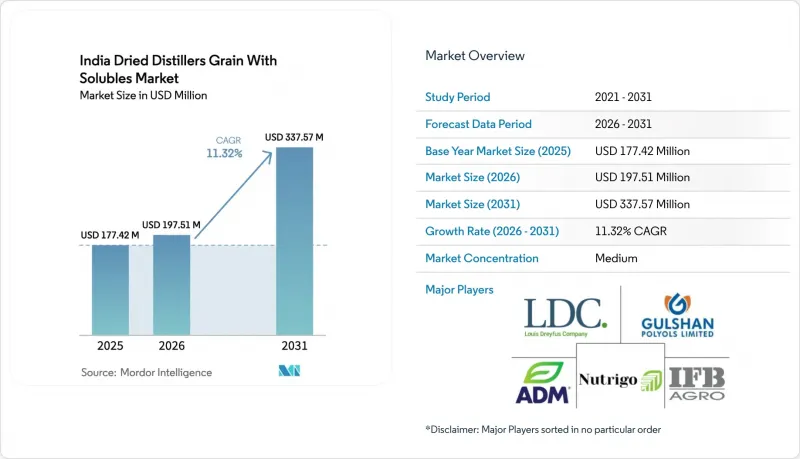
Mordor Intelligence에 의하면, 인도의 용해성 성분 포함 증류 잔류물(DDGS) 시장 규모는 2025년에 1억 7,742만 달러로 평가되었고, 2026년 1억 9,751만 달러로 추정되고, 2031년까지 3억 3,757만 달러에 이를 것으로 예측되며, 예측 기간(2026-2031년) CAGR은 11.32%입니다.
본 보고서는 제품 유형별(옥수수, 밀, 쌀, 혼합 곡물, 기타 제품 유형) 및 동물 유형별(반추동물, 가금류, 돼지, 수산 양식, 기타 동물 유형)로 분류되어 있습니다. 시장 예측은 금액(달러) 기준으로 제시되어 있습니다.
인도의 용해성 성분 포함 증류 잔류물(DDGS) 시장 동향 및 인사이트
지속 가능한 가축 사료 원료에 대한 수요 증가
인도의 축산 부문은 2024년에 7,800만 톤의 소용 농축 사료 부족에 직면하고 있으며, 이로 인해 사료 제조업체들은 현지에서 구할 수 있고 순환 경제의 원칙을 뒷받침하는 대체 단백질 원료를 모색할 수밖에 없게 되었습니다. DDGS는 에탄올 생산의 부산물을 사료로 전환함으로써 대두박 수입에 대한 의존도를 낮추고 외화를 절약함으로써 이러한 요건을 충족합니다. 연간 1,700만 톤의 배합 사료를 생산하는 대규모 사료 공장에서는 적절한 품질 관리 조치를 통해 단백질 함량이 26-30%로 안정적이고 소화율이 높다는 특징 덕분에 DDGS를 활용하고 있습니다. 육류 가공업체들의 지속가능성 인증 도입이 확대됨에 따라, 탄소 발자국이 낮고 지역 기반 공급망을 갖춘 원료의 사용이 장려되고 있습니다. 이러한 요인들로 인해 DDGS는 낙농 사업, 가금류 통합 사업자, 상업용 양식 시설용 사료 배합에서 필수적인 성분으로서의 입지를 확고히 하고 있습니다.
국내 에탄올 생산 확대에 따른 DDGS 공급 견인
인도에서는 E20 혼합 목표를 달성하기 위해 연간 약 101억 6,000만 리터의 에탄올이 필요합니다. 2024년 중반까지 곡물 기반 증류소에서 18억 1,000만 리터의 에탄올이 공급되었으며, 그중 옥수수가 11억 리터를 차지하여 다량의 DDGS 생산을 이끌어 냈습니다. 2025년 3월 시행된 정책에 따라, 협동조합 계열 제당 공장은 사탕수수 착즙 시즌 이외에도 옥수수나 손상된 식용 곡물을 가공할 수 있게 되어, 연중 DDGS 생산이 가능해졌습니다. 정부는 자본 비용을 절감하기 위해 5년 동안 최대 6%의 이자 보조금을 제공하고 있으며, 한편 인도 전국 농업협동조합 판매연맹(National Agricultural Cooperative Marketing Federation of India Ltd.)은 안정적인 곡물 조달을 확보하고 있습니다. 이러한 조치 덕분에 인도의 용해성 성분 포함 증류 잔류물(DDGS) 시장에서 안정적인 생산량이 유지되고 있습니다.
GST 분류의 불확실성과 세금 부담
인도의 용해성 성분 포함 증류 잔류물(DDGS) 시장은 GST(상품 및 서비스세) 분류와 관련된 과제에 직면해 있습니다. 이는 DDGS가 5%의 GST가 적용되는 ‘동물사료’로 분류될지, 아니면 18%의 GST가 적용되는 ‘공업 제품’으로 분류될지 여부에 달려 있기 때문입니다. 이러한 분류의 불확실성은 생산자의 가격 전략과 사료 제조업체의 조달 결정에 영향을 미치고 있습니다. 세무상 분류는 옥수수 유래, 쌀 유래, 혼합 제품 등 DDGS 유형에 따라 달라지며, 이로 인해 시장의 세분화와 관리상의 과제가 발생하고 있습니다. 인도 식품안전기준청(FSSAI)은 식용 동물에게 급여되는 사료에 대해 인도표준협회(BIS)의 인증을 의무화하고 있으며, 그 결과 규제 관련 비용과 지연이 발생하고 있어 특히 소규모 생산자들에게 큰 영향을 미치고 있습니다.
부문 분석
2025년, 인도의 용해성 성분 포함 증류 잔류물(DDGS) 시장에서 옥수수 기반 제품이 64.90%의 점유율을 차지했습니다. 이는 곡물 기반 증류소에서 옥수수가 광범위하게 사용되고 있으며, 사료 배합업체들 사이에서 확고한 수용도가 형성되어 있음을 반영합니다. 인도의 옥수수 기반 DDGS 시장은 안정적인 품질, 예측 가능한 공급, 마하라슈트라주, 우타르프라데시주, 카르나타카주에 걸친 에탄올 생산 거점의 지속적인 생산 능력 확장의 혜택을 받고 있습니다. 이해관계자들은 신뢰할 수 있는 아미노산 조성 및 변동성이 적다는 점 때문에 옥수수 기반 DDGS를 선호하며, 가금류 및 유우 사료에서 높은 배합 비율이 유지되고 있습니다. 확립된 국내 거래 네트워크가 옥수수 기반 DDGS의 유통을 강화하고 있어, 제분업자들은 선물 계약을 통해 안정적인 품질의 제품을 조달할 수 있게 되었습니다.
쌀 기반 DDGS 시장은 2031년까지 연평균 성장률(CAGR) 11.96%라는 급속한 성장을 이루고 있습니다. 이러한 성장은 정부의 흠집 쌀 및 깨진 쌀 할당 정책에 기인하며, 증류소는 2025년에 1 퀸탈당 2,250루피(1톤당 270달러)의 보조금이 포함된 가격으로 이를 구매하고 있습니다. 이 원료공급으로 공장은 연중 가동을 유지할 수 있을 뿐만 아니라, 섬유질 함량이 높은 어류 및 새우 사료에 유용한 독자적인 영양 프로파일을 갖추고 있습니다. 밀, 보리, 수수 등은 여전히 틈새 제품이지만, 이러한 곡물이 윤작의 주류를 이루는 지역에서는 배합 유연성을 높여줍니다. 다양한 원료의 조합을 통해 사료 제조업체는 혼합된 DDGS 제품을 시험적으로 사용하여, 품종별로 최적의 단백질, 섬유질, 에너지 균형을 조정한 사료를 최적화할 수 있게 됩니다.
기타 혜택
- 엑셀 형식 시장 예측(ME) 시트
- 3개월간의 애널리스트 지원
자주 묻는 질문
목차
제1장 서론
제2장 조사 방법
제3장 주요 요약
제4장 시장 구도
제5장 시장 규모 및 성장 예측
제6장 경쟁 구도
제7장 시장 기회 및 향후 전망
AJY 26.09.15According to Mordor Intelligence, the India dried distillers grain with solubles market size was valued at USD 177.42 million in 2025 and estimated to grow from USD 197.51 million in 2026 to reach USD 337.57 million by 2031, at a CAGR of 11.32% during the forecast period (2026-2031).
This report is Segmented by Product Type (Corn, Wheat, Rice, Blended Grains, and Other Product Types), and Animal Type (Ruminants, Poultry, Swine, Aquaculture, and Other Animal Types). The Market Forecasts are Provided in Terms of Value (USD).
India Dried Distillers Grain With Solubles Market Trends and Insights
Rising Demand for Sustainable Livestock Feed Ingredients
India's livestock sector faces a cattle concentrate deficit of 78 million metric tons in 2024, compelling feed manufacturers to seek alternative protein sources that are locally available and support circular economy principles. DDGS meets these requirements by converting ethanol byproducts into feed, reducing dependence on soybean meal imports, and conserving foreign exchange. Organized feed mills, which produce 17 million metric tons of compound feed annually, utilize DDGS for its consistent 26-30% protein content and digestibility when managed with appropriate quality control measures. The increasing adoption of sustainability certifications by meat processors encourages the use of ingredients with reduced carbon footprints and localized supply chains. These factors establish DDGS as an essential component in feed formulations for dairy operations, poultry integrators, and commercial aquaculture facilities.
Expansion of Domestic Ethanol Production Drives DDGS Supply
India requires approximately 10.16 billion liters of ethanol annually to achieve E20 blending targets. By mid-2024, grain-based distilleries supplied 1.81 billion liters of ethanol, with maize contributing 1.10 billion liters and generating significant DDGS production. The March 2025 policy allows cooperative sugar mills to process maize and damaged food grains beyond the cane-crushing season, enabling year-round DDGS production. The government provides interest subvention up to 6% for five years to reduce capital costs, while the National Agricultural Cooperative Marketing Federation of India Ltd. ensures stable grain procurement. These measures support consistent DDGS production volumes in the India dried distillers grain with solubles market.
Uncertain GST Classification and Tax Burden
The India dried distillers grain with solubles market faces GST classification challenges, as it can be categorized either as animal feed at 5% GST or as industrial by-products at 18% GST. This classification uncertainty affects pricing strategies for producers and procurement decisions for feed manufacturers. The tax classification varies for different DDGS types, including corn-based, rice-based, and blended products, which creates market fragmentation and administrative challenges. The Food Safety and Standards Authority of India requires Bureau of Indian Standards Certification for animal feeds used in food-producing animals, resulting in regulatory costs and delays that particularly impact small-scale producers.
Other drivers and restraints analyzed in the detailed report include:
- Cost-Effective Protein and Fiber Source Versus Conventional Meals
- Adoption of DDGS in Commercial Aquaculture Feed Blends
- Volatile Domestic Raw Material Prices Disrupt Supply
For complete list of drivers and restraints, kindly check the Table Of Contents.
Segment Analysis
Corn accounted for 64.90% of the India dried distillers grain with solubles market share in 2025, reflecting the extensive use of maize within grain-based distilleries and its established acceptance among feed formulators. The India dried distillers grain with solubles market for corn variants benefits from consistent quality, predictable supply, and ongoing capacity additions in ethanol clusters across Maharashtra, Uttar Pradesh, and Karnataka. Industry stakeholders prefer corn DDGS due to its reliable amino acid profiles and lower variability, maintaining high inclusion rates in poultry and dairy diets. Established domestic trading networks strengthen corn DDGS distribution, enabling mills to contract forward volumes with consistent quality.
Rice is experiencing rapid growth with a 11.96% CAGR through 2031. This growth stems from government allocations of damaged and broken rice that distilleries purchase at subsidized rates of Rs 2,250 per quintal (USD 270 per metric ton) in 2025. This raw material supply ensures year-round plant utilization and provides a distinct nutrient profile valuable in fish and shrimp feeds that accommodate higher fiber content. Wheat, barley, and sorghum remain niche products but provide formulation flexibility in regions where these grains dominate crop rotations. The diverse feedstock mix enables feed mills to test blended DDGS products to optimize protein, fiber, and energy balance for species-specific diets.
Complete Report Scope:
- By Product Type
- Corn
- Wheat
- Rice
- Blended Grains
- Other Product Types (Barley, Sorghum, and Bajra)
- By Animal Type
- Ruminants
- Poultry
- Swine
- Aquaculture
- Other Animal Types (Equine, Camel, etc.)
List of Companies Covered in this Report:
- ADM (Archer Daniels Midland Company)
- Louis Dreyfus Company B.V.
- IFB Agro Industries Limited
- Globus Spirits Limited
- Grainotch Industries Limited
- Nutrigo Feeds Pvt Ltd (SSL Group)
- Prorich Agro Foods Pvt. Ltd
- Gulshan Polyols Limited (Gulshan Holdings Private Limited)
- Crux Biotech India Private Limited
- Rainbow Biotech
- Radha Group of Companies (Rishaan Enterprises)
- Innovative Soch
- CB Agro Food Private Limited
- Prodigy Foods Pvt. Ltd.
- Afzal Industries
Additional Benefits:
- The market estimate (ME) sheet in Excel format
- 3 months of analyst support
TABLE OF CONTENTS
1 Introduction
- 1.1 Study Assumptions and Market Definition
- 1.2 Scope of the Study
2 Research Methodology
3 Executive Summary
4 Market Landscape
- 4.1 Market Overview
- 4.2 Market Drivers
- 4.2.1 Rising Demand for Sustainable Livestock Feed Ingredients
- 4.2.2 Expansion of Domestic Ethanol Production Drives DDGS Supply
- 4.2.3 Cost-Effective Protein and Fiber Source Versus Conventional Meals
- 4.2.4 Government Biofuel Mandate Catalyzes New Distilleries
- 4.2.5 Adoption of DDGS in Commercial Aquaculture Feed Blends
- 4.2.6 Introduction of High-Protein Fractionated DDGS Improves Feed Conversion
- 4.3 Market Restraints
- 4.3.1 Uncertain GST Classification and Tax Burden
- 4.3.2 Anti-Nutritional Risks From Excess Inclusion in Animal Rations
- 4.3.3 Volatile Domestic Raw Material Prices Disrupt Supply
- 4.3.4 Limited Bulk Logistics From Distilleries to Demand Centers
- 4.4 Regulatory Landscape
- 4.5 Technological Outlook
- 4.6 Porter's Five Forces Analysis
- 4.6.1 Bargaining Power of Suppliers
- 4.6.2 Bargaining Power of Buyers
- 4.6.3 Threat of New Entrants
- 4.6.4 Threat of Substitute Products
- 4.6.5 Intensity of Competitive Rivalry
5 Market Size and Growth Forecasts (Value)
- 5.1 By Product Type
- 5.1.1 Corn
- 5.1.2 Wheat
- 5.1.3 Rice
- 5.1.4 Blended Grains
- 5.1.5 Other Product Types (Barley, Sorghum, and Bajra)
- 5.2 By Animal Type
- 5.2.1 Ruminants
- 5.2.2 Poultry
- 5.2.3 Swine
- 5.2.4 Aquaculture
- 5.2.5 Other Animal Types (Equine, Camel, etc.)
6 Competitive Landscape
- 6.1 Market Concentration
- 6.2 Strategic Moves
- 6.3 Market Share Analysis
- 6.4 Company Profiles (Includes Global Level Overview, Market Level Overview, Core Segments, Financials as Available, Strategic Information, Market Rank/Share for Key Companies, Products and Services, and Recent Developments)
- 6.4.1 ADM (Archer Daniels Midland Company)
- 6.4.2 Louis Dreyfus Company B.V.
- 6.4.3 IFB Agro Industries Limited
- 6.4.4 Globus Spirits Limited
- 6.4.5 Grainotch Industries Limited
- 6.4.6 Nutrigo Feeds Pvt Ltd (SSL Group)
- 6.4.7 Prorich Agro Foods Pvt. Ltd
- 6.4.8 Gulshan Polyols Limited (Gulshan Holdings Private Limited)
- 6.4.9 Crux Biotech India Private Limited
- 6.4.10 Rainbow Biotech
- 6.4.11 Radha Group of Companies (Rishaan Enterprises)
- 6.4.12 Innovative Soch
- 6.4.13 CB Agro Food Private Limited
- 6.4.14 Prodigy Foods Pvt. Ltd.
- 6.4.15 Afzal Industries


