

|
시장보고서
상품코드
2125496
유럽의 가정용 에너지 관리 시스템 시장 : 시장 점유율 분석, 업계 동향 및 통계, 성장 예측(2026-2031년)Europe Home Energy Management System - Market Share Analysis, Industry Trends & Statistics, Growth Forecasts (2026 - 2031) |
||||||
 Mordor Intelligence
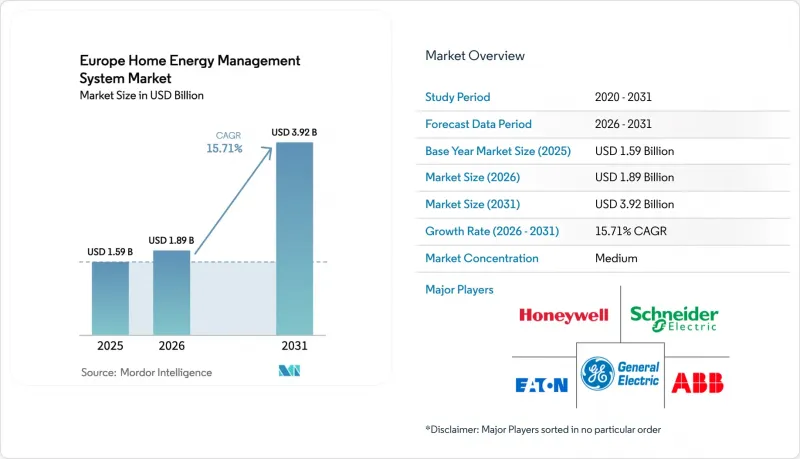
Mordor Intelligence에 의하면, 유럽의 가정용 에너지 관리 시스템 시장 규모는 2025년에 15억 9,000만 달러로 평가되었고, 2026년에 18억 9,000만 달러로 추정되고, 2031년까지 39억 2,000만 달러에 이를 것으로 예측됩니다.
2026-2031년 연평균 성장률(CAGR) 15.71%로 성장할 것으로 전망됩니다.
본 보고서는 구성 요소별(하드웨어, 소프트웨어, 서비스), 제품 유형별(조명 제어, 자가 모니터링 시스템·서비스, 프로그래밍 가능한 통신 기능 탑재 온도 조절기, 고급 중앙 제어 장치, 기타), 기술별(Zigbee, Wi-Fi, 기타), 설치 유형별(신축, 개조 설치), 지역별로 분류되어 있습니다. 시장 전망은 금액(달러) 기준으로 제시되어 있습니다.
유럽의 가정용 에너지 관리 시스템 시장 동향 및 인사이트
EU 청정 에너지 패키지에 따른 스마트 계량기 도입 의무화
2026년까지 가구의 80%를 커버함으로써, 안전한 백본을 통해 30분마다 소비 데이터를 전송하는 디지털 기반이 확립되어, 소매업체는 도매 가격에 따라 변동하는 세분화된 요금제를 제시할 수 있게 됩니다. 독일은 2025년 초에 이 기준을 초과하였고, 스마트 계량기 도입을 동적 요금제로 전환함에 따라, 사전에 프로그램된 부하 이동을 가능하게 하는 자동 제어 장치에 대한 소비자 수요가 증가하고 있습니다. 영국의 5,700만 건에 달하는 설치 실적은 그 규모를 잘 보여주고 있지만, 초기 SMETS1 기기에서 상호 운용성 문제가 여전히 남아 있어 하드웨어의 특이성을 추상화할 수 있는 플랫폼 독립적인 소프트웨어의 가치가 부각되고 있습니다. 프랑스의 Linky 계량기는 2024년에 전국적인 보급을 달성했으나, 동적 요금제 도입이 지연되고 있어 가정용 에너지 관리 패키지를 활용하는 신생 공급업체들이 시장 점유율을 확보할 여지가 남아 있습니다. 이미 스마트 요금 보급률이 70%를 넘어선 스페인의 사례는 정책의 명확성이 유럽 가정용 에너지 관리 시스템 시장의 두 자릿수 성장 궤적과 직접적인 상관관계가 있음을 보여줍니다. 이 지역 전체에서 스마트 계량기의 보급은 더 이상 예측 변수가 아니라, 자동화된 유연성 서비스를 뒷받침하는 운영상의 현실이 되었습니다.
에너지 위기 이후 가정용 전기요금의 급등
2025년 1분기, 독일 가구는 1kWh당 0.42유로(1kWh당 0.47달러)를 지불했는데, 이는 여전히 위기 이전 수준보다 60% 높은 수준이며, 소비자의 비용 절감을 목적으로 한 자동화에 대한 관심이 더욱 높아지고 있습니다. 영국의 요금 상한선은 1kWh당 0.28파운드(1kWh당 0.36달러)에 달했으며, ‘애자일(Agile)’ 요금제를 이용하는 고객들은 기기의 가동 주기를 낮 시간대의 낮은 가격대에 맞추어 조정함으로써 연간 180파운드(230달러)를 절약한 것으로 입증되었습니다. 스페인에서는 피크 시간대와 비피크 시간대의 가격 차이가 1kWh당 0.15유로(1kWh당 0.17달러)로 확대되어, 배터리 저장 장치를 갖춘 가구의 차익 거래 기회가 증가했습니다. 소매 가격의 급등으로 인해 온도 조절기, 회로 레벨 모니터, 클라우드 소프트웨어를 결합한 하드웨어 번들의 투자 회수 기간이 단축되었으며, 가격 상승 압력이 유럽의 가정용 에너지 관리 시스템 시장 전체에서 도입을 촉진하는 계기가 되고 있습니다.
기존 제어 시스템에 비해 높은 초기 하드웨어 비용
가정용 에너지 관리 키트의 전체 세트 가격은 800-1,500유로(900-1,690달러)이지만, 기본적인 프로그래밍식 온도 조절기는 150-250유로(169-281달러)입니다. 가처분 소득이 낮고 요금 체계의 변동 폭이 작은 스페인, 이탈리아, 포르투갈의 가구에서는 5년이라는 회수 기간이 너무 길다고 느끼는 경우가 많이 나타납니다. 2025년 조사에 따르면, 스페인 응답자의 48%가 도입의 주요 장벽으로 비용을 꼽았습니다. tado나 Hive의 번들 플랜에서 볼 수 있듯이, 단말기 비용을 면제하는 대신월10-15유로(11-17달러)의 서비스 요금을 지불하는 구독 모델이 등장하여 보급률은 확대되고 있지만, 남유럽 시장에서 도입을 저해하는 요인은 아직 해소되지 못하고 있습니다.
부문 분석
센서, 스마트 플러그, 게이트웨이는 데이터 수집에 필수적이기 때문에 2025년 지출의 48.19%를 하드웨어가 차지했으나, 성장의 중심은 이러한 자산을 통합·관리하는 클라우드 플랫폼으로 이동하고 있습니다. 소프트웨어 매출은 애그리게이터가 알고리즘, 수요 반응(demand response) 등록, 도매 시장 입찰을 월간 구독에 묶어 제공함에 따라 2031년까지 16.23%의 성장률을 기록하며 증가할 것입니다. 이러한 수익 구조의 변화로 인해 지속적 수익이 증가하고 공급업체의 이익률이 개선될 뿐만 아니라, 유럽의 가정용 에너지 관리 시스템 시장 전반에 벤처 캐피털 유입이 촉진될 것입니다. 설치 및 원격 모니터링을 포괄하는 서비스 역시 가정이 기술적 복잡성을 외부에 위탁하는 추세에 따라 유사한 성장 궤도에 올라서고 있습니다.
동적 요금 체계를 조기에 도입한 사용자들은 가격 곡선을 예측하고, 피크 시간 30분 전에 예열 주기를 예약할 수 있는 소프트웨어가 필요합니다. Octopus는 2025년에 24억 건의 30분 단위 계량 데이터를 처리하고, 18만 개의 분산형 배터리를 최적화했습니다. 이는 차별화의 핵심이 구리선이 아니라 코드에 있음을 보여줍니다. 슈나이더 일렉트릭(Schneider Electric)은 2024 회계연도에 소프트웨어 및 서비스가 가정용 부문 매출의 34%를 차지했다고 보고하며, 이 부문의 수익화에서 우위를 점하고 있음을 부각시켰습니다.
조명 제어는 소비자들이 일찍부터 친숙해져 왔기 때문에 2025년에도 매출 점유율 37.28%를 유지했으나, 요금 차익 거래의 효과는 제한적입니다. 연간 16.51%의 속도로 성장하고 있는 자가 모니터링 플랫폼에는 회로 수준의 계량기, 요금 API, 모바일 대시보드가 통합되어 있어 프로슈머가 주간 가격 차이를 활용하거나 대기 전력을 절감할 수 있게 해줍니다. 이로 인해 소프트웨어 구독과 관련된 유럽 가정용 에너지 관리 시스템 시장 규모가 확대되고 있습니다. 한때 주력 기기였던 온도 조절기는 현재 북유럽에서 시장이 포화 상태에 이르고, 추가 판매가 남유럽 및 동유럽으로 이동하고 있습니다.
고급 중앙 제어 장치는 HVAC, 전기차 충전, 에너지 저장을 통합하여 여러 부하를 가진 가정의 ‘디지털 지휘자’ 역할을 수행합니다. Tado의 ‘Auto-Assist’ 구독 서비스는 사용자 기반의 42%를 확보했으며, 2025년에는 하드웨어 도입 대수를 1,800만 유로(2,000만 달러)의 지속적 수익으로 전환시켰습니다. Netatmo의 Matter 지원 온도 조절기는 Legrand의 커넥티드 제품 매출을 전년 대비 19% 증가시키는 데 기여했으며, 이는 더 광범위한 생태계에 통합될 수 있는 표준 규격 준수 기기에 대한 소비자 수요를 입증합니다.
기타 혜택
- 엑셀 형식 시장 예측(ME) 시트
- 3개월간의 애널리스트 지원
자주 묻는 질문
목차
제1장 서론
제2장 조사 방법
제3장 주요 요약
제4장 시장 구도
제5장 시장 규모 및 성장 예측
제6장 경쟁 구도
제7장 시장 기회 및 향후 전망
AJY 26.09.15According to Mordor Intelligence, the Europe home energy management system market size is projected to be USD 1.59 billion in 2025, USD 1.89 billion in 2026, and reach USD 3.92 billion by 2031, growing at a CAGR of 15.71% from 2026 to 2031.
This report is Segmented by Component (Hardware, Software, and Services), Product Type (Lighting Controls, Self-Monitoring Systems and Services, Programmable Communicating Thermostats, Advanced Central Controllers, and More), Technology (Zigbee, Wi-Fi, and More), Installation Type (New-Build, and Retrofit), and Geography. The Market Forecasts are Provided in Terms of Value (USD).
Europe Home Energy Management System Market Trends and Insights
Mandatory Smart-Meter Rollouts Under the EU Clean Energy Package
Eighty percent household coverage before 2026 is locking in a digital substrate that transmits half-hourly consumption data over secure backbones, allowing retailers to publish granular tariffs that fluctuate with wholesale prices. Germany crossed the threshold in early 2025, converting smart-meter rollouts into dynamic tariff offers that sharpen consumer demand for automated controllers capable of pre-programmed load shifting. The United Kingdom's 57 million installations illustrate scale, yet lingering interoperability issues with early SMETS1 devices highlight the value of platform-agnostic software capable of abstracting hardware quirks. France's Linky meters achieved national coverage in 2024, but the slower uptake of dynamic tariffs left room for challenger suppliers using home energy management bundles to win share. Spain, already above a 70% smart-tariff penetration rate, demonstrates how policy clarity directly correlates with a double-digit growth trajectory in the Europe home energy management system market. Across the region, smart-meter ubiquity is no longer a forecast variable; it is an operational reality that anchors automated flexibility services.
Soaring Household Electricity Prices
German households paid EUR 0.42 per kWh (USD 0.47 per kWh) in Q1 2025, still 60% higher than pre-crisis levels, intensifying consumer focus on cost-saving automation. British tariff caps reached GBP 0.28 per kWh (USD 0.36 per kWh), and customers on Agile products realized documented annual savings of GBP 180 (USD 230) by aligning device cycles with intraday price valleys. Peak-to-off-peak spreads in Spain widened to EUR 0.15 per kWh (USD 0.17 per kWh), amplifying arbitrage opportunities for battery-equipped households. Elevated retail rates compress the payback period for hardware bundles that combine thermostats, circuit-level monitors, and cloud software, converting price pressure into an adoption catalyst across the Europe home energy management system market.
High Upfront Hardware Cost vs Traditional Controls
A full home energy management kit costs EUR 800-1,500 (USD 900-1,690), whereas a basic programmable thermostat is EUR 150-250 (USD 169-281). Households in Spain, Italy, and Portugal, with lower disposable income and flatter tariffs, often perceive a five-year payback as too lengthy. A 2025 survey showed 48% of Spanish respondents citing cost as the primary barrier to adoption. Subscription models that waive device payments in exchange for EUR 10-15 (USD 11-17) monthly service fees are emerging, exemplified by tado and Hive bundles, and are broadening penetration but cannot yet neutralize the restraint in the southern tier markets.
Other drivers and restraints analyzed in the detailed report include:
- Residential Electrification Requiring Load Orchestration
- Solar plus Battery Bundling Unlocking Behind-the-Meter Optimization
- Fragmented Device Standards
For complete list of drivers and restraints, kindly check the Table Of Contents.
Segment Analysis
Hardware retained 48.19% of 2025 spending because sensors, smart plugs, and gateways are prerequisites for data capture, yet growth momentum has pivoted to cloud platforms that orchestrate these assets. Software revenue climbs at 16.23% through 2031 as aggregators bundle algorithms, demand-response enrolment, and wholesale market bidding into monthly subscriptions. This revenue mix shift elevates recurring income, deepening vendor margins and attracting venture capital inflows across the Europe home energy management system market. Services, covering installation and remote monitoring, ride the same vector as households outsource technical complexity.
Early dynamic tariff adopters require software that forecasts price curves and schedules pre-heating cycles thirty minutes before peak events. Octopus processed 2.4 billion half-hourly reads in 2025 and optimized 180,000 distributed batteries, demonstrating how code rather than copper is the locus of differentiation. Schneider Electric reported software and services contributing 34% of its home segment sales in fiscal-2024, underscoring the sector's monetization advantage.
Lighting controls kept 37.28% revenue share in 2025 due to early consumer familiarity, yet they deliver limited tariff arbitrage. Self-monitoring platforms, expanding at 16.51% per year, embed circuit-level meters, tariff APIs, and mobile dashboards, enabling prosumers to chase intraday spreads and curtail phantom loads, thereby increasing the Europe home energy management system market size associated with software subscriptions. Thermostats, once the flagship device, now saturate Northern Europe, shifting incremental sales to Southern and Eastern corridors.
Advanced central controllers integrate HVAC, EV charging, and storage, performing as the digital conductor of multi-load households. Tado's Auto-Assist subscription attracted 42% of its user base, converting a hardware installed base into EUR 18 million (USD 20 million) of recurring revenue in 2025. Netatmo's Matter-ready thermostat fed 19% year-on-year connected-product sales growth at Legrand, evidencing consumer demand for standards-compliant devices that slot into broader ecosystems.
Complete Report Scope:
- By Component
- Hardware
- Software
- Services
- By Product Type
- Lighting Controls
- Self-Monitoring Systems and Services
- Programmable Communicating Thermostats
- Advanced Central Controllers
- Intelligent HVAC Controllers
- By Technology
- Zigbee
- Wi-Fi
- Internet
- Z-Wave
- Others
- By Installation Type
- New-Build
- Retrofit
- By Country
- United Kingdom
- Germany
- France
- Spain
- Rest of Europe
List of Companies Covered in this Report:
- Schneider Electric SE
- Eaton Corporation plc
- ABB Ltd
- General Electric Company
- Honeywell International Inc.
- tado GmbH
- Netatmo (Legrand SA)
- Legrand SA
- EnergyHub Inc.
- Johnson Controls International plc
- OVO Energy Ltd
- E.ON SE
- sonnen GmbH
- Hive Smart-Home (Centrica plc)
- Devolo AG
- Thermondo GmbH
- Deutsche Telekom AG (Magenta SmartHome)
- Enel X S.r.l.
- Octopus Energy Ltd
- Bosch Smart Home GmbH
Additional Benefits:
- The market estimate (ME) sheet in Excel format
- 3 months of analyst support
TABLE OF CONTENTS
1 INTRODUCTION
- 1.1 Study Assumptions and Market Definition
- 1.2 Scope of the Study
2 RESEARCH METHODOLOGY
3 EXECUTIVE SUMMARY
4 MARKET LANDSCAPE
- 4.1 Market Overview
- 4.2 Market Drivers
- 4.2.1 Mandatory Smart-Meter Rollouts Under EU Clean Energy Package
- 4.2.2 Soaring Household Electricity Prices Post-Energy Crisis
- 4.2.3 Residential Electrification (Heat Pumps and EV Chargers) Needing Load Orchestration
- 4.2.4 Utility-Led Demand-Response Incentive Programmes
- 4.2.5 Retail-Energy Flexibility Trading Revenue Streams for Prosumers
- 4.2.6 Solar plus Battery Bundling Unlocking Behind-the-Meter Optimisation
- 4.3 Market Restraints
- 4.3.1 High Upfront Hardware Cost vs Traditional Controls
- 4.3.2 Fragmented Device Standards (Zigbee, Thread, Matter, etc.)
- 4.3.3 Consumer Cyber-Privacy Concerns on Granular Load Data
- 4.3.4 Slow Roll-Out of Dynamic Tariffs in Several EU States
- 4.4 Industry Value-Chain Analysis
- 4.5 Regulatory Landscape
- 4.6 Technological Outlook
- 4.7 Impact of Macroeconomic Factors on the Market
- 4.8 Porter's Five Forces Analysis
- 4.8.1 Threat of New Entrants
- 4.8.2 Bargaining Power of Buyers
- 4.8.3 Bargaining Power of Suppliers
- 4.8.4 Threat of Substitute Products
- 4.8.5 Intensity of Competitive Rivalry
5 MARKET SIZE AND GROWTH FORECASTS (VALUE)
- 5.1 By Component
- 5.1.1 Hardware
- 5.1.2 Software
- 5.1.3 Services
- 5.2 By Product Type
- 5.2.1 Lighting Controls
- 5.2.2 Self-Monitoring Systems and Services
- 5.2.3 Programmable Communicating Thermostats
- 5.2.4 Advanced Central Controllers
- 5.2.5 Intelligent HVAC Controllers
- 5.3 By Technology
- 5.3.1 Zigbee
- 5.3.2 Wi-Fi
- 5.3.3 Internet
- 5.3.4 Z-Wave
- 5.3.5 Others
- 5.4 By Installation Type
- 5.4.1 New-Build
- 5.4.2 Retrofit
- 5.5 By Country
- 5.5.1 United Kingdom
- 5.5.2 Germany
- 5.5.3 France
- 5.5.4 Spain
- 5.5.5 Rest of Europe
6 COMPETITIVE LANDSCAPE
- 6.1 Market Concentration
- 6.2 Strategic Moves
- 6.3 Market Share Analysis
- 6.4 Company Profiles (includes Global Level Overview, Market Level Overview, Core Segments, Financials as available, Strategic Information, Market Rank/Share, Products and Services, Recent Developments)
- 6.4.1 Schneider Electric SE
- 6.4.2 Eaton Corporation plc
- 6.4.3 ABB Ltd
- 6.4.4 General Electric Company
- 6.4.5 Honeywell International Inc.
- 6.4.6 tado GmbH
- 6.4.7 Netatmo (Legrand SA)
- 6.4.8 Legrand SA
- 6.4.9 EnergyHub Inc.
- 6.4.10 Johnson Controls International plc
- 6.4.11 OVO Energy Ltd
- 6.4.12 E.ON SE
- 6.4.13 sonnen GmbH
- 6.4.14 Hive Smart-Home (Centrica plc)
- 6.4.15 Devolo AG
- 6.4.16 Thermondo GmbH
- 6.4.17 Deutsche Telekom AG (Magenta SmartHome)
- 6.4.18 Enel X S.r.l.
- 6.4.19 Octopus Energy Ltd
- 6.4.20 Bosch Smart Home GmbH
7 MARKET OPPORTUNITIES AND FUTURE OUTLOOK
- 7.1 White-Space and Unmet-Need Assessment


