

|
시장보고서
상품코드
2125507
무선 접속 칩셋 시장 : 시장 점유율 분석, 업계 동향 및 통계, 성장 예측(2026-2031년)Wireless Connectivity Chipset - Market Share Analysis, Industry Trends & Statistics, Growth Forecasts (2026 - 2031) |
||||||
 Mordor Intelligence
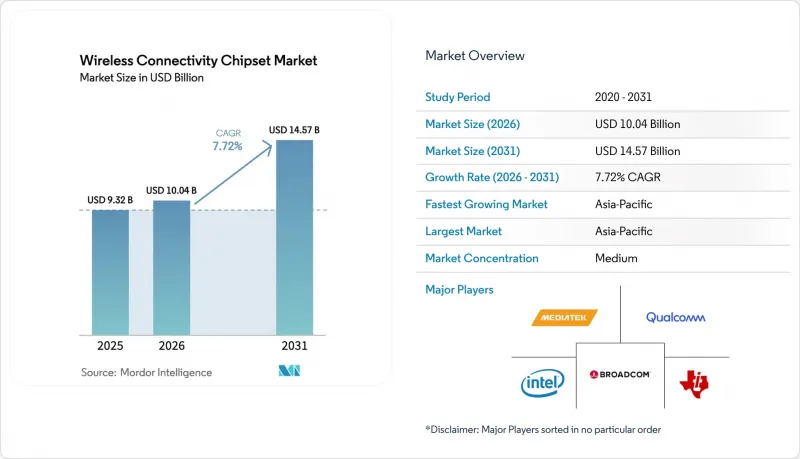
Mordor Intelligence에 의하면, 무선 접속 칩셋 시장 규모는 2025년 93억 2,000만 달러로 평가되었고, 2026년에는 100억 4,000만 달러로 추정되고, 2026-2031년 CAGR 7.72%로 성장을 지속할 전망이며, 2031년에는 145억 7,000만 달러에 이를 것으로 예측됩니다.
본 보고서는 유형별(Wi-Fi 독립형, 블루투스 독립형, 기타), 기술 표준별(Wi-Fi 4, Wi-Fi 5, 기타), 최종 사용자 용도별(가전, 엔터프라이즈 인프라, 기타), 기기 카테고리별(스마트폰·태블릿, PC·노트북, 기타), 지역별로 분류되어 있습니다. 시장 예측은 금액(달러) 기준으로 제시되어 있습니다.
세계의 무선 접속 칩셋 시장 동향 및 인사이트
소비자용 및 산업용 부문에서 IoT 기기 대수의 급증
현재 공장 자동화 분야에서는 결정론적 무선 기술과 기존 Wi-Fi/블루투스를 동일한 칩 위에 통합하는 것이 요구되고 있으며, 이를 통해 기존에는 유선 연결에 의존하던 미션 크리티컬 센서 루프가 실현되고 있습니다. 스마트 홈용 출하 대수는 2024년에 14억 대를 돌파했습니다. 각 디바이스에는 최소 1개의 무선 칩셋이 내장되어 있어 규모의 경제가 가속화되고 있습니다. 이에 따라 각 벤더는 소비자용과 산업용 모두의 펌웨어 스택을 지원하는 통합 레퍼런스 설계를 추구하며, 개발 비용을 절감하는 동시에 대상 시장을 확대되고 있습니다.
Wi-Fi 6/6E/7 및 Bluetooth 5.x/LE Audio의 확산 가속화
Wi-Fi 7의 멀티링크 작동은 2.4GHz, 5GHz, 6GHz 대역을 동시에 커버하며, 새로운 처리량 및 지연 시간 벤치마크를 수립하고, 첨단 RF 프론트엔드를 주류 클라이언트 기기에 도입하고 있습니다. 기업들은 액세스 포인트 군을 Wi-Fi 6E로 업그레이드하고 6GHz 대역을 활용함으로써 혼잡 없는 고밀도 캠퍼스 환경을 실현하고 있습니다. 한편, Bluetooth LE Audio의 LC3 코덱은 멀티 스트림 재생 및 보청기와의 호환성을 제공하기 위해 자동차 헤드 유닛의 재설계를 촉진하고 있으며, 연결성 SoC 내의 DSP 요구 사항을 높이고 있습니다.
2.4GHz ISM 대역에서 심화되는 RF 스펙트럼 혼잡
고밀도 공동 주택에서는 블루투스와 Wi-Fi 신호가 서로 간섭하기 때문에 각 벤더는 민첩한 채널 호핑 및 공존 기능을 구현하는 펌웨어의 도입을 서둘러야 하는 상황에 처해 있습니다. 층당 수백 개의 센서를 도입하고 있는 산업 시설에서는 재전송이 반복됨에 따라 배터리 수명이 현저히 단축된다는 보고가 있어 5GHz 및 6GHz로의 전환이 진행되고 있지만, 한편으로는 트라이밴드 프런트엔드의 BOM 비용이 증가하고 있습니다.
부문 분석
2025년에는 Wi-Fi+블루투스 콤보 칩이 무선 접속 칩셋 시장 점유율의 79.62%를 차지했습니다. 저전력 무선 IC는 현재 시장 규모가 작지만, 배터리 구동형 IoT 노드가 확대됨에 따라 연평균 성장률(CAGR) 9.02%를 나타낼 것으로 예측됩니다. 콤보 설계를 통해 PCB 면적이 축소되고 인증 절차가 효율화되므로, 가전 및 웨어러블 기기 벤더는 RF 동작이 통일된 세계 SKU를 출하할 수 있게 됩니다.
콤보 SoC에 대한 수요는 스마트 홈 생태계가 Matter를 채택하고 있는 점에서도 기인합니다. Matter에서는 초기 설정 및 제어를 위해 Wi-Fi와 Thread/BLE의 동시 사용이 규정되어 있습니다. 두 무선 기능을 하나의 SoC에 통합함으로써 불필요한 수정 발진기나 전원 레일이 필요 없어져, 5달러 미만의 스마트 플러그에 대한 비용 목표를 낮출 수 있게 됩니다.
기존 Wi-Fi 5는 평균 판매 가격(ASP)이 낮고 인증 기반이 광범위하여 여전히 매출의 62.35%를 차지하고 있지만, 멀티 기가비트 메시 및 클라우드 게임이 수요를 견인함에 따라,Wi-Fi 7 칩셋은 연평균 성장률(CAGR) 9.18%로 성장할 전망입니다. 자동차 인포테인먼트 부문에서는 간섭 없는 뒷좌석 스트리밍을 실현하기 위해 Wi-Fi 6을 건너뛰고, 6GHz 대역을 지원하는 Wi-Fi 6E가 이미 채택되고 있습니다.
블루투스 LE 오디오는 완전 무선 이어폰 및 인포테인먼트 부문에서 보급이 확대되고 있으며, 기존 A2DP 헤드셋을 대체하고 있습니다. 멀티포인트 및 Auracast 브로드캐스트 기능을 통해 차별화를 꾀하는 벤더들은 새로운 베이스밴드 로직과 메모리를 번들로 제공하며, 이로 인해 단위당 실리콘 함량이 증가하고 있습니다.
지역별 분석
아시아태평양은 중국의 IoT 제조 클러스터와 일본의 커넥티드카 연구 개발 분야의 리더십에 힘입어 2025년 매출의 56.65%를 차지했습니다. 정부의 스마트 시티 시범 사업으로 인해 작년에는 5억 대 이상의 기기가 활성화되었습니다. 한국의 5G URLLC 시범 운영은 Wi-Fi 7을 백업으로 선호하는 산업용 사설 네트워크의 기반이 되고 있습니다. 인도 농촌 지역의 광대역 계획에서는 엄격한 가격 상한선이 설정되어 있지만, 저비용 CPE에는 콤보 칩셋이 채택되고 있습니다.
북미는 2위를 차지했으며, 기업용 Wi-Fi 6E 및 Wi-Fi 7의 조기 도입으로 칩셋 교체 주기가 가속화되고 있습니다. FCC의 1.2GHz-6GHz 대역 전면 개방으로 트라이밴드 액세스 포인트 수주가 가속화되었습니다. 캐나다의 중요 인프라 프로젝트에서는 FIPS 인증을 받은 실리콘이 요구되는 반면, 멕시코의 니어쇼어링 붐으로 인해 자동차 산업의 Tier 1 공급업체들은 연결성 모듈의 생산 라인을 현지화해야 하는 압박을 받고 있습니다.
유럽 시장은 지속가능성과 사이버 복원력에 관한 규제의 영향으로 꾸준히 성장하고 있습니다. EU의 ‘사이버 복원력법’은 연결성용 칩에 하드웨어 루트 오브 트러스트와 SBOM 기능 탑재를 의무화하고 있으며, 보안 IP 포트폴리오를 보유한 공급업체에 우대 조치가 제공되고 있습니다. 독일의 ‘인더스트리 4.0’ 연구소에서는 Wi-Fi 7의 결정론적 스케줄링 시범 운영이 진행되고 있는 반면, 영국에서는 브렉시트 이후 자체 칩 설계를 위한 보조금 제도를 추진하고 있습니다.
기타 혜택
- 엑셀 형식 시장 예측(ME) 시트
- 3개월간 애널리스트 지원
자주 묻는 질문
목차
제1장 서론
제2장 조사 방법
제3장 주요 요약
제4장 시장 구도
제5장 시장 규모 및 성장 예측
제6장 경쟁 구도
제7장 시장 기회 및 향후 전망
AJY 26.09.15According to Mordor Intelligence, the wireless connectivity chipset market size is expected to grow from USD 9.32 billion in 2025 to USD 10.04 billion in 2026 and is forecast to reach USD 14.57 billion by 2031 at 7.72% CAGR over 2026-2031.
This report is Segmented by Type (Wi-Fi Standalone, Bluetooth Standalone, and More), Technology Standard (Wi-Fi 4, Wi-Fi 5, and More), End-User Application (Consumer Electronics, Enterprise Infrastructure, and More), Device Category (Smartphones and Tablets, Pcs and Laptops, and More), and Geography. The Market Forecasts are Provided in Terms of Value (USD).
Global Wireless Connectivity Chipset Market Trends and Insights
Surging IoT-device volumes across consumer and industrial sectors
Factory automation now specifies deterministic wireless plus traditional Wi-Fi/Bluetooth in the same die, enabling mission-critical sensor loops that previously relied on wired links. Smart-home shipments topped 1.4 billion units in 2024; each gadget embeds at least one wireless chipset, accelerating scale economies. Vendors therefore pursue unified reference designs that cater to both consumer and industrial firmware stacks, compressing development expense while widening addressable markets.
Accelerated roll-out of Wi-Fi 6/6E/7 and Bluetooth 5.x/LE Audio
Wi-Fi 7's multi-link operation simultaneously spans 2.4, 5, and 6 GHz, creating new throughput and latency benchmarks that pull advanced RF front-ends into mainstream client devices. Enterprises are refreshing access-point fleets to Wi-Fi 6E, monetizing 6 GHz spectrum for congestion-free high-density campuses. Bluetooth LE Audio's LC3 codec, meanwhile, prompts head-unit redesigns in vehicles to offer multi-stream playback and hearing-aid compatibility, raising DSP requirements inside connectivity SoCs.
Intensifying RF-spectrum congestion in the 2.4 GHz ISM band
Bluetooth and Wi-Fi signals collide in dense apartment blocks, pushing vendors to implement agile channel hopping and coexistence firmware. Industrial sites deploying hundreds of sensors per floor report retries that sap battery life, nudging migration toward 5 GHz and 6 GHz but adding BOM cost for tri-band front-ends.
Other drivers and restraints analyzed in the detailed report include:
- Growth of automotive 5G / C-V2X telematics design-wins
- Edge-AI demand for combo SoCs with integrated neural accelerators
- Persistent supply-chain lead-time volatility for advanced nodes
For complete list of drivers and restraints, kindly check the Table Of Contents.
Segment Analysis
Wi-Fi + Bluetooth combo silicon captured 79.62% wireless connectivity chipset market share in 2025. Low-power wireless ICs, although smaller today, are expected to post a 9.02% CAGR as battery-operated IoT nodes scale. Combo designs shrink PCB area and streamline certifications, letting appliance and wearables vendors ship global SKUs with uniform RF behavior.
The appetite for combo SoCs also stems from smart-home ecosystems adopting Matter, which prescribes concurrent Wi-Fi and Thread/BLE for commissioning and control. Integrating both radios into one SoC eliminates extra crystal oscillators and power rails, lowering USD cost targets for sub-USD 5 smart plugs.
Legacy Wi-Fi 5 still accounts for 62.35% of revenue, given its low ASPs and broad certification base, but Wi-Fi 7 chipsets will experience a 9.18% CAGR as multi-gigabit mesh and cloud gaming drive demand. Automotive infotainment is already skipping Wi-Fi 6 in favor of Wi-Fi 6E, which is 6 GHz-enabled, for interference-free back-seat streaming.
Bluetooth LE Audio is ramping up on true-wireless earbuds and infotainment, replacing classic A2DP headsets. Vendors differentiating on multipoint or Auracast broadcast features bundle new baseband logic and memory, lifting silicon content per unit.
Complete Report Scope:
- By Type
- Wi-Fi Standalone
- Bluetooth Standalone
- Wi-Fi and Bluetooth Combo
- Low-power Wireless IC (BLE, Zigbee, UWB)
- By Technology Standard
- Wi-Fi 4 (802.11n)
- Wi-Fi 5 (802.11ac)
- Wi-Fi 6 / 6E (802.11ax)
- Wi-Fi 7 (802.11be)
- Bluetooth Classic
- Bluetooth Low-Energy 5.x
- By End-user Application
- Consumer Electronics
- Enterprise Infrastructure
- Mobile Handsets
- Automotive (Telematics, V2X, Infotainment)
- Industrial and IIoT
- Others (Healthcare, Wearables, Smart-City)
- By Device Category
- Smartphones and Tablets
- PCs and Laptops
- Smart-Home / IoT Nodes
- Networking Infrastructure (Routers, APs)
- Wearables and Hearables
- Automotive Control Units
- By Geography
- North America
- United States
- Canada
- Mexico
- South America
- Brazil
- Argentina
- Rest of South America
- Europe
- Germany
- United Kingdom
- France
- Italy
- Spain
- Russia
- Rest of Europe
- Asia-Pacific
- China
- Japan
- India
- South Korea
- Rest of Asia-Pacific
- Middle East and Africa
- Middle East
- Saudi Arabia
- United Arab Emirates
- Turkey
- Rest of Middle East
- Africa
- South Africa
- Nigeria
- Rest of Africa
- Middle East
- North America
Geography Analysis
Asia-Pacific delivered 56.65% of 2025 revenue, benefitting from China's IoT manufacturing clusters and Japan's connected-car R&D leadership. Government smart-city pilots drove over 500 million device activations last year. South Korea's 5G URLLC trials underpin industrial private networks that prefer Wi-Fi 7 back-ups. India's rural broadband schemes adopt combo chipsets in low-cost CPE, albeit with strict price caps.
North America ranks second as early Wi-Fi 6E and Wi-Fi 7 enterprise roll-outs amplify chipset refresh cycles. The FCC's release of the full 1.2 GHz to 6 GHz band accelerated orders for tri-band access points. Canada's critical-infrastructure projects demand FIPS-certified silicon, while Mexico's near-shoring boom pushes automotive tier-1s to localize connectivity module lines.
Europe's market grows steadily under sustainability and cyber-resilience mandates. The EU Cyber Resilience Act compels hardware-root-of-trust and SBOM features inside connectivity silicon, rewarding suppliers with security IP portfolios. Germany's Industrie 4.0 labs are piloting Wi-Fi 7 deterministic scheduling, whereas the U.K. is pursuing sovereign chip design grants post-Brexit.
- Broadcom Inc.
- Qualcomm Technologies Inc.
- MediaTek Inc.
- Intel Corporation
- Texas Instruments Incorporated
- STMicroelectronics N.V.
- NXP Semiconductors N.V.
- ON Semiconductor Corporation
- Infineon Technologies AG
- Microchip Technology Inc.
- Qorvo Inc.
- Skyworks Solutions Inc.
- HiSilicon Technologies Co., Ltd.
- UNISOC (Shanghai) Technologies Co., Ltd.
- Nordic Semiconductor ASA
- Silicon Laboratories Inc.
- Realtek Semiconductor Corp.
- Espressif Systems (Shanghai) Co., Ltd.
- Marvell Technology, Inc.
- Cypress Semiconductor
Additional Benefits:
- The market estimate (ME) sheet in Excel format
- 3 months of analyst support
TABLE OF CONTENTS
1 INTRODUCTION
- 1.1 Study Assumptions and Market Definition
- 1.2 Scope of the Study
2 RESEARCH METHODOLOGY
3 EXECUTIVE SUMMARY
4 MARKET LANDSCAPE
- 4.1 Market Overview
- 4.2 Market Drivers
- 4.2.1 Surging IoT-device volumes across consumer and industrial sectors
- 4.2.2 Accelerated roll-out of Wi-Fi 6/6E/7 and Bluetooth 5.x/LE Audio
- 4.2.3 Growth of automotive 5G/ C-V2X telematics design-wins
- 4.2.4 Edge-AI demand for combo SoCs with integrated neural accelerators
- 4.2.5 Subsidised smart-home programs and green-building regulations
- 4.2.6 Vendor consolidation unlocking scale-driven cost declines
- 4.3 Market Restraints
- 4.3.1 Intensifying RF-spectrum congestion in 2.4 GHz ISM band
- 4.3.2 Persistent supply-chain lead-time volatility for advanced nodes
- 4.3.3 Rising cybersecurity-compliance costs (WPA3, ISO 21434, Matter)
- 4.3.4 Inter-stack interoperability gaps slowing multi-protocol adoption
- 4.4 Impact of Macroeconomic Factors
- 4.5 Industry Supply Chain Analysis
- 4.6 Regulatory Landscape
- 4.7 Technological Outlook
- 4.8 Porter's Five Forces Analysis
- 4.8.1 Bargaining Power of Suppliers
- 4.8.2 Bargaining Power of Buyers
- 4.8.3 Threat of New Entrants
- 4.8.4 Threat of Substitutes
- 4.8.5 Degree of Competition
5 MARKET SIZE AND GROWTH FORECASTS (VALUE)
- 5.1 By Type
- 5.1.1 Wi-Fi Standalone
- 5.1.2 Bluetooth Standalone
- 5.1.3 Wi-Fi and Bluetooth Combo
- 5.1.4 Low-power Wireless IC (BLE, Zigbee, UWB)
- 5.2 By Technology Standard
- 5.2.1 Wi-Fi 4 (802.11n)
- 5.2.2 Wi-Fi 5 (802.11ac)
- 5.2.3 Wi-Fi 6 / 6E (802.11ax)
- 5.2.4 Wi-Fi 7 (802.11be)
- 5.2.5 Bluetooth Classic
- 5.2.6 Bluetooth Low-Energy 5.x
- 5.3 By End-user Application
- 5.3.1 Consumer Electronics
- 5.3.2 Enterprise Infrastructure
- 5.3.3 Mobile Handsets
- 5.3.4 Automotive (Telematics, V2X, Infotainment)
- 5.3.5 Industrial and IIoT
- 5.3.6 Others (Healthcare, Wearables, Smart-City)
- 5.4 By Device Category
- 5.4.1 Smartphones and Tablets
- 5.4.2 PCs and Laptops
- 5.4.3 Smart-Home / IoT Nodes
- 5.4.4 Networking Infrastructure (Routers, APs)
- 5.4.5 Wearables and Hearables
- 5.4.6 Automotive Control Units
- 5.5 By Geography
- 5.5.1 North America
- 5.5.1.1 United States
- 5.5.1.2 Canada
- 5.5.1.3 Mexico
- 5.5.2 South America
- 5.5.2.1 Brazil
- 5.5.2.2 Argentina
- 5.5.2.3 Rest of South America
- 5.5.3 Europe
- 5.5.3.1 Germany
- 5.5.3.2 United Kingdom
- 5.5.3.3 France
- 5.5.3.4 Italy
- 5.5.3.5 Spain
- 5.5.3.6 Russia
- 5.5.3.7 Rest of Europe
- 5.5.4 Asia-Pacific
- 5.5.4.1 China
- 5.5.4.2 Japan
- 5.5.4.3 India
- 5.5.4.4 South Korea
- 5.5.4.5 Rest of Asia-Pacific
- 5.5.5 Middle East and Africa
- 5.5.5.1 Middle East
- 5.5.5.1.1 Saudi Arabia
- 5.5.5.1.2 United Arab Emirates
- 5.5.5.1.3 Turkey
- 5.5.5.1.4 Rest of Middle East
- 5.5.5.2 Africa
- 5.5.5.2.1 South Africa
- 5.5.5.2.2 Nigeria
- 5.5.5.2.3 Rest of Africa
- 5.5.5.1 Middle East
- 5.5.1 North America
6 COMPETITIVE LANDSCAPE
- 6.1 Market Concentration
- 6.2 Strategic Moves
- 6.3 Market Share Analysis
- 6.4 Company Profiles (includes Global level Overview, Market level overview, Core Segments, Financials as available, Strategic Information, Market Rank/Share, Products and Services, Recent Developments)
- 6.4.1 Broadcom Inc.
- 6.4.2 Qualcomm Technologies Inc.
- 6.4.3 MediaTek Inc.
- 6.4.4 Intel Corporation
- 6.4.5 Texas Instruments Incorporated
- 6.4.6 STMicroelectronics N.V.
- 6.4.7 NXP Semiconductors N.V.
- 6.4.8 ON Semiconductor Corporation
- 6.4.9 Infineon Technologies AG
- 6.4.10 Microchip Technology Inc.
- 6.4.11 Qorvo Inc.
- 6.4.12 Skyworks Solutions Inc.
- 6.4.13 HiSilicon Technologies Co., Ltd.
- 6.4.14 UNISOC (Shanghai) Technologies Co., Ltd.
- 6.4.15 Nordic Semiconductor ASA
- 6.4.16 Silicon Laboratories Inc.
- 6.4.17 Realtek Semiconductor Corp.
- 6.4.18 Espressif Systems (Shanghai) Co., Ltd.
- 6.4.19 Marvell Technology, Inc.
- 6.4.20 Cypress Semiconductor
7 MARKET OPPORTUNITIES AND FUTURE OUTLOOK
- 7.1 White-space and Unmet-need Assessment


