|
시장보고서
상품코드
2125517
미국의 자동차 대리점 시장 : 점유율 분석, 업계 동향과 통계, 성장 예측(2026-2031년)United States Automotive Dealership - Market Share Analysis, Industry Trends & Statistics, Growth Forecasts (2026 - 2031) |
||||||
 Mordor Intelligence
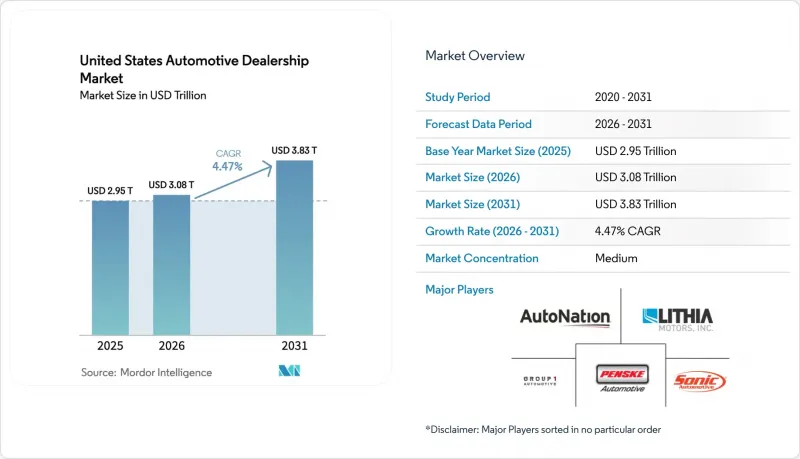
Mordor Intelligence에 의하면, 미국 자동차 대리점 시장 규모는 2025년 2조 9,500억 달러에서 2026년에는 3조 800억 달러로 확대되어 2026년부터 2031년까지 CAGR 4.47%로 성장을 지속하여, 2031년까지 3조 8,300억 달러에 이를 것으로 예측됩니다.
본 보고서는 유형별(신차 판매 및 중고차 판매), 판매업체별(프랜차이즈 딜러, 독립 딜러 등), 차종별(승용차, 소형 트럭 및 SUV 등),판매 채널별(오프라인 매장, 온라인/옴니채널), 고객 부문별, 지역별로 분류되어 있습니다. 시장 예측은 금액(달러) 기준으로 제시되어 있습니다.
미국 자동차 대리점 시장 동향 및 인사이트
EV 모델 출시 가속화
프랜차이즈 그룹은 전기차 전용 쇼룸 및 정비 구역에 수십억을 투자하겠다고 약속하고 있습니다. 1개 지점당 설비 투자액은 레벨 2 충전기의 경우 10만 달러부터, 레벨 3 DC 급속 충전기 및 전력 설비 업그레이드가 필요한 경우 100만 달러 이상까지 폭이 넓습니다. 포드의 ‘Model e Certified Elite’ 프로그램은 엄격한 일정 하에 교육, 공구, 충전기 설치를 패키지로 묶은 OEM의 요구 사항을 보여주는 좋은 예이며, 이를 통해 소매업체의 설비 투자 계획 주기가 재구성되고 있습니다. 선제적으로 대응한 딜러들은 배터리 보증 작업 및 소프트웨어 구독 제공을 통해 서비스 수익 증가분을 확보하고 있으며, 이를 통해 전기차의 기계적 수리 빈도가 낮다는 점을 상쇄하고 있습니다. 지역 간 격차는 여전히 존재하며, 캘리포니아주나 뉴욕주의 딜러는 미국 중서부 북부 지역의 딜러에 비해 충전기 이용률이 높지만, 2024년 전미 전기차 등록 대수 증가는 장기적인 투자의 수익성을 뒷받침하고 있습니다.
신차 재고 수준 회복
OEM의 생산이 안정화됨에 따라 2024년 11월까지 딜러의 재고는 323만 대에 달하고,, 팬데믹 이전 수준인 340만-350만 대에 근접했습니다. 공급 상황의 개선으로 소매업체들은 기존의 인센티브 프로그램을 재개하고 판매 대수에 따른 보너스를 복원할 수 있게 되어, 공급 제약으로 인해 2년 동안 지속되었던 이익률 하락을 만회하고 있습니다. 반도체 공급이 정상화된 것을 배경으로, 국내 브랜드들은 경쟁력 있는 리스 플랜을 재도입하여 가격에 민감한 구매자들을 쇼룸으로 다시 불러모으고 있습니다. 각 딜러사는 2022년 공급 부족기에 비해 재고 회전율이 낮아진 상황에 대응해야 하며, 과잉 재고를 피하기 위해 AI를 활용한 수요 예측 엔진에 대한 의존도를 높이고 있습니다. 또한, 풍부한 재고는 대형 딜러 그룹의 협상력을 강화하고 할당 대수를 일괄 구매할 수 있게 함으로써, 소규모 독립 딜러에 대한 비용 면에서의 우위를 더욱 확대하게 됩니다.
EV 및 ADAS 서비스 업그레이드에 따른 고액의 설비 투자
EV용 배터리 리프트, 단열 보관고, ADAS 캘리브레이션 장치 도입 비용은 매장 1곳당 56,000-65만 달러에 달할 전망입니다. 합리적인 가격의 전력 공급과 전문 기술자 확보는 특히 지방 시장에서 제약받고 있어, 일부 단독 매장 운영자들은 노후화된 시설을 재임대하는 대신 사업에서 철수할 수밖에 없는 상황에 몰리고 있습니다. 통합 기업은 규모의 경제를 누리고, 더 큰 처리량으로 설비 투자를 상각할 수 있으므로 변동비 격차를 더욱 확대할 수 있습니다. OEM 상환 프로그램은 비용의 일부를 보전해 주지만, 일반적으로 처리량에 대한 약정이 요구되므로 추가적인 통합 유인이 내재되어 있습니다. 그 결과, 자본 집약성은 독립 사업자에게 가장 시급한 구조적 역풍이 되고 있으며, 시장 전체의 성장률을 추정치로 0.6퍼센트 포인트 낮추고 있습니다.
부문 분석
2025년, 미국 중고차 판매 시장 규모는 52.85%의 점유율을 차지하며, 이 채널의 경제적 기반으로서의 역할을 확고히 했습니다. 리스 반납 대수 감소에 힘입은 잔존 가치 상승으로 인해, 도매 지수가 정상화되었음에도 불구하고 딜러들은 매출 총이익을 유지할 수 있었습니다. 마진은 경매 수수료를 피하고 입고 물류 비용을 절감하는 개인 간 임베디드 도구를 통해 계속해서 혜택을 보고 있습니다. 인증 중고차(Certified)의 각 등급은 프리미엄 가격을 유지하며 회전율이 25% 빨라졌고, 이로 인해 현금 흐름이 개선되어 재고 자금의 이자 부담을 지탱하고 있습니다.
OEM의 생산 제약이 완화됨에 따라, 2031년까지 신차의 연평균 성장률(CAGR)은 5.41%를 기록하여 중고차의 성장률을 상회할 것으로 예측됩니다. 2025년 초에는 거래 가격의 평균 6.8%에 해당하는 인센티브가 제공되어, 특히 엔트리 레벨 트림에서 구매를 미루고 있던 고객들을 쇼룸으로 다시 불러들이는 데 성공했습니다. 공급이 정상화됨에 따라 미국 자동차 대리점 시장에서 신차의 점유율은 완만하게 상승할 것으로 예상되지만, 가격 투명화 및 대리점 제도의 시범 도입으로 인해 판매 초기 단계의 매출 총이익 상승폭에는 상한선이 설정될 전망입니다. 각 딜러사는 트레이드인 차량의 정비 주기를 단축하여, 업계 중앙값인 35일 대비 27일 이내에 중고차 재고를 회전시키는 것을 목표로 하고 있으며, 이를 통해 두 차종 모두에서 종합적인 매출 총이익 실적을 유지하고 있습니다.
2025년 시점에서 프랜차이즈 그룹은 미국 자동차 대리점 시장의 57.60%를 차지하고 있으며, 소비자 직접 판매형 디지털 플랫폼은 OEM으로부터의 독점적 할당, 보증 권한,및 진입 장벽을 높이는 자회사 금융사와의 제휴에 힘입어, 2031년까지의 예상 연평균 성장률(CAGR)이 6.02%로 가장 높습니다. 시장 통합 기업들은 리시아(Lithia)의 조달 및 마케팅 분야의 규모의 경제와 같은 인수에 따른 시너지 효과를 활용하여 매장당 EBITDA를 확대되고 있습니다. 디지털 전문 기업들은 자산 경량화 모델을 활용하여 기여 이익률이 낮음에도 불구하고 두 자릿수의 판매 대수 증가를 기록하고 있습니다. 그럼에도 불구하고 옴니채널형 하이브리드 모델이 등장하고 있으며, 아마존 오토(Amazon Autos)는 딜러를 통한 차량 인도 체계를 통합함으로써 소비자의 편의성을 유지하면서도 라스트 마일 물류의 비용 효율성을 확보하고 있습니다.
가격에 민감한 구매자가 협상 유연성이나 비OEM 보증 패키지를 중시하는 지역에서는 독립 대리점이 여전히 존재 의의를 유지하고 있습니다. 그러나 프랜차이즈 운영자에게는 전기차 대응 설비 도입 의무나 OTA 소프트웨어 사용권이 부과되어 있어, 전동화가 진행되는 미래에 구조적인 우위를 가져다주고 있습니다. 장기적으로는 후계자 계획이나 자본 집약도가 높아짐에 따라 단일 매장 소유주가 사업 매각을 단행하게 됨에 따라, 미국 자동차 대리점 시장 규모는 실적이 우수한 여러 주에 걸쳐 있는 그룹으로 편중될 것으로 예측됩니다. ‘클릭 투 바이(Click-to-Buy)’ 플랫폼이나 당일 서비스 레인에 투자하는 프랜차이즈 가맹점은 기존에 매장 방문 고객에만 의존하는 동종 업계 경쟁사보다 우수한 실적을 거둘 것입니다.
기타 혜택:
- 엑셀 형식 시장 예측(ME) 시트
- 3개월간의 애널리스트 지원
자주 묻는 질문
목차
제1장 서론
제2장 조사 방법
제3장 주요 요약
제4장 시장 구도
제5장 시장 규모와 성장 예측
제6장 경쟁 구도
제7장 시장 기회와 향후 전망
JHS 26.09.11According to Mordor Intelligence, the United States automotive dealership market size is expected to grow from USD 2.95 trillion in 2025 to USD 3.08 trillion in 2026 and is forecast to reach USD 3.83 trillion by 2031 at 4.47% CAGR over 2026-2031.
This report is Segmented by Type (New-Vehicle Sales and Used-Vehicle Sales), Retailer (Franchised Dealers, Independent Dealers, and More), Vehicle Type (Passenger Cars, Light Trucks and SUVs, and More), Sales Channel (Brick and Mortar, Online/Omnichannel), Customer Segment, and Region. The Market Forecasts are Provided in Terms of Value (USD).
United States Automotive Dealership Market Trends and Insights
Accelerating EV Model Launches
Franchise groups have pledged billions for EV-ready showrooms and service bays . Capital outlays per location range from USD 100,000 for Level 2 chargers to more than USD 1 million, where Level 3 DC fast-charging plus utility upgrades are required. Ford's Model e Certified Elite program illustrates OEM mandates that bundle training, tooling, and charger installation under strict timelines, reshaping cap-ex planning cycles for retailers. Early movers capture incremental service profits from battery warranty work and software-subscription enablement, offsetting EVs' lower mechanical-repair frequency. Geographic disparity persists; dealers in California and New York see higher charger utilization than peers in the Upper Midwest, yet nationwide EV registration growth in 2024 supports long-run investment viability.
Recovery in New-Vehicle Inventory Levels
OEM production stability lifted dealer stock to 3.23 million units by November 2024, close to the 3.4 - 3.5 million pre-pandemic norm. Improved supply lets retailers restore traditional incentive programs and recoup volume-based bonuses, reversing two years of margin erosion caused by constrained pipelines. Domestic brands, supported by normalized chip supply, re-establish competitive lease offers that draw payment-sensitive buyers back to showrooms. Dealers must manage slower turn-rates than in 2022's shortage era, prompting heavier reliance on AI-driven demand-forecasting engines to avoid over-stocking. Robust inventory also strengthens the negotiating power of large dealer groups, who can bulk-purchase allocations, widening their cost advantage over smaller independents.
High CAPEX for EV and ADAS Service Upgrades
EV battery hoists, insulated storage, and ADAS calibration rigs cost USD 56,000-650,000 per rooftop . Access to affordable power feeds and specialized technicians is especially constrained in rural markets, forcing some single-point operators to exit instead of refinancing aging facilities. Consolidators enjoy scale cost leverage and can amortize tooling over larger throughput, widening their variable-cost gap. OEM reimbursement programs partially defray expenses but usually require volume commitments, embedding further consolidation incentives. Consequently, capital intensity is the most immediate structural headwind for independents, lowering market-wide growth by an estimated 0.6 percentage points.
Other drivers and restraints analyzed in the detailed report include:
- Dealer-Led Expansion of F&I Products
- Growth of Certified Pre-Owned (CPO) Programs
- OEM Direct-to-Consumer Models
For complete list of drivers and restraints, kindly check the Table Of Contents.
Segment Analysis
The United States automotive dealership market size for used vehicles held a 52.85% share in 2025, cementing its role as the channel's economic backbone. Elevated residual values, bolstered by curtailed lease returns, helped dealers protect grosses even as wholesale indices normalized. Margins continue to benefit from private-party acquisition tools that circumvent auction fees and reduce inbound logistics costs. Certified tiers maintain premium pricing and 25% faster turn-rates, improving cash velocity that supports floorplan interest outlays.
New vehicles are projected to log a 5.41% CAGR, outpacing used growth through 2031 as OEM production constraints fade. Incentives averaging 6.8% of transaction price in early 2025 have pulled sidelined buyers back into showrooms, especially on entry-level trims. As supply normalizes, the United States automotive dealership market share for new vehicles is expected to climb modestly, though pricing transparency and agency pilots will cap front-end gross upside. Dealers tighten reconditioning cycles on trade-ins, aiming to flip used inventory within 27 days versus the 35-day industry median, sustaining blended gross performance across both vehicle streams.
Franchised groups controlled 57.60% of the United States automotive dealership market in 2025, and direct-to-consumer digital platforms record the highest forecast CAGR at 6.02% to 2031, underpinned by exclusive OEM allocations, warranty authority, and financing captive ties that erect high entry barriers. Market consolidators leverage acquisition synergies such as Lithia's economies in procurement and marketing to expand EBITDA per rooftop. Digital pure-plays leverage asset-light models, booking double-digit unit gains despite narrow contribution margins. Still, omnichannel hybrids are emerging, with Amazon Autos integrating dealer fulfillment to keep last-mile logistics cost-effective while preserving consumer convenience.
Independent lots retain relevance where price-sensitive shoppers value negotiation flexibility and non-OEM warranty bundles. Yet franchise operators' mandated EV tooling and OTA software rights grant them a structural advantage in an electrified future. Over time, the United States automotive dealership market size is expected to skew toward high-performing multi-state groups as succession planning and capital intensity prompt single-store owners to divest. Franchisees that invest in click-to-buy platforms and same-day service lanes will outperform peers relying solely on legacy walk-in traffic.
Complete Report Scope:
- By Type
- New-Vehicle Sales
- Used-Vehicle Sales
- By Retailer
- Franchised Dealers
- Independent Dealers
- Direct-to-Consumer Digital Retailers
- By Vehicle Type
- Passenger Cars
- Light Trucks and SUVs
- Medium and Heavy Commercial Vehicles
- By Sales Channel
- Brick and Mortar
- Online / Omnichannel
- By Customer Segment
- Individual Consumers
- Fleet and Corporate
- By Region (United States)
- Northeast
- Midwest
- South
- West
List of Companies Covered in this Report:
- AutoNation Inc.
- Lithia Motors Inc.
- Penske Automotive Group
- Group 1 Automotive Inc.
- Sonic Automotive Inc.
- Asbury Automotive Group Inc.
- Hendrick Automotive Group
- CarMax Inc.
- Carvana Co.
- Larry H. Miller Dealerships
- Ken Garff Automotive Group
- Staluppi Auto Group
- Morgan Auto Group
- Holman Automotive
- Serra Automotive
- Napleton Automotive Group
- Suburban Collection
Additional Benefits:
- The market estimate (ME) sheet in Excel format
- 3 months of analyst support
TABLE OF CONTENTS
1 Introduction
- 1.1 Study Assumptions & Market Definition
- 1.2 Scope of the Study
2 Research Methodology
3 Executive Summary
4 Market Landscape
- 4.1 Market Overview
- 4.2 Market Drivers
- 4.2.1 Accelerating EV Model Launches
- 4.2.2 Recovery in New-Vehicle Inventory Levels
- 4.2.3 Dealer-Led Expansion of F&I Products
- 4.2.4 Growth of Certified Pre-Owned (CPO) Programs
- 4.2.5 State-Level Digital Retailing Legislation
- 4.2.6 OEM Subscription Models via Dealers
- 4.3 Market Restraints
- 4.3.1 High CAPEX for EV and ADAS Service Upgrades
- 4.3.2 OEM Direct-to-Consumer Models
- 4.3.3 Margin Compression from Online Price Transparency
- 4.3.4 Increased FTC Compliance Costs (F&I)
- 4.4 Value / Supply-Chain Analysis
- 4.5 Regulatory Landscape
- 4.6 Technological Outlook
- 4.7 Porter's Five Forces Analysis
- 4.7.1 Threat of New Entrants
- 4.7.2 Bargaining Power of Buyers
- 4.7.3 Bargaining Power of Suppliers
- 4.7.4 Threat of Substitutes
- 4.7.5 Intensity of Competitive Rivalry
5 Market Size & Growth Forecasts (Value (USD))
- 5.1 By Type
- 5.1.1 New-Vehicle Sales
- 5.1.2 Used-Vehicle Sales
- 5.2 By Retailer
- 5.2.1 Franchised Dealers
- 5.2.2 Independent Dealers
- 5.2.3 Direct-to-Consumer Digital Retailers
- 5.3 By Vehicle Type
- 5.3.1 Passenger Cars
- 5.3.2 Light Trucks and SUVs
- 5.3.3 Medium and Heavy Commercial Vehicles
- 5.4 By Sales Channel
- 5.4.1 Brick and Mortar
- 5.4.2 Online / Omnichannel
- 5.5 By Customer Segment
- 5.5.1 Individual Consumers
- 5.5.2 Fleet and Corporate
- 5.6 By Region (United States)
- 5.6.1 Northeast
- 5.6.2 Midwest
- 5.6.3 South
- 5.6.4 West
6 Competitive Landscape
- 6.1 Market Concentration
- 6.2 Strategic Moves
- 6.3 Market Share Analysis
- 6.4 Company Profiles (Includes Global Level Overview, Market Level Overview, Core Segments, Financials as Available, Strategic Information, Market Rank/Share for Key Companies, Products and Services, SWOT Analysis, and Recent Developments)
- 6.4.1 AutoNation Inc.
- 6.4.2 Lithia Motors Inc.
- 6.4.3 Penske Automotive Group
- 6.4.4 Group 1 Automotive Inc.
- 6.4.5 Sonic Automotive Inc.
- 6.4.6 Asbury Automotive Group Inc.
- 6.4.7 Hendrick Automotive Group
- 6.4.8 CarMax Inc.
- 6.4.9 Carvana Co.
- 6.4.10 Larry H. Miller Dealerships
- 6.4.11 Ken Garff Automotive Group
- 6.4.12 Staluppi Auto Group
- 6.4.13 Morgan Auto Group
- 6.4.14 Holman Automotive
- 6.4.15 Serra Automotive
- 6.4.16 Napleton Automotive Group
- 6.4.17 Suburban Collection
7 Market Opportunities & Future Outlook
- 7.1 White-Space & Unmet-Need Assessment