

|
시장보고서
상품코드
2125526
첨단 바이오연료 : 시장 점유율 분석, 업계 동향 및 통계, 성장 예측(2026-2031년)Advanced Biofuel - Market Share Analysis, Industry Trends & Statistics, Growth Forecasts (2026 - 2031) |
||||||
 Mordor Intelligence
Mordor Intelligence에 의하면, 첨단 바이오연료 시장 규모는 2025년에 184억 4,000만 달러로 평가되었습니다. 2026년 200억 7,000만 달러에서 2031년까지 306억 6,000만 달러에 이를 것으로 예상되며, 예측 기간(2026-2031년) CAGR은 8.84%를 나타낼 전망입니다.

본 보고서는 원료(리그노셀룰로오스계 잔여물, 에너지 작물, 조류 등), 바이오연료의 유형(재생 가능 디젤, 바이오가스/바이오메탄 등), 기술(생화학적 전환, 열화학적 전환, 하이브리드·신기술),최종 용도(도로 운송용 연료, 항공 연료, 선박용 연료, 산업용 열·전력), 그리고 지역(북미, 유럽, 아시아태평양, 기타)별로 분류되어 있습니다.
세계의 첨단 바이오연료 시장 동향 및 인사이트
전 세계 혼합 의무 강화
각국 및 초국가적 법규제는 자발적인 노력에서 생산자에게 수요 전망이 명확해지는 구속력 있는 할당제로 전환되고 있습니다. 영국의 지속 가능한 항공유 의무화 비율은 2025년 2%에서 2040년까지 22%로 상향 조정됩니다. 이는 경제에 50억 파운드를 창출하고 최대 1만 5,000개의 일자리를 유지할 가능성이 있는 수익 확실성 메커니즘에 의해 뒷받침되고 있습니다. 브라질에서 계획 중인 E30 가솔린 혼합 연료는 연간 170만 톤의 온실가스 배출량을 감축하는 동시에 90억 레알의 외국인 투자를 유치할 것으로 예측됩니다. 캐나다의 ‘청정 연료 규정’과 EU의 ‘ReFuelEU Aviation’ 규정 역시 마찬가지로 장기적인 인수량의 확실성을 보장하여 장기 프로젝트 자금 조달을 가능하게 하고 있습니다. 이러한 의무화 조치로 인해 자본 집약적인 정유시설는 처리량을 확보할 수 있게 되고, 리스크 프리미엄이 낮아지며, 첨단 바이오연료 시장 전체의 규모 확대가 가속화됩니다.
급증하는 지속가능 항공연료(SAF) 수요
항공사들의 넷제로 공약은 기존의 제트 연료 판매업체를 거치지 않는 직접적인 인수 계약으로 이어지고 있습니다. DHL 익스프레스는 싱가포르 창이 공항을 위해 네스테(Nestle)로부터 7,400톤의 SAF를 조달했습니다. 한편, 캐세이퍼시픽 항공은 중국에서 연간 생산 능력이 각각 5만-10만 톤인 파워-투-리퀴드(P2L) 플랜트 4기를 공동 개발하고 있습니다. 미국의 SAF 생산량은 2024년 12월부터 2025년 2월에 걸쳐 2배로 증가하여 하루 약 3만 배럴에 달했으나, 여전히 국내 제트 연료 수요의 2% 미만을 충당하는 데 그쳐 공급 격차가 크다는 점이 부각되고 있습니다. 이에 따라 항공 업계 이해관계자들은 생산 능력 확대와 기술 다각화를 뒷받침하는 장기 계약을 가속화하고 있으며, 첨단 바이오연료 시장을 기존의 도로용 연료의 범위를 훨씬 뛰어넘는 수준으로 끌어올리고 있습니다.
원료 가격 변동과 식용 작물
원료비는 운영비의 60%-80%를 차지하기 때문에 사용 후 식용유, 대두, 옥수수 줄기와 잎 등의 가격 변동은 이익률을 압박하고 신규 설비 투자를 저해할 가능성이 있습니다. HVO(수소화 식물성 기름) 생산자 및 식품 가공업체 수요 증가로 인해 식용유 가격이 상승하고 있으며, 개발도상국에서는 식량 안보를 둘러싼 논쟁이 일고 있습니다. 생산자들은 상품 가격 변동 주기에 대비하기 위해 농업 잔여물, 도시 고형 폐기물, 조류 등으로의 다각화를 추진하고 있습니다. 조류 배양 비용은 여전히 리터당 0.43달러에서 8.75달러 범위 내에 있으며, 오염 및 영양 관리 위험이 비용을 상승시키고 있습니다. 그 결과 발생하는 가격 변동으로 인해 투자자들은 더 큰 예비 예산을 요구할 수밖에 없게 되어, 첨단 바이오연료 시장의 단기적인 성장을 억제하고 있습니다.
부문별 분석
리그노셀룰로오스계 잔여물은 풍부한 농작물 폐기물, 톱밥, 임업 잔재물을 활용하고 토지 이용에 대한 부담을 최소화함으로써 2025년에는 첨단 바이오연료 시장 점유율의 28.62%를 차지했습니다. 에너지 작물의 재배 면적은 수확량이 낮은 농지에서 확대되고 있으며, 미스칸투스나 스위치그래스가 안정적인 바이오매스 생산량과 토양 개량 효과를 가져오고 있습니다. 사용 후 식용유 및 기타 유지의 회수 네트워크는 레스토랑 체인 및 지자체의 재활용 프로그램을 활용해 왔으나, 현재는 수요가 공급을 초과하여 가격 프리미엄이 발생하고 있습니다. 이에 따라 첨단 바이오연료 시장은 도시 고형 폐기물 흐름으로 원료 기반을 확대되고 있습니다. 에너켐(Enerchem)사의 에드먼턴 시설은 매립 제로 규제가 안정적인 원료 공급량을 가져다주는 한 예가 되고 있습니다. 합성 생물학의 비약적인 발전으로 인해 밀폐형 레이스웨이에서 미세조류의 생산성은 하루 1제곱미터당 60g을 초과하여 생산 비용을 절감하는 동시에, 2026년부터 2031년에 걸쳐 조류 시장이 연평균 성장률(CAGR) 14.92%로 성장하는 원동력이 되고 있습니다. 생산자들은 스마트 수확, 응집, 다운스트림 공정에서의 지질 추출을 결합하여 경작지를 빼앗지 않고도 육상 유지종자와 맞먹는 수확량을 실현하고 있습니다.
원료 전략은 점점 더 다각화되고 있습니다. 정제소에서는 베이스로드 공급을 위해 농업 잔여물을 혼합하고, 고부가가치 HVO 배치에 폐지질을 첨가하는 한편, 향후 확장성을 확보하기 위해 조류 및 도시 폐기물의 시범 도입을 진행하고 있습니다. 이러한 헤지 전략을 통해 원자재 가격 주기의 영향을 완화하고, 비식용 원료를 우대하는 정책 인센티브의 적용 요건을 더 쉽게 충족할 수 있습니다. 기업 구매자들이 엄격한 추적성을 갖춘 수명 주기 평가를 요구하는 가운데, 잔여물을 원료로 하는 제조 경로는 첨단 바이오연료 시장에서 입지를 강화하고 있습니다.
재생 가능 디젤은 기존 엔진 및 물류 네트워크와의 드롭인 호환성 덕분에 2025년에는 매출의 45.38%를 차지했습니다. 이를 통해 차량은 자산을 교체하지 않고도 탈탄소화가 가능해졌습니다. HEFA 플랜트는 구하기 쉬운 사용 후 식용유와 동물성 지방 덕분에 시운전 기간이 단축되어 높은 가동률을 유지했습니다. 바이오가스와 바이오메탄은 제로 메탄 배출 규제에 따라 매립지나 대규모 낙농 시설 근처에 혐기성 소화 클러스터가 잇달아 생겨남에 따라 연평균 성장률(CAGR) 12.11%로 성장을 지속하고, 있습니다. 셀룰로오스계 에탄올은 여전히 효소 비용으로 인해 제약을 받고 있지만, 연속 발효 및 통합 바이오프로세싱을 통해 비용 격차는 점차 줄어들고 있습니다. 뛰어난 에너지 밀도와 옥탄가 성능을 지닌 바이오부탄올이지만, 자본 비용이 낮아질 때까지는 틈새 시장인 항공 연료 블렌드로 제한될 전망입니다.
시장 수요에 따라 각 연료는 최종 용도별 틈새 시장에 자리 잡고 있습니다. HVO는 대형 운송 차량 및 한랭지용, SAF 블렌드는 장거리 항공 운송용, 파이프라인 등급의 바이오메탄은 산업용 열원용입니다. 생산 품목을 유연하게 전환할 수 있는 생산자는 규제나 원료의 변화가 발생했을 때 가치를 창출하는 데 유리한 입장에 있습니다. 이러한 선택의 폭은 대형 석유 회사의 수직 통합 움직임을 뒷받침하며, 그 결과 첨단 바이오연료 시장 내 진입 장벽을 더욱 높이고 있습니다.
지역별 분석
북미는 저탄소 연료를 위한 성숙한 크레딧 시장을 형성한 수십 년에 걸친 정책 지원의 결과, 2025년 매출의 38.42%를 차지했습니다. 미국의 재생 가능 디젤 생산 능력은 2023년에 44% 증가하여 국내 바이오연료 총 생산량을 연간 240억 갤런으로 끌어올렸으며, 중서부 지역에 새로운 원료 수집 거점 형성을 촉진했습니다. 캐나다의 ‘청정 연료 규정’은 주 정부의 의무 규정에 연방 차원의 탄소 가격 신호를 더하고 있어, 미국과의 국경 간 무역 분쟁이 지속되는 상황에서도 수요의 확실성을 확보하고 있습니다.
중국, 인도, 아세안(ASEAN) 회원국들이 수입 의존도를 낮추고 국내 공급망을 구축하고 있어, 아시아태평양은 2031년까지 연평균 성장률(CAGR) 12.23%를 기록할 전망입니다. 인도의 ‘바이오연료 계획-2025’에서는 바이오 CNG·에탄올 프로젝트에 대해 토지 이용 우대 조치와 세제 혜택이 제공되고 있으며, 비하르 주만 해도 2026년까지 9개의 에탄올 플랜트 건설을 목표로 하고 있어, 이를 통해 5만 개의 일자리가 창출될 전망입니다. 중국의 민간 항공 규제 당국은 2024년에 최초의 SAF(지속 가능한 항공 연료) 상업 운항을 승인했으며, 지역 항공사들은 예상 할당량에 앞서 공급을 확보하기 위해 현재 오프테이크 계약을 체결하고 있습니다. 호주의 정책 환경 지연으로 인해 BP사의 쿠이나나 업그레이드 계획이 지연되고 있으며, 첨단 바이오연료 시장 전반에서 투자 확보에 있어 규제가 결정적인 역할을 하고 있음이 부각되고 있습니다.
유럽은 ‘재생에너지 지침’에 따라 꾸준한 성장을 유지하고 있지만, 간접적인 토지 이용 변화와 관련된 정책의 불확실성에 직면해 있으며, 이로 인해 허가 절차가 장기화되고 있습니다. 독일과 프랑스는 폐지질을 처리하기 위해 바이오디젤 반응 장치를 업그레이드한 반면, 북유럽 국가 정부들은 생산자를 현물 가격 변동으로부터 보호하기 위해 장기 구매 약속을 제도에 포함시키고 있습니다. ‘ReFuelEU Aviation’의 의무화와 각국의 탄소세로 인해 2030년까지 SAF 수요는 500만 톤을 넘어설 것으로 예측됩니다. 복잡한 수명 주기 회계 규정은 규정 준수 비용을 상승시키고, 견고한 추적성 체계를 갖춘 생산자들에게는 고부가가치의 틈새 시장을 창출하고 있습니다.
기타 혜택 :
- 엑셀 형식 시장 예측(ME) 시트
- 3개월간의 애널리스트 지원
자주 묻는 질문
목차
제1장 서론
제2장 조사 방법
제3장 주요 요약
제4장 시장 구도
제5장 시장 규모 및 성장 예측
제6장 경쟁 구도
제7장 시장 기회 및 향후 전망
KTH 26.09.16According to Mordor Intelligence, the advanced biofuel market size was valued at USD 18.44 billion in 2025 and estimated to grow from USD 20.07 billion in 2026 to reach USD 30.66 billion by 2031, at a CAGR of 8.84% during the forecast period (2026-2031).
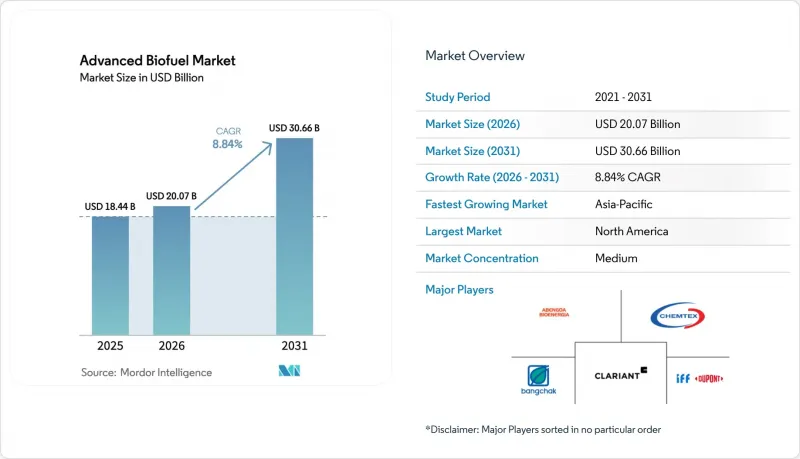
This report is Segmented by Raw Material (Lignocellulosic Residues, Energy Crops, Algae, and More), Biofuel Type (Renewable Diesel, Biogas/Biomethane, and More), Technology (Biochemical Conversion, Thermochemical Conversion, and Hybrid and Emerging Pathways), End-Use (Road Transport Fuel, Aviation Fuel, Marine Fuel, and Industrial Heat and Power), and Geography (North America, Europe, Asia-Pacific, and More).
Global Advanced Biofuel Market Trends and Insights
Tightening Global Blending Mandates
National and supranational legislation is shifting from voluntary schemes to binding quotas that hard-wire demand visibility for producers. The United Kingdom's sustainable aviation-fuel obligation rises from 2% in 2025 to 22% by 2040, supported by a revenue-certainty mechanism that could add GBP 5 billion to the economy and sustain up to 15,000 jobs. Brazil's planned E30 gasoline blend is projected to cut greenhouse-gas emissions by 1.7 million t per year while mobilising BRL 9 billion in inbound investment. Canada's Clean Fuel Regulation and the EU's ReFuelEU Aviation rule likewise embed long-range offtake certainty, enabling long tenor project financing. These mandates allow capital-intensive refineries to lock in throughput volumes, lowering risk premiums and accelerating scale-up across the advanced biofuel market.
Surging Sustainable Aviation-Fuel Demand
Airline net-zero pledges translate into direct offtake agreements that bypass traditional jet-fuel distributors. DHL Express procured 7,400 t of SAF from Neste for Singapore's Changi Airport, while Cathay Pacific is co-developing four power-to-liquids plants in China capable of 50,000-100,000 t per year each. United States SAF production doubled between December 2024 and February 2025 to about 30,000 bpd, yet still covers less than 2% of national jet-fuel demand, underscoring a sizeable supply gap. Aviation stakeholders are therefore accelerating long-term contracts that underwrite capacity expansions and technology diversification, lifting the advanced biofuel market well beyond conventional road-fuel confines.
Feedstock-Price Volatility vs. Food Crops
Feedstock accounts for 60%-80% of operating expenditure, so price swings in used cooking, soybean, or corn stover can erode margins and discourage new builds. Rising demand from HVO producers and food processors pushes edible oil prices higher, sparking food security debates in developing economies. Producers diversify toward agricultural residues, municipal solid waste, and algae to buffer against commodity cycles. Algal cultivation still ranges between USD 0.43 and USD 8.75 per l, with contamination and nutrient management risks inflating costs. The resulting volatility obliges investors to demand larger contingency budgets, tempering near-term growth in the advanced biofuel market.
Other drivers and restraints analyzed in the detailed report include:
- Corporate Net-Zero Procurement Targets
- Carbon-Negative BECCS Pathways Emerge
- High Capex for Cellulosic Biorefineries
For complete list of drivers and restraints, kindly check the Table Of Contents.
Segment Analysis
Lignocellulosic residues provided 28.62% of the advanced biofuel market share in 2025 by exploiting plentiful crop waste, sawdust, and forestry slash with minimal land-use penalty. Energy-crop acreage is expanding in lower-yield farmland where miscanthus and switchgrass offer reliable biomass tonnage and soil-health benefits. Collection networks for used cooking oil and other fats, oils, and grease tapped into restaurant chains and municipal recycling programs, but demand is now outstripping supply, driving price premiums. Therefore, the advanced biofuel market is broadening its raw-material base to municipal solid waste streams; Enerkem's Edmonton facility illustrates how zero-landfill rules can provide steady feedstock volumes. Synthetic-biology breakthroughs have pushed microalgae productivity beyond 60 g per m2 per day in closed raceways, compressing production costs and fuelling a 14.92% CAGR for algae between 2026 and 2031. Producers are layering smart harvesting, flocculation, and downstream lipid extraction to achieve yields that rival terrestrial oilseeds without competing for arable land.
Feedstock strategy is increasingly multipronged: refineries blend agricultural residues for base-load supply, add waste lipids for high-value HVO batches, and trial algae or municipal waste to secure future scalability. This hedge lowers exposure to commodity cycles and enhances eligibility for policy incentives favoring non-food inputs. As corporate buyers request life-cycle assessments with rigorous traceability, residue-based pathways strengthen their status inside the advanced biofuel market.
Renewable diesel captured 45.38% revenue in 2025 thanks to drop-in compatibility with existing engines and logistics networks, allowing fleets to decarbonise without asset swaps. HEFA plants operated at high utilisation because readily available used cooking oil and tallow shorten commissioning lead time. Biogas and biomethane ride a 12.11% CAGR as anaerobic-digestion clusters spring up near landfills and large dairy operations under zero-methane-emission rules. Cellulosic ethanol remains restrained by enzyme costs, although continuous fermentation and consolidated bioprocessing are closing the cost gap. Despite its superior energy density and octane performance, biobutanol is held to niche aviation blends until capital costs fall.
Market demand aligns each fuel with end-use niches: HVO for heavy-duty transport and winter climates, SAF blends for long-haul aviation, and pipeline-quality biomethane for industrial heat. Producers that can flex between outputs are better positioned to capture value when regulation or feedstock shifts. Such optionality reinforces vertical-integration moves by oil majors, thereby deepening competitive barriers inside the advanced biofuel market.
Complete Report Scope:
- By Raw Material
- Lignocellulosic Residues
- Energy Crops (e.g., Miscanthus)
- Used Cooking Oil and FOG
- Algae
- Municipal Solid Waste
- By Biofuel Type
- Cellulosic Ethanol
- Hydroprocessed Esters and Fatty Acids (HEFA)
- Renewable Diesel (HVO)
- Biogas/Biomethane
- Biobutanol
- By Technology
- Biochemical Conversion
- Thermochemical Conversion
- Hybrid & Emerging Pathways
- By End-Use Sector
- Road Transport Fuel
- Aviation Fuel (SAF)
- Marine Fuel
- Industrial Heat and Power
- By Geography
- North America
- United States
- Canada
- Mexico
- Europe
- Germany
- United Kingdom
- France
- Italy
- NORDIC Countries
- Russia
- Rest of Europe
- Asia-Pacific
- China
- India
- Japan
- South Korea
- ASEAN Countries
- Rest of Asia-Pacific
- South America
- Brazil
- Argentina
- Rest of South America
- Middle East and Africa
- Saudi Arabia
- United Arab Emirates
- South Africa
- Egypt
- Rest of Middle East and Africa
- North America
Geography Analysis
North America delivered 38.42% of 2025 revenue after decades of policy support that created a mature credit market for low-carbon fuelsRenewable diesel capacity in the United States climbed 44% in 2023, lifting total national biofuel output to 24 billion gal per year and stimulating fresh feedstock collection hubs in the Midwest. Canada's Clean Fuel Regulation layers a federal carbon-price signal onto provincial mandates, ensuring demand certainty even as cross-border trade arbitration with the United States persists.
Asia-Pacific is on track for a 12.23% CAGR through 2031 as China, India, and ASEAN members tighten import dependency and build domestic supply lines. India's "Biofuel Scheme-2025" offers land-use concessions and tax breaks for Bio-CNG and ethanol projects, and Bihar alone targets nine ethanol plants by 2026 that will employ 50,000 people. China's civil-aviation regulator cleared the first commercial SAF flight in 2024, and regional airlines are now entering offtake contracts to secure supply ahead of anticipated quotas. Australia's lagging policy environment delayed BP's Kwinana upgrade, emphasising the decisive role of regulation in securing investment across the advanced biofuel market.
Europe sustains steady growth under the Renewable Energy Directive but faces indirect land-use-change policy uncertainty that lengthens permitting cycles. Germany and France upgraded biodiesel reactors to process waste lipids, while Nordic governments embed long-term purchase commitments to shield producers from spot-price swings. The ReFuelEU Aviation mandate and national carbon taxes are expected to pull SAF demand past 5 million t by 2030. Complex life-cycle accounting rules elevate compliance costs and create a premium niche for producers with robust traceability frameworks.
- Neste Oyj
- Chevron (Renewable Energy Group)
- TotalEnergies (SAFE)
- Gevo Inc.
- POET LLC
- Aemetis Inc.
- Verbio AG
- UPM Biofuels
- LanzaJet Inc.
- Fulcrum BioEnergy
- Shell plc (Biofuels)
- BP (bp Bunge Bioenergia)
- Clariant AG
- Abengoa Bioenergy
- Green Plains Inc.
- Sekab Biofuels & Chemicals
- Enerkem Inc.
- Algenol Biotech
- GranBio
- Sundrop Fuels Inc.
Additional Benefits:
- The market estimate (ME) sheet in Excel format
- 3 months of analyst support
TABLE OF CONTENTS
1 Introduction
- 1.1 Study Assumptions & Market Definition
- 1.2 Scope of the Study
2 Research Methodology
3 Executive Summary
4 Market Landscape
- 4.1 Market Overview
- 4.2 Market Drivers
- 4.2.1 Tightening global blending mandates
- 4.2.2 Surging sustainable aviation-fuel demand
- 4.2.3 Corporate net-zero procurement targets
- 4.2.4 Carbon-negative BECCS pathways emerge
- 4.2.5 MSW-to-bio-crude backed by zero-landfill laws
- 4.2.6 Synthetic-biology cost breakthroughs
- 4.3 Market Restraints
- 4.3.1 Feedstock-price volatility vs. food crops
- 4.3.2 High capex for cellulosic biorefineries
- 4.3.3 Algal-culture scaling & contamination risks
- 4.3.4 ILUC policy uncertainty in key regions
- 4.4 Supply-Chain Analysis
- 4.5 Regulatory Landscape
- 4.6 Key Existing & Upcoming Projects
- 4.7 Technological Outlook
- 4.8 Porter's Five Forces
- 4.8.1 Bargaining Power of Suppliers
- 4.8.2 Bargaining Power of Consumers
- 4.8.3 Threat of New Entrants
- 4.8.4 Threat of Substitutes
- 4.8.5 Intensity of Competitive Rivalry
5 Market Size & Growth Forecasts
- 5.1 By Raw Material
- 5.1.1 Lignocellulosic Residues
- 5.1.2 Energy Crops (e.g., Miscanthus)
- 5.1.3 Used Cooking Oil and FOG
- 5.1.4 Algae
- 5.1.5 Municipal Solid Waste
- 5.2 By Biofuel Type
- 5.2.1 Cellulosic Ethanol
- 5.2.2 Hydroprocessed Esters and Fatty Acids (HEFA)
- 5.2.3 Renewable Diesel (HVO)
- 5.2.4 Biogas/Biomethane
- 5.2.5 Biobutanol
- 5.3 By Technology
- 5.3.1 Biochemical Conversion
- 5.3.2 Thermochemical Conversion
- 5.3.3 Hybrid & Emerging Pathways
- 5.4 By End-Use Sector
- 5.4.1 Road Transport Fuel
- 5.4.2 Aviation Fuel (SAF)
- 5.4.3 Marine Fuel
- 5.4.4 Industrial Heat and Power
- 5.5 By Geography
- 5.5.1 North America
- 5.5.1.1 United States
- 5.5.1.2 Canada
- 5.5.1.3 Mexico
- 5.5.2 Europe
- 5.5.2.1 Germany
- 5.5.2.2 United Kingdom
- 5.5.2.3 France
- 5.5.2.4 Italy
- 5.5.2.5 NORDIC Countries
- 5.5.2.6 Russia
- 5.5.2.7 Rest of Europe
- 5.5.3 Asia-Pacific
- 5.5.3.1 China
- 5.5.3.2 India
- 5.5.3.3 Japan
- 5.5.3.4 South Korea
- 5.5.3.5 ASEAN Countries
- 5.5.3.6 Rest of Asia-Pacific
- 5.5.4 South America
- 5.5.4.1 Brazil
- 5.5.4.2 Argentina
- 5.5.4.3 Rest of South America
- 5.5.5 Middle East and Africa
- 5.5.5.1 Saudi Arabia
- 5.5.5.2 United Arab Emirates
- 5.5.5.3 South Africa
- 5.5.5.4 Egypt
- 5.5.5.5 Rest of Middle East and Africa
- 5.5.1 North America
6 Competitive Landscape
- 6.1 Market Concentration
- 6.2 Strategic Moves (M&A, Partnerships, PPAs)
- 6.3 Market Share Analysis (Market Rank/Share for key companies)
- 6.4 Company Profiles (includes Global level Overview, Market level overview, Core Segments, Financials as available, Strategic Information, Products & Services, and Recent Developments)
- 6.4.1 Neste Oyj
- 6.4.2 Chevron (Renewable Energy Group)
- 6.4.3 TotalEnergies (SAFE)
- 6.4.4 Gevo Inc.
- 6.4.5 POET LLC
- 6.4.6 Aemetis Inc.
- 6.4.7 Verbio AG
- 6.4.8 UPM Biofuels
- 6.4.9 LanzaJet Inc.
- 6.4.10 Fulcrum BioEnergy
- 6.4.11 Shell plc (Biofuels)
- 6.4.12 BP (bp Bunge Bioenergia)
- 6.4.13 Clariant AG
- 6.4.14 Abengoa Bioenergy
- 6.4.15 Green Plains Inc.
- 6.4.16 Sekab Biofuels & Chemicals
- 6.4.17 Enerkem Inc.
- 6.4.18 Algenol Biotech
- 6.4.19 GranBio
- 6.4.20 Sundrop Fuels Inc.
7 Market Opportunities & Future Outlook
- 7.1 White-space & Unmet-need Assessment


