

|
시장보고서
상품코드
2125536
말레이시아의 정제 석유 제품 시장 : 점유율 분석, 업계 동향과 통계, 성장 예측(2026-2031년)Malaysia Refined Petroleum Products - Market Share Analysis, Industry Trends & Statistics, Growth Forecasts (2026 - 2031) |
||||||
 Mordor Intelligence
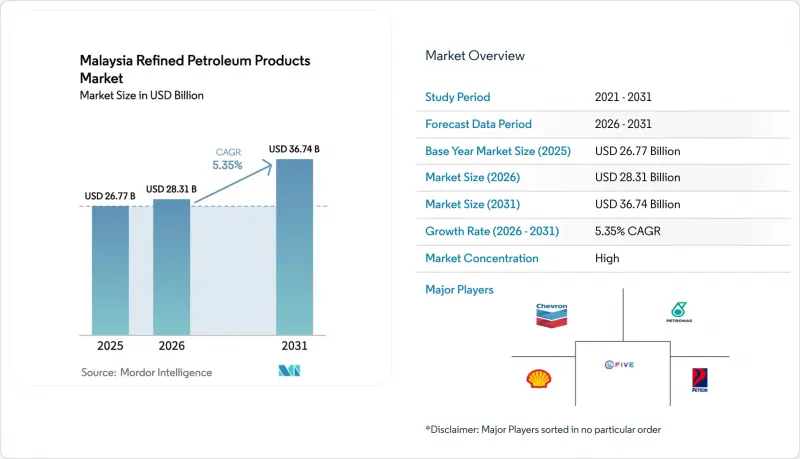
Mordor Intelligence에 의하면, 말레이시아 정제 석유 제품 시장 규모는 2025년 267억 7,000만 달러에서 2026년에는 283억 1,000만 달러로 확대되어 2026년부터 2031년까지 CAGR 5.35%로 성장을 지속하여, 2031년에는 367억 4,000만 달러에 이를 것으로 예측됩니다.
본 보고서는 제품 유형(가솔린, 디젤, LPG, 항공유, 연료유, 기타),유황 함량(저유황 및 고유황), 공급원(국내 정유시설 및 수입), 유통 채널(소매 주유소, 온라인/자동 연료 배송 등), 최종 용도 부문(운송, 산업 제조, 선박 및 벙커링, 농업 및 광업 등)에 따라 분류되어 있습니다.
말레이시아 정제 석유 제품 시장 동향 및 인사이트
국내 운송용 연료 수요의 급증
말레이시아에서는 2023년에 79만 9,731대의 자동차가 신규 등록되었으며, 승용차가 등록 대수의 대부분을 차지했습니다. 2024년 기준 전기차 누적 대수는 2만 대 미만에 그치고 있지만, 가솔린 및 디젤 수요는 견조한 추세를 보이고 있습니다. 리터당 1.99 말레이시아 링깃으로 설정된 RON95의 보조금 가격 덕분에 가계 부담은 경감되고 있지만, 2025년 중반 보조금 재검토에 따라 고소득층 운전자들의 RON97 전환이 진행되어 전체적인 판매량은 유지될 전망입니다. 연료 소매업체들은 Setel사의 ‘DuitNow QR’ 및 ‘Touch 'n Go’ 전자지갑과의 연동을 통해 900만 명의 사용자를 대상으로 주유소에서의 결제 효율을 높임으로써, 낮은 마진을 보완하고 있습니다. 말레이 반도의 주요 도시와 동말레이시아 각 주를 연결하는 장거리 트럭 운송은 디젤에 의존하고 있어, 클랑 밸리의 도시 지역에 집중된 지역적 전기차 도입의 영향을 덜 받는 수요를 보이고 있습니다.
석유화학 하류 통합 확대
펭게랑 통합 단지는 하루 30만 배럴의 정제 능력과 연간 330만 톤의 석유화학 생산 능력을 결합한 것으로, 페트로나스는 연료와 수익성이 높은 올레핀 사이에서 생산량을 유연하게 전환할 수 있습니다. 헨위안(Hen Yuan)사는 포트 딕슨에서 유사한 나프사에서 올레핀으로의 전환 계획을 검토하고 있으나, 이를 실행하기 위해서는 원료 확보와 자금 조달이 확정되어야 합니다. 이러한 통합 자산을 통해 말레이시아는 폴리머 전구체를 베트남이나 인도네시아로 수출할 수 있는 입지에 있습니다. 두 나라는 2024년에 말레이시아산 화학제품을 150만 톤 이상 수입했습니다. 펭게란에 위치한 다이얼로그 그룹의 저장 시설은 혼합 및 중계 과정에서 유연성을 제공하여 선박의 대기 시간을 최소화하고 있습니다.
전기차 보급 가속화와 연비 효율 향상
충전소 수는 2023년 1,500곳에서 2024년 10월 기준 3,354곳으로 증가했으며, 2025년 말까지 10,000곳을 목표로 하고 있습니다. 하지만 셀랑고르주와 쿠알라룸푸르 이외 지역에서의 주행 거리 불안이 보급의 걸림돌이 되고 있습니다. 딜로이트의 조사에 따르면, 전기차의 최저 가격이 42,000-60,000링깃인 반면, 내연기관 차량은 124,000링깃 이상이기 때문에 소비자의 58%는 여전히 내연기관 차량을 선호하는 것으로 나타났습니다. 자동차 제조업체들에게 하이브리드 차량 도입을 촉진하는 연비 기준에 따라, 향후 10년 동안 차량 1대당 연료 소비량은 20-30% 감소할 전망입니다.
부문 분석
2025년, 말레이시아의 정제 석유 제품 시장에서 휘발유는 46.7%의 점유율을 유지했습니다. 이는 전년도에 71만 9,160대의 승용차가 신규 등록된 것이 요인으로 작용했습니다. 항공 연료는 여객 수송량이 1억 1,290만 회로 회복되고, 2028년 이후 국내에서 지속가능 항공 연료(SAF) 공급이 확대됨에 따라 연평균 성장률(CAGR) 7.5%를 나타낼 것으로 전망됩니다. 디젤 연료는 2025년에 도로에서 79억 리터를 소비한 상용차 대열에 여전히 필수적입니다. 가정용 조리 연료는 LPG가 주류를 이루는 반면, 거의 전면적인 전기화의 진전에 따라 등유 수요는 줄어들고 있습니다. 연료유 수요는 스크러버를 장착한 선박 및 산업용 보일러에 의존하고 있으며, 벙커유 부문에서는 고황 등급이 여전히 주류를 이루고 있습니다. 나프타는 PETRONAS RAPID의 연간 330만 톤 크래커를 뒷받침하고 있으며, 휘발유 블렌딩보다 높은 다운스트림 부문의 마진을 창출하고 있습니다.
이 부문은 항공 여행 및 해운의 확대에 따라 제트 연료 및 선박용 연료로 계속 전환될 것이며, 반면 휘발유의 성장은 연비 기준의 강화로 인해 완만해질 것입니다. 따라서 휘발유가 절대적인 수량 점유율을 유지하는 한편, 2031년까지 항공 연료는 말레이시아 정제 석유 제품 시장에서의 점유율을 확대하게 될 것입니다.
2021년에 유로 5 디젤이, 2025년에 유로 5 휘발유가 시행됨에 따라, 2025년에는 저유황 연료가 말레이시아 정제 석유 제품 시장 점유율의 55.1%를 차지했습니다. 이 부문은 본질적으로 초저유황 기준을 충족하는 SAF(지속 가능한 항공 연료)의 혼합에 힘입어 연평균 성장률(CAGR) 5.9%를 기록할 전망입니다. 고황분 연료는 발전소 및 스크러버를 장착한 선박에 힘입어 나머지 44.9%의 점유율을 차지하고 있지만, 규정 준수 비용의 상승에 따라 연평균 성장률(CAGR)은 4.6%로 제한되고 있습니다.
국내 정유사들은 10ppm 상한선을 충족하기 위해 수소화 처리 설비에 투자하고 있으며, PETRONAS Melaka는 2020년에 12억 링깃을 투자했고, Hengyuan은 원료 공급 상황이 허락하는 한 유로 5 규격을 충족할 수 있는 수소화 분해 설비를 가동하고 있습니다. 싱가포르와 태국의 정유사들은 이미 유로 5 블렌드를 공급하고 있으므로, 이러한 전환은 지역 간 차익 거래 기회를 확보하는 한편, 수소 수요와 운영 비용 증가를 초래하고 있습니다.
기타 혜택:
- 엑셀 형식 시장 예측(ME) 시트
- 3개월간의 애널리스트 지원
자주 묻는 질문
목차
제1장 서론
제2장 조사 방법
제3장 주요 요약
제4장 시장 구도
제5장 시장 규모와 성장 예측
제6장 경쟁 구도
제7장 시장 기회와 향후 전망
JHS 26.09.11According to Mordor Intelligence, the Malaysia refined petroleum products market size is expected to grow from USD 26.77 billion in 2025 to USD 28.31 billion in 2026 and is forecast to reach USD 36.74 billion by 2031 at 5.35% CAGR over 2026-2031.
This report is Segmented by Product Type (Petrol, Diesel, LPG, Aviation Fuel, Fuel Oil, and Others), Sulfur Content (Low-Sulfur and High-Sulfur), Source (Domestic Refineries and Imports), Distribution Channel (Retail Fuel Stations, Online/Automated Fuel Delivery, and More), and End-Use Sector (Transportation, Industrial Manufacturing, Marine and Bunkering, Agriculture and Mining, and More).
Malaysia Refined Petroleum Products Market Trends and Insights
Surge in Domestic Transportation Fuel Demand
Malaysia added 799,731 vehicles in 2023, with passenger cars dominating registrations and cementing a robust gasoline and diesel requirement despite fewer than 20,000 cumulative electric vehicles by 2024. Subsidized RON95 pricing at MYR 1.99 per liter shields household budgets, yet mid-2025 subsidy retargeting moves higher-income drivers toward RON97, sustaining overall throughput. Fuel retailers are cushioning thin margins through Setel's DuitNow QR and Touch 'n Go e-wallet integration, which streamlines forecourt payments for nine million users. Long-haul trucking between Peninsular hubs and East Malaysian states depends on diesel, insulating demand from localized EV adoption concentrated in Klang Valley urban centers.
Expansion of Petrochemical Downstream Integration
The Pengerang Integrated Complex couples 300,000 bpd of refining with 3.3 million tpy of petrochemical capacity, allowing PETRONAS to swing output between fuels and higher-margin olefins. Hengyuan is studying a similar naphtha-to-olefins retrofit at Port Dickson but must lock in feedstock and financing before proceeding. Integrated assets position Malaysia to ship polymer precursors to Vietnam and Indonesia, which imported more than 1.5 million t of Malaysian chemicals in 2024. Dialog Group's storage farms at Pengerang provide blending and staging flexibility that minimizes vessel waiting time.
Accelerating EV Adoption and Fuel Efficiency Improvements
Charging points increased from 1,500 in 2023 to 3,354 by October 2024, and the target is 10,000 by the end of 2025. Even so, range anxiety outside Selangor and Kuala Lumpur slows uptake. Deloitte finds that 58% of consumers still prefer internal combustion vehicles, given the MYR 42,000-60,000 entry price versus MYR 124,000-plus for EVs. Fuel-efficiency standards that push automakers toward hybrids will trim per-vehicle consumption by 20-30% over a decade.
Other drivers and restraints analyzed in the detailed report include:
- Government Incentives for Bunker Fuel Hub Development
- Bio-Refinery Investments for Sustainable Aviation Fuel
- Carbon Taxation and Removal of Fuel Subsidies
For complete list of drivers and restraints, kindly check the Table Of Contents.
Segment Analysis
Petrol retained 46.7% of the Malaysia refined petroleum products market share in 2025, powered by 719,160 passenger-vehicle additions in the prior year. Aviation fuel is poised for a 7.5% CAGR as passenger traffic rebounds toward 112.9 million journeys and as local SAF supply ramps from 2028. Diesel remains essential for a commercial fleet that burned 7.9 billion liters on roads in 2025. LPG dominates household cooking, while kerosene shrinks with near-universal electrification. Fuel oil demand hinges on scrubber-equipped ships and industrial boilers; high-sulfur grades persist in the bunker segment. Naphtha supports PETRONAS RAPID's 3.3 million tpy cracker, generating a higher downstream margin than gasoline blending.
This segment will continue to pivot toward jet and marine grades as air travel and shipping expand, whereas gasoline growth moderates under efficiency norms. Aviation fuel will therefore raise its slice of Malaysia's refined petroleum products market by 2031, even as petrol maintains absolute volume dominance.
Low-sulfur fuels captured 55.1% of Malaysia's refined petroleum products market share in 2025 after Euro 5 diesel took effect in 2021 and Euro 5 petrol followed in 2025. The category should post a 5.9% CAGR, aided by SAF blending that inherently meets ultra-low-sulfur thresholds. High-sulfur fuels hold the remaining 44.9% share, buoyed by power plants and scrubber-equipped vessels yet capped at 4.6% CAGR as compliance costs rise.
Domestic refiners have invested in hydrotreaters to meet the 10 ppm ceiling, with PETRONAS Melaka spending MYR 1.2 billion in 2020 and Hengyuan operating a hydrocracker that can hit Euro 5 specs when feedstock availability allows. The shift secures regional arbitrage opportunities, since Singaporean and Thai refiners already supply Euro 5 blends, but it also raises hydrogen demand and operating costs.
Complete Report Scope:
- By Product Type
- Petrol (Gasoline)
- Diesel
- LPG
- Kerosene
- Aviation Fuel
- Fuel Oil (HSFO, VLSFO)
- Others (Bitumen, Naphtha)
- By Sulfur Content
- Low-Sulfur (Up to 10 ppm)
- High-Sulfur (Above 10 ppm)
- By Source
- Domestic Refineries
- Imports
- By Distribution Channel
- Retail Fuel Stations
- Commercial Bulk Sales
- Direct Supply Contracts
- Online/Automated Fuel Delivery
- By End-Use Sector
- Transportation
- Power Generation
- Industrial Manufacturing
- Petrochemicals
- Residential and Commercial
- Marine and Bunkering
- Agriculture and Mining
List of Companies Covered in this Report:
- Petronas (Petroliam Nasional Berhad)
- Shell PLC
- Chevron Corporation (Caltex Malaysia)
- Petron Malaysia Refining & Marketing Bhd
- Hengyuan Refining Company Berhad
- Gas Malaysia Berhad
- Petroleum Sarawak Berhad (PETROS)
- FIVE Petroleum Malaysia Sdn Bhd
- EcoCeres
- Dialog Group Berhad
- PETMAL Oil Holdings Sdn Bhd
- Rongsheng Petrochemical Co. Ltd
- Sinopec International (Trading) Pte Ltd
- Vitol Asia Pte Ltd
- Trafigura Group Pte Ltd
- Malaysia Marine & Heavy Engineering Holdings Bhd
- YTL Power International Berhad
- BHPetrol (Boustead Petroleum Marketing Sdn Bhd)
- Caltex (Malaysia) Marketing Sdn Bhd
Additional Benefits:
- The market estimate (ME) sheet in Excel format
- 3 months of analyst support
TABLE OF CONTENTS
1 Introduction
- 1.1 Study Assumptions & Market Definition
- 1.2 Scope of the Study
2 Research Methodology
3 Executive Summary
4 Market Landscape
- 4.1 Market Overview
- 4.2 Market Drivers
- 4.2.1 Surge in domestic transportation fuel demand
- 4.2.2 Expansion of petrochemical downstream integration
- 4.2.3 Government incentives for bunker fuel hub development
- 4.2.4 Bio-refinery investments for Sustainable Aviation Fuel
- 4.2.5 Strategic stockpiling policies enhancing refinery utilization
- 4.2.6 Regional supply-chain shifts due to shipping lane realignments
- 4.3 Market Restraints
- 4.3.1 Accelerating EV adoption & fuel efficiency improvements
- 4.3.2 Carbon taxation & removal of fuel subsidies
- 4.3.3 Volatility in crude import differentials affecting refinery margins
- 4.3.4 Tightening marine fuel sulfur regulations compressing HSFO demand
- 4.4 Supply-Chain Analysis
- 4.5 Regulatory Landscape
- 4.6 Technological Outlook
- 4.7 Porter's Five Forces
- 4.7.1 Threat of New Entrants
- 4.7.2 Bargaining Power of Suppliers
- 4.7.3 Bargaining Power of Buyers
- 4.7.4 Threat of Substitutes
- 4.7.5 Competitive Rivalry
- 4.8 PESTLE Analysis
5 Market Size & Growth Forecasts
- 5.1 By Product Type
- 5.1.1 Petrol (Gasoline)
- 5.1.2 Diesel
- 5.1.3 LPG
- 5.1.4 Kerosene
- 5.1.5 Aviation Fuel
- 5.1.6 Fuel Oil (HSFO, VLSFO)
- 5.1.7 Others (Bitumen, Naphtha)
- 5.2 By Sulfur Content
- 5.2.1 Low-Sulfur (Up to 10 ppm)
- 5.2.2 High-Sulfur (Above 10 ppm)
- 5.3 By Source
- 5.3.1 Domestic Refineries
- 5.3.2 Imports
- 5.4 By Distribution Channel
- 5.4.1 Retail Fuel Stations
- 5.4.2 Commercial Bulk Sales
- 5.4.3 Direct Supply Contracts
- 5.4.4 Online/Automated Fuel Delivery
- 5.5 By End-Use Sector
- 5.5.1 Transportation
- 5.5.2 Power Generation
- 5.5.3 Industrial Manufacturing
- 5.5.4 Petrochemicals
- 5.5.5 Residential and Commercial
- 5.5.6 Marine and Bunkering
- 5.5.7 Agriculture and Mining
6 Competitive Landscape
- 6.1 Market Concentration
- 6.2 Strategic Moves (M&A, Partnerships, PPAs)
- 6.3 Market Share Analysis (Market Rank/Share for key companies)
- 6.4 Company Profiles (includes Global level Overview, Market level overview, Core Segments, Financials as available, Strategic Information, Products & Services, and Recent Developments)
- 6.4.1 Petronas (Petroliam Nasional Berhad)
- 6.4.2 Shell PLC
- 6.4.3 Chevron Corporation (Caltex Malaysia)
- 6.4.4 Petron Malaysia Refining & Marketing Bhd
- 6.4.5 Hengyuan Refining Company Berhad
- 6.4.6 Gas Malaysia Berhad
- 6.4.7 Petroleum Sarawak Berhad (PETROS)
- 6.4.8 FIVE Petroleum Malaysia Sdn Bhd
- 6.4.9 EcoCeres
- 6.4.10 Dialog Group Berhad
- 6.4.11 PETMAL Oil Holdings Sdn Bhd
- 6.4.12 Rongsheng Petrochemical Co. Ltd
- 6.4.13 Sinopec International (Trading) Pte Ltd
- 6.4.14 Vitol Asia Pte Ltd
- 6.4.15 Trafigura Group Pte Ltd
- 6.4.16 Malaysia Marine & Heavy Engineering Holdings Bhd
- 6.4.17 YTL Power International Berhad
- 6.4.18 BHPetrol (Boustead Petroleum Marketing Sdn Bhd)
- 6.4.19 Caltex (Malaysia) Marketing Sdn Bhd
7 Market Opportunities & Future Outlook
- 7.1 White-space & unmet-need assessment
- 7.2 Emerging Biofuel Integration
- 7.3 Digital Supply Chain Optimization
- 7.4 Carbon Capture & Low-Carbon Refinery Projects
- 7.5 Hydrogen Co-processing Opportunities


