|
시장보고서
상품코드
2125564
독일의 해상 풍력발전 시장 : 점유율 분석, 업계 동향과 통계, 성장 예측(2026-2031년)Germany Offshore Wind Energy - Market Share Analysis, Industry Trends & Statistics, Growth Forecasts (2026 - 2031) |
||||||
 Mordor Intelligence
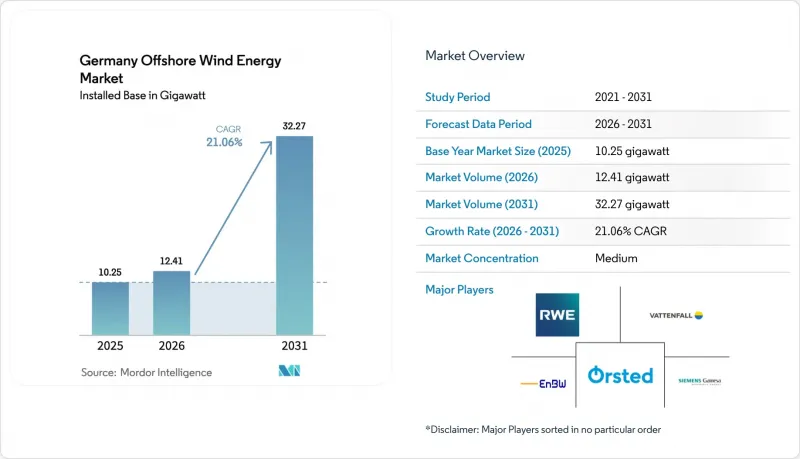
Mordor Intelligence에 의하면, 2026년 독일 해상 풍력발전 시장 규모는 12.41기가와트로 추정되고 있어 2025년 10.25기가와트에서 확대해, 2031년에는 32.27기가와트에 이를 것으로 예측됩니다.
2026년부터 2031년까지 연평균 성장률(CAGR) 21.06%로 성장할 것으로 전망됩니다.
본 보고서는 기초 방식(고정식 및 부유식), 터빈 출력(3MW 이하, 3-6MW, 6MW 이상), 용도(유틸리티 규모, 상업 및 산업용, 지역 프로젝트)별로 분류되어 있습니다. 시장 규모 및 전망은 설치 용량(GW) 단위로 표시되어 있습니다.
독일 해상 풍력발전 시장 동향 및 인사이트
2030년까지 30GW 달성을 목표로 한 국가 목표의 가속화
이전 공약보다 두 배로 늘어난 이 연방 목표를 달성하려면 연간 약 3.1GW의 신규 설비 도입이 필요하며, 이는 2023년에 기록된 300MW 미만의 속도를 훨씬 상회하는 수치입니다. 연방 해양·수로청은 개발업체가 설비 발주 및 설비 투자를 보다 확실하게 계획할 수 있도록 구체적인 건설 구역을 지정하고 있습니다. 허가 절차의 신속화와 경매의 투명성 제고를 통해 수 기가와트 규모의 프로젝트가 잇따르고 있으며, 이로 인해 독일 해상 풍력발전 시장은 급속한 성장 궤도를 유지하게 될 것입니다. 각 기업은 신규 발전 용량이 남부 수요 거점에 전력을 공급할 수 있도록 송전망 연결을 신속히 처리해 줄 것을 요구하며 로비 활동을 펼치고 있습니다. 이 목표를 달성함으로써 독일은 영국에 이어 유럽 제2위의 해상 풍력발전 시장으로서의 입지를 확고히할 것입니다.
14MW를 초과하는 터빈에 의한 균등화 발전 비용(LCOE)의 하락
14-15 MW급 터빈의 급속한 보급으로 인해 1기당 발전량이 증가하고, 배선 케이블의 부설 거리가 단축되고 있습니다. 지멘스 가메사(Siemens Gamesa)의 ‘SG 14-222DD’는 이전 모델인 11 MW 기종에 비해 연간 발전량이 25% 증가했습니다. 프라운호퍼 ISE는 2024년 균등화 발전 원가(LCOE)를 5.5-10.3 유로센트/kWh로 추정하고 있으며, 이에 따라 독일의 해상 풍력발전은 가스 화력 발전과 동등한 비용 수준에 도달하게 될 것입니다. 개발 사업자들은 더 큰 로터를 선호하고 있습니다. 이는 설치 대수가 줄어들어 건설 예산 중 가장 비용이 많이 드는 항목인 크레인 가동 일수와 선박 용선 기간을 줄일 수 있기 때문입니다. 독일 해상 풍력발전 시장에서 보조금 없는 입찰이 일반화되고 있는 가운데, 이러한 추세는 이익률 유지에 기여하고 있습니다.
계통 연계 대기 및 육상 송전의 병목 현상
TenneT사는 케이블 혼잡으로 인해 2024년에 북해 발전량의 9%를 제한했습니다. 연방 규제 당국은 2045년까지 50만 km의 신규 송전선과 변압기가 필요할 것으로 예측했습니다. 이러한 지연은 자금 조달 비용을 상승시키고 설비 가동률을 저하시켜, 중요한 확장 단계에 있는 독일 해상 풍력발전 시장의 성장을 저해하고 있습니다.
부문별 분석
2025년 독일 해상 풍력발전 시장에서 고정식 구조물이 84.68%를 차지했습니다. 이는 보르크룸 및 지르트 인근의 얕은 해역이 주도하고 있으며, 이 지역에서는 모노파일의 비용이 1MW당 평균 190만-210만 유로입니다. RWE가 Steelwind사와 체결한 300기 모노파일 예약 계약은 2027년까지공급을 확보하는 것이지만, 유럽 제철소의 가동률이 85%에 그치고 있어 공급 부족의 조짐을 보이고 있습니다. 공급 부족과 철강 가격 급등으로 인해 제조 리드타임이 2년을 초과하게 될 경우, 부유식 구조물로 전환되는 속도가 가속화될 가능성이 있습니다.
2025년에는 부유식 기초가 15.32%의 점유율을 차지하며, 수심 50미터 등심선보다 깊은 발트해나 헬고란트 서쪽의 북해 건설 현장을 배경으로 2031년까지 연평균 성장률(CAGR) 25.41%로 성장할 것으로 전망됩니다. 자본 비용은 여전히 1MW당 280만-340만 유로이지만, 부유식 기술을 통해 비용이 많이 드는 해저 준설이 불필요해짐에 따라 독일 영해 내 개발 가능한 해저 면적이 40% 확대됩니다. 향후 예정된 아르코나 분지 입찰에는 총 1.2GW 규모의 부유식 전용 구역 3곳이 포함되어 있으며, 2030년 이후 BalWin 5를 통해 송전망에 연결될 전망입니다. 터빈의 정격 출력이 높아짐에 따라, 부유식 플랫폼의 높은 정격 용량이 초기 비용의 높은 부분을 상쇄하여 독일 해상 풍력발전 시장의 성장세를 유지할 것입니다.
기타 혜택:
- 엑셀 형식 시장 예측(ME) 시트
- 3개월간의 애널리스트 지원
자주 묻는 질문
목차
제1장 서론
제2장 조사 방법
제3장 주요 요약
제4장 시장 구도
제5장 시장 규모와 성장 예측
제6장 경쟁 구도
제7장 시장 기회와 향후 전망
JHS 26.09.11According to Mordor Intelligence, Germany offshore wind energy market size in 2026 is estimated at 12.41 gigawatt, growing from 2025 value of 10.25 gigawatt with 2031 projections showing 32.27 gigawatt, growing at 21.06% CAGR over 2026-2031.
This report is Segmented by Foundation Type (Fixed-Bottom and Floating), Turbine Capacity (Up To 3 MW, 3 To 6 MW, and Above 6 MW), and Application (Utility-Scale, Commercial and Industrial, and Community Projects). The Market Size and Forecasts are Provided in Terms of Installed Capacity (GW).
Germany Offshore Wind Energy Market Trends and Insights
Accelerated 30 GW-by-2030 National Target
The federal goal, doubled from its earlier pledge, obliges yearly additions near 3.1 GW, far above the sub-300 MW pace logged in 2023. The Federal Maritime and Hydrographic Agency has zoned precise build areas that let developers plan equipment orders and capital spending with more certainty. Faster permits and auction clarity are driving a queue of multi-gigawatt projects that will keep the German offshore wind energy market on its steep growth track. Companies are lobbying for quicker grid links so new capacity can feed demand centers in the south. Meeting the target cements Germany as Europe's second-largest offshore arena, below only the United Kingdom.
Falling Levelized Cost from>14 MW Turbines
Rapid adoption of 14-15 MW turbines lifts output per foundation and trims array-cable runs. Siemens Gamesa's SG 14-222 DD delivers 25% more annual energy than its 11 MW predecessor. Fraunhofer ISE pegs 2024 LCOE at 5.5-10.3 €c/kWh, putting offshore wind on par with gas-fired power in Germany. Developers favor bigger rotors because fewer units cut crane days and vessel charters, two of the priciest items in a build budget. The trend protects margins as zero-subsidy bids become common in the German offshore wind energy market.
Grid-Connection Queue & Onshore Transmission Bottlenecks
TenneT curtailed 9% of North Sea output in 2024 due to cable congestion. The federal regulator forecasts that 500,000 km of new lines plus transformers will be needed by 2045. Delays inflate financing costs and dent capacity factors, holding back the German offshore wind energy market during a critical scale-up phase.
Other drivers and restraints analyzed in the detailed report include:
- Federal-State North Sea-Baltic "Area Development Plan 2023" Build-out Timetable
- Corporate PPA Boom Among German Heavy Industry
- Heavy-Lift Vessel & Monopile Forging Scarcity
For complete list of drivers and restraints, kindly check the Table Of Contents.
Segment Analysis
Fixed-bottom structures represented 84.68% of the German offshore wind energy market in 2025, driven by shallow-water zones near Borkum and Sylt, where monopile costs average EUR 1.9-2.1 million per MW. RWE's 300-monopile reservation with Steelwind secures capacity through 2027 but signals scarcity, as European mills run at 85% utilization. Supply tightness and steel price inflation could accelerate the adoption of floating if fabrication lead times extend beyond two years.
Floating foundations held 15.32% in 2025 and are forecast to grow at a 25.41% CAGR through 2031, supported by Baltic sites beyond the 50-meter isobath and the North Sea west of Heligoland. Although the capital cost remains EUR 2.8-3.4 million per MW, floating technology eliminates costly seabed dredging and expands the developable seabed by 40% in German waters. Upcoming Arkona Basin tenders include three floating-specific zones totaling 1.2 GW, expected to connect through BalWin 5 after 2030. As turbine ratings climb, floating platforms' higher nameplate capacities could offset upfront cost premiums, sustaining momentum in the German offshore wind energy market.
Complete Report Scope:
- By Foundation Type
- Fixed-Bottom
- Floating
- By Turbine Capacity
- Up to 3 MW
- 3 to 6 MW
- Above 6 MW
- By Application
- Utility-scale
- Commercial and Industrial
- Community Projects
- By Component (Qualitative Analysis)
- Nacelle/Turbine
- Blade
- Tower
- Generator and Gearbox
- Balance-of-System
- Others (Installation, Vessels, O&M)
List of Companies Covered in this Report:
- Orsted A/S
- RWE AG
- Vattenfall AB
- EnBW Energie Baden-Wurttemberg AG
- Siemens Gamesa Renewable Energy S.A.
- General Electric Company
- Nordex SE
- Enercon GmbH
- Vestas Wind Systems A/S
- PNE AG
- wpd AG
- Iberdrola Renovables Deutschland GmbH
- Equinor ASA
- Shell plc
- TotalEnergies SE
- Copenhagen Infrastructure Partners
- Parkwind NV
- EDF Renewables
- BP plc
- TenneT TSO GmbH
Additional Benefits:
- The market estimate (ME) sheet in Excel format
- 3 months of analyst support
TABLE OF CONTENTS
1 Introduction
- 1.1 Study Assumptions & Market Definition
- 1.2 Scope of the Study
2 Research Methodology
3 Executive Summary
4 Market Landscape
- 4.1 Market Overview
- 4.2 Market Drivers
- 4.2.1 Accelerated 30 GW-by-2030 national target
- 4.2.2 Falling levelized cost from >14 MW turbines
- 4.2.3 Federal-state North Sea - Baltic "Area Development Plan 2023" build-out timetable
- 4.2.4 Corporate PPA boom among German heavy industry
- 4.2.5 Offshore wind-to-hydrogen pilot tenders (H2Global, AquaVentus)
- 4.2.6 Digital-twin O&M platforms cutting downtime
- 4.3 Market Restraints
- 4.3.1 Grid-connection queue & onshore transmission bottlenecks
- 4.3.2 Lengthy maritime environmental permitting
- 4.3.3 Heavy-lift vessel & monopile forging scarcity
- 4.3.4 High interest-rate environment squeezing project IRRs
- 4.4 Supply-Chain Analysis
- 4.5 Regulatory Landscape
- 4.6 Technological Outlook
- 4.7 Porter's Five Forces
- 4.7.1 Threat of New Entrants
- 4.7.2 Bargaining Power of Suppliers
- 4.7.3 Bargaining Power of Buyers
- 4.7.4 Threat of Substitutes
- 4.7.5 Competitive Rivalry
- 4.8 PESTLE Analysis
5 Market Size & Growth Forecasts
- 5.1 By Foundation Type
- 5.1.1 Fixed-Bottom
- 5.1.2 Floating
- 5.2 By Turbine Capacity
- 5.2.1 Up to 3 MW
- 5.2.2 3 to 6 MW
- 5.2.3 Above 6 MW
- 5.3 By Application
- 5.3.1 Utility-scale
- 5.3.2 Commercial and Industrial
- 5.3.3 Community Projects
- 5.4 By Component (Qualitative Analysis)
- 5.4.1 Nacelle/Turbine
- 5.4.2 Blade
- 5.4.3 Tower
- 5.4.4 Generator and Gearbox
- 5.4.5 Balance-of-System
- 5.4.6 Others (Installation, Vessels, O&M)
6 Competitive Landscape
- 6.1 Market Concentration
- 6.2 Strategic Moves (M&A, Partnerships, PPAs)
- 6.3 Market Share Analysis (Market Rank/Share for key companies)
- 6.4 Company Profiles (includes Global level Overview, Market level overview, Core Segments, Financials as available, Strategic Information, Products & Services, and Recent Developments)
- 6.4.1 Orsted A/S
- 6.4.2 RWE AG
- 6.4.3 Vattenfall AB
- 6.4.4 EnBW Energie Baden-Wurttemberg AG
- 6.4.5 Siemens Gamesa Renewable Energy S.A.
- 6.4.6 General Electric Company
- 6.4.7 Nordex SE
- 6.4.8 Enercon GmbH
- 6.4.9 Vestas Wind Systems A/S
- 6.4.10 PNE AG
- 6.4.11 wpd AG
- 6.4.12 Iberdrola Renovables Deutschland GmbH
- 6.4.13 Equinor ASA
- 6.4.14 Shell plc
- 6.4.15 TotalEnergies SE
- 6.4.16 Copenhagen Infrastructure Partners
- 6.4.17 Parkwind NV
- 6.4.18 EDF Renewables
- 6.4.19 BP plc
- 6.4.20 TenneT TSO GmbH
7 Market Opportunities & Future Outlook
- 7.1 White-space & Unmet-Need Assessment