

|
시장보고서
상품코드
2125623
그린 수소 시장 : 시장 점유율 분석, 산업 동향 및 통계 데이터, 성장 예측(2026-2031년)Green Hydrogen - Market Share Analysis, Industry Trends & Statistics, Growth Forecasts (2026 - 2031) |
||||||
 Mordor Intelligence
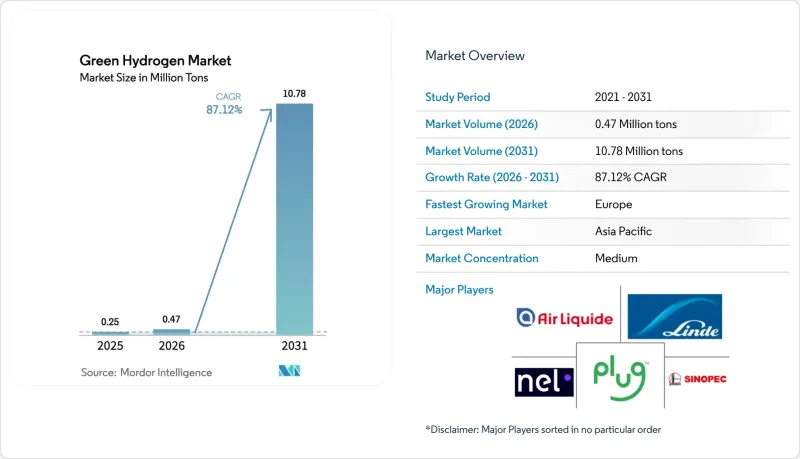
Mordor Intelligence에 의하면, 그린 수소 시장 규모는 2025년 25만 톤으로 평가되었고, 2026년 47만 톤으로 추정되고, 2031년까지 1,078만 톤으로 확대될 것으로 예측되며, 2026-2031년 연평균 복합 성장률(CAGR)은 87.12%를 나타낼 전망입니다.
본 보고서는 기술별(알칼리, PEM, 고체 산화물, AEM 전해), 최종 사용자 산업별(정유, 화학, 철강, 운송, 기타), 지역별(아시아태평양, 북미, 유럽, 남미, 중동 및 아프리카)로 분류되어 있습니다. 시장 전망은 수량(톤) 단위로 표시되어 있습니다.
세계의 그린 수소 시장 동향 및 인사이트
일사량이 높은 지역에서의 재생에너지 LCOE 하락
2025년, 사우디아라비아, 칠레, 호주의 태양광 및 육상 풍력 발전 프로젝트는 낮은 발전 비용을 달성했습니다. 이러한 가격 수준을 바탕으로, 천연가스 가격이 유리한 수준을 유지하는 한, 전해 수소는 증기 메탄 개질법과 경쟁할 수 있게 될 것입니다. NEOM 복합 단지는 경쟁력 있는 혼합 LCOE를 자랑하며, 보조금 없이도 운영이 가능합니다. 한편, 칠레의 마가야네스 풍력 클러스터는 2030년까지 그린 암모니아 수출을 목표로 하고 있습니다. 전해 설비를 자원 채굴 현장에 병설함으로써, 프로젝트는 송전 비용을 대폭 절감할 수 있습니다. 그 대표적인 예가 필바라에 위치한 포트에스크(Fort Esc)사의 시스템으로, 철광석 생산자가 어떻게 수소를 운영에 통합하고 있는지를 보여줍니다. 이러한 노력들이 맞물리면서, 그린 프리미엄은 시간이 지남에 따라 축소되어 왔습니다.
EU의 산업 탈탄소화 의무(철강, 비료)
2026-2030년 배출권 거래 제도(ETS) 하에서는 탄소 가격 하한선이 설정되므로, 탄소 포집 또는 수소를 원료로 하는 직접 환원철(DRI)을 채택하지 않는 한 고로강 생산은 수익성을 확보할 수 없게 됩니다. 이는 함부르크에서 아르셀로미탈이 실시한 실험을 통해 입증되었으며, 해당 지역에서는 수소 전환을 통해 스코프 1 배출량을 대폭 감축하는 데 성공했습니다. 독일은 비료 제조업체가 그린 프리미엄을 경감할 수 있도록 자금을 배분하고, 그린 암모니아의 임베디드을 촉진했습니다. 탄소 국경 조정 메커니즘(CBAM)은 이러한 과제를 EU 역외로 확대하고 있으며, 튀르키예와 우크라이나의 제철소는 전해법을 도입할지, 자사 제품의 가치에 대한 관세에 대비할지 중 하나를 선택해야만 하는 상황에 처해 있습니다.
PEM 스택용 이리듐 및 백금 공급 병목 현상
2025년 전 세계 이리듐 생산량은 상당한 규모였으나, 부하율이 일정하게 유지된다면 2028년에는 PEM 수요가 대폭 증가할 가능성이 있습니다. 2025년 12월에는 이리듐 현물 가격이 급등하여 PEM 비용 상승에 박차를 가했습니다. 재활용을 통한 연간 공급량은 제한적이며, 혼합 산화물을 이용한 대체재는 내구성 면에서 열세입니다. 공급업체들은 2027년까지 부하율을 낮추는 것을 목표로 하고 있지만, 남아프리카공화국으로공급 집중과 노동 분쟁으로 인해 가격 변동성이 커지고 있습니다.
부문 분석
알칼리계 시스템은 자본 비용과 수명이 거의 최대 효율로 가동되는 정제소 및 화학 플랜트의 요구 사항과 완벽하게 부합했기 때문에 2025년 판매량의 55.13%를 차지했습니다. 한편, PEM 시스템은 급속한 출력 증가율에 힘입어 연평균 성장률(CAGR) 92.35%로 확대될 전망이며, 간헐적인 전력 활용에 이상적입니다. 재생에너지 통합 전략이 성숙해짐에 따라, 그린 수소 분야의 PEM 프로젝트 시장 규모는 현저한 성장을 보일 것으로 예측됩니다. 반면, 뛰어난 발전 효율을 자랑하는 고온 SOEC의 시범 프로젝트는 스택의 수명이 20,000시간 미만에 그친다는 과제에 직면해 있으며, 이는 즉각적인 도입을 저해하는 요인이 되고 있습니다. AEM 유닛은 백금족 금속 사용을 피하는 데 성공했으나, 상용화에 이르기 전에 막의 내구성이 20,000시간 미만이라는 과제에 직면해 있습니다.
최근 수주 동향은 이 업계의 변화를 여실히 보여주고 있습니다. 2025년, 아시아태평양의 정유사들은 설비 투자 축소를 우선시하며 알칼리계 설비를 대량으로 발주했습니다. 대조적으로, PEM을 선호하는 유럽은 잠재적인 계통 서비스 수익을 이유로 높은 가격을 정당화하며 이러한 수주의 대부분을 확보했습니다. 고체 산화물 시스템은 2025년 출하량에서 차지하는 비중은 작지만, 철강 플랜트가 전해 공정을 폐열 흐름과 통합하고 있다는 점을 배경으로 견조한 성장이 예상됩니다. 이러한 동향은 기술 선택이 특정 기술에 대한 일률적인 선호가 아니라, 플랜트 고유의 경제성에 의해 점점 더 좌우되고 있다는 결정적인 변화를 여실히 보여주고 있습니다.
지역별 분석
아시아태평양은 2025년에 48.23%의 점유율을 차지했습니다. 이는 중국과 인도의 전해조 용량 급속한 확대에 힘입은 것이지만, 석탄에 의존하는 전력망이 탄소 강도 개선에 과제를 안겨주고 있습니다. 중국 삼협그룹은 비용 효율적인 비피크 시간대 풍력발전을 활용한 대규모 전해조를 운영하고 있습니다. 국내 재생에너지 자원이 제한적인 일본이 장기 계약을 체결하며 최대 수입 후보국으로 부상하고 있습니다. 한국은 막대한 보조금의 지원을 받아 울산 및 인천의 클러스터를 개조하고, 2029년까지 그린 수소 공급으로의 완전한 전환을 목표로 하고 있습니다. 한편, 인도의 ‘국가 미션(National Mission)’은 많은 지지를 얻고 있지만, 라자스탄주의 무효 전력 및 고조파 제약을 해결하기 위해서는 송전망 강화를 위한 투자가 필요합니다.
유럽은 연평균 성장률(CAGR)이 94.19%로 예측되어 가장 높은 성장률을 기록하고 있습니다. CBAM 정책에 따라 업스트림 공급업체들은 그린 수소로의 전환을 강요받게 되며, 그렇지 않을 경우 관세가 부과될 것입니다. 동시에 독일은 해상 풍력 자원을 룰(Ruhr) 지역의 플랜트에 연결하는 파이프라인 사업에 막대한 자금을 투입하고 있습니다. 이 지역의 잠재력을 여실히 보여주는 사례로, 카스티야-라만차 주에서 이베르드로라(Iberdrola)사가 추진하는 야심 찬 프로젝트는 경쟁력 있는 가격의 태양광 발전을 통해 저비용으로 수소를 생산할 수 있음을 입증하고 있습니다. 영국도 장기적인 스트라이크 가격 보장을 통해 신규 설비 개발을 촉진하는 등 꾸준한 진전을 보이고 있습니다. 이에 뒤지지 않으려는 듯, 프랑스의 토탈에너지(TotalEnergies)는 재생 가능 디젤의 배출량을 대폭 감축하는 것을 목표로 라 메드(La Medee) 시설의 확장을 추진하고 있습니다.
북미에서는 미국의 45V 세액 공제의 뒷받침을 받아 견조한 성장이 나타나고 있습니다. 에어 프로덕츠(Air Products)사는 루이지애나주에 대규모 복합 시설을 건설하고, 전기분해와 재생 에너지를 통합함으로써 수출용 연간 대규모 생산량을 목표로 삼는 등 큰 움직임을 보이고 있습니다. 캐나다 퀘벡주에서는 수력발전을 활용하는 플랜트가 가동 중이며, 이를 통해 생산 비용 절감이 실현되고 있습니다. 멕시코도 이 경쟁에 합류하여, 툴라 정유시설의 개조를 통해 ‘회색 수소’를 대체함으로써 연간 상당한 양의 CO₂ 감축이 예상됩니다.
2030년까지 NEOM과 마스달이 주도하는 중동 및 아프리카은 대량의 그린 암모니아를 수출할 수 있는 체제를 갖출 전망입니다. 한편, 남미 칠레의 풍력 발전 회랑에서는 수출을 목적으로 한 프로젝트에 막대한 투자가 몰리고 있습니다.
기타 특전 :
- Excel 형식 시장 예측(ME) 시트
- 3개월간의 애널리스트 지원
자주 묻는 질문
목차
제1장 서론
제2장 분석 방법
제3장 주요 요약
제4장 시장 구도
제5장 시장 규모 및 성장률 예측
제6장 경쟁 구도
제7장 시장 기회 및 향후 전망
AJY 26.09.15According to Mordor Intelligence, the green hydrogen market size is projected to expand from 0.25 million tons in 2025 and 0.47 million tons in 2026 to 10.78 million tons by 2031, registering a CAGR of 87.12% between 2026 to 2031.
This report is Segmented by Technology (Alkaline, PEM, Solid Oxide, and AEM Electrolysis), End-User Industry (Refining, Chemicals, Iron and Steel, Transportation, and Other), and Geography (Asia-Pacific, North America, Europe, South America, and Middle-East and Africa). Market Forecasts are Provided in Terms of Volume (Tons).
Global Green Hydrogen Market Trends and Insights
Declining LCOE of Renewables in High-Irradiance Regions
In 2025, solar and onshore wind projects in Saudi Arabia, Chile, and Australia achieved low generation costs. This pricing enables electrolytic hydrogen to compete with steam methane reforming, provided natural gas prices remain favorable. The NEOM complex enjoys a competitive blended LCOE, allowing it to operate without subsidies. Meanwhile, Chile's Magallanes wind cluster aims to export green ammonia by 2030. By co-locating electrolyzers with resource sites, projects can significantly reduce transmission costs. A case in point is Fortescue's system in Pilbara, which showcases how iron-ore producers are integrating hydrogen into their operations . Collectively, these initiatives have narrowed the green premium over time.
EU Industrial Decarbonization Mandates (Steel, Fertilizer)
Under the 2026-2030 ETS, a carbon price floor renders blast-furnace steel unviable unless carbon capture or hydrogen-based DRI is employed. This is underscored by ArcelorMittal's trials in Hamburg, where a shift to hydrogen achieved a significant reduction in Scope 1 emissions. Germany allocated funds to help fertilizer producers mitigate the green premium, facilitating the offtake of green ammonia. The Carbon Border Adjustment Mechanism amplifies these challenges beyond the EU, leading Turkish and Ukrainian mills to either explore electrolytic methods or brace for tariffs on their product's value.
Iridium and Platinum Supply Bottlenecks for PEM Stacks
Global iridium output was significant in 2025, yet PEM demand may increase substantially in 2028 if loading rates stay constant. Spot iridium prices rose sharply in December 2025, adding to PEM costs. Recycling provides only a limited amount annually, and mixed-oxide substitutes lag in durability. Suppliers aim to cut loadings by 2027, but supply concentration in South Africa and labor strikes heighten price volatility.
Other drivers and restraints analyzed in the detailed report include:
- Maritime Fuel Rules Spurring Green-Ammonia Bunkering Demand
- Electrolyzer-Gigafactory Economies of Scale
- Limited Grid-Hosting Capacity for Large Electrolyzers
For complete list of drivers and restraints, kindly check the Table Of Contents.
Segment Analysis
Alkaline systems controlled 55.13% of 2025 volume, thanks to capital costs and lifetimes aligning perfectly with the demands of refiners and chemical plants operating at near-maximum efficiency. Meanwhile, PEM systems are set to climb at a 92.35% CAGR, bolstered by their rapid ramp rates, making them ideal for harnessing intermittent power. As strategies for renewable integration mature, the market size for PEM projects in the green hydrogen sector is set for a pronounced uptick. On the other hand, high-temperature SOEC pilots, boasting impressive electrical efficiency, face a hurdle: their stack life, falling short of 20,000 hours, curtails immediate adoption. AEM units, while successfully sidestepping the use of platinum group metals, grapple with a challenge of membrane durability, also under the 20,000-hour mark, before they can hit the commercial stage.
Recent orders highlight this industry shift. In 2025, refiners in the Asia-Pacific region secured a significant amount of alkaline equipment, prioritizing lower capital expenditures. Conversely, Europe, leaning towards PEM, captured a dominant share of those orders, justifying the premium with potential grid-service revenue. Solid oxide systems, though holding a smaller share of the 2025 volume, are on track for robust growth, driven by iron and steel plants merging electrolysis with their waste heat streams. This trend underscores a pivotal shift: the choice of technology is increasingly dictated by plant-specific economics rather than a blanket preference for one technology over another.
Complete Report Scope:
- By Technology
- Alkaline Electrolysis
- Proton Exchange Membrane (PEM) Electrolysis
- Solid Oxide Electrolysis
- Anion Exchange Membrane (AEM) Electrolysis
- By End-user Industry
- Refining
- Chemicals
- Iron and Steel
- Transportation
- Other End-user Industries (Power Generation, Glass, Semiconductors)
- By Geography
- Asia-Pacific
- China
- India
- Japan
- South Korea
- Rest of Asia-Pacific
- North America
- United States
- Canada
- Mexico
- Europe
- Germany
- United Kingdom
- France
- Italy
- Rest of Europe
- South America
- Brazil
- Argentina
- Rest of South America
- Middle-East and Africa
- Saudi Arabia
- South Africa
- Rest of Middle-East and Africa
- Asia-Pacific
Geography Analysis
Asia-Pacific's 48.23% share in 2025, driven by the rapid expansion of electrolyzer capacity in China and India, even as coal-dominated grids pose challenges to carbon intensity improvements. China Three Gorges operates a large electrolyzer, harnessing cost-effective off-peak wind power. With limited domestic renewable resources, Japan emerges as the top prospective importer, securing long-term agreements. South Korea, bolstered by substantial subsidies, is retrofitting the Ulsan and Incheon clusters, targeting a complete transition to green supply by 2029. Meanwhile, India's National Mission has rallied commitments, but to address reactive power and harmonic constraints in Rajasthan, an investment is needed for grid enhancements.
Europe records the highest growth rate at a projected 94.19% CAGR. The CBAM policy compels upstream suppliers to pivot to green hydrogen or incur tariffs. Concurrently, Germany is channeling significant funding into a pipeline initiative, connecting offshore wind resources to plants in the Ruhr Valley. Highlighting the region's potential, Iberdrola's ambitious project in Castilla-La Mancha demonstrates that competitively priced solar energy can yield hydrogen at a low cost. The UK is making strides too, with a long-term guarantee of a strike price, facilitating the development of new capacity. Not to be outdone, France's TotalEnergies has augmented its La Mede facility, aiming for a substantial reduction in renewable diesel emissions.
North America, buoyed by the U.S. 45V tax credit, is witnessing robust growth. Air Products is making a significant move with a large complex in Louisiana, integrating electrolysis with renewable energy, targeting substantial annual output for export. In Quebec, Canada, a plant is capitalizing on hydro energy, translating to a low production cost. Mexico is also in the fray, with Tula refinery's retrofit set to substitute gray hydrogen, leading to significant annual CO2 savings.
By 2030, the Middle East and Africa, spearheaded by NEOM and Masdar, are poised to export a large volume of green ammonia. Meanwhile, South America's Chilean wind corridor is attracting substantial investment for projects aimed at exports.
- Air Liquide
- Air Products and Chemicals Inc.
- BP PLC
- CHARBONE Hydrogen Corporation
- China Petroleum & Chemical Corporation (Sinopec)
- China Three Gorges Corporation
- Cummins Inc.
- Engie SA
- Fortescue Future Industries
- Green Hydrogen International Corp.
- Iberdrola SA
- Intercontinental Energy
- ITM Power PLC
- Lhyfe SA
- Linde PLC
- McPhy Energy S.A.
- Nel
- Ningxia Baofeng Energy Group Co. Ltd.
- Orsted A/S
- Plug Power Inc.
- Reliance Industries Limited
- Shell PLC
- Siemens Energy AG
- thyssenkrupp nucera
- Tidewater Renewables Ltd.
- Uniper SE
- Yara
Additional Benefits:
- The market estimate (ME) sheet in Excel format
- 3 months of analyst support
TABLE OF CONTENTS
1 Introduction
- 1.1 Study Assumptions and Market Definition
- 1.2 Scope of the Study
2 Research Methodology
3 Executive Summary
4 Market Landscape
- 4.1 Market Overview
- 4.2 Market Drivers
- 4.2.1 Declining LCOE of renewables in high-irradiance regions
- 4.2.2 EU industrial decarbonization mandates (steel, fertilizer)
- 4.2.3 Maritime fuel rules spurring green-ammonia bunkering demand
- 4.2.4 Electrolyzer-gigafactory economies of scale
- 4.2.5 Surplus curtailed wind/solar PPAs enabling negative-price H2
- 4.3 Market Restraints
- 4.3.1 Iridium and platinum supply bottlenecks for PEM stacks
- 4.3.2 Limited grid-hosting capacity for greater than 100 MW electrolysis clusters
- 4.3.3 High cost of cryogenic LH2 shipping over 7,000 km routes
- 4.4 Value Chain Analysis
- 4.5 Technological Outlook
- 4.6 Porter's Five Forces
- 4.6.1 Bargaining Power of Suppliers
- 4.6.2 Bargaining Power of Buyers
- 4.6.3 Threat of New Entrants
- 4.6.4 Threat of Substitute Products
- 4.6.5 Degree of Competition
5 Market Size and Growth Forecasts (Volume)
- 5.1 By Technology
- 5.1.1 Alkaline Electrolysis
- 5.1.2 Proton Exchange Membrane (PEM) Electrolysis
- 5.1.3 Solid Oxide Electrolysis
- 5.1.4 Anion Exchange Membrane (AEM) Electrolysis
- 5.2 By End-user Industry
- 5.2.1 Refining
- 5.2.2 Chemicals
- 5.2.3 Iron and Steel
- 5.2.4 Transportation
- 5.2.5 Other End-user Industries (Power Generation, Glass, Semiconductors)
- 5.3 By Geography
- 5.3.1 Asia-Pacific
- 5.3.1.1 China
- 5.3.1.2 India
- 5.3.1.3 Japan
- 5.3.1.4 South Korea
- 5.3.1.5 Rest of Asia-Pacific
- 5.3.2 North America
- 5.3.2.1 United States
- 5.3.2.2 Canada
- 5.3.2.3 Mexico
- 5.3.3 Europe
- 5.3.3.1 Germany
- 5.3.3.2 United Kingdom
- 5.3.3.3 France
- 5.3.3.4 Italy
- 5.3.3.5 Rest of Europe
- 5.3.4 South America
- 5.3.4.1 Brazil
- 5.3.4.2 Argentina
- 5.3.4.3 Rest of South America
- 5.3.5 Middle-East and Africa
- 5.3.5.1 Saudi Arabia
- 5.3.5.2 South Africa
- 5.3.5.3 Rest of Middle-East and Africa
- 5.3.1 Asia-Pacific
6 Competitive Landscape
- 6.1 Market Concentration
- 6.2 Strategic Moves
- 6.3 Market Share/Ranking Analysis
- 6.4 Company Profiles (includes Global-level Overview, Market-level Overview, Core Segments, Financials as available, Strategic Information, Products and Services, Recent Developments)
- 6.4.1 Air Liquide
- 6.4.2 Air Products and Chemicals Inc.
- 6.4.3 BP PLC
- 6.4.4 CHARBONE Hydrogen Corporation
- 6.4.5 China Petroleum & Chemical Corporation (Sinopec)
- 6.4.6 China Three Gorges Corporation
- 6.4.7 Cummins Inc.
- 6.4.8 Engie SA
- 6.4.9 Fortescue Future Industries
- 6.4.10 Green Hydrogen International Corp.
- 6.4.11 Iberdrola SA
- 6.4.12 Intercontinental Energy
- 6.4.13 ITM Power PLC
- 6.4.14 Lhyfe SA
- 6.4.15 Linde PLC
- 6.4.16 McPhy Energy S.A.
- 6.4.17 Nel
- 6.4.18 Ningxia Baofeng Energy Group Co. Ltd.
- 6.4.19 Orsted A/S
- 6.4.20 Plug Power Inc.
- 6.4.21 Reliance Industries Limited
- 6.4.22 Shell PLC
- 6.4.23 Siemens Energy AG
- 6.4.24 thyssenkrupp nucera
- 6.4.25 Tidewater Renewables Ltd.
- 6.4.26 Uniper SE
- 6.4.27 Yara
7 Market Opportunities and Future Outlook
- 7.1 White-space and Unmet-Need Assessment


