|
시장보고서
상품코드
2125645
기후 변화 컨설팅 시장 : 시장 점유율 분석, 업계 동향 및 통계, 성장 예측(2026-2031년)Climate Change Consulting - Market Share Analysis, Industry Trends & Statistics, Growth Forecasts (2026 - 2031) |
||||||
 Mordor Intelligence
기후 변화 컨설팅 시장 규모는 2025년 60억 7,000만 달러로 평가되었고, 2026년에는 67억 6,000만 달러로 추정되고, 2031년까지 109억 9,000만 달러에 이를 것으로 예상되며, 2026-2031년 CAGR 10.21%로 성장할 전망입니다.
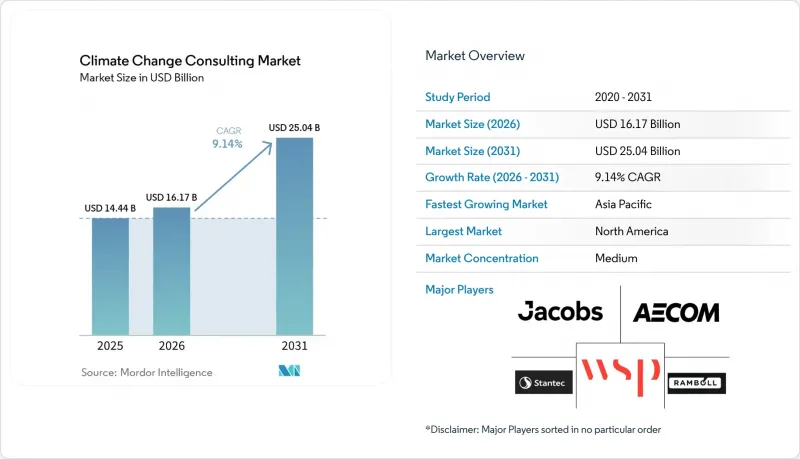
본 보고서는 서비스 유형별(위험 평가 및 시나리오 분석 등), 최종 사용자 산업별(에너지 및 전력 등), 조직 규모별(대기업, 중소기업), 컨설팅 유형별(다분야에 걸친 엔지니어링 기업 등), 제공 형태별(온사이트 자문 등), 지역별로 분류되어 있습니다. 시장 전망은 금액(달러)으로 표시되어 있습니다.
세계의 기후 변화 컨설팅 시장 동향 및 인사이트
전 세계적으로 강화되는 ESG 공시 의무
2024년 미국 증권거래위원회(SEC)의 규정 제정 및 같은 해 유럽연합(EU)의 ‘기업 지속가능성 보고 지침’은 기준선 배출량 평가와 내부 통제 강화의 물결을 일으켰습니다. 국제 지속가능성 기준 위원회(ISSB)는 IFRS S1 및 S2를 통해 보고 기준을 통일하고, 관할 구역 간의 차익 거래를 배제하는 동시에 엄격성 기준을 높였습니다. 현재 컨설턴트들은 데이터 아키텍처 설계, 이중 중요성 분석 수행, 그리고 2025-2028년 단계적으로 설정되는 기한을 충족하는 감사 대응 파일 작성을 진행하고 있습니다. 공시에는 제3자의 보증이 요구되므로, 자문 수요는 최초 제출 후에도 지속될 것이며, 기후 변화 컨설팅 시장에서 향후 수년에 걸친 수익 전망이 나타나고 있습니다.
투자자가 요구하는 기업의 탄소 섀도우 감사
‘넷 제로 자산 운용사(Net Zero Asset Managers)’ 이니셔티브 하에 130조 달러 규모의 자산을 운용하는 자산 운용사들은 2024년부터 포트폴리오 기업들에게 자금 지원에 따른 배출량 감축 경로를 공개할 것을 요구하기 시작했습니다. ‘파트너십 포 카본 어카운팅 파이낸셜(Partnership for Carbon Accounting Financials)’은 스코프 3 산정 방법을 표준화하고, 은행 및 보험사에 대해 보유 자산에 대한 감사와 대응이 지연되고 있는 기업에 대한 시정 조치를 의무화했습니다. 사모펀드(PE) 스폰서들은 현재, 어닝아웃을 조정할 수 있는 기후 변화 관련 계약 조항을 관리 계약에 포함시키고 있습니다. 각 컨설팅 회사는 투자자에게는 포트폴리오 스크리닝을, 투자 대상 기업에게는 상세한 탈탄소화 로드맵 제공이라는 이중 업무를 수탁하고 있으며, 이를 통해 기후 변화 컨설팅 시장의 지속적인 수익이 강화되고 있습니다.
검증 가능한 스코프 3 배출량 데이터의 부족
스코프 3은 기업의 탄소 발자국의 70%-90%를 차지하는 경우가 많기 때문에 공급업체로부터의 데이터는 여전히 파편화되어 있어 50% 이상의 오차가 발생할 가능성이 있는 지출 기반의 대체 지표에 의존할 수밖에 없는 상황입니다. 국제 지속가능성 기준 위원회(ISSB)는 보다 적절한 조사 기법에 대한 협의를 막 시작했으며, 표준화는 적어도 2027년까지 미뤄질 전망입니다. 특히 자동차 및 전자제품 공급망은 다국적 기업들이 50개국 이상에서 조달을 진행하고 있기 때문에 이 문제의 영향을 크게 받고 있습니다. 이러한 뿌리 깊은 데이터 부족은 고객의 불만을 초래하고, 수년에 걸친 노력의 시작을 미루게 하며, 기후 변화 컨설팅 시장의 성장을 둔화시키고 있습니다.
부문 분석
온실가스(GHG) 산정 및 보고와 관련된 기후 변화 컨설팅 시장 규모는 2025년에 19억 달러에 달했으며, 총 매출의 31.28%를 차지했습니다. 기업들은 새로운 공시 규정을 준수하기 위해 기준선 인벤토리를 우선시하고 있으며, 이 서비스가 대부분의 프로젝트에서 출발점이 되고 있습니다. 물리적 위험이 재무적으로 중요한 요소로 부상함에 따라, 기후 변화 적응 및 회복탄력성 계획은 서비스 유형 중 가장 높은 연평균 성장률(CAGR) 11.40%를 기록하며 성장할 것으로 예측됩니다. 이러한 변화에 따라 홍수 모델링, 열 스트레스 매핑, 회복탄력성 투자 로드맵에 대한 지출이 재분배되고 있습니다. 공시, 위험 정량화, 자금 조달 간의 상호작용을 통해 시나리오 분석과 적응을 위한 설비 투자 계획을 통합한 패키지형 서비스가 등장하면서, 기후 변화 컨설팅 시장 내 교차 판매 기회가 강화되고 있습니다.
탈탄소 전략 서비스는 한계 감축 비용 곡선의 범위를 넘어 수소, 탄소 포집, 전기화 등의 대안을 평가하는 방향으로 전환되고 있습니다. 자문사들은 지속가능 금융의 구조화를 점점 더 통합하여, 투자 로드맵을 그린본드 및 지속가능성 연계형 대출과 연계하고 있습니다. 탄소 상쇄 및 배출권 거래에 관한 자문 업무는 일관성 심사를 통해 많은 산림 크레딧이 무효화됨에 따라 여전히 소규모에 그치고 있지만, 특히 고객이 잔여 상쇄량을 필요로 하는 넷제로 주장을 추구할 경우 고품질의 자연 기반 제거 프로젝트에 대한 수요는 지속되고 있습니다. 현재 틈새 분야인 생물다양성 및 순환 경제에 관한 컨설팅은 향후 시행될 유럽의 실사 규정에 따라 환경 영향의 정의가 확대됨에 따라 성장하고 있으며, 기후 변화 컨설팅 시장의 전문 기업들에게 추가 수익을 가져다줄 것으로 기대됩니다.
에너지 및 전력 분야는 2025년에 17억 3,000만 달러의 매출을 창출하여 기후 변화 컨설팅 시장 전체 매출의 28.53%를 차지했습니다. 유틸리티 기업들은 임박한 공시 기한과 배출권 거래제 의무에 직면하여, 기준선 감사 및 로드맵 수립에 막대한 비용을 지출했습니다. 광업 및 금속 분야는 규모는 작지만, 투자자들이 해당 부문의 탄소 중립 공약에 부합하는 신뢰할 수 있는 Scope 1 및 2 로드맵을 요구하고 있어 2031년까지 연평균 성장률(CAGR) 10.61%로 성장할 전망입니다. 컨설팅 업체들은 전동화 운반 트럭, 그린 수소를 이용한 직접 환원 철, 재생에너지 통합에 대해 자문을 제공하며 기술경제 분석에 대한 견조한 수요를 뒷받침하고 있습니다.
다자간 기후 자금 채널의 경우, 자금 지원 전에 타당성 조사가 요구되기 때문에 공공 부문 수요가 증가하고 있습니다. 자동차에서 화학에 이르기까지 아우르는 제조업에서는 자본 계획 주기에 탈탄소화가 반영되어 있으며, 공정 엔지니어링과 기후 자금에 관한 지침을 융합한 다분야에 걸친 업무 의뢰가 발생하고 있습니다. 금융 기관은 중앙은행의 스트레스 테스트를 준수하기 위해 포트폴리오 수준의 위험 분석이 필요합니다. ICT 및 통신 사업자들은 데이터센터의 에너지 최적화 및 공급망의 탄소 발자국 감축을 위해 자문가를 기용하고 있습니다. 농업, 식품, 운송, 물류 각 분야는 기후 변화 컨설팅 시장의 기반을 확대하고 있으며, 토양 탄소량 측정부터 차량 전기화 시나리오에 이르기까지 각각 고유한 서비스 요구 사항을 가지고 있습니다.
지역별 분석
2025년, 북미는 전 세계 매출의 37.33%를 차지했습니다. 이는 수천 개의 발행사 및 산업 플랜트를 대상으로 하는 SEC의 공시 규정과 캘리포니아주의 배출권 거래제가 큰 버팀목이 되고 있기 때문입니다. 2025년에 1메트르톤당 80캐나다 달러(59달러)로 인상된 캐나다의 탄소 가격 하한선 조치는 에너지, 광업, 제조업 분야의 자문 수요를 촉진했습니다. 멕시코의 배출권 거래 시범 제도는 그 범위가 제한적이긴 하지만, 향후 노력을 위한 토대를 마련하고 있습니다. 미국 내 규제 관련 소송은 실행 위험을 초래하고 있으며, 법적 명확성이 확보될 때까지 지출을 단계적으로 재검토하는 기업도 있지만, 자본 시장의 깊이 자체가 자금 조달에 수반되는 배출량 분석에 대한 기초적인 수요를 뒷받침하며 기후 변화 컨설팅 시장을 견인하고 있습니다.
유럽은 매출액 기준으로 2위를 차지하고 있으며, 그 원동력은 ‘기업 지속가능성 보고 지침(CSRD)’, ‘EU 택소노미 규정’, 그리고 ‘탄소 국경 조정 메커니즘(CBAM)’입니다. 이 세 가지가 결합되어 세계에서 가장 엄격한 공시 및 가격 책정 체계를 구성하고 있습니다. 독일의 그린 수소 및 전기화를 위한 300억 유로(340억 달러) 규모의 보조금 프로그램은 타당성 조사를 뒷받침하고 있는 반면, 영국의 전환 계획에 관한 규정에서는 미래를 내다보는 시나리오 보고가 의무화되어 있습니다. 프랑스의 ‘제29조’ 의무는 포트폴리오 분석을 촉진하고 있으며, 북유럽 기업들은 넷제로 선언을 위해 자연 기반 배출 감축 프로젝트에 착수하고 있습니다. 이러한 중복되는 규제 요건은 고부가가치이며 여러 관할 구역에 걸친 자문 업무를 창출하여, 기후 변화 컨설팅 시장에서 해당 지역의 영향력을 강화하고 있습니다.
아시아태평양은 연평균 성장률(CAGR) 11.07%로 가장 빠르게 성장하고 있는 지역입니다. 중국은 2025년에 국가 배출권 거래 제도를 8개 부문으로 확대하고, 이산화탄소 배출 감축과 경제 발전이라는 두 가지 목표(이중 탄소 목표)를 각 성의 행동 계획에 반영함으로써 도시 차원의 컨설팅 계약이 창출되고 있습니다. 인도는 그린 택소노미를 최종 확정하고 에너지 효율 기준을 강화함에 따라, 배출 감축이 어려운 산업들이 자문 서비스를 이용해야만 하는 상황에 처해 있습니다. 일본의 ‘그린 트랜스포메이션 리그’는 저탄소 프로젝트에 1,500억 달러를 투입하고 있는 반면, 한국의 탄소중립 프레임워크에서는 각 부문별 로드맵 수립이 의무화되어 있습니다. 동남아시아 국가들은 기후 변화 관련 자금 유입을 놓고 경쟁하고 있지만, 현지 컨설팅 역량은 여전히 미흡하여 기후 변화 컨설팅 시장에서 입지를 확대하고자 하는 세계 기업들에게 진입 기회가 생기고 있습니다.
남미, 중동 및 아프리카 시장 규모는 작지만 성장 속도는 가속화되고 있습니다. 2027년 도입이 예정된 브라질의 규제 대상 탄소 시장은 이미 규정 준수 사전 감사에 대한 수요를 창출하고 있습니다. 중동의 정부계 펀드는 재생에너지에 자본을 배분하고 있으며, 국영 석유 기업들은 UAE의 넷제로 공약에 부합하는 전환 전략이 필요합니다. 이러한 동향은 신흥 지역 전반에 걸쳐 점점 더 다양해지는 기후 변화 컨설팅 시장의 기반을 마련하고 있습니다.
기타 혜택 :
- 엑셀 형식 시장 예측(ME) 시트
- 3개월간의 애널리스트 지원
자주 묻는 질문
목차
제1장 서론
제2장 조사 방법
제3장 주요 요약
제4장 시장 구도
제5장 시장 규모 및 성장 예측
제6장 경쟁 구도
제7장 시장 기회 및 향후 전망
AJY 26.09.15According to Mordor Intelligence, the climate change consulting market size is expected to increase from USD 6.07 billion in 2025 to USD 6.76 billion in 2026 and reach USD 10.99 billion by 2031, growing at a CAGR of 10.21% over 2026-2031.
This report is Segmented by Service Type (Risk Assessment and Scenario Analysis, and More), End-User Industry (Energy and Power, and More), Organization Size (Large Enterprises, and Small and Medium Enterprises), Consultancy Type (Multidisciplinary Engineering Firms, and More), Delivery Mode (On-Site Advisory, and More), and Geography. The Market Forecasts are Provided in Terms of Value (USD).
Global Climate Change Consulting Market Trends and Insights
Mandatory ESG Disclosures Tightening Worldwide
Rulemaking by the U.S. Securities and Exchange Commission in 2024 and the European Union's Corporate Sustainability Reporting Directive in the same year triggered a wave of baseline emission assessments and internal-control upgrades. The International Sustainability Standards Board harmonized reporting through IFRS S1 and S2, removing jurisdictional arbitrage and raising the rigor bar. Consultants now design data architectures, run double-materiality analyses, and prepare audit-ready files that satisfy phased deadlines rolling from 2025 to 2028. Because disclosures require third-party assurance, advisory demand persists beyond first filings, creating multi-year revenue visibility for the climate change consulting market.
Corporate Carbon-Shadow Audits Demanded by Investors
Asset managers overseeing USD 130 trillion under the Net Zero Asset Managers initiative began ordering portfolio companies to publish financed-emission pathways in 2024. The Partnership for Carbon Accounting Financials standardized Scope 3 calculations, compelling banks and insurers to audit holdings and remediate laggards. Private-equity sponsors now embed climate covenants into management agreements that can adjust earn-outs. Consultants secure dual mandates, serving investors with portfolio screens and investees with deep dive decarbonization road maps, reinforcing recurring revenue for the climate change consulting market.
Scarcity of Verifiable Scope 3 Emissions Data
Scope 3 often represents 70%-90% of a company's footprint, yet supplier data remain fragmented, forcing reliance on spend-based proxies that can deviate by more than 50%. The International Sustainability Standards Board has only started consultations on better methodologies, delaying standardization until at least 2027. Automotive and electronics supply chains are particularly exposed, where multinationals source from over 50 countries. Persistent data gaps frustrate clients and postpone multi-year commitments, tempering expansion within the climate change consulting market.
Other drivers and restraints analyzed in the detailed report include:
- Rapid Scaling of Sustainability-Linked Finance Instruments
- Supply-Chain Decarbonization Pressures from OEMs
- Inconsistent Regional Carbon-Pricing Mechanisms
For complete list of drivers and restraints, kindly check the Table Of Contents.
Segment Analysis
The climate change consulting market size for GHG accounting and reporting reached USD 1.90 billion in 2025, equal to 31.28% of total revenue. Companies prioritized baseline inventories to satisfy new disclosure laws, positioning this service as the entry point for most engagements. As physical risk becomes financially material, climate adaptation and resilience planning is projected to grow at an 11.40% CAGR, the fastest among service types. This shift reallocates spend toward flood modelling, heat stress mapping, and resilience investment road maps. The interplay of disclosure, risk quantification, and financing has created bundled offerings that integrate scenario analysis with adaptation capex planning, reinforcing cross-selling opportunities in the climate change consulting market.
Decarbonization strategy services have moved beyond marginal-abatement cost curves to evaluate hydrogen, carbon capture, and electrification options. Advisors increasingly integrate sustainable finance structuring, tying investment road maps to green bonds or sustainability-linked loans. Carbon offset and trading advisory remains modest because integrity reviews invalidated many forestry credits, but demand persists for high-quality nature-based removal projects, especially where clients pursue net-zero claims that require residual offsetting. Biodiversity and circular-economy consulting, presently niche, is expanding as forthcoming European due-diligence rules widen the definition of environmental impact, promising incremental revenue for specialized firms within the climate change consulting market.
Energy and power generated USD 1.73 billion in 2025, representing 28.53% of climate change consulting market revenue. Utilities faced immediate disclosure deadlines and cap-and-trade obligations, driving heavy spend on baseline audits and road maps. Mining and metals, while smaller, will expand at a 10.61% CAGR to 2031 as investors push for credible Scope 1 and 2 pathways that align with sector net-zero commitments. Consultants advise on electrified haul trucks, green hydrogen direct-reduced iron, and renewable power integration, fostering robust demand for techno-economic analysis.
Public-sector demand is rising because multilateral climate-finance channels require feasibility studies before disbursing funds. Manufacturing, spanning automotive to chemicals, is embedding decarbonization into capital-planning cycles, generating multi-disciplinary mandates that blend process engineering with climate finance guidance. Financial-services institutions need portfolio-level risk analytics to comply with central-bank stress tests. ICT and telecom operators hire advisers for data-center energy optimization and supply-chain footprint reductions. Agriculture, food, transportation, and logistics are broadening the base of the climate change consulting market, each with distinct service requirements from soil-carbon measurement to fleet electrification scenarios.
Complete Report Scope:
- By Service Type
- Risk Assessment and Scenario Analysis
- GHG Accounting and Reporting
- Decarbonisation Strategy and Road-Mapping
- Climate Adaptation and Resilience Planning
- Carbon Offset and Trading Advisory
- Sustainable Finance and ESG Integration
- Other Service Types
- By End-User Industry
- Energy and Power
- Mining and Metals
- Public Sector
- Manufacturing
- Financial Services
- ICT and Telecom
- Agriculture and Food
- Transportation and Logistics
- Other End-User Industry
- By Organisation Size
- Large Enterprises
- Small and Medium Enterprises
- By Consultancy Type
- Multidisciplinary Engineering Firms
- Pure-Play Sustainability Boutiques
- Big Four Accounting Firms
- Management Consulting Firms
- Think Tanks and NGOs
- By Delivery Mode
- On-Site Advisory
- Remote / Virtual Advisory
- Hybrid Engagements
- By Geography
- North America
- United States
- Canada
- Mexico
- Europe
- Germany
- United Kingdom
- France
- Spain
- Italy
- Rest of Europe
- Asia-Pacific
- China
- Japan
- India
- South Korea
- Rest of Asia-Pacific
- South America
- Brazil
- Argentina
- Rest of South America
- Middle East and Africa
- Middle East
- Israel
- Saudi Arabia
- United Arab Emirates
- Turkey
- Rest of Middle East
- Africa
- South Africa
- Egypt
- Rest of Africa
- Middle East
- North America
Geography Analysis
North America produced 37.33% of global revenue in 2025, anchored by the SEC disclosure rule and California's cap-and-trade program that cover thousands of issuers and industrial plants. Canada's carbon-pricing backstop, which rose to CAD 80 per metric ton (USD 59) in 2025, stimulated advisory demand in energy, mining, and manufacturing. Mexico's pilot emissions-trading system, although narrow, sets the stage for future engagements. Regulatory litigation in the United States introduces execution risk, leading some firms to phase spending until legal clarity emerges, but the sheer depth of capital markets sustains baseline demand for financed-emission analytics, bolstering the climate change consulting market.
Europe ranks second in revenue, propelled by the Corporate Sustainability Reporting Directive, EU Taxonomy Regulation, and Carbon Border Adjustment Mechanism that jointly constitute the world's strictest disclosure and pricing framework. Germany's EUR 30 billion (USD 34 billion) subsidy program for green hydrogen and electrification fuels feasibility studies, while the United Kingdom's transition-plan rules require forward-looking scenario reports. France's Article 29 obligations drive portfolio analytics, and Nordic corporates pursue nature-based removal projects for net-zero claims. These overlapping mandates generate high-value, multi-jurisdictional advisory work that reinforces the region's influence on the climate change consulting market.
Asia-Pacific is the fastest-growing region at an 11.07% CAGR. China expanded its national emissions trading system to eight sectors in 2025 and linked dual-carbon goals to provincial action plans, spawning city-level consulting contracts. India finalized its green taxonomy and tightened energy-efficiency standards, compelling hard-to-abate industries to seek advisory. Japan's Green Transformation League is channelling USD 150 billion into low-carbon projects, while South Korea's carbon-neutrality framework mandates sectoral road maps. Southeast Asian countries vie for climate-finance inflows, but local consulting capacity remains thin, creating entry opportunities for global players eager to enlarge their footprint in the climate change consulting market.
South America and Middle East and Africa are smaller but quickening. Brazil's regulated carbon market, expected in 2027, already motivates pre-compliance audits. Sovereign wealth funds in the Middle East are allocating capital to renewables, and national oil companies need transition strategies aligned with UAE's net-zero pledge. These developments are laying the groundwork for an increasingly diversified climate change consulting market across emerging regions.
- Jacobs Solutions Inc.
- AECOM
- WSP Global Inc.
- Stantec Inc.
- Ramboll Group A/S
- Tetra Tech Inc.
- ERM International Group Ltd.
- Arup Group Ltd.
- GHD Group Pty Ltd.
- Sweco AB
- Deloitte Touche Tohmatsu Ltd.
- PricewaterhouseCoopers International Ltd.
- KPMG International Ltd.
- Ernst and Young Global Ltd.
- McKinsey and Company
- Boston Consulting Group Inc.
- ICF International Inc.
- South Pole Holding AG
- Carbon Trust Advisory Ltd.
- Sustainalytics
Additional Benefits:
- The market estimate (ME) sheet in Excel format
- 3 months of analyst support
TABLE OF CONTENTS
1 INTRODUCTION
- 1.1 Study Assumptions and Market Definition
- 1.2 Scope of the Study
2 RESEARCH METHODOLOGY
3 EXECUTIVE SUMMARY
4 MARKET LANDSCAPE
- 4.1 Market Overview
- 4.2 Market Drivers
- 4.2.1 Mandatory ESG Disclosures Tightening Worldwide
- 4.2.2 Corporate Carbon-Shadow Audits Demanded by Investors
- 4.2.3 Rapid Scaling of Sustainability-Linked Finance Instruments
- 4.2.4 Supply-Chain Decarbonisation Pressures from OEMs
- 4.2.5 Breakthroughs in AI-Driven Climate-Risk Analytics
- 4.2.6 Growing Demand for Nature-Based Carbon Removal Advisory
- 4.3 Market Restraints
- 4.3.1 Scarcity of Verifiable Scope 3 Emissions Data
- 4.3.2 Inconsistent Regional Carbon-Pricing Mechanisms
- 4.3.3 Talent Shortage at the Climate Science-Finance Interface
- 4.3.4 Green-Washing Litigation Risk Discouraging Advisory Uptake
- 4.4 Industry Value-Chain Analysis
- 4.5 Impact of Macroeconomic Factors on the Market
- 4.6 Regulatory Landscape
- 4.7 Technological Outlook
- 4.8 Porter's Five Forces Analysis
- 4.8.1 Bargaining Power of Suppliers
- 4.8.2 Bargaining Power of Buyers
- 4.8.3 Threat of New Entrants
- 4.8.4 Threat of Substitutes
- 4.8.5 Competitive Rivalry
- 4.9 Service Trend Analysis
5 MARKET SIZE AND GROWTH FORECASTS (VALUE)
- 5.1 By Service Type
- 5.1.1 Risk Assessment and Scenario Analysis
- 5.1.2 GHG Accounting and Reporting
- 5.1.3 Decarbonisation Strategy and Road-Mapping
- 5.1.4 Climate Adaptation and Resilience Planning
- 5.1.5 Carbon Offset and Trading Advisory
- 5.1.6 Sustainable Finance and ESG Integration
- 5.1.7 Other Service Types
- 5.2 By End-User Industry
- 5.2.1 Energy and Power
- 5.2.2 Mining and Metals
- 5.2.3 Public Sector
- 5.2.4 Manufacturing
- 5.2.5 Financial Services
- 5.2.6 ICT and Telecom
- 5.2.7 Agriculture and Food
- 5.2.8 Transportation and Logistics
- 5.2.9 Other End-User Industry
- 5.3 By Organisation Size
- 5.3.1 Large Enterprises
- 5.3.2 Small and Medium Enterprises
- 5.4 By Consultancy Type
- 5.4.1 Multidisciplinary Engineering Firms
- 5.4.2 Pure-Play Sustainability Boutiques
- 5.4.3 Big Four Accounting Firms
- 5.4.4 Management Consulting Firms
- 5.4.5 Think Tanks and NGOs
- 5.5 By Delivery Mode
- 5.5.1 On-Site Advisory
- 5.5.2 Remote / Virtual Advisory
- 5.5.3 Hybrid Engagements
- 5.6 By Geography
- 5.6.1 North America
- 5.6.1.1 United States
- 5.6.1.2 Canada
- 5.6.1.3 Mexico
- 5.6.2 Europe
- 5.6.2.1 Germany
- 5.6.2.2 United Kingdom
- 5.6.2.3 France
- 5.6.2.4 Spain
- 5.6.2.5 Italy
- 5.6.2.6 Rest of Europe
- 5.6.3 Asia-Pacific
- 5.6.3.1 China
- 5.6.3.2 Japan
- 5.6.3.3 India
- 5.6.3.4 South Korea
- 5.6.3.5 Rest of Asia-Pacific
- 5.6.4 South America
- 5.6.4.1 Brazil
- 5.6.4.2 Argentina
- 5.6.4.3 Rest of South America
- 5.6.5 Middle East and Africa
- 5.6.5.1 Middle East
- 5.6.5.1.1 Israel
- 5.6.5.1.2 Saudi Arabia
- 5.6.5.1.3 United Arab Emirates
- 5.6.5.1.4 Turkey
- 5.6.5.1.5 Rest of Middle East
- 5.6.5.2 Africa
- 5.6.5.2.1 South Africa
- 5.6.5.2.2 Egypt
- 5.6.5.2.3 Rest of Africa
- 5.6.5.1 Middle East
- 5.6.1 North America
6 COMPETITIVE LANDSCAPE
- 6.1 Market Concentration
- 6.2 Strategic Moves
- 6.3 Market Share Analysis
- 6.4 Company Profiles (includes Global Level Overview, Market Level Overview, Core Segments, Financials as available, Strategic Information, Market Rank/Share, Products and Services, Recent Developments)
- 6.4.1 Jacobs Solutions Inc.
- 6.4.2 AECOM
- 6.4.3 WSP Global Inc.
- 6.4.4 Stantec Inc.
- 6.4.5 Ramboll Group A/S
- 6.4.6 Tetra Tech Inc.
- 6.4.7 ERM International Group Ltd.
- 6.4.8 Arup Group Ltd.
- 6.4.9 GHD Group Pty Ltd.
- 6.4.10 Sweco AB
- 6.4.11 Deloitte Touche Tohmatsu Ltd.
- 6.4.12 PricewaterhouseCoopers International Ltd.
- 6.4.13 KPMG International Ltd.
- 6.4.14 Ernst and Young Global Ltd.
- 6.4.15 McKinsey and Company
- 6.4.16 Boston Consulting Group Inc.
- 6.4.17 ICF International Inc.
- 6.4.18 South Pole Holding AG
- 6.4.19 Carbon Trust Advisory Ltd.
- 6.4.20 Sustainalytics
7 MARKET OPPORTUNITIES AND FUTURE OUTLOOK
- 7.1 White-Space and Unmet-Need Assessment