|
시장보고서
상품코드
2125681
배터리 플레이트 시장 : 점유율 분석, 업계 동향과 통계, 성장 예측(2026-2031년)Battery Plate - Market Share Analysis, Industry Trends & Statistics, Growth Forecasts (2026 - 2031) |
||||||
 Mordor Intelligence
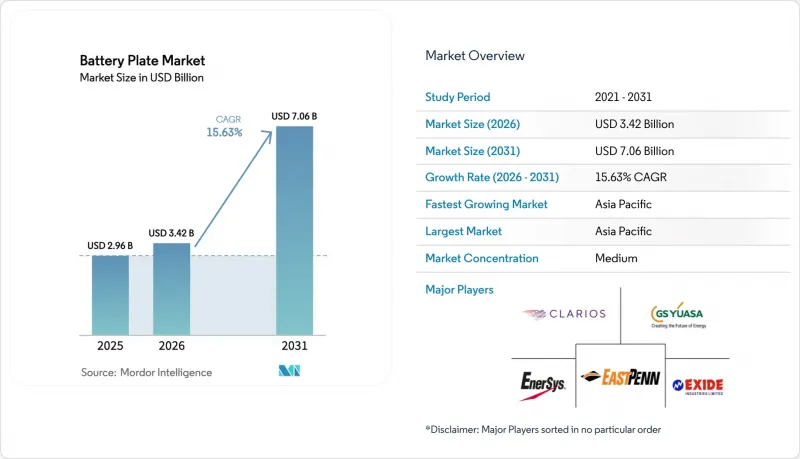
Mordor Intelligence에 의하면, 배터리 플레이트 시장 규모는 2025년 29억 6,000만 달러에서 2026년에는 34억 2,000만 달러로 확대되어 2026년부터 2031년까지 CAGR 15.63%로 성장을 지속하여, 2031년에는 70억 6,000만 달러에 이를 것으로 예측됩니다.
본 보고서는 배터리 유형(납산, 리튬이온, 니켈계, 기타), 전극판 재료(납-안티몬 합금, 납-칼슘 합금, 첨단 복합재료, 기타),제조 기술(중력 주조, 연속 페이스트 성형, 양극/3D 프린팅, 기타), 최종 사용자(자동차, 산업용, 에너지 저장 시스템 등), 지역(북미, 유럽, 아시아태평양 등)별로 분류되어 있습니다.
세계 배터리 플레이트 시장 동향 및 인사이트
전기차(EV) 주도 하에 급증하는 납산 SLI 수요
전기자동차에서는 중요한 기능의 페일세이프 전원으로서 12V 납축전지가 사용되고 있으며, 리튬이온 구동용 배터리가 주류를 이루고 있음에도 불구하고 SLI용 플레이트에 대해서는 여전히 상당한 수요 기반이 남아 있습니다. 2024년 전 세계 전기차 판매 대수는 1,400만 대에 달했습니다. 내연기관 차량에 탑재되는 스타트-스톱 시스템은 충방전 주기의 빈도를 높이고 내구성 요건을 엄격하게 만들기 때문에 더 높은 품질의 그리드 설계가 요구되고 있습니다. 마일드 하이브리드 차량에는 듀얼 배터리 구성이 채택되어 있기 때문에 납축전지 플레이트는 고전압 팩과 경쟁 관계에 있다기보다는 보완적인 역할을 계속 수행하고 있습니다. 따라서 각 OEM 업체들은 보조 시스템용으로 정평이 나 있는 플레이트 공급업체와 장기 계약을 유지하고 있습니다. 이러한 협력을 통해 배터리 플레이트 시장은 납축전지의 급격한 대체로 인한 영향을 완화하고, 지역에 관계없이 기준 판매량을 안정적으로 유지하고 있습니다.
신흥 시장의 유틸리티 규모 ESS 도입
2024년, 신흥국에서는 42 GW의 계통 연계형 에너지 저장 설비가 추가되었으며, 그 설치량의 35%는 성숙한 OECD 시장 이외의 지역에서 차지했습니다. 지속 시간을 중시하는 프로젝트에서는 철-플로우 배터리, 나트륨 이온 배터리 및 기타 화학계 배터리가 채택되고 있으며, 각각 수 시간에 걸친 방전을 지원하기 위해 맞춤형 전극판 형상이 필요합니다. 세계 최대 규모의 나트륨 이온 BESS가 2024년에 가동을 시작하면서, 리튬 조달 비용이 높은 지역에서 그 비용 대비 효과가 입증되었습니다. 각국 정부는 재생에너지와 지역 밀착형 에너지 저장 의무를 결합하여, 기존의 리튬 이온 플레이트 이외의 조달 범위를 확대되고 있습니다. 각 화학 계열에 특화된 플레이트 설계를 할 수 있는 공급업체는 전력 회사가 턴키 솔루션을 요구하는 가운데, 선구자로서의 우위를 확보하고 있습니다.
정제 납 가격 변동
2024년, 공급 차질과 배터리에 대한 지속적인 수요에 힘입어 납 가격은 격렬하게 변동했습니다. 원자재비는 전극판 제조 비용의 최대 70%를 차지하기 때문에 가격 급등은 단기간에 이익률을 압박합니다. 재활용은 일부 문제를 완화하지만, 고순도 합금 규격으로 인해 고급 전극판에 재생재의 함유율은 제한되고 있습니다. 제조업체들은 장기 계약이나 선물 거래를 통해 리스크 헤지를 하고 있지만, 중소기업들은 투입 비용을 안정적으로 유지할 만한 재무력이 부족합니다. 따라서 가격의 불안정성은 새로운 납판 생산 라인에 대한 설비 투자를 주저하게 만들고, 조달 방침을 화학 성분의 다양화로 전환시키는 요인이 되고 있습니다.
부문 분석
2025년, 납산 기술은 배터리 플레이트 시장의 56.60% 점유율을 차지하고 있으며, 그 주된 요인은 자동차용 SLI(시동·조명용 배터리) 및 비용 중심의 산업용 틈새 시장에서 확고히 자리 잡은 사용에 있습니다. 그러나 전기차(EV) 및 고성능 에너지 저장 시스템의 보급에 따라 리튬 이온 배터리 플레이트는 연평균 성장률(CAGR) 17.15%로 확대되고 있으며, 이에 따라 배터리 플레이트 시장 내 조달 예산의 균형이 재조정되고 있습니다. 액체식 납축전지는 설치 업체들이 현장 실적과 비용 면을 신뢰하고 있어 여전히 통신 분야의 백업 전원으로 주류를 이루고 있습니다. VRLA(밀폐형 납축전지)의 파생 제품은 공급망 리스크 및 안전성 문제를 해결하는 나트륨 이온 전지나 아연-공기 전지의 도입에 따라 자동차 분야의 프리미엄 수요를 충족시키고 있습니다. CATL은 2025년 6월, 유지보수가 필요 없는 설계와 급속 충전 기능을 특징으로 하는 ‘Naxtra’ 나트륨 이온 배터리의 양산을 시작했습니다. 니켈계 시스템은 항공우주 및 방위 분야의 마이크로 부문에서 채택되고 있으며, 극한 온도 내성이 높은 가격을 상쇄하고 있습니다.
공급망 리스크와 안전성 과제를 해결하는 나트륨 이온 배터리 및 아연-공기 배터리의 등장으로 다양화는 계속되고 있습니다. CATL은 2025년 6월, 구리 집전극 대신 알루미늄이 필요한 ‘Naxtra’ 나트륨 이온 배터리의 양산을 시작했습니다. 현재 전극판 제조업체들은 각 화학 조성의 부식 특성에 맞추어 여러 가지 야금 기술 세트를 활용하고 있습니다. 이러한 세분화로 인해 제조를 전제로 한 설계의 복잡성은 증가하고 있지만, 한편으로는 배터리 플레이트 시장 전체에서 비즈니스 기회도 확대되고 있습니다.
2025년에는 납·칼슘 그리드가 배터리 플레이트 수요의 47.05%를 차지했으며, 밀폐형 배터리에서 내식성과 우수한 기계적 특성을 겸비하고 있었습니다. 그럼에도 불구하고, 배터리 플레이트 시장은 혁신을 중시하고 있으며, 경량화 및 열 관리에 대한 수요를 배경으로 흑연 피복재와 탄소 폼 복합재는 2031년까지 연평균 19.52%의 성장률이 예상됩니다. 납·안티몬 합금은 과방전 시의 기계적 스트레스를 견디는 능력이 뛰어나기 때문에 딥 사이클형 지게차에서 여전히 사용되고 있습니다. 틈새 용도에서는 우수한 전도성을 위해 납·주석 합금이 채택되고 있지만, 주석 가격의 급등으로 인해 그 채택은 특수 제품으로 한정되고 있습니다.
복합재료에 대한 관심이 높아지고 있는 배경에는 에너지 밀도 향상을 추구하는 업계 전반의 강력한 수요가 있습니다. 예를 들어, Group 14사의 실리콘을 풍부하게 함유한 SCC55 음극은 셀 용량을 50% 향상시켰으며, 탄소를 풍부하게 함유한 매트릭스가 내부 저항을 저감하는 경우에도 동등한 효과가 기대됩니다. 비용을 대폭 증가시키지 않으면서 복합 그리드의 양산화를 실현할 수 있는 플레이트 제조업체는 배터리 플레이트 시장에서 차별화된 제품 포트폴리오를 구축할 수 있을 것입니다.
지역별 분석
아시아태평양은 2025년에 배터리 플레이트 시장의 58.90%를 차지하며, 2031년까지 연평균 성장률(CAGR) 16.28%로 주도적인 위치를 유지할 전망입니다. 중국의 동력용 배터리 생산량은 2024년 상반기에 176% 급증했으나, 공급 과잉 우려로 인해 업계 재편 및 효율화 프로젝트가 진행되고 있습니다. 한국은 LG에너지솔루션과 SK온을 통해 전 세계 배터리 셀 생산 능력의 37%를 유지하고 있으며, 정부의 보조금은 상용화 전의 전고체 배터리 플랫폼에 중점을 두고 있습니다. 일본은 생산량이 아시아 대륙으로 이동하는 상황 속에서도 소재 기술에 대한 전문 지식을 활용해 항공우주 분야 및 고급차용 틈새 시장을 확보하고 있습니다. 인도의 ‘생산 연계형 인센티브(PLI)’ 프로그램은 막대한 투자를 유치하고 있으며, 아마라 라자 씨가 계획 중인 950억 루피 규모의 기가팩토리는 인도의 현지화 추진을 보여주는 좋은 사례입니다.
북미와 유럽은 합쳐서 배터리용 플레이트 시장의 다음 개척지가 될 것입니다. 미국에서는 2025년에 가동을 시작할 예정인 10개의 신규 공장에 힘입어 2030년까지 생산 능력이 1,200 GWh에 달할 전망입니다. 연방 정부의 세액 공제 제도로 인해 조달처가 국내 전극판 제조업체로 쏠리는 경향이 있어, 공급업체의 거점 확대가 진행되고 있습니다. 유럽의 프로젝트는 2030년까지 1.5 TWh를 목표로 하고 있지만, 자금 조달 지연으로 인해 발표된 계획의 절반이 위태로운 상황입니다. 독일에는 노스볼트(Northvolt)사의 60 GWh 규모 시설이 있으며, 프랑스는 덩케르크에 위치한 베르코르(Vercor)사를 지원하고 있고, EU 그린딜은 미래 전극 합금 수요를 뒷받침할 재활용 분야에 자금을 투입하고 있습니다.
남미 및 중동 및 아프리카은 배터리 플레이트 시장에 새로운 성장 전망을 제시하고 있습니다. 브라질과 아르헨티나는 리튬 및 납 매장량을 활용하고 있지만, 인프라 측면의 과제로 인해 당분간은 규모 확대가 완만한 수준에 그치고 있습니다. 걸프 연안 국가들은 태양광 발전 도입률이 높은 전력망을 구축하고 있으며, 대규모 에너지 저장 버퍼가 필요함에 따라 나트륨 이온 배터리 및 납-탄소 배터리 시스템을 대상으로 한 입찰이 시작되었습니다. 아프리카의 풍부한 광물 자원은 수직 통합의 가능성을 제시하고 있지만, 기가팩토리의 수익성을 확보하기 위해서는 정치적 안정과 물류망 정비가 여전히 전제조건입니다.
기타 혜택:
- 엑셀 형식 시장 예측(ME) 시트
- 3개월간의 애널리스트 지원
자주 묻는 질문
목차
제1장 서론
제2장 조사 방법
제3장 주요 요약
제4장 시장 구도
제5장 시장 규모와 성장 예측
제6장 경쟁 구도
제7장 시장 기회와 향후 전망
JHSAccording to Mordor Intelligence, the battery plate market size is expected to grow from USD 2.96 billion in 2025 to USD 3.42 billion in 2026 and is forecast to reach USD 7.06 billion by 2031 at 15.63% CAGR over 2026-2031.
This report is Segmented by Battery Type (Lead-Acid, Lithium-Ion, Nickel-Based, and Others), Plate Material (Lead-Antimony Alloy, Lead-calcium Alloy, Advanced Composites, and More), Manufacturing Technology (Gravity Casting, Continuous Pasting, Bipolar/3-D Printing, and More), End-User (Automotive, Industria, Energy Storage Systems, and More), and Geography (North America, Europe, Asia-Pacific, and More).
Global Battery Plate Market Trends and Insights
EV-led Surge in Lead-acid SLI Demand
Electric vehicles utilize 12 V lead-acid batteries for fail-safe power to critical functions, leaving a sizable floor for SLI plates despite the dominance of lithium-ion traction. Global EV sales touched 14 million units in 2024. Start-stop systems within internal-combustion cars extend cycling frequency and heighten durability requirements, spurring higher-grade grid designs. Mild hybrids employ dual-battery setups, so lead-acid plates remain complementary rather than competitive to high-voltage packs. OEMs, therefore, maintain long-term contracts with established plate suppliers for auxiliary systems. This linkage cushions the battery plate market against abrupt lead-acid displacement and stabilizes baseline volumes across regions.
Utility-scale ESS Roll-outs in Emerging Markets
Emerging economies added 42 GW of grid storage in 2024, with 35% of the installations located outside mature OECD markets. Duration-driven projects select iron-flow, sodium-ion, and other chemistries, each needing bespoke plate geometry for multi-hour discharge. The world's largest sodium-ion BESS entered service in 2024, proving cost-effectiveness where lithium sourcing remains pricey. Governments couple renewables with localized storage mandates, broadening procurement beyond conventional lithium-ion plates. Suppliers capable of engineering chemistry-specific plates gain a first-mover advantage as utilities solicit turnkey solutions.
Volatility in Refined-lead Prices
Lead prices fluctuated sharply in 2024, driven by supply disruptions and sustained demand for batteries. Raw materials account for up to 70% of plate production cost, so pricing spikes compress margins in short order. Recycling offers partial relief, yet high-purity alloy grades limit secondary content ratios in premium plates. Manufacturers hedge through long-term contracts and futures positions, but smaller firms lack the financial firepower to maintain stable input costs. Price instability, therefore, discourages capital investment in new plate lines and tilts procurement decisions toward chemistry diversification.
Other drivers and restraints analyzed in the detailed report include:
- Adoption of Corrosion-resistant Pb-Ca-Sn Grids
- 3-D Printed Bipolar Plate Architectures
- Stringent Hazardous-waste Directives (RoHS, ELV)
For complete list of drivers and restraints, kindly check the Table Of Contents.
Segment Analysis
Lead-acid technology controlled 56.60% of the battery plate market share in 2025, primarily due to its entrenched use in automotive SLI and cost-sensitive industrial niches. Lithium-ion plates, however, are scaling at 17.15% CAGR as EV and high-performance storage proliferate, thereby re-balancing procurement budgets within the battery plate market. Flooded lead-acid units still anchor telecom backup because installers trust their field heritage and cost profile. VRLA derivatives meet the premium automotive demand for the introduction of sodium-ion and zinc-air entrants that address supply-chain risk and safety. CATL placed Naxtra sodium-ion batteries into mass production in June 2025, utilizing maintenance-free designs and rapid charge acceptance. Nickel-based systems fill aerospace and defense micro-segments, where extreme temperature tolerance offsets higher price points.
Diversification continues with sodium-ion and zinc-air entrants that address supply-chain risk and safety. CATL placed Naxtra sodium-ion batteries into mass production in June 2025, requiring aluminum rather than copper current collectors. Plate manufacturers now juggle multiple metallurgical toolkits to align with each chemistry's corrosion profile. This fragmentation elevates design-for-manufacture complexity but also widens addressable opportunity across the battery plate market.
Lead-calcium grids owned a 47.05% share of plate material demand in 2025, combining corrosion resistance with robust mechanical properties in sealed batteries. The battery plate market, nevertheless, rewards innovation; graphite-coated and carbon-foam composites are predicted to grow at a rate of 19.52% annually through 2031, driven by lightweighting and thermal-management agendas. Lead-antimony alloys persist in deep-cycle forklifts because they better withstand mechanical stress during heavy discharge. Niche applications turn to lead-tin mixes for superior conductivity, though elevated tin costs confine uptake to specialty products.
Composite momentum mirrors wider industry appetite for energy density gains. Group14's silicon-rich SCC55 anode, for instance, lifts cell capacity by 50%, signalling comparable payoffs when carbon-rich matrices reduce internal resistance. Plate makers able to scale composite grids without cost blow-outs secure a differentiated portfolio within the battery plate market.
Complete Report Scope:
- By Battery Type
- Lead-acid (Flooded, VRLA)
- Lithium-ion
- Nickel-based
- Others (Zn-Air, Na-Ion, etc.)
- By Plate Material
- Lead-Antimony Alloy
- Lead-Calcium Alloy
- Lead-Tin Alloy
- Advanced Composites (Graphite-coated, Carbon Foam)
- By Manufacturing Technology
- Gravity Casting
- Continuous Pasting
- Expanded Metal
- Bipolar/3-D Printing
- By End-user
- Automotive (SLI, Start-Stop)
- Industrial (Forklifts, Telecom, UPS)
- Energy Storage Systems
- Consumer Electronics
- Aerospace and Defense
- By Geography
- North America
- United States
- Canada
- Mexico
- Europe
- Germany
- United Kingdom
- France
- Italy
- NORDIC Countries
- Russia
- Rest of Europe
- Asia-Pacific
- China
- India
- Japan
- South Korea
- ASEAN Countries
- Rest of Asia-Pacific
- South America
- Brazil
- Argentina
- Rest of South America
- Middle East and Africa
- Saudi Arabia
- United Arab Emirates
- South Africa
- Egypt
- Rest of Middle East and Africa
- North America
Geography Analysis
Asia-Pacific controlled 58.90% of the battery plate market in 2025 and will maintain leadership at a 16.28% CAGR through 2031. China's power battery output surged 176% in the first half of 2024, yet looming oversupply drives consolidation and efficiency projects. South Korea retains 37% of global battery cell capacity through LG Energy Solution and SK On, while government grants focus on pre-commercial solid-state platforms. Japan secures niche aerospace and premium-vehicle contracts, leveraging materials expertise even as volume shifts to mainland Asia. India's Production-Linked Incentive program has attracted substantial investment; Amara Raja's INR 95 billion gigafactory exemplifies the country's localization push.
North America and Europe together represent the next frontier for the battery plate market. United States capacity is slated to hit 1,200 GWh by 2030, aided by 10 new factories commencing in 2025. Federal tax credits tilt procurement toward domestic plates, prompting supplier footprint expansion. European projects aim for 1.5 TWh by 2030, though financing delays imperil half the announced pipeline. Germany hosts Northvolt's 60 GWh facility, France backs Verkor at Dunkirk, and the EU Green Deal channels funds into recycling streams that will feed future plate alloy demand.
South America and the Middle East & Africa add emerging prospects for the battery plate market. Brazil and Argentina exploit lithium and lead reserves, yet infrastructure hurdles moderate immediate scale-up. Gulf states deploy high-solar-penetration grids that require large energy storage buffers, opening tenders for sodium-ion and lead-carbon systems. Africa's mineral wealth promises vertical integration possibilities, although political stability and logistics build-out remain prerequisites before gigafactory economics align.
- Clarios, LLC
- Exide Industries Ltd.
- GS Yuasa Corporation
- East Penn Manufacturing Co.
- Enersys
- Amara Raja Energy & Mobility Ltd.
- Narada Power Source Co., Ltd.
- Camel Group Co., Ltd.
- Chaowei Power Holdings Ltd.
- Leoch International Technology Ltd.
- Crown Battery Manufacturing Co.
- Tianneng Power International Ltd.
- Hitachi Chemical Energy Technology
- Fiamm Energy Technology S.p.A.
- Panasonic Energy Co., Ltd.
- Toshiba Corporation
- BYD Co., Ltd.
- Contemporary Amperex Technology Co., Ltd. (CATL)
- SVOLT Energy Technology
- Envision AESC Group
Additional Benefits:
- The market estimate (ME) sheet in Excel format
- 3 months of analyst support
TABLE OF CONTENTS
1 Introduction
- 1.1 Study Assumptions & Market Definition
- 1.2 Scope of the Study
2 Research Methodology
3 Executive Summary
4 Market Landscape
- 4.1 Market Overview
- 4.2 Market Drivers
- 4.2.1 EV-led surge in lead-acid SLI demand
- 4.2.2 Utility-scale ESS roll-outs in emerging markets
- 4.2.3 Adoption of corrosion-resistant Pb-Ca-Sn grids
- 4.2.4 3-D printed bipolar plate architectures
- 4.3 Market Restraints
- 4.3.1 Volatility in refined-lead prices
- 4.3.2 Stringent hazardous-waste directives (RoHS, ELV)
- 4.3.3 Limited availability of high-purity recycled lead
- 4.4 Supply-Chain Analysis
- 4.5 Regulatory Landscape
- 4.6 Technological Outlook
- 4.7 Porter's Five Forces
- 4.7.1 Bargaining Power of Suppliers
- 4.7.2 Bargaining Power of Buyers
- 4.7.3 Threat of New Entrants
- 4.7.4 Threat of Substitutes
- 4.7.5 Intensity of Competitive Rivalry
5 Market Size & Growth Forecasts
- 5.1 By Battery Type
- 5.1.1 Lead-acid (Flooded, VRLA)
- 5.1.2 Lithium-ion
- 5.1.3 Nickel-based
- 5.1.4 Others (Zn-Air, Na-Ion, etc.)
- 5.2 By Plate Material
- 5.2.1 Lead-Antimony Alloy
- 5.2.2 Lead-Calcium Alloy
- 5.2.3 Lead-Tin Alloy
- 5.2.4 Advanced Composites (Graphite-coated, Carbon Foam)
- 5.3 By Manufacturing Technology
- 5.3.1 Gravity Casting
- 5.3.2 Continuous Pasting
- 5.3.3 Expanded Metal
- 5.3.4 Bipolar/3-D Printing
- 5.4 By End-user
- 5.4.1 Automotive (SLI, Start-Stop)
- 5.4.2 Industrial (Forklifts, Telecom, UPS)
- 5.4.3 Energy Storage Systems
- 5.4.4 Consumer Electronics
- 5.4.5 Aerospace and Defense
- 5.5 By Geography
- 5.5.1 North America
- 5.5.1.1 United States
- 5.5.1.2 Canada
- 5.5.1.3 Mexico
- 5.5.2 Europe
- 5.5.2.1 Germany
- 5.5.2.2 United Kingdom
- 5.5.2.3 France
- 5.5.2.4 Italy
- 5.5.2.5 NORDIC Countries
- 5.5.2.6 Russia
- 5.5.2.7 Rest of Europe
- 5.5.3 Asia-Pacific
- 5.5.3.1 China
- 5.5.3.2 India
- 5.5.3.3 Japan
- 5.5.3.4 South Korea
- 5.5.3.5 ASEAN Countries
- 5.5.3.6 Rest of Asia-Pacific
- 5.5.4 South America
- 5.5.4.1 Brazil
- 5.5.4.2 Argentina
- 5.5.4.3 Rest of South America
- 5.5.5 Middle East and Africa
- 5.5.5.1 Saudi Arabia
- 5.5.5.2 United Arab Emirates
- 5.5.5.3 South Africa
- 5.5.5.4 Egypt
- 5.5.5.5 Rest of Middle East and Africa
- 5.5.1 North America
6 Competitive Landscape
- 6.1 Market Concentration
- 6.2 Strategic Moves (M&A, Partnerships, PPAs)
- 6.3 Market Share Analysis (Market Rank/Share for key companies)
- 6.4 Company Profiles (includes Global level Overview, Market level overview, Core Segments, Financials as available, Strategic Information, Products & Services, and Recent Developments)
- 6.4.1 Clarios, LLC
- 6.4.2 Exide Industries Ltd.
- 6.4.3 GS Yuasa Corporation
- 6.4.4 East Penn Manufacturing Co.
- 6.4.5 Enersys
- 6.4.6 Amara Raja Energy & Mobility Ltd.
- 6.4.7 Narada Power Source Co., Ltd.
- 6.4.8 Camel Group Co., Ltd.
- 6.4.9 Chaowei Power Holdings Ltd.
- 6.4.10 Leoch International Technology Ltd.
- 6.4.11 Crown Battery Manufacturing Co.
- 6.4.12 Tianneng Power International Ltd.
- 6.4.13 Hitachi Chemical Energy Technology
- 6.4.14 Fiamm Energy Technology S.p.A.
- 6.4.15 Panasonic Energy Co., Ltd.
- 6.4.16 Toshiba Corporation
- 6.4.17 BYD Co., Ltd.
- 6.4.18 Contemporary Amperex Technology Co., Ltd. (CATL)
- 6.4.19 SVOLT Energy Technology
- 6.4.20 Envision AESC Group
7 Market Opportunities & Future Outlook
- 7.1 White-space & Unmet-Need Assessment