

|
시장보고서
상품코드
2125690
위성 제조 시장 : 점유율 분석, 업계 동향과 통계, 성장 예측(2026-2031년)Satellite Manufacturing - Market Share Analysis, Industry Trends & Statistics, Growth Forecasts (2026 - 2031) |
||||||
 Mordor Intelligence
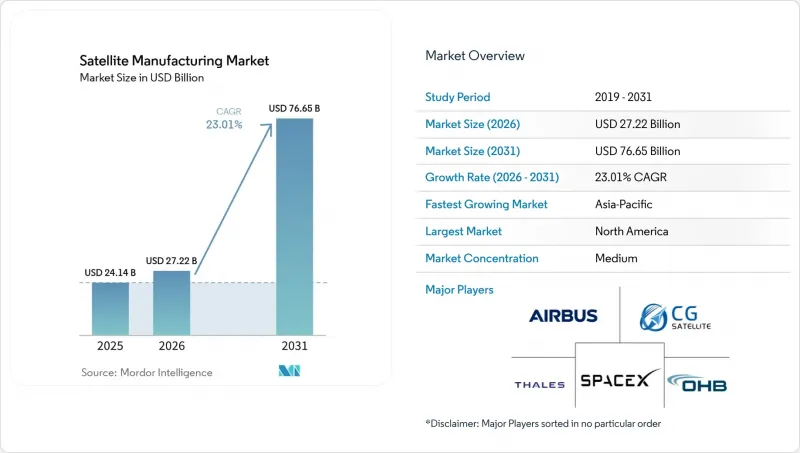
Mordor Intelligence에 의하면, 위성 제조 시장 규모는 2025년에 241억 4,000만 달러로 평가되었고 2026년 272억 2,000만 달러에서 2031년까지 766억 5,000만 달러로 성장하여 2026년부터 2031년까지 기간에서 CAGR 23.01%를 나타낼 것으로 예측됩니다.
본 보고서는 용도(통신, 지구관측, 항법, 우주 관측, 기타), 위성 질량(소형, 중형, 대형), 궤도(LEO, MEO, GEO), 최종 사용자(민간, 정부·민간, 군사), 지역(북미, 유럽, 아시아태평양, 남미, 중동 및 아프리카)별로 분류되어 있습니다. 시장 예측은 금액(달러) 기준으로 제시되어 있습니다.
전 세계 위성 제조 시장 동향 및 인사이트
LEO 광대역 및 위성 군집 구축
LEO 광대역 위성 군집은 위성 제조 시장 수요를 견인하는 주요 요인으로 계속 작용하고 있습니다. 스페이스X(SpaceX)는 2025년 말까지 9,350기 이상의 스타링크(Starlink) 위성을 궤도에 배치할 예정이며, 이는 대규모 광대역 시스템에 필요한 생산 규모를 보여줍니다. 아마존의 프로젝트 쿠이퍼(Project Kuiper)의 경우, FCC 요건에 따라 2026년 7월까지 1,618기의 위성을 배치해야 하며, 이는 승인된 3,236기 위성 군의 50%에 해당합니다. 계획된 많은 위성 군집은 각 사업자가 자체적으로 제조하기 때문에 독립 계약 제조업체에 할당되는 점유율은 제한적입니다. 따라서 독립 공급업체는 정부 프로그램이나 소규모 상용 위성 군집 수주 경쟁에 참여할 기회가 많아집니다. 이러한 프로그램에서는 최저 단가보다 전문적인 페이로드 통합, 신뢰성 및 임무 지원이 중시되는 경향이 있습니다.
정부 및 국방 분야의 우주 관련 지출
정부 및 국방 분야의 조달 활동은 위성 제조 시장에서 인증을 완료한 고부가가치 우주 기체에 대한 수요를 뒷받침하고 있습니다. 2026 회계연도 미국 국방 우주 예산에는 ‘골든 돔(Golden Dome)’ 아키텍처 및 관련 우주 프로그램에 대한 막대한 자금이 포함되었습니다. 미국 상원 세출위원회는 연구개발(R&D) 예산에서 5억 2,800만 달러를 조달 비용으로 배정했으며, 여기에는 GPS 위성 2기의 추가 조달이 포함됩니다. 이러한 접근 방식은 이미 플랫폼 및 제조 공정에 대한 인증을 획득한 제조업체를 지원하는 것입니다. 록히드 마틴은 디지털 제조 도구를 활용하여 2026년 4월 GPS IIIF 우주선 11호의 코어 메이트 마일스톤을 달성했습니다. 정부 계약은 다년간의 생산 계획에 대한 가시성을 제공할 뿐만 아니라, 보안, 일정 및 임무 보증 요건을 충족할 수 있는 기업을 평가하고 보상하는 것입니다.
높은 자본 비용, 시험 비용, 발사 비용
우주선은 발사 전에 특수한 환경 시험 및 임무 시험을 통과해야 하기 때문에 자본 요건은 여전히 높은 수준을 유지하고 있습니다. 열진공 시험, 진동 시험 및 방사선 내성 시험은 제한된 시설과 경험이 풍부한 팀에 의존하고 있습니다. 제조 속도가 가속화되면 이러한 공유되는 시험 자원에 대한 부담이 더욱 커질 가능성이 있습니다. 이로 인해 위성 설계나 자금 조달이 준비된 경우에도 프로그램이 지연될 우려가 있습니다. 발사 서비스의 비용과 가용성도 개발 일정 및 자금 수요에 영향을 미칩니다. 이러한 상황은 재현 가능한 시험 프로세스와 확립된 공급업체 관계를 보유한 위성 제조 시장의 기존 참여 기업들에게 유리하게 작용합니다.
부문 분석
2025년에는 통신 위성이 시장의 45.25%를 차지하며, LEO 광대역 위성군 및 고처리량 GEO 시스템 중에서 가장 큰 수익 기반을 제공했습니다. 위성 제조 업계는 통신 프로그램의 규모로부터 혜택을 받고 있지만, 생산량의 대부분은 위성군 운영 사업자가 사내에서 직접 수행하고 있습니다. SpaceX와 Amazon은 자사 네트워크용 시스템을 직접 제조하고 있어, 공개 조달을 통해 확보되는 통신 수요의 점유율을 축소시키고 있습니다. 독립 제조업체들은 국가 통신 프로그램이나 소규모 상용 시스템 분야에서 여전히 활발히 활동하고 있습니다. 이러한 프로젝트에서는 일반적으로 맞춤형 페이로드, 국가 안보 기능, 또는 특정 지상 시스템과의 통합이 요구됩니다. 또한 통신 프로그램에서는 제조업체가 생산 시기, 발사 일정 및 주파수 대역 관련 요건을 관리해야 합니다.
지구관측 분야는 2031년까지 연평균 성장률(CAGR) 24.71%를 나타낼 것으로 예측되며, 가장 빠르게 성장하는 응용 분야가 될 전망입니다. 수요는 기존의 광학 촬영에 그치지 않고, 합성 개구 레이더, 하이퍼스펙트럼 센싱, RF 인텔리전스로 확대되고 있습니다. 정부 조달 담당자들은 기후 모니터링, 국가 안보 및 토목 계획을 위해 이러한 기능을 활용하고 있습니다. 이에 따라 복잡한 페이로드와 안전한 데이터 링크를 지원할 수 있는 우주선 섀시에 대한 요구 사항이 확산되고 있습니다. 항법 및 우주 관측 분야에서는 GPS IIIF나 갈릴레오 2세대와 같은 프로그램을 통해, 보다 안정적인 다년간의 조달 주기가 확립되어 있습니다. ‘기타’ 범주에는 과학, 기술 실증 및 IoT(사물 인터넷) 위성이 포함되어 있으며, 이는 제조업체가 대규모 계약 사이의 수주 흐름을 유지하는 데 도움이 되고 있습니다.
2025년, 중형 위성은 위성 제조 시장의 42.69%를 차지했습니다. 이러한 위상은 Starlink V2 Mini, Amazon Kuiper 및 Eutelsat OneWeb 위성에 사용되는 질량 범위에 의해 뒷받침되었습니다. 이러한 프로그램들이 제조량의 대부분을 차지했습니다. 수요는 저궤도(LEO) 광대역의 경제성을 반영하고 있으며, 제조업체들은 궤도상 성능과 공동 발사 요건 간의 균형을 맞추고 있습니다. 이러한 균형 덕분에 반복 가능한 생산과 표준화된 우주기체 부품의 광범위한 활용이 가능해집니다.
소형 위성 시장은 2031년까지 연평균 성장률(CAGR) 24.52%를 나타낼 것으로 예측되며, 이는 위성 제조 시장에 큰 영향을 미칠 전망입니다. 이러한 성장은 지구관측, 위성 통신, 원격 감지 및 국방 분야 수요 증가에 의해 주도되고 있습니다. 노바스페이스(NovaSpace)의 예측에 따르면, 2026년부터 2035년 사이에 중량 500kg 미만의 소형 위성 16,900기가 발사될 전망이며, 이는 위성 군집(constellation) 주도형 수요가 지속되고 있음을 보여줍니다. 2026년 4월, Blue Canyon Technologies사는 소형 우주선에 대한 수요 증가를 반영하여 리액션 휠의 생산 능력을 연간 650대에서 2,400대로, 거의 4배 확대할 것이라고 발표했습니다.
지역별 분석
2025년, 북미는 위성 제조 시장의 53.77%를 차지했습니다. 이 지역은 수직 통합형 위성 군집 사업자, 국방 지출, 확고한 입지를 가진 주요 제조업체, 그리고 성숙한 우주선 공급망의 혜택을 받고 있습니다. 또한, 미국 제조업체들은 높은 신뢰성이 요구되는 정부 시스템에 대한 오랜 경험을 보유하고 있습니다. 보잉은 생산 능력을 확대하여 2026년까지 26기의 위성 납품을 목표로 하고 있습니다. 록히드 마틴은 GPS IIIF 생산을 진행 중이며, 노스롭 그루먼은 우주 공간에서의 유지보수 및 정비 사업으로 활동을 확대되고 있습니다. 캐나다는 특정 비정지 궤도 시스템에 대한 5년간의 폐기 의무를 포함하는 우주 쓰레기 관련 라이선스 요건을 개정했습니다. 이러한 규제는 북미 위성 제조 시장 전체의 설계 요건에 영향을 미칠 가능성이 있습니다.
아시아태평양은 2031년까지 연평균 성장률(CAGR) 24.63%를 나타낼 것으로 예측됩니다. 중국은 대규모 위성 군집 역량을 구축하고 있는 반면, 인도는 국내 위성 플랫폼 및 제조 인프라를 지원하고 있습니다. 인도의 IN-SPACe는 국산 상용 위성 버스 플랫폼 개발 기업으로 아스트롬 테크놀로지스(Astrome Technologies), 아지스타 인더스트리즈(Ajista Industries), 돌바 스페이스(Dolva Space)를 선정했습니다. 돌바 스페이스의 ‘프로젝트 가르드(Project Gard)’는 500kg급 위성 군 임무를 위한 국내 역량 구축을 지원하고 있습니다. 이 지역에서는 통신, 지구관측, 항법, 국가 안보 임무에서의 수요가 제조업체에 제공되고 있습니다. 정부가 중요한 우주 자산을 국내에서 관리하는 것을 우선시하는 경우, 현지 생산 능력이 중요해집니다.
유럽은 고부가가치 기관용, 상업용, 방위 프로그램의 중요한 거점으로 계속 자리 잡고 있습니다. 에어버스사는 2026년 1월, 유텔샛(Eutelsat)사로부터 원웹(OneWeb)의 LEO 위성 340기를 추가로 수주하여 툴루즈의 신규 생산 라인에서 제조하게 되었습니다. 유럽우주국(ESA) 및 각국의 우주 기관은 통신, 기상, 과학 분야에서 제조업체를 뒷받침하는 임무를 지원하고 있습니다. 남미에서는 브라질 정부 및 군의 조달이 주도적인 역할을 하고 있으며, 상용 광대역 수요에 대한 관심도 높아지고 있습니다. 중동에서는 적응성이 높은 위성 시스템으로의 전환이 진행되고 있으며, 그 예로 2026년 6월 탈레스 알레니아 스페이스가 에스하일샛과 체결한 소프트웨어 정의 위성 계약을 들 수 있습니다. 아프리카에서는 제조거점이 발전하고 있으며, 통신 및 지구관측에 대한 수요가 위성 제조 시장의 향후 지역별 조달을 촉진할 가능성이 있습니다.
기타 혜택:
- 엑셀 형식 시장 예측(ME) 시트
- 3개월간의 애널리스트 지원
자주 묻는 질문
목차
제1장 서론
제2장 조사 방법
제3장 주요 요약
제4장 시장 구도
제5장 시장 규모와 성장 예측
제6장 경쟁 구도
제7장 시장 기회와 향후 전망
JHS 26.09.11According to Mordor Intelligence, the satellite manufacturing market size was valued at USD 24.14 billion in 2025, and is projected to grow from USD 27.22 billion in 2026 to USD 76.65 billion by 2031, registering a CAGR of 23.01% between 2026 and 2031.
This report is Segmented by Application (Communication, Earth Observation, Navigation, Space Observation, and Others), Satellite Mass (Small, Medium, and Large), Orbit (LEO, MEO, and GEO), End-User (Commercial, Government and Civil, and Military), and Geography (North America, Europe, Asia-Pacific, South America, and Middle East and Africa). The Market Forecasts are Provided in Terms of Value (USD).
Global Satellite Manufacturing Market Trends and Insights
LEO Broadband and Constellation Deployment
LEO broadband constellations remain a major driver of demand for the satellite manufacturing market. SpaceX had more than 9,350 Starlink satellites in orbit by the end of 2025, showing the production scale needed for large broadband systems. Amazon's Project Kuiper is required by the FCC to deploy 1,618 satellites by July 2026, representing 50% of its approved 3,236-satellite constellation. Many planned constellation satellites will be built in-house by their operators, limiting the share available to independent contract manufacturers. Independent suppliers, therefore, compete more often for sovereign programs and smaller commercial constellations. These programs can favor specialized payload integration, reliability, and mission support over the lowest unit cost.
Government and Defense Space Spending
Government and defense procurement support demand for qualified, high-value spacecraft in the satellite manufacturing market. The FY2026 US defense space budget included major funding for the Golden Dome architecture and related space programs. The US Senate Appropriations Committee directed USD 528 million from R&D toward procurement, including two additional GPS satellites. This approach supports manufacturers that have already qualified their platforms and production processes. Lockheed Martin completed the GPS IIIF Space Vehicle 11 core mate milestone in April 2026 using digital manufacturing tools. Government contracts provide multiyear production visibility and reward firms that can meet security, schedule, and mission-assurance requirements.
High Capital, Testing, and Launch Costs
Capital requirements remain high because spacecraft must pass specialized environmental and mission testing before launch. Thermal-vacuum testing, vibration testing, and radiation qualification depend on scarce facilities and experienced teams. Higher manufacturing rates can place more pressure on those shared test resources. This can delay programs even when the satellite design and funding are in place. The cost and availability of launch services also affect development schedules and cash requirements. These conditions favor established satellite manufacturing market participants that have repeatable testing processes and established supplier relationships.
Other drivers and restraints analyzed in the detailed report include:
- Satellite Miniaturization and Lower Production Costs
- Earth Observation and Remote-Sensing Demand
- Radiation-Tolerant Semiconductor and Specialty-Material Bottlenecks
For complete list of drivers and restraints, kindly check the Table Of Contents.
Segment Analysis
Communication satellites accounted for 45.25% of the market in 2025, providing the largest revenue base among LEO broadband constellations and high-throughput GEO systems. The satellite manufacturing industry benefits from the scale of communications programs, although much of the highest-volume production is performed internally by constellation operators. SpaceX and Amazon produce systems for their own networks, reducing the share of communication demand available through open procurement. Independent manufacturers remain active in sovereign communications programs and smaller commercial systems. These projects usually require tailored payloads, national security features, or specific ground-system integration. Communication programs also require manufacturers to manage production timing, launch schedules, and spectrum-related requirements.
Earth observation is forecast to grow at a 24.71% CAGR through 2031, making it the fastest-growing application segment. Demand is extending beyond conventional optical imaging to synthetic aperture radar, hyperspectral sensing, and RF intelligence. Government buyers are using these capabilities for climate monitoring, national security, and civil planning. This broadens requirements for spacecraft buses that can support complex payloads and secure data links. Navigation and space observation provide more stable, multiyear procurement cycles through programs such as GPS IIIF and Galileo Second Generation. The others category includes scientific, technology demonstration, and Internet of Things satellites, which help sustain order flow for manufacturers between larger contracts.
Medium satellites held 42.69% of the satellite manufacturing market in 2025. Their position was supported by the mass range used by Starlink V2 Mini, Amazon Kuiper, and Eutelsat OneWeb satellites. These programs accounted for a major share of manufacturing volume. Demand reflects LEO broadband economics, where manufacturers balance on-orbit capability with rideshare launch requirements. This balance supports repeatable production and wider use of standardized spacecraft components.
The small satellite market is projected to grow at a CAGR of 24.52% through 2031, significantly influencing the satellite manufacturing market. This growth is driven by rising demand for Earth observation, satellite communications, remote sensing, and defense applications. Novaspace forecasts that 16,900 small satellites weighing below 500 kg will be launched during 2026-2035, indicating sustained constellation-driven demand. In April 2026, Blue Canyon Technologies announced a nearly fourfold increase in reaction wheel production capacity, from 650 to 2,400 units annually, reflecting rising demand for small spacecraft.
Complete Report Scope:
- By Application
- Communication
- Earth Observation
- Navigation
- Space Observation
- Others
- By Satellite Mass
- Small
- Medium
- Large
- By Orbit Class
- Low Earth Orbit (LEO)
- Medium Earth Orbit (MEO)
- Geostationary Orbit (GEO)
- By End User
- Commercial
- Government and Civil
- Military
- By Geography
- North America
- United States
- Canada
- Mexico
- Europe
- United Kingdom
- France
- Germany
- Russia
- Rest of Europe
- Asia-Pacific
- China
- India
- Japan
- Australia
- South Korea
- Rest of Asia-Pacific
- South America
- Brazil
- Rest of South America
- Middle East and Africa
- Middle East
- Saudi Arabia
- United Arab Emirates
- Rest of Middle East
- Africa
- South Africa
- Rest of Africa
- Middle East
- North America
Geography Analysis
North America held 53.77% of the satellite manufacturing market in 2025. The region benefits from vertically integrated constellation operators, defense spending, established primes, and a mature network of spacecraft suppliers. US manufacturers also have long experience with high-assurance government systems. Boeing is targeting 26 satellite deliveries in 2026 as it expands production capacity. Lockheed Martin is progressing with GPS IIIF production, while Northrop Grumman is extending its activity into in-space servicing. Canada has updated space-debris licensing requirements, including a 5-year disposal requirement for certain non-geostationary systems. These rules can influence design requirements across the North American satellite manufacturing market.
Asia-Pacific is forecast to grow at a 24.63% CAGR through 2031. China is developing large constellation capacity, while India is supporting domestic satellite platforms and manufacturing infrastructure. India's IN-SPACe selected Astrome Technologies, Azista Industries, and Dhruva Space to develop indigenous commercial satellite bus platforms. Dhruva Space's Project Garud supports domestic capability for 500 kg-class constellation missions. The region offers manufacturers demand from communications, Earth observation, navigation, and national security missions. Local production capability will be important where governments prefer domestic control over critical space assets.
Europe remains a key location for high-value institutional, commercial, and defense programs. Airbus received a January 2026 Eutelsat contract for 340 additional OneWeb LEO satellites, with production on a new Toulouse line. ESA and national agencies support missions that sustain manufacturers across communications, meteorology, and science. South America is led by government and military procurement in Brazil, with commercial broadband demand adding interest. The Middle East is moving toward adaptable satellite systems, as shown by Thales Alenia Space's June 2026 Es'hailSat contract for a software-defined satellite. Africa has a developing manufacturing base, while connectivity and Earth observation needs can support future regional procurement in the satellite manufacturing market.
- Airbus SE
- The Boeing Company
- Lockheed Martin Corporation
- Northrop Grumman Corporation
- Space Exploration Technologies Corp.
- Chang Guang Satellite Technology Co., Ltd.
- Thales Alenia Space
- Maxar Technologies Inc.
- Mitsubishi Electric Corporation
- Mitsubishi Heavy Industries, Ltd.
- Blue Canyon Technologies LLC (RTX Corporation)
- ICEYE Oy
- OHB SE
- GomSpace A/S
- Leidos Holdings, Inc.
- Planet Labs PBC
- Spire Global, Inc.
- AAC Clyde Space AB
- Indian Space Research Organisation
- NewSpace India Limited
Additional Benefits:
- The market estimate (ME) sheet in Excel format
- 3 months of analyst support
TABLE OF CONTENTS
1 INTRODUCTION
- 1.1 Study Assumptions and Market Definition
- 1.2 Scope of the Study
2 RESEARCH METHODOLOGY
3 EXECUTIVE SUMMARY
4 MARKET LANDSCAPE
- 4.1 Market Drivers
- 4.1.1 LEO broadband and constellation deployment
- 4.1.2 Government and defense space spending
- 4.1.3 Satellite miniaturization and lower production costs
- 4.1.4 Earth observation and remote-sensing demand
- 4.1.5 Factory-scale spacecraft production and standardized platforms
- 4.1.6 Orbital sustainability and end-of-life design as procurement differentiators
- 4.2 Market Restraints
- 4.2.1 High capital, testing and launch costs
- 4.2.2 Complex licensing, export controls, and frequency allocation
- 4.2.3 Radiation-tolerant semiconductor and specialty-material bottlenecks
- 4.2.4 Debris, space-traffic compliance, and insurance constraints
- 4.3 Value Chain Analysis
- 4.4 Regulatory Landscape
- 4.5 Technological Outlook
- 4.6 Porter's Five Forces Analysis
- 4.6.1 Bargaining Power of Suppliers
- 4.6.2 Bargaining Power of Buyers/Consumers
- 4.6.3 Threat of New Entrants
- 4.6.4 Threat of Substitutes
- 4.6.5 Intensity of Competitive Rivalry
5 MARKET SIZE AND GROWTH FORECASTS (VALUE)
- 5.1 By Application
- 5.1.1 Communication
- 5.1.2 Earth Observation
- 5.1.3 Navigation
- 5.1.4 Space Observation
- 5.1.5 Others
- 5.2 By Satellite Mass
- 5.2.1 Small
- 5.2.2 Medium
- 5.2.3 Large
- 5.3 By Orbit Class
- 5.3.1 Low Earth Orbit (LEO)
- 5.3.2 Medium Earth Orbit (MEO)
- 5.3.3 Geostationary Orbit (GEO)
- 5.4 By End User
- 5.4.1 Commercial
- 5.4.2 Government and Civil
- 5.4.3 Military
- 5.5 By Geography
- 5.5.1 North America
- 5.5.1.1 United States
- 5.5.1.2 Canada
- 5.5.1.3 Mexico
- 5.5.2 Europe
- 5.5.2.1 United Kingdom
- 5.5.2.2 France
- 5.5.2.3 Germany
- 5.5.2.4 Russia
- 5.5.2.5 Rest of Europe
- 5.5.3 Asia-Pacific
- 5.5.3.1 China
- 5.5.3.2 India
- 5.5.3.3 Japan
- 5.5.3.4 Australia
- 5.5.3.5 South Korea
- 5.5.3.6 Rest of Asia-Pacific
- 5.5.4 South America
- 5.5.4.1 Brazil
- 5.5.4.2 Rest of South America
- 5.5.5 Middle East and Africa
- 5.5.5.1 Middle East
- 5.5.5.1.1 Saudi Arabia
- 5.5.5.1.2 United Arab Emirates
- 5.5.5.1.3 Rest of Middle East
- 5.5.5.2 Africa
- 5.5.5.2.1 South Africa
- 5.5.5.2.2 Rest of Africa
- 5.5.5.1 Middle East
- 5.5.1 North America
6 COMPETITIVE LANDSCAPE
- 6.1 Strategic Moves
- 6.2 Market Share Analysis
- 6.3 Company Profiles (includes Global level Overview, Market level overview, Core Segments, Financials, Strategic Information, Market Rank/Share, Products and Services, and Recent Developments)
- 6.3.1 Airbus SE
- 6.3.2 The Boeing Company
- 6.3.3 Lockheed Martin Corporation
- 6.3.4 Northrop Grumman Corporation
- 6.3.5 Space Exploration Technologies Corp.
- 6.3.6 Chang Guang Satellite Technology Co., Ltd.
- 6.3.7 Thales Alenia Space
- 6.3.8 Maxar Technologies Inc.
- 6.3.9 Mitsubishi Electric Corporation
- 6.3.10 Mitsubishi Heavy Industries, Ltd.
- 6.3.11 Blue Canyon Technologies LLC (RTX Corporation)
- 6.3.12 ICEYE Oy
- 6.3.13 OHB SE
- 6.3.14 GomSpace A/S
- 6.3.15 Leidos Holdings, Inc.
- 6.3.16 Planet Labs PBC
- 6.3.17 Spire Global, Inc.
- 6.3.18 AAC Clyde Space AB
- 6.3.19 Indian Space Research Organisation
- 6.3.20 NewSpace India Limited
7 MARKET OPPORTUNITIES AND FUTURE OUTLOOK
- 7.1 White-space and Unmet-need Assessment


